Billboards in Bellingham, WA
No Minimum Spend. No Long-Term Contracts. Just Results.
Trusted by Leading Brands


Billboard advertising
in Bellingham has never been easier




How much is a billboard in Bellingham?
Why Choose Blip for Billboard Advertising in Bellingham
Blip's self-serve platform lets you launch Bellingham billboards fast on I-5, Meridian, or campus routes—no middleman needed.
Use Blip in Bellingham to auto-pick boards and timing around WWU, cross-border shoppers, and I-5 commuter peaks.
Set a flexible daily budget in Bellingham and Blip keeps spend on track while you ramp up for weekends, holidays, or Mt. Baker trips.
Daypart Bellingham ads for 7-9 a.m. commutes, lunch rushes, or 4-9 p.m. downtown dining with Blip's timing controls.
No contracts make it easy to test Bellingham traffic on Guide Meridian, then shift budget when the data shows what works.
Track Bellingham results in real time and update creative for WWU students, Canadian shoppers, or summer tourists in minutes.
Frequently Asked Questions About Billboard Advertising in Bellingham
How much does a billboard cost in Bellingham, Washington with Blip?
With Blip, you set your own daily budget for Bellingham billboards, and Blip automatically keeps your campaign within that amount, so you stay in control whether you’re spending a little or a lot. Every “blip” is a brief 7.5–10 second ad on digital billboards in Bellingham, Washington, and you only pay for the blips you receive. Costs change based on when and where your ad runs and current advertiser demand, but you can adjust your budget any time to speed up or slow down your exposure.
Where can I advertise with Blip in Bellingham, Washington?
The most valuable traffic flows around Bellingham include Interstate 5, Meridian Street / Guide Meridian, Downtown & Waterfront Approaches, and University & College Access Routes. These areas connect commuters, students, tourists, and Canadian shoppers, giving Bellingham billboards a mix of local and regional reach. Selecting boards along these corridors helps you intercept the right mix of locals, students, and visitors.
Who sees Bellingham billboards from Blip during the year?
Bellingham gives us a rare mix of a vibrant college town, a major cross-border corridor, and a gateway to outdoor recreation. When we plan digital billboard campaigns here with Blip, we can tap into a daily flow of commuters, students, tourists, and Canadian shoppers that is much larger than the city’s size might suggest. The city’s younger median age and the presence of WWU, WCC, and BTC also shape what works best for Bellingham billboard advertising.
When is the best time to run Blip billboards in Bellingham, Washington?
Bellingham’s rhythms are driven by both academic calendars and seasonal tourism, so Blip’s scheduling flexibility lets us adjust bids and budgets around those patterns. WWU, WCC, and BTC bring more than 20,000 students plus several thousand faculty and staff into the city each academic year, while summer brings a disproportionately high share of visitor spending. High-impact timing tactics include Friday afternoons and weekend mornings, plus dayparting for coffee, lunch, and dinner windows.
What kind of traffic do Bellingham billboards reach on I-5 and Meridian Street?
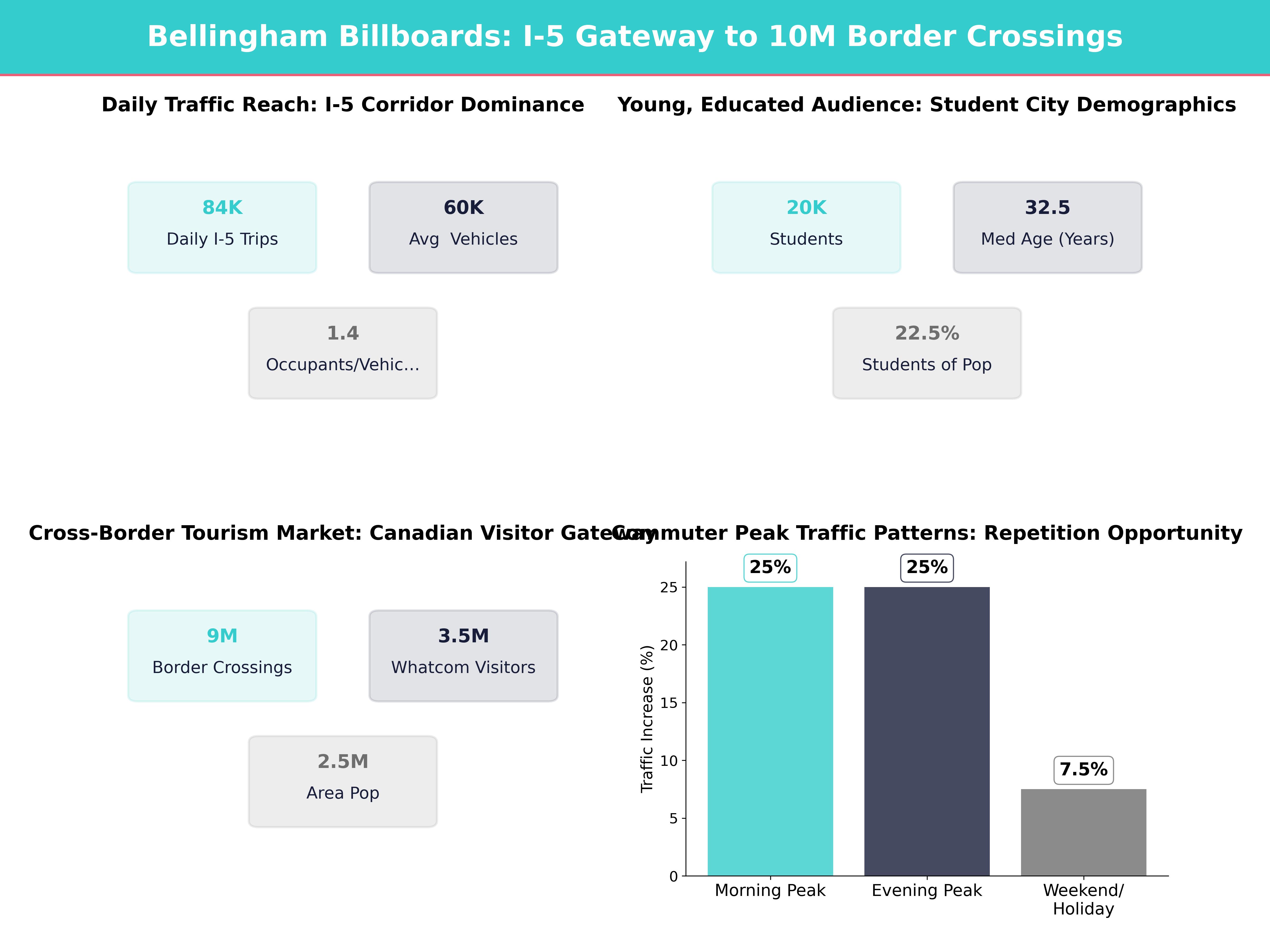
Near Downtown Bellingham, Interstate 5 traffic counts typically range from about 55,000 to 70,000 vehicles per day, and north and south of the city volumes commonly fall in the 50,000–80,000 vehicles per day range. Meridian Street / Guide Meridian is another key corridor, with busy segments carrying 25,000–35,000 vehicles per day, especially near major retail nodes. At even a conservative average of 60,000 vehicles per day and 1.4 occupants per vehicle, that’s roughly 84,000 daily person-trips passing many Bellingham-area boards.
Do I need a contract to advertise with Blip in Bellingham?
No, Blip has no long-term contracts or minimum commitments. You can start, pause, or stop your campaign at any time.
How fast can I launch a billboard campaign with Blip in Bellingham?
You can have your campaign live in minutes. Create a free account, select your locations, set your budget, upload your design, and start running once approved.
Where can I advertise with Blip in Bellingham?
Blip has digital billboards in Bellingham. You can browse available locations on a map, choose the ones that fit your audience, and start advertising right away.
Still have questions? Launch a campaign in minutes — no contracts, no commitments.
Start Your CampaignBellingham Billboard Advertising Guide
Bellingham, Washington gives us the rare mix of a vibrant college town, a major cross-border corridor, and a gateway to outdoor recreation. When we plan digital billboard campaigns here with Blip, we can tap into a daily flow of commuters, students, tourists, and Canadian shoppers that is much larger than the city’s size might suggest, making Bellingham billboards an efficient way to extend a local brand’s reach.
Understanding the Bellingham Market
According to recent estimates from the City of Bellingham and Whatcom County, Bellingham’s population is just under 93,000 residents, while Whatcom County is home to roughly 230,000–235,000 residents spread across Bellingham, Ferndale, Lynden, Blaine, and the county’s rural communities. The city’s median age sits around 32–33 years, significantly younger than the overall Washington State median age in the upper 30s, driven by Western Washington University (WWU) and other colleges. This skew toward younger adults means a comparatively higher concentration of students, early-career professionals, and young families than in many Washington cities, and it shapes what works best for Bellingham billboard advertising.
Key local anchors and their approximate scale:
- Western Washington University: about 15,000–16,000 total students and over 1,800 faculty and staff, concentrated near the south side of Bellingham (WWU). WWU alone accounts for roughly 1 in 6 people physically present in the city on a typical weekday during the academic year.
-
Whatcom Community College & Bellingham Technical College: together, Whatcom Community College and Bellingham Technical College serve roughly 8,000–10,000 students annually, many of whom commute daily from across Whatcom County.
- Learn more: Whatcom Community College, Bellingham Technical College.
- Cross-border traffic: Bellingham sits about 20 miles south of the Canadian border. Data summarized by regional planners and local media indicate that the Peace Arch, Pacific Highway, and Lynden/Aldergrove crossings routinely see 8–10 million passenger vehicle crossings per year combined in strong economic years, much of it flowing along I‑5 through Whatcom County toward Bellingham, Burlington, and Seattle.
- Tourism: Visit Bellingham | Whatcom County reports that Whatcom County welcomes 3–4 million visitors per year, generating on the order of $600–$700 million in direct visitor spending across lodging, dining, retail, and recreation. Tourism supports an estimated 7,000+ local jobs, making visitor traffic a major audience for billboard campaigns and a core reason advertisers turn to billboards in Bellingham instead of relying on online channels alone.
For traffic exposure, Interstate 5 (I‑5) runs straight through Bellingham. Washington State Department of Transportation (WSDOT) traffic counts show:
- Near Downtown Bellingham (around Exit 253–254), Average Annual Daily Traffic (AADT) typically ranges from about 55,000 to 70,000 vehicles per day.
- North and south of the city, volumes commonly fall in the 50,000–80,000 vehicles per day range.
At even a conservative average of 60,000 vehicles per day and 1.4 occupants per vehicle, that’s roughly 84,000 daily person-trips passing many Bellingham-area boards. A modest Blip schedule with a few hundred to a few thousand daily plays on a well-sited board can realistically generate tens of thousands of daily impressions, illustrating how Bellingham billboard advertising can behave like a mass-reach channel in a mid-sized market.
When we build a Blip campaign here, we’re really speaking to several overlapping audiences:
- Local residents (working professionals, families, and service workers)
- Students and staff at WWU, WCC, and BTC
- Canadian shoppers and leisure travelers
- Outdoor tourists heading to Mt. Baker, the San Juan Islands, or the Chuckanuts
- Industrial, logistics, and port-related workers along the waterfront corridor and the Port of Bellingham
Our strategy should account for when each of these groups is on the road and what messages resonate most with them so we can match our billboard rental in Bellingham to the highest-value moments.
Key Corridors and Placement Strategy
With Blip, we can pick specific boards and times, so it pays to think geographically and understand exactly where Bellingham billboards will intercept the right mix of locals, students, and visitors.
The most valuable traffic flows around Bellingham include:
-
Interstate 5 (North–South Spine)
- Connects Bellingham with Mount Vernon and the rest of Skagit County to the south, and Blaine/Canada to the north. I‑5 is the only continuous north–south interstate on the West Coast and carries the bulk of long-distance and cross‑border traffic.
- WSDOT counts around Bellingham regularly show 50,000–70,000+ vehicles per day on this stretch, with weekend and holiday peaks often 5–10% higher.
- Commuter peaks: roughly 7:00–9:00 a.m. and 4:00–6:00 p.m., when volumes can spike 20–30% above off‑peak hours.
-
Strong use for:
- Regional retail campaigns
- Auto dealers
- Healthcare and professional services
- Fast-casual and drive-thru restaurants
-
Meridian Street / Guide Meridian (SR 539)
- Main retail corridor connecting I‑5 (Exits 255–256) to the Bellis Fair shopping area, Costco, and north-county communities.
- Local traffic counts reported by the City of Bellingham Transportation Division indicate busy segments carrying 25,000–35,000 vehicles per day, especially near major retail nodes.
- High concentration of shopping centers, restaurants, and services; Bellis Fair alone once drew over 7 million visitors per year at its peak and still anchors a large share of regional retail trips.
-
Ideal for:
- Point-of-sale reminders (“Next right for…”)
- Limited-time offers and sales events
- New store openings and local services
-
Downtown & Waterfront Approaches
- Corridors feeding into Downtown Bellingham, the historic Fairhaven district, and the waterfront redevelopment areas highlighted by the Port of Bellingham.
- Downtown hosts a dense mix of restaurants, bars, offices, and housing; local surveys and parking utilization studies show downtown can see thousands of additional daily visitors during peak summer weekends and large events.
- Heavier mix of local residents, tourists, and students, especially near WWU shuttle stops and transit hubs such as the Bellingham Station.
-
Excellent for:
- Dining, bars, and nightlife
- Arts, events, and festivals
- Local brands building ongoing awareness
-
University & College Access Routes
- Roads leading to WWU (e.g., Samish Way/Old Fairhaven Pkwy connections, Bill McDonald Pkwy) and WCC/BTC (off Meridian St and Bakerview Rd).
- During the academic year, WWU reports campus populations exceeding 10,000 people per weekday on campus at any given time, with significant peaks at class changes. WCC and BTC add thousands more daily trips.
- Higher volume during the academic year, lighter in summer when enrollment drops and many students leave town.
-
Perfect for:
- Student-focused offers (food, entertainment, housing, subscriptions)
- Hiring campaigns targeting young job seekers
- Campus events and services
When selecting Blip boards, we should map our ideal customer journeys: where they live, where they work or study, and which routes they drive most frequently. In practice, this often means prioritizing boards that intersect:
- The 50,000–70,000 daily I‑5 corridor flows
- The 25,000–35,000 daily vehicles on Meridian/Guide Meridian
- The dense student and downtown traffic feeding WWU, WCC, BTC, and city centers
This is how we turn generic billboards in Bellingham into precisely targeted touchpoints that support both awareness and response.
Seasonality, Weekparts, and Timing
Bellingham’s rhythms are driven by both academic calendars and seasonal tourism. Blip’s scheduling flexibility lets us adjust bids and budgets around those patterns so our Bellingham billboard advertising always lines up with real-world demand.
Academic Calendar
WWU, WCC, and BTC together bring more than 20,000 students plus several thousand faculty and staff into the city each academic year.
-
WWU & local colleges in session (roughly late September–mid June):
- WWU’s three main quarters each run about 10–11 weeks, with campus occupancy highest in October–May.
- Higher weekday traffic linked to class schedules and campus events; transit usage data from Whatcom Transportation Authority show notable ridership spikes when classes are in session, indicating parallel increases in car traffic and rideshare.
-
Stronger demand for:
- Housing and rentals (with lease-up and move-in peaks in August–October)
- Food, entertainment, and nightlife concentrated around evenings and weekends
- Tutoring, health, and wellness services near exam periods
-
We can raise bids around:
- Start of quarters/semesters (when tens of thousands of students and parents are in motion)
- Midterms and finals (for stress-relief offers or study resources)
- Big campus events (homecoming, graduation weeks, and major athletic or cultural events)
-
Summer (mid June–September):
- Fewer students on campus; WWU summer enrollment is typically a fraction (often under 30%) of fall enrollment.
- However, tourist visitation rises sharply; Visit Bellingham | Whatcom County notes that summer months account for a disproportionately high share of yearly visitor spending, with lodging occupancy and ADR (average daily rate) peaking.
-
Great window for:
- Tourism experiences (whale watching, mountain adventures, breweries)
- Local attractions and events (concerts, festivals, waterfront activities)
- Seasonal retail (outdoor gear, marine services, home improvement)
Tourism and Outdoor Seasons
Whatcom County is a major outdoor-recreation hub:
-
Winter–early spring:
- The Mt. Baker Ski Area is nationally known for heavy snowfall, at times recording 600–800+ inches of snow per season and occasionally setting world records.
- On powder days and weekends, Mt. Baker Highway (SR 542) and I‑5 see surges of ski traffic, with hundreds of additional vehicles heading up the mountain in the early morning.
-
Late spring–summer:
- Hiking, biking, and water recreation on Bellingham Bay, Lake Whatcom, and the Chuckanut area flourish. Local and regional tourism data suggest that summer can account for 40–50% of annual visitor trips.
- The San Juan Islands—accessible via nearby Washington State Ferries Anacortes terminal—draw hundreds of thousands of passengers each year, with a large share driving through or near Bellingham on I‑5.
-
Shoulder seasons:
- Weekend getaways and Canadian visitors taking advantage of price differences and exchange rates. Even when overall tourism softens, cross-border shopping trips often remain strong on long weekends and holidays.
High-impact timing tactics:
- Bid up Friday afternoons and weekend mornings on I‑5 and main access routes to capture outbound and inbound recreation traffic. For many destinations, Friday–Sunday can account for 50% or more of weekly visitor volume.
-
Use “dayparting” (time-of-day targeting) to:
- Promote coffee and breakfast options 6:00–10:00 a.m.
- Lunch specials 11:00 a.m.–2:00 p.m.
- Dinner, events, and nightlife 4:00–10:00 p.m.
Weekday Patterns
Local commuting and shopping patterns are fairly consistent and mirror many small metros:
- Morning peak: 7:00–9:00 a.m. (commute + school traffic). On many arterials, counts in this window can be 30–40% higher than mid‑day off-peak levels.
- Midday: 11:00 a.m.–1:00 p.m. (errands, lunch, students between classes). Retail centers and grocery trips cluster here.
- Evening peak: 4:00–6:00 p.m. (commuters, shopping, school activities). For many Bellingham corridors, this is the single busiest 2‑hour window on weekdays.
- Evening leisure: 6:00–9:00 p.m. (restaurants, entertainment, downtown events).
With Blip, we can reallocate budget dynamically, concentrating impressions in our most valuable 2–3 hour windows instead of spreading spend thin across the whole day, which is a key advantage of digital billboard rental in Bellingham over static placements.
Audience Segments and Message Strategy
Because Bellingham’s population base is smaller than big metros, message precision matters. We want to speak directly to the most relevant audiences and make each impression count, especially when we’re using Bellingham billboards to complement digital and social media.
Students and Young Adults
Who they are:
- Tens of thousands of students and recent grads across WWU, WCC, and BTC—together representing roughly 20–25% of Bellingham’s total population.
- National and regional surveys consistently show college students spend heavily on food, coffee, nightlife, entertainment, and technology, even when overall budgets are tight.
- Frequent users of transit, rideshare, bikes, and cars; WWU, for example, notes that thousands of students commute from off-campus neighborhoods daily.
Effective creative approaches:
- Clear, high-contrast headlines with 5–7 words.
- Strong value propositions: “$5 Student Lunch,” “20% Off with Student ID.”
- Call-to-action locations: “2 Minutes from WWU,” “Next Exit – Samish Way.”
- Include simple URLs or short vanity domains and QR codes where boards are slower-speed (e.g., city arterials rather than freeway).
Commuters and Local Residents
Who they are:
- Local workers across healthcare, education, manufacturing, logistics, and services. The broader Whatcom labor force numbers well over 100,000 workers, many of whom commute into Bellingham daily from Ferndale, Lynden, Blaine, and rural communities.
- Daily drivers on I‑5, Meridian, and cross-town roads, with many logging 10–30 minutes each way in the car.
Effective creative approaches:
- Problem–solution framing: “Back Pain? Same-Day Appointments – Exit 253.”
- Brand-building messages repeated consistently for at least 4–8 weeks to reach the same commuter dozens of times.
- Time-sensitive offers aligned with pay cycles (end-of-month deals, early‑month promotions) and local event calendars published by the City of Bellingham.
Canadian Visitors and Cross-Border Shoppers
Who they are:
-
Visitors from Greater Vancouver and the Fraser Valley, a region of over 2.5 million people, often heading to Bellingham for:
- Retail and outlet shopping
- Gas and groceries
- Recreation and dining
- Local retail studies and media coverage from outlets like the Bellingham Herald and Cascadia Daily News frequently note that cross-border shoppers can represent a double‑digit percentage of sales for some Bellingham stores when exchange rates are favorable.
Effective creative approaches:
- Currency and price sensitivity: “Save Big with U.S. Prices,” “Tax-Free on Many Items” (only when accurate for your category).
- Location cues: “Just 10 Minutes from Exit 256 – Meridian St.”
- Clear directional cues and simple English (and optionally French for differentiation).
Tourists and Outdoor Enthusiasts
Who they are:
- Visitors heading to Mt. Baker, the San Juan Islands, and local trails and parks.
- Families and adventure travelers drawn to mountain biking, hiking, skiing, paddling, whale watching, and coastal scenery.
- Tourism data show that overnight visitors typically spend 2–3 times more per day than day-trippers, making them especially valuable.
Effective creative approaches:
- Visuals featuring local landscapes (bay, mountains, forests) to create instant relevance.
- Urgency-based messages: “Tours Leaving Daily,” “Rent Today – Limited Availability.”
- Weather-tuned creative where possible (e.g., “Rain or Shine Indoor Fun” vs. “Sunny Day Patio Dining”).
Crafting High-Performing Creative for Bellingham
Digital billboards near Bellingham are often viewed at highway or major-arterial speeds—typically 35–60 mph—so clarity and legibility are critical. Studies in out-of-home (OOH) advertising show that drivers may have only 3–7 seconds to absorb a message, so Bellingham billboard advertising has to be simple and punchy to work.
Core design guidelines:
- Word count: Aim for 6–10 words max; 3–5 is even better at freeway speeds.
- Font size: Large, bold sans-serif type; avoid thin or script fonts.
- Contrast: Light text on dark background or vice versa; avoid low-contrast color pairs.
- Logo presence: Prominent but not overpowering; it should be readable from distance and within 1–2 seconds.
- Single focus: One offer or one message per creative.
Context-specific tips:
-
For boards on I‑5 and higher-speed segments:
- Emphasize brand, simple offer, and exit cues: “Next Exit 254 – Family Dining.”
- Avoid small print, phone numbers, and complex URLs; use brand names people can easily search later.
-
For boards closer to downtown or slower arterials:
- We can experiment with QR codes, short URLs, or simple maps.
- Highlight upcoming events with dates, “This Weekend,” or “Tonight 7 PM” style messaging, especially when coordinated with event listings from Downtown Bellingham Partnership.
Seasonal creative ideas for Bellingham:
-
Fall (Sept–Nov):
- “Welcome Back WWU – 15% Off with Student ID.”
- “Rainy Day? Cozy Up at [Your Café Name].”
-
Winter (Dec–Feb):
- “Heading to Mt. Baker? Grab Gear at Exit 256.”
- “Holiday Shopping? Exit Now for Local Gifts.”
-
Spring (Mar–May):
- “Time to Tune Up – Auto Service 2 Miles Ahead.”
- “Spring Adventures Start in Fairhaven.”
-
Summer (Jun–Aug):
- “Boat Days Are Here – Marina Services Next Exit.”
- “Patio Drinks on the Bay Tonight.”
Because Blip lets us upload multiple creatives, we can rotate seasonal and audience-specific variants without significant extra cost, testing 2–4 versions at a time and optimizing toward those that align with better sales or website performance.
Budgeting, Bidding, and Flighting with Blip
Bellingham is less expensive than Seattle or other large metros, which allows us to do meaningful campaigns even with modest budgets. While precise Blip pricing varies by board and competition, advertisers often see effective local campaigns for hundreds rather than thousands of dollars per month, making billboard rental in Bellingham accessible for small and mid-sized businesses.
Key considerations:
-
Establish a core daily budget for always-on presence (for example, $10–$25/day, or roughly $300–$750/month), then layer on short bursts of higher spend around:
- Weekends
- Holidays and long weekends (U.S. and Canadian)
- Major events and sales
-
Bid strategy:
- Start with moderate bids to ensure delivery across your chosen boards and dayparts; monitor delivered impressions in your Blip dashboard over the first 3–7 days.
- Adjust bids upward during peak times (e.g., evening commute) or for premium boards with heavier traffic counts, while scaling back bids in lower‑value hours.
-
Campaign duration:
- For brand awareness: aim for at least 4–8 weeks of consistent presence. Repeated exposures over several weeks can increase ad recall by 50–100% versus short bursts.
- For promotions and events: intensify impressions in the 7–21 days before the event, with highest frequency in the final 3–7 days when intent and planning peak.
Example campaign structures:
-
Small local business (e.g., restaurant or salon):
- Budget: $300–600 per month.
- Focus: 2–3 boards near business location, evenings and weekends.
- Strategy: Promote one primary offer and rotate creative seasonally, aiming for regular exposure to the same drivers multiple times per week.
-
Regional retailer or multi-location brand:
- Budget: $1,500–$3,000+ per month regionally.
- Focus: I‑5 and Meridian plus neighborhood boards near key stores.
- Strategy: Run continuous brand messaging with short, high-frequency bursts during key sales (Black Friday, back‑to‑school, Canada long weekends, etc.).
Industry-Specific Playbooks
Restaurants, Cafés, and Breweries
Bellingham is known for its food and craft beer scene, with dozens of breweries, taprooms, and specialty cafés highlighted regularly by outlets like Bellingham Whatcom County Tourism and the Bellingham Herald. Use Blip to:
- Target commute and evening leisure hours (4:00–9:00 p.m.), plus late-night where relevant.
-
Highlight:
- Happy hour windows (“Happy Hour 3–6 PM – 2 Miles Ahead”)
- Seasonal menus (“Fresh Local Seafood Tonight”)
- Location cues (“Waterfront Patio – Exit 253”)
Coordinate with local events and coverage from outlets such as the Bellingham Herald and Cascadia Daily News to amplify moments when people are already thinking about going out—e.g., big festival weekends, arts walks, or downtown concerts.
Retail and Shopping
From Bellis Fair and big-box stores along Meridian to local boutiques in Fairhaven and downtown, Bellingham billboards can drive last-minute store visits and remind shoppers of key offers:
-
Emphasize distance, savings, and urgency:
- “Extra 30% Off Clearance – Exit 256.”
- “This Weekend Only – Outdoor Gear Sale.”
-
Align creative with:
- Holiday shopping peaks (November–December), when national data show retail sales can be 20–30% higher than typical months.
- Cross-border traffic surges (long weekends, favorable exchange rates), when Whatcom retailers often report double-digit percentage increases in Canadian sales.
-
Consider referencing local hubs:
- “Shop Local in Fairhaven – 10 Minutes Ahead.”
- “Bellis Fair Deals Today – Exit 256.”
Tourism, Lodging, and Experiences
Bellingham Whatcom County Tourism promotes the region as a four-season destination (Visit Bellingham | Whatcom County). According to their reports, visitor spending on lodging alone can exceed $150–$200 million per year, with hotel occupancy and room rates peaking in summer.
We can ride that wave:
-
Target:
- Friday afternoon–Sunday evening traffic for weekend getaways.
- Key holiday weekends (Memorial Day, 4th of July, Labor Day, Canadian long weekends such as Victoria Day and Thanksgiving).
-
Messages:
- “Stay on the Bay – Waterfront Rooms Tonight.”
- “Family Fun in Downtown Bellingham – Exit 253.”
Directory-style boards can also act as wayfinding for clusters of attractions and lodging, especially around I‑5 exits that feed downtown, Fairhaven, and the waterfront.
Healthcare, Dental, and Professional Services
For a market of roughly 230,000 county residents, Bellingham has a robust healthcare and professional-services presence, including major providers such as PeaceHealth St. Joseph Medical Center, numerous dental practices, and legal and financial offices anchored in downtown and surrounding neighborhoods.
-
Focus on:
- Brand recognition and trust, since healthcare decisions are infrequent but high-stakes.
- “Same-day appointments” or “New patients welcome” to capture immediate demand.
- Insurance and local-access advantages (e.g., “In-Network for Most Local Plans”).
-
Example messages:
- “Walk-In Urgent Care – Exit 255, Open 8–8.”
- “Local Attorneys You Can Trust – Serving Whatcom County.”
Run campaigns for at least several months to build familiarity; people often make healthcare and legal decisions only when needs arise, so repeated exposure is key.
Hiring and Workforce Campaigns
Whatcom County employers in logistics, healthcare, manufacturing, and services continuously compete for workers. Unemployment in the region has often hovered near 3–5% in recent years, indicating a tight labor market.
- Target commuting routes and industrial corridors during morning and evening peaks.
-
Use simple, strong calls to action:
- “Now Hiring CDL Drivers – $X/Hour – Apply at [ShortURL].”
- “Full Benefits from Day One – Join Our Team.”
-
Pair billboards with:
- A mobile-friendly landing page
- Quick-apply forms
- Tracking of applications that arrive during campaign windows
Combining out-of-home with online recruitment can significantly boost awareness; many employers see noticeable lifts in direct website visits and branded search queries when hiring campaigns go live.
Measuring and Optimizing Results
While digital billboards aren’t click-based like online ads, we can still measure and optimize performance using both digital and offline indicators.
-
Set a clear primary KPI:
- Website sessions from the local region (Bellingham/Whatcom)
- Calls or form fills using trackable phone numbers or contact forms
- Coupon redemptions or codes (“Mention ‘BLIP’ for 10% Off”)
- Foot traffic during specific campaign windows (measured via POS data or in-store counts)
-
Use time-based analysis:
- Compare performance in periods with active Blip campaigns versus similar prior periods (same days of week, similar season).
-
Look for changes in:
- Direct and branded search traffic (people typing your name into search engines)
- Store visits and sales by day of week and time of day
-
A/B test creatives:
- Run 2–3 variants rotating equally across your chosen boards.
- After 1–2 weeks, pause the lowest-performing creative (based on correlated business metrics or qualitative feedback from customers and staff) and iterate.
Local news and city sources such as the City of Bellingham, Whatcom County, the Bellingham Herald, and Cascadia Daily News regularly publish data on population trends, traffic projects, housing, and events. Reviewing those periodically can help us fine-tune where and when we run our boards, especially as new developments emerge or traffic patterns shift—for example, a major road construction project, a new retail center, or a waterfront festival expected to draw thousands of visitors.
Bringing It All Together
Bellingham’s combination of students, residents, cross-border visitors, and outdoor tourists makes it a high-leverage market for targeted digital billboards. By:
- Choosing boards aligned with I‑5, Meridian, downtown, and campus access routes that collectively reach tens of thousands of daily drivers
- Timing our messages around commuting peaks, academic calendars, and tourism seasons when visitor and student numbers spike
- Crafting concise, high-contrast creatives tailored to specific audiences and tested over 4–8 week cycles
- Using Blip’s flexible budgeting, bidding, and scheduling tools to concentrate spend into the most valuable hours and days
we can build campaigns that punch above their weight and deliver measurable impact, even on modest budgets. With the right blend of data, timing, and creative, digital billboards in Bellingham become a powerful, always-on presence in the daily life of Bellingham and the broader Whatcom County community, and smart billboard rental in Bellingham turns everyday traffic flows into consistent, trackable brand growth.