Billboards near Lakeland South, WA
No Minimum Spend. No Long-Term Contracts. Just Results.
Trusted by Leading Brands


Billboard advertising
near Lakeland South has never been easier



How much is a billboard near Lakeland South?
Why Choose Blip for Billboard Advertising near Lakeland South
Blip lets you self-serve Lakeland South billboards fast, so you can reach I-5 and SR-167 commuters without traditional buy-in delays.
Set flexible budgets in Lakeland South and pay only for short blips, perfect for testing commuter, family, and shopper traffic near Tacoma and Fife.
Daypart your Lakeland South campaign for 6-9 a.m. and 3-7 p.m. peaks, hitting commuters when road volume is highest.
No contracts means Lakeland South advertisers can launch, pause, or scale around Tacoma Dome events and holiday retail surges.
Use Blip's real-time analytics and creative tools to tune Lakeland South ads for Port of Tacoma workers, students, and South King shoppers.
Frequently Asked Questions About Billboard Advertising near Lakeland South
How much does a billboard cost near Lakeland South, Washington with Blip?
With Blip, you choose a daily budget that works for you, and your ads appear on Lakeland South billboards for quick 7.5 to 10-second “blips” throughout the day. You only pay for the blips you receive, so the total cost of your campaign is simply the sum of each individual ad display. Because pricing is based on when and where your ad runs, plus real-time advertiser demand, you stay in control and can adjust your budget anytime.
Where can I advertise with Blip near Lakeland South, Washington?
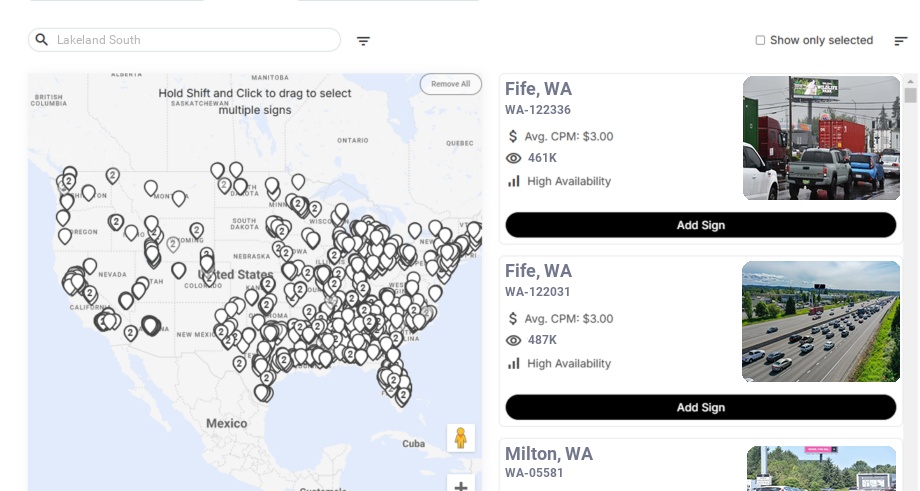
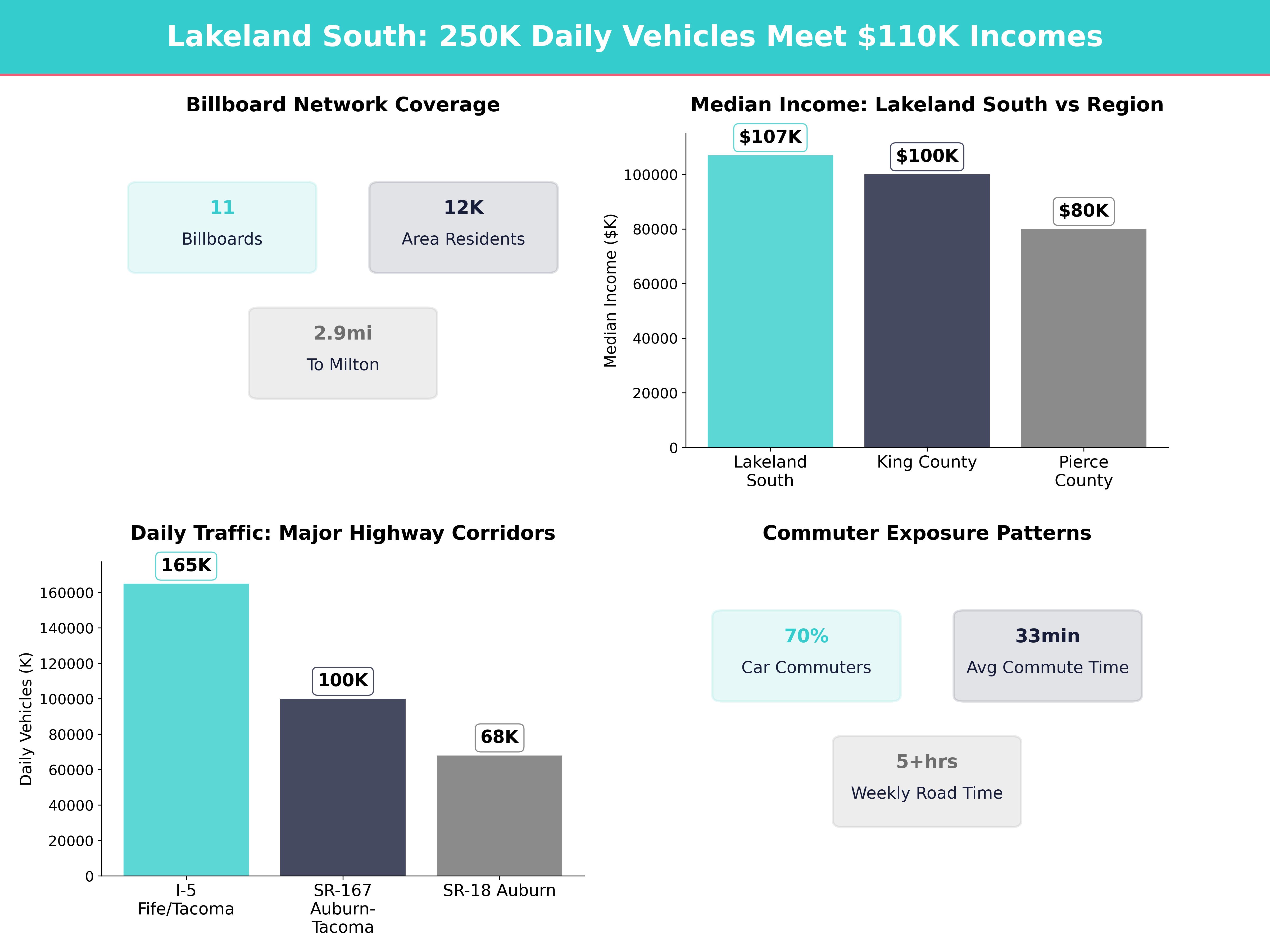
We have 11 digital billboards serving the Lakeland South area, positioned in neighboring communities that locals constantly travel through. The network includes Milton, Fife, and Tacoma, which lets you follow drivers across their full weekly routine. This gives you options to reach people near home, on the freeway, and at major destinations.
What kind of drivers does Lakeland South, Washington billboard advertising reach?
Lakeland South is a suburban community with a strong commuter profile and high buying power. The area sits just east of I-5 and near SR-18 and SR-167, which together carry well over 250,000 vehicles per day across nearby segments. Residents in the Lakeland South area frequently commute to Tacoma, Auburn, Kent, Federal Way, and Seattle.
When is the best time to run billboards in Lakeland South, Washington with Blip?
Digital billboards near the Lakeland South area allow us to adjust your schedule by hour and day to match real-world traffic patterns. Morning peak runs from 6:00–9:00 a.m., evening peak from 3:00–7:00 p.m., and weekends also bring strong retail and family traffic. With Blip, you can increase your bid and frequency during proven high-impact windows and scale back during lower-value hours.
How does Blip help me get repeated exposure near Lakeland South, Washington?
By spreading your Blip campaign across multiple boards in Milton, Fife, and Tacoma, we can capture the same person several times throughout their week. OOH studies consistently show that increased frequency, seeing a message 4–8 times per week, significantly boosts ad recall and action. With this strategy, it’s realistic for a robust campaign to reach a large share of regular commuters in the broader Lakeland South–Fife–Tacoma corridor.
Do I need a contract to advertise with Blip near Lakeland South?
No, Blip has no long-term contracts or minimum commitments. You can start, pause, or stop your campaign at any time.
How fast can I launch a billboard campaign with Blip near Lakeland South?
You can have your campaign live in minutes. Create a free account, select your locations, set your budget, upload your design, and start running once approved.
Where can I advertise with Blip near Lakeland South?
Blip has digital billboards near Lakeland South. You can browse available locations on a map, choose the ones that fit your audience, and start advertising right away.
Still have questions? Launch a campaign in minutes — no contracts, no commitments.
Start Your CampaignLakeland South Billboard Advertising Guide
Nestled between Tacoma and the South King County employment corridor, the Lakeland South area sits at the crossroads of commuters, families, and shoppers moving daily between Milton, Fife, Federal Way, Auburn
Understanding the Lakeland South Area Market
Lakeland South is a suburban community with a strong commuter profile and high buying power:
- The Lakeland South CDP has roughly 12,000–12,500 residents, with a median household income estimated above $100,000 (commonly cited in the $104,000–$110,000 range in recent local analyses), significantly higher than both Pierce County King County
- A large share of households are owner‑occupied single‑family homes, and in many nearby South Sound suburbs around 65–75% of occupied housing units are owner‑occupied, reflecting stable, family-oriented neighborhoods and strong long‑term buying power.
-
The area sits just east of I‑5 and near SR‑18 and SR‑167, which together carry well over 250,000 vehicles per day across nearby segments, according to Washington State Department of Transportation (WSDOT):
- I‑5 near Fife/Tacoma: frequently 150,000–180,000 vehicles/day on key segments
- SR‑167 between Auburn and Tacoma: often 100,000+ vehicles/day
- SR‑18 near Auburn: typically in the 60,000–75,000 vehicles/day range
- Local arterial routes connecting Lakeland South to Milton, Federal Way, Auburn, and Fife often handle 15,000–30,000 vehicles/day in peak locations, making surface‑street digital Lakeland South billboards highly visible to daily errand traffic as well as commuters.
Residents in the Lakeland South area frequently commute to major employment hubs:
- Tacoma and the Port of Tacoma industrial area
- Auburn, Kent, and the manufacturing/logistics corridor along SR‑167
- Federal Way and other South King County business centers
- Downtown Seattle and the I‑5 corridor employment spine for a segment of higher‑income professionals
Across Pierce and South King counties, more than 70% of workers commute alone by car, and typical one‑way commute times often average 30–35 minutes or more, which means your audience is spending 5+ hours per week on the road—prime time for repeated billboard exposure.
This commuter pattern creates predictable, high-frequency impressions for digital billboards near Lakeland South, especially along the I‑5 and SR‑167 approaches into Fife and Tacoma. Industry research on out‑of‑home (OOH) advertising shows that well‑placed roadside billboards can deliver tens of thousands to hundreds of thousands of impressions per week per face, and digital rotation allows your brand to tap into that volume efficiently.
To ground your strategy in local context, it’s worth browsing:
- City of Tacoma
- City of Fife
- City of Milton
- City of Federal Way
- City of Auburn
- City of Kent
- Pierce County
- Travel Tacoma – Mt. Rainier Tourism & Sports
- Travel Tacoma – South Sound Visitor Statistics
- Local news outlets such as The News Tribune KING 5, and KIRO 7
These sites reveal what locals are talking about, the events driving traffic, and the community priorities your creative should reflect. Tourism and visitor data for the South Sound often show millions of annual visitors to the Tacoma–Pierce County area, generating hundreds of millions of dollars in local spending—a reminder that your Lakeland South‑area billboards reach not only residents but a substantial visitor audience.
Where Our Billboards Reach Drivers Near Lakeland South
We have 11 digital billboards serving the Lakeland South area, positioned in neighboring communities that locals constantly travel through. This network of Lakeland South billboards lets you follow drivers across their full weekly routine:
-
Milton (about 2.9 miles from Lakeland South)
- Primarily residential and local-arterial traffic flowing toward I‑5, SR‑167, and SR‑18. Key streets in similar South Sound bedroom communities often carry 10,000–20,000 vehicles/day, especially near commercial nodes and school zones.
- Great for reaching Lakeland South area residents close to home, particularly for neighborhood-focused businesses (gyms, restaurants, home services, medical practices, churches).
- Proximity targeting here can deliver repeated daily exposures for the same households as they leave and return home, supporting frequency‑driven goals like brand recall and local loyalty through ongoing billboard advertising near Lakeland South.
-
Fife (about 4.5 miles from Lakeland South)
- A major logistics and industrial hub adjacent to I‑5 and the Port of Tacoma. The City of Fife notes that Fife’s industrial and commercial zones support thousands of jobs and a daytime population significantly higher than its residential base.
- I‑5 through Fife is one of the busiest corridors in the state, channeling daily commuters, freight, and regional shoppers heading to Tacoma and beyond. With 150,000–180,000 vehicles/day on I‑5 plus heavy truck volume, single digital faces in this area can routinely achieve hundreds of thousands of weekly impressions.
- Ideal for broad-reaching campaigns (auto dealers, regional retail, attractions, higher education, healthcare) seeking both local and regional exposure.
-
Tacoma (about 6.9 miles from Lakeland South)
- Urban, high-intensity traffic around downtown Tacoma, the Tacoma Dome, and major medical and educational institutions. The greater Tacoma area population exceeds 220,000 residents, and the daytime population swells with students, workers, and visitors.
- Major destinations like Tacoma Mall tens of thousands of shoppers and workers daily, while the Tacoma Dome alone can host events drawing 10,000–20,000+ attendees on a single night.
- Serves commuters, students, visitors, and event traffic from the broader region, including Lakeland South area residents attending concerts, sports, and cultural activities.
By spreading your Blip campaign across multiple boards in these nearby cities, we can capture the same person several times throughout their week—near home in Milton, on the freeway in Fife, and at their destination in Tacoma—multiplying recall and response. OOH studies consistently show that increased frequency (seeing a message 4–8 times per week) significantly boosts ad recall and action compared to one‑off exposures, especially when that repetition comes from highly visible billboards near Lakeland South.
Who You Reach: Key Audience Segments
Understanding the people who live and commute near the Lakeland South area helps us tailor both targeting and messaging.
1. Dual‑income commuter families
- Many households in the Lakeland South area are dual-income, with parents commuting to Tacoma, Federal Way, Auburn, Kent, or Seattle. In similar South Sound suburbs, families with children often represent 30–40% of households, and the share of two‑worker households is high.
- With household incomes commonly above $100,000, they have discretionary income for autos, home improvement, financial services, travel, and activities for kids. Households in this income band routinely spend $10,000–20,000+ per year on discretionary categories (dining out, entertainment, retail, vacations).
- They typically see billboards during school drop‑off runs, commute peaks, weekend shopping, and recreational drives—often twice per weekday plus multiple weekend trips, allowing efficient frequency.
2. Logistics and industrial workers
- The Port of Tacoma handles millions of tons of cargo annually and is part of the Northwest Seaport Alliance, one of the largest container gateways on the West Coast. This activity draws thousands of workers and truck drivers daily into the industrial areas of Tacoma and Fife.
- Distribution centers and warehouses in Fife and along SR‑167 create a regular flow of shift-based workers. In nearby industrial corridors, large employers can operate 24/7 with hundreds to thousands of employees per site, fueling strong a.m., p.m., and overnight traffic pulses.
- These audiences are prime for recruitment campaigns, safety messaging, quick‑service restaurants, and financial services along their commute paths. Recruitment ads that highlight hourly pay and benefits can reach workers who may be actively seeking better opportunities.
3. Students and education‑oriented families
- Nearby institutions, including University of Washington Tacoma, Tacoma Community College, and trade schools attract thousands of students each term from across Tacoma, Pierce County, and South King County. UW Tacoma alone enrolls thousands of undergraduate and graduate students, with a large share commuting from outside city limits.
- The broader Tacoma–South King educational ecosystem (community colleges, technical colleges, private trade schools) serves tens of thousands of students annually, many of whom drive daily on I‑5, SR‑167, and feeder arterials.
- Billboard campaigns for colleges, trade schools, and training programs can use Tacoma‑area boards to stay top of mind for both prospective students and parents making education decisions.
4. Visitors and event‑goers
- The Tacoma Dome, museums, and waterfront attractions promoted by Travel Tacoma draw regional visitors year‑round. Tourism reports frequently cite millions of visitor days per year in Tacoma–Pierce County, supporting hotels, restaurants, and attractions.
- Events often spike traffic through Fife and Tacoma, especially on weekends and evenings. A single sold‑out concert at the Tacoma Dome can push 10,000–23,000 visitors through nearby roadways in a tight time window.
- Entertainment, hospitality, casinos, and attractions near the Lakeland South area can leverage event calendars to time their Blip campaigns, using short, high‑frequency bursts on major event days.
Timing Your Campaign: When Impressions Matter Most
Digital billboards near the Lakeland South area allow us to adjust your schedule by hour and day to match real-world traffic patterns.
Weekday patterns
-
Morning peak (6:00–9:00 a.m.)
- Strong flows from the Lakeland South area toward I‑5, SR‑167, and Tacoma. In regional traffic studies, this window can account for 25–35% of weekday daily traffic volume on commuter corridors.
- Use for coffee shops, breakfast QSRs, transit or rideshare apps, and “start your day” messages.
- Also ideal for employer branding and job recruitment (“Now Hiring – Apply Today”), when workers are mentally comparing job options.
-
Midday (10:00 a.m.–2:00 p.m.)
- Service workers, retirees, stay‑at‑home parents, and flexible‑schedule workers on the roads. For many retail corridors, midday traffic represents 30–40% of daily volume, especially around shopping centers.
- Great for healthcare (clinics, dentists), retail, restaurants, real estate, and home services that benefit from same‑day appointments and walk‑ins.
-
Evening peak (3:00–7:00 p.m.)
- Heavy commuter return traffic toward the Lakeland South area. Evening volumes on key highways often rival or exceed morning peaks.
- Prioritize messages related to dinner, grocery runs, gyms, streaming/entertainment, and reminders (“Don’t forget your…”, “Stop by on your way home”).
- OOH research indicates that after‑work exposures can be especially effective for driving same‑day purchase decisions.
-
Late evening (7:00–11:00 p.m.)
- Captures hospitality, entertainment, and late‑shift workers returning from Tacoma and Fife. Traffic is lower than peak hours but still includes thousands of vehicles per hour on I‑5 in many segments.
- Consider casino, bar and restaurant, and delivery app campaigns, where a lower cost per play can still deliver strong ROI.
Weekend patterns
- Saturdays typically see strong traffic around retail centers, big-box stores, and entertainment venues near Tacoma and Fife. In many shopping districts, Saturday can be the single busiest day of the week, often 15–25% of weekly retail traffic.
- Sundays skew more toward family outings, religious services, and grocery or big‑box shopping. Late morning and early afternoon often show clear traffic bumps tied to brunch and shopping routines.
With Blip, we can:
- Increase your bid and frequency during proven high-impact windows (e.g., weekday commute times), concentrating spend when traffic volumes and purchase intent are both high.
- Scale back during lower-value hours while still maintaining some presence for brand recall.
- Create weekend‑only campaigns for retail sales, events, and attractions, or short “takeover” bursts for big sales events.
Creative Strategy for the Lakeland South Area
The best creative for the Lakeland South area reflects local geography, commute realities, and community identity.
1. Keep it readable at freeway speeds
On busy corridors like I‑5 and SR‑167, drivers often have 6–8 seconds to view your message. To maximize clarity:
- Limit to 7–10 words of main text. Studies of roadside readability show that every extra word can reduce comprehension, especially above freeway speeds of 55–60 mph.
- Use one big idea per design (e.g., “New ER in Fife – Open 24/7,” “$0 Down Auto Loans – Exit 142”).
- High-contrast color palettes (light text on dark backgrounds or vice versa).
- Large, bold fonts and minimal fine detail to ensure legibility from 500–1,000+ feet away.
2. Localize your message
Referencing familiar roads and landmarks builds trust and relevance:
-
Use exit numbers and landmarks:
- “Just off I‑5 at Fife”
- “Minutes from the Lakeland South area”
- “Near the Tacoma Dome”
-
Mention nearby cities in a simple, directional way:
- “Serving the Lakeland South area from our Milton location”
- “Tacoma clinic, minutes from the Lakeland South area”
Localized creative is consistently shown to improve response rates; when people recognize an exit or neighborhood, they are more likely to act because the mental distance to your location feels shorter. This is especially important when you are investing in premium billboards near Lakeland South and want every impression to feel immediately relevant.
3. Speak to commuters’ real needs
Common commuter pain points you can tap into:
- Time pressure: “Save 30 minutes – Order groceries ahead,” “Fast check‑in, no wait urgent care.”
- Fatigue and convenience: “Drive‑thru espresso – Next Exit,” “Dinner done. Take‑out in 15 minutes.”
- Financial stress: “Refi your auto loan – Lower your payment,” “Affordable braces for Lakeland South area families.”
In auto‑dependent regions like Pierce and South King counties, where households routinely spend hundreds of dollars per month on fuel, parking, and vehicle costs, convenience and cost‑saving messages often perform especially well.
4. Align visuals with South Sound identity
The broader Tacoma–South King County region identifies strongly with:
- Water and mountains (Commencement Bay, Mount Rainier views).
- Outdoor lifestyle (trails, lakes, parks).
- Local professional and college sports.
Consider imagery of:
- Evergreen trees, mountains, skyline silhouettes.
- Diverse, everyday families and workers, reflecting the region’s significant racial and cultural diversity.
- Real local photography when possible (waterfronts, neighborhoods, or generic but regionally resonant scenes), which can increase perceived authenticity and relevance.
Using Multiple Creatives and A/B Testing
Digital boards near the Lakeland South area are perfect for testing and optimization.
Rotate multiple creatives
We can upload several artwork variations and let Blip show them in rotation:
- Version A: Price-focused (“$49 Intro Offer – Join Today”).
- Version B: Benefit-focused (“Stronger. Healthier. Happier – Local Gym Minutes Away”).
- Version C: Location-focused (“Gym Serving the Lakeland South Area – Exit 142B”).
After a few weeks, compare:
- Website traffic and phone calls by period. For example, if your site typically sees 500 sessions/week from local ZIP codes, a well‑executed billboard flight might lift that by 10–30%.
- Redemption of promo codes tied to each message. Even single‑digit percentage redemption rates can indicate strong ROI given billboard reach.
- Store foot traffic trends during flight dates, using POS data or simple door counters.
Test time‑sensitive messages
For example, a restaurant near Fife might run:
- Breakfast-specific creative from 6 a.m.–10 a.m.
- Lunch creative from 10 a.m.–2 p.m.
- Dinner and happy hour messages from 3 p.m.–8 p.m.
We can then adjust your budget to emphasize the dayparts with the strongest response—often breakfast and dinner for QSRs, or midday for casual dining and coffee.
Budgeting and Reach Strategy with 11 Boards
With 11 digital billboards serving the Lakeland South area, we can mix broad reach with focused targeting and give you options that feel more like flexible billboard rental near Lakeland South than traditional long-term contracts.
Start with a core presence
For smaller budgets:
- Focus on 2–3 key billboards: one in Milton (close to home), one or two on high-traffic corridors near Fife or Tacoma.
- Target weekdays, commute hours, and perhaps Saturday mid‑day.
- This gives repeated exposure to regular commuters without stretching your budget too thin. Even at modest daily spends, you can accumulate thousands to tens of thousands of impressions per week.
Scale up with layered coverage
For larger or regional campaigns:
-
Spread impressions across 6–11 boards to capture multiple approach routes:
- East–west movement between Lakeland South and Tacoma.
- North–south flows along I‑5 and SR‑167.
- Run all days of the week, with a heavier focus on commute peaks and key retail hours.
- Use creative variations to address both commuters and weekend shoppers, as well as specific segments like students, visitors, or industrial workers.
With this strategy, it’s realistic for a robust campaign to reach a large share of regular commuters in the broader Lakeland South–Fife–Tacoma corridor multiple times per week, building familiarity over a 4–8 week flight.
Flexible budgeting with Blip
Because Blip sells “blips” (individual ad plays) rather than fixed monthly rentals, we can:
- Start at just a few dollars per day to test creative and locations—useful for newer businesses or one‑off promotions.
- Increase bids on boards that generate more engagement or better-located traffic, informed by web analytics and in‑store feedback.
- Pause or ramp up quickly to match promotions, events, or seasonality—ideal for retailers whose revenue can swing 20–40% between peak and off‑peak periods.
This approach turns traditional billboard rental near Lakeland South into an on‑demand tool you can align closely with cash flow and marketing goals.
Seasonality and Local Events to Leverage
Traffic near the Lakeland South area shifts subtly across the year. Aligning your messaging with these cycles increases relevance.
Back‑to‑school and fall
- Families in the Lakeland South area return to rigid school and work routines. Local districts can serve tens of thousands of K–12 students, pushing up morning and afternoon traffic near schools and main arterials.
-
Strong time for:
- After-school programs, tutoring, and education services.
- Healthcare (vaccinations, checkups, dentistry).
- Gyms, fitness, and wellness resets as schedules stabilize.
Holiday season (November–December)
- Retail and shopping traffic jumps along I‑5 and in Tacoma retail zones like Tacoma Mall and big-box clusters around Fife and Federal Way. Many retailers see 20–30% (or more) of annual sales in the holiday period.
- Use urgency-driven offers (“This Weekend Only,” “Holiday Sale Ends Sunday”).
- Promote gift ideas, local attractions, and seasonal events such as light displays, holiday markets, and New Year’s Eve celebrations.
Spring and early summer
- Boost for home improvement, landscaping, real estate, and outdoor recreation as weather improves. Home services and real estate agents often see inquiry volumes rise 15–25% compared with winter months.
- Families planning vacations and summer activities, including camping, sports camps, and local attractions.
- Perfect window for contractors, realtors, RV/boat dealerships, and local attractions to speak to “upgrade your home” and “get outside” mindsets.
Major local events
Monitor calendars from:
- Tacoma Dome events
- Travel Tacoma’s events calendar
- City event pages for Fife and Tacoma
- Regional happenings highlighted by The News Tribune KING 5
When concerts, sports events, or festivals are scheduled, traffic around Tacoma and Fife spikes. Large festivals, sporting events, and shows can each bring thousands to tens of thousands of visitors into the area in a single day. We can time ad bursts around those dates to attract visitors passing near the Lakeland South area, emphasizing wayfinding (“Next Exit”) and quick‑decision offers.
Vertical‑Specific Tips for the Lakeland South Area
Local retail and restaurants
-
Use Milton and Fife boards to highlight proximity:
- “2 Miles from This Sign – Exit [X]”
- “Serving the Lakeland South Area – Dine In or Take Out”
- Emphasize convenience for commuters: “Order Online, Pick Up On Your Way Home.”
- Keep offers clear and measurable: “Buy One, Get One 50% Off,” “Kids Eat Free on Tuesdays.” Retailers often see lift spikes of 5–20% during well‑timed OOH promotions tied to strong offers.
Healthcare and wellness
- Position clinics, urgent care, dental, and specialty providers as nearby, easy-access options. Major health systems and local clinics around Tacoma and Federal Way serve hundreds of thousands of patient visits per year, many from commuters living in bedroom communities like Lakeland South.
- Target commute hours with messages like “Same-Day Appointments – Fife Clinic” or “New Patients Welcome – Serving the Lakeland South Area.”
- Use reassuring, benefit‑oriented lines: “Walk‑In Urgent Care – Open 7 Days,” “Fast Sports Physicals for Students.”
Recruitment and staffing
-
Use industrial traffic near Fife/Tacoma:
- “Hiring Warehouse Associates – Apply Today.”
- “CDL Drivers Wanted – Home Nightly.”
- Include starting pay (“From $25/hour”), shift info, and a simple URL or text code. Wage transparency can dramatically improve engagement; even a $1–2/hour difference is highly motivating for hourly workers.
- Coordinate with local organizations like the Fife Milton Edgewood Chamber of Commerce or Tacoma-Pierce County Chamber for broader workforce and business context.
Education and training
- Highlight job outcomes, location, and schedule flexibility. For example, “Train for a New Career in 9 Months – Tacoma Campus.”
- Target both high school graduates and mid‑career adults commuting from the Lakeland South area to Tacoma or South King County. Evening and weekend creatives can speak to working adults balancing schedules.
- Community and technical colleges in the region serve thousands of continuing‑ed and workforce students, many of whom discover programs through local advertising and word of mouth.
Real estate
-
Promote new developments, apartments, or townhomes:
- “New Homes Minutes from the Lakeland South Area – Starting in the $500s.”
- Use lifestyle imagery (families, parks, nearby lakes) to appeal to move‑up buyers and renters. The South Sound’s combination of outdoor amenities and relative affordability compared with Seattle is a major draw.
- For lease‑up campaigns, short, high‑frequency flights of 4–12 weeks can effectively accelerate leasing velocity by keeping your brand visible to daily commuters who are actively evaluating housing options.
Measuring Success and Iterating
With Blip’s digital format, we can continually refine your campaign:
- Map billboard locations to store catchment areas and primary commute routes, using local ZIP codes and drive‑time data.
-
Track:
- Website sessions from the Lakeland South area and surrounding ZIP codes (e.g., a 10–30% lift during your campaign period).
- Direct traffic and branded searches during campaign dates, which often climb as awareness grows.
- Call volumes and form submissions tied to unique phone numbers or landing pages.
- Promo code or vanity URL redemptions to measure direct response.
Then we:
- Shift budget toward the best‑performing boards and time blocks—for example, if Fife freeway boards drive more web visits per dollar than local arterials, or if evening commutes outperform mornings.
- Retire underperforming creatives and double down on proven messaging, keeping your rotation fresh while maintaining your strongest offers and headlines.
- Test new offers or visuals, especially around major seasonal shifts or events, to maintain relevance and capture incremental demand.
By combining hyper-local knowledge of how people move through the Lakeland South area with the flexibility of digital billboards in Milton, Fife, and Tacoma, we can build campaigns that reach the right drivers at the right times with messaging that feels tailored to their daily life. Whether you are exploring billboard advertising near Lakeland South for the first time or looking to scale an existing presence, the right mix of Lakeland South billboards, smart scheduling, clear creative, and ongoing optimization grounded in real data can turn the heavy traffic near the Lakeland South area into meaningful, measurable results.