Billboards in Arlington, WA
No Minimum Spend. No Long-Term Contracts. Just Results.
Trusted by Leading Brands


Billboard advertising
in Arlington has never been easier



How much is a billboard in Arlington?
Why Choose Blip for Billboard Advertising in Arlington
Launch on Blip in Arlington and reach I‑5 commuters near Smokey Point in minutes—self-serve makes setup fast and simple.
Arlington’s SR‑9 and I‑5 traffic shifts by hour; Blip dayparting lets you hit commute peaks, shift changes, and weekend trips.
Use Blip’s flexible budgets in Arlington to reach industrial workers, families, and Cascades tourists without contracts or minimums.
Blip-optimized campaigns in Arlington can auto-pick the best boards and timing for I‑5, SR‑530, and event weekends.
Track Arlington billboard results in real time and pivot fast around Fly‑In, summer recreation, or casino traffic spikes.
Create bold Arlington ads with Blip’s creative tools—perfect for rainy commutes, bright summer drives, and quick 1-3 second glances.
Frequently Asked Questions About Billboard Advertising in Arlington
How much does a billboard cost in Arlington, Washington with Blip?
With Blip’s pay-per-blip model, you can put your message on digital Arlington billboards for any budget, because you set a daily limit that Blip automatically respects. Each blip is a brief 7.5 to 10-second display, and the cost of each one depends on when and where your ad runs, plus current advertiser demand. That means you only pay for the exposure you actually receive, and you can adjust your budget or schedule at any time to match your goals.
Where can I advertise with Blip in Arlington, Washington?
Arlington’s billboard value is driven primarily by a few critical corridors, including I-5, SR-9, and SR-530. Near I-5, nearby segments in north Snohomish County routinely carry 80,000–110,000 vehicles per day, making it ideal for wide-reach brand awareness and exit-driven calls to action. SR-9 and SR-530 also offer strong placement options for local commuter traffic and recreation-bound visitors.
Who sees Arlington, Washington billboards on Blip?
Arlington billboards can reach daily I‑5 commuters, blue‑collar and logistics workers, young families, and destination tourists heading for the Cascades and tribal gaming. The area also draws a large industrial and warehouse workforce, along with regional road-trippers and outdoor tourists who add a substantial weekend and summer surge in traffic. This means Arlington billboard advertising can reliably reach both local households and pass-through visitors.
When should I run Blip ads on Arlington, Washington billboards?
For commuter-focused campaigns, heavier morning and evening drive-time blips are recommended, roughly 6:00–9:00 a.m. and 3:00–7:00 p.m. For tourism and weekend leisure, Fridays through Sundays are strongest, especially when recreation traffic peaks. The page also recommends increasing frequency 1–2 weeks before major events to capture planning and anticipation phases.
Why are Arlington, Washington billboards good for Blip campaigns?
Arlington sits at the crossroads of commuter traffic, industrial growth, and outdoor recreation in north Snohomish County. That gives advertisers access to a growing local population, a large workforce, and regional visitors heading to nearby attractions. The page also notes that Arlington billboard advertising can be a scalable way to extend or replace other higher-cost media.
Do I need a contract to advertise with Blip in Arlington?
No, Blip has no long-term contracts or minimum commitments. You can start, pause, or stop your campaign at any time.
How fast can I launch a billboard campaign with Blip in Arlington?
You can have your campaign live in minutes. Create a free account, select your locations, set your budget, upload your design, and start running once approved.
Where can I advertise with Blip in Arlington?
Blip has digital billboards in Arlington. You can browse available locations on a map, choose the ones that fit your audience, and start advertising right away.
Still have questions? Launch a campaign in minutes — no contracts, no commitments.
Start Your CampaignArlington Billboard Advertising Guide
Arlington, Washington, sits at the crossroads of commuter traffic, industrial growth, and outdoor recreation in north Snohomish County. When we plan digital billboard campaigns here, we are speaking simultaneously to daily I‑5 commuters, blue‑collar and logistics workers, young families, and destination tourists heading for the Cascades and tribal gaming. Below, we break down how to turn Arlington’s unique patterns of traffic, demographics, and seasonality into high‑performing Blip campaigns and how to make Arlington billboards work as a core part of your local media mix.
Understanding the Arlington Market
Arlington’s population has grown quickly over the last decade, from 17,926 residents in 2010 to 19,868 in the 2020 Census (about 10.9% growth), with city estimates now topping 20,000–21,000 residents based on recent projections from the City of Arlington. It sits in a much larger trade area:
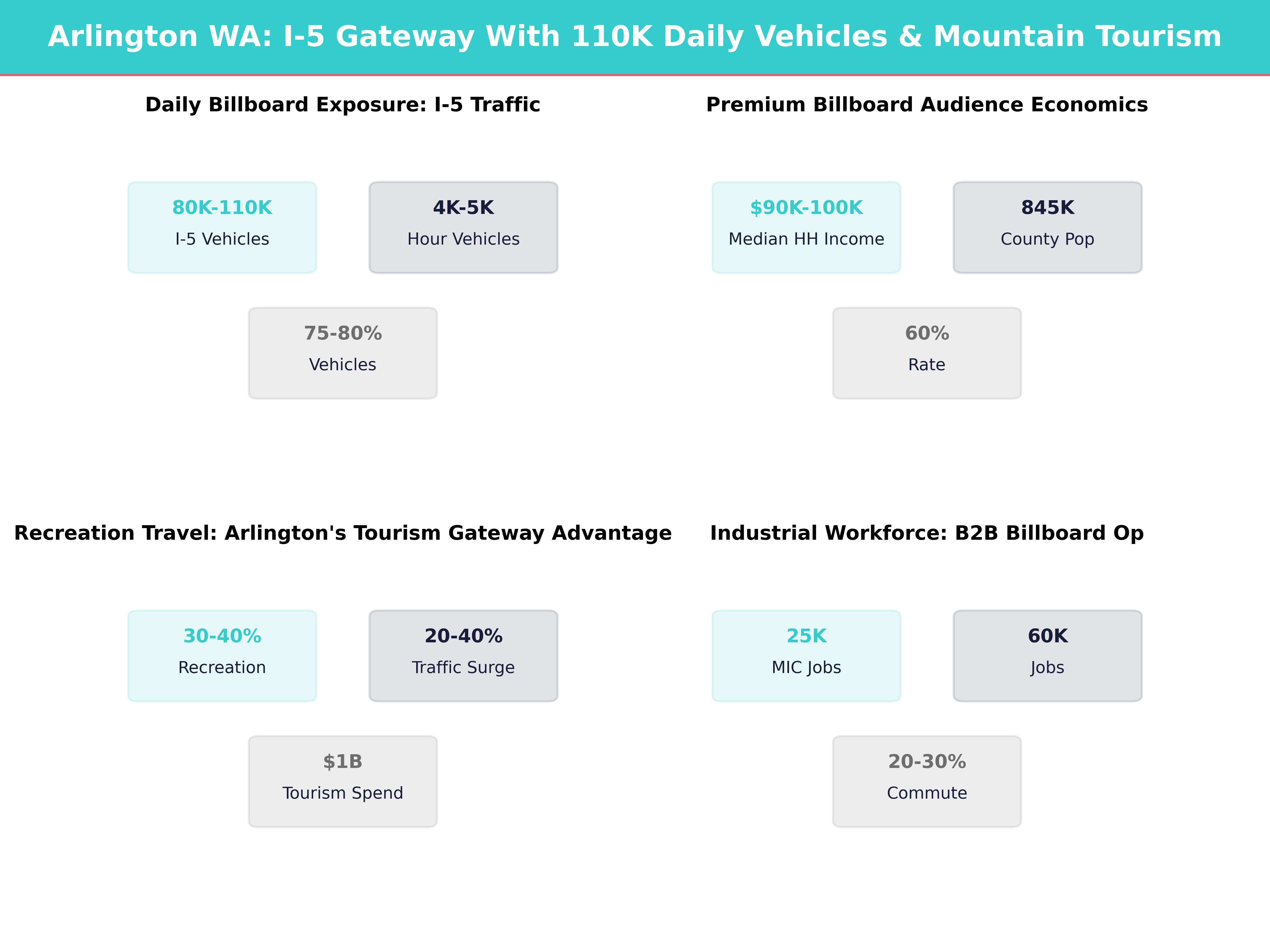
- Snohomish County population: roughly 845,000 residents (2023 estimate), making it one of Washington’s three most populous counties, according to Snohomish County.
- Arlington is just 10–15 minutes north of Marysville, home to 72,000+ residents per the City of Marysville, and about 25–30 minutes from Everett (over 110,000 residents), according to the City of Everett.
- The broader “North County” area, served by outlets like the North County Outlook well over 100,000 residents.
Economically, Arlington punches above its size:
- The Arlington‑Marysville Manufacturing Industrial Center (MIC) covers more than 4,000 acres around the Arlington Municipal Airport 25,000+ jobs at build‑out, according to the City of Arlington.
- Snohomish County manufacturing employment totals more than 60,000 jobs, with aerospace and advanced manufacturing making up a significant share, per Snohomish County Economic Development.
- The area is home to aerospace suppliers, distribution centers, and construction‑related firms, drawing workers from across north Snohomish and Skagit Counties and from regional hubs like the Port of Everett and Naval Station Everett
Tourism and recreation add another layer:
- Nearby attractions like the Stillaguamish River recreation corridor, North Cascades access routes, and Angel of the Winds Casino Resort (operated by the Stillaguamish Tribe) bring in regional visitors year‑round. Angel of the Winds alone reports hundreds of thousands of guest visits annually, with gaming, lodging, and entertainment drawing from across western Washington.
- The county’s tourism arm, Seattle NorthCountry, estimates that visitor spending in Snohomish County regularly tops $1 billion per year, supporting 10,000+ tourism‑related jobs, and highlights Arlington as a base for hiking, fishing, and scenic drives, especially along SR‑530.
For advertisers, this means we are not just buying impressions from 20,000 local residents; we are buying access to:
- Daily commuter traffic between Everett–Seattle and the growing north county suburbs.
- A large industrial/warehouse workforce that numbers in the tens of thousands within a 30‑minute drive.
- Regional road‑trippers and outdoor tourists who add a substantial weekend and summer surge in traffic.
In this environment, Arlington billboard advertising can reliably reach both local households and pass‑through visitors, making billboards in Arlington a scalable way to extend or replace other higher‑cost media.
Key Traffic Flows and Where Your Message Fits
Arlington’s billboard value is driven primarily by a few critical corridors. When we choose Blip boards, we should think in terms of corridor strategy—who is on each road, when, and why.
I‑5: The North–South Spine
Interstate 5 is the main artery between Seattle and the Canadian border, passing just west of Arlington near Smokey Point.
- Traffic volumes: Nearby I‑5 segments in north Snohomish County routinely carry 80,000–110,000 vehicles per day, depending on the exact mile, according to WSDOT traffic counts Smokey Point / Exit 206–208 area often exceed 4,000–5,000 vehicles per hour during rush periods.
- Roughly 75–80% of vehicles on I‑5 in this region are personal passenger vehicles, with 10–15% commercial trucks, based on WSDOT classifications—ideal for both consumer and B2B messages.
- Drivers include long‑distance truckers, Everett/Seattle commuters, military personnel heading to and from Naval Station Everett
Blip inventory near I‑5 is ideal when we need:
- Wide‑reach brand awareness (insurance, healthcare, regional retail) across tens of thousands of daily impressions.
- Immediate exit‑driven calls to action (fast food, fuel, hotels, casinos, auto services) targeting hundreds of drivers per minute during peak flows.
We should schedule heavier morning and evening “drive time” blips (approx. 6:00–9:00 a.m. and 3:00–7:00 p.m.) to match commuter waves, when up to 40–45% of daily traffic is concentrated. For brands using Arlington billboards primarily for I‑5 coverage, concentrating spend in these windows keeps billboard rental in Arlington efficient while still maximizing reach.
SR‑9: The Eastside North–South Alternative
State Route 9 runs north–south just east of Arlington and connects exurban and rural communities.
- Traffic volumes: Depending on the segment, SR‑9 carries roughly 18,000–30,000 vehicles per day in the greater Arlington–Lake Stevens corridor, serving bedroom communities and light‑industrial areas (per WSDOT).
- Average speeds and lower congestion compared to I‑5 mean drivers have slightly longer glance time at signs, improving recall.
- Audience: local commuters avoiding I‑5, tradespeople, delivery drivers, and residents of areas like Bryant, Lake Stevens, and north Marysville.
SR‑9 boards are powerful for:
- Local service businesses (contractors, HVAC, dental, veterinary, auto repair) that draw from a 15–20‑minute drive‑time radius.
- Recruitment for industrial and logistics firms that draw from nearby communities where 20–30% of workers commute out of their home city daily.
- Grocery, hardware, and neighborhood retailers competing for frequent weekly trips.
SR‑530: Gateway to the Cascades
State Route 530 connects Arlington to Darrington and recreation areas near the North Cascades.
- Daily volumes are typically in the 5,000–10,000 vehicles per day range near Arlington—lower than I‑5 or SR‑9, but SR‑530 concentrates high‑value tourist, outdoor, and weekend traffic, especially in spring, summer, and early fall. Summer weekend day volumes can jump 20–40% above weekday averages.
- Drivers include anglers, hikers, campers, and visitors heading toward mountain cabins and scenic byways promoted by Seattle NorthCountry.
Along this corridor, we can:
- Promote outdoor‑oriented businesses (gear shops, guides, RV parks, campgrounds) that rely heavily on April–October revenue, when many outdoor operators see 60–70% of their annual sales.
- Advertise dining, groceries, and fuel in Arlington as the “last big stop” before the mountains—capturing trip‑prep spending that can average $50–$150 per party.
- Push timely messages tied to seasonal events and festivals in Arlington and Darrington, where event weekends often increase traffic by 15–30%.
Who We’re Reaching: Audience and Demographic Insights
Understanding who lives and works in and around Arlington helps us tune our creatives and schedules.
Families and Suburban Homeowners
Snohomish County has a relatively young, family‑oriented profile:
- Median age across the county is in the mid‑30s to late‑30s.
- Average household size is around 2.6–2.8 people, higher than many urban cores.
- In many North County communities, 30–35% of households have children under 18.
Arlington itself includes:
- Numerous single‑family neighborhoods and subdivisions, with a homeownership rate commonly above 60%.
- Growing multi‑family developments near employment hubs and transportation corridors.
- A notable share of long‑term residents, with many households living in the area for 10+ years, according to local housing reports from the City of Arlington.
Median household incomes in Snohomish County sit in the $90,000–$100,000+ range, creating strong purchasing power for family‑oriented products and services.
For this audience, billboards should lean into:
- Clear family benefits: “Save Time,” “Family‑Friendly,” “Safe,” “Affordable.”
- Locality and community pride: “Right here in Arlington,” “Serving North County,” “Minutes from Smokey Point.”
- Visuals featuring families, kids’ activities, and Pacific Northwest outdoor lifestyles that reflect common local activities like youth sports, camping, and river trips.
Blue‑Collar, Industrial, and Logistics Workers
The Arlington‑Marysville MIC and the Arlington Municipal Airport
- Aerospace component manufacturers, metal fabrication, logistics warehouses, and other production employers, as documented by the City of Arlington Economic Development.
- Dozens of industrial and logistics firms clustered along key arterials, employing a combined workforce in the thousands within a short radius of the airport.
- Shifts running around the clock—day shift, swing, and sometimes graveyard—typical for aerospace and warehouse operations.
In Snohomish County overall, manufacturing, trade, transportation, and utilities together often account for 20–25% of total employment, underscoring the size of the blue‑collar audience reachable via roadways.
Campaign implications:
- Recruitment campaigns can perform well, especially highlighting hourly wages (e.g., “Starting at $22/hr”), benefits, and location convenience.
- Ads targeting shift workers should be scheduled in early mornings (4:30–7:30 a.m.) and late afternoons/evenings (2:00–6:00 p.m.) when shifts change, capturing repeated daily impressions.
- Creative should emphasize reliability, growth opportunities, and short commutes—key priorities for a workforce where over half may travel 15–30 minutes each way.
Regional Visitors and Day‑Trippers
Arlington’s proximity to outdoor attractions and tribal gaming draws:
- Weekend travelers from the Seattle–Tacoma–Everett metro (combined population well over 3 million).
- RV and boat owners heading toward lakes and rivers, especially during summer when Snohomish County campgrounds and parks can run at 80–100% occupancy on peak weekends, per Seattle NorthCountry.
- Casino and event visitors, including concerts and tournaments at Angel of the Winds Casino Resort.
For this segment:
- Focus on weekend‑heavy scheduling (Friday afternoon through Sunday evening), when recreation traffic can represent 30–40% of vehicles on SR‑530 and key I‑5 segments.
- Emphasize “Exit Now,” “Tonight Only,” or “This Weekend” messaging for urgency, knowing many buyers are in a spend‑ready mindset on leisure trips.
- Use large, vivid images of mountains, rivers, cabins, and nightlife scenes; visitors are in a discovery mindset and respond strongly to visual cues of local experiences.
Seasonality and Weather: How the Sky Changes Your Creative
Arlington’s climate and daylight patterns should shape how we design and schedule our campaigns.
Long, Gray Winters
North Snohomish County sees:
- Around 150–170 days of measurable precipitation per year, according to regional climate summaries from Snohomish County.
- Seasonal rainfall totals commonly in the 35–45 inches per year range.
- Short daylight: in December, sunset can be as early as ~4:15 p.m., with fewer than 8.5 hours of daylight on the shortest days.
Campaign tips:
- Use high‑contrast color palettes (bright yellows, oranges, and whites against dark blues or blacks) to cut through gray skies and wet pavement glare.
- Avoid subtle gradients and thin fonts; heavy fonts (bold sans‑serifs) and simple icons perform better when drivers have 1–3 seconds to read your message.
- Schedule more impressions during dark commute hours (before sunrise and after sunset) to take advantage of digital boards’ brightness—particularly effective on high‑traffic I‑5 segments.
Long, Bright Summers
In June and July:
- Daylight stretches to around 16 hours, with sunset after 9:00 p.m. near the solstice.
- Outdoor activities surge: rivers, trails, patios, road trips, and local festivals.
- Many tourism‑oriented and home‑service businesses see 40–60% of their annual revenue in just 4–5 months.
Summer strategy:
- Creative can use cool blues and greens, more photography, and scenic backgrounds—they will read clearly in bright light and align with outdoor mindsets.
- Allocate more budget to weekends and early evenings, when people are out driving for leisure, events, and dining, and when traffic around destinations like Angel of the Winds Casino Resort and the Stillaguamish River corridor is highest.
- Promote seasonal offers: home improvement, landscaping, summer events, and tourism that align with peak demand.
Local Events and Calendars to Sync With
Aligning with Arlington’s calendar can dramatically boost relevance. We can plan campaigns around:
- Arlington Fly‑In: A major aviation event at the Arlington Municipal Airport drawing aviation enthusiasts and families from across the region. Past events have attracted tens of thousands of attendees over multi‑day runs, according to organizers at Arlington Airport
- Fourth of July celebrations and parades, often covered by outlets like the North County Outlook
- County fairs and festivals in nearby communities (e.g., the Evergreen State Fair in Monroe, which frequently draws 250,000–300,000+ visitors annually, per the Evergreen State Fair Park), ~45–60 minutes south but heavily promoted within Snohomish County.
- High school sports seasons with the Arlington School District: football in fall, basketball in winter, baseball/softball in spring. These bring repeated traffic patterns before and after games as hundreds of students and families converge on stadiums multiple times per week.
We should:
- Increase frequency 1–2 weeks before major events, capturing planning and anticipation phases.
- Use event‑specific creatives (“Welcome Pilots and Families!”, “Heading to the Fly‑In? Stop Here First.”).
- Swap creatives quickly—one of Blip’s biggest advantages—right after the event to avoid wasted impressions and pivot to the next seasonal hook.
Crafting Creative That Works in Arlington
Digital billboards allow us to change and test artwork easily. For Arlington, successful creatives usually share these traits:
Embrace “North County” Identity
Residents often identify with:
- “North County” or “North Snohomish,” as used by North County Outlook
- Nearby landmarks like Smokey Point, the Stillaguamish River, the Cascades, and Old Town Arlington.
Messaging ideas:
- “Your North County HVAC Experts”
- “Arlington’s Local Family Dentist”
- “Proudly Serving Smokey Point & Arlington”
Tie‑ins to local pride help differentiate from generic, regional brands and tap into the strong community identity fostered by groups like the Stilly Valley Chamber of Commerce.
Keep Messages Ultra‑Simple
Typical readable word count at highway speed is around 7–10 words. At 60 mph, drivers may see your board for only 2–3 seconds, so clarity is critical.
Structure your creatives as:
- 1 short headline (3–5 words)
- 1 supporting phrase (3–5 words) or offer
- 1 call to action (URL, short phrase, or exit number)
For example:
- “New Patients: $99 Exam”
- “3 Minutes from I‑5 Exit 206”
- “BookAtArlingtonDental.com”
This format has been shown in out‑of‑home studies to significantly improve recall and action rates versus cluttered designs.
Design for Rain and Reflective Pavement
With frequent wet roads and glare, we should:
- Use large, high‑contrast text (white/yellow on dark backgrounds), sized so key words are at least 18–24 inches tall on a traditional‑sized digital face.
- Avoid text over photography; place text in a solid color block or banner.
- Limit competing elements—one logo, one key photo or icon—to ensure quick comprehension.
Speak to Drivers’ Real Journeys
Link messages to what people are actually doing:
- Commuters: “Skip I‑5 Traffic—Try Our Express Service in Smokey Point.”
- Outdoor travelers: “Forgot Your Gear? Exit in Arlington—Open Late.”
- Workers: “Hiring Warehouse Associates – Arlington – $22/hr + Benefits.”
Grounding your copy in real, daily behaviors and specific wage or price points has been shown to lift response rates for recruitment and retail advertisers. When combined with well‑placed billboards in Arlington, these tailored messages can make even modest billboard rental in Arlington deliver outsized results.
Dayparting and Budget Allocation With Blip
Blip’s pay‑per‑flip and scheduling tools let us target by time of day, day of week, and even by board. For Arlington, we can create a few default patterns:
Commuter‑Focused Campaigns
Ideal for: coffee shops, quick‑serve restaurants, car washes, automotive services, recruitment.
- Weekdays, 5:30–9:00 a.m. and 3:00–7:00 p.m. capture the bulk of commuter traffic on I‑5 and SR‑9—often 40–50% of weekday volumes.
- Emphasize I‑5 and SR‑9 boards near major on‑ramps and arterials.
- Messages: “Drive‑Thru Coffee Ahead,” “Oil Change After Work,” “Now Hiring Night Shift.”
We can lower spend during midday weekdays to stretch budget while still catching core work trips.
Family & Errand Traffic
Ideal for: grocery, retail, healthcare, dental, kid activities.
- Weekdays, 9:30 a.m.–3:00 p.m. (errands, appointments), when stay‑at‑home parents, retirees, and flexible workers are on the road.
- Saturdays and Sundays, 10:00 a.m.–5:00 p.m. (shopping and family activities), when many retailers report 25–35% of weekly sales.
- Focus on boards that capture neighborhood and commercial center traffic, such as routes into Old Town Arlington and Smokey Point shopping areas.
Tourism & Weekend Leisure
Ideal for: restaurants, breweries, casinos, hotels, RV parks, outdoor businesses.
- Fridays, 2:00–9:00 p.m.; Saturdays, 9:00 a.m.–9:00 p.m.; Sundays, 9:00 a.m.–7:00 p.m., when leisure trips, casino visits, and outdoor getaways peak.
- Use creatives that highlight “This Weekend,” “Live Music Tonight,” “Happy Hour,” and similar hooks.
- Target routes toward casinos, rivers, and mountain gateways (I‑5 northbound, SR‑530, key local arterials) highlighted by Seattle NorthCountry.
Location Strategy: Matching Boards to Business Goals
While specific Blip board locations vary over time, we can think strategically about where we want presence.
Near I‑5 Interchanges (Smokey Point, Exit 206/208)
Best for:
- Regional brands and franchises (QSR, fuel, lodging, big‑box retail) seeking tens of thousands of daily impressions.
- Casinos, destination entertainment, and large medical facilities like Cascade Valley Hospital
- Any advertiser needing large‑scale brand awareness.
CTA suggestions:
- “Exit 206 – Turn Right at Smokey Point.”
- “Next Exit – Angel of the Winds Shuttle.”
- “10 Minutes South in Marysville.”
These messages align with typical 1–10 mile detour tolerances for freeway travelers and are some of the most effective ways to leverage Arlington billboard advertising for on‑the‑spot response.
Routes to Arlington Municipal Airport
Best for:
- Aviation‑related businesses, flight schools, maintenance, and hangar services clustered around the Arlington Municipal Airport
- Industrial employers, logistics, and B2B services that rely on the airport‑adjacent MIC.
- Event‑driven campaigns (Fly‑In, airshows, trade events).
Emphasize:
- Proximity to the airport (“Across from Airport Entrance”).
- Business‑focused value props: “Same‑Day Parts,” “24/7 Logistics Support,” “Just 5 Minutes Off I‑5.”
Neighborhood and Commercial Arterials
Best for:
- Hyperlocal services—healthcare clinics, dental offices, salons, gyms, pet care.
- Restaurants and independent retailers.
- Schools, nonprofits, local government campaigns from entities like the City of Arlington or Snohomish County.
Messaging should include:
- Neighborhood names and drive times: “Old Town Arlington – 3 Minutes Ahead.”
- Local hashtags or URLs for community initiatives promoted by organizations such as the Stilly Valley Chamber of Commerce or Arlington School District.
Vertical‑Specific Strategy Ideas
To make this more concrete, here are some Arlington‑tailored playbooks by industry.
Restaurants and Coffee Shops
Audience: commuters, families, road‑trippers.
Tactics:
- Heavy weekday morning impressions for coffee and breakfast spots near I‑5 and SR‑9; morning commuter flows can hit 3,000–4,000 vehicles per hour past key interchanges.
- Weekend afternoon/evening push for dine‑in restaurants when restaurant spending typically spikes by 20–30% versus weekdays.
- Creative featuring 1–2 menu items with price points (“$5 Breakfast Burritos,” “Kids Eat Free Tuesdays”)—price‑anchored creatives often outperform generic branding in food service.
- “Exit Now” or “Next Right in Arlington” to capture impulse visits from highway travelers.
Home Services (HVAC, Roofing, Landscaping, Plumbing)
Audience: homeowners in Arlington, Marysville, Lake Stevens, Stanwood.
Tactics:
-
Run continuously but increase impressions during key seasons:
- HVAC: first major heat waves (typically late June–August) and cold snaps (November–February).
- Roofing/gutters: early fall and early spring, when heavy rainfall and wind events are most common.
- Landscaping: early spring through early summer, ahead of the main growing season.
- Use strong value claims (“24/7 Emergency Service,” “Financing Available,” “Free Estimates”).
- Emphasize locality: “Family‑Owned in Arlington Since 20XX”—local service providers often see higher close rates when emphasizing community roots.
Healthcare and Dental
Audience: families and workers across North County.
Tactics:
- Focus on convenience: “Same‑Day Appointments,” “Open Evenings,” “Walk‑Ins Welcome.” Clinics that extend hours often see 10–20% more visit capacity utilized.
- Schedule around commuting hours and midday for appointments: 7:00–9:00 a.m., 11:00 a.m.–1:00 p.m., 3:00–6:00 p.m.
- Promote specific services: pediatric care, urgent care, dental promotions, physical therapy. Tie in with local care networks like Cascade Valley Hospital
Recruitment and Workforce
Audience: industrial, warehouse, healthcare, and retail workers.
Tactics:
- Short, bold messages: “Now Hiring – $22/hr + Benefits,” “Day & Night Shifts,” “Apply at [Short URL].” Including pay information has been shown to increase application rates significantly in competitive markets.
- Run heavily near industrial corridors and major commuting routes that connect MIC employers with worker neighborhoods.
- Increase presence after major layoffs or during peak hiring sprints; follow coverage from local outlets like the Everett Herald
Tourism, Lodging, and Entertainment
Audience: visitors along I‑5 and SR‑530, regional day‑trippers.
Tactics:
- Use scenic imagery: rivers, forests, night lights, and recognizable North County landscapes promoted by Seattle NorthCountry.
- Tie messages to specific weekends or events: “This Weekend Only – Live Music,” “Summer Stay & Play Packages.” Properties that promote event weekends often see double‑digit percentage lifts in occupancy or ticket sales versus non‑promoted dates.
- Emphasize quick access: “15 Minutes from This Exit,” “Free Parking,” “Family‑Friendly,” knowing many travelers are deciding within a few miles where to stop.
Measuring and Refining Campaigns
Arlington’s market is compact enough that we can see impact quickly if we plan measurement.
Ideas:
-
Track changes in:
- Direct traffic to your website and “near me” searches around Arlington and Smokey Point—local businesses often see 10–30% lifts in branded search during well‑timed billboard flights.
- Coupon redemptions or promo codes featured only on billboards, isolating out‑of‑home impact.
- Call volume or online bookings during specific dayparts when your ads run.
-
Use A/B creative testing:
- Version A: focus on price (“Oil Change $49.99”).
- Version B: focus on speed/convenience (“Oil Change in 15 Minutes”).
- Run each version for at least 1–2 weeks and compare results (calls, bookings, web form fills).
-
Coordinate with local media:
- Pair Blip campaigns with coverage or ad buys on outlets like North County Outlook Everett Herald
- Sync campaigns with social media pushes and community calendar listings from the City of Arlington and Snohomish County.
Putting It All Together
Arlington, Washington, offers a powerful blend of dense traffic corridors, rapid population growth, a strong industrial base, and steady flows of outdoor and gaming tourism. With Blip’s flexible, pay‑per‑flip model, we can:
- Target the exact corridors—like I‑5, SR‑9, and SR‑530—that match our audience and deliver tens of thousands of daily impressions.
- Align our schedule with real‑world behavior: commutes, shift changes, weekends, and seasonal tourism that drive predictable spikes in traffic.
- Continuously refine creative to account for North County’s weather, daylight, and community identity.
By grounding our campaigns in local data, traffic patterns, and event calendars from sources such as the City of Arlington, Snohomish County, WSDOT, Seattle NorthCountry, and regional news outlets like North County Outlook Everett Herald