Billboards near Mill Creek East, WA
No Minimum Spend. No Long-Term Contracts. Just Results.
Trusted by Leading Brands


Billboard advertising
near Mill Creek East has never been easier
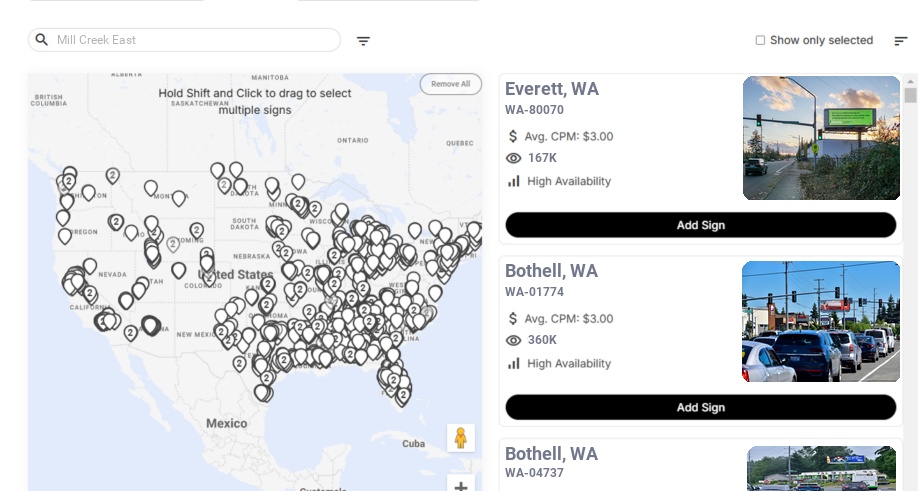



How much is a billboard near Mill Creek East?
Why Choose Blip for Billboard Advertising near Mill Creek East
Blip lets you launch in Mill Creek East fast and self-serve, reaching I-405, SR-527, and SR-524 commuters without a traditional contract.
Set a flexible budget for Mill Creek East and target peak 6–9 a.m. and 3–7 p.m. traffic when Bothell and Lynnwood commuters are on the road.
Use Blip’s real-time analytics in Mill Creek East to see what works and shift spend toward Alderwood shoppers or Eastside-bound drivers.
No long-term commitment means you can test Mill Creek East billboards around back-to-school, holiday retail, or spring home-improvement season.
Blip’s creative tools help tailor Mill Creek East ads for affluent families, tech workers, and shoppers moving between Everett, Seattle, and Alderwood.
Frequently Asked Questions About Billboard Advertising near Mill Creek East
How much does a billboard cost near Mill Creek East, Washington with Blip?
With Blip, you choose a daily budget that works for you, and your campaign of Mill Creek East billboards automatically stays within that amount. Each 7.5 to 10-second “blip” is a brief digital display, and you only pay per blip, so you are always in control of how much you spend on billboards near Mill Creek East, Washington. The price of each blip adjusts based on when and where you choose to advertise and on advertiser demand, and your total cost is simply the sum of all the blips you receive.
Where can I advertise with Blip near Mill Creek East, Washington?
While our digital billboards are not physically inside Mill Creek East itself, they are placed in nearby cities that naturally serve the Mill Creek East area and function as Mill Creek East billboards for commuters and shoppers. The main nearby inventory is in Bothell, about 1.1 miles from Mill Creek East, and Lynnwood, about 3.5 miles away. By strategically selecting Blip inventory near Bothell and Lynnwood, we can ensure campaigns effectively reach people who live, work, shop, and commute through the Mill Creek East area on a daily basis.
What kind of audience can Blip reach in Mill Creek East, Washington?
The Mill Creek East area sits at the heart of one of the fastest-growing, most affluent corridors in Snohomish County. The Mill Creek East CDP had roughly 25,000 residents in 2020, up from just over 15,000 residents in 2010, and the City of Mill Creek reports a median household income above $110,000. Roughly 45–50% of households in the Mill Creek / Mill Creek East area earn $125,000 or more annually, creating an outsized pool of high-discretionary-income consumers.
When is the best time to run billboards near Mill Creek East with Blip?
Weekday 6–9 a.m. and 3–7 p.m. are prime windows to reach commuters traveling between the Mill Creek East area and Bothell/Lynnwood. Midday and early evening are ideal for retail, dining, and services campaigns, as residents head to Alderwood, Mill Creek Town Center, and big-box retailers along SR-527 and I-5. Weekends are excellent for family-oriented, leisure, and retail messages, as traffic increases around shopping districts and recreational destinations.
Why are billboards near Mill Creek East, Washington effective for commuters?
Many residents commute to tech and professional jobs in Bothell, Lynnwood, Bellevue, and Seattle, with strong ties to employers in the I-405 and I-5 corridors, as well as Boeing and aerospace jobs centered around Everett. In Snohomish County, around 75–80% of workers commute by car, with average one-way commute times in the 30–35 minute range. This commuter dynamic means our billboards near Bothell and Lynnwood can repeatedly reach the same Mill Creek East–area consumers during both morning and evening drive times.
Do I need a contract to advertise with Blip near Mill Creek East?
No, Blip has no long-term contracts or minimum commitments. You can start, pause, or stop your campaign at any time.
How fast can I launch a billboard campaign with Blip near Mill Creek East?
You can have your campaign live in minutes. Create a free account, select your locations, set your budget, upload your design, and start running once approved.
Where can I advertise with Blip near Mill Creek East?
Blip has digital billboards near Mill Creek East. You can browse available locations on a map, choose the ones that fit your audience, and start advertising right away.
Still have questions? Launch a campaign in minutes — no contracts, no commitments.
Start Your CampaignMill Creek East Billboard Advertising Guide
The Mill Creek East area sits at the heart of one of the fastest‑growing, most affluent corridors in Snohomish County. With strong commuter traffic flowing between Everett, Bothell, Lynnwood, and the greater Seattle tech hubs, digital billboards near Mill Creek East give us a powerful way to reach high‑value audiences throughout their daily routines. For brands looking for flexible, high‑impact billboard advertising near Mill Creek East, these placements offer consistent visibility without needing a long‑term traditional contract.

Understanding the Mill Creek East Market
Mill Creek East is an unincorporated community immediately east of the City of Mill Creek in south Snohomish County. It’s part of the broader suburban corridor that includes Bothell and Lynnwood, where our digital billboards are located, making Mill Creek East billboards an efficient way to tap into both local and regional traffic.
Key market characteristics:
-
Population density and growth
- The Mill Creek East CDP had roughly 25,000 residents in 2020, up from just over 15,000 residents in 2010—an increase of about 65% in a decade, underscoring sustained suburban infill and new housing development.
- Population density in the Mill Creek / Mill Creek East area is estimated at 4,500–5,000 residents per square mile, significantly higher than the Snohomish County average of around 420 residents per square mile, making billboard impressions highly concentrated.
- Snohomish County overall grew to more than 840,000 residents by 2023, adding over 120,000 people since 2010 and consistently ranking among Washington’s top growth counties. The county tracks growth and planning initiatives through its official portal.
-
High household incomes and spending power
- The City of Mill Creek reports a median household income above $110,000, and many nearby neighborhoods, including Mill Creek East, commonly track in the $120,000–140,000 range, driven by well‑paid tech, healthcare, and aerospace jobs.
- Roughly 45–50% of households in the Mill Creek / Mill Creek East area earn $125,000 or more annually, compared with closer to 30% countywide, creating an outsized pool of high‑discretionary‑income consumers.
- Median home values in and around Mill Creek East regularly exceed $750,000–$800,000, with some newer subdivisions crossing the $900,000 mark, reflecting strong equity positions and capacity for higher‑ticket purchases (remodels, vehicles, financial services).
- With this income base, local households routinely outspend national averages in categories such as home improvement (20–30% above U.S. average), travel and recreation, and dining out, making them a prime target for premium and experience‑driven brands that use billboards near Mill Creek East to stay top of mind.
-
Employment and commuter patterns
- Snohomish and adjoining King County employment data show that a large share of Mill Creek / Bothell corridor residents work in professional, scientific, and technical services; information technology; healthcare; and manufacturing (including aerospace). Tech and professional services alone typically account for 25–30% of local jobs.
- Many residents commute to tech and professional jobs in Bothell, Lynnwood, Bellevue, and Seattle, with strong ties to employers in the I‑405 and I‑5 corridors, as well as Boeing and aerospace jobs centered around Everett.
- In Snohomish County, around 75–80% of workers commute by car (driving alone or carpooling), with average one‑way commute times in the 30–35 minute range. This commuter dynamic means our billboards near Bothell and Lynnwood can repeatedly reach the same Mill Creek East–area consumers during both morning and evening drive times, maximizing the value of billboard rental near Mill Creek East.
For deeper local context on community make‑up, events, and services, it’s useful to monitor the City of Mill Creek and Snohomish County websites, as well as regional tourism sources like Seattle NorthCountry (Snohomish County tourism) and nearby city visitor pages such as Visit Bothell City of Lynnwood.
Where Our Billboards Reach the Mill Creek East Area
While our digital billboards are not physically inside Mill Creek East itself, they are placed in nearby cities that naturally serve the Mill Creek East area and function as Mill Creek East billboards for commuters and shoppers:
-
Bothell, WA (about 1.1 miles from Mill Creek East)
- Bothell sits at a strategic junction where I‑405, SR‑527 (Bothell‑Everett Highway), and local arterials intersect. The Bothell urban center has grown steadily, with the city’s population now exceeding 48,000 residents, up more than 30% in the last decade, which adds to local trip volume.
- According to WSDOT traffic count data 160,000–180,000 vehicles per day, and SR‑527 south of Mill Creek commonly sees 35,000–45,000 vehicles per day. Annual traffic volumes on these corridors translate to well over 50 million vehicle trips per year, creating substantial repeated‑exposure potential.
- These boards are ideal for reaching commuters heading to and from tech campuses and office parks in Bothell, Bellevue, Kirkland, and Seattle, as well as students and staff at the nearby University of Washington Bothell and Cascadia College, which together enroll over 10,000 students. For advertisers searching for billboards near Mill Creek East with strong Eastside reach, Bothell locations are often the most efficient choice.
-
Lynnwood, WA (about 3.5 miles from Mill Creek East)
- Lynnwood is a major retail and transportation hub with I‑5, I‑405, and SR‑525 converging, plus the busy Alderwood retail area. The City of Lynnwood, with a population of roughly 40,000 residents, draws a daytime population closer to 60,000–70,000 when workers and shoppers are included, according to city economic development estimates.
- I‑5 through Lynnwood typically records 180,000–200,000 vehicles per day, based on WSDOT counts, making it one of the highest‑volume freeway segments in the region. SR‑525 and nearby arterials such as 196th St SW and Alderwood Mall Parkway add tens of thousands more daily trips.
- Alderwood and adjacent shopping complexes host hundreds of businesses and generate millions of visits annually; even a conservative estimate of 20,000–30,000 visitors per day on busy weekends translates to strong exposure for retail, dining, and entertainment campaigns on nearby boards.
- Our Lynnwood‑area boards capture Mill Creek East–area residents on shopping, dining, and entertainment trips, not just work commutes, and are a core part of any billboard advertising near Mill Creek East aimed at retail‑driven audiences.
By strategically selecting Blip inventory near Bothell and Lynnwood, we can ensure campaigns effectively reach people who live, work, shop, and commute through the Mill Creek East area on a daily basis. This gives local businesses flexible options for billboard rental near Mill Creek East without the overhead of owning or managing static displays.
How People Move Around the Mill Creek East Area
Understanding how residents travel guides when and where we schedule billboard “blips” for maximum impact.
Commuting and driving patterns
- County travel surveys indicate that roughly 75–80% of employed residents in the broader Mill Creek / Bothell / Lynnwood corridor drive alone or carpool to work, while 8–10% use transit and 10–15% work from home at least part time. This car‑oriented pattern directly supports out‑of‑home advertising and increases the value of placing billboards near Mill Creek East along high‑volume roadways.
-
Average daily traffic on key corridors:
- I‑5 (Lynnwood area): 180,000–200,000 vehicles per day
- I‑405 (Bothell area): 160,000–180,000 vehicles per day
- SR‑527 (Bothell‑Everett Highway): 35,000–45,000 vehicles per day
- SR‑524 / 196th St SW between Mill Creek and Lynnwood: commonly 25,000–35,000 vehicles per day
-
Mill Creek East–area residents commonly:
- Drive south on SR‑527 toward Bothell and I‑405.
- Drive west on SR‑524 / 196th St SW toward Lynnwood and I‑5.
- Connect to Seattle, Bellevue, and the Eastside via I‑5 and I‑405, with many commuters covering 15–25 miles one way.
Transit and park‑and‑ride usage
- Agencies like Community Transit and Sound Transit operate key commuter routes from the Mill Creek and Lynnwood areas to Seattle and the Eastside. Combined, these agencies carry tens of thousands of riders per weekday in Snohomish County, with several routes passing directly through or adjacent to our billboard corridors.
- The Ash Way Park & Ride and Lynnwood Transit Center together provide well over 2,000 parking spaces, with pre‑pandemic utilization rates often exceeding 85–90% on weekdays. Even with some growth in remote work, morning and late‑afternoon periods still show strong, predictable flows.
- The Lynnwood Link light rail extension, highlighted by the City of Lynnwood, is expected to draw tens of thousands of daily riders once fully operational, further strengthening the area as a regional mobility hub and increasing visibility for nearby digital boards.
Implications for scheduling with Blip
- Weekday 6–9 a.m. and 3–7 p.m. are prime windows to reach commuters traveling between the Mill Creek East area and Bothell/Lynnwood. These windows typically account for 40–50% of daily traffic volume on key corridors, but only a fraction of the 24‑hour day, making targeted buying highly efficient.
- Midday and early evening (11 a.m.–8 p.m.) are ideal for retail, dining, and services campaigns, as residents head to Alderwood, Mill Creek Town Center, and big‑box retailers along SR‑527 and I‑5. Retail centers commonly see 20–30% higher visit counts on weekend days, with lunchtime and early evening peaks.
- Weekends are excellent for family‑oriented, leisure, and retail messages, as traffic increases around shopping districts and recreational destinations such as local parks, sports fields, and nearby waterfronts.
With Blip, we can precisely buy these windows rather than paying for 24/7 rotations, allowing us to align spend directly with Mill Creek East–area movement patterns and make billboard advertising near Mill Creek East more cost‑effective.
Key Audience Segments in the Mill Creek East Area
Because of who lives and works in the Mill Creek East area, certain messages perform particularly well.
1. Affluent families and professionals
- In the Mill Creek / Mill Creek East area, homeownership rates often exceed 70%, compared with closer to 60–65% across Washington State, with a high proportion of newer single‑family homes and townhomes built since 2000.
- Household size averages around 2.7–2.9 people, with a large share of families with children under 18, supporting strong demand for education, childcare, healthcare, and family leisure.
- A significant portion of residents hold bachelor’s or graduate degrees (often 45–55% in nearby tracts), which correlates with higher expectations for quality and professional services.
What this means for campaigns:
- Promote mortgage refinancing, financial planning, insurance, and investment services—emphasizing trust, expertise, and local presence, especially as many households manage six‑figure incomes and high‑value properties.
- Highlight home improvement, landscaping, and contractor services, especially in spring and early summer when home‑services spending typically rises 15–25% above winter levels in the Pacific Northwest.
- Position private schools, tutoring, and extracurricular programs with messages focused on academic excellence and convenience, tapping into the area’s education‑oriented households.
2. Tech and knowledge‑industry workers
- Proximity to major employers in Bothell’s business parks, the North Creek area, and the I‑405 corridor creates a large tech‑savvy and early‑adopter audience. In some nearby employment centers, information and professional services comprise 30–40% of jobs.
- Many of these workers have flexible or hybrid schedules, increasing their daytime presence on local roads for errands, gym trips, and coffee runs.
- This group is highly responsive to clear digital calls‑to‑action (QR codes, unique URLs, discount codes) and values time‑saving solutions.
Campaign implications:
- Feature apps, SaaS platforms, telehealth services, and subscription products with short, benefit‑driven copy. Tech‑oriented buyers often respond well to trial offers and clear value metrics (“Save 5 hours a week,” “Cut costs by 20%”).
- Use simple landing pages and vanity URLs that can be remembered from a fast billboard impression, and consider A/B testing different CTAs to see which drives higher click‑through or sign‑up rates.
3. Retail and dining shoppers
-
The Mill Creek Town Center, highlighted by the Mill Creek Town Center merchants association, features more than 80 shops, restaurants, and services serving the Mill Creek East area and attracting regular foot traffic from nearby neighborhoods.
- Nearby Alderwood in Lynnwood is one of the region’s largest shopping destinations, with over 150 stores and restaurants, multiple anchor tenants, and an attached lifestyle and entertainment area. Regional shopping centers of this scale typically draw 8–10 million visits per year, with strong spikes in November and December.
- Additional retail corridors along SR‑527 and 164th St SW host grocery stores, big‑box retailers, auto services, and fast‑casual dining that depend heavily on repeat local trips.
Campaign implications:
- Run time‑sensitive promotions (e.g., “This Weekend Only,” “Tonight”) during midday and evening, targeting impulse shopping and dining decisions. Limited‑time offers can lift in‑store traffic by 10–25% when well timed around paydays and weekends.
- Use simple offers (“20% off,” “Kids eat free,” “Happy hour 3–6”) and strong directional cues (“Exit 183, 5 minutes from here”) to capture spur‑of‑the‑moment decisions.
Using Seasonality and Local Events to Your Advantage
Local patterns in weather, school calendars, and events shape when campaigns will have the greatest impact.
Weather and lifestyle seasonality
-
The Mill Creek East area experiences typical Puget Sound weather:
- Rainy, darker months (roughly October–April) bring frequent rainfall and shorter daylight—Seattle‑area climate data show around 150 rainy days per year and winter sunset times as early as 4:15 p.m. This encourages indoor activities, home projects, and travel planning.
- Drier, brighter months (May–September) account for the majority of sunny or partly sunny days and see higher use of parks, trails, and outdoor spaces. Regional park visitation can increase 30–50% compared with winter months.
- Home‑improvement and landscaping businesses often report seasonal revenue peaks in late spring and early summer, while travel, tourism, and outdoor recreation peak in June–August.
Campaign ideas:
-
Fall–winter (Oct–Feb)
- Emphasize home services, healthcare (flu shots, urgent care), e‑commerce, and indoor recreation. Healthcare systems often see 20–30% higher urgent‑care and primary‑care visits during cold and flu season.
- Use high‑contrast, bright creative to stand out against gray skies and early sunsets—digital billboards with bold color palettes can improve message recall by 10–20% compared with low‑contrast designs.
-
Spring–summer (Mar–Sep)
- Promote landscaping, roofing, exterior painting, summer camps, outdoor dining, and local events. Many families make summer‑camp decisions between March and May, so early campaigns capture intent.
- Feature imagery of green spaces, trails, and outdoor family activities that reflect the region’s lifestyle, such as nearby parks and county trail systems.
School‑driven seasonality
The areas served by Everett Public Schools and Northshore School District, both detailed on their respective sites (Everett Public Schools, Northshore School District), follow a traditional school year. Combined, these districts educate over 45,000 students, creating large, predictable patterns in family schedules.
This creates predictable spikes in demand:
-
Back‑to‑school (Aug–Sep)
- Ideal for retail, apparel, electronics, tutoring, and after‑school programs, as families purchase supplies, clothes, and devices. Many retailers generate 15–20% of annual sales during back‑to‑school and holiday periods combined.
-
Spring and summer breaks
- Great for camps, attractions, family travel, and enrichment programs, as families look for structured activities and local experiences.
Local festivals and community events
- The City of Mill Creek promotes regular events such as the Mill Creek Festival & Street Fair, farmers markets, and seasonal celebrations on its events calendar 10,000+ visitors over a weekend, significantly boosting local traffic.
- Nearby Bothell and Lynnwood host their own community festivals, parades, and summer concert series, which are often covered by local outlets like the Everett Herald Lynnwood Today My Edmonds News
- Regional attractions like the Port of Everett waterfront, detailed by the Port of Everett, and Paine Field’s aviation‑related draws also help anchor seasonal tourism and weekend day‑trip traffic through Snohomish County.
We can schedule short, intense Blip campaigns in the week or two leading up to these events to drive attendance, sponsorship visibility, or event‑related offers, making your Mill Creek East billboards work hardest when local interest is highest.
Crafting Effective Creative for the Mill Creek East Area
High‑quality creative is crucial, especially on digital billboards where we may have 6–8 seconds of viewer attention.
Message and tone
- Professional yet approachable: Residents expect quality; avoid gimmicky messaging. Speak to them as informed consumers making thoughtful choices, consistent with the area’s higher education and income levels.
- Benefit‑driven: Lead with clear outcomes—“Cut your commute costs,” “Transform your backyard,” “Get care in 15 minutes.” Short, benefit‑focused headlines can increase ad recall by up to 30% versus vague messaging.
- Local relevance: Reference key landmarks and areas that resonate locally, such as “near Mill Creek Town Center,” “just off I‑5 at Alderwood,” or “minutes from the Mill Creek East area,” which reinforces that these are true billboards near Mill Creek East and not generic regional placements.
Visual design best practices
-
Use large, readable fonts and keep the main headline to 7–9 words. Studies of out‑of‑home effectiveness show readability drops sharply beyond 12–14 total words of primary copy.
- Prioritize high contrast: light text on dark backgrounds or vice versa, especially important during dark winter months.
- Limit design elements to one main image, one logo, and one call‑to‑action to avoid clutter and confusion in the few seconds viewers have.
- Consider using regional imagery (evergreen trees, local trails, family‑friendly neighborhoods) to establish instant geographic relevance.
Calls‑to‑action tailored to this audience
- “Schedule online today” – great for healthcare, home services, and professional services. In service sectors, easy online booking can raise conversion rates by 10–30%.
- “Download the app” – for tech products; pair with a short custom URL and/or QR code for commuters stopped in slower traffic.
- “Exit ___, then 5 minutes north” – for location‑driven retail and dining near I‑5 or I‑405, giving a clear mental map.
- Use promo codes tied to the billboard (e.g., “MILL25”) to track ROI. Many local advertisers find that even 5–10% of redemptions tagged to billboards can validate and refine their out‑of‑home strategy.
Making the Most of Blip’s Scheduling and Budget Controls
With Blip, we don’t need a large, fixed contract to advertise near the Mill Creek East area. We can scale and target efficiently, making billboard rental near Mill Creek East accessible for businesses of many sizes.
Dayparting around commute flows
-
Focus budgets on:
- 6–9 a.m. for B2B services, coffee, quick‑service breakfast, and commuter‑oriented offerings. Morning peak hours typically account for 20–25% of weekday traffic on major corridors.
- 3–7 p.m. for grocery, family dining, kids’ activities, and local retail, when afternoon and evening peaks add another 25–30% of daily volume.
- Test splitting your budget 60% on peak commute hours, 40% on midday/evening to reach both workers and at‑home audiences. After a few weeks, compare KPIs (calls, web visits, coupon redemptions) to refine the mix.
Weekday vs. weekend strategies
- Weekdays: Emphasize work‑related services, healthcare, education, and errands. Weekdays generally see more consistent, predictable commute patterns and business‑hour trips.
- Weekends: Shift spend to promote entertainment, events, restaurants, and big‑ticket shopping (appliances, furniture, cars). Retail analytics often show 15–30% higher store traffic on Saturdays and Sundays versus midweek, especially around payday periods and holidays.
Geo‑allocation between Bothell and Lynnwood boards
- If your main customers live closer to the eastern side of the Mill Creek East area or commute toward the Eastside, skew delivery toward Bothell boards, which tap into I‑405, North Creek business parks, and Eastside‑bound traffic.
- If your customers more often shop at Alderwood or along I‑5, or you want broader regional reach, invest more heavily in Lynnwood boards, which connect to I‑5, SR‑525, and the upcoming light rail terminus.
- Many advertisers in the Mill Creek East area see success with a 60/40 split favoring the location closest to their business, then fine‑tuning toward a 70/30 or 50/50 balance once campaign data indicates which corridor performs best.
Industry‑Specific Tips for the Mill Creek East Area
Different categories can leverage the area’s demographics and traffic in specific ways when planning billboard advertising near Mill Creek East.
Local retail & dining
- Position stores as convenient stops “on your way home” from Bothell or Lynnwood, especially targeting the 3–7 p.m. window when many workers return to Mill Creek East.
- Promote lunch and dinner specials around midday and late afternoon on weekdays. Restaurants often see a 10–20% lift in same‑store sales when consistently promoting time‑bound offers.
- Highlight proximity to major shopping areas (“2 minutes from Alderwood” or “near Mill Creek Town Center”) to plug into existing travel patterns and capture even a small share of the thousands of daily shopping trips.
Home services and contractors
- Target spring through early fall heavily; this is peak season for roofing, landscaping, painting, and remodels across the Pacific Northwest. Many contractors generate 50–60% of annual revenue in these months.
- Use before‑and‑after visuals with short, bold copy like “New Roof in 2 Weeks” or “Stress‑Free Kitchen Remodels.” Clear timeframe promises can meaningfully increase inquiry rates.
- Focus on trust signals: “Locally owned,” “Serving the Mill Creek East area for 15+ years,” or customer review counts (for example, “500+ 5‑star reviews”), which are particularly important in higher‑value, higher‑income markets.
Healthcare and wellness
- The area has strong demand for urgent care, dental, vision, pediatric care, physical therapy, and fitness centers, reflecting its high share of families and professionals with employer‑sponsored insurance.
- Emphasize same‑day appointments, evening hours, and online booking. Clinics offering extended hours can capture 10–15% more patient volume from working families who can’t schedule during the traditional 9–5 window.
- Use reassuring language: “Care for your whole family,” “Walk‑in visits welcome,” “Open late near I‑5.” Consider aligning campaigns with flu season (Oct–Feb) and sports seasons (for sports medicine and physical therapy).
Education, childcare, and enrichment
-
Promote daycares, preschools, private schools, tutoring centers, music and sports programs during:
- Late summer for fall enrollment, when many programs fill 60–80% of their rosters.
- Mid‑winter for mid‑year transfers or spring programs, when families reassess school fit.
- Focus on outcomes and convenience: “Top test scores,” “Flexible schedules for busy families,” “5 minutes from the Mill Creek East area.” Data points such as graduation rates or average test scores (when available) can strengthen credibility.
Auto dealers and service
- The I‑5 and I‑405 corridors are prime for auto dealership advertising, while SR‑527 connects directly to many service centers and independent shops. Combined corridor volumes of 300,000+ vehicles per day mean auto‑related messages are highly contextually relevant.
- Use simple, compelling offers: “0% APR,” “Oil change $49,” “Trade‑in bonuses this weekend only.” Limited‑time sales events often account for 20–30% of monthly dealership volume.
- Schedule heavier frequency around paydays and tax refund season (late winter/early spring), when vehicle and service purchases typically spike.
Measuring Success and Optimizing Over Time
To get the most from digital billboards near the Mill Creek East area, we should treat campaigns as ongoing, test‑and‑learn programs.
Tracking and attribution ideas
- Custom URLs and landing pages (e.g., yoursite.com/millcreek) to monitor direct traffic from billboard viewers. A simple landing page with a clear offer can significantly boost conversion; many advertisers see 20–40% higher response rates when visitors land on a tailored page rather than a generic homepage.
- Promo codes unique to each location or board type to compare Bothell vs. Lynnwood performance.
- Call tracking numbers assigned to billboard campaigns, with call logs analyzed by time of day and day of week to align with Blip schedules.
- Watch for spikes in branded search and web traffic patterns corresponding to your Blip schedule. Even a 5–10% lift in branded search volume during your flight can indicate strong awareness impact.
Optimization strategies
- Compare performance between Bothell‑heavy and Lynnwood‑heavy schedules to see which better aligns with your customer base. For example, track cost per call, cost per lead, or in‑store coupon redemption by corridor.
- Test creative variations—different headlines, offers, or imagery—and rotate the best‑performing designs more frequently. Out‑of‑home studies often find 10–25% performance differences between top‑ and bottom‑performing creatives.
- Align your campaigns with coverage in local and regional news sources such as the Everett Herald Lynnwood Today The Seattle Times
Compliance, Community Fit, and Local Goodwill
Advertising near the Mill Creek East area also means being mindful of local standards and community expectations.
- Local governments like the City of Mill Creek, City of Bothell, and City of Lynnwood emphasize neighborhood character, family‑oriented environments, and safety in their comprehensive plans and public communications.
-
While Blip’s billboard partners handle permitting and technical compliance, we recommend creative that:
- Avoids overly aggressive or shock imagery.
- Reflects community values—family, nature, education, and local pride.
- Uses inclusive language and visuals that represent the area’s diversity; Snohomish County’s population includes significant Asian, Hispanic/Latino, and multi‑racial communities, and campaigns that reflect this diversity tend to build stronger connections.
- Consider occasional cause‑related or community‑support messages—such as sponsoring local school events, charity runs, or festivals—and referencing that support briefly on your boards. Brands that are visibly involved in local life often see higher favorability and loyalty scores in surveys and customer feedback.
Businesses that align their messages with these values tend to see stronger engagement and improved brand perception in the Mill Creek East area, especially when they consistently use billboards near Mill Creek East as part of their broader marketing mix.
By combining the high‑income, family‑oriented demographics of the Mill Creek East area with the heavy traffic flows through Bothell and Lynnwood, we can build digital billboard campaigns that punch far above their weight. Using Blip’s flexible budgeting, precise scheduling, and creative testing, advertisers of any size can efficiently reach this valuable audience where they live, shop, and commute—without needing a traditional large billboard contract, and with straightforward options for billboard rental near Mill Creek East whenever campaigns need to scale up or pivot.