Billboards in Seattle, WA
No Minimum Spend. No Long-Term Contracts. Just Results.
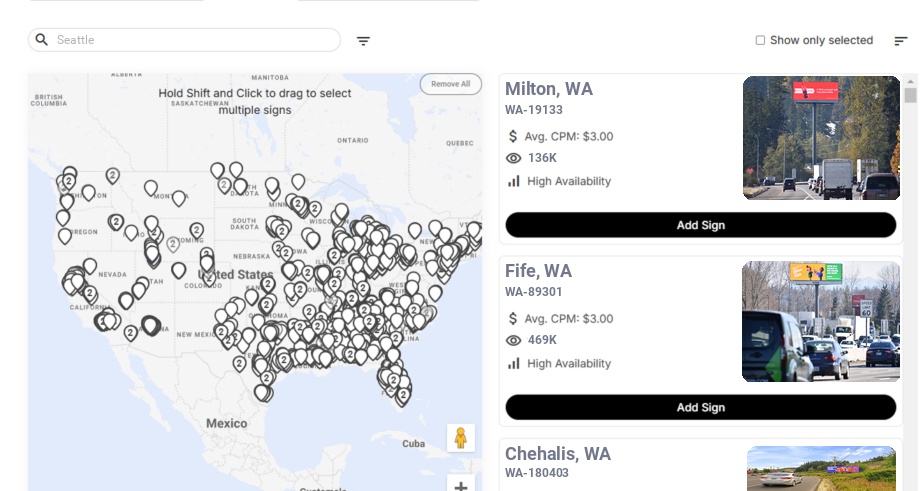
Turn heads and spark curiosity with Seattle billboards made easy. With Blip, you choose when and where your message shines on digital billboards in Seattle, Washington, set any budget, and tweak campaigns in real time for maximum impact and fun.
Trusted by Leading Brands


How much is a billboard in Seattle?
Why Choose Blip for Billboard Advertising in Seattle
Blip lets you launch Seattle billboards self-serve and fast, with no contracts. Hit I-5, SR 520, or SR 99 when commuter traffic is highest.
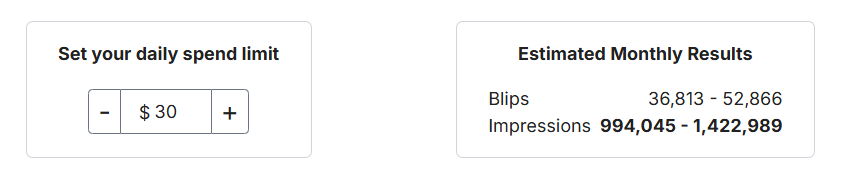
Set any budget in Seattle and Blip keeps you on track. Pay for each blip, not a fixed buy, and adjust anytime as results come in.
Use Blip dayparting to meet Seattle's 7-9 a.m. and 3:30-6:30 p.m. rushes. Time ads for bridge commuters on I-90 and SR 520.
Blip-optimized campaigns in Seattle auto-pick billboards and timing to match your goals. Great for game days near T-Mobile Park and Lumen Field.
Track Seattle performance in real time and shift spend fast. See what works during rainy winter commutes, then scale it before summer festivals.
Blip's creative tools make Seattle ads easy to refresh for local audiences. Swap copy for South Lake Union tech workers, Capitol Hill nights, or Eastside commuters.
Frequently Asked Questions About Billboard Advertising in Seattle
How much does a billboard cost in Seattle, Washington with Blip?
Where can I advertise with Blip in Seattle, Washington?
When is the best time to run Blip billboards in Seattle, Washington?
What kind of audience do Seattle, Washington billboards reach?
How do weather and seasonality affect billboard advertising in Seattle, Washington with Blip?
Do I need a contract to advertise with Blip in Seattle?
How fast can I launch a billboard campaign with Blip in Seattle?
Where can I advertise with Blip in Seattle?
Still have questions? Launch a campaign in minutes — no contracts, no commitments.
Start Your CampaignSeattle Billboard Advertising Guide
Seattle is one of the most visually distinctive and economically dynamic cities in the U.S., which makes it a powerful place to run digital billboard campaigns. With a population of roughly 762,000 residents in the city and more than 4.1 million people across the broader metro area, advertisers can use Blip’s flexible tools to reach highly mobile, tech-savvy, and affluent audiences throughout their daily routines in and around Seattle. When planned strategically, Seattle billboards can anchor both citywide and neighborhood-level awareness in this fast-growing market.
Understanding the Seattle Market
Seattle combines dense urban neighborhoods, affluent suburbs, and heavy commuter corridors, all of which influence how we plan billboard campaigns and where billboards in Seattle can deliver the most value.
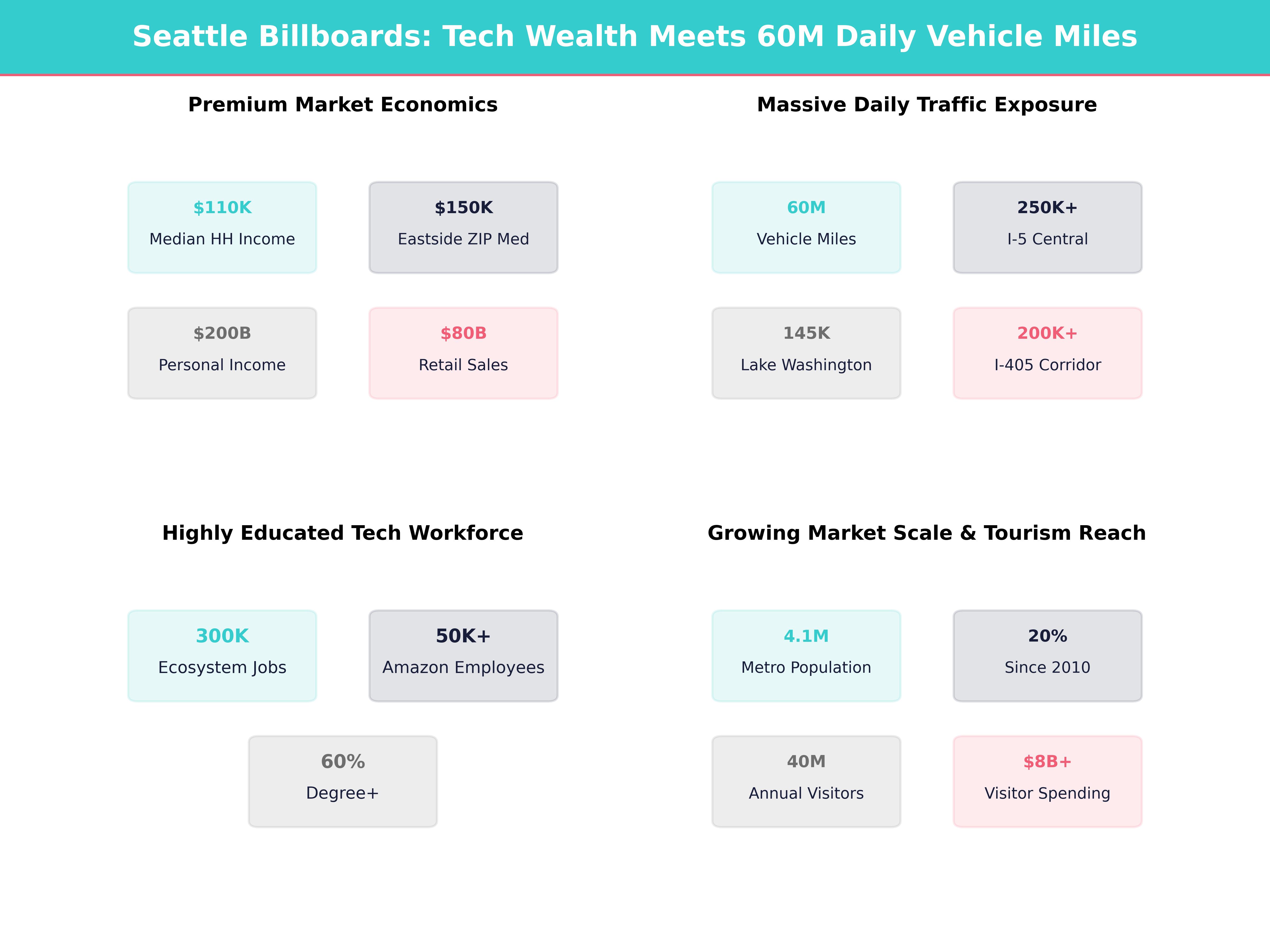
- Population & growth: The City of Seattle has grown by more than 20% since 2010, adding well over 120,000 residents in about a decade, according to city demographic reports. Dense growth pockets like South Lake Union saw multi-family housing units increase by thousands of new apartments in the 2010s, and King County overall has added more than 300,000 residents since 2010, as tracked by King County
- Income & spending power: Median household income in Seattle is above $110,000, and in nearby cities like Bellevue and Redmond it often exceeds $130,000, with some Eastside ZIP codes reporting medians closer to $150,000. King County’s total personal income now exceeds $200 billion annually, and taxable retail sales in the county have surpassed $80 billion per year, indicating strong consumer spending capacity for categories like tech, professional services, premium retail, dining, and healthcare.
- Age profile: Roughly 45–50% of Seattle residents fall into the 25–44 age bracket in central neighborhoods, and more than 60% of adults hold a bachelor’s degree or higher per city and county reports. This young, educated base is ideal for B2B tech, startups, entertainment, and lifestyle brands that benefit from always-on visibility via digital billboards in Seattle’s busiest corridors.
- Major employers: Headquarters and large offices for Amazon, Microsoft (nearby Redmond), Starbucks, Boeing, and many other companies fuel daily travel between urban cores and Eastside suburbs. Amazon alone employs well over 50,000 people in the Seattle area; Microsoft’s Puget Sound workforce is estimated in the tens of thousands; and the region’s broader tech ecosystem supports more than 300,000 jobs, contributing to some of the highest tech job densities in the country, as highlighted in regional economic reports from the Washington State Department of Commerce King County
Local sources like the City of Seattle and King County
Traffic Patterns and High-Impact Corridors
Seattle’s geography—waterways, bridges, and limited north–south corridors—funnels traffic into a few key routes. This is ideal for strategic digital billboard placement and time-based bidding, since a relatively small number of Seattle billboards can capture a large share of daily impressions.
According to WSDOT and the Seattle Department of Transportation, the Seattle metro sees more than 60 million vehicle miles traveled (VMT) on a typical weekday across King County, with some corridors carrying among the highest volumes in the state.
Key routes and patterns to consider:
-
I-5 through downtown Seattle
- Carries well over 250,000 vehicles per day through central segments, with some sections approaching 300,000 average daily trips.
- Serves commuters from Northgate, Shoreline, and Lynnwood to downtown and SoDo, and from the South King County suburbs northward.
- Rush hours typically peak 7:00–9:00 a.m. and 3:30–6:30 p.m.; travel times can more than double vs. off-peak according to WSDOT.
- Collision and construction hotspots reported by WSDOT and covered regularly by outlets like KING 5 and The Seattle Times
-
I-90 and SR 520 (Lake Washington bridges)
- I-90 handles ~140,000–150,000 vehicles per day over Lake Washington.
- SR 520 hosts similar volumes and reaches many of the region’s highest-income households between Seattle, Medina, and Bellevue, where median home values commonly exceed $1 million.
- These are prime for targeting Eastside tech workers commuting to and from Seattle; transit ridership on corridors connecting to these bridges via Sound Transit and King County Metro
-
SR 99 / Alaskan Way Viaduct replacement tunnel and surface routes
- Carries roughly 70,000–80,000 vehicles per day through the SR 99 tunnel, with additional volume on surface streets feeding into downtown, SoDo, and West Seattle.
- Connects North Seattle to downtown, SoDo, and West Seattle.
- Strong exposure to sports fans traveling to T-Mobile Park and Lumen Field, which together can host more than 100 home games and large events annually, making this a high-value corridor for Seattle billboard advertising during game days.
-
North Seattle and suburban connectors
- Routes like SR 522, SR 99 (Aurora Ave N), and I‑405 connect fast-growing areas like Bothell, Kirkland, and Renton to the core city.
- I‑405 segments between Renton and Bellevue see well over 200,000 vehicles per day, making them high-frequency touchpoints for commuters heading toward downtown Bellevue and Seattle.
- Arterial streets under Seattle Department of Transportation management collectively carry hundreds of thousands of trips per day, especially in corridors like Rainier Ave S, 15th Ave NW, and Lake City Way.
Blip’s ability to schedule by time of day and location lets us concentrate bids on peak congestion windows on these routes, extracting maximum impressions when vehicles are moving slowly and dwell time on boards is highest. This flexibility is a key advantage when planning any billboard rental in Seattle.
Seasonality and Weather: Using Seattle’s Climate to Your Advantage
Seattle’s climate and seasonality significantly influence behavior and campaign strategy, and Seattle billboards can capitalize on these patterns with dynamic creative and adjusted schedules:
-
Rain & overcast: Seattle averages around 150–160 days of measurable rain annually, and roughly 200–220 cloudy days, according to climate summaries from the National Weather Service Seattle office and local analysis often covered by KIRO 7 and KOMO News. This creates:
- More time indoors and in cars during fall–winter, especially October–March, when monthly rainfall totals can exceed 5 inches.
- Strong demand for cozy dining, delivery, entertainment, and home services; local restaurant and delivery spending tends to spike during prolonged wet periods, as reported in regional business coverage by The Seattle Times
- Opportunities for playful rain-themed creative (“Don’t let the rain stop date night…”) that taps into the city’s weather identity.
-
Daylight swings:
- Winter: In December, sunrise can be after 7:45 a.m. and sunset before 4:30 p.m., giving barely 8.5 hours of daylight.
- Summer: In June, sunrise can be before 5:15 a.m. and sunset after 9:00 p.m., with more than 16 hours of light.
- In winter, we can focus Blip budgets heavily on peak commuting hours in darkness, when bright digital billboards stand out the most, especially along I‑5, SR 520, and major arterials.
- In summer, extended daylight boosts impressions for outdoor, travel, and recreation messages, particularly drives to waterfronts, parks, and regional trails promoted by Seattle Parks and Recreation.
-
Tourism seasonality:
- Visitor counts spike from late May through September, with major draws like the waterfront, Pike Place Market, and festivals.
- The Visit Seattle tourism bureau reports that the region has hosted on the order of 40 million total visitors per year in recent years, including more than 20 million overnight visitors, with visitor spending in King County surpassing $8–9 billion annually.
- Cruise traffic through the Port of Seattle has rebounded, with more than 1 million cruise passengers passing through the port in strong seasons, creating high-value traffic flows to and from the waterfront.
- Campaigns for attractions, events, and hospitality do well when weighted toward late spring and summer, particularly on weekends and along corridors feeding the downtown waterfront and Seattle Center
With Blip, we can adjust bids and budgets month-by-month to align with these seasonal shifts rather than committing to a single static buy, ensuring your billboards in Seattle stay relevant and cost-efficient year-round.
Ready to reach your audience in Seattle?
Start Your Campaign →Neighborhoods and Audience Targeting
Seattle is a city of distinct neighborhoods. Understanding who travels where helps us decide which boards to prioritize and what messages to show, so that Seattle billboards feel hyper-local rather than generic.
Some key zones and how to think about them:
-
Downtown & South Lake Union
- Heavy density of office workers (Amazon’s core campus, tech companies), business travelers, and tourists. At peak, the downtown core housed well over 100,000 office workers daily; even with hybrid work, tens of thousands still commute in on typical weekdays, according to downtown recovery reports often covered by The Seattle Times
- Hotel occupancy downtown can climb above 80% in peak summer months per Visit Seattle data, amplifying tourist impressions around convention and visitor hubs.
- Optimal for B2B services, corporate branding, professional education, hotel and restaurant offers, and event promotion.
- Creative that speaks to productivity, convenience, or “after-work” activities tends to resonate.
-
Capitol Hill & Central District
- Younger, highly educated, and culturally engaged residents, with many zip codes where more than 50% of adults hold bachelor’s degrees or higher.
- Strong nightlife, arts, and LGBTQ+ communities, with numerous music venues and bars that can each draw hundreds to thousands of attendees on weekend nights.
- Ideal for music venues, bars, restaurants, local brands, and cause-focused campaigns.
- Use bold colors, concise copy, and culturally aware messages.
-
Ballard, Fremont, and Interbay
- Mix of long-time residents, young professionals, and industrial businesses. Median household incomes in several of these neighborhoods sit in the $90,000–$120,000 range.
- High weekend and evening traffic for dining, breweries, and shopping; local business districts highlighted by Visit Seattle and neighborhood chambers routinely promote dozens of restaurants, breweries, and boutiques within walkable clusters.
- Target lifestyle, family activities, and local services.
-
West Seattle & SoDo
- SoDo hosts major sports venues and industrial businesses; West Seattle is highly residential and somewhat self-contained due to its bridge access.
- Game days for the Mariners and Seahawks can draw tens of thousands of fans to SoDo; T‑Mobile Park capacity is about 47,000, and Lumen Field’s capacity is around 68,000, with many games approaching or exceeding 30,000–60,000 attendees as reported by KING 5 and KIRO 7.
- The West Seattle Bridge KOMO News.
- Sports, transit, and event campaigns should scale up spending around home games; schedules can be pulled from team sites and covered heavily in outlets like The Seattle Times
-
Eastside (Bellevue, Redmond, Kirkland)
- Very high median incomes, often $130,000–$150,000+, and large concentrations of tech workers at Microsoft, Amazon, and other firms, with tens of thousands of employees in the subregion.
- Heavy bridge and freeway commuting into Seattle via I‑90, SR 520, and I‑405, each carrying over 100,000 vehicles per day on key segments.
- Excellent for high-value services (financial, legal, healthcare), luxury products, and tech B2B.
- Local governments including City of Bellevue and City of Redmond publish economic dashboards that help quantify the purchasing power in these markets.
Using Blip’s location selection, we can build board sets that map neatly onto these audience clusters and test varied messaging by corridor, turning billboards in Seattle into precise neighborhood targeting tools.
Leveraging Commuter and Work-From-Home Patterns
While many workers have returned to offices at least part-time, hybrid work remains common in Seattle’s tech and professional sectors. Surveys and mobility data frequently cited by The Seattle Times KING 5 indicate that on some weekdays, downtown worker volumes remain 20–40% below pre‑2020 peaks, but transit and freeway use have largely stabilized at strong levels.
This creates nuanced traffic patterns that we can match with tailored Seattle billboard advertising:
- Traditional peak commuting is still strong on major freeways, especially Tuesday–Thursday, when many offices designate in‑person collaboration days.
- Mondays and Fridays can show slightly lighter inbound commuter volumes but higher travel to amenities, shopping centers, and weekend getaways along I‑5, US‑2, and I‑90.
- Midday traffic remains meaningful due to flexible schedules and remote workers running errands. Data from King County Metro Sound Transit shows significant ridership during 10 a.m.–3 p.m. windows on key lines, which typically parallel high‑volume road corridors.
How we can use Blip’s tools:
-
Adjust bids upward on Tuesday–Thursday rush hours for board locations near downtown, South Lake Union, and Eastside bridges, when freeway speeds often drop below 25 mph in congestion.
- Allocate more impressions to midday windows in residential corridors and shopping areas to catch remote workers and parents; large shopping nodes like Northgate Station, Westfield Southcenter, and The Bellevue Collection
- Run weekend-heavy campaigns for restaurants, events, and retail in entertainment districts and near malls, especially during major sales periods and holiday seasons when retail foot traffic surges.
We can use free data from agencies like WSDOT and local coverage from KING 5, KIRO 7, or KOMO News to monitor emerging commute and construction patterns that may increase or decrease exposure along certain routes and influence where billboard rental in Seattle will perform best.
Event-Driven Campaigns and City Rhythm
Seattle’s calendar is packed with events that draw local and regional visitors, and billboards in Seattle can be timed around these surges to deliver efficient reach:
- Sports: Mariners (MLB), Seahawks (NFL), Sounders FC (MLS), OL Reign (NWSL), and Kraken (NHL) games can attract 15,000–68,000 attendees per event. A full Mariners season alone consists of 81 home games, and the Seahawks play 10+ home games including preseason; combined with Sounders, OL Reign, and Kraken schedules, that’s well over 150 major league sporting events a year in the stadium/arena district.
-
Festivals & fairs:
- Seafair summer festival activities, including the Torchlight Parade and hydroplane races, can draw hundreds of thousands of participants and spectators across the season, with single marquee events often attracting 50,000–100,000 people as reported by The Seattle Times KING 5.
- Bumbershoot at Seattle Center has historically attracted tens of thousands of attendees over its run, and Capitol Hill Block Party routinely brings 25,000–30,000+ music fans across a weekend.
- Numerous neighborhood street fairs and farmers markets—such as the Ballard Farmers Market and West Seattle Summer Fest—each draw thousands of visitors on peak days, highlighted by Visit Seattle and local neighborhood blogs.
- Conventions and business travel: The Washington State Convention Center (now branded the Seattle Convention Center) hosts hundreds of events per year, with total annual attendance historically exceeding 400,000–500,000 visitors, driving hotel stays and restaurant visits throughout downtown and Capitol Hill.
With Blip, we can:
- Boost bids around game days and festival weekends along ingress routes (I-5, SR 99, I‑90, and primary arterial streets).
- Run short, high-intensity bursts of impressions 1–3 days before events to drive last-minute ticket sales or restaurant bookings.
- A/B test event-focused creative by location (e.g., different headlines on Eastside vs. South Seattle boards) and then quickly iterate based on performance.
Monitoring event calendars at Visit Seattle and local news event listings on sites like The Seattle Times KING 5 helps us plan these surges strategically and get more from every dollar spent on Seattle billboard advertising.
Ready to reach your audience in Seattle?
Start Your Campaign →Creative Strategy for Seattle Audiences
Seattleites are media-savvy and values-driven. They respond well to straightforward, visually clean creative that respects their intelligence and time, which is critical when your message appears on fast-moving Seattle billboards.
Key guidelines:
- Clarity over cleverness: Keep to 7–10 words of copy wherever possible, with a large, legible font. At typical freeway speeds, drivers have about 5–8 seconds to process a billboard; limiting to one core message and one call to action maximizes recall.
- Tech-forward but human: Messaging that blends innovation with social responsibility, sustainability, or community resonates strongly in a city anchored by big tech and environmental consciousness. Surveys highlighted in local coverage by The Seattle Times
-
Reflect local identity:
- References to the Sounders, ferries, Mount Rainier, Pike Place Market, or neighborhood names can increase relevance and local pride.
- Use weather as a device (“Rain or shine…”, “When the sun finally comes out…”) but avoid clichés that feel condescending; locals are used to rain and often push back on outsider stereotypes.
- High contrast and color: Overcast skies are common; in winter months, Seattle can go weeks with predominantly gray conditions. Use bold contrast (light text on dark backgrounds, or vice versa) so the message pops in gray conditions and low light, especially near tunnels, bridges, and dense corridors.
- Multilingual opportunities: Certain corridors (e.g., parts of South Seattle, the International District, and some Eastside communities) have large immigrant and multilingual populations. In some South Seattle zip codes, more than 30% of residents speak a language other than English at home, according to city demographic dashboards. Consider simple bilingual creative if your customer base warrants it.
Because Blip allows unlimited creative swaps, we can:
- Run multiple variants simultaneously in different zones (e.g., “Capitol Hill” callout on boards near Capitol Hill vs. “Ballard” on northwest routes).
- Swap creatives for weather conditions—sunny-weekend messages vs. rainy-week specials—using local forecasts from the National Weather Service Seattle office.
- Tailor messages by time of day: commute-focused in the morning (“Make your commute count—listen to…”) vs. leisure-focused in the evening (“Where to go after work tonight”).
This level of creative agility is one of the biggest advantages of digital Seattle billboard advertising over traditional static boards.
Timing, Dayparting, and Budget Allocation
Blip’s ability to schedule “blips” (individual ad plays) by hour and day is particularly valuable in a city with strong commuter patterns and seasonal daylight swings.
Recommended timing frameworks:
-
Weekday rush hours (7–9 a.m., 4–7 p.m.):
- Best for commuter services, B2B, transit, podcasts/audio apps, and quick restaurant decisions.
- Traffic speeds on I‑5, I‑90, and SR 520 can drop below 20–25 mph during peak congestion, as documented by WSDOT, increasing the time drivers spend within view of each board.
- Focus on boards along I‑5, SR 520, I‑90, and I‑405.
-
Midday (10 a.m.–3 p.m.):
- Good for retail, grocery, healthcare, and services targeting remote workers and stay-at-home parents.
- Emphasize boards near commercial districts and shopping centers, including hubs like University Village, Northgate Station, Westlake Center, and Eastside malls that attract millions of visits annually.
-
Evenings and late night (7 p.m.–11 p.m.):
- Strong for entertainment, dining, delivery, nightlife, and streaming.
- Neighborhood boards near Capitol Hill, Ballard, and the U‑District are particularly valuable, especially on Thursday–Saturday when bar and venue traffic peaks.
-
Weekends:
- Shift budget toward entertainment, recreation, real estate open houses, and local experiences.
- Prioritize corridors leading to popular spots like Alki Beach Park, Golden Gardens Park, Discovery Park, and major shopping nodes; many parks listed by Seattle Parks and Recreation see visitor counts swell dramatically on sunny weekends.
We can start with a balanced allocation—e.g., 50% of budget on weekday rush hours, 30% on evenings/weekends, 20% on midday—and then refine based on performance metrics from your campaigns, gradually zeroing in on the times when your Seattle billboards drive the strongest response.
Segmentation and Testing With Blip
Seattle’s diversity makes it fertile ground for structured testing. Instead of one generic citywide message, we can break campaigns into segments and use Blip’s flexibility to measure impact.
Approaches that work well:
- By corridor: One creative for I‑5 southbound (targeting commuters heading into downtown), another for SR 520 (aimed at Eastside tech workers), and a third for SR 99 or I‑405 (capturing stadium traffic and cross‑lake commuters).
- By persona: Lifestyle-focused messaging in Capitol Hill and Ballard vs. family-oriented messaging in Northgate and West Seattle, where single‑family home ownership rates and household sizes tend to be higher.
- By offer type: Test two different offers (e.g., “$0 delivery fee” vs. “15% off first order”) across similar boards on different days or times, then track which messages correlate with higher web traffic, app installs, or store visits.
Because Blip doesn’t lock us into static, months-long designs, we can update creative frequently—weekly or even daily for short promotions—without production delays. This is especially useful around holidays and sales events (e.g., Black Friday, Prime Day, back-to-school) that are widely covered by local outlets like The Seattle Times KING 5, and that often justify short-term spikes in billboard rental in Seattle.
Ready to reach your audience in Seattle?
Start Your Campaign →Compliance, Local Context, and Community Tone
While Blip handles the technical compliance of digital billboard placements, we should also be mindful of Seattle’s civic culture and expectations:
- Regulatory environment: Seattle has historically had strict on-premise vs. off-premise sign regulations and robust citizen engagement on visual issues, overseen by agencies like the Seattle Department of Construction & Inspections. Aligning with a professional, clean aesthetic tends to be appreciated.
- Community values: Environmental sustainability, social justice, and local business support are prominent themes. The city’s climate goals, highlighted by the Office of Sustainability & Environment, emphasize emissions reduction and transit use—messages that align with transit, EV, or green product campaigns.
- Local news climate: Awareness of major local issues (transportation projects, housing, climate events) helps us avoid tone-deaf messaging; local outlets like The Seattle Times KING 5 are useful references. For example, large infrastructure projects such as light rail expansion by Sound Transit or lane closures reported by WSDOT can significantly reshape traffic flows and campaign exposure.
Brands that demonstrate understanding and respect for these priorities typically see better long-term brand perception and stronger engagement from Seattle audiences, making their investment in Seattle billboards more sustainable over time.
Putting It All Together
To build a successful Blip campaign in Seattle, we recommend the following process:
- Define your primary audience: Commuters, tourists, local residents, or Eastside tech workers? Use local data from the City of Seattle, King County Visit Seattle to quantify your core segments and match them to the right mix of billboards in Seattle.
- Select key corridors: Choose boards along I‑5, I‑90, SR 520, SR 99, or neighborhood arterials that align with that audience, referencing traffic volumes from WSDOT and construction updates from the Seattle Department of Transportation.
- Align timing with behavior: Use Blip’s dayparting to focus impressions on the hours when your audience is most likely to be on the road, adjusting for seasonal daylight swings and hybrid-work patterns.
- Design focused, locally relevant creative: High contrast, minimal copy, and, where appropriate, nods to Seattle landmarks, weather, sports teams, or neighborhoods. Consider weather-triggered or event-triggered variations.
- Test and iterate: Launch with multiple creatives, review performance data regularly, and rotate or refine artwork and schedules. Use local news and event calendars from The Seattle Times KING 5, and Visit Seattle to time bursts around big moments.
- Layer in seasonality and events: Increase intensity around major sports games, festivals, tourism peaks, and holiday shopping periods, when daily downtown or stadium-area attendance can jump by tens of thousands compared to baseline days.
Seattle’s unique blend of dense urban traffic, affluent and mobile residents, and a robust tourism and events calendar makes it an exceptional environment for digital billboard advertising. By thoughtfully combining local insights with Blip’s flexible, data-driven tools, we can craft Seattle billboard advertising campaigns that reach the right people, at the right time, with messaging that feels at home in the Emerald City.