Quick Answer: A successful billboard marketing strategy focuses on long-term brand awareness, repeated local exposure, and geographic targeting rather than immediate clicks or conversions. Most small businesses should commit to at least 90 days, prioritize frequency over reach, and use billboards to strengthen the performance of their digital marketing campaigns.
Launch a campaign, wait two weeks, see no spike in website clicks, declare billboards “don’t work” for their business.
Spencer Cook has watched thousands of small businesses make this mistake time and time again. As Chief Architect at Blip, Spencer built the platform that made billboards accessible to anyone. No more traditional multi-month contracts. Businesses can buy, set up, and launch all within minutes. His experience onboarding SMBs led him to develop a billboard marketing strategy built for businesses with tight budgets and limited time.
“For a lot of our users, this is their first foray into out-of-home marketing, and maybe even into marketing or advertising at all,” says Spencer.
Through onboarding countless SMBs to Blip’s platform, he discovered why most billboard campaigns fail- and how to build ones that succeed.
Many of these businesses often approach out-of-home advertising backwards. They expect immediate ROI like web advertising delivers, not understanding that billboards work fundamentally differently than digital channels. If you’re looking for instant gratification, let your search continue.
The businesses that succeed understand one critical truth: billboards build the awareness foundation that makes every other marketing channel more effective over time.
Key Takeaways
- Commit to at least 90 days before judging your billboard marketing strategy, since OOH needs time to build recognition and recall.
- Choose locations based on where your customers actually drive and commute, then let reach and frequency guide your budget.
- Prioritize frequency over reach because repeated exposure to the same audience builds memory, trust, and brand familiarity.
- Set your measurement baseline before launch so you can compare website traffic, social engagement, inquiries, and conversions accurately.
- Layer Google Ads and social campaigns on top of OOH after billboard exposure has warmed up your audience.
- Launch your billboard marketing strategy with Blip to control your budget, locations, schedule, and creative from one self-serve platform.
Key Types of Billboards
A strong billboard advertising strategy starts with choosing the right type of billboard for your audience, budget, and campaign goals.
Digital Billboards
Digital billboards use LED screens to rotate multiple ads throughout the day. They allow businesses to update messaging, schedules, and budgets quickly without replacing printed materials.
Static Billboards
Static billboards use printed vinyl ads that stay in place for extended periods. They are commonly used for long-term brand awareness campaigns and consistent local visibility.
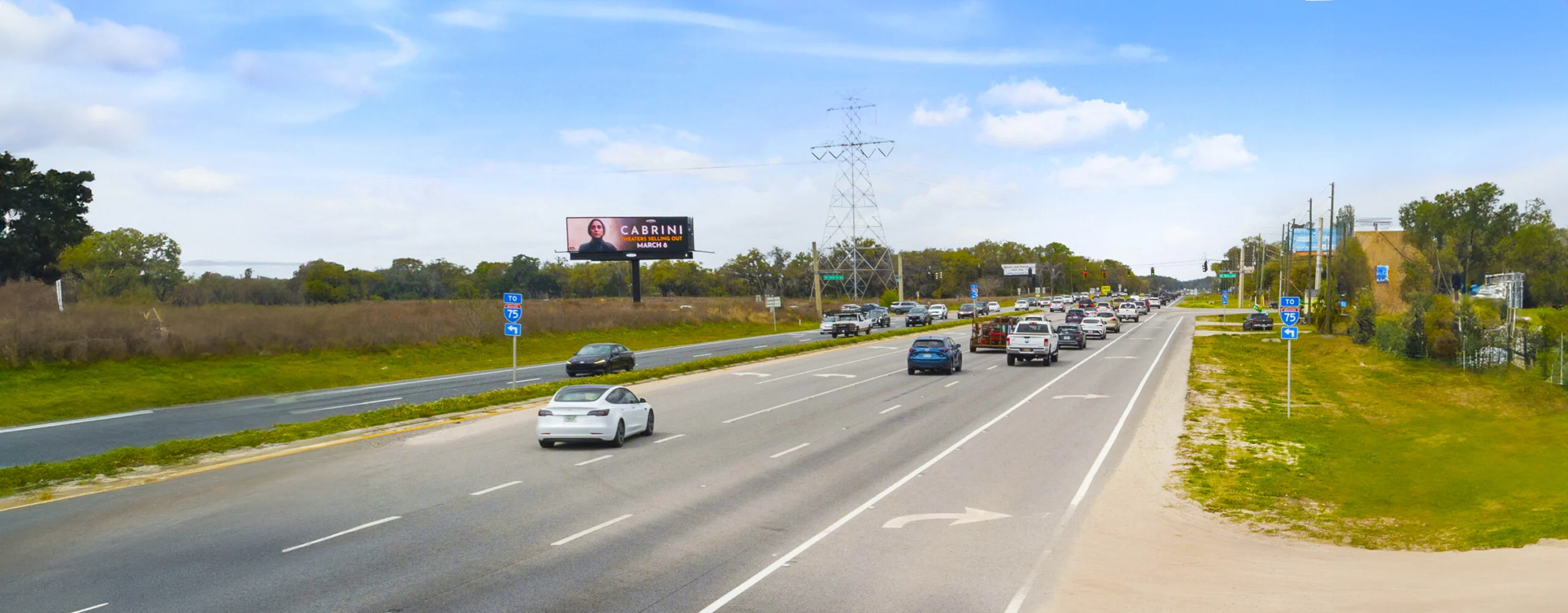
Highway Billboards
Highway billboards are placed along major roads and commuter routes to maximize visibility and repeated exposure among drivers.
Urban and Street-Level Billboards
Urban billboards appear in downtown areas, entertainment districts, and busy intersections where businesses want to reach local traffic and pedestrians.
Mobile Billboards
Mobile billboards display ads on moving vehicles that travel through targeted neighborhoods, event zones, and high-traffic areas.
Transit Billboards
Transit billboards appear on buses, bus shelters, taxis, trains, and transit stations. They help businesses reach commuters throughout the day in dense urban areas.
Commitment Over Clicks: The Case for 90 Days
Unlike digital advertising that can show results in days, billboard advertising follows a completely different timeline and measurement approach.
“I almost would never recommend anyone running a billboard campaign for less than 90 days,” Spencer explains. “It takes that long for people to see it enough in the wild to internalize it, think about it, and especially take action on it.”
This insight runs counter to how most small businesses think about advertising – and we can’t blame them. In a world shoving digital in our faces, SMBs (and their investors) are conditioned to expect trackable, immediate results. But billboards function as a foundational layer of marketing strategy, not as a standalone insta-conversion tool.
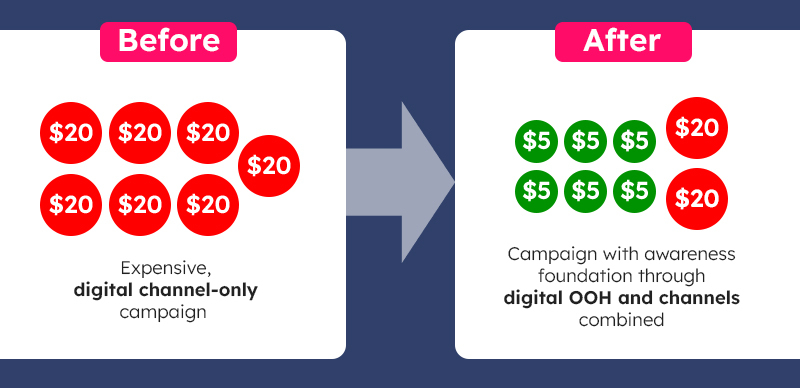
Spencer’s core thesis is this: Use low-CPM billboards to build a brand awareness foundation, then add trackable digital channels on top of that.
“Instead of spending $20 CPM to get your 7 touches, you’re gonna spend $5 CPM for your first 6 touches, and then you’re gonna only spend $20 for your next 1 or 2, when they’re actually more likely to take action.”
This tiny change-up is simple to execute, but it requires patience and fortitude to see the results.
In 90 days, you can build the brand recognition that makes every dollar you spend after work 4x harder. Ready to lock in?
The 90-Day Billboard Strategy Blueprint
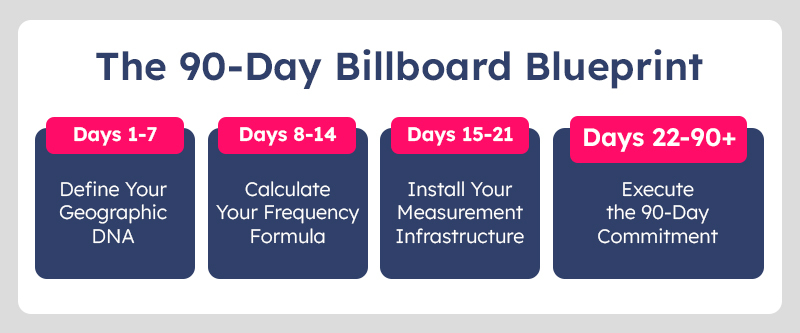
Define Your Geographic DNA (Days 1-7)
While many small businesses approach billboard advertising with budget in mind first, Spencer flips that line of thinking. Start by choosing the location before budget planning.
“We have to remember that the strategy’s root has to be geo-based, because billboards only reach people who pass by them,” Spencer explains.
This geographic certainty is actually billboard advertising’s superpower, compared to digital channels where you’re never quite sure where your ads will appear. Instead of an ad showing up on a webpage for someone across the country who can’t immediately take action, billboards create hyperlocal presence where it matters most.
Map out exactly where your customers travel daily—not just where they live. Then choose 3-5 strategic billboard locations along common commute routes. You have to understand customer behavior patterns, not just their demographic data, in order to get this step right.
Calculate Your Frequency Formula (Days 8-14)
Spencer’s framework prioritizes frequency over reach for small business budgets.
“Once you’ve dialed in on the reach of where you want to be, your next spend should focus on increasing frequency,” Spencer advises. “The name of the game is getting repeat impressions on the same person.”
Think of your budget as an output rather than an input. Start with reach and frequency and let that equation tell you how much you need to spend. Then adjust accordingly. Many marketers follow the 70/20/10 rule for marketing budgets: 70% on proven channels, 20% on emerging ones, and 10% on experiments. Billboards through Blip can start in that 10% experimental tier and move up fast once you see traction.
If the budget output is too much, for example, play around with the other pieces of the puzzle until you’re happy with all the numbers.
“Take the example of a plumber,” says Spencer. “You pass multiple billboards about this guy day after day, so that when all of a sudden you need a plumber, who are you gonna think of first? The face you saw for the last 3 weeks, right?”
The same principle applies to law firms, dental practices, restaurants, real estate agencies, and any business that depends on local trust. Repeated visibility along the routes your customers drive builds the kind of trust that a single digital ad never can.
To build trust, people need to see your brand multiple times in multiple places. It’s just how our brains work. And since billboards can’t move around like people do (that would be horrifying), you have to make sure they’re strategically positioned to catch those same eyes repeatedly.
Install Your Measurement Infrastructure (Days 15-21)
Your campaign is useless if you can’t measure the metrics. Before launch, Spencer swears by the following:
- Create a website
- Install Google Analytics (don’t worry, it’s free)
- Establish baseline website metrics 2 weeks prior to launch
It seems like common sense, but many small businesses skip this part, leaving them unable to determine whether their billboard campaign worked.
“If you haven’t established a baseline before you start advertising out of home, then you can’t tell if there’s a bump there,” says Spencer.
We get it, the measurement challenge is real – there’s no click-through rate with billboards. But indirect measurement through website traffic, social engagement, and business inquiries can still reveal a campaign’s impact over time.
Execute the 90-Day Commitment (Days 22-90+)
Okay, here we go. It’s launch time.
Launch your campaign and maintain consistent presence without changing creative or locations while awareness compounds over three months.
Yup. Leave it alone. No touchy.
“It’s gonna be day 60 to 90 when you really start feeling more engagement on your socials, your website, or your walk-ins,” Spencer says.
End the campaign too early, and you’ll have spent all your time setting up your experiment, and not enough time gathering data from it. And while Spencer understands how difficult it is to not tweak, tinker, and fret, he stresses how important it is to maintain consistent presence during this period.
He also suggests trying creative ways to amplify billboard presence through social media (for example, “If you see my billboard and send me a picture, I’ll give you a free soda”) to create network effects and social proof.
After day 30, start layering in your trackable digital campaigns. Now those expensive Google Ads and Facebook campaigns will perform better, because people have already seen your name.
You’re no longer introducing yourself – you’re closing a conversation you started on the highway.
What a Strong Billboard Marketing Strategy Delivers
Spencer’s 90-day approach turns market mayflies into local powerhouses, delivering a bounty of outcomes for small businesses to leave their mark.
Instant Credibility
– “It legitimizes me as a business to show up on a billboard,” Spencer notes. “It used to only be big companies that could afford that. But now, even small businesses can be on a billboard to show that they are real and a big deal.” Your local pizza shop suddenly looks like it belongs in the same conversation as national chains.
Maximum Reach, Minimum Spend
Reach thousands of potential customers for $20-50/day versus hundreds with the same digital budget. Spencer has found this model works across all business sizes. A local HVAC company spending $20/day can build the same kind of neighborhood presence that a car dealership spending $200/day achieves across a metro area.
Built for Business Speed
With digital billboards, you can launch campaigns in minutes instead of the weeks it can take for traditional billboard contracts. Ads can appear within 24-48 hours of submission, giving small businesses the agility to respond to market opportunities faster than their larger competitors.
No Commitment
Making a 90-day commitment to OOH testing can fundamentally change how your business competes. Instead of fighting for expensive last-click conversions, you’re building the brand awareness foundation that makes every marketing dollar more effective.
Spencer’s framework is a masterclass in patience and consistency. With it, small businesses go from invisible players into invincible local brands.
Best Billboard Design Practices
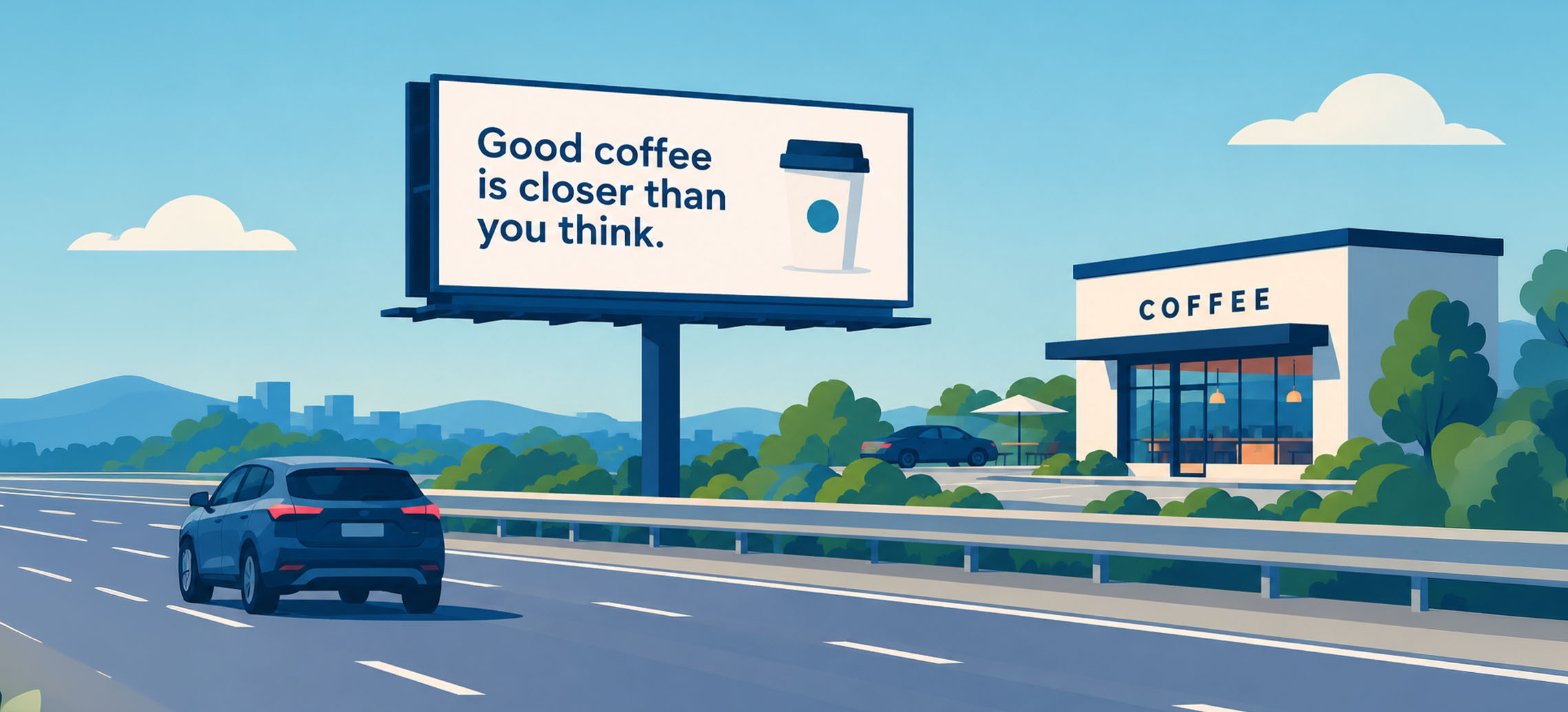
The best billboard designs are simple, clear, and easy to read in a few seconds. Drivers are moving quickly, so your message should be easy to understand at a glance.
Focus on one main idea, use short copy, choose bold fonts, and make your branding easy to spot. Strong contrast, a clean layout, and one clear visual can also help your ad stand out without feeling crowded.
Many of the best billboard advertising examples follow the same rule: make it easy for people to understand, remember, and act. For more design tips, check out our full billboard design guide.
How to Get Started With Blip
Start by choosing billboard locations based on where your customers already drive. With Blip, you can find local digital boards, set a budget you are comfortable with, and choose when your ads run.
From there, upload your creative, review your campaign, and go live when you are ready. You can manage everything in one place, track your campaign, and adjust your schedule, locations, or budget anytime.
Ready to build recognition where your customers already drive? Launch your 90-day billboard strategy with Blip, choose your locations, set your own daily budget, and start showing up locally without contracts or minimum spend.
FAQs About Billboard Advertising Strategy
How long should a billboard campaign run?
A billboard campaign should run for at least 90 days. Brand awareness builds through repeated exposure. Most people need to see your ad several times before they take action. Short campaigns (under 30 days) rarely produce meaningful results because viewers have not had enough time to internalize your message.
How much does a billboard marketing strategy cost for a small business?
With Blip, small businesses can run billboard campaigns for as little as $20-50 per day. You set your own daily budget and only pay when your ad displays. There are no contracts or minimum commitments. Start with what you are comfortable with and scale up as you see results.
Can billboard advertising work with a small budget?
Yes. The key is to focus on frequency over reach. Pick a few strategic locations along your customers’ commute routes and run your ads consistently. A focused billboard strategy on a tight budget will outperform a scattered one with more money behind it.
How do I measure if my billboard campaign is working?
Blip’s dashboard shows how your campaign is performing, including total spend, total Blips, estimated impressions, average cost per Blip, average daily spend, and impressions per dollar. You can also see results by billboard location, including Blips, spend, and estimated impressions for each board.
For more detail, run a proof of performance report or review your analytics by date range.It also helps to compare website traffic, branded search, social engagement, and phone inquiries before and after your campaign runs.
Should I run billboard ads and digital ads at the same time?
Yes. Billboards and digital ads can work well together. If you are already running Google Ads, paid social, or other digital campaigns, you do not need to stop. Billboards can help more people recognize your brand, which can make your online ads feel more familiar when they see them later.
If you are starting from scratch, you can run billboards first to build awareness, then add digital ads after 30 days. Either way, the goal is the same: get seen on the road, stay top of mind online, and give customers more chances to remember you.