Learn Spencer Cook's Multi-Touch Awareness Architecture that reduces customer acquisition costs 40-60% using $5 CPM billboards before expensive conversions.
Written by Lauren Chun
Quick answer
The most expensive impression is the one that has to do all the work alone.
If you’re solely focused on last-click attribution, you’re missing out on building the brand recognition that makes conversions cheaper and easier.
With digital ad costs escalating as platforms like Facebook and Google auction off increasingly scarce “ready-to-buy” audiences, SMBs are feeling the drain on their wallets.
As they burn through budget for quick clicks, they’re also ignoring the massive pool of future customers who simply haven’t seen them enough yet to recognize or trust them.
The math problem small businesses get wrong about customer acquisition is compressing all the customer touchpoints they need into one expensive interaction.
Spencer Cook, Chief Architect at Blip, solves this equation by building a brand recognition foundation first, then only focusing on conversion when it actually makes financial sense, instead of fighting for these uberly expensive bottom-of-funnel clicks.
Through building technology that makes billboard advertising accessible, Spencer has enabled thousands of SMBs to discover some of the secrets enterprise advertisers have always known.
Now, he’s revealing how small businesses can engineer multi-touch customer journeys that previously required six-figure budgets.
The Last-Click Trap
“The amount of touches has evolved over time based on your business, but the standard is still seven touches,” Spencer explains. “It’s how people and memory work. They need to see your brand in multiple places.”
The challenge becomes economic when businesses attempt to deliver all seven touches through premium-priced digital channels.
SMBs pour entire budgets into bottom-funnel digital advertising, trying to jam all the necessary touchpoints into one extremely costly interaction. This fixation on trackable conversions causes businesses to ignore cheaper awareness channels that make conversion campaigns actually work.
Digital ad costs are rising annually while billboard CPMs remain stable. Yet SMBs continue to compete in the same expensive auctions instead of exploring the opportunity sitting right in front of them—literally, on the highways they drive every day.
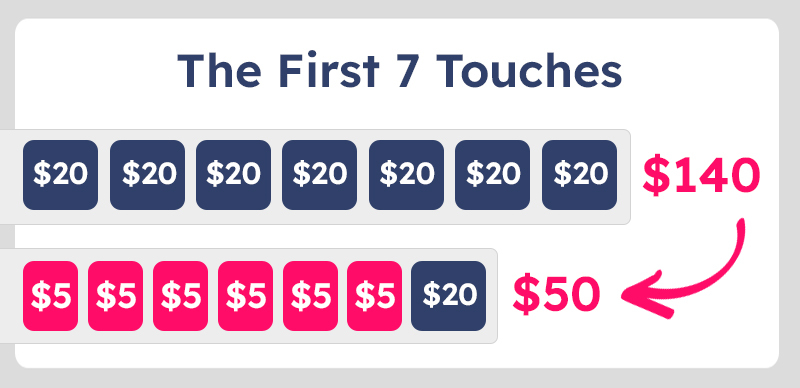
Spencer’s data, gathered from thousands of campaigns, reveals the cost structure most businesses miss:
“Instead of spending $20 CPM to get your seven touches, you’re going to spend $5 CPM for your first six touches, and then you’re only going to spend $20 for your final one or two, when they’re actually more likely to take action.”
The stakes extend beyond immediate cost savings. Businesses locked into last-click thinking miss the compound benefits of consistent market presence, the credibility premium of physical advertising, and the geographic certainty that comes with knowing exactly where your message appears.
The Multi-Touch Awareness Architecture
The Impression Stacking System
The CPM arbitrage model works by separating awareness-building from conversion-driving activities.
“CPMs in out-of-home are pretty low compared to other channels,” Spencer notes. “So if you’re at the top of the funnel, you should be blowing your name up everywhere.”
The economic advantage compounds when you consider that billboard impressions have 100% viewability (you can’t block or skip a billboard), making the true CPM calculations favor physical media over digital alternatives.
When you layer these low-cost, high-visibility billboard impressions on top of each other over time, you build cumulative brand recognition that makes your expensive digital conversions significantly more effective.
Instead of asking a single $20 CPM digital ad to introduce your brand AND convert a stranger, you’ve already done the introduction work through multiple $5 CPM billboard exposures—so that final digital touchpoint is converting someone who already knows and trusts your name.
The 90-Day Recognition Window
Recognition building follows a predictable timeline that Spencer has observed across thousands of campaigns.
Days 1-30 represent an invisible accumulation phase where impressions register but don’t yet drive action.
Days 30-60 build subconscious recognition where your brand becomes familiar without customers actively seeking you.
Days 60-90 mark active consideration emergence when accumulated impressions translate to business impact.
“I would never recommend anyone running a billboard campaign for less than 90 days,” Spencer explains. “It takes that long for people to see it enough in the wild to internalize it, think about it, and especially take action on it.”
The Frequency-First Budget Allocation
Strategic budget allocation prioritizes frequency over reach for small business marketing. Lock geography first based on where customers actually travel, then maximize frequency with available budget.
Frequency matters more than reach, because it speaks to how trust develops. A single billboard impression creates awareness, but trust requires familiarity—and familiarity only comes through repetition.
When someone needs your service, they’ll choose the business name that feels most familiar, not the one they saw once three months ago. This is why Spencer recommends focusing your limited budget on fewer locations with higher frequency rather than spreading too thin across many spots.
Once you do that, you can say hello to:
A significant reduction in customer acquisition costs
Persistent market presence sans the daily bidding wars
Predictable monthly marketing spend
Awareness generation that makes every other channel perform better
Strategic Principles for SMBs
Here are three lessons worth keeping in mind for SMBs who want to find a balance between marketing, budget, and awareness.
Marketing ROI compounds over time—early touches cost the same but deliver increasing value as recognition builds, similar to compound interest in financial markets.
Knowing exactly where your ads appear beats knowing approximately who might see them. Geographic certainty provides targeting precision that demographic probability cannot match.
Billboard presence delivers brand elevation that would cost thousands in PR or content marketing to achieve elsewhere. People see a brand on a billboard and think, “They must be a big deal.”
While competitors burn budget fighting for the same expensive last-touch conversions, smart businesses build recognition foundations that make those final touches significantly more effective and affordable.
With digital advertising costs continuing their climb, a stable billboard inventory creates a massive inventory opportunity for forward-thinking SMBs.
“Probably only 10-15% of the billboards in the US right now are digital. The rest are still vinyl,” Spencer observes. “So this is the bleeding edge.” Smart businesses gain first-mover advantage in local billboard markets before pricing pressure from increased demand affects the arbitrage opportunity.
As enterprise competitors get tangled in planning quarters ahead, small businesses can test and iterate billboard campaigns in real-time, with ads appearing within 20 minutes of campaign submission thanks to Blip’s platform.
In this environment, speed-to-market remains the SMB superpower. (They just have to use it.)
Ready to see what billboard advertising can do for you?
Launch a campaign in minutes. No contracts, no hassle.