Billboards near Derby, CT
No Minimum Spend. No Long-Term Contracts. Just Results.
Trusted by Leading Brands


Billboard advertising
near Derby has never been easier
How much is a billboard near Derby?
Why Choose Blip for Billboard Advertising near Derby
-
Blip lets you launch Derby billboards in minutes, reaching Route 8 and CT-34 commuters without long-term commitments.
-
Set flexible budgets for Derby, then scale up on I-95 and US-1 traffic near Milford, West Haven, Orange, and New Haven.
-
Use dayparting on Blip to hit Derby commuters at 6:30-9 a.m. and 3:30-6:30 p.m. when Valley traffic is strongest.
-
No contracts means Derby brands can test campaigns around Griffin Hospital, Yale, and University of New Haven traffic, then pivot fast.
-
Track Derby results in real time and shift spend to boards near Milford beaches, New Haven campuses, or Orange's US-1 retail corridor.
-
Blip's creative tools make it easy to tailor Derby ads for winter HVAC, back-to-school, or summer I-95 travel seasons.
Frequently Asked Questions About Billboard Advertising near Derby
How much does a billboard cost near Derby, Connecticut with Blip?
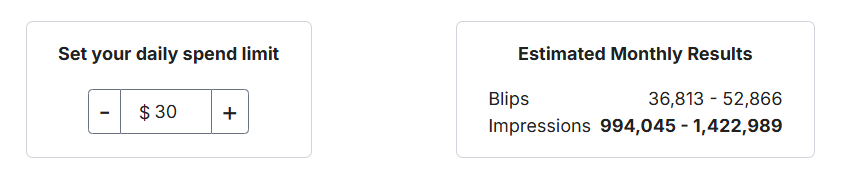
With Blip, you control exactly what you spend on Derby billboards by setting a daily budget that can be adjusted any time. Each ad, or “blip,” is a brief 7.5 to 10-second display, and you only pay for the blips you actually receive, so even a small budget can get your message on billboards near Derby, Connecticut. The price of each blip changes based on when you choose to run your ads, where they appear in the Derby area, and overall advertiser demand.
Where can I advertise with Blip near Derby, Connecticut?
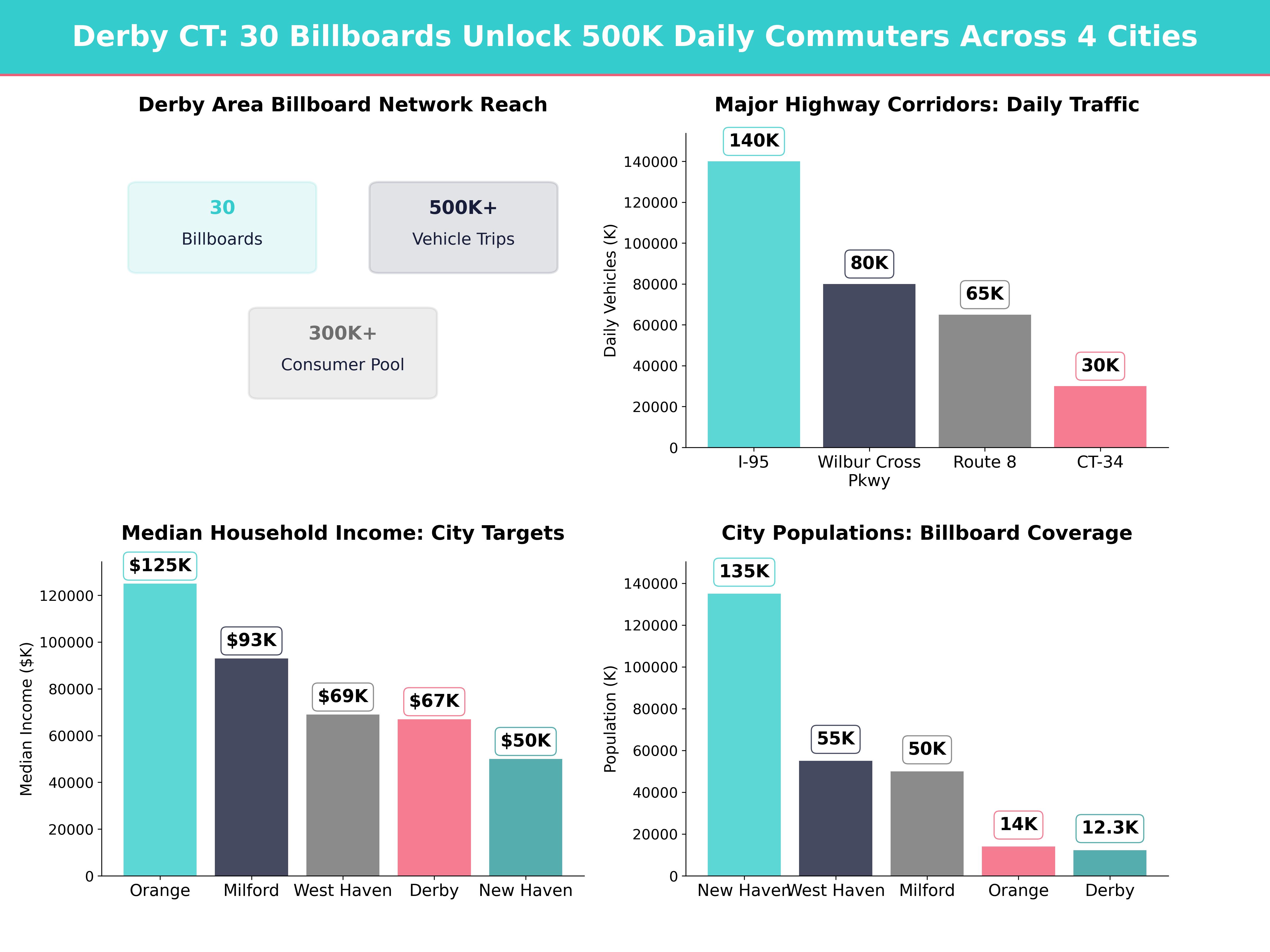
With 30 digital billboards serving the Derby area from nearby Orange, Milford, West Haven, and New Haven, advertisers can reach heavy daily commuter flows, strong local loyalty, and a diverse mix of residents, workers, and visitors. These nearby clusters provide efficient coverage without needing to buy into distant markets. The area is concentrated around key corridors like Route 8 / CT-34, I-95, and the Wilbur Cross Parkway.
What kind of audience can Derby, Connecticut billboards reach?
The Derby area sits at the crossroads of blue-collar tradition, suburban stability, and the powerful educational and healthcare engine of Greater New Haven. Within a roughly 10-mile radius, advertisers can access a consumer pool of well over 300,000 people. That mix includes local residents, commuters, students, and visitors across Derby, Milford, West Haven, Orange, and New Haven.
When is the best time to run Blip ads near Derby, Connecticut?
Morning and evening peaks are especially important, with inbound work/school traffic roughly 6:30–9:00 a.m. and outbound peaks about 3:30–6:30 p.m. New Haven’s colleges and universities also create strong weekday traffic August–May, while winter evenings and summer beach traffic create additional seasonal opportunities. Blip’s flexible budgeting allows you to increase spending in high-value seasons such as back-to-school or the winter holidays and reduce it in quieter periods.
What areas near Derby, Connecticut should I focus on for billboard advertising with Blip?
New Haven is best for Derby-area residents commuting into the city, plus healthcare and university employees and students. West Haven works well for value-oriented coastal suburbs, University of New Haven students, and traffic along I-95 and the Boston Post Road, while Milford is strong for mall and big-box retail and summer beach traffic. Orange is a good fit for high-income commuters, office workers, and high-ticket consumer categories.
Do I need a contract to advertise with Blip near Derby?
No, Blip has no long-term contracts or minimum commitments. You can start, pause, or stop your campaign at any time.
How fast can I launch a billboard campaign with Blip near Derby?
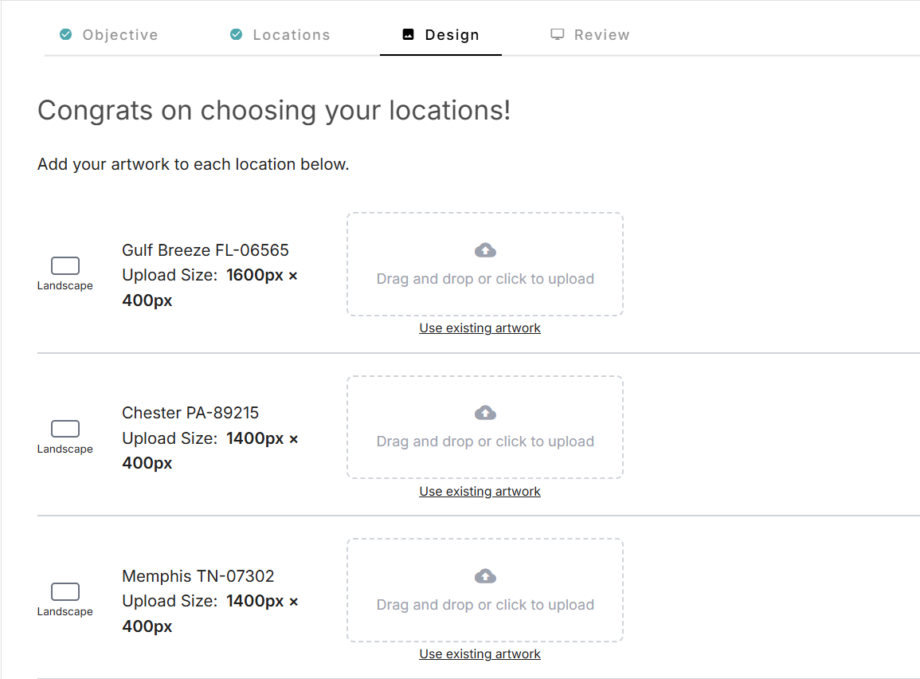
You can have your campaign live in minutes. Create a free account, select your locations, set your budget, upload your design, and start running once approved.
Where can I advertise with Blip near Derby?
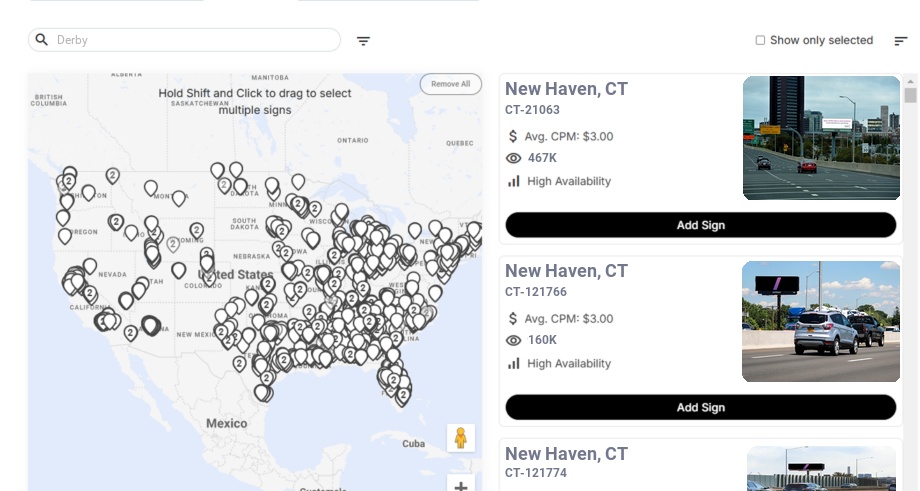
Blip has digital billboards near Derby. You can browse available locations on a map, choose the ones that fit your audience, and start advertising right away.
Still have questions? Launch a campaign in minutes — no contracts, no commitments.
Start Your CampaignDerby Billboard Advertising Guide
The Derby, Connecticut area sits at the crossroads of blue‑collar tradition, suburban stability, and the powerful educational and healthcare engine of Greater New Haven. With 30 digital billboards serving the Derby area from nearby Orange, Milford, West Haven, and New Haven, we can help advertisers tap into heavy daily commuter flows, strong local loyalty, and a diverse mix of residents, workers, and visitors. For brands specifically looking for billboards near Derby, this cluster of locations provides efficient coverage without needing to buy into distant markets.
Understanding the Derby Area Market
Derby itself is a compact city of roughly 12,000–13,000 residents, but it is embedded in a much larger economic corridor:
- Derby’s population is about 12,000–13,000 (recent estimates hover around 12,300), making it one of the smallest cities in Connecticut by land area at just over 5 square miles yet with a density of well above 2,000 residents per square mile.
- The broader New Haven County region includes over 850,000 residents (roughly 860,000 as of the early‑2020s), many of whom regularly travel through or near Derby for work, shopping, and healthcare.
-
Nearby communities served by our 30 digital billboards add significant audience density:
- New Haven: about 135,000 residents and a daytime population that swells to well over 160,000 when you factor in tens of thousands of students and workers anchored by Yale University and Yale New Haven Health.
- Milford: roughly 50,000+ residents, with one of the region’s largest retail footprints along the I‑95 corridor, including the Connecticut Post Mall, which draws millions of visits annually.
- West Haven: around 55,000 residents plus roughly 7,000–8,000 students at the University of New Haven.
- Orange: about 14,000 residents with a strong retail and office presence along the Boston Post Road (US‑1), including major national chains and regional employers.
Local governments and organizations such as the City of Derby, City of New Haven City of Milford, City of West Haven, and Town of Orange highlight the area’s blend of historic neighborhoods, small manufacturing, major hospitals, universities, and commuter suburbs. Nearby partners like Griffin Hospital in Derby, the Valley Council of Governments, and regional news outlets such as the Valley Independent Sentinel reinforce Derby’s role as a hub for the lower Naugatuck Valley.
For advertisers, this means digital billboards near Derby reach a compact but economically varied audience—ideal for both broad consumer brands and tightly targeted local campaigns. If you’re comparing Derby billboards to inventory in other nearby cities, this mix of local residents, commuters, and students often delivers stronger relevance for businesses based in the Valley.
Key Commuter and Traffic Patterns Near Derby
The Derby area is shaped by a few critical corridors where our surrounding billboards can make repeated daily impressions. According to traffic counts from the Connecticut Department of Transportation
-
Route 8 / CT‑34 Corridor (Derby–Shelton–Ansonia):
- Route 8 near Derby typically carries in the range of 60,000–70,000 vehicles per day on some segments, linking the Naugatuck Valley north to Waterbury and south toward Bridgeport.
- CT‑34 connects Derby to New Haven, carrying approximately 25,000–35,000 vehicles per day near major junctions like the Derby–Shelton bridges and approaches to the Wilbur Cross Parkway.
- In many Valley communities, more than 80% of workers commute by car, with single‑occupancy driving rates often above 70%. Derby, Ansonia, and Shelton collectively send tens of thousands of commuters daily toward New Haven, Milford, and Bridgeport employment centers.
-
I‑95 (Milford, West Haven, New Haven):
- In the coastal corridor near Milford and West Haven, I‑95 regularly exceeds 130,000–150,000 vehicles per day on key segments, making it one of the most heavily traveled highways in Connecticut.
- These vehicles include daily commuters, shoppers heading to destinations like the Connecticut Post Mall and downtown New Haven, and interstate through‑traffic between the New York metro and Rhode Island/Massachusetts.
-
Wilbur Cross Parkway / Merritt Parkway (New Haven / Orange):
- The Wilbur Cross Parkway in the New Haven–Orange stretch typically sees 70,000–90,000 vehicles per day, much of it higher‑income suburban commuters from towns such as Orange, Woodbridge, and Bethany.
- Average travel times from Derby to New Haven via CT‑34 and the parkway often sit under 20 minutes during off‑peak hours, keeping Derby well within the practical commuting catchment of the New Haven job market.
With 30 digital billboards serving the Derby area from Orange, Milford, West Haven, and New Haven, we can align your campaign with the exact flows that matter: Derby‑area residents driving toward work, students and staff heading to New Haven, and shoppers traveling along I‑95 and US‑1. This makes billboard advertising near Derby especially efficient for capturing repeat impressions from the same commuters throughout the week.
Strategic implication:
If you want to reach Derby‑area commuters:
- Use New Haven and West Haven boards to catch Derby residents heading east on CT‑34 into the city, especially during the 6:30–9:00 a.m. and 3:30–6:30 p.m. peaks when tens of thousands of trips funnel in and out of New Haven.
- Use Milford and Orange boards to reach Derby‑area residents who work in coastal or suburban office and retail hubs, or who shop along US‑1 and I‑95, corridors that collectively handle well over 200,000 vehicle movements per day in the local segment.
Demographics and Buying Power in the Derby Area
Although Derby is small, the surrounding markets multiply your potential customer base. Within a roughly 10‑mile radius, advertisers can access a consumer pool of well over 300,000 people, making billboard rental near Derby a strong option even for brands that also serve broader parts of New Haven County.
Income and household profile
Recent estimates for key communities in the region show a wide income range:
- Derby median household income: roughly mid‑$60,000s (around $65,000–$68,000).
- West Haven: upper‑$60,000s (around $68,000–$70,000).
- New Haven: low‑$50,000s (heavily influenced by a large student population and significant renter base).
- Milford: low‑$90,000s (around $90,000–$95,000), reflecting strong dual‑income household presence.
- Orange: around $120,000+ (some estimates place it in the $120,000–$130,000 range), making it one of the higher‑income towns in the county.
Across New Haven County, total annual consumer expenditures run into the tens of billions of dollars, with particularly strong spending in housing, transportation, healthcare, and food away from home. In many Valley and shore communities, homeownership rates sit in the 55–70% range, supporting robust demand for home services, renovation, and local retail.
This spread allows nuanced targeting:
- Value‑driven messaging (coupons, price points, financing) will resonate strongly with Derby and West Haven households, where a larger share of residents fall into the sub‑$75,000 income brackets.
- Upscale or discretionary offers (home improvement, financial services, higher‑end restaurants, elective healthcare) can perform especially well on boards serving Orange and Milford, where a significant share of households earn $100,000+ annually.
- Student and young‑professional offers (fast casual dining, entertainment, gyms, tech gadgets) will perform well on New Haven–area boards; in some central New Haven tracts, roughly half of residents are in the 18–34 age range due to the cluster of campuses.
Age and life stage
The Derby area includes:
- A strong base of working‑age adults commuting to hospitals, factories, offices, and retail centers. In many nearby towns, 60–65% of residents are between ages 18 and 64.
- Significant student populations in New Haven (Yale University, Southern Connecticut State University, Albertus Magnus College, Gateway Community College University of New Haven). Collectively, greater New Haven’s colleges enroll well over 40,000 students, creating sizable demand for budget‑friendly food, housing, entertainment, and transit‑adjacent services.
- Established families in suburbs like Orange and Milford, where a substantial share of households include children under 18 and where local school districts, such as Milford Public Schools and Orange Public Schools, are key community anchors.
Creative takeaway:
We recommend building at least two to three creative variations tailored to these segments:
- Family/household focus for Milford and Orange commuters, highlighting school‑friendly hours, home comfort, youth activities, or long‑term value.
- Value‑oriented or practical messaging for Derby and West Haven audiences, where price sensitivity and convenience are powerful drivers.
- Youthful, modern creative aimed at students and hospital/academic staff in the New Haven area, tapping into late‑night hours and mobile‑first behaviors.
Local Economy and Category Opportunities
Understanding local anchors helps you position your message:
-
Healthcare and Education:
- Yale New Haven Hospital Yale New Haven Health system employs well over 25,000 people across Connecticut and Rhode Island.
- Yale University alone employs over 14,000 faculty and staff plus more than 12,000 students in New Haven, generating steady traffic and high demand for housing, dining, and services.
- Griffin Hospital, based in the Derby area, supports thousands of jobs directly and indirectly, drawing employees and patients from throughout the Naugatuck Valley and beyond. As a community teaching hospital, its catchment reaches multiple Valley towns including Ansonia, Seymour, Shelton, and Oxford.
- Additional campuses like Southern Connecticut State University and Gateway Community College
-
Manufacturing and Engineering:
- The lower Naugatuck Valley, including Derby, has a strong history in metals, machinery, and aerospace components. Manufacturing still accounts for thousands of local jobs in the corridor stretching from Shelton and Derby north through Ansonia, Seymour, and Naugatuck.
- Regional development agencies such as the Naugatuck Valley Council of Governments highlight advanced manufacturing, precision components, and logistics as growth areas, supporting B2B marketing opportunities.
-
Retail and Services:
- Milford’s I‑95 corridor and US‑1 corridor (Boston Post Road) are lined with big‑box retailers, automotive dealerships, and dining options, anchored by the Connecticut Post Mall, which is one of the largest malls in the state with more than 150 stores and restaurants.
- Orange features major retail strips along US‑1 as well as corporate offices and mixed‑use developments, including regional auto dealerships, grocery anchors, and national restaurant brands.
- The Derby–Shelton side of the Valley continues to see infill development, with new small businesses and mixed‑use projects regularly covered by outlets like the Connecticut Post Valley Independent Sentinel.
High‑potential billboard categories near the Derby area:
- Healthcare (urgent care, specialists, dental, vision, elective procedures) serving a county where healthcare and social assistance are among the top employment sectors.
- Education (trade schools, colleges, continuing education, test prep) targeting tens of thousands of local students and working‑age adults.
- Home services (roofing, HVAC, solar, landscaping, renovation) in a region where more than half of households in many suburbs are owner‑occupied.
- Automotive (dealerships, repair, tire centers) along I‑95, Route 8, and US‑1, which together move hundreds of thousands of vehicles daily.
- Financial services (local banks, credit unions, insurance, tax prep) in a corridor with wide income dispersion and significant small‑business activity.
- Restaurants and quick‑service food tapping into high daily foot and vehicle traffic around campuses, malls, and downtowns.
- Local events and festivals promoted by municipalities and tourism groups such as Explore New Haven Derby, Milford, and West Haven.
Seasonality and Timing in the Derby Area
The Derby area follows a classic New England seasonal pattern, with meaningful spikes you can exploit using Blip’s scheduling tools.
Academic calendar and weekday flows
- New Haven’s colleges and universities create strong weekday traffic August–May. Enrollment at major campuses in the city and nearby communities exceeds 40,000 students, and this population largely vacates during late May–mid‑August and winter breaks, shifting traffic patterns.
-
Morning and evening peaks:
- Typical inbound work/school traffic runs roughly 6:30–9:00 a.m., with some corridors seeing 30–40% of their daily volume in these hours.
- Evening outbound peaks run about 3:30–6:30 p.m., coinciding with school dismissal and standard workday endings.
- Healthcare and university shifts also create late‑night and early‑morning travel, especially near New Haven facilities and Griffin Hospital, keeping traffic elevated beyond standard commuter windows.
Recommendations:
- For commuter‑oriented services (coffee shops, car repair, dry cleaners), concentrate impressions on weekday morning and afternoon drive‑times when average speeds slow and dwell time with your creative increases.
- For restaurants and entertainment, emphasize late afternoon and evening slots Thursday–Saturday, when dining and nightlife trips spike and discretionary spending is highest.
Seasonal patterns
-
Winter (Dec–Feb):
- Sunset can fall as early as 4:20 p.m., meaning a large share of evening commutes occur in darkness. This provides excellent nighttime visibility for digital billboards.
- Use high‑contrast creative and focus on services with winter relevance: heating and HVAC, auto repair and tires, urgent care/flu shots, and indoor entertainment.
-
Spring (Mar–May):
- Strong period for home services, landscaping, spring sports, and graduation‑related campaigns.
- Housing markets often thaw in the spring, driving demand for real estate, moving services, and home improvement across the Derby–Milford–New Haven corridor.
-
Summer (Jun–Aug):
- Traffic shifts toward coastal recreation (Milford and West Haven beaches) and travel along I‑95. Local parks and beaches such as Silver Sands State Park City of West Haven, attract hundreds of thousands of visits across the season.
- University traffic dips, but tourism and family travel increase.
- Digital billboards near Milford and West Haven are ideal for beach destinations, attractions, and seasonal restaurants, as well as highway‑oriented lodging and quick‑service options.
-
Fall (Sep–Nov):
- Back‑to‑school and college return drive increased weekday traffic.
- This is an ideal window for education, tutoring, retail, and healthcare campaigns ahead of flu and open‑enrollment seasons. Many local districts, including Derby Public Schools
Blip’s flexible budgeting allows us to increase your spending in high‑value seasons (such as back‑to‑school or the winter holidays) and reduce it or retarget in quieter periods without long‑term contracts. This is especially useful if you time billboard advertising near Derby to match busy local event calendars or seasonal demand for your services.
Creative Best Practices for Derby‑Area Billboards
To stand out on digital billboards near Derby, we recommend:
-
Hyper‑local cues:
- Reference nearby landmarks or routes: “Just off Route 8,” “10 minutes from Derby Green,” “Exit off I‑95 in Milford.”
- Mention local teams or institutions (e.g., “Serving Derby and the Naugatuck Valley,” “Proud to serve Yale and Griffin Hospital employees”) when relevant. Local pride is strong in Valley communities like Derby, Ansonia, Shelton, and Seymour, so acknowledging them can boost response.
-
Simple, bold messaging:
- Aim for 6–8 words or fewer of primary text so drivers traveling 40–65 mph can absorb your message in 3–5 seconds.
- Use one main call‑to‑action, such as “Visit Today in Milford,” “Call for Same‑Day Service,” or “Book Online.”
-
High contrast for New England weather:
- Overcast skies and winter darkness are common; New Haven County sees more than 100 days per year with significant cloud cover.
- Use bold color and strong contrast (light on dark or dark on light) so your message remains legible in fog, rain, and twilight.
-
Mobile‑friendly CTAs:
- Assume most viewers are on smartphones; in Connecticut, smartphone adoption consistently exceeds 80% of adults.
- Short URLs, brand names that are easy to search, and simple directions (“Exit 39B”) outperform longer, complex messages.
-
Multiple creatives for multiple sub‑markets:
-
For example:
- Creative A (value and financing) for West Haven and Derby‑commuter routes.
- Creative B (premium features, lifestyle imagery) for boards serving Orange and Milford.
- Creative C (student and staff discounts) for boards closest to New Haven hospital and campus areas.
-
For example:
With Blip, you can rotate multiple creative files within one campaign, letting us test variations and optimize over time while all of your messages stay within the same budget. This flexibility is particularly helpful when you’re experimenting with different Derby billboards and want to see which messages resonate best along each corridor.
Geographic Strategy: Where to Emphasize Your Blips
Our 30 digital billboards serving the Derby area are concentrated in four nearby cities: Orange, Milford, West Haven, and New Haven. Each cluster is better suited to certain objectives and can be combined to create comprehensive billboard advertising near Derby without overextending your budget.
New Haven (approx. 9 miles from Derby)
Best for:
- Reaching Derby‑area residents who commute into the city via CT‑34; this corridor alone moves tens of thousands of daily trips between the Valley and downtown New Haven.
- Targeting healthcare and university employees and students, a combined workforce/student audience that easily tops 40,000–50,000 in the core city.
- Promoting cultural events, nightlife, and restaurants in a city that regularly hosts large‑scale events, festivals, and concerts highlighted by City of New Haven Explore New Haven
Use‑case examples:
- A Derby medical practice seeking city‑based patients can highlight convenience and parking: “Top‑Rated Care, 10 Minutes from Derby – Easy Parking, Griffin‑Area Specialists.”
- A New Haven restaurant wanting Derby patrons can run evening and weekend blips on routes Derby‑area residents use to come into the city, coinciding with Friday and Saturday evening dining peaks.
Local references and partners:
- City of New Haven
- Yale New Haven Health
- New Haven Register
West Haven (approx. 7 miles from Derby)
Best for:
- Reaching value‑oriented coastal suburbs and University of New Haven students.
- Promoting automotive, quick‑service dining, and budget‑friendly retail along I‑95 and the Boston Post Road, which in West Haven together carry well over 100,000 vehicle trips per day.
- Tapping into beach and travel traffic in warmer months; West Haven’s public beaches stretch for several miles and draw sizeable crowds on peak summer weekends.
Local references:
- City of West Haven
- University of New Haven
- Local news coverage from outlets such as the New Haven Register West Haven Voice (community paper).
Milford (approx. 6.7 miles from Derby)
Best for:
- Mall and big‑box retail, especially around the Connecticut Post Mall, which serves a catchment extending across New Haven and Fairfield counties.
- Higher‑income family households with strong purchasing power; Milford’s median household income near the low‑$90,000s translates into substantial discretionary spending.
- Summer beach traffic (Walnut Beach, Silver Sands State Park CTvisit regularly promote.
Local references:
- City of Milford
- Milford Regional Chamber of Commerce
- Local news via the Connecticut Post
Orange (approx. 3.7 miles from Derby)
Best for:
- High‑income commuters and office workers along US‑1 and the Wilbur Cross Parkway, many of whom have household incomes above $100,000.
- B2B services, professional services, and high‑ticket consumer categories (home renovations, luxury autos, financial/investment services).
- Reaching shoppers at major national chains clustered along the Boston Post Road, which pulls customers from Derby, Ansonia, Seymour, and New Haven.
Local references:
By mixing boards from these four cities within one Blip campaign, we can design coverage that:
- Keeps your brand in front of Derby‑area residents through most of their weekly travel, including both Route 8/CT‑34 and I‑95/US‑1 patterns.
- Reaches both their work destinations (New Haven, Milford, Orange) and their shopping/entertainment patterns (I‑95, US‑1, and city centers), capturing multiple touchpoints with the same households over time and maximizing the value of your billboard rental near Derby.
Budgeting and Flight Planning With Blip
Blip allows you to buy individual “blips” (ad showings) instead of renting an entire board for weeks at a time. For the Derby area, that flexibility is especially effective because of the multiple sub‑markets within a small radius—four coastal/urban hubs within about 10 miles of Derby.
Example approaches:
-
Local business with a modest budget (e.g., Derby restaurant, contractor):
- Focus spend on 8–10 key boards closest to Derby commuter routes and shopping destinations, such as boards along CT‑34 into New Haven and US‑1 in Orange/Milford.
- Concentrate impressions on weekday evening and weekend periods, when local errands, dining, and home projects peak.
- Use a strong local CTA such as “5 Minutes from Derby Green” or “Serving Derby & the Valley” to tap into neighborhood loyalty.
-
Regional brand (bank, healthcare, retail chain) seeking broad awareness:
- Use all 30 digital billboards serving the Derby area for market saturation, aiming to touch a combined audience of well over 200,000 potential viewers within a normal week’s travel patterns.
- Maintain a base level of always‑on impressions, then “pulse” extra budget around promotions (open enrollment, grand opening, holiday sale).
- Schedule 60–70% of impressions during drive‑time and 30–40% off‑peak for economical frequency and incremental nighttime visibility.
-
Event or seasonal advertiser (festivals, fairs, concerts, tourism):
- Run a 2–4 week high‑frequency burst, heavy on boards in New Haven and Milford where visitor traffic and hotel stays are highest.
- Utilize countdown creatives (e.g., “3 Days Until Derby Day!”) and shift focus to boards closest to the event site as the date approaches.
- Coordinate with town event calendars from the City of Derby, City of Milford, and City of West Haven to align with parades, fireworks, and festivals.
Because there are 30 digital billboards within roughly 10 miles of Derby, we can scale spending up or down quickly across multiple boards without losing geographic reach. This makes it easy to test and refine different Derby billboards and placements until you find the ideal mix of reach and cost.
Measuring Impact and Optimizing Over Time
Out‑of‑home in the Derby area becomes far more powerful when paired with simple measurement strategies:
-
Web and search lift:
- Track direct traffic to your URL and brand‑name search volume during and after campaign periods. Businesses in service categories (healthcare, home services, legal, financial) often see 10–30% bumps in branded search when they launch sustained billboard flights.
- When your boards mention a specific URL or offer code, watch for spikes during your active flight windows and drive‑time peaks.
-
Promo codes and landing pages:
- Use Derby‑specific codes (e.g., “DERBY10”) or city‑named URLs. This helps you isolate responses driven by the boards serving the Derby area versus other marketing channels.
- For multi‑location brands, assign different codes to New Haven, Milford, and Orange boards to understand which corridors over‑perform.
-
Customer surveys and point‑of‑sale questions:
- Asking “How did you hear about us?” and including “Billboard near Derby/New Haven/Milford” as an option gives qualitative insight into your campaign’s effectiveness.
- Even small sample sizes—50–100 survey responses—can reveal if billboards are among your top three awareness drivers.
-
Geography‑based analysis:
- Compare sales, appointments, or leads from Derby, Ansonia, Shelton, and Seymour before and after your campaign. Increases in these ZIP codes suggest your Derby‑area billboard efforts are resonating.
- Use local property, building, and business permit updates from sources like the City of Derby, Town of Seymour, City of Shelton Valley Independent Sentinel to track where new development and customer clusters are emerging.
Use local news and government data to track broader trends—such as reported growth in housing permits, new businesses, or major infrastructure changes—from sources like the City of Derby, Valley Independent Sentinel, and the Connecticut Post
Putting It All Together for the Derby Area
To build a powerful digital billboard strategy serving the Derby area, we recommend:
-
Define your Derby‑area audience:
- Are you targeting Derby residents commuting to New Haven or Milford, higher‑income households near Orange, or students and hospital workers in New Haven?
- Consider how many of your customers likely come from within a 5‑, 10‑, or 20‑mile radius, and match that to the population clusters around Derby, Milford, West Haven, and New Haven.
-
Select the right board mix:
- Use New Haven and West Haven for urban, student, and healthcare audiences; Milford for regional retail and family spending; Orange for higher‑income commuters and B2B/professional services.
- For many advertisers, an initial split might allocate 40–50% of impressions to New Haven, 20–25% to Milford, 15–20% to West Haven, and 10–15% to Orange, then adjust based on performance.
-
Align your timing with real‑world patterns:
- Emphasize drive‑times for commuters, evenings and weekends for retail and dining, and academic/seasonal peaks (back‑to‑school, holidays, summer tourism) as appropriate.
- Layer in short, intense bursts around major regional events promoted by tourism and civic sites like Explore New Haven CTvisit.
-
Craft geo‑smart creatives:
- Keep messages short, localized, and visually bold; rotate 2–4 versions targeted to specific sub‑markets within the Derby area.
- Test references to local landmarks and time‑sensitive offers (“Book Before Friday for Derby Discount”) and then double down on the versions that correlate with measurable response lift.
-
Measure and iterate:
- Track simple indicators (web traffic, promo code use, local sales) and adjust your targeting, timing, and creative based on what performs best.
- Revisit your board mix quarterly to respond to shifting traffic, construction detours, or new business openings highlighted by local news outlets.
With 30 digital billboards serving the Derby area from nearby Orange, Milford, West Haven, and New Haven, we can help you build a campaign that reaches residents where they actually travel, work, shop, and study—maximizing every dollar you invest in out‑of‑home advertising and making Derby billboards a core part of your regional marketing strategy.