Billboards in Greenwich, CT
No Minimum Spend. No Long-Term Contracts. Just Results.
Trusted by Leading Brands


Billboard advertising
in Greenwich has never been easier
How much is a billboard in Greenwich?
Why Choose Blip for Billboard Advertising in Greenwich
-
Blip lets Greenwich brands launch fast on I-95 and the Merritt Parkway with self-serve control—no agency delays.
-
Set flexible budgets in Greenwich and pay only for the blips that run, whether you want weekday commutes or weekend shoppers.
-
Daypart Greenwich billboards for NYC-bound mornings, school drop-off, or evening return traffic to match your audience's routine.
-
No contracts means Greenwich advertisers can test luxury, finance, or family offers and shift spend as results come in.
-
Use Blip's real-time analytics to see what works on Greenwich Avenue and Route 1, then optimize for affluent drivers and shoppers.
-
Blip's creative tools make it easy to build polished Greenwich ads that fit affluent, time-starved commuters in seconds.
Frequently Asked Questions About Billboard Advertising in Greenwich
How much does a billboard cost in Greenwich, Connecticut with Blip?
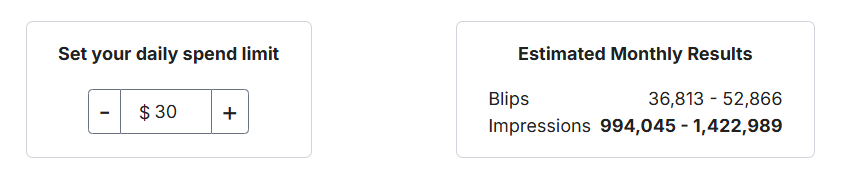
With Blip, you can run your message on Greenwich billboards on any budget, because you only pay per “blip”—a 7.5 to 10-second ad display—rather than committing to expensive, long-term contracts. You simply set a daily budget that Blip will never exceed, and your cost per blip adjusts based on when and where you choose to advertise, along with current advertiser demand. This means the total cost of your campaign is just the sum of the individual blips you receive.
Where can I advertise with Blip in Greenwich, Connecticut?
Greenwich’s geography is defined by two major east-west corridors plus local arterials that funnel residents to and from New York and Stamford. I-95 through Greenwich carries heavy commuter and regional traffic, while the Merritt Parkway draws an affluent suburban driving base. Local connectors like Route 1, Arch Street, Steamboat Road, and Greenwich Avenue also provide qualified local exposure.
What kind of audience do Greenwich, Connecticut billboards reach?
Greenwich is one of the most affluent communities in the United States, with median household income widely reported in the $180,000–$200,000+ range. More than 50% of households are estimated to earn $200,000+ annually, and the town has strong ties to finance, hedge funds, private equity, wealth management, legal services, luxury retail, and healthcare. A sizable share of households are families with children, and thousands of residents commute daily to Manhattan and Stamford.
When is the best time to run Greenwich, Connecticut billboards with Blip?
Because many Greenwich residents commute, time of day strongly influences who is on the road and what mood they’re in. Weekday morning, midday, evening commute, and weekends each attract different audiences, from NYC-bound commuters to shoppers on Greenwich Avenue and families heading to parks, beaches, and events. Blip’s flexible scheduling lets campaigns focus on AM inbound, PM outbound, or weekend daytimes depending on the goal.
What types of businesses work best on Greenwich, Connecticut billboards?
Certain industries are especially well-matched with Greenwich’s demographics and traffic patterns, including financial and professional services, real estate and home services, healthcare and wellness, education, camps, and luxury retail. The page notes that affluent, time-pressed, and highly educated audiences respond well to high-quality visuals and clear value. It also recommends aligning messaging with local landmarks, commuter rhythms, and seasonal events.
Do I need a contract to advertise with Blip in Greenwich?
No, Blip has no long-term contracts or minimum commitments. You can start, pause, or stop your campaign at any time.
How fast can I launch a billboard campaign with Blip in Greenwich?
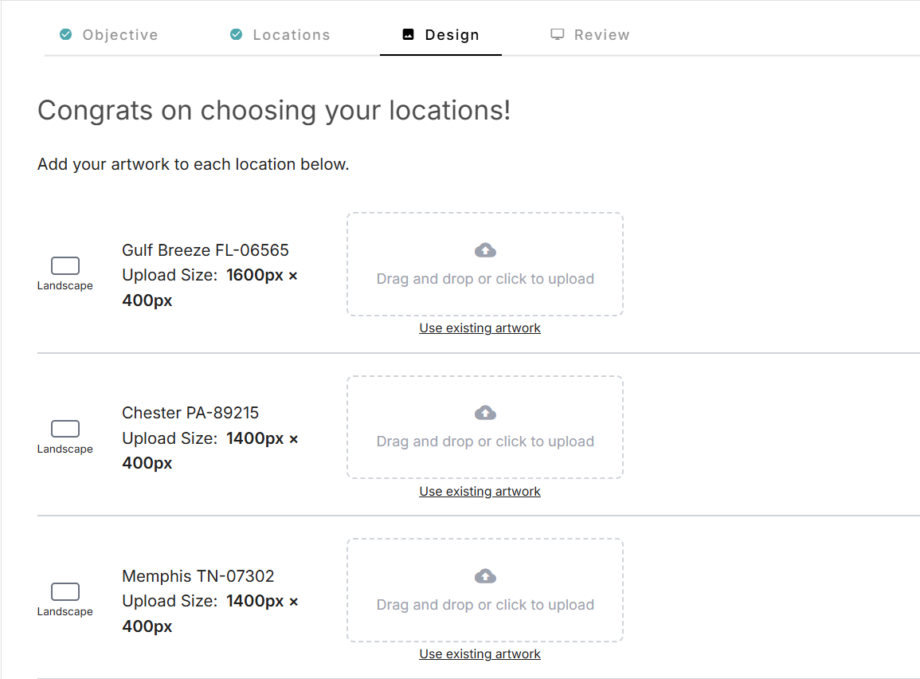
You can have your campaign live in minutes. Create a free account, select your locations, set your budget, upload your design, and start running once approved.
Where can I advertise with Blip in Greenwich?
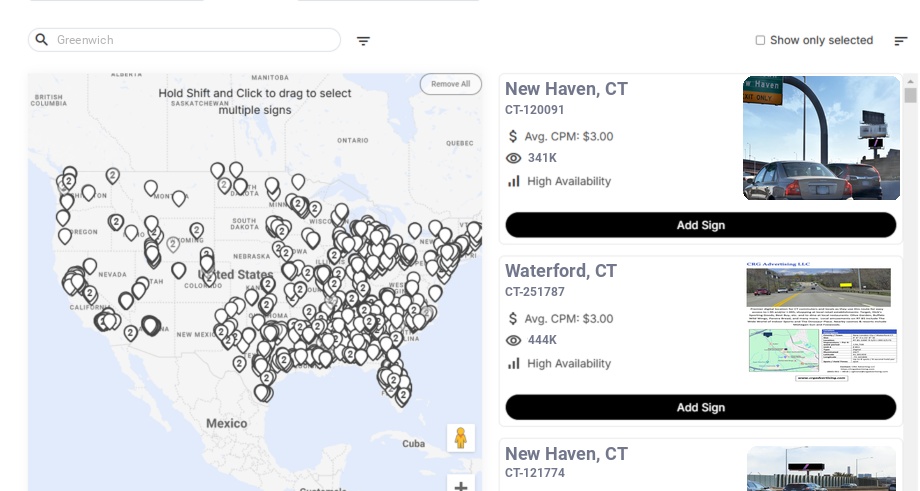
Blip has digital billboards in Greenwich. You can browse available locations on a map, choose the ones that fit your audience, and start advertising right away.
Still have questions? Launch a campaign in minutes — no contracts, no commitments.
Start Your CampaignGreenwich Billboard Advertising Guide
Greenwich, Connecticut sits at a powerful crossroads of wealth, commuting, and culture. With high household incomes, heavy daily traffic on I‑95 and the Merritt Parkway, and strong ties to New York City’s financial sector, this is a market where digital Greenwich billboards can reach decision‑makers, affluent consumers, and families in a matter of seconds. In this guide, we’ll walk through how to build smart, data‑driven Blip campaigns tailored specifically to Greenwich and its surrounding corridors, and how to make the most of Greenwich billboard advertising opportunities.
Understanding the Greenwich Market
Greenwich is one of the most affluent communities in the United States, which has major implications for both messaging and targeting.
Key demographic and economic signals:
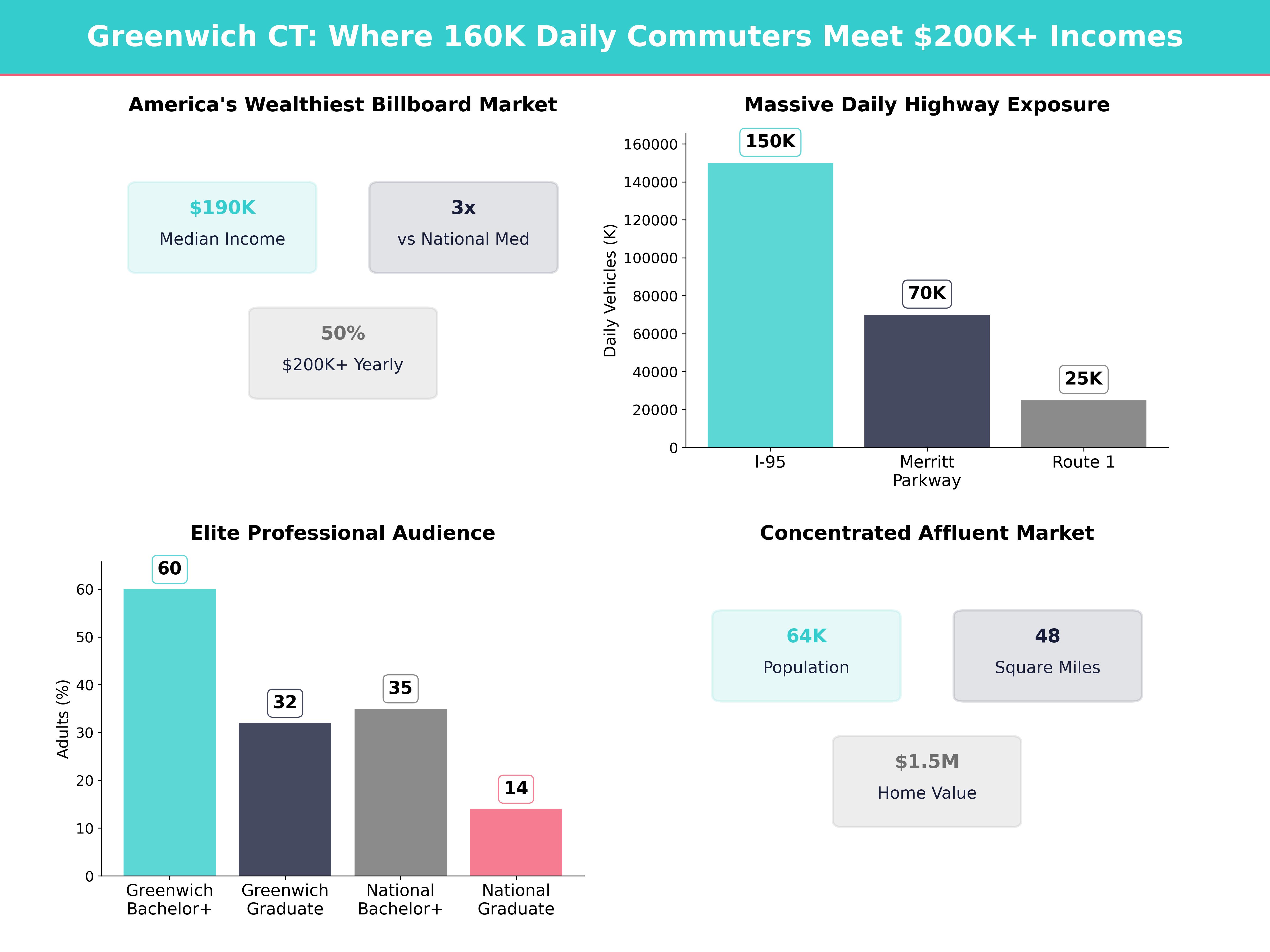
- Population: About 63,500–64,000 residents as of the early 2020s, spread across roughly 48 square miles.
- Household income: Median household income is widely reported in the $180,000–$200,000+ range, which is more than 2.5–3× higher than the overall Connecticut median (around the $80,000–85,000 range) and roughly 3× the national median.
- High‑income penetration: More than 50% of Greenwich households are estimated to earn $200,000+ annually, with a meaningful share well above $500,000.
- Home values: Typical home values in town often exceed $1.5 million, with many neighborhoods (e.g., backcountry and waterfront areas) averaging $3–5 million+ for single‑family homes.
- Education: More than 60% of adults hold at least a bachelor’s degree and roughly 30–35% hold graduate or professional degrees, far above national averages (around 35% with a bachelor’s and 13–15% with graduate degrees).
- Commuters: Thousands of residents commute daily to Manhattan and Stamford; Greenwich’s four Metro‑North Railroad stations (Greenwich, Cos Cob, Riverside, Old Greenwich) collectively serve well over 5,000–7,000 boardings per weekday in typical, non‑disrupted years.
- Industries: Strong presence of finance, hedge funds, private equity, wealth management, legal services, luxury retail, and healthcare. In Fairfield County as a whole, finance and insurance alone account for roughly 10–15% of total employment and an even larger share of total wages.
- Age and family profile: A sizable share of households are families with children; local school enrollment for Greenwich Public Schools alone is around 8,500–9,000 students, not including thousands more in private and independent schools.
These data points tell us a few important things for campaign strategy:
- Price sensitivity is relatively low; value and quality messaging win.
With median incomes nearly triple national levels and home values several times the U.S. norm, it’s often more effective to highlight exclusivity, service, expertise, and outcomes than discounts. Messaging that focuses on long‑term value, risk management, and premium experiences tends to perform better than “lowest price” appeals. - Time‑starved professionals are a core audience.
A large share of residents work in finance, law, consulting, and executive roles, many with 60‑hour+ weeks and 60–90‑minute daily commutes. Clear, concise creatives that can be absorbed in under 2 seconds are essential, in line with research showing typical digital OOH dwell times of 1–3 seconds. - Family‑oriented messaging resonates.
Greenwich is known for excellent public schools, a dense network of independent schools, and strong youth programming. With thousands of students in K‑12 and high participation in enrichment and sports, many households prioritize education, enrichment, healthcare, and wellness for children and teens.
For more local context, we recommend reviewing updates and planning information from the Town of Greenwich and business insights from the Greenwich Chamber of Commerce. The Connecticut Department of Economic and Community Development
Traffic Patterns and Where Your Audience Is Moving
Greenwich’s geography is defined by two major east‑west corridors plus local arterials that funnel residents to and from New York and Stamford. Understanding these flows is crucial when choosing Blip boards and scheduling, especially when you want billboards in Greenwich to intersect with the right audience at the right time.
The Connecticut Department of Transportation
1. I‑95 (Connecticut Turnpike)
Running along the shoreline, I‑95 through Greenwich carries:
- Average Annual Daily Traffic (AADT) often reported in the 140,000–160,000 vehicles per day range through southwestern Connecticut, with peak segments in Fairfield County exceeding 170,000+ vehicles per day.
- In rush hours, hourly flows can top 8,000–10,000 vehicles per direction, creating dense exposure windows.
- A mix of NYC commuters, Stamford/Greenwich workers, regional travelers, and commercial traffic; truck volumes on I‑95 in this corridor can account for 10–15% of total vehicles.
Advertising implications:
-
Morning eastbound, evening westbound:
- Eastbound toward Stamford/New Haven catches residents heading to local offices between roughly 6:30–9:30 a.m.
- Westbound catches NYC‑bound traffic in the early morning (often 5:30–8:30 a.m.) and returning commuters in the evening (4:00–7:00 p.m.).
- With daily traffic well into six figures, a single well‑placed digital face can generate hundreds of thousands of weekly impressions.
- Ideal for: B2B, financial services, luxury vehicles, healthcare systems, higher‑end retail, and regional attractions that benefit from both local and through‑traffic reach via Greenwich billboards.
2. Merritt Parkway (Route 15)
Just north of I‑95, the Merritt Parkway is more residential and commuter focused:
- AADT typically in the 60,000–80,000 vehicles per day range in Fairfield County, with some segments approaching 90,000.
- Passenger‑vehicle only (no commercial trucks), drawing a more upscale driving base due to adjacent neighborhoods and scenic character.
- Commuter peaks are pronounced, with AM and PM rush hours accounting for a disproportionately high share of daily traffic.
Advertising implications:
- Strong alignment with affluent suburban families and professionals commuting between Greenwich, Stamford, Norwalk, and New York.
- Great placement for private schools, real estate, luxury home services, remodeling, high‑end fitness, and lifestyle brands where car owners and homeowners are primary targets.
- Slightly lower total volume than I‑95 but often higher average household income among drivers due to the road’s alignment with established residential areas.
3. Local connectors and retail corridors
Important local roads include:
- Route 1 (East Putnam Ave / West Putnam Ave): Main commercial spine passing through Greenwich, Cos Cob, Riverside, and Old Greenwich. CTDOT traffic counts frequently put segments of Route 1 in Greenwich in the 20,000–30,000 vehicles per day range.
- Arch Street / Steamboat Road area: Feeds downtown and near‑waterfront business districts, including key access to the train station and the harbor.
- Roads connecting to Greenwich Avenue, the premier shopping street, where pedestrian counts on busy weekends can reach into the thousands per day.
Traffic on these routes is lower than on I‑95, but:
- Often more qualified: People are already in a shopping, dining, or errand‑running mode. Retail trade area studies for Greenwich Avenue often show high capture rates from within a 10–15‑minute drive time.
- Repetition matters: Residents may pass the same boards twice daily (e.g., school runs or office commutes), building frequency quickly. OOH research frequently shows that 3–5 exposures can significantly improve ad recall versus a single exposure.
To align with these flows, we can use Blip’s flexible scheduling to concentrate impressions on:
- AM inbound to Greenwich business and shopping districts (roughly 7:00–10:00 a.m.).
- PM outbound toward residential pockets and school areas (3:00–7:00 p.m.).
- Weekend daytimes when Greenwich Avenue, waterfront parks, and local events are busiest (often 10:00 a.m.–6:00 p.m.).
For local roadway and planning details, we can monitor updates from Greenwich’s Public Works and Planning Departments and traffic‑related coverage from outlets like the Greenwich Time
Seasonality and Key Greenwich Events
Unlike many markets where traffic composition is relatively stable year round, Greenwich experiences strong seasonal and event‑driven shifts that we can harness with tactical Blip campaigns.
Visitor and event data from sources such as CTvisit’s Greenwich page Greenwich Chamber of Commerce, and local organizers show that major events can draw several thousand to 10,000+ attendees in a single weekend, temporarily reshaping who is on local roads.
Spring (March–May)
- Residents emerge from winter; outdoor dining, home projects, and school events surge. Home improvement retailers and landscapers often report double‑digit percentage increases in inquiries versus January–February.
- Real estate listings and open houses ramp up; Fairfield County’s spring market is traditionally strong, with some years seeing 30–40% of annual sales volume occurring between March and June.
- Major events often include early‑season fundraisers, charity walks, and school galas, many drawing hundreds of attendees each.
Strategy ideas:
- Home services and real estate: Rotate creatives that feature “spring refresh,” staging, landscaping, and renovation messages. Tie campaigns to weekends with high open‑house density (often late April through June).
- Private schools, camps, enrichment programs: Promote enrollment deadlines for summer and fall. Many day and sleepaway camps close registration by April–May, making countdown messaging (“2 weeks left to enroll”) effective.
Summer (June–August)
- Families split between local activities and travel; some weekly commuter volume dips (rail and highway weekday volumes can fall 5–15% vs. peak months), but tourism and leisure trips increase, especially on Fridays and Sundays.
- Popular attractions include Greenwich Point Park (Tod’s Point), other town beaches, and local marinas, which together can see thousands of visitors on peak summer weekends, according to Town of Greenwich Parks & Recreation
- The area hosts high‑profile events like the Greenwich Town Party, which has historically drawn around 10,000 attendees, and the Greenwich Concours d’Elegance classic car show, which can attract several thousand car enthusiasts over its run (Greenwich Town Party, Greenwich Concours d’Elegance).
Strategy ideas:
- Restaurants, waterfront venues, and events: Push happy hour, weekend brunch, or ticket sales leading into Thursdays–Saturdays, when restaurant traffic and event attendance typically peak.
- Tourism‑oriented businesses and regional attractions: Target weekend travelers heading along I‑95. Summer Fridays on I‑95 can see noticeable afternoon traffic spikes starting as early as 1–2 p.m..
- Use dynamic day‑of‑week scheduling to focus on Thursday–Sunday when leisure activity peaks and visitors from elsewhere in Connecticut and Westchester are most likely to be on local roads and see your Greenwich billboards.
Discover more local happenings and seasonality from CTvisit’s Greenwich page Greenwich Chamber of Commerce.
Fall (September–November)
- Commuter patterns normalize after summer; schools and offices are fully back. Rail ridership and highway volumes typically rebound from summer dips, with some corridors returning to near‑peak weekday levels.
- Busy season for finance and professional services, as year‑end planning begins and firms approach bonus season. Financial advisors and CPAs often see Q4 inquiry spikes compared with Q2–Q3.
- Strong period for back‑to‑school retail, after‑school programs, and healthcare appointments (e.g., sports physicals, wellness visits).
Strategy ideas:
- Financial advisors, accountants, estate planners: Launch campaigns keyed to “year‑end planning,” “quarterly review,” and “bonus season” messaging from September through December.
- Education and enrichment: Market tutoring, test prep, music, and sports programs around back‑to‑school and mid‑semester checkpoints (e.g., September and late October/early November when progress reports go out).
Winter (December–February)
- Holiday retail, charitable giving, and travel spike in November–December. Many retailers see 20–30% or more of annual sales in the holiday period.
- January often brings fitness, wellness, and financial‑resolution mindsets; gyms and studios frequently report membership and trial spikes of 20–50% compared to December.
- Weather can disrupt traffic patterns, but also increases reliance on vehicles vs. walking or biking; on cold or stormy days, in‑car media like digital billboards can play an even larger role.
Strategy ideas:
- Holiday campaigns: Time‑limited countdown creatives driving urgency to shop or book services before specific dates (e.g., “Only 5 days left for holiday catering orders”).
- Gyms, medical providers, mental health, and wellness brands: “New year, new plan” messaging starting the last week of December and running through late January, when resolution interest is highest.
Crafting Creative That Resonates in Greenwich
Affluent, time‑pressed, and highly educated audiences demand high‑quality visuals and clear value. On digital billboards, we only have 1–3 seconds to communicate, and studies of OOH effectiveness suggest that ads with fewer than 10 words are significantly more likely to be recalled.
We recommend these creative principles for Greenwich billboard advertising:
-
Lead with sophistication, not clutter.
- Use minimalist design, generous white space, and brand‑consistent colors. In tests across OOH campaigns, high‑contrast, uncluttered designs have shown double‑digit percentage gains in recall versus busy layouts.
- Limit copy to 7–10 words; focus on one clear message that can be understood at 55–65 mph.
-
Show lifestyle, not just products.
- For luxury retail: Highlight the aspirational lifestyle—Greenwich Avenue shopping, waterfront leisure, or high‑end interiors. High‑end consumer research routinely finds that lifestyle imagery can lift purchase intent by 10–20% compared to product‑only visuals.
- For professional services: Use visuals that convey confidence and stability (subtle financial imagery, calm healthcare environments, families at ease).
-
Align visuals with local landmarks and identity.
- Use images suggestive of Greenwich Harbor, Tod’s Point, stone walls, tree‑lined streets, and classic New England homes to tap into local pride.
- Reference “Greenwich,” “Backcountry,” “Old Greenwich,” or “By the Avenue” when location is an asset. Localized messaging often drives higher engagement; across many markets, including “your town name” can improve brand favorability metrics by 5–10 percentage points.
-
Use precise calls to action suited for out‑of‑home.
- Website or short URL: keep it short and memorable, ideally 10–15 characters or less.
- Emphasize actions that can be taken later: “Book your consultation,” “Schedule a test drive in Greenwich,” “RSVP by June 15.” OOH is particularly strong at upper‑funnel awareness and consideration, which then supports later search and direct visits.
-
Leverage multiple creatives for micro‑targeting.
With Blip, rotating multiple designs is affordable. We can:- Run weekday vs. weekend creatives (e.g., “Before the office” vs. “Weekend on Greenwich Avenue”).
- Test two value propositions (e.g., “Private wealth management” vs. “Tax‑efficient estate strategies”) and watch which drives more branded search or inquiries. Even basic A/B splits can reveal 15–30% differences in downstream response.
Dayparting: Matching Your Message to the Greenwich Daily Rhythm
Because many Greenwich residents commute, time of day strongly influences who is on the road and what mood they’re in. Blip’s minute‑by‑minute scheduling lets us tune campaigns tightly to these patterns and make each Greenwich billboard placement as efficient as possible.
Weekday morning (6:00–10:00 a.m.)
Audience:
- Westbound I‑95 and Merritt commuters heading toward NYC and Stamford; in peak hours, these directions can see thousands of vehicles per hour.
- Parents on school drop‑off routes heading to public and private campuses between roughly 7:15–9:00 a.m..
- Service professionals and contractors starting their day.
Best for:
- Financial services, B2B, recruiting, legal, corporate events.
- Coffee shops, grab‑and‑go breakfast, fitness studios for early‑bird specials.
Messaging angles:
- “On your way to the office? It’s time to rethink your portfolio.”
- “Drop‑off done. Now it’s your time—9 a.m. classes in Greenwich.”
Midday (10:00 a.m.–3:00 p.m.)
Audience:
- Local shoppers, retirees, flexible and remote workers using co‑working spaces or home offices.
- Service appointments (medical, dental, home services). Providers such as Greenwich Hospital and independent practices see heavy weekday scheduling in this band.
Best for:
- Retail, healthcare, beauty, home improvement, lunch‑focused restaurants.
Messaging angles:
- “Today only: Lunch on the Avenue 11–2.”
- “Same‑week dermatology appointments in Greenwich. Scan later: [short URL].”
Evening commute (3:00–7:00 p.m.)
Audience:
- Parents picking up kids from school and activities; after‑school program and sports participation among Greenwich families is high, meaning many are on the road between 3:00–6:00 p.m..
- Commuters returning from NYC and Stamford (eastbound/westbound flow varies by route).
- Families deciding on dinner and evening plans.
Best for:
- Restaurants, grocery, family entertainment, tutoring, sports programs, streaming and digital services.
Messaging angles:
- “Nothing in the fridge? Order dinner from downtown in 20 minutes.”
- “Stronger grades this semester. Greenwich tutoring programs enrolling now.”
Weekends
Audience:
- Shoppers on Greenwich Avenue, including visitors from neighboring communities. Trade area studies often show that high‑end districts like Greenwich Avenue pull consumers from a 15–30‑minute drive radius.
- Families heading to parks, beaches, and events, especially late mornings and afternoons.
- Visitors from other parts of Connecticut and Westchester.
Best for:
- Dining, retail, arts and culture, auto dealers, tourism attractions, real estate open houses.
Messaging angles:
- “Open house Sunday 1–4 p.m. in Riverside – Exit X off I‑95.”
- “Weekend on the water—book your Greenwich charter.”
We can set higher bid levels for prime commuter and weekend windows, and lower bids during softer periods to maintain presence cost‑effectively while still achieving meaningful weekly frequency.
Geographic Targeting: Thinking Beyond Town Boundaries
While Greenwich itself is relatively compact, its economic influence extends well beyond its borders. When choosing boards with Blip, we should think in corridors and catchment areas, not just ZIP codes, to unlock the full value of billboard rental in Greenwich and nearby communities.
Consider targeting:
-
West to East: NYC–Greenwich–Stamford corridor
- Many Greenwich residents work in Manhattan or Stamford, and Metro‑North schedules show frequent peak‑hour trains moving thousands of riders between these hubs each weekday.
- Placing boards both before and after Greenwich can echo your message across their daily journey.
- Example: A wealth management firm can run creatives on I‑95 near Stamford, where daily traffic often exceeds 150,000 vehicles, plus closer‑in boards to reinforce the brand multiple times a day.
-
North along Merritt Parkway and backcountry routes
- Backcountry Greenwich and neighboring towns like New Canaan and Pound Ridge are home to some of the region’s highest‑net‑worth households, with median household incomes frequently above $200,000–$220,000 and typical home values over $1.5–2 million.
- Reinforcing your message along routes they use to reach I‑95, the Merritt, or Greenwich Avenue ensures regular frequency with this segment.
-
Retail draw zones
- Greenwich Avenue’s luxury mix draws shoppers from across Fairfield County and Westchester County. Mall and downtown studies in similar markets show that 30–50% of high‑end shoppers come from outside the host municipality.
- Campaigns for high‑end retail, art galleries, or specialty clinics should consider boards that catch these inbound trips along I‑95, the Merritt, and Route 1, not just local residents.
-
Healthcare and education catchment areas
- High‑quality healthcare providers and private schools in or near Greenwich regularly serve families up to 30–40 minutes away by car.
- Using regional boards, we can promote specialized services (e.g., pediatrics, orthopedics, college counseling) to a broader affluent audience that includes nearby communities such as Stamford, Darien, Rye, and Port Chester.
Board availability will vary, but the planning principle is consistent: use Blip to tell a cohesive story across the commute, not just at a single touchpoint, and treat Greenwich billboard advertising as part of a wider regional visibility strategy.
Vertical‑Specific Opportunities in Greenwich
Certain industries are especially well‑matched with Greenwich’s demographics and traffic patterns. Here are some angles we’ve seen work well in similar markets and that translate directly to Greenwich billboards.
Financial and Professional Services
- Audience: High‑income households, business owners, and finance professionals. In Fairfield County, a significant share of households hold investable assets in the high six‑ and seven‑figure range.
-
Suggested tactics:
- Focus on expertise and trust: “Serving Greenwich families since 19XX” or “Institutional‑grade strategies for private clients.”
- Align with calendar milestones: tax season (Jan–Apr), year‑end planning (Oct–Dec), market volatility spikes. Many firms report Q1 and Q4 as their strongest new‑client acquisition quarters.
- Use short, confident headlines: “Your next move in volatile markets starts here.”
Real Estate and Home Services
- Audience: Homeowners with substantial equity and discretionary budgets; with typical home values above $1.5 million, even modest renovations are often five‑ and six‑figure projects.
-
Suggested tactics:
- For residential realtors: Promote listings with price point + neighborhood (“Backcountry estate – $4.2M – Open Sunday”). Including price helps qualify viewers; median single‑family sales in many Greenwich sub‑markets exceed $2 million.
- For contractors/designers: Emphasize quality and design over price (“Architect‑designed kitchens for Greenwich homes”). High‑end project close rates can improve when messaging highlights design credentials and craftsmanship.
- Time campaigns to spring and fall listing peaks; local transaction data frequently shows spikes in closings and listings in these seasons versus mid‑winter.
Healthcare and Wellness
- Audience: Families, executives, retirees emphasizing longevity and performance.
-
Suggested tactics:
- Highlight access and specialization: “Same‑week orthopedic consults in Greenwich,” “Concierge primary care accepting new members.” In affluent markets, concierge and membership models can account for 10–20% of primary‑care practices.
- Use seasonal cues: back‑to‑school physicals, flu season, “new year, new health plan.”
- For mental health, wellness, and fitness, focus on performance and resilience rather than purely aesthetics, matching the priorities of high‑achieving households.
Education, Camps, and Enrichment
- Audience: Parents focused on academic and extracurricular excellence; with thousands of K‑12 students in town and high private‑school participation, the addressable market is large and highly engaged.
-
Suggested tactics:
- Promote admissions windows and enrollment deadlines with countdown messaging (“2 weeks left for summer camp registration”). Many independent schools close applications by January–February for the following fall.
- Call out outcomes: test score improvements, college placements, competition wins. For example: “Average SAT scores +150 points in 6 months.”
- Target boards on school routes and key intersections during drop‑off and pickup windows (typically 7:15–9:00 a.m. and 2:30–4:30 p.m.).
Luxury Retail, Dining, and Leisure
- Audience: High‑spend locals and visitors. In affluent trade areas, average transaction sizes for luxury goods and fine dining can be 2–3× those in mass‑market areas.
-
Suggested tactics:
- Use brand‑forward, image‑heavy creatives with very few words to fit the 1–3 second read time.
- Align dayparts to behavior: lunch spots (10 a.m.–2 p.m.), fine dining (3–8 p.m.), weekend retail (10 a.m.–6 p.m. Sat/Sun).
- Promote limited‑time events: trunk shows, wine dinners, gallery openings, ideally with specific dates and simple directions from I‑95 or the Merritt.
For inspiration on local positioning and consumer behavior, we can monitor lifestyle coverage from outlets like Greenwich Time Greenwich Patch.
Measuring and Optimizing Your Greenwich Campaign
Blip gives us control over budget, timing, and creative rotation, which we can use to continuously improve performance in this sophisticated market.
Here’s how we recommend structuring optimization:
-
Start with a focused test period (2–4 weeks).
- Run 2–3 creatives targeting specific corridors and dayparts (e.g., I‑95 AM commuters plus weekend shoppers).
- Maintain a consistent daily budget to gather stable data, ideally generating at least tens of thousands of impressions per week so that changes in search and web traffic are easier to interpret.
-
Track off‑board signals.
-
Watch for lifts in:
- Branded search volume on Google (look for week‑over‑week or year‑over‑year increases during active flight dates).
- Direct website traffic (people typing your URL), which often rises 5–20% during strong OOH campaigns in similar markets.
- Phone inquiries or form fills mentioning “billboard” or “sign.”
- Where possible, sync peaks in these signals with your scheduled Blip times to confirm daypart and corridor effectiveness.
-
Watch for lifts in:
-
Iterate creatives.
- If one creative rotates with another on similar boards and timeframes but you see better response (higher search lift, more calls, more direct visits), gradually allocate more impressions toward the winner.
-
Test changes to:
- Headline clarity.
- Call to action.
- Visual contrast and color choices. Small shifts in contrast or font size can improve legibility at highway speeds and increase recall.
-
Refine timing and locations.
- If weekday commuter targeting underperforms for a leisure brand, shift budget to weekends when your customers are in a more relaxed, planning mindset.
- If creative is too time‑sensitive (e.g., lunch special) for boards that are mostly seen during evening commute, adjust the scheduling accordingly and monitor for upticks in time‑matched transactions.
-
Scale with confidence.
-
Once we identify a winning mix, we can increase:
- Daily budget to expand reach and frequency.
- Number of boards in the NYC‑Greenwich‑Stamford corridor to capture more of your target audience’s journeys and potentially add thousands of additional daily impressions.
- In many OOH case studies, scaling successful campaigns has delivered incremental lifts of 10–30% in key metrics such as store traffic or web visits.
-
Once we identify a winning mix, we can increase:
As you scale, consider how additional billboard rental in Greenwich and on nearby routes can reinforce your strongest messages without overwhelming your budget.
Bringing It All Together
Advertising in Greenwich, Connecticut means speaking to an informed, affluent audience whose time and attention are valuable. By combining:
- High‑impact locations along I‑95, the Merritt Parkway, and key local arterials,
- Smart dayparting tuned to commuter and family rhythms,
- Creatives that match Greenwich’s sophisticated aesthetic and lifestyle, and
- Ongoing testing and optimization made possible by Blip’s flexible model,
we can build digital billboard campaigns that don’t just generate impressions—they influence real decisions. Thoughtful use of Greenwich billboards and surrounding placements helps keep your brand in front of high‑value audiences throughout their daily routines.
By grounding our strategy in the data and local dynamics covered here, and drawing on resources from organizations such as the Town of Greenwich, Connecticut Department of Transportation Greenwich Chamber of Commerce, and local media like Greenwich Time