Billboards in Madison, CT
No Minimum Spend. No Long-Term Contracts. Just Results.
Trusted by Leading Brands


Billboard advertising
in Madison has never been easier



How much is a billboard in Madison?
Why Choose Blip for Billboard Advertising in Madison
-
Blip lets you launch Madison, Connecticut billboards fast on I-95 and Route 1, reaching beachbound traffic and New Haven commuters without a media buy maze.
-
Use flexible budgets in Madison, Connecticut to spend more on summer weekends near Hammonasset and scale back when shoreline traffic cools.
-
Daypart your Madison, Connecticut ads for 6-9 a.m. commuters and 2-7 p.m. beach traffic, so Blip pays to show when drivers are on the road.
-
No contracts means you can test Madison, Connecticut billboard messaging around festivals, holidays, and shoulder-season tourism, then adjust anytime.
-
Track Madison, Connecticut campaign results in real time and shift spend toward the I-95 Exit 62 and Route 1 corridors that perform best.
-
Blip's creative tools help you build bold, local Madison, Connecticut ads for affluent homeowners, beachgoers, and family-focused shoppers.
Frequently Asked Questions About Billboard Advertising in Madison
How much does a billboard cost in Madison, Connecticut with Blip?
With Blip, you control exactly what you spend on Madison billboards by setting a daily budget that can be as small or as flexible as you’d like, and Blip automatically keeps your campaign within that amount. You pay per “blip,” a 7.5–10 second ad display, and each blip’s price depends on when and where you choose to show your ad, as well as current advertiser demand for billboards in Madison, Connecticut. Over time, your total cost is simply the sum of those individual blips, giving you transparent, predictable pricing.
Where can I advertise with Blip in Madison, Connecticut?
The backbone of Madison’s outdoor advertising exposure is the I‑95 corridor, where CTDOT average annual daily traffic is in the 85,000–95,000 vehicles per day range, with some nearby stretches topping 100,000 vehicles per day. Route 1/Boston Post Road through Madison and neighboring shoreline towns also has frequent daily volumes in the 12,000–20,000 vehicles per day range and lower speeds that are ideal for detailed or directional messages. Well‑placed billboards in Madison can intercept tourists right as they make spending decisions, especially near I‑95 Exit 62 and Route 1.
When is the best time to run Blip ads on Madison billboards?
Madison’s advertising value changes dramatically across the calendar, and summer shoreline visitation in Connecticut can be 2–3 times higher than in winter months. Peak summer weekends are especially strong, with Fridays from 2–8 p.m., Saturdays from 9 a.m.–7 p.m., and Sundays from 10 a.m.–7 p.m. recommended for heavier budgets and bids. For commuters, weekday morning and evening commute windows are especially valuable.
What kind of audience will I reach with Madison, Connecticut billboards?
Madison is a small but high‑value coastal town with just under 18,000 residents, a median household income commonly reported in the $125,000–$135,000 range, and owner‑occupancy rates typically above 80%. The town also draws a powerful mix of seasonal tourists and daily commuters along the I‑95 shoreline corridor. That means Madison billboards can reach high‑income locals, commuters, and beachgoers all at once.
How can Blip help me target commuters and beach traffic in Madison, Connecticut?
On I‑95 westbound, heavy morning commuter traffic runs from 6:30–9:00 a.m., while eastbound traffic is strongest on Friday afternoons and Saturdays for people driving to Hammonasset Beach and other shoreline destinations. The page recommends using dayparting to focus commuter‑oriented creatives during 6–9 a.m. and 3:30–7 p.m. on weekdays, and beach traffic during high‑volume summer weekend windows. This allows campaigns to align with the exact audience moving through Madison at the right time.
Do I need a contract to advertise with Blip in Madison?
No, Blip has no long-term contracts or minimum commitments. You can start, pause, or stop your campaign at any time.
How fast can I launch a billboard campaign with Blip in Madison?
You can have your campaign live in minutes. Create a free account, select your locations, set your budget, upload your design, and start running once approved.
Where can I advertise with Blip in Madison?
Blip has digital billboards in Madison. You can browse available locations on a map, choose the ones that fit your audience, and start advertising right away.
Still have questions? Launch a campaign in minutes — no contracts, no commitments.
Start Your CampaignMadison Billboard Advertising Guide
Madison, Connecticut, offers a powerful combination of affluent year‑round residents, heavy seasonal tourism, and constant commuter flow along the I‑95 shoreline corridor. When we plan digital billboard campaigns here, we can tap into beachgoers headed to Hammonasset, professionals commuting to New Haven
Understanding the Madison Market
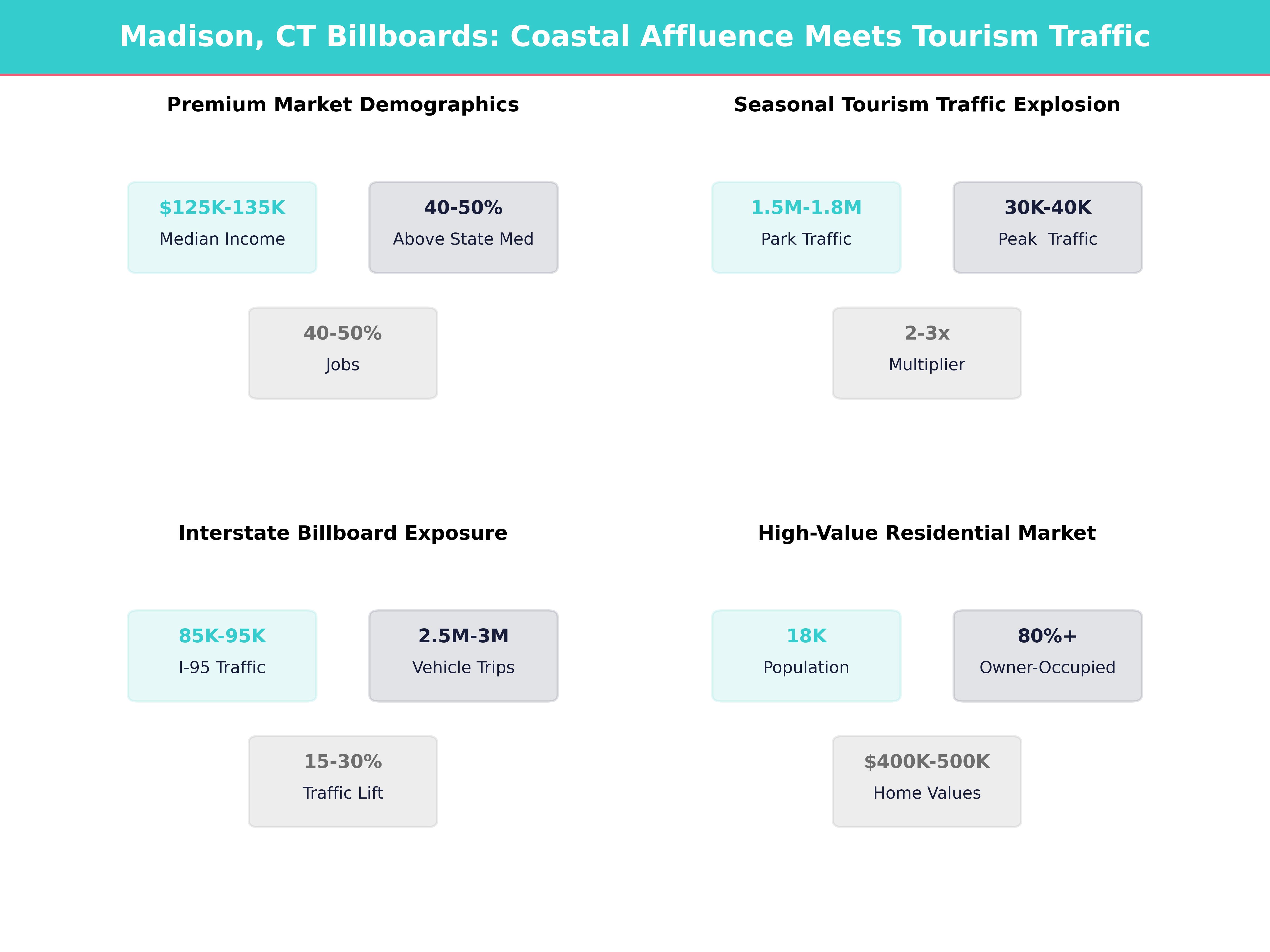
Madison is a small but high‑value coastal town. According to recent estimates from state and local planning sources, the population is just under 18,000 residents and has grown modestly over the past decade (roughly 3–5%), with a stable base of long‑term homeowners. Median household income is commonly reported in the $125,000–$135,000 range—more than 40–50% higher than the statewide median—positioning it among the more affluent communities in Connecticut’s shoreline region and an especially attractive environment for Madison billboard advertising.
Owner‑occupancy rates in Madison are typically above 80%, and in many neighborhoods single‑family homes represent 90%+ of housing units, which signals strong roots in the community and sustained local spending on home services, retail, and dining. Unemployment in the broader New Haven–Middlesex labor market has generally trended near historic lows in recent years (often in the 3–4% range), supporting consistent demand for discretionary goods and services—an ideal foundation for ongoing billboard rental in Madison.
The town’s official website, the Town of Madison, highlights its strong public schools, vibrant downtown, and access to beaches as core quality‑of‑life drivers—all signals of stable disposable income and consistent local spending. Madison Public Schools routinely rank among the top districts in Connecticut in statewide assessments and graduation rates, with graduation often around 95–97%, reinforcing the town’s educated, family‑oriented profile.
Key market traits we should keep in mind:
-
Affluent, family‑oriented households
Many residents are professionals working in New Haven, Hartford, or the broader New York–Boston corridor. Regional commuting data show that a significant share of shoreline residents travel 20–45 minutes each way, with daily flows into New Haven’s employment centers, Yale‑affiliated institutions, and regional hospitals such as Yale New Haven Hospital. This makes them prime targets for:- Financial services and wealth management (the typical homeowner in towns like Madison often has home values exceeding $400,000–$500,000)
- Healthcare and wellness services, including primary care, dental, and specialty practices
- Home improvement, landscaping, and design, supported by high homeownership and large lot sizes
- Youth activities, camps, and educational services, given strong K‑12 enrollment and high participation in extracurriculars
-
Regional draw far beyond town borders
Madison is a destination for visitors from the rest of Connecticut, New York, Massachusetts, and Rhode Island, thanks largely to Hammonasset Beach State Park roughly 1.5 million visitors annually, with peak years climbing closer to 1.8 million, making it the state’s most‑visited shoreline park. On busy holiday weekends, daily attendance can spike above 30,000–40,000 visitors. A very large share of that traffic passes near or through Madison’s key roadways, particularly I‑95 Exit 62 and Route 1, where well‑placed billboards in Madison can intercept tourists right as they make spending decisions.State tourism reports from CTVisit indicate that leisure travel in Connecticut generates more than $15 billion in annual visitor spending and supports over 150,000 jobs; shoreline destinations like Madison capture a meaningful slice of that, especially in the summer months when hotel occupancy and short‑term rentals can reach 80–90% on peak weekends.
-
Part of the New Haven–Middlesex media corridor
Locals consume news from regional outlets like the New Haven Register Shoreline Times WTNH News 8 Middlesex County Chamber of Commerce and neighboring Shoreline Chamber of Commerce also promote cross‑town events, boosting regional traffic to Madison businesses.
For advertisers, this means we can use Madison boards to reach three overlapping audiences: high‑income locals, daily commuters, and seasonal tourists—all with different needs but shared roads and viewing patterns. With an estimated tens of thousands of unique drivers passing through the Madison segment of I‑95 each week, even modest campaign frequencies on Madison billboards can translate into hundreds of thousands of impressions over a month.
Traffic Flows and Key Corridors
The backbone of Madison’s outdoor advertising exposure is the I‑95 corridor. The Connecticut Department of Transportation Average Annual Daily Traffic (AADT) on I‑95 through the shoreline in the 85,000–95,000 vehicles per day range, depending on the specific segment and direction, with some nearby stretches topping 100,000 vehicles per day. Over a 30‑day campaign, that can translate to 2.5–3 million vehicle trips passing key digital billboard locations, even before accounting for seasonal surges, underscoring how central this corridor is to effective Madison billboard advertising.
That’s our opportunity to align Blip campaigns with:
- Beach traffic (spring–summer weekends and holidays)
- Commuter flows (weekday rush hours)
- Regional retail traffic (afternoons, evenings, and weekends year‑round)
On Route 1/Boston Post Road through Madison and neighboring shoreline towns, AADT volumes frequently fall in the 12,000–20,000 vehicles per day range, but at much lower speeds than the interstate—ideal for more detailed or directional messages and hyperlocal billboards in Madison.
Key patterns to build into your Blip scheduling:
-
I‑95 Westbound (toward New Haven and New York):
- Heavy morning commuter traffic 6:30–9:00 a.m., where traffic speeds often drop well below free‑flow—boosting dwell time and billboard visibility.
- Strong Friday evening and weekend morning spikes as beachgoers and weekend travelers head west after staying in or visiting the shoreline; summer Friday volumes can run 10–20% higher than winter Fridays.
-
Ideal for messaging that targets:
- Commuters: staffing agencies, higher education, healthcare, B2B, and professional services
- Travelers: attractions, restaurants, retail, and entertainment closer to New Haven
-
I‑95 Eastbound (toward Old Saybrook and Rhode Island):
- Strong Friday afternoon/evening and Saturday morning volumes as people drive to Hammonasset Beach and other shoreline destinations; CTDOT counts typically show the highest summer weekend eastbound volumes between 2 p.m. and 7 p.m.
- Sunday afternoon/early evening return traffic, especially in summer, often with speeds reduced by 10–25 mph versus posted limits.
-
Ideal for:
- “Exit now” or “Next 2 exits” messaging for restaurants, gas, hotels, and shops
- Attractions and experiences east of Madison
-
Route 1 / Boston Post Road:
- Lower speeds and more local traffic than the interstate, but high daily counts for local commerce, frequently 12,000+ vehicles per day through commercial segments.
- Captures grocery, pharmacy, banking, dine‑in and takeout traffic. Major anchors like supermarkets, pharmacies, and home improvement stores create repeated weekly exposure, with typical shoppers visiting these categories 1–3 times per week.
- Perfect for hyperlocal campaigns: salons, gyms, medical and dental practices, real estate, and local events.
With Blip, we can deliberately set our campaigns to prioritize certain boards and hours that best match these flows rather than paying for impressions when traffic is light or off‑target. Shifting even 20–30% of your budget toward peak periods can materially increase effective impressions without increasing total spend, making your billboard rental in Madison more efficient.
Seasonality: When Madison’s Audience Spikes
Madison’s advertising value changes dramatically across the calendar. Summer shoreline visitation in Connecticut can be 2–3 times higher than in winter months, and Hammonasset’s usage patterns reflect this. We can use this to our advantage by adjusting budgets, bids, and creative timing inside Blip so that our Madison billboard advertising is strongest when the audience is largest.
Summer (Late May – Early September)
- Hammonasset Beach State Park routinely records hundreds of thousands of visits per month in peak summer, contributing to its roughly 1.5 million annual visitors. July and August can each account for 20–25% of total yearly attendance.
- On sunny weekend days, daily park visitation can reach 20,000–40,000 people, especially around holiday periods like Memorial Day, July 4th, and Labor Day.
-
Traffic increases on:
- I‑95 exits serving Madison and Hammonasset, with CTDOT sometimes recording 15–30% higher volumes versus off‑season
- Route 1 through downtown and commercial areas, as out‑of‑town visitors seek food, fuel, and shopping before or after the beach
Campaign implications:
-
Increase your Blip budget and bid ceilings for:
- Fridays 2–8 p.m.
- Saturdays 9 a.m.–7 p.m.
- Sundays 10 a.m.–7 p.m.
- Consider raising bids by 25–50% during peak summer weekends to secure a larger share of plays amid higher advertiser competition.
-
Use concise, beach‑relevant creative:
- “Beach day? Exit 62 for ice cream & coffee”
- “Forgot sunscreen? Next exit – CVS & local shops”
- “Rainy beach day? Indoor fun 5 minutes ahead”
Shoulder Seasons (April–May, September–October)
-
The shoreline remains active with:
- Spring and fall festivals promoted by the Town of Madison and Madison Chamber of Commerce
- College families and visitors passing through to New Haven and other campuses, with universities like Yale University and Quinnipiac University bringing in tens of thousands of students and visitors each year
- Leaf‑peeping and coastal weekend trips—Connecticut tourism data show that fall travel can account for 20–25% of annual leisure trips statewide
- Traffic is lower than mid‑summer but more composed of higher‑value weekenders and locals, often staying longer and spending more per trip than day‑only beach visitors.
Campaign implications:
-
Maintain moderate budgets with heavier focus on:
- Thursday evening through Sunday evening
- Weekend brunch and dinner dayparts
-
Emphasize:
- Real estate (spring and fall are strong home‑buying seasons; statewide, over 60% of home sales typically close between April and October)
- Home improvement, landscaping, and design, as homeowners tackle seasonal projects
- Local events and seasonal menus for restaurants
Winter (November–March)
- Lower tourist counts, but we gain a more purely local and commuter audience. Visitor traffic to Hammonasset during the coldest months may drop to 5–10% of summer peaks, shifting the mix heavily toward Madison and neighboring town residents.
-
Holiday retail and service demand spikes from early November through December:
- In many New England towns, retailers see 20–30% of annual sales during November–December.
- Gifts, jewelry, fashion, toys, and local boutiques respond well to “shop local” messaging supported by the Madison Chamber of Commerce.
- Financial and tax services in late winter, aligned with the January–April tax season.
- Heating, snow removal, and home services during storms—Southern Connecticut can receive 20–40 inches of snow in a typical winter, driving spikes in emergency and maintenance needs.
Campaign implications:
-
Shift budget to:
- Weekday morning and evening commute windows
- Pre‑holiday weekends in November and December
-
Tailor creative to locals:
- “Madison families trust us for [service] – Exit [X]”
- “Shoreline small business? Shop local in Madison Center”
By adjusting spend month‑to‑month through Blip, we can keep CPMs efficient while staying visible during the most valuable traffic periods. Even a 10–15% monthly budget reallocation based on seasonality can significantly increase local impressions for the same annual spend and ensure your billboards in Madison are always aligned with audience demand.
Audience Mindset and Messaging Angles
To design creatives that work on Madison billboards, we should think in terms of the viewer’s mindset at the exact moment their eyes hit the screen. Drivers on I‑95 at highway speeds typically have 1.5–3 seconds to absorb a message; Route 1 viewers at traffic lights or in slower congestion may have 5–8 seconds.
For Beachgoers and Day‑Trippers
- Often traveling with kids or groups—family parties to Hammonasset often range from 2–6 people, amplifying each vehicle impression into multiple human impressions.
- Short windows to make decisions (food, supplies, parking, activities) and high sensitivity to convenience: if something is within 5–10 minutes of the exit, it’s a viable option.
-
High responsiveness to:
- Simple calls to action: “Exit now,” “2 miles ahead,” “Next traffic light on right”
- Visual cues: beach icons, umbrellas, ice cream, coffee, cold drinks
- Offers: “Kids eat free,” “Parking included,” “Beach bundle discount”
Suggested creative structure:
- 5–7 words maximum
- Big, high‑contrast typography that can be read at 55–65 mph
- One main image (e.g., bright, sunny, family‑oriented photo or graphic)
- Geographically anchored CTA: “Off Exit 62, on Route 1”
For Year‑Round Residents
Madison’s residents skew educated and higher income. Local school performance and home values suggest a high share of college‑educated adults, and professional/managerial occupations can account for 40–50% of the local labor force in similar shoreline communities. They value:
- Quality, trust, and community reputation
- Kid‑friendly activities and education
- Health, wellness, and longevity
- Home comfort and aesthetics
Effective angles:
-
Social proof: “Trusted by Madison families since 1998”
- Expertise: “Board‑certified specialists, 10 minutes from downtown Madison”
- Community: “Proud sponsor of [local school/team/event]”
For professional and B2B services (law firms, accountants, consultants, niche healthcare), use straightforward, confident messaging:
- “Estate planning for shoreline families – Call [Phone]”
- “Shoreline business lending, locally decided – Visit [Short URL]”
On Route 1 or at slower intersections, you can safely include slightly more detail—up to 10–12 words—without overwhelming drivers.
For Commuters
Commuters on I‑95 often come from or go to New Haven, Hartford, or beyond. In the greater New Haven region, average one‑way commute times commonly fall in the 25–30 minute range, and more than 75% of workers drive alone or carpool, meaning roadside media is a frequent touchpoint.
Their concerns:
- Time and convenience
- Reliable services near home or on their route
- Career growth, education, and big‑ticket decisions
Message examples:
- “Beat traffic – schedule your oil change near Exit [X]”
- “Evening MBA within 30 minutes of Madison – Learn more”
- “Telehealth & same‑day appointments – Scan to book”
We can schedule commuter‑oriented creatives primarily during 6–9 a.m. and 3:30–7 p.m. on weekdays via Blip’s dayparting tools so we’re paying to show messages when these drivers are actually on the road. For many advertisers, focusing 60–70% of spend into these windows yields higher engagement than an always‑on schedule and maximizes the impact of their Madison billboard advertising.
Leveraging Blip’s Flexibility in Madison
Because Blip sells digital billboard space by the “blip” (a single ad play), we can fine‑tune:
-
Locations: Target only the boards closest to your store, office, or event. For example:
- Eastbound I‑95 boards for businesses east of Madison
- Westbound boards for New Haven‑oriented commuters
- Route 1 boards for strictly local foot‑traffic campaigns
For a typical small business, concentrating impressions within a 5–10 mile radius can dramatically increase local frequency compared with a broader, unfocused buy and helps you get the most from billboard rental in Madison.
-
Dayparts:
- Restaurants: 11 a.m.–2 p.m. and 4–9 p.m.
- Coffee shops and breakfast: 6–10 a.m.
- Retail and attractions: afternoons and weekends
- Healthcare and professional services: commute windows plus midday
Many advertisers see CTR or direct response lift of 20–40% when they align creative with relevant dayparts (e.g., lunch offers during lunchtime).
-
Budgets and bid control:
- Increase bids during high‑value periods (e.g., July weekends near Hammonasset)
- Lower or pause spending on rainy weekdays if your service is weather‑dependent (for example, beach rentals or outdoor activities)
- Test short “bursts” of higher spend (3–7 days) tied to paydays, holidays, or local events highlighted by CTVisit or the Town of Madison
This flexibility is particularly valuable in a seasonal market like Madison, where traffic and audience mix shift dramatically within the year. Instead of locking into a static four‑week buy, advertisers can adjust bids weekly based on real‑time conditions and keep their billboards in Madison working at peak efficiency.
Creative Best Practices for Madison Billboards
Given the mix of highway and surface‑street locations, we recommend:
-
High contrast and legibility
- Use dark text on light backgrounds or vice versa.
- Minimum font size large enough to be read in under 2 seconds from highway speeds; in practice, that often means headline text sized for visibility at 300–500 feet.
-
Local cues
- Reference “Madison,” “Shoreline,” “Exit [X],” or known landmarks like “near Hammonasset” to immediately ground the message.
- Feature recognizable imagery: beach, boats, lighthouses, or classic New England architecture can resonate with both locals and visitors and can increase ad recall by 10–20% compared with generic imagery.
-
One goal per creative
- Either drive in‑person visits (with a direction) or build brand awareness (with a simple tagline)—not both.
-
For example, split creatives as:
- Awareness: “[Brand] – Madison’s family dentist”
- Directional: “Turn right at next light for [Brand] Dental”
-
Use multiple creatives strategically
-
With Blip, rotate 2–4 creatives in a single campaign:
- One for locals (mentions “Madison residents”)
- One for tourists (“Heading to Hammonasset?”)
- One offer‑based (“Show this ad for 10% off”)
- One brand‑only, for frequency and recognition
Rotating creatives can help combat ad fatigue; research on digital out‑of‑home often finds that multi‑creative campaigns enjoy higher recall and perceived freshness than single‑creative flights.
-
With Blip, rotate 2–4 creatives in a single campaign:
-
Short URLs or memorable names
- Avoid long website addresses. Use something like “Visit ShorelineDentist.com” or “Call 203‑XXX‑XXXX.”
- If you use QR codes, reserve them for slower‑speed boards (Route 1, near intersections) rather than highway locations. At speeds under 30 mph, drivers and passengers have enough time to notice and scan; at interstate speeds, they typically do not.
Vertical‑Specific Opportunities in Madison
Different industries can leverage Madison’s unique dynamics in distinct ways and get strong returns from well‑planned Madison billboard advertising:
Restaurants, Cafés, and Ice Cream Shops
- Target peak summer weekends, plus Thursday–Sunday evenings in shoulder seasons. Many eateries see 20–40% higher sales on summer weekends compared with winter weekdays.
-
Highlight:
- Proximity to the beach (“3 minutes from Hammonasset”)
- Family‑friendly seating (important when over half of visiting parties include children)
- Seasonal specialties (lobster rolls, local seafood, craft beer, ice cream)
You can amplify the effect by synchronizing campaigns with coverage in local outlets like the Shoreline Times CTVisit.
Local Retail and Boutiques
- Use boards to anchor your store as a must‑visit stop along Route 1. With 12,000–20,000 vehicles passing daily, even a small capture rate (e.g., 0.1–0.5%) can translate into dozens of extra store visits per day.
- Coordinate messaging with features in local media like the Shore Publishing network or community calendars managed by the Madison Chamber of Commerce.
-
Promote:
- “Back to school” (late August–September), when families increase apparel and supply spending
- “Shop local” holiday messaging (November–December), coinciding with events like Small Business Saturday and downtown holiday strolls
Real Estate and Home Services
- Madison’s higher‑income homeowner base makes this a prime vertical. In similar shoreline towns, median home values often exceed $450,000–$550,000, and annual transaction volumes can number in the hundreds of sales per year.
-
Align campaigns with listing seasons and tax‑refund periods:
- March–June and September–October for buying and selling (these windows can account for 60–70% of yearly home sales)
- Spring and fall for home maintenance and improvements
-
Examples:
- “Thinking of selling in Madison? Free valuation at [URL]”
- “Shoreline decks, docks & patios – Serving Madison homeowners”
Highlight local expertise and longevity—agents and contractors with 10+ years on the shoreline can emphasize that tenure in their creative.
Healthcare, Dental, and Wellness
-
Emphasize:
- Proximity (“5 minutes from downtown Madison”)
- Insurance acceptance and new‑patient availability
- Same‑day or next‑day availability (which can be a deciding factor for 30–40% of patients choosing urgent or immediate care)
-
Run consistently year‑round, with heavier emphasis in:
- Back‑to‑school health and dental checkups (August–September)
- New Year’s wellness push (January–February), when gym memberships, weight‑loss programs, and preventive screenings spike
Coordinate your messaging with seasonal health campaigns from regional systems like Yale New Haven Health to ride broader awareness waves.
Events, Arts, and Tourism
- Madison’s cultural calendar, combined with spillover from New Haven’s arts and academic scene, creates strong event audiences. Seasonal events advertised by the Town of Madison and regional arts organizations can draw hundreds to several thousand attendees each.
-
Use boards to promote:
- Local festivals and fairs
- Seasonal events like holiday strolls or craft markets
- Concerts, theater, and gallery openings
Schedule event campaigns to ramp up 2–4 weeks before the date, intensifying in the final 7–10 days, with heavier weekend and commute‑time presence. For large events (1,000+ expected attendees), consider doubling your daily impression goals in the final 3–5 days so your billboards in Madison stay top of mind as the event approaches.
Tying It All Together: A Sample Madison Strategy
To illustrate how we might put all of this into action, consider a Madison‑area restaurant near Hammonasset:
-
May–September Strategy
- Budget: Higher; bid more aggressively Fridays–Sundays. For example, allocate 60–70% of your summer monthly budget to weekends and late‑afternoon/early‑evening dayparts.
- Target: Eastbound and westbound I‑95 boards and Route 1 boards near Exit 62.
- Dayparts: 10 a.m.–9 p.m. (covering late breakfast, lunch, and dinner traffic).
-
Creatives:
- “Beach day? Family‑friendly dining 3 min from Exit 62”
- “Kids eat free Sundays – Exit 62, turn right on Route 1”
With Hammonasset drawing thousands of cars per day on peak weekends, even a 0.2% response rate from exposed vehicles could translate into dozens of additional tables per day.
-
October–April Strategy
- Budget: Moderate, focused on locals; perhaps 30–40% lower than peak‑summer spend but steadier across weeks.
- Target: Primarily Route 1 boards for local traffic and I‑95 commute windows.
- Dayparts: 4–8 p.m. weekdays; noon–8 p.m. weekends.
-
Creatives:
- “Madison locals’ favorite comfort food – Dinner tonight?”
- “Takeout & delivery 7 days a week – Call 203‑XXX‑XXXX”
By adjusting bids and creatives in Blip to match Madison’s seasonality, traffic flows, and audience mindsets, we can make every advertising dollar work harder. Over a full year, a well‑tuned strategy can shift a significant share of impressions into the top 30–40% of highest‑value hours, maximizing impact without necessarily increasing overall budget and ensuring your Madison billboard advertising delivers consistent returns.
By understanding Madison’s unique mix of affluent residents, high‑volume seasonal tourism, and intense I‑95 commuter traffic, we can design highly targeted, flexible digital billboard campaigns that reach the right people at the right time. Leveraging local resources such as the Town of Madison, Madison Chamber of Commerce, CTVisit, the Connecticut Department of Transportation