Billboards in Orange, CT
No Minimum Spend. No Long-Term Contracts. Just Results.
Trusted by Leading Brands


Billboard advertising
in Orange has never been easier



How much is a billboard in Orange?
Why Choose Blip for Billboard Advertising in Orange
-
Blip lets you launch Orange, Connecticut billboards fast on I-95, Route 1, or Merritt Parkway—no media-buying hurdles.
-
Set flexible budgets in Orange, Connecticut and reach affluent commuters and shoppers on Boston Post Road without a fixed contract.
-
Use dayparting in Orange, Connecticut to catch 6:30–9:30 a.m. and 3:30–7:30 p.m. traffic when commuters are on the move.
-
Track real-time results in Orange, Connecticut and shift spend around the Orange Country Fair, summer shoreline traffic, or PEZ visitors.
-
Blip's creative tools help tailor Orange, Connecticut ads for homeowners, healthcare, and retail with quick, clear messages for fast-moving drivers.
Frequently Asked Questions About Billboard Advertising in Orange
How much does a billboard cost in Orange, Connecticut with Blip?
With Blip, you control exactly what you spend on Orange billboards by setting a daily budget that can be adjusted anytime, so you only pay for the 7.5–10 second blips your ad actually receives. Costs vary based on when and where you run your ad and on advertiser demand, but even modest budgets can get your message on billboards in Orange, Connecticut. Instead of committing to a large, fixed-price contract, you pay-per-blip, meaning the total cost of your campaign is simply the sum of each individual ad display.
Where can I advertise with Blip in Orange, Connecticut?
Digital billboards in and around Orange largely concentrate along I‑95, U.S. Route 1 / Boston Post Road, and Merritt Parkway (Route 15). These routes represent the core spine for Orange billboards and determine how many impressions your campaign can realistically generate. Blip can be used to focus spend on morning and evening rush hours on I‑95 and Route 15, or midday and weekend bursts on Boston Post Road.
Who sees billboards in Orange, Connecticut?
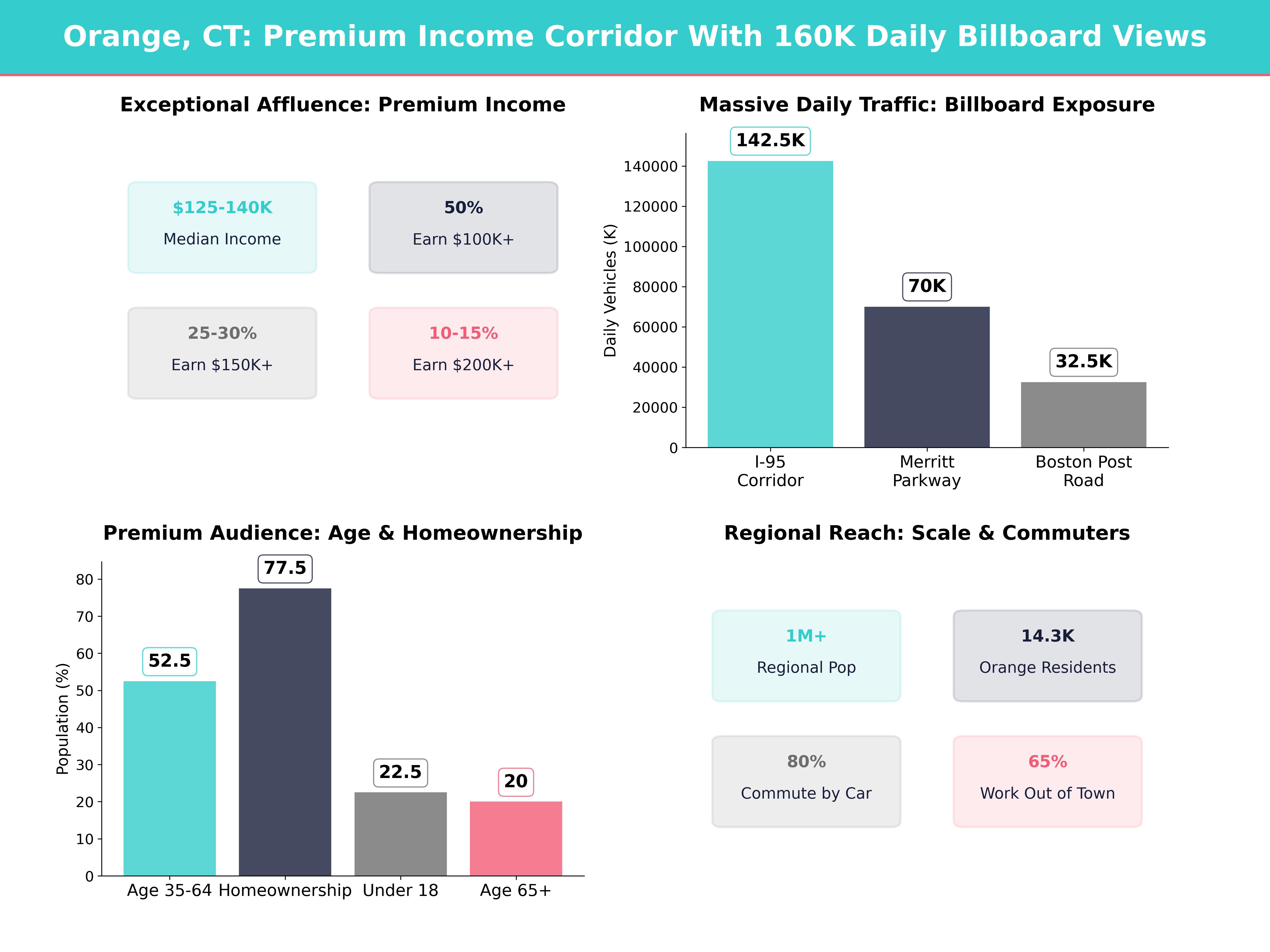
Orange combines older, established homeowners with families and professionals who commute to regional job centers. Suburban communities like Orange often have around 50–55% of residents aged 35–64, and many profiles indicate that roughly 18–22% of Orange’s population is 65+, with children and teens commonly making up around 20–25% of the local population. Median household income in the $125,000–$140,000 range and homeownership at 75–80% of households support categories like home improvement, healthcare, and financial planning.
What traffic makes Orange, Connecticut billboards effective?
Orange sits directly on U.S. Route 1 and is bordered by I‑95 and the Merritt Parkway, three of Connecticut’s highest-volume corridors. I‑95 New Haven–Milford stretch generally carries 120,000–160,000 vehicles per day, Boston Post Road in Orange/Milford commonly sees 25,000–40,000 vehicles per day, and Merritt Parkway near Orange-access points is typically 60,000–80,000 vehicles per day. Weekday commuter peaks on these corridors often see traffic volumes at 140–160% of midday baselines.
What seasonal events should I target with Orange, Connecticut billboards on Blip?
The Orange Country Fair, typically held each September, draws thousands of visitors over a weekend and often more than 10,000 total attendees across the fair’s run. The PEZ Visitor Center in Orange receives 75,000–80,000 visitors annually, and summer shoreline traffic can boost I‑95 and Route 1 volumes by 5–15% compared with off-season days. Blip’s ability to increase or decrease budgets by date makes it possible to push 20–50% more impressions on event weekends and pull back during slower periods.
Do I need a contract to advertise with Blip in Orange?
No, Blip has no long-term contracts or minimum commitments. You can start, pause, or stop your campaign at any time.
How fast can I launch a billboard campaign with Blip in Orange?
You can have your campaign live in minutes. Create a free account, select your locations, set your budget, upload your design, and start running once approved.
Where can I advertise with Blip in Orange?
Blip has digital billboards in Orange. You can browse available locations on a map, choose the ones that fit your audience, and start advertising right away.
Still have questions? Launch a campaign in minutes — no contracts, no commitments.
Start Your CampaignOrange Billboard Advertising Guide
Orange, Connecticut sits at a powerful crossroads of affluent suburbs, regional shopping, and heavy commuter traffic between New Haven and Fairfield County. When we use digital Orange billboards here, we’re speaking to high-income households, decision-makers on the road, and frequent shoppers who pass the same locations day after day. This guide walks through how to turn those impressions into measurable results using Blip’s flexible scheduling and creative tools, whether you’re exploring Orange billboard advertising for the first time or looking to optimize existing placements.
Understanding the Orange Market
Orange is a small town with outsized economic impact. According to recent estimates from the Town of Orange and state economic profiles, the town’s population is roughly 14,000–14,500 residents, but its daytime population swells significantly thanks to commuters, retail workers, and visitors drawn to Boston Post Road, the PEZ Visitor Center New Haven Milford
Key context:
- Orange sits directly on U.S. Route 1 (Boston Post Road) and is bordered by I‑95 and the Merritt Parkway (Route 15), three of Connecticut’s highest-volume corridors, all managed by the Connecticut Department of Transportation
- The town is part of New Haven County, which had about 860,000–870,000 residents as of the early 2020s, making it one of the state’s largest counties by population.
- Median household income in Orange is well above both Connecticut and U.S. medians; multiple state and town profiles place it in the $125,000–$140,000 range, with some estimates noting that more than 50% of households earn $100,000+ and roughly 25–30% earn $150,000+. That means a large share of your viewers have spending power for higher-margin products and services.
- Homeownership in the Orange area is consistently measured at 75–80% of households, well above many urban markets, which strongly supports categories like home improvement, landscaping, roofing, HVAC, and financial planning.
- The greater New Haven metro area supports more than 275,000 jobs, anchored by major employers such as Yale University, Yale New Haven Health, and advanced manufacturing and distribution hubs in nearby towns.
Local sources worth reviewing as you plan:
- Town government and community info: Town of Orange
- Local community and event info: Orange Economic Development Corporation
- Regional tourism and visitor behavior: CTvisit – New Haven Region Visit New Haven
- Regional economic and community news: New Haven Register New Haven Independent
- Regional TV and traffic/weather: WTNH News 8
- Neighboring municipal hubs: City of New Haven City of Milford City of West Haven
Because Orange is tightly connected to West Haven, and Milford, we should think of our billboard campaigns not just as “Orange-only,” but as part of the larger corridor between New Haven and Bridgeport, a stretch that supports over 1 million residents within an approximate 30–35 minute drive. This corridor view is essential when you’re evaluating Orange billboard advertising versus placements in adjacent communities.
Traffic Patterns and High-Value Corridors
Digital billboards in and around Orange largely concentrate along:
- I‑95 (Connecticut Turnpike): This interstate runs just south of Orange through nearby Milford and West Haven, carrying regional traffic between New York City and Rhode Island.
- U.S. Route 1 / Boston Post Road: The primary commercial strip through Orange, lined with big-box retailers, auto dealerships, restaurants, and services.
- Merritt Parkway (Route 15): A major commuter route slightly inland, connecting New Haven County to Fairfield County and beyond.
These routes represent the core spine for Orange billboards and determine how many impressions your campaign can realistically generate.
According to recent Connecticut Department of Transportation traffic counts
- I‑95 New Haven–Milford stretch: Generally 120,000–160,000 vehicles per day, with some segments near New Haven and Milford interchanges exceeding 165,000 vehicles per day.
- Boston Post Road (U.S. 1) in Orange/Milford: Commonly 25,000–40,000 vehicles per day, with volumes pushing toward the upper end of that range near major shopping centers, such as large retail clusters in Orange and the Connecticut Post Mall in Milford.
- Merritt Parkway (Route 15) near Orange-access points: Typically 60,000–80,000 vehicles per day, reflecting its role as a preferred commuter route for drivers traveling between New Haven County and Fairfield County.
Additional behavior patterns from regional planning agencies and municipal traffic studies show:
- Weekday commuter peaks on these corridors often see traffic volumes at 140–160% of midday baselines.
- Roughly 75–85% of workers in suburban towns like Orange commute by car, truck, or van, supporting the idea that most working-age adults are reachable via roadside media.
- Weekend traffic on I‑95 in summer months can rise 5–10% over non-summer baselines due to shoreline and tourism travel.
What this implies for our strategy:
- Commuter-heavy impressions: A large share of viewers are repeated commuters—professionals heading to New Haven Bridgeport, or Stamford 6:30–9:30 a.m. and 3:30–7:30 p.m. peaks.
- Retail-intent traffic: The Boston Post Road stretch is a destination for shopping and dining. With tens of thousands of vehicles daily and some retail nodes drawing several million visits per year, shoppers often arrive with a purchase in mind, making last-mile calls to action extremely effective (“Exit now for…”, “Next light, on your right”).
- Weekend variability: I‑95 volumes stay high on weekends, especially in summer, but local traffic on Route 1 can become more leisure-oriented (meals, errands, entertainment), with some retail centers reporting 20–30% of weekly sales concentrated in Saturday–Sunday periods.
When using Blip, we can concentrate spend on:
- Morning and evening rush hours on I‑95 and Route 15 to maximize high-frequency commuter reach.
- Midday and weekend bursts on Boston Post Road for retail, dining, and services when purchase intent is high.
- Directional targeting where available (e.g., eastbound vs. westbound) to catch commuters headed to or from specific hubs such as downtown New Haven, the Milford shoreline
Audience and Demographics: Who Sees Our Boards?
Orange combines older, established homeowners with families and professionals who commute to regional job centers. Understanding this audience is critical when deciding which billboards in Orange best match your ideal customer.
From town profiles, state labor statistics, and regional planning data, we can draw several useful points:
-
Age distribution:
- Suburban communities like Orange often have around 50–55% of residents aged 35–64, a prime target demographic for financial services, healthcare, home improvement, and high-ticket retail.
- Many profiles indicate that roughly 18–22% of Orange’s population is 65+, higher than many urban areas, aligning with strong demand for healthcare providers, senior living, financial planning, and home services.
- Children and teens (under 18) commonly make up around 20–25% of the local population, supporting family-oriented businesses and education services.
-
Income:
- Median household income in the $125,000–$140,000 range.
- It is common for 25–30% of households to earn $150,000+, and 10–15% to earn $200,000+, supporting luxury and premium brands such as high-end auto, specialty healthcare, and custom home services.
-
Commuter patterns:
- In similar commuter-heavy Connecticut suburbs, 60–70% of working residents travel outside their town for work.
- Major employment destinations for Orange residents include New Haven, Milford, Bridgeport, and Stamford, each with tens of thousands of jobs.
- New Haven alone has more than 130,000 residents and a daytime population that swells by tens of thousands of workers and students, particularly tied to Yale University and the Yale New Haven Health system.
-
Education and professions:
- Town and regional profiles indicate that 40%+ of adults in many New Haven County suburbs hold a bachelor’s degree or higher, well above national averages.
- There is an overrepresentation in professional, managerial, healthcare, legal, and educational occupations, with professional and related occupations frequently accounting for 35–45% of employed residents.
For creative and media planning, this means:
- We can confidently use messaging that assumes higher disposable income, familiarity with professional services, and comfort with digital behavior (online booking, QR codes in lower-speed zones).
- Offers around home ownership (remodeling, roofing, landscaping, HVAC, solar, financial planning, remodeling of 30–50-year-old homes) resonate strongly.
- Healthcare messaging (specialty practices, dental, orthopedics, vision) finds a ready audience, particularly when emphasizing convenience (evening hours, urgent care, walk-ins) and insurance acceptance.
- With commuters from other towns passing through, we are not limited to Orange businesses—regional brands within a 20–30-minute drive can benefit from a single Orange-area presence. Well-placed Orange billboards can effectively serve multiple neighboring markets from one central location.
Seasonal Events and Tourism Drivers
While Orange is not a traditional tourism hub like Mystic or coastal resort towns, it hosts and neighbors several attractions and events that meaningfully shift traffic patterns.
Notable drivers:
- Orange Country Fair: Typically held each September at the Orange Fairgrounds, this event draws thousands of visitors over a weekend, often multiple times the town’s daily baseline. Local reports frequently cite 10,000+ total attendees across the fair’s run, causing noticeable traffic surges on Route 1 and feeder roads. Learn more via the Orange Country Fair site.
- PEZ Visitor Center (Orange): Located right off I‑95, the PEZ Visitor Center 75,000–80,000 visitors annually, many of them families and tourists traveling the corridor. A meaningful portion visit between late spring and early fall, concentrating demand in a 4–5 month window.
- Proximity to New Haven events: New Haven’s schedule—Yale University events, concerts, festivals, and athletic events—brings tens of thousands of visitors into the region across the year. Major downtown events, graduations, and cultural festivals can each draw 5,000–20,000 attendees, adding to regional hotel, restaurant, and traffic demand. The City of New Haven Visit New Haven list many of these.
- Shoreline and summer traffic: Towns like West Haven, Milford thousands on peak summer weekends, which in turn boosts I‑95 and Route 1 traffic near Orange by 5–15% compared with off-season days.
How to integrate this into a Blip campaign:
- Event countdowns: In the 2–4 weeks leading up to the Orange Country Fair or major regional events, we can run rotating countdown creatives (“Orange Country Fair – 10 days!”) to build anticipation. For very short events, consider compressing to a 7–10 day burst with higher frequency.
- Tourism tie-ins: Restaurants, breweries, family attractions, and hotels can reference the PEZ Visitor Center or New Haven landmarks in their creatives during peak visitation periods. For example, “5 minutes from PEZ,” or “Stay in Orange, 10 minutes to Yale & Downtown New Haven.”
-
Summer schedule shifts: From late May through early September, lean into:
- Weekend-heavy, 10:00 a.m.–10:00 p.m. dayparts.
- Messaging around outdoor dining, HVAC and cooling, landscaping, recreational sales (boats, kayaks, bikes), and tourism.
- Short, urgent calls to action to capture spur-of-the-moment day trips.
By using Blip’s ability to increase or decrease budgets by date, we can push 20–50% more impressions on event weekends and pull back during slower periods, keeping monthly budgets stable while capitalizing on peaks. This kind of flexible approach is one of the biggest advantages of digital Orange billboard advertising compared with static boards.
Dayparting: Matching Messages to Mindsets
The same driver passes a billboard with very different needs at 7:30 a.m. than at 6:30 p.m. With Blip’s scheduling flexibility, we can match creative to those moments.
Typical daily patterns in the Orange area, supported by regional transportation and mobile-location data:
-
Morning drive (6:30–9:30 a.m.)
- Heavy commuter flows east-west along I‑95, Route 1, and Route 15.
- In many commuter corridors, 30–35% of weekday daily traffic occurs in the combined morning and evening peak windows.
- Viewers are time-constrained and destination-focused.
-
Effective campaigns:
- Service reminders (auto repair near work or home, oil change before a trip).
- Coffee and breakfast options (“Next exit for coffee,” “Turn right at the next light”).
- Professional services with short, benefit-led lines (“Lower your mortgage payment,” “Same-day urgent care”).
-
Midday (10:00 a.m.–3:00 p.m.)
- Mix of shoppers, retirees, stay-at-home parents, and service traffic.
- For many retail centers, 40–50% of weekday sales occur between late morning and late afternoon.
-
Good for:
- Retail, grocery, salons, healthcare appointments.
- B2B services targeting local business owners.
- We can emphasize details like store hours, promos, or directions because dwell time can be slightly higher in slower traffic.
-
Evening commute (3:30–7:30 p.m.)
- Return commuters, errands, and dining decisions.
- National and regional data often show 25–30% of weekday traffic in the afternoon/evening rush.
-
Strong use cases:
- Restaurants and takeout (“Skip cooking tonight,” “Kids eat free Tuesdays”).
- Gyms, fitness studios, and after-work services.
- Home improvement and home services with aspirational imagery.
-
Late evening (8:00–11:00 p.m.)
-
Lighter traffic but still valuable for:
- Entertainment (cinemas, bowling, escape rooms, bars).
- Streaming, app installs, and online services where QR codes can work in slower-moving traffic areas.
- Good for campaigns that do not need maximum reach but benefit from lower competition in the ad rotation.
-
Lighter traffic but still valuable for:
We should tailor not only our schedule but our creative per daypart. Because we can upload multiple creatives in Blip, consider:
- A concise, commute-focused creative for peak a.m. and p.m.
- A more offer-heavy, shopping-focused creative for late morning and midday.
- A lifestyle or entertainment-focused creative for evenings and weekends.
- Seasonal variations (at least 3–4 sets per year) for winter, spring, summer, and fall.
This level of dayparting control makes billboard rental in Orange feel more like running a digital ad campaign than a traditional fixed media buy.
Creative Strategy for Orange: What Works on the Screens
Given Orange’s demographics and traffic patterns, certain creative approaches consistently perform well.
Keep It Hyper-Local
Drivers respond when they immediately understand where we are:
- Use clear directional cues: “Exit 41 – Next Right,” “On Boston Post Rd, 0.5 miles ahead,” “Across from Costco” if applicable.
- Reference recognizable landmarks: PEZ Visitor Center, Home Depot, major plazas, or nearby exits.
- Use town names: “Serving Orange, Milford & West Haven” feels more relevant than a generic regional label.
- Research from outdoor advertising industry groups frequently shows that adding a simple distance cue like “2 miles ahead” can increase recall and response by 10–20% versus generic branding alone.
Design for High-Speed Viewing
On I‑95 and Route 15, vehicles often travel 55–65 mph. We should design for a 3–5 second read:
- Limit text to 6–10 words max.
- One bold focal image, high contrast.
- Large logo and a single, clear call-to-action.
- Avoid complex website URLs; use short domains or simple phrases, or direct users to search your name.
- Use high-contrast color combinations; studies from outdoor media associations show that strong contrast can improve legibility by up to 40% at highway speeds.
On Boston Post Road where speeds and congestion can be lower (often 25–40 mph in commercial zones), we can afford slightly more detail—perhaps a second line of text or a price point—but we should still aim for instant comprehension.
Align With Affluence and Professionalism
Because Orange skews high-income and educated:
- Emphasize quality, reliability, and expertise over deep-discount messaging, unless you’re explicitly a discount brand.
-
Professional services (attorneys, financial advisors, medical specialists, real estate teams) should showcase:
- A strong, clean logo.
- A short credibility hook (“30+ years serving New Haven County,” “Board-certified specialists,” “Top-rated in Connecticut”).
- A direct next step (“Call today,” “Book online,” “Visit our Orange office”).
- Consider featuring awards or ratings if recognizable locally (e.g., “Voted Best of New Haven 2024” from a local outlet like New Haven Register
Family and Lifestyle Imagery
With many families and older adults:
-
Use imagery of families, children, and multi-generational households for:
- Healthcare.
- Education and childcare.
- Family entertainment and dining.
-
Use lifestyle imagery that reflects suburban home life:
- Backyards, kitchens, patios, home offices.
- Outdoor activities common in Connecticut’s seasons (fall foliage, snow scenes, summer coastline).
- Consumer research frequently finds that ads featuring people can increase emotional engagement and recall by 15–30% vs. abstract visuals, particularly for family-focused services.
Seasonally Adaptive Messaging
Connecticut’s four seasons dramatically change needs and mindsets, and local businesses often see 20–40% swings in demand across seasons:
-
Winter (Dec–Feb):
- Roadside services, snow removal, HVAC, indoor entertainment, tax prep, and healthcare (flu shots, urgent care).
- Use visuals of warmth, safety, and comfort, and consider weather-triggered messaging (“Cold today? Call for heating service”).
-
Spring (Mar–May):
- Landscaping, roofing, painting, outdoor furniture, car dealerships, grad events.
- Bright, fresh colors and “renewal” themes. Many home services report spring lead volumes 20–50% higher than winter.
-
Summer (Jun–Aug):
- Beaches, ice cream, outdoor dining, kids’ activities, home cooling.
- Tap into day-trip tourism to the shoreline and PEZ Visitor Center with lines like “On your way back from the beach? Stop in Orange.”
-
Fall (Sep–Nov):
- Back-to-school services, fall sports, home maintenance before winter, healthcare checkups, fair and festival promotion.
- Orange Country Fair is a prime anchor event for localized campaigns; local businesses often see fair weekends deliver double or triple normal traffic when promotions align.
Using Blip, we can swap creatives by date so each season has its own message without changing our underlying campaign structure, effectively running a rolling 12-month content calendar for your Orange billboard advertising.
Industry-Specific Opportunities in Orange
Some verticals tend to see especially strong results in and around Orange given local behavior and infrastructure.
Auto Sales and Service
Boston Post Road and the I‑95 corridor are lined with dealerships and service centers extending from Orange into Milford and West Haven.
Opportunities:
- “This weekend only” sales layered on weekend-heavy schedules. Auto retailers often find that 30–40% of weekly showroom traffic occurs between Friday and Sunday.
- Service reminders targeting commuters (“Oil change on your way home – Exit 41”). Many drivers delay maintenance for months; frequent exposures (e.g., 20–40 impressions per commuter per month) can push them to act.
- Lease or financing offers targeting higher-income households (“Luxury lease from $499/mo”). In high-income suburbs, luxury and near-luxury brands tend to capture a larger share of registrations than the national average.
Healthcare and Wellness
Orange and neighboring towns host:
- Primary care practices, urgent care centers, and specialty clinics.
- Dental and orthodontic offices.
- Specialists serving broader New Haven County.
- Fitness centers and boutique studios.
Billboards are excellent for:
- New patient acquisition within a 10–20-minute drive radius, a range that routinely covers Orange, Milford, West Haven, and parts of New Haven and Woodbridge.
- Promoting new locations, urgent care centers, or walk-in hours; urgent care providers often see 15–25% patient volume growth in their first 6–12 months when backed by strong local awareness campaigns.
- Brand-building for multi-location practices that want to be top-of-mind across the New Haven–Milford corridor.
Consider linking in your own materials to local health anchors such as Yale New Haven Health or Griffin Health (Derby/Shelton area) when appropriate to signal regional integration.
Restaurants and Retail
With daily traffic counts of 25,000–40,000+ on Boston Post Road, last-mile advertising is critical:
- Highlight simple offers (“Lunch specials starting at $9.99,” “Kids eat free Wednesdays”).
- Provide simple directional cues (“Next right,” “Across from Target,” “1 mile ahead on Boston Post Rd”).
- Time promos to lunch, dinner, and weekend shopping peaks. Restaurants often see 60–70% of daily revenue concentrated in a few key hours; aligning billboard dayparts with those hours can amplify results.
- Many retailers report that adding clear directional and time-based messages (e.g., “Open late tonight”) increases in-store visits by 10–20% compared with generic brand-only creatives.
Home Services and Improvement
Given the high homeownership and aging housing stock in Southern Connecticut:
- Roofing, siding, windows, solar, HVAC, and plumbing campaigns work very well.
- In many local markets, 70–80% of home service customers come from within a 20–25-minute drive, matching Orange’s regional reach.
-
Use:
- Before/after or “problem/solution” visuals (“Leaky roof? Call us before the next storm”).
- Clear service area labels (“Serving Orange, Milford, New Haven & beyond”).
- Seasonal urgency (“Book your fall furnace tune-up now,” “Beat the summer heat – install central air”).
Education and Nonprofits
The region is dense with schools, colleges, and nonprofits:
- Private schools, enrichment centers, and tutoring programs can target parents during morning and afternoon commutes, especially on routes leading toward school clusters.
- Colleges and training programs in and around New Haven and Milford can run enrollment and open-house campaigns, particularly for spring and fall semester intakes.
- Nonprofits can promote fundraisers, awareness campaigns, and events, especially near New Haven. Local major events (walks, runs, galas) often aim for hundreds to several thousand participants, and outdoor visibility can play a key role in hitting those targets.
Geo-Targeting and Corridor Strategy
When we think about Orange, we should consider how far customers are realistically willing to travel. In this region, a 15–25-minute drive time is common for:
- Healthcare visits.
- Restaurant and shopping trips.
- Professional services (legal, financial, real estate, specialized trades).
That radius from Orange reaches:
- New Haven, West Haven, Milford, and Stratford along I‑95.
- Parts of Derby, Shelton
- Substantial portions of the greater New Haven labor market, which employs hundreds of thousands of workers.
Using Blip’s flexibility, we can:
-
Select boards on:
- I‑95 for regional reach and brand awareness, capturing through-traffic from New York and Rhode Island in addition to locals.
- Route 15 for commuter-focused services and higher-income Fairfield-bound drivers.
- Boston Post Road for conversion-focused, “exit now” messages linked to specific shopping centers or plazas.
-
Adjust our mix depending on our objective:
- Brand building: Heavier use of I‑95 and Route 15, broad daypart coverage, and consistent presence for 8–12 weeks at a time to build familiarity.
- Store traffic: Focus on Boston Post Road and boards nearest our location, with peak shopping and dining times, and shorter, more intensive 2–4 week promotional bursts.
This corridor-based planning helps ensure your billboard rental in Orange aligns with where your best customers actually travel.
Budgeting, Testing, and Optimization
To get the most from digital billboards in Orange, we should treat campaigns as living experiments.
Start with Clear Goals
Common KPIs include:
- Increased foot traffic or calls within a defined radius.
- Website visits or coupon redemptions tied to billboard-only codes or landing pages.
- Appointment bookings or event registrations.
- For many small and mid-sized businesses, a good starting benchmark is to aim for tens of thousands of impressions per month per key corridor and adjust based on observed response.
We can assign rough values to these conversions to decide what impression levels we need. For example:
- If a new customer is worth $500 on average,
- And you aim for 20 new customers from a 4-week campaign,
- You can work backward from $10,000 in revenue to decide what ad spend and impression volume make sense.
Use A/B Creative Testing
With multiple uploads allowed, we can test:
- Headline A vs. Headline B.
- “Price-focused” vs. “Benefit-focused” messaging.
- Different images (e.g., product shot vs. people-focused).
- Different calls to action (“Book online” vs. “Call today”).
Run each version for at least 1–2 weeks at similar impression levels and track downstream metrics (calls, site visits, walk-ins) as best you can. Even small improvements—like a 5–10% lift in calls—compound over time.
Adjust by Time and Location
After a few weeks:
-
Shift more of your budget to:
- Boards that correlate with stronger performance (as seen in store data or web analytics).
- Dayparts where you naturally see more conversions (e.g., dinner rush, weekend bookings, Monday–Wednesday for healthcare, Thursday–Sunday for dining).
-
Consider pulsing:
- Heavy weeks around events, sales, or busy seasons (e.g., home services in March–May and Sept–Nov, retail around back-to-school and holidays).
- Maintenance-level awareness in between, keeping your presence but at 30–50% of peak spend.
- Use tools like Google Analytics, call tracking, or POS reporting to compare “on” vs. “off” periods. Even without perfect attribution, directional trends (up 10–20% during flighted weeks) are useful.
This optimization mindset turns Orange billboard advertising into a measurable part of your marketing mix rather than a set-and-forget expense.
Practical Next Steps for Advertisers in Orange
To translate this guide into an actionable campaign:
- Define your service radius: Decide whether you want mostly Orange and Milford, or a broader New Haven to Bridgeport corridor. Consider where 80% of your current customers live today.
-
Choose primary corridors:
- I‑95 / Route 15 for broad exposure and commuting professionals.
- Boston Post Road for retail, dining, and immediate actions.
- Set your seasonal focus: Map out 12 months and mark high-priority windows (e.g., Orange Country Fair, back-to-school, tax season, summer tourism, year-end holidays).
-
Create 2–4 core creatives:
- At least one for commuters.
- One for weekend/shoppers.
- One for seasonal peaks (summer, holidays).
- Optional test variant for A/B comparison.
- Launch with a 4–8 week test: Use Blip to schedule your preferred dayparts and corridors, then monitor store, phone, or web activity. Aim for consistent impression levels during the test so results are clean.
- Refine based on data: Reallocate budget to best-performing times and creatives, add or remove boards based on performance, and keep iterating quarterly.
By understanding Orange’s traffic flows, demographics, and seasonal rhythms—and grounding your strategy in concrete data—you can use digital billboards in Orange not just as broad awareness tools, but as precise, flexible levers that drive measurable business outcomes all year long. Thoughtful billboard rental in Orange can anchor your regional visibility and support both short-term promotions and long-term brand growth.