Billboards in Milford, CT
No Minimum Spend. No Long-Term Contracts. Just Results.
Trusted by Leading Brands


Billboard advertising
in Milford has never been easier
How much is a billboard in Milford?
Why Choose Blip for Billboard Advertising in Milford
-
Blip lets you launch Milford billboards fast on I-95 and Boston Post Road, reaching commuters and shoreline visitors without a long setup.
-
Use flexible budgets in Milford to test weekend beach traffic at Silver Sands and scale up when summer spikes hit.
-
Daypart your Milford campaign for 7-9 a.m. and 4-6 p.m. commuters, or midday shoppers near Connecticut Post Mall.
-
No contracts means you can pivot Milford ads for holiday retail, back-to-school, or summer tourism as seasons change.
-
Track Milford billboard results in real time and shift spend from I-95 reach to Route 1 detail as clicks and visits tell you what works.
-
Blip's creative tools help Milford brands make bold, simple ads for fast highway drivers, mall shoppers, and beachgoers alike.
Frequently Asked Questions About Billboard Advertising in Milford
How much does a billboard cost in Milford, Connecticut with Blip?
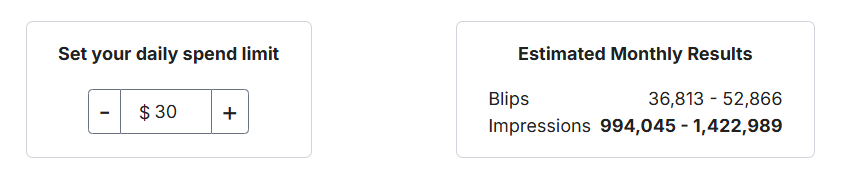
With Blip, you control exactly what you spend on Milford billboards by setting a daily budget that can be adjusted anytime, so your campaign always stays within your comfort zone. Each 7.5–10 second “blip” is individually priced based on when and where it runs, plus real-time advertiser demand, so you only pay for the exposure you actually receive. Because Blip uses pay-per-blip pricing, the total cost of your campaign is simply the sum of your chosen blips on billboards in Milford, Connecticut.
Where can I advertise with Blip in Milford, Connecticut?
Milford sits at a transportation crossroads for coastal Connecticut, so the highest-impact corridors include Interstate 95, U.S. Route 1, and areas near the Connecticut Post Mall. I-95 cuts directly through Milford with multiple exits, while Route 1 is a dense commercial strip with auto dealerships, restaurants, big-box retail, and the mall. Local arterials and beach access routes are also prime spots for more targeted billboards in Milford aimed at beachgoers and day-trippers.
Who sees Milford, Connecticut billboards with Blip?
Milford is a mid-sized coastal city with strong household incomes and year-round economic activity, which makes billboard advertising effective for both brand building and direct response. The city has roughly 50,000–51,000 residents, median household income of about $95,000–$100,000, and a median age in the low-40s. The mix of local residents, shoreline visitors, and I-95 through-traffic makes Milford billboards unusually versatile.
When is the best time to run Blip billboards in Milford, Connecticut?
Milford’s coastal climate and regional role create distinct advertising seasons, so timing matters for getting the most from your campaign. Summer is peak tourism and beach season, while fall brings back-to-school, Halloween, and the December shopping season. The page also notes that peak auto volumes are typically between 7–9 a.m. and 4–6 p.m., which aligns well with commuter dayparting.
Why is I-95 important for billboard advertising in Milford, Connecticut?
I-95 cuts directly through Milford with multiple exits 35–40 and carries about 140,000–160,000 vehicles per day according to Connecticut DOT. A well-placed, highway-visible digital board can deliver millions of impressions per month at peak frequency. The Milford segment captures commuters, long-distance New York-to-Boston traffic, and seasonal tourism traffic headed to shore destinations.
Do I need a contract to advertise with Blip in Milford?
No, Blip has no long-term contracts or minimum commitments. You can start, pause, or stop your campaign at any time.
How fast can I launch a billboard campaign with Blip in Milford?
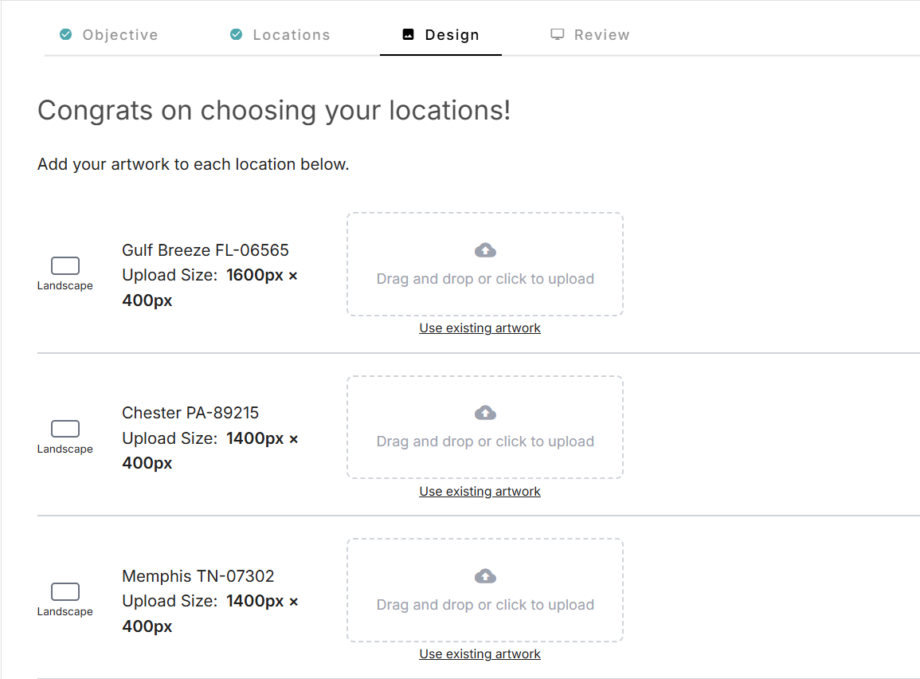
You can have your campaign live in minutes. Create a free account, select your locations, set your budget, upload your design, and start running once approved.
Where can I advertise with Blip in Milford?
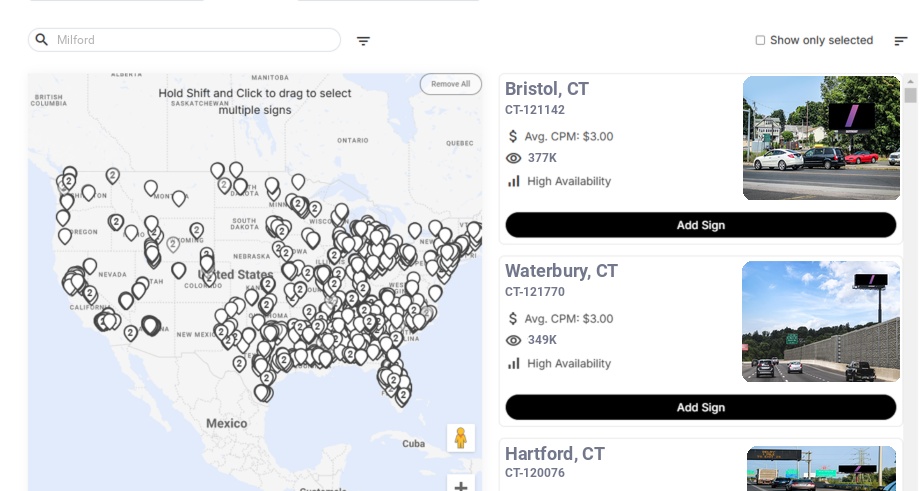
Blip has digital billboards in Milford. You can browse available locations on a map, choose the ones that fit your audience, and start advertising right away.
Still have questions? Launch a campaign in minutes — no contracts, no commitments.
Start Your CampaignMilford Billboard Advertising Guide
Milford, Connecticut, blends small‑city stability with coastal tourism and heavy regional commuting. That mix makes local digital billboards unusually versatile: we can reach everyday residents, shoreline visitors, and I‑95 through‑traffic with the same campaign—then fine‑tune timing, boards, and creative in real time with Blip. When you use Milford billboards strategically, you can connect with all three of these audiences in a single, coordinated plan.
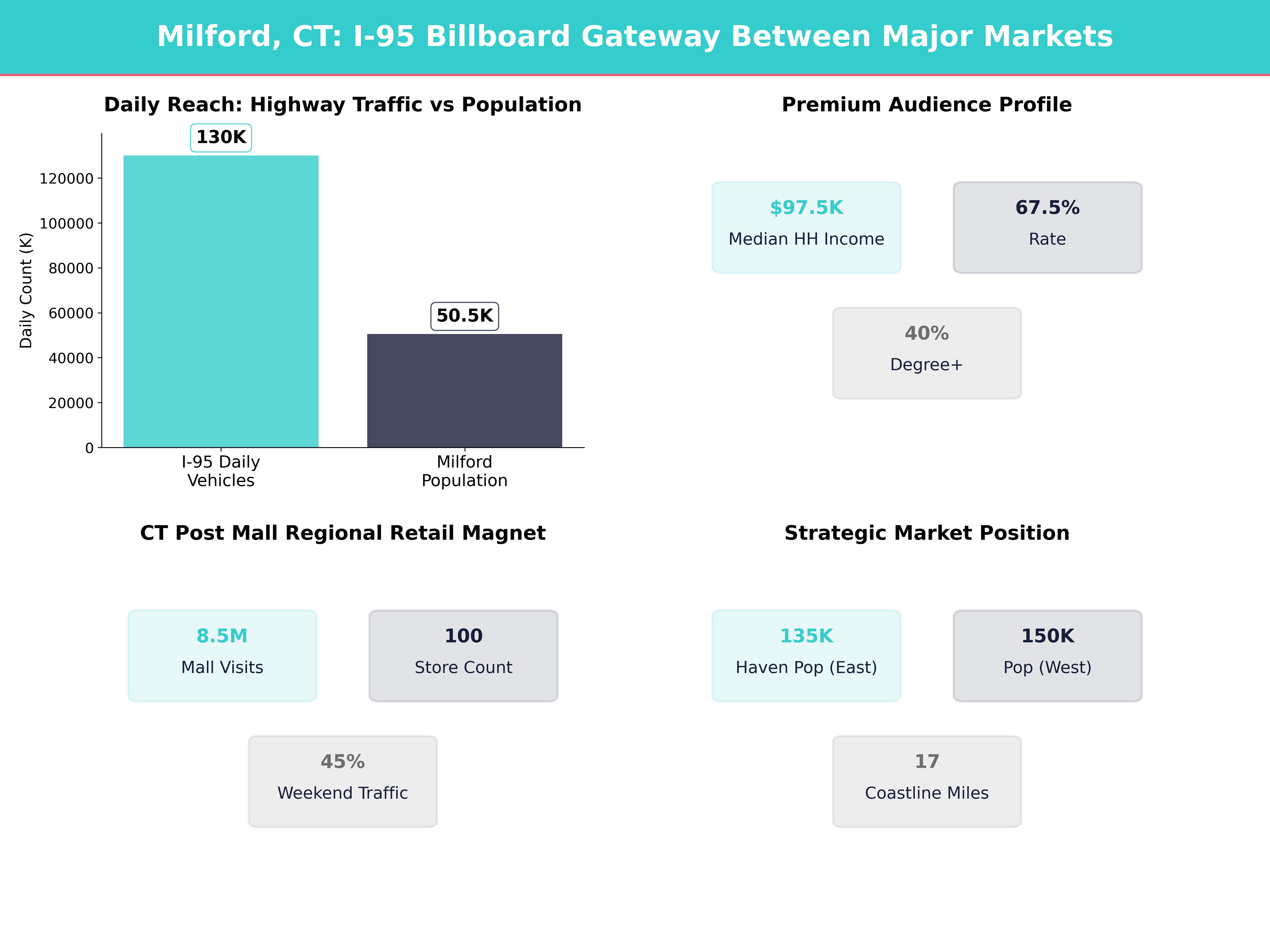
Milford at a Glance: Who We’re Reaching
Milford is a mid‑sized coastal city with strong household incomes and year‑round economic activity, which makes Milford billboard advertising especially effective for both brand building and driving direct response.
- Population: roughly 50,000–51,000 residents (the 2020 count was just over 50,500 according to state demographic summaries)
- Median household income: about $95,000–$100,000, significantly above the U.S. average and higher than the Connecticut median of roughly $90,000
- Land area: about 23 square miles, including 17+ miles of coastline and more than 1,400 acres of parks and open space documented by the City of Milford Recreation Department
- Households: just over 20,000 housing units, with homeownership rates around 65–70%
- Median age: in the low‑40s, indicating a mix of young families, established professionals, and retirees
- Education: more than 40% of adult residents hold at least a bachelor’s degree, supporting demand for professional and premium services
Commuting patterns are essential for billboard strategy and help us decide where Milford billboards will have the most impact:
- Average one‑way commute: about 26 minutes, similar to the Connecticut average
- Roughly 75–80% of workers drive alone, with another 7–10% carpooling
- Around 8–12% use public transportation, largely via Metro‑North’s New Haven Line from the Milford train station
- Major job centers nearby: New Haven Bridgeport (population ~150,000) is 15–20 minutes west via I‑95 or the Post Road. Both cities are major employment hubs with a combined metropolitan workforce in the hundreds of thousands, according to regional labor data from the South Central Regional Council of Governments MetroCOG
Key local context and resources:
- City government and community data: City of Milford
- Tourism and business: Discover Milford CT and the Milford Regional Chamber of Commerce
- Regional news and trends: CTPost – Milford section Milford Patch
- Transit and traffic projects: Connecticut Department of Transportation Milford Transit District
These demographics tell us that clear, benefits‑driven messaging that speaks to families, commuters, and coastal lifestyles will resonate most in Milford. The combination of above‑average incomes, strong homeownership, and educated commuters also supports higher‑ticket offers (home services, healthcare, financial products) alongside everyday retail, making billboard rental in Milford a viable option for both local and regional brands.
Traffic Corridors That Matter for Digital Billboards
Milford sits at a transportation crossroads for coastal Connecticut. To plan an effective campaign using billboards in Milford, we should prioritize the highest‑impact corridors:
Interstate 95 (Connecticut Turnpike)
I‑95 cuts directly through Milford with multiple exits (35–40). According to Connecticut DOT 140,000–160,000 vehicles per day, with average annual daily traffic (AADT) near Milford regularly exceeding 130,000 vehicles. This means a well‑placed, highway‑visible digital board can deliver millions of impressions per month at peak frequency.
Milford’s segment captures:
- Daily commuters traveling between New Haven, Milford, Stratford, and Bridgeport
- Long‑distance traffic between the New York City metro and Rhode Island/Massachusetts; the New York–Boston corridor moves tens of thousands of through‑vehicles daily
- Seasonal tourism traffic headed to shore destinations and Cape Cod; summer weekend volumes on I‑95 can spike 10–20% above typical weekdays, according to DOT seasonal traffic reports
For I‑95‑visible boards, we should use:
- Short, high‑contrast messages (traffic moves quickly, often at 55–65 mph; drivers typically have 5–8 seconds to absorb a message)
- Brand awareness and directional cues (“Next 2 Exits,” “Right off Exit 39B”)
- Time‑sensitive offers only when we know we’re catching drivers close to our location
U.S. Route 1 (Boston Post Road)
In Milford, the Boston Post Road is a dense commercial strip with auto dealerships, restaurants, big‑box retail, and the Connecticut Post Mall (one of the largest malls in the state, with 100+ stores, over 1 million square feet of leasable space, and historically 7–10 million visits per year based on regional retail reports).
Traffic along Route 1 is typically slower and more local than I‑95:
- Typical posted speeds of 25–40 mph
- Daily traffic counts commonly in the 20,000–30,000 vehicles per day range on busy Milford segments, per local traffic studies
This makes Route 1 ideal for:
- Retail, restaurant, and service promotions
- “Tonight only,” “Weekend sale,” and other tactical messages
- Creative that includes a bit more copy (while still staying billboard‑friendly) and can support more detailed Milford billboard advertising messages
Connecticut Post Mall & Retail Hubs
The mall, combined with adjacent centers, pulls shoppers from Milford, Orange, West Haven, and Stratford. Trade‑area data for regional malls of this size typically show 60–70% of visitors coming from within a 10–15 mile radius and 30–40% from farther afield.
Visit patterns:
- Weekends and late‑afternoon/early‑evening periods see especially heavy volumes; shopping center analytics commonly show Friday–Sunday accounting for 40–50% of weekly traffic
- The November–December holiday season can generate 20–25% of annual mall sales and double‑digit increases in foot traffic compared to off‑peak months
If our audience includes:
- Families shopping for back‑to‑school
- Holiday gift buyers
- Casual diners and entertainment seekers
then concentrating impressions around the mall area and Route 1 is extremely efficient, especially when combined with I‑95‑visible Milford billboards that build broader awareness.
Local Arterials & Beach Access Routes
Milford’s shoreline and parks draw significant visitor traffic:
- Silver Sands State Park hosts well over 500,000 visitors annually, based on Connecticut recreation usage reports from the CT Department of Energy & Environmental Protection
- Beaches like Walnut Beach Gulf Beach thousand beachgoers per day across Milford’s shoreline.
- The Milford Harbor
Relevant arterials and connectors feed this activity, including local roads linking I‑95 and Route 1 to Silver Sands and beach neighborhoods. When Blip inventory is available near these routes, it is ideal for:
- Seasonal promotions (ice cream, waterfront dining, events)
- Recreation‑related services (boat rentals, fishing charters, outdoor gear)
- Lodging and short‑term rentals
These local arterials are prime spots for more targeted billboards in Milford aimed at beachgoers and day‑trippers.
Seasonality: Timing Campaigns to Milford’s Calendar
Milford’s coastal climate and regional role create distinct advertising “seasons.” With Blip’s flexible scheduling, we can align spend and messaging with these patterns instead of running a static annual campaign. Seasonality matters not just for messaging, but also for how you schedule billboard rental in Milford to match your busiest periods.
Winter (January–March)
-
Activity:
- Post‑holiday slowdown in tourism but steady local demand for services.
- Retail often sees 10–20% lower foot traffic than peak Q4, while fitness centers typically experience a 10–15% membership bump tied to New Year’s resolutions.
- Tax season prep and home‑improvement planning ramp up, with many households receiving refunds in February–March.
-
Strategy:
- Emphasize financial services, home improvement planning, fitness, and healthcare—categories that benefit from winter planning behavior.
- Use evening commute and weekend daytime slots when people are running errands or heading to indoor venues.
- Promote services that address winter pain points: heating, auto repair, snow removal, indoor entertainment.
Spring (April–June)
-
Activity:
- Graduation season, homebuying and moving, outdoor dining opening, shoreline visits starting to ramp up.
- In many Connecticut communities, 30–40% of annual home sales close between April and June.
- Landscaping, roofing, and renovation inquiries often jump 20–30% from winter levels once weather improves.
-
Strategy:
- Increase presence near retail and service corridors (Route 1, mall approaches).
- Showcase landscaping, contractors, real estate, weddings/events, and education programs.
- Use positive imagery: greenery, coastal visuals, and bright colors that stand out after winter.
Summer (July–August)
-
Activity:
- Peak tourism and beach season. Silver Sands State Park and Milford’s beaches are busiest, especially on weekends and holidays like July 4.
- State park data show summer months accounting for 60–70% of annual visitors at popular shoreline parks.
- Restaurants with patios and ice cream shops can see 30–50% higher sales on hot weekends compared to off‑season.
-
Strategy:
- Temporarily raise bids and frequency on weekends and holiday periods when roads to beaches and I‑95 see surges.
-
Focus on:
- Restaurants, bars, and ice cream/frozen treats
- Waterfront experiences, boat tours, and outdoor recreation
- Local events and festivals promoted by the city and Milford Regional Chamber of Commerce / Discover Milford
- Feature weather‑relevant creative: “Beat the heat,” “After the beach, stop at…”
Fall (September–December)
-
Activity:
- Back‑to‑school, college commuting (many residents connect to New Haven schools like Yale University and Southern Connecticut State University), Halloween, Thanksgiving, and the December shopping season.
- Retailers typically generate 20–30% of annual revenue in November–December alone.
- Youth activities and tutoring programs often see enrollment spikes of 15–25% at the start of school terms.
-
Strategy:
- Early fall: Target back‑to‑school and after‑school programs, tutoring, kids’ activities.
- October: Highlight Halloween events, pumpkin patches, local attractions, and fall festivals promoted through Discover Milford CT.
-
November–December:
- Ramp up retail and e‑commerce campaigns leading into Black Friday and Christmas.
- Focus heavily on Route 1 and Connecticut Post Mall approaches, plus I‑95 for broader reach.
- Use countdown‑style messages (“3 Days Left,” “Ends Sunday”) and gift‑oriented visuals.
Dayparting: Reaching Milford’s Audiences at the Right Times
Because most Milford workers drive—and many commute to nearby cities—we can sharpen our campaigns by targeting specific time windows. Regional commute surveys in coastal Connecticut consistently show peak auto volumes between 7–9 a.m. and 4–6 p.m., aligning well with digital billboard dayparting.
Thoughtful dayparting also helps make each dollar you spend on Milford billboards work harder, by serving impressions when your audience is most likely to see and act on them.
Morning Commute (6–9 a.m.)
- Audience: Professionals driving toward New Haven, Bridgeport, and local Milford offices; parents after school drop‑off. In many towns, 60–70% of commuters start work between 7 and 9 a.m.
-
Best for:
- Coffee shops and breakfast options (“Exit 39B – Coffee in 2 Minutes”)
- Transit alternatives (rideshare, shuttle services, park‑and‑ride messaging)
- B2B brands (IT services, staffing, office solutions) raising awareness among decision‑makers on their way to work
-
Creative tips:
- Keep copy minimal and direct; morning drivers are task‑oriented.
- Messages like “Beat Traffic,” “Save 20 Minutes,” or “Start Your Day Better” perform well.
Midday (11 a.m.–2 p.m.)
- Audience: Local workers on lunch, stay‑at‑home parents, retirees, and flexible/remote workers. In office districts, 30–40% of daily restaurant traffic often occurs during this window.
-
Best for:
- Restaurants, quick‑service food, and cafés
- Medical appointments, wellness services, and salons
- Retail promos aimed at local Milford and Orange/West Haven shoppers
-
Creative tips:
- Include time‑bound prompts: “Lunch Special Today,” “Same‑Day Appointments.”
- Feature appetizing food photography and simple offers.
Afternoon & School Dismissal (2–5 p.m.)
- Audience: Parents on school pickup routes, after‑school activities, and early‑shift commuters. Many K–12 dismissal times cluster between 2:30 and 3:30 p.m., creating mini‑peaks on local roads.
-
Best for:
- Kids’ programs (tutoring, sports clubs, arts and music lessons)
- Family dining and casual entertainment
-
Creative tips:
- Lean into family‑friendly visuals and clear directions from key schools or main roads.
Evening Commute & Prime Time (4–8 p.m.)
- Audience: Homeward‑bound commuters and evening diners/shoppers. Nationally, 35–45% of weekday restaurant visits occur after 4 p.m., and similar patterns hold in suburban Connecticut.
-
Best for:
- Restaurants and happy hours
- Retail, gyms, and entertainment (movie theaters, bowling, escape rooms)
- Reminder ads for services: “Call tonight, service tomorrow.”
-
Creative tips:
- Use “on your way home” framing: “Dinner Tonight?”, “Stop In Before You Head Home.”
Weekends
- Audience: Shoppers, beachgoers, tourists, and families on leisure trips. For many brick‑and‑mortar retailers, 40–50% of weekly sales happen on Saturday and Sunday.
-
Best for:
- Events, festivals, farmers’ markets
- Shoreline activities and seasonal attractions
- Big‑ticket retail (autos, furniture, home improvement)
-
Creative tips:
- Play up relaxation and experiences rather than chores.
- Emphasize proximity: “5 Minutes from Silver Sands,” “Across from Connecticut Post Mall.”
Creative Strategy: Designing Billboards That Fit Milford
Given Milford’s road speeds and audiences, billboard artwork should be both simple and locally attuned. Industry studies show that reducing billboard copy from 13+ words to 7 or fewer can improve recall by up to 30–40%, especially on high‑speed roads. This is particularly important on I‑95, where Milford billboards must communicate in seconds to busy commuters and visitors.
1. Match Copy Length to Road Type
-
I‑95 and fast arterials (45–55+ mph):
- Aim for 6–8 words total.
- Example: “Milford’s Fastest Oil Change – Exit 40.”
-
Route 1 and slower corridors (25–40 mph):
- Can stretch to 10–12 words but still keep hierarchy clear.
- Example: “Back‑to‑School Shoes Under $40 – Boston Post Rd, Next Light.”
2. Use Local Landmarks and Orientation
Milford residents intuitively navigate via:
- Exit numbers on I‑95 (35–40)
- “Boston Post Road,” “across from the mall,” “near Silver Sands”
- Neighboring towns (Orange, West Haven, Stratford)
Using these in copy increases response without extra words:
- “2 Minutes from Exit 39A”
- “Across from Connecticut Post Mall”
- “Just Past Silver Sands Turnoff”
You can further localize by referencing:
- “By the Milford Green
- “Near Milford Harbor & Marina”
- “Next to the Train Station
These location cues help your billboards in Milford feel immediately relevant to locals and visitors alike.
3. Visual Style for Coastal Connecticut
Milford’s identity is strongly tied to the shoreline and New England character:
- Lean into crisp, clean designs, blues and greens, and simple photography.
- For tourism, hospitality, and restaurants, integrate coastal imagery (beaches, boats, sunsets), but
- Ensure high contrast: white or bright text on dark overlays so nothing disappears against sky or water backgrounds.
- Maintain a strong logo presence; research shows clear logo placement can improve brand recognition by 20–30% in out‑of‑home campaigns.
4. Think Mobile: Many Viewers Are in Motion
- Use one main idea per creative.
- Large, legible typography—avoid thin fonts and small URLs.
- Prefer short URLs or simple search prompts: “Search ‘Milford Moving Co’.”
- Phone numbers: only if they’re extremely simple; otherwise, emphasize brand name or search term.
- Consider adding QR codes only on slower roads like Route 1 where dwell time is longer; tests often show 10–15% of engaged viewers scanning when safe and convenient.
Audience Opportunities by Industry
Because Milford lies between major employment and education hubs, several verticals are especially well‑suited to digital billboards. The city’s above‑average incomes and strong commuter base mean many categories can support higher average transaction values than the national norm, which strengthens the case for ongoing billboard rental in Milford.
Local Retail & Restaurants
- Target: Residents plus shoppers coming from Orange, West Haven, and Stratford. The combined population of these nearby towns exceeds 150,000, expanding Milford’s natural trade area.
-
Tactics:
- Focus on Route 1, mall approaches, and exits 39–40 on I‑95.
- Run stronger frequency on weekends and evenings when dining and shopping peaks.
-
Use rotating creatives:
- Brand awareness (“Milford’s Favorite Pizza Since 1980”)
- Offer‑based (“Buy 1 Get 1 Mondays”)
- Seasonal (“Patio Now Open”)
- Data note: Restaurant and retail advertisers in similar Connecticut corridors often see 5–15% uplifts in foot traffic during active out‑of‑home campaigns, especially when combined with search and social.
Home Services & Contractors
Milford’s housing stock skews toward single‑family homes with solid homeownership rates, making it fertile ground for:
- Roofing, siding, and windows
- HVAC and plumbing
- Landscaping and tree services
- Solar installers
In communities with 65–70% homeownership and median home values well above $300,000, spending on maintenance, upgrades, and energy efficiency is typically robust.
Strategy:
- Run campaigns March–November, when home projects are active. In New England, industry data show 70–80% of exterior projects booked in this window.
- Prioritize commuter routes and local arterials where homeowners live and drive.
- Use proof‑oriented messaging: “Over 2,000 Milford Homes Served,” “Rated #1 in New Haven County.”
- Tie into local credibility by highlighting reviews on regional platforms or memberships in the Milford Regional Chamber of Commerce.
Healthcare & Wellness
Milford is served by facilities like the Bridgeport Hospital Milford Campus
-
Promote:
- Urgent care and walk‑in clinics
- Dental practices
- Physical therapy and orthopedic services
- Mental health and counseling services
-
Data context:
- In many Connecticut suburbs, healthcare and social assistance are among the top 3 employment sectors, and outpatient visits per resident commonly exceed 3–4 visits per year.
-
Strategy:
- Timely creative: “Urgent Care Open Until 9 p.m.”
- Focus impressions close to facilities and during after‑work hours.
- Emphasize access: “Walk‑Ins Welcome,” “Most Insurance Accepted,” “Same‑Day Appointments.”
Education, Training & Child‑Focused Services
With many families and proximity to New Haven’s colleges, education advertising can perform well:
- Private schools, tutoring centers, test‑prep
- Childcare and enrichment programs
- Community and adult‑learning courses (often promoted by the Milford Public Schools or Milford Adult Education
Strategy:
- Concentrate campaigns around August–September and January, when families re‑evaluate schooling and activities; these windows can account for 50%+ of annual enrollments for many programs.
- Emphasize outcomes and trust: “SAT Scores Up 150+ Points on Average,” “Licensed, CPR‑Certified Staff.”
- Use local proof: “Serving Milford Families for 15+ Years,” “Trusted by 300+ Local Parents.”
Tourism, Events & Entertainment
Milford’s events calendar—from summer concerts and fairs to holiday festivities—creates recurring opportunities:
- Signature events promoted on Discover Milford CT and via the City of Milford draw thousands of attendees, with major festivals often exceeding 5,000–10,000 visitors over a weekend.
- Use billboard campaigns to boost attendance and ticket sales, especially in the final 2–3 weeks before an event when awareness spikes convert to action.
- Collaborate with organizations featured on Discover Milford CT’s events page.
- Tie creative to dates: “This Saturday Only,” “Fridays on the Green All Summer.”
- For indoor venues like cinemas, bowling alleys, or escape rooms, emphasize rainy‑day or off‑season entertainment when beach visits dip.
Using Local Data to Optimize Your Blip Campaign
We can turn Milford‑specific data into actionable campaign choices that improve the ROI of billboards in Milford:
-
Population & Income → Message Positioning
With median incomes around $95k–$100k, Milford supports:- Value‑oriented offers (people still appreciate savings)
- But also premium positioning for quality services, private education, and specialty healthcare
- Household spending models for similar income bands show more than $20,000 per year in discretionary spending, on average
- Test both “Save $X” and “Best in Milford” messaging to see which drives more response.
-
Commuting Patterns → Daypart Focus
Since three‑quarters of workers drive, and average commute is ~26 minutes:- Invest in morning and evening commute windows Monday–Friday, when traffic data from CT DOT
- Use weekend daytimes for leisure, tourism, and large‑ticket retail.
- If your audience includes rail commuters to New Haven or Bridgeport, consider boards near the Milford train station
-
Traffic Volumes → Board Selection & Budget Allocation
A single I‑95‑visible location may impact 100,000+ daily drivers, but with rapid movement.- Pair at least one I‑95 board (for reach) with slower‑speed, local boards near your business (for detail and directional info).
- Allocate higher bids to peak‑value periods (e.g., summer weekends for beach‑related businesses, November–December for retail).
- Use performance data: if a location near Route 1 consistently aligns with higher web traffic or store visits, shift 10–20% more budget there.
-
Seasonality → Flexible Creative Rotation
Instead of one static creative for 12 months:- Plan 3–4 versions per year (winter, spring, summer, holiday).
- Swap creatives to match context: snow removal in January, AC repair in July, holiday shopping in November.
- Advertisers who rotate seasonal creative on digital out‑of‑home often see 20–30% better ad recall than those running a single evergreen message.
-
Local News & Events → Agile Messaging
Monitoring outlets like CTPost – Milford Milford Patch helps us:- Tie messages to local happenings (festivals, new school openings, road construction patterns).
- Promote timely community involvement: sponsorships, charity drives, and local partnerships.
- React to weather, travel advisories, or transit changes reported by CT DOT Milford Transit District, adjusting messaging accordingly.
Practical Tips for Launching and Scaling in Milford
To make the most of a Milford‑focused digital billboard campaign with Blip, we recommend a phased, data‑driven approach. This approach applies whether you’re testing a single board or planning a larger mix of Milford billboards across multiple corridors.
-
Start with a 4–6 Week Test
-
Include at least:
- One I‑95 or major highway‑visible board for reach (targeting 100,000+ daily impressions where possible).
- One Route 1 / retail‑area board for local action (where speeds allow slightly longer copy and QR codes).
- Spread impressions across commute times + weekend afternoons.
- Aim for a minimum of 10–20 impressions per day per board for smaller budgets, scaling up as results warrant.
-
Include at least:
-
Use 2–3 Creatives from Day One
- Version A: Brand awareness (“Milford’s Trusted [Service] Since 1999”).
- Version B: Strong offer (“$50 Off This Week Only”).
- Version C: Directional (“Exit 39A – Right on Boston Post Rd”).
- Reviewing performance after 2–3 weeks often reveals a clear winner; pausing the lowest‑performing creative can reallocate 30–50% of impressions to the best‑performer.
-
Track Response with Simple Signals
- Unique offer codes for “billboard only.”
- Landing pages or URLs only mentioned on billboards.
- Ask new customers “Where did you hear about us?” and track “billboard” responses.
- Compare periods with active billboard flighting to prior weeks; even 5–10% lifts in calls, web sessions, or in‑store visits can justify scaling.
-
Refine by Time and Location
-
After a few weeks, re‑allocate budget to:
- Times with more web traffic, calls, or store visits (for many businesses, that’s lunchtime and early evening).
- Locations closer to top‑performing ZIP codes such as 06460 and 06461, or nearby communities sending you the most customers.
- Consider increasing bids 10–25% on your top‑performing corridors while trimming low‑impact placements.
-
After a few weeks, re‑allocate budget to:
-
Build a Year‑Round Calendar
- Identify your peak seasons (e.g., home services in spring/fall, retail Q4, tourism summer).
-
Pre‑plan creative swaps aligned with Milford’s seasonal rhythms:
- Beach season, back‑to‑school, holiday shopping, and winter services.
- Coordinate with the local events calendar on Discover Milford CT and the City of Milford to ride natural spikes in tourist and resident activity.
By layering Milford’s local realities—traffic patterns, incomes, commuting flows, and coastal seasonality—onto the flexibility of Blip’s digital billboard platform, we can design campaigns that are not only visible, but truly relevant. That relevance, supported by data on who is on the road, when, and why, is what turns passing impressions on I‑95 and the Boston Post Road into measurable growth for businesses throughout Milford and the surrounding shoreline communities, and makes Milford billboard advertising a powerful component of your overall marketing mix.