Billboards in Cromwell, CT
No Minimum Spend. No Long-Term Contracts. Just Results.
Trusted by Leading Brands


Billboard advertising
in Cromwell has never been easier
How much is a billboard in Cromwell?
Why Choose Blip for Billboard Advertising in Cromwell
-
Launch in Cromwell fast with Blip’s self-serve platform and reach I-91 and Route 9 commuters without old-school buying hassles.
-
Cromwell’s 80% drive-alone commuters make flexible dayparting powerful—run Blip ads for morning Hartford trips or evening return traffic.
-
No contracts in Cromwell mean you can test around the Travelers Championship and pause or scale as visitor traffic changes.
-
Use Blip’s real-time analytics in Cromwell to see what performs on I-91 vs. Berlin Road, then shift budget to the better corridor.
-
Blip’s creative tools help you tailor Cromwell billboards for local retail, Middletown, and golf-season visitors with fast refreshes.
Frequently Asked Questions About Billboard Advertising in Cromwell
How much does a billboard cost in Cromwell with Blip?
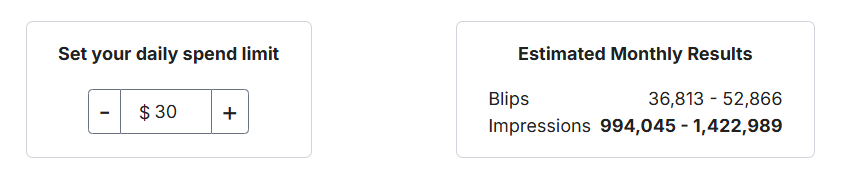
With Blip, the cost of billboard advertising in Cromwell can be surprisingly accessible because you only pay when your ad actually appears. Each “blip” is a 7.5-to-10-second display on a rotating digital billboard, and pricing starts at $0.01 per display. You set a daily budget, and Blip’s algorithm uses it to bid for open ad slots, helping maximize your reach without overspending.
Where can I advertise with Blip in Cromwell?
Cromwell is a strong billboard market because it combines small-town efficiency with central Connecticut reach. The town sits at the crossroads of Interstate 91, Route 9, and local retail corridors that connect us to Hartford, Middletown, Berlin, and Meriden. That means a Cromwell campaign can speak to commuters moving between job centers, suburbs, and destination districts.
Why is Cromwell a good place for billboard advertising?
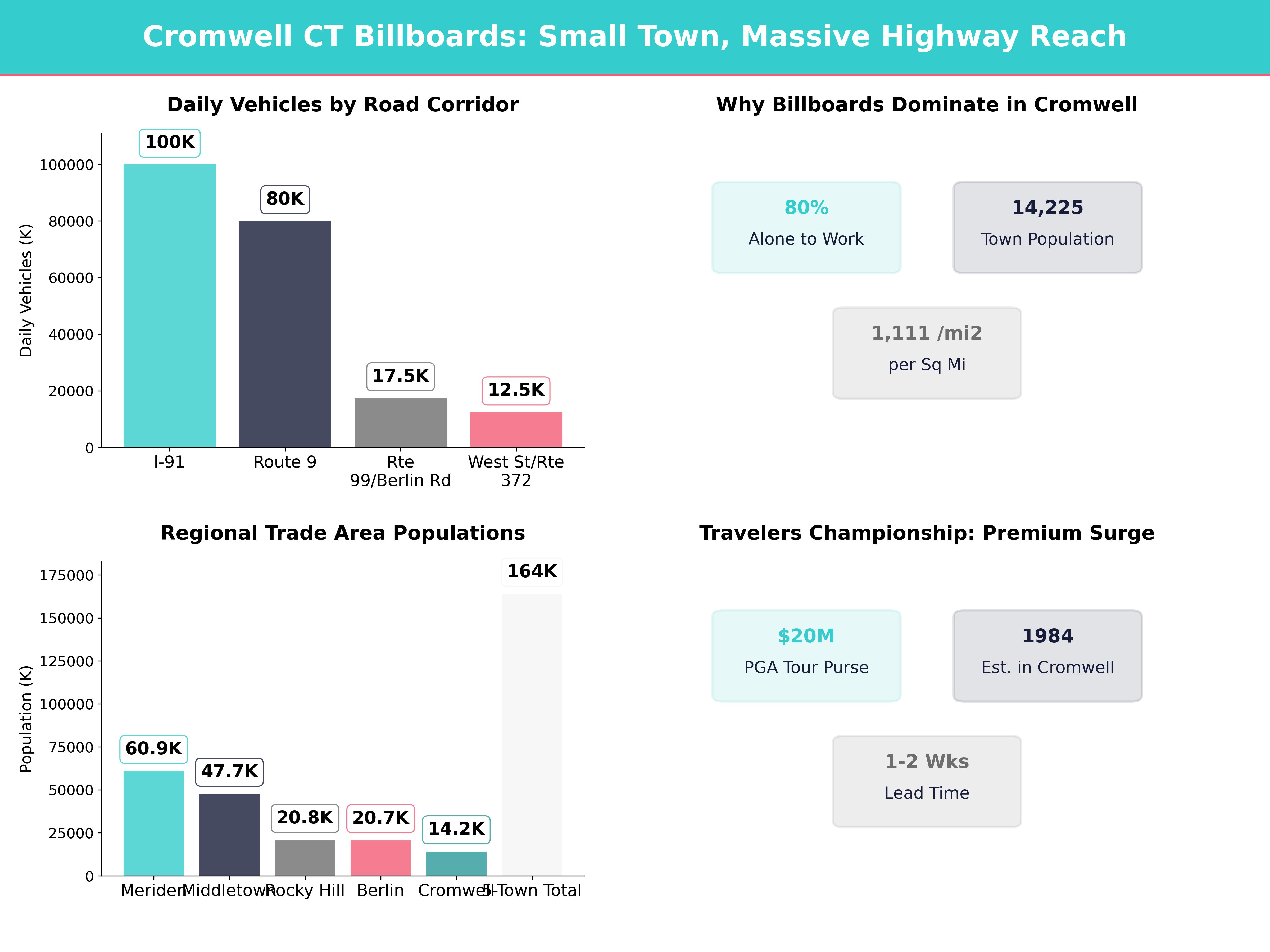
Cromwell works best when we view it as a regional access point instead of only a standalone town. Its local population is modest, but its position in central Connecticut lets us capture multiple audience pools with one well-planned digital billboard strategy. The area is heavily car-oriented, with about 80% of employed residents commuting by driving alone, which gives roadside media repeated exposure among daily commuters and weekend errand traffic.
When is the best time to run a billboard campaign in Cromwell with Blip?
June is Cromwell’s signature ad window because the Travelers Championship brings a $20 million purse, national sports visibility, and elevated regional traffic. For many brands, the best strategy is to run one campaign 1 to 2 weeks before the tournament and another during tournament week. Late August and September are also important because the Wesleyan University audience returns and local routines become more predictable.
What roads get the most billboard traffic in Cromwell?
Interstate 91 through Cromwell typically carries more than 100,000 vehicles per day on major segments, depending on count location and year. Route 9 segments are commonly in the 70,000 to 90,000 vehicles per day range, while Route 99 and Berlin Road are often in the 15,000 to 20,000 range. West Street and Route 372 usually see about 10,000 to 15,000 vehicles per day, making them useful for local decision-zone messaging.
Do I need a contract to advertise with Blip in Cromwell?
No, Blip has no long-term contracts or minimum commitments. You can start, pause, or stop your campaign at any time.
How fast can I launch a billboard campaign with Blip in Cromwell?
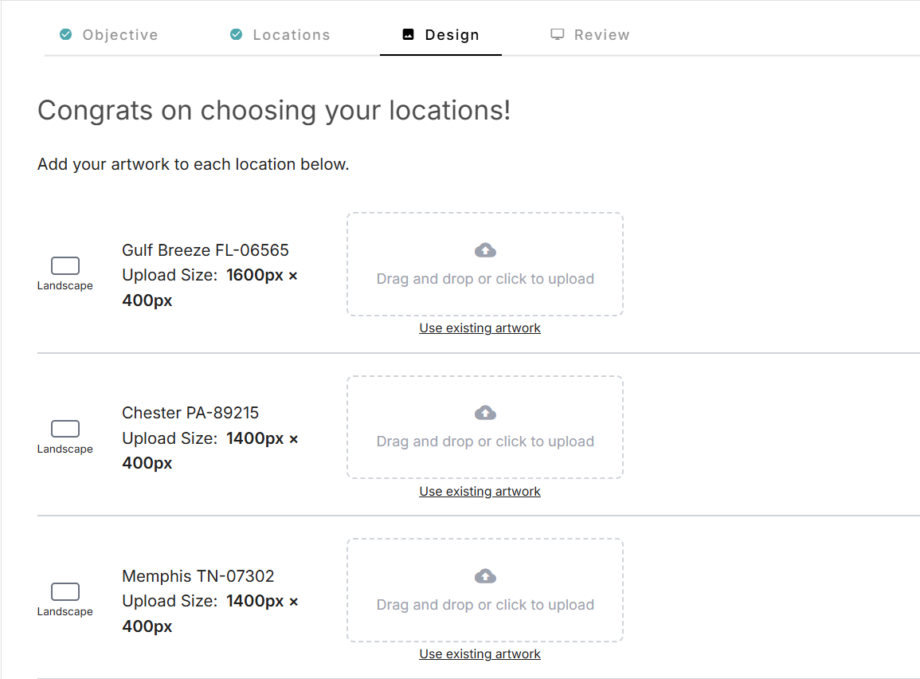
You can have your campaign live in minutes. Create a free account, select your locations, set your budget, upload your design, and start running once approved.
Where can I advertise with Blip in Cromwell?
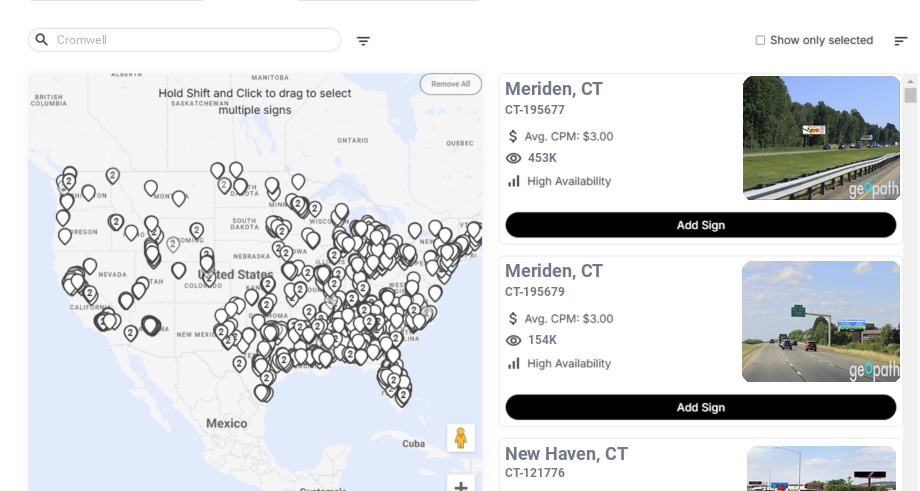
Blip has digital billboards in Cromwell. You can browse available locations on a map, choose the ones that fit your audience, and start advertising right away.
Still have questions? Launch a campaign in minutes — no contracts, no commitments.
Start Your CampaignCromwell Billboard Advertising Guide
Cromwell 2020 population of 14,225, yet it sits at the crossroads of Interstate 91, Route 9, and local retail corridors that connect us to Hartford, Middletown Meriden. The area is heavily car-oriented, with about 80% of employed residents commuting by driving alone, which gives roadside media repeated exposure among daily commuters and weekend errand traffic. Cromwell also benefits from destination demand, especially around TPC River Highlands Travelers Championship
Market Overview for Cromwell
Cromwell works best when we view it as a regional access point instead of only a standalone town. Its local population is modest, but its position in central Connecticut lets us capture multiple audience pools with one well-planned digital billboard strategy.
A compact town with outsized regional reach
Cromwell’s 2020 population was 14,225, up from 14,005 in 2010, which represents growth of about 1.6%. The town covers about 13.5 square miles, including roughly 12.8 square miles of land and 0.7 square miles of water, which puts population density near 1,111 residents per square mile. That compact footprint matters because trips concentrate onto a relatively small number of roads, and concentration is good for billboard efficiency.
The town also sits inside Middlesex County, which had a 2020 population of 164,245. Just to the west, Middletown 47,717 residents in 2020. Nearby Rocky Hill 20,845, Berlin 20,696, and Meriden had 60,850. Those five municipalities alone, including Cromwell, total 164,333 residents, which shows why advertisers in Cromwell are really buying into a multi-town trade area.
Cromwell also benefits from its placement between larger urban anchors. Hartford had 121,054 residents in 2020, and New Haven 134,023. We are roughly 15 miles from Hartford, about 5 miles from Middletown, and close to 30 miles from New Haven, so a Cromwell campaign can speak to commuters moving between job centers, suburbs, and destination districts.
What Cromwell’s commuting pattern means for advertisers
Cromwell is an auto-first market. Recent community estimates show that about 4 in 5 employed Cromwell residents commute by driving alone, which is exactly the kind of behavior that makes digital billboards work harder. Transit options from River Valley Transit CTtransit are valuable, but the dominant reality is that most buyers here still make decisions from behind the wheel.
That driving pattern creates two practical advantages for us. First, frequency builds quickly because many residents repeat the same routes every weekday. Second, purchase intent is often immediate, especially for restaurants, urgent care, home services, automotive businesses, banks, gyms, and retail stores that sit just off I-91, Route 9, Berlin Road, or West Street.
Economic anchors that support billboard demand in Cromwell
Cromwell’s economy is tied to a broader corridor shaped by healthcare, education, professional services, hospitality, golf tourism, and logistics. Middlesex Health 275-bed hospital in nearby Middletown, which supports steady flows of employees, patients, and caregivers. Wesleyan University brings roughly 3,200 undergraduate students and about 200 graduate students into the adjacent market, creating demand for apartments, food, entertainment, healthcare, and local services.
On the visitor side, TPC River Highlands Travelers Championship PGA TOUR Signature Event with a $20 million purse, and it has been played in Cromwell since 1984. That single event creates a concentrated seasonal burst of affluent visitor traffic, regional media attention, and hospitality spending that few towns of 14,225 residents can match.
Key Traffic Corridors for Cromwell Billboards
Cromwell’s advertising value is driven by road hierarchy. A small group of highways and arterial roads carries the majority of the market’s visibility, and each one attracts a different type of buyer.
Interstate 91 through Cromwell
According to Connecticut Department of Transportation traffic monitoring, I-91 through Cromwell typically carries more than 100,000 vehicles per day on major segments, depending on count location and year. That puts it in the top tier of Connecticut commuter corridors. It links the market north to Hartford, Wethersfield Springfield, and south to Meriden, Wallingford New Haven
This corridor is ideal for advertisers that need broad reach and repeated weekday exposure.
- Regional retailers can use I-91 to stay visible across the Hartford-to-New Haven commute shed.
- Healthcare providers can target employees, patients, and caregivers traveling to and from Middlesex Health Hartford HealthCare, and other medical networks.
- Recruiters and employers can build awareness among workers crossing town lines for office, warehouse, and service jobs.
- Legal, financial, and education brands benefit because I-91 catches both white-collar commuters and high-intent local drivers.
I-91 boards generally perform best when creative is simple, bold, and highly legible at highway speed. We should think of this route as our scale corridor.
Route 9 in the Cromwell-Middletown corridor
Route 9 is the other essential route for Cromwell. CTDOT counts commonly place key Cromwell-area segments in roughly the 70,000 to 90,000 vehicles per day range, depending on the segment. Unlike I-91, Route 9 carries a stronger blend of commuter traffic, shoreline leisure traffic, and Middletown destination trips.
That mix makes Route 9 especially valuable for the following categories.
- Tourism, entertainment, and hospitality advertisers can reach travelers headed toward Middletown Downtown, the lower Connecticut River valley, and the shoreline.
- Restaurants, breweries, and event venues can attract people before they pick an exit or dinner stop.
- Colleges, training programs, and healthcare marketers can connect with Middletown-bound traffic that includes students, staff, and service users.
- Home-service companies can use Route 9 to cover residential communities stretching from Cromwell to Berlin and south toward the shoreline.
Route 9 is often where we balance reach with slightly more destination-minded behavior. Drivers on this road are frequently choosing where to go next, not just passing through.
Route 99, Berlin Road, and the Cromwell retail spine
Route 99 and Berlin Road form one of Cromwell’s most useful local commercial spines. CTDOT traffic counts on these segments are commonly in the 15,000 to 20,000 vehicles per day range. That volume is lower than I-91 or Route 9, but intent is often higher because many trips are local and transactional.
This corridor is a smart fit for the following advertiser types.
- Quick-service restaurants, coffee shops, and casual dining can target drivers who are actively deciding where to stop.
- Auto repair, tires, car washes, and dealerships can benefit from proximity to everyday errands and commute traffic.
- Banks, fitness brands, and healthcare offices can stay top of mind in a corridor where buyers are already near the point of purchase.
- Apartment communities and senior living providers can highlight proximity, convenience, and neighborhood access.
Berlin Road is where we trade some raw traffic volume for stronger action potential.
Route 372, West Street, and local decision zones
West Street, which carries Route 372 through part of the area, is another useful approach road. Traffic volumes on important local segments are often in the 10,000 to 15,000 vehicles per day range. These numbers are smaller, but the road’s value comes from the fact that people are close to schools, shopping areas, hotels, and neighborhood services when they see an ad.
This is the right environment for messages that need immediate action.
- Medical, dental, and urgent care providers can promote same-day or next-day appointments.
- Furniture, mattress, and home-improvement brands can advertise sales that justify a same-trip visit.
- Children’s activities, family attractions, and tutoring services can target parents making routine local trips.
- Churches, nonprofits, and community events can benefit because local roads support higher familiarity and easier recall.
If I-91 is our reach corridor, West Street is our conversion corridor.
Audience Segments We Can Reach in Cromwell
Cromwell is not a one-audience market. A good campaign here works because it speaks differently to commuters, visitors, students, families, and service buyers who all move through the same road network.
Daily commuters across central Connecticut
Commuters are the backbone of Cromwell billboard advertising. The town sits about 15 miles south of Hartford, about 5 miles from Middletown, and within roughly 30 miles of New Haven. That positioning lets us capture northbound work trips in the morning and southbound return trips in the late afternoon.
For many advertisers, this is the highest-value audience in the market.
- Professional services can build weekday frequency with office-bound drivers.
- Auto, insurance, and banking brands can benefit from repeated exposure to employed households.
- Healthcare systems and recruiters can stay visible during habitual travel windows when recall is strongest.
Because about 80% of Cromwell workers drive alone, we are often talking to decision-makers directly rather than to a passive passenger audience.
Golf fans, event visitors, and leisure travelers
Cromwell’s visitor profile spikes every June because TPC River Highlands Travelers Championship par of 70 at 6,844 yards, and the event’s $20 million purse signals the level of attention it receives. Since the tournament has been in Cromwell since 1984, the event is part of the town’s identity, not a one-off novelty.
This audience matters for premium, time-sensitive campaigns.
- Hotels, restaurants, and entertainment venues can target short-stay visitors and local spectators.
- Luxury services, financial firms, and regional brands can align with an affluent sports audience.
- Consumer packaged goods and beverage brands can use June placements for broad awareness during a high-visibility week.
Outside tournament season, leisure traffic also comes from attractions such as Wadsworth Falls State Park, which spans 285 acres, Kidcity Children’s Museum, and dining in Middletown Downtown.
Students, faculty, and young professionals
Adjacent Middletown gives Cromwell access to a younger and more educated audience than the town’s size alone would suggest. Wesleyan University enrolls about 3,200 undergraduates and around 200 graduate students. That population drives demand for restaurants, apartments, moving services, retail, tutoring, wellness, and nightlife.
Student-oriented campaigns in this region work best when we focus on practical decisions instead of generic branding. Food delivery, internet service, banks, thrift and furniture stores, fitness offers, concerts, and local event promotion are all strong fits. We can also target parents and visiting families during move-in, homecoming, and graduation periods.
Families, patients, and local service buyers
The combined nearby populations of Cromwell, Middletown, Rocky Hill, Berlin, and Meriden total 164,333 residents. That is a large enough family and household base to support year-round campaigns for dentists, pediatric care, HVAC, roofing, real estate, groceries, childcare, and home improvement.
Middlesex Health 275-bed hospital attracts employees, patients, outpatient visitors, and caregivers from across the region. Healthcare, pharmacy, physical therapy, and senior-focused services can all benefit from boards that sit on routes feeding into Middletown and Cromwell.
Industrial, warehouse, and trade workers
The I-91 corridor supports a meaningful blue-collar and trade audience as well. While Cromwell itself is not a massive industrial city, it is surrounded by communities where construction, warehousing, logistics, automotive services, maintenance, and field work generate early-morning road traffic. For trade schools, staffing firms, tool suppliers, workwear brands, and B2B service companies, commuter billboards can be a cost-efficient way to build familiarity with working households.
Seasonal and Timing Opportunities in Cromwell
Cromwell rewards advertisers who plan around the calendar. Traffic stays strong year-round, but message relevance changes by season.
Spring in Cromwell for home services and refresh campaigns
From March through May, we can lean into restart categories. Tax refunds, warmer weather, and home-project planning make spring ideal for HVAC tune-ups, landscaping, roofing, remodeling, windows, outdoor furniture, and automotive maintenance. Spring is also a good time for healthcare checkups, gyms, and elective services because consumers are emerging from winter routines.
In creative terms, spring campaigns in Cromwell should feel clean and active. They should also stay practical because this audience often responds better to convenience and timing than to abstract brand language.
June in Cromwell around the Travelers Championship
June is Cromwell’s signature ad window. The Travelers Championship $20 million purse, national sports visibility, and elevated regional traffic. We should treat this as a short, high-attention burst rather than a normal month.
For many brands, the best strategy is to run one campaign 1 to 2 weeks before the tournament and another during tournament week. That schedule lets us build anticipation first and capture visitors second. Hospitality, retail, rides, premium services, and event-driven messaging all benefit.
Late summer and back-to-school around Cromwell and Middletown
Late August and September are important because the Wesleyan University audience returns, local sports resume, and family routines become more predictable. That period works well for apartments, internet, storage, moving, tutoring, quick-service restaurants, healthcare providers, and fall events.
If we want younger adult reach, this is one of the best windows of the year. If we want family reach, the back-to-school reset creates repeat trips on local roads and stronger response to practical offers.
Fall in Cromwell for foliage, events, and holiday retail
Fall is one of central Connecticut’s most attractive travel periods. Weekend trips to Wadsworth Falls State Park, Powder Ridge Mountain Park & Resort Connecticut Office of Tourism attractions network help support leisure traffic, while weekday commuting remains steady. Early nightfall also increases the impact of bright digital creative.
From October through December, we can shift messaging toward holiday shopping, restaurants, family entertainment, healthcare enrollment periods, and winter service preparation. This is also a strong time for community events, fundraising, and church campaigns because local attention is high.
Winter in Cromwell for urgency and high-contrast messaging
Winter campaigns in Cromwell should emphasize urgency, reliability, and comfort. Snow, darkness, and cold temperatures create good conditions for urgent care, tire shops, heating services, indoor entertainment, and comfort-food advertising. Weather can also slow traffic, which sometimes increases dwell time near congestion points and makes concise digital ads easier to absorb.
Billboard Design Tips for the Cromwell Market
Creative that works in Cromwell usually feels local, direct, and useful. We do not need to overcomplicate the message when the market already gives us strong route-based relevance.
Use place-based language that sounds like central Connecticut
Cromwell drivers respond well to specificity. We should use town names, route names, and destination cues that feel immediately familiar, such as Cromwell, Middletown, Berlin Road, West Street, Route 9, and I-91. A message tied to a nearby decision point often outperforms a generic regional slogan.
We should also keep text short. On faster roads like I-91 and Route 9, 6 to 8 words is often a smart target for the main line. If the ad is on a slower local approach, we can add one more detail, such as a category cue, a price anchor, or a directional phrase.
Match the creative to Cromwell’s audience mix
Cromwell is not one-dimensional, so our visual style should change by campaign type.
- For commuter and professional audiences, we should use strong contrast, clean typography, and one unmistakable value proposition.
- For golf-season and hospitality campaigns, we can lean into deep greens, navy, white, and polished imagery that feels at home with TPC River Highlands
- For family and healthcare advertisers, trustworthy blues, greens, and bright whites tend to feel more credible than edgy or overly stylized visuals.
- For winter retail and food campaigns, warmer reds, oranges, and yellows help creative stand out against gray roads, early darkness, and snow-muted scenery.
The important point is fit. Cromwell creative should feel like it belongs on that corridor at that time of year.
Design for the road, not just the brand guide
A digital billboard in Cromwell usually gets only a quick look. Since each blip lasts about 7.5 to 10 seconds, we should prioritize one idea, one image, and one action. On I-91, that might be a brand name plus a service category. On Berlin Road or West Street, it might be a brand name plus a stronger directional cue or promotion.
When possible, we should localize the call to action. “Minutes from Route 9” or “Right in Cromwell” often works better here than a broad “Visit us today” line, because the market is highly route-aware.
Regional Strategies Around Cromwell
We get the best results in Cromwell when we do not treat every nearby sub-area the same. Different roads serve different behaviors, and our message should follow those behaviors.
The Cromwell interchange core
The area around the I-91 and Route 9 connection is our broadest-reach zone. We should use it for campaigns that need scale, such as hospital systems, colleges, regional retailers, auto groups, and major events. This zone also works well for hotel, dining, and golf-related messaging because it captures through-travel and destination travel at the same time.
Middletown and the west-side influence zone
Middletown 47,717 residents, Wesleyan University, Middlesex Health Middletown Downtown. Campaigns aimed at students, young professionals, healthcare users, and event-goers should usually include a Middletown-facing component, even if the advertiser is physically in Cromwell.
The northbound Hartford-facing strategy
North of Cromwell, Rocky Hill 20,845 residents, Wethersfield 26,486, and Hartford has 121,054. This direction is especially useful for B2B brands, white-collar recruiting, healthcare systems, legal services, and conference-related messaging tied to venues such as the Connecticut Convention Center, which spans 540,000 square feet.
The southbound and southwest strategy toward Berlin, Meriden, and New Haven
South and southwest of Cromwell, Berlin 20,696 residents, Meriden has 60,850, and New Haven 134,023. This direction supports retail, entertainment, auto, home services, and multi-location healthcare campaigns. If our goal is to stay visible beyond Cromwell without buying a full New Haven metro program, this is one of the smartest approaches.
Applying Blip Tools and Capabilities in Cromwell
Blip’s flexibility is especially useful in a market like Cromwell because traffic patterns and audience intent change by route, by season, and even by time of day. We can use the platform’s controls to make local strategy more precise instead of simply buying generic exposure.
Use dayparting to match Cromwell travel behavior
Morning commuting and evening commuting are not the same audience moment. We should generally lean into northbound work-trip messaging from about 6:00 to 9:00 a.m., and southbound or local errand messaging from about 3:00 to 7:00 p.m. Restaurants, grocery, fitness, and retail often perform better later in the day, while B2B, education, healthcare, and recruiting can be stronger in the morning.
We can also use weekend-heavy scheduling for leisure campaigns tied to golf, restaurants, family attractions, and outdoor recreation.
Test corridor differences instead of guessing
Cromwell is a great market for A/B testing. We can compare I-91 visibility against Route 9 intent, or compare a local retail board on Berlin Road against a broader commuter board near the interchange. Real-time analytics help us see which corridor aligns best with our goal, whether that goal is awareness, traffic, or timely event promotion.
Rotate creative for Cromwell’s seasonal moments
Because Cromwell has clear calendar spikes, we should swap artwork instead of running one generic design all year. A spring HVAC ad, a June golf-week message, a fall healthcare enrollment reminder, and a winter urgent-care ad can all live within the same broader campaign strategy. Blip’s artwork tools make that kind of localized refresh easier to execute quickly.
Balance reach and efficiency with flexible budgets
Premium commuter locations around I-91 and Route 9 can be worth the spend, but local routes often deliver strong action at a lower cost. We can spread budget across both. That is especially useful in Cromwell, where one campaign may need a high-traffic regional board for scale and a lower-cost local board for conversion.
Getting Started with Billboard Rental in Cromwell
Renting a billboard in Cromwell is easiest when we begin with the business objective, not the map. Once we know whether we want awareness, foot traffic, event attendance, recruiting, or seasonal demand capture, the right locations become much clearer.
Start with one primary goal for Cromwell
We should first decide which of these goals matters most. Then we can match the right road behavior to the right campaign objective.
- Regional awareness is usually best served by I-91 or Route 9 placements.
- Immediate local action is often better on Berlin Road, West Street, or other lower-speed commercial approaches.
- Seasonal visitor capture is strongest around June golf traffic, fall leisure travel, and holiday activity.
- Recruiting and service awareness often benefit from repeated weekday commuting exposure.
A focused objective keeps us from buying traffic that looks impressive but does not match buyer intent.
Evaluate each Cromwell billboard by route context
When we review locations, we should ask practical questions. Is the board northbound or southbound. Is it near a retail cluster, a highway decision point, or a destination exit. Are drivers moving at full highway speed, or slowing near congestion. Is the surrounding audience more commuter-heavy, student-heavy, or family-heavy.
Those questions matter more than simple map proximity. A board 2 miles earlier on the right road can outperform a board that looks closer on paper but reaches the wrong audience moment.
Expect more agility than traditional billboard buying
Traditional outdoor companies often sell inventory in 4-week blocks, and they may require longer planning cycles or larger minimum commitments. Blip simplifies the process by letting us choose boards on a map, set a budget that fits the campaign, and adjust timing or creative as conditions change. We can start small, learn from the data, and scale what works.
That flexibility is valuable in Cromwell because demand can shift around tournament week, commuter peaks, school calendars, and weather events. A 2- to 4-week test campaign is often enough to identify which corridor and message deserve additional spend.
Build a smart first campaign in Cromwell
For many advertisers, a strong first campaign in Cromwell uses a mix of 3 to 5 boards across two environments. We might pair one or two high-reach commuter boards with one or two local retail or decision-zone boards. Then we can watch which placements align with our goals and refine from there.
Cromwell rewards advertisers who stay local in their thinking. If we choose boards by travel behavior, use creative that feels native to central Connecticut, and time campaigns around real demand windows, we can make this small town perform like a much larger market.