Billboards in Branford, CT
No Minimum Spend. No Long-Term Contracts. Just Results.
Trusted by Leading Brands


Billboard advertising
in Branford has never been easier



How much is a billboard in Branford?
Why Choose Blip for Billboard Advertising in Branford
-
Blip lets you launch Branford billboards fast, reaching I-95 Exits 54-56 commuters without contracts or long setup.
-
Set a Branford daily budget in Blip and stay in control while targeting Route 1 shoppers and shoreline drivers.
-
Use dayparting in Branford to hit 7-9 a.m. New Haven commuters and 4-7 p.m. return traffic when it matters most.
-
Blip's real-time analytics show what's working in Branford, so you can shift spend between I-95 and Route 1 on the fly.
-
Create and refresh Branford billboard ads easily with Blip tools, from Thimble Islands summer themes to winter local offers.
Frequently Asked Questions About Billboard Advertising in Branford
How much does a billboard cost in Branford, Connecticut with Blip?
With Blip, you can start advertising on Branford billboards with any budget because you only pay per “blip,” a 7.5 to 10-second ad display. You choose your daily budget during campaign setup, and Blip automatically keeps your advertising within that amount, while letting you adjust it anytime. Pricing is flexible because each blip’s cost changes based on when and where your ad runs and current advertiser demand.
Where can I advertise with Blip in Branford, Connecticut?
Branford is just off I-95 Exits 54–56, one of the busiest travel corridors in New England, and daily traffic on this stretch routinely tops 100,000 vehicles. Route 1 is Branford’s main commercial corridor, linking shopping centers, auto dealerships, and service businesses. Route 142 and Route 146 also serve shoreline and village routes feeding Stony Creek, Pine Orchard, and Short Beach.
Who does billboard advertising in Branford, Connecticut reach?
Branford offers a rare combination of shoreline charm, commuter traffic, and proximity to major institutions in nearby New Haven. That mix means campaigns can reach local residents as well as a large volume of through-traffic on I-95 headed between New York City, New Haven, Providence, and Boston. The town also has strong economic and commuter ties to the Greater New Haven region.
When is the best time to run a billboard in Branford, Connecticut with Blip?
With Blip’s time-based buying, campaigns can focus on the hours when best prospects are actually on the road. Weekday morning rush is 7–9 a.m. westbound toward New Haven, while evening traffic is strongest from 4–6:30 p.m. eastbound back to Branford and shoreline towns. Midday and weekend slots can also work well for shoppers headed to Route 1 retail complexes and downtown.
What kind of businesses work best on Branford, Connecticut billboards?
Restaurants, breweries, and hospitality businesses are well-suited to Branford’s shoreline and town center, especially during summer months when leisure traffic increases. Healthcare and wellness providers also fit well because Branford has a meaningful older adult population and strong demand for medical, dental, and wellness services. Home services and real estate are another strong fit because Branford has older homes and higher-value waterfront properties that drive ongoing demand for renovations and upgrades.
Do I need a contract to advertise with Blip in Branford?
No, Blip has no long-term contracts or minimum commitments. You can start, pause, or stop your campaign at any time.
How fast can I launch a billboard campaign with Blip in Branford?
You can have your campaign live in minutes. Create a free account, select your locations, set your budget, upload your design, and start running once approved.
Where can I advertise with Blip in Branford?
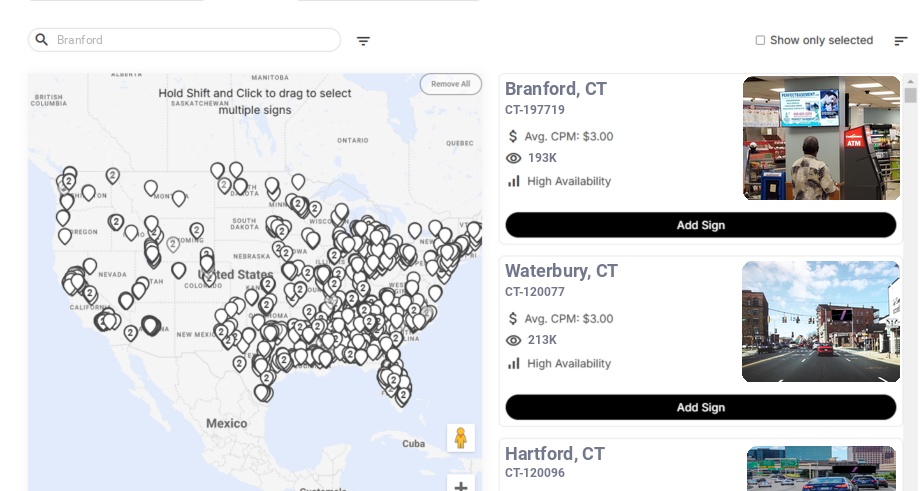
Blip has digital billboards in Branford. You can browse available locations on a map, choose the ones that fit your audience, and start advertising right away.
Still have questions? Launch a campaign in minutes — no contracts, no commitments.
Start Your CampaignBranford Billboard Advertising Guide
Branford, Connecticut offers a rare combination of shoreline charm, commuter traffic, and proximity to major institutions in nearby New Haven. When we plan digital Branford billboard advertising campaigns here, we’re speaking both to local residents who know every cove and back road, and to a large volume of through-traffic on I‑95 headed between New York City, New Haven, Providence, and Boston. That mix makes Branford an efficient, high-impact market for advertisers who use Blip’s flexibility to target the right times, messages, and audiences with Branford billboards.
Understanding the Branford Market
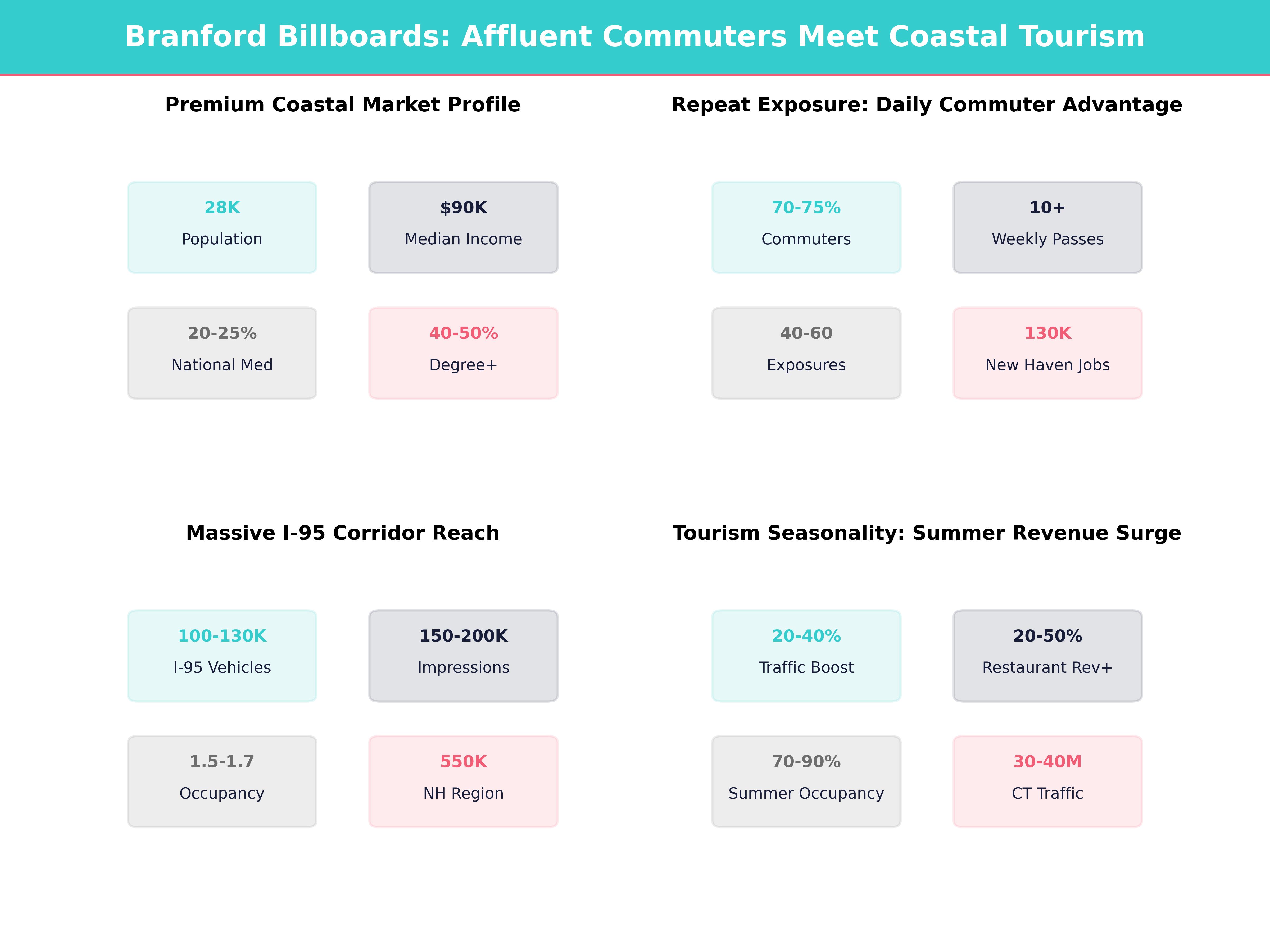
Branford is a coastal town of roughly 28,000 residents, located just 8 miles east of downtown New Haven along Long Island Sound. It anchors a stretch of the Connecticut shoreline that includes East Haven Guilford, and Madison, and benefits from strong economic and commuter ties to the Greater New Haven region.
Key context for advertisers:
-
Population and households
- Branford population: about 28,000 residents, accounting for roughly 5% of the Greater New Haven region.
- Household count: roughly 13,000 households, with an average household size of about 2.1 people.
- Median household income is close to $90,000, which is roughly 20–25% higher than the national median and about 10–15% higher than the Connecticut statewide median, indicating strong discretionary spending power for retail, dining, and services.
- Homeownership rates in Branford are in the 65–70% range, a sign of residential stability and ongoing demand for home services, renovations, and financial products such as mortgages and refinancing.
-
Regional reach
- The Greater New Haven region, anchored by the City of New Haven 550,000 people, with more than 130,000 jobs concentrated in New Haven itself.
- Branford is just off I‑95 Exits 54–56, one of the busiest travel corridors in New England. Daily traffic on this stretch routinely tops 100,000 vehicles, giving even small campaigns on billboards in Branford substantial reach.
- Roughly 70–75% of Branford workers commute out of town for work, and a significant share travel toward New Haven and the I‑95 corridor—exactly where key digital billboards sit.
-
Local economic profile
- The town highlights a mix of small businesses, marine trades, light manufacturing, biotech, and professional services on the official Town of Branford site.
- Branford is part of the Shoreline Chamber of Commerce region (Branford, North Branford, Guilford), which represents 700+ local businesses, from restaurants and retailers to healthcare and B2B services.
- Greater New Haven’s life sciences and healthcare sector, detailed by organizations such as the Greater New Haven Chamber of Commerce, includes 100+ biotech and medtech firms and supports tens of thousands of high-income jobs that feed residential demand in Branford.
For Blip advertisers, this means we can design campaigns that simultaneously:
- Build brand familiarity with an affluent residential base that spends heavily on dining, home improvement, healthcare, and education.
- Capture high-frequency impressions from daily commuters to New Haven and points west/east, many of whom drive past the same locations 10+ times per week.
- Tap into seasonal surges of visitors drawn to Branford’s shoreline and nearby attractions, boosting weekend and summer impressions by 20–40% compared with shoulder seasons through well-timed Branford billboard advertising.
Traffic Flows and Commuter Patterns
Successful Branford billboard advertising starts with understanding how people move through the area.
Major roadways and volumes
-
Interstate 95 (I‑95)
- The Branford segment of I‑95 typically carries 100,000–130,000 vehicles per day, according to traffic data published by the Connecticut Department of Transportation
-
This traffic includes:
- Local commuters between Branford, East Haven, Guilford, and New Haven.
- Long-distance travelers along the Boston–New York corridor, where tourism and freight account for an estimated 25–30% of the vehicle mix.
- With an average vehicle occupancy of about 1.5–1.7 people, that translates into roughly 150,000–200,000 daily impressions potential for high-visibility I‑95 boards.
-
U.S. Route 1 (North Main Street & West Main Street)
- Serves as Branford’s main commercial corridor, linking shopping centers, auto dealerships, and service businesses.
- Typical daily traffic along key Route 1 segments in Branford often falls in the 20,000–30,000 vehicles per day range based on CTDOT counts, heavily weighted toward local residents and nearby workers.
- Because speeds are lower (often 25–40 mph), Route 1 supports longer message dwell times and more detailed offers than I‑95, making it ideal for local-focused billboards in Branford.
-
Route 142 and Route 146
- Shoreline and village routes feeding Stony Creek, Pine Orchard, and Short Beach.
- Traffic volumes are smaller—often 5,000–10,000 vehicles per day on many segments—but audiences are typically higher income, with median home values in these shoreline neighborhoods running 30–60% higher than Branford’s townwide median.
- These routes are ideal for premium brands, real estate, marine services, and hospitality targeting high-value residents and visitors.
Commuter behavior
Drawing from regional employment data and local transport patterns:
- A large share of Branford residents commute to New Haven, home to Yale University (yale.edu) and Yale New Haven Health (ynhhs.org), which together employ well over 30,000 people across the region.
- New Haven’s total employment base exceeds 80,000 jobs, with major concentrations in education, healthcare, research, and government, detailed on sites such as Economic Development New Haven
-
Typical weekday rush hours:
- Morning: 7:00–9:00 a.m. westbound (toward New Haven), when traffic volumes on I‑95 can be 25–40% higher than off-peak periods.
- Evening: 4:00–6:30 p.m. eastbound (returning to Branford and shoreline towns), with similar upticks in volume.
- Tweed New Haven Airport hundreds of thousands, airport growth has increased airport-related traffic along the I‑95/East Haven/Branford corridor, especially around early-morning and evening flight banks.
With Blip’s time-based buying, we can concentrate impressions in:
- 7–9 a.m. and 4–7 p.m. on weekdays for B2B, professional services, commuter-focused offers, and messages that benefit from repeat exposure—drivers in these windows can see the same board 40–60 times per month.
- Midday and weekend slots to reach shoppers headed to Branford’s Route 1 retail complexes and downtown, when discretionary trips for errands, dining, and recreation can account for 50%+ of total traffic.
Seasonality: Summer Shoreline vs. Year-Round Routine
Branford’s coastal location introduces strong seasonal shifts that we can harness in creative and scheduling strategies.
Summer (May–September)
- The Connecticut Office of Tourism reports that Connecticut welcomes 30–40 million visitors annually, generating over $16 billion in visitor spending and supporting more than 80,000 tourism-related jobs statewide. Coastal communities like Branford capture a significant share of these trips between May and September.
- State tourism data show that summer accounts for roughly 40–45% of annual leisure travel in Connecticut, with day trips representing 60–70% of all visits. That means a large number of visitors are driving in for a single day—exactly the kind of audience reachable via I‑95 and Route 1 billboards.
- Branford’s own attractions—like the Thimble Islands 100% in peak months, and local tours and waterfront venues regularly sell out on weekends.
-
Seasonal patterns we can expect:
- Increased weekend and midday traffic, with vehicle counts on key corridors typically 10–25% higher on peak summer days than in winter.
- Higher volumes of out-of-town visitors on I‑95 and Route 1, many of whom are unfamiliar with the area and actively scanning for exit and attraction information.
- More leisure trips for dining, boating, and events promoted through local sources such as Branford Parks & Recreation Town of Branford events calendar.
Advertising opportunities in summer:
- Restaurants, breweries, waterfront venues, and experiences (e.g., Thimble Islands cruises), which often see revenue increases of 20–50% versus off-season months.
- Lodging, short-term rentals, and attractions throughout the shoreline, where weekend occupancy can run 70–90% in June–August.
- Event-driven campaigns tied to festivals, concerts, and seaside activities promoted via Branford Parks & Recreation Visit Connecticut.
Fall & Winter (October–March)
- Traffic stabilizes into a more commuter-dominant pattern, with school-year routines driving predictable morning and afternoon peaks.
- Branford residents focus on school schedules, healthcare appointments, major purchases, and home improvement. Regional retail data show that October–December can account for 30–40% of annual revenue for some retailers and specialty shops.
- Holiday shopping peaks from late November through December along Route 1 and in Branford Center, with weekend traffic and parking demand often 20–30% above typical fall levels.
In cooler months, we typically recommend:
- Retail, financial services, medical/dental practices, and education—categories that benefit from stable, repeat local exposure.
- “Support local” campaigns that resonate with year-round residents and leverage messaging promoted by organizations such as the Shoreline Chamber of Commerce.
- Holiday and New Year promotions timed to payday cycles and key shopping weekends (Black Friday, Small Business Saturday, and the first two weekends in December), when consumers plan big-ticket purchases and gift buying.
Audience & Demographic Insights
Branford’s audience is attractive for both local and regional brands because it blends stability, affluence, and proximity to major institutions.
Income and education
- Median household income near $90,000 reflects a solidly middle-to-upper-middle income population, with a sizable portion of households earning $100,000+ per year.
- A substantial share of residents hold bachelor’s or advanced degrees—local estimates often put this figure in the 40–50% range—supported by proximity to Yale University, Southern Connecticut State University (southernct.edu), University of New Haven (newhaven.edu), and Gateway Community College ( gatewayct.edu
-
This cohort is responsive to:
- Professional and financial services, including wealth management and retirement planning.
- Healthcare and wellness, particularly specialty care and preventive services.
- Home renovation, real estate, and luxury goods, given higher home values along the shoreline and in established neighborhoods.
- Education and enrichment programs for both children and adults, including continuing education, certifications, and arts and culture.
Age and household mix
Branford’s age distribution and neighborhood structure indicate:
- A strong population of working-age adults (25–64), typically representing around 50–55% of residents, many of whom commute to New Haven and other job centers.
- A meaningful number of families with school-age children, served by Branford Public Schools (info via Branford Public Schools), which enroll thousands of students across multiple elementary schools, an intermediate school, and a high school.
- A notable older adult/retiree population—often 20%+ of residents are age 65 or older—many in shoreline neighborhoods and senior communities, driving demand for healthcare, home services, and recreation tailored to active retirees.
We can tailor campaigns to:
- Families: child-focused healthcare, sports programs, tutoring, family dining, and local attractions, especially during back-to-school and summer registration windows.
- Professionals: B2B services, financial planning, career education, commuter-convenient services (dry cleaning, car care, fitness), and high-end dining.
- Older adults: medical specialists, senior living, home services, pharmacies, and community events promoted through local sources like the Town of Branford and regional news outlets such as the New Haven Register ( nhregister.com WTNH News 8 ( wtnh.com
Creative Strategy: What Works on Branford Billboards
In a market like Branford, where many drivers see the same boards every weekday and others pass through once on a trip, our creative has to perform for both audiences. Strong creative is what turns simple billboard rental in Branford into a campaign that actually drives measurable results.
1. Clear, commuter-friendly messaging
On high-speed segments of I‑95:
- Aim for 6–10 words total plus a clear logo; outdoor advertising studies consistently show that recall drops sharply when copy exceeds 10–12 words.
- Use high-contrast colors that stand out in variable New England weather (bright yellows, whites, and strong blues/reds against dark backgrounds).
-
Focus on one primary action:
- “Exit 55 – Dinner Tonight at [Restaurant Name].”
- “Branford Dentist – New Patients This Week – Call ###‑####.”
- Use large, simple URLs or memorable vanity domains. Short URLs or brand names work better than long .com addresses—drivers have only 3–6 seconds to process your message at highway speeds.
On slower Route 1 traffic:
- You can support more detail (e.g., a short offer line + secondary benefit), as drivers may have 6–10 seconds to view the board in stop‑and‑go conditions.
- Consider rotating between branding, offer, and testimonial messages across different time slots using multiple Blip creatives so frequent drivers see something fresh every few days.
2. Local identity and trust cues
Branford residents care about local identity and community. To build trust:
-
Integrate recognizable landmarks or phrases:
- References to the Thimble Islands, Shoreline, or “Exit 55/56” anchor your brand as local.
- Mentions of “Branford Center,” “ Branford Green
-
Highlight community involvement:
- “Proud Sponsor of Branford Youth Sports.”
- “Serving Branford Families for 20+ Years.”
- When relevant, align with institutions the community recognizes, such as local hospitals, schools, or service organizations (without implying formal endorsements unless they exist). For example, referencing proximity to Yale New Haven Health facilities or Branford schools can be powerful for healthcare and education brands.
3. Seasonal and weather-aware creative
We can rotate creative automatically with Blip to match the season:
- Summer: Images of the shoreline, outdoor dining, boating, ice cream, and family activities. Summer-themed creative can boost engagement by 10–20% versus generic imagery in tourism-heavy months.
- Fall: Back-to-school, home projects, heating and energy services, and weekend outings for foliage and local events.
- Winter: Holiday themes, indoor activities, wellness, and financial planning; emphasize warmth, comfort, and convenience.
- Spring: Tax services, renovations, landscaping, and health checkups; many home services see inquiry volumes rise 30–50% from March to May.
Branford’s coastal climate also makes weather-responsive messaging powerful. For example:
- On rainy days: “Rainy Day? Order In from [Restaurant Name].”
- On hot days: “Beat the Heat – Air Conditioning Service Today.”
- During winter storms covered by outlets like WTNH News 8
Timing and Dayparting with Blip
Because Blip lets us buy by the “blip” (individual ad plays), we can structure campaigns around Branford’s real-world rhythms rather than buying fixed blocks of time. This makes billboard rental in Branford more efficient, since you’re paying to show up when your best prospects are actually on the road.
Weekday vs. weekend focus
-
Weekdays
- 7–9 a.m.: Commuters to New Haven and industrial parks; ideal for coffee shops, quick breakfast, parking, transit-linked services, and B2B brands. This window can capture 30–40% of daily commuter impressions.
- 11 a.m.–2 p.m.: Lunchtime and errand runs; good for restaurants, retail, healthcare, and gyms. Many local businesses see 25–35% of daily in‑person visits in this midday period.
- 4–7 p.m.: After-work shopping, dining, and activities; prime for local services, childcare, home improvement, and appointment-based businesses, when household decision-makers are most likely to be in the car together.
-
Weekends
- Higher share of leisure trips, shopping, and visits to waterfront and recreational areas; traffic to malls and shopping centers can be 20–30% higher on Saturdays than weekdays.
- Focus on attractions, seasonal events, restaurants, automotive, and big-box or local retailers that rely on strong Friday–Sunday sales.
Audience-based scheduling examples
-
Healthcare practice
- Push screenings and checkups during 7–9 a.m. and 4–7 p.m. on weekdays, when working adults can call to schedule on their commute.
- Promote urgent care hours and weekend availability on Saturdays and Sundays, especially during flu season (often October–March) when walk-in volumes spike.
-
Restaurant or brewery
- Run lunch specials 11 a.m.–1 p.m. and happy hour/dinner creatives 3–7 p.m.
- Increase impressions Thursday–Sunday to capture weekend traffic and visitors; many restaurants see 50%+ of weekly revenue from these four days.
-
Home services (HVAC, roofing, landscaping)
- Focus impressions in late afternoon/early evening (4–8 p.m.), when homeowners are thinking about projects and comfort at home.
- Layer heavier schedules in spring and fall when project planning peaks and weather triggers service calls, often producing double the inquiry volume of mid-winter.
Location Strategy: Reaching the Right Parts of Branford and Beyond
While specific Branford billboards available through Blip will vary, the strategic principles remain consistent.
I‑95 boards (Regional and commuter reach)
-
Best for:
- Brands drawing customers from multiple towns across the Greater New Haven shoreline.
- Destinations reachable within 5–15 minutes of the exits, such as Branford Center, Route 1 retail, and waterfront districts.
- Commuter-focused products, regional healthcare, education, and large attractions that can serve a 20–30 mile radius.
-
Messaging approach:
- Directional cues (“Exit 55,” “Next Right,” “2 Miles Ahead”) to help unfamiliar drivers.
- Clear distance promises (“5 minutes from this exit”), which are especially effective for capturing impulse visits from travelers.
- Short, benefit-driven headlines that can be read at 60–65 mph.
These I‑95 placements are often the backbone of Branford billboard advertising for brands that want visibility across multiple communities, not just within town limits.
Route 1 boards (Local shoppers and errand traffic)
-
Best for:
- Grocery, retail, auto dealers, personal services, gyms, salons, and quick-serve food that rely on repeat local customers.
- Neighborhood-based businesses wanting repetition among the same local residents; a typical Branford driver using Route 1 for daily errands may pass the same spot 200–300 times per year.
-
Messaging approach:
- Short offers: “Oil Change $X,” “New Patient Special,” “Today Only” promos and limited-time discounts.
- Frequent creative refreshes to feature rotating deals—updating at least every 4–8 weeks keeps content feeling current for repeat viewers.
Boards closer to New Haven
-
If your business is in Branford but draws heavily from New Haven or the wider region, consider boards west of Branford as well:
- Target drivers who don’t yet realize how close Branford is (often just 10–15 minutes from downtown New Haven, as highlighted on Visit New Haven
- Position Branford as a quick escape: “Just 2 Exits East – Dinner on the Water.”
- Reach students, hospital staff, and downtown workers, a population that can exceed 50,000 people on a typical weekday.
With Blip, we can test multiple locations, see where we get the best response (via web analytics, store traffic, or calls), and then concentrate budget on the highest-performing billboards in Branford and the most valuable times of day.
Industry-Specific Opportunities in Branford
Certain categories are particularly well-suited to Branford’s market structure.
Restaurants, Breweries, and Hospitality
- Branford’s shoreline and town center host a dense cluster of dining and nightlife options, plus breweries and seasonal venues. Many coastal restaurants report summer sales volumes 1.5–2x their winter averages.
-
Strategy:
- Use high-frequency impressions on nearby Route 1/I‑95 boards during lunch and evening.
- Emphasize travel time from the exit (“3 minutes from Exit 55”) and specific landmarks (“Near Branford Green”).
- Highlight specials on high-volume days (Thurs–Sun, summer months, holidays), which often account for 60–70% of weekly revenue in this sector.
Healthcare and Wellness
- The Greater New Haven area is a healthcare hub led by Yale New Haven Health, complemented by local clinics, specialists, and dental offices in Branford.
- Branford residents skew older than many urban cores, with 1 in 5 residents often in the 65+ age bracket, supporting strong demand for healthcare, dentistry, eye care, and wellness.
-
Strategy:
- Promote convenience: “Same-Day Appointments,” “Walk-Ins Welcome,” or “Evening Hours Available.”
- Run campaigns around seasonal health needs: back-to-school physicals in late summer, flu season from fall through winter, and new-year wellness checks in January–February.
- Use trust-building language: “Serving Branford Families Since [Year]” and feature board‑certified credentials or local affiliations when appropriate.
Home Services and Real Estate
- Branford’s housing stock includes older homes and higher-value waterfront properties, both of which drive demand for renovations, maintenance, and upgrades.
- The share of housing units built before 1980 is significant—often 50%+—indicating ongoing needs for roofing, siding, windows, HVAC, and energy efficiency upgrades.
-
Strategy:
- Align creative with seasonal cycles: HVAC in spring/fall, roofing and siding in warm months, snow services in winter; service calls for HVAC alone can increase 30–40% as temperatures swing.
- Showcase strong visuals: before/after photos, clear service icons, and brief benefit lines (“Cut Energy Bills by 20%+”).
-
For real estate:
- Brand agents and brokerages year-round to stay top-of-mind in a market where homes can sell quickly, especially in desirable shoreline neighborhoods.
- Run “Just Listed” or “Open House” creative in short, high-intensity bursts around key weekends, particularly in the spring market (March–June), when a large share of annual sales occur.
Education, Camps, and Youth Programs
- Families in Branford and neighboring towns look for enrichment, tutoring, sports, and camps, especially in late winter and spring as they plan for summer.
- Regional patterns show that 60–70% of camp registrations happen in the 8–10 weeks before programs start.
-
Strategy:
- Concentrate impressions in the weeks before registration deadlines and before key school calendar breaks (April vacation, end-of-school).
- Use bright, family-friendly visuals and simple calls to action (“Register by April 15,” “Spots Are Limited”).
- Target boards near family shopping routes (Route 1) and commuter corridors toward New Haven so both parents and caregivers see your message.
Tourism and Experiences
- Visitors staying in New Haven, Guilford, or along the coastline may not know local attractions in Branford.
- With millions of annual visitors passing through the region according to Visit Connecticut, even a small share diverted to Branford’s attractions can significantly move the needle for local businesses.
-
Strategy:
- Use I‑95 boards to position Branford as a must-visit stop: “Thimble Islands Cruises – Exit 56,” “Historic Branford Green – 10 Minutes Ahead.”
- Coordinate with events listed by Visit Connecticut and local tourism/parks sites so your messaging echoes what visitors see online.
- Run heavier schedules on Fridays, weekends, and holidays, when hotel occupancy and day‑trip volumes peak across the shoreline.
Measuring Impact and Optimizing Over Time
Digital billboards in a town the size of Branford are often part of a broader local or regional media mix. To make the most of Blip’s flexibility, we should plan from the start how we’ll measure success, whether you’re running a short-term billboard rental in Branford or an ongoing always-on presence.
Practical tracking methods
-
Unique URLs and promo codes
- Use short, memorable URLs (e.g., “BrandNameBranford.com”) and offer codes specific to your billboard campaign.
- Track page visits and redemptions by date and geography; look for 10–30% lifts in direct and branded traffic when campaigns launch.
-
Call tracking
- Use call tracking numbers on billboard creative to monitor call volumes and call outcomes.
- Many local campaigns see initial call volume bumps of 10–25% when boards go live, especially for service businesses and healthcare practices.
-
“How did you hear about us?”
- Train staff and include a billboard option in online forms.
- Track responses over at least one full campaign cycle (e.g., 4–8 weeks). In smaller markets like Branford, even 5–10% of new customers citing billboards can represent a strong ROI, given relatively modest media budgets.
-
Web analytics
- Watch for spikes in direct and branded search traffic from the Branford/New Haven area corresponding to your campaign’s on-air times.
- Review metrics by hour and day of week; align peaks with your Blip daypart schedule to identify the strongest-performing windows.
Optimizing your Blip campaign
Because Blip campaigns can be adjusted quickly, we recommend:
-
Start with 2–4 creatives testing different:
- Headlines (price vs. benefit vs. urgency).
- Images (product vs. people vs. local landmarks).
- Calls to action (call vs. visit website vs. exit directions).
- Run for 2–3 weeks to gather initial performance indicators (calls, web visits, store traffic). In this window you should see clear directional trends even if the sample size is modest.
- Shift budget toward boards and dayparts that correlate with better results; dropping underperforming slots can improve cost-per-response by 20–40%.
- Refresh creative at least every 4–8 weeks, even if the core message remains the same, to avoid “creative fatigue” for frequent local drivers.
Leveraging Local Information Sources
To keep campaigns aligned with what Branford residents are actually seeing and talking about, we like to watch:
- The official Town of Branford site for public events, infrastructure projects, and announcements that may affect traffic or community mood.
- Branford Parks & Recreation
- Local news outlets such as the New Haven Register ( nhregister.com Shore Publishing ( shorepublishing.com Zip06 Branford section ( zip06.com WTNH News 8 ( wtnh.com
- The Shoreline Chamber of Commerce and the Greater New Haven Chamber of Commerce for business trends, networking events, and collaborative marketing opportunities.
- Regional tourism and visitor information from Visit Connecticut and Visit New Haven
By pairing this local intelligence with Blip’s precise scheduling and easy creative rotation, we can build digital billboard campaigns in Branford that are not only visible, but also deeply relevant—capturing both the daily life of residents and the steady flow of visitors who travel the Connecticut shoreline every day.