Billboards near Middletown, CT
No Minimum Spend. No Long-Term Contracts. Just Results.
Trusted by Leading Brands


Billboard advertising
near Middletown has never been easier



How much is a billboard near Middletown?
Why Choose Blip for Billboard Advertising near Middletown
-
Blip lets Middletown businesses launch fast and target I-91, Route 9, and I-691 commuters without traditional ad buying delays.
-
Set a flexible daily budget in Middletown and adjust anytime to match campus, healthcare, and downtown traffic patterns.
-
Use Blip dayparting to hit Middletown rush hours, Wesleyan moves, and weekend riverfront visitors when they're most likely to notice.
-
No contracts means Middletown advertisers can test a campaign near Meriden, then scale what works across the Connecticut River corridor.
-
Track Middletown billboard results in real time and optimize for healthcare workers, students, and families on the go.
-
Blip's creative tools make it easy to build bold Middletown ads for fast-moving drivers on Route 15 and Route 66.
Frequently Asked Questions About Billboard Advertising near Middletown
How much does a billboard cost near Middletown, Connecticut with Blip?
With Blip, you control exactly what you spend on Middletown billboards by setting a daily budget that can be adjusted anytime, so your message can appear on digital billboards near Middletown, Connecticut even with a small budget. Each “blip” is a brief 7.5–10 second ad display, and you only pay per blip, similar to pay-per-click ads online. The price of each display changes based on when and where your ad runs and current advertiser demand, so your total cost is simply the sum of all the blips you receive.
Where can I advertise with Blip in Middletown, Connecticut?
With 4 digital billboards near Middletown serving the area from nearby Meriden, we can use highly targeted, data-driven campaigns to repeatedly reach the people who live, work, study, and shop in and around Middletown. These Middletown billboards give local advertisers a cost-effective way to stay visible along the busiest nearby corridors. Because our 4 digital billboards near Meriden sit at critical junctions that Middletown-area residents use daily, advertisers can use them to reach commuters, visitors, and shoppers.
What kind of people does Blip reach in the Middletown, Connecticut area?
Middletown, Connecticut sits at a strategic crossroads along the Connecticut River, drawing daily traffic from commuters, college students, healthcare workers, and visitors exploring the region. Middletown is a compact but economically diverse hub in central Connecticut, with roughly 47,000–48,000 residents and a median household income in the upper $70,000s. This gives advertisers a mix of middle-income households and a strong professional class commuting to and from nearby cities.
What traffic patterns make Middletown, Connecticut billboards effective with Blip?
According to traffic count data from the Connecticut Department of Transportation, the highways tying Middletown and Meriden together carry tens of thousands to well over 100,000 vehicles per day. Interstate 91 near Meriden is in the 100,000–115,000 vehicles per day range, and Route 9 in the Middletown area commonly runs between 60,000 and 80,000 vehicles per day. Off-peak midday volumes on these corridors still commonly reach 60–70% of peak traffic, giving billboards extended exposure beyond rush hour.
When is the best time to run Blip billboards in Middletown, Connecticut?
Traffic data from the Connecticut Department of Transportation shows pronounced peaks on I-91, I-691, and Route 15 near Meriden that line up with common work schedules. Heavy flows near Meriden connect directly to the Middletown area during the morning commute, roughly 6:30–9:00 a.m., and the evening commute, roughly 3:30–6:30 p.m. For leisure and dining campaigns, late afternoon and evening hours, especially Thursdays–Saturdays, are recommended because dining and entertainment spending typically surges 15–25% vs. early week.
Do I need a contract to advertise with Blip near Middletown?
No, Blip has no long-term contracts or minimum commitments. You can start, pause, or stop your campaign at any time.
How fast can I launch a billboard campaign with Blip near Middletown?
You can have your campaign live in minutes. Create a free account, select your locations, set your budget, upload your design, and start running once approved.
Where can I advertise with Blip near Middletown?
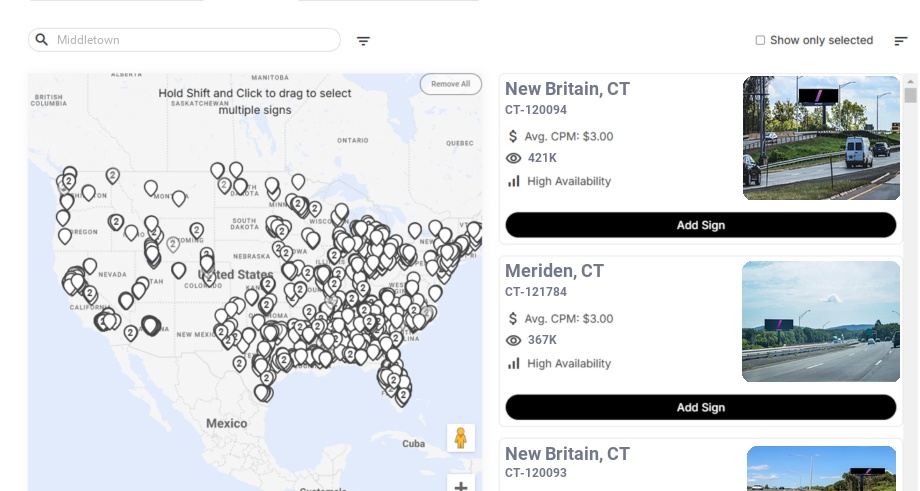
Blip has digital billboards near Middletown. You can browse available locations on a map, choose the ones that fit your audience, and start advertising right away.
Still have questions? Launch a campaign in minutes — no contracts, no commitments.
Start Your CampaignMiddletown Billboard Advertising Guide
Middletown, Connecticut sits at a strategic crossroads along the Connecticut River, drawing daily traffic from commuters, college students, healthcare workers, and visitors exploring the region. With 4 digital billboards near Middletown serving the area from nearby Meriden (about 7.3 miles away), we can use highly targeted, data-driven campaigns to repeatedly reach the people who live, work, study, and shop in and around Middletown. These Middletown billboards give local advertisers a cost-effective way to stay visible along the busiest nearby corridors.
Understanding the Middletown Area Market
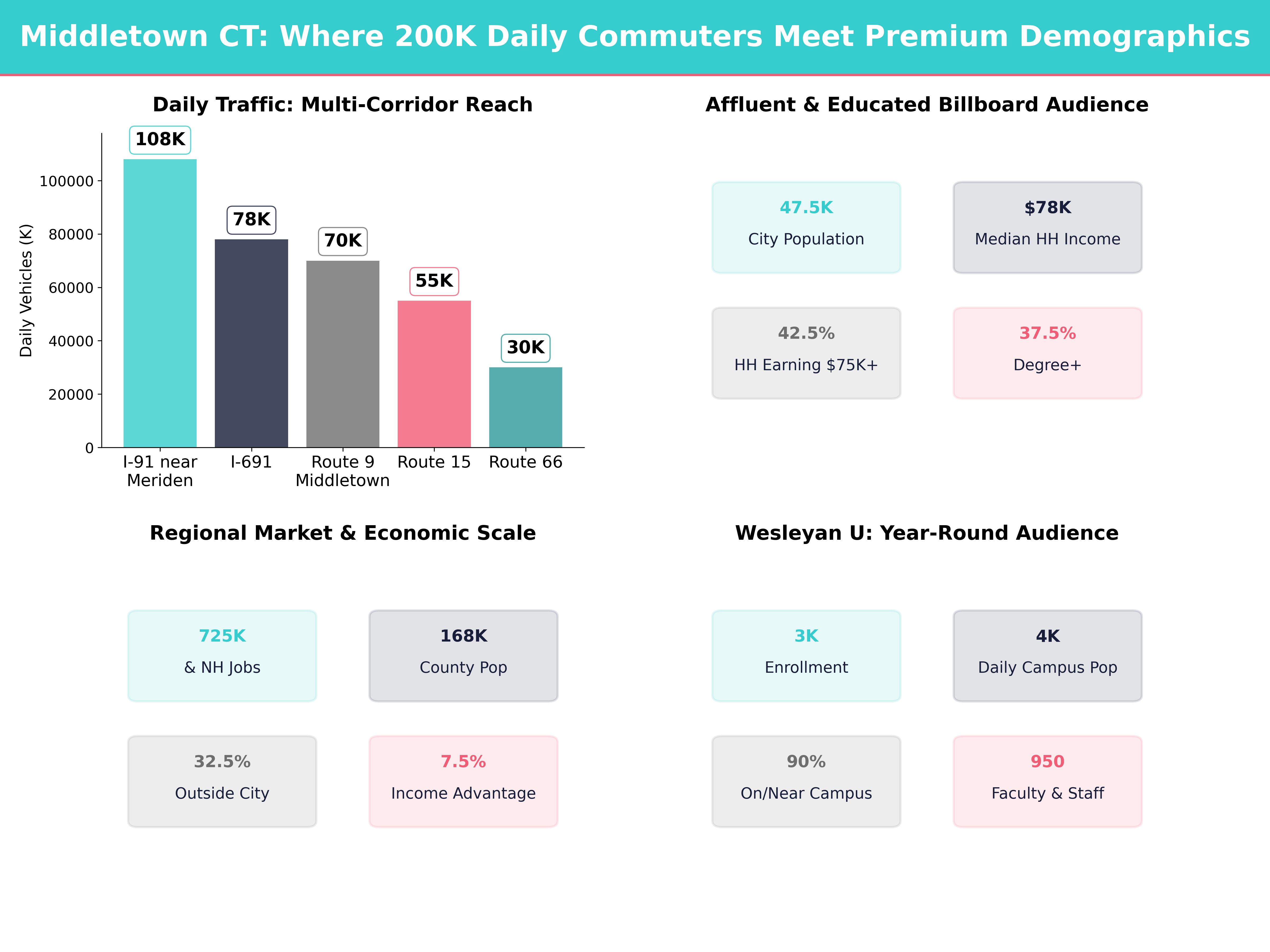
Middletown is a compact but economically diverse hub in central Connecticut. According to recent state and local data, the city has roughly 47,000–48,000 residents (around 20,000 households), with a median household income in the upper $70,000s (often cited around $78,000–$80,000). This gives us a mix of middle‑income households and a strong professional class commuting to and from nearby cities.
For context, Middletown’s median income trends 5–10% higher than many nearby communities in Middlesex County, and local unemployment typically runs in the 3–4% range in stable economic periods, underscoring a solid base of employed, spending-ready residents.
Key demographic and economic points:
- Population: About 47,000–48,000 residents in the Middletown area
- Households: Roughly 20,000 households, with an average household size around 2.3–2.4 people
-
Age profile: A relatively balanced mix, with notable concentrations of:
- College‑aged adults (18–24) thanks to Wesleyan University, which enrolls around 3,000 undergraduates plus several hundred graduate students and faculty
- Working‑age adults (25–54) employed in healthcare, education, manufacturing, and state government, typically accounting for over 50% of the population
- Income: Median household income in the $75,000–$80,000 range, with roughly 40–45% of households earning $75,000+, supporting discretionary spending on dining, retail, home services, and leisure
- Education: Higher than average educational attainment, with roughly 35–40% of adult residents holding a bachelor’s degree or higher—well above many neighboring communities, driven in part by Wesleyan and the presence of major professional employers
Major employers in and around the Middletown area include:
- Middlesex Health – a regional hospital and healthcare network employing an estimated 3,000+ staff (physicians, nurses, technicians, support), drawing workers and patients from across central Connecticut
- City of Middletown and Middlesex County court and government facilities, which together support hundreds of public‑sector jobs
- Education sector – Middletown Public Schools (serving roughly 4,000–4,500 students and employing 600–700 staff), Wesleyan University, and nearby institutions
- Nearby advanced manufacturing and aerospace employers in greater central Connecticut, particularly in the I‑91 corridor, where manufacturing can account for 10–12% of regional employment
Regional economic organizations like the Middlesex County Chamber of Commerce highlight Middletown as a central employment and retail hub within a county of roughly 165,000–170,000 residents.
For advertisers, this means we are not just speaking to “small‑town” audiences. We are reaching a well‑educated, professionally diverse, and relatively affluent population that frequently travels regional corridors—especially through Meriden and the I‑91 / I‑691 / Route 15 network that our digital billboards tap into. This is the same network that delivers strong exposure for anyone investing in billboard advertising near Middletown.
How Traffic Flows Shape Billboard Strategy Near Middletown
To build an effective Blip campaign—and to get the most out of billboards near Middletown—we need to align with how people actually move around the Middletown area each day.
According to traffic count data from the Connecticut Department of Transportation, the highways tying Middletown and Meriden together carry tens of thousands to well over 100,000 vehicles per day, providing substantial reach even with a focused set of billboards.
Key transportation dynamics:
-
Highways:
- Interstate 91 (I‑91) carries north–south traffic between New Haven Hartford, with Meriden as a major node. Typical average daily traffic (ADT) volumes near Meriden are in the 100,000–115,000 vehicles per day range. Many Middletown‑area commuters use I‑91 to reach work in Hartford, New Haven, and other employment centers.
- I‑691 and Route 15 (Wilbur Cross Parkway) form a busy east–west and parallel north–south alternative, connecting Meriden to Cheshire, Wallingford, and points west. Sections of I‑691 often see 70,000–85,000 vehicles per day, while Route 15 carries a mix of commuter and leisure traffic approaching 50,000–60,000 vehicles per day on busy stretches.
- Route 9 and Route 66 move traffic directly to and from Middletown, channeling vehicles toward the I‑91 corridor near Meriden. ADT on Route 9 in the Middletown area commonly runs between 60,000 and 80,000 vehicles per day, with Route 66 handling another 25,000–35,000 vehicles per day.
-
Commuter patterns:
- The combined Hartford and New Haven metropolitan areas support well over 700,000–750,000 jobs. Local labor data typically show 30–35% of Middletown residents commuting to jobs outside the city, especially toward these metros, often via Meriden.
- Hospital, manufacturing, retail, and university shifts create sustained traffic throughout the daytime, not just at rush hour; off‑peak midday volumes on these corridors still commonly reach 60–70% of peak traffic.
Because our 4 digital billboards near Meriden sit at critical junctions that Middletown‑area residents use daily, advertisers can use them to:
- Reach Middletown residents commuting north or south along I‑91
- Capture out‑of‑town visitors heading toward Middletown’s riverfront, downtown, and Wesleyan
- Engage regional shoppers making trips to large retail destinations in Meriden and surrounding towns, then returning home to the Middletown area
For many local campaigns—healthcare, education, events, restaurants, and home services—it’s strategically ideal to intercept audiences on these corridors just before or after they visit Middletown. This is where well-placed Middletown billboards can consistently reinforce your brand between home, work, and key destinations.
Key Audience Segments in the Middletown Area
When designing your campaign, consider which of these core segments you most want to reach; then tailor both your messaging and your Blip scheduling.
1. College and University Community
- Wesleyan University enrolls around 3,000+ students and employs 900–1,000 faculty and staff, creating a daily campus population easily topping 4,000 people during the academic year.
- Roughly 90%+ of undergraduates live on or near campus, but students frequently travel to nearby cities for shopping, off‑campus housing errands, internships, and entertainment, often using major corridors that pass near Meriden.
- Each academic year brings thousands of visiting parents, alumni, and prospective students. If even 40–50% of these visitors arrive by car, that’s several thousand visitor trips annually feeding through regional highways like I‑91, Route 9, and I‑691.
Ideal advertisers for this segment include:
- Local restaurants, bars, and coffee shops
- Fitness centers, salons, and lifestyle services
- Student housing, storage, and moving services
- Entertainment venues and seasonal events
Messaging tips:
- Use bold, minimal text appealing to younger audiences (e.g., “Late‑Night Eats 10 Minutes from Campus”).
- Highlight specials (student discounts, open‑late hours, live music nights); student‑oriented offers with 10–20% discounts or “Buy 1 Get 1” deals tend to perform well.
- Incorporate event‑timed campaigns around orientation, homecoming, parents’ weekend, and graduation, when campus visit volumes can spike 20–40% over normal weekends.
2. Healthcare and Professional Workers
Middletown’s economy is anchored by healthcare and professional services:
- Middlesex Health and its associated facilities employ several thousand workers. With multiple shifts and regional clinics, it generates a steady flow of employee and patient traffic—often thousands of vehicle trips per weekday—across the Middletown–Meriden corridor.
- Specialist practices and clinics draw patients from across central Connecticut, including Middlesex and New Haven counties, where combined populations exceed 800,000 residents.
- Professional services (finance, law, insurance, consulting, engineering) are concentrated in and around downtown Middletown and connected to larger hubs in Hartford and New Haven by I‑91 and Route 9.
Ideal advertisers:
- Financial services (local banks, credit unions, advisors)
- Childcare and after‑school programs
- Auto dealers and repair shops
- Real estate agents, home improvement and landscaping companies
Messaging tips:
- Focus on time saving, convenience, and trust (e.g., “Trusted Pediatric Care 15 Minutes from the Middletown Area”).
- Use short, direct CTAs that busy commuters can process at a glance (e.g., “Book in 60 Seconds – Visit [URL]”).
- Consider emphasizing metrics—“Rated 4.8★ by 500+ Local Families” or “Same‑Day Service in 95% of Calls”—to signal reliability.
3. Families and Suburban Households
The Middletown area has a substantial base of families living in single‑family homes in Middletown and nearby towns like Portland, Cromwell Middlefield. In many of these communities, 60–70% of housing units are owner‑occupied, and family households with children often make up 25–30% of all households.
These residents frequently travel through the Meriden area for shopping, school sports, and commuting. Retail trade, food service, and entertainment businesses in the broader Middletown–Meriden region support thousands of jobs and generate tens of millions of dollars in annual sales, much of it fueled by these family trips.
Ideal advertisers:
- Grocery, retail, and family dining
- Youth sports programs, camps, and tutoring
- Home services: HVAC, roofing, solar, lawn care, plumbing
- Regional attractions: zoos, museums, family fun centers, ski areas
Messaging tips:
- Emphasize value and reliability (e.g., “Winter‑Ready Heating Tune‑Up for Middletown‑Area Homes”).
- Feature clear promotions with numbers: “$0 Down,” “$99 Tune‑Up,” “Save 20% This Month.”
- Reference local coverage and community identity, such as family‑focused events highlighted by The Middletown Press or the City of Middletown events calendar.
4. Visitors and Regional Leisure Travelers
Middletown markets itself as a riverfront and cultural destination:
- The City of Middletown promotes a vibrant downtown, seasonal festivals, and scenic parks along the Connecticut River.
- The Connecticut River Valley is a recognized tourism region within the state, supported by organizations highlighted on CTvisit. Visitor spending in central Connecticut is commonly estimated in the hundreds of millions of dollars annually, spanning dining, lodging, and attractions.
- Wesleyan’s arts scene, along with local venues and restaurants, attracts visitors from the broader region. A single well‑attended festival or college event can bring several thousand visitors into downtown over a weekend.
Ideal advertisers:
- Hotels, inns, and short‑term rentals
- Restaurants, breweries, and nightlife spots
- Event organizers (concerts, fairs, seasonal markets)
- Tourist attractions within a 30–45 minute drive
Messaging tips:
- Focus on distance and direction (e.g., “Exit Now for Historic Downtown Middletown Area Dining” or “Riverfront Dining 10 Miles Ahead”).
- Use vivid imagery—food, river views, historic streets—to quickly convey experience.
- Tie offers to major regional calendars promoted by CTvisit and local news outlets like Hartford Courant and The Middletown Press.
Seasonal and Event‑Based Opportunities
The Middletown area has a distinct annual rhythm. With digital billboards, we can easily adapt campaigns to that cycle.
Visitor and traffic patterns shift measurably by season—for example, state tourism data typically show summer and early fall accounting for 50–60% of annual leisure trips, while retail sales spike 20–30% above monthly averages in November–December.
Spring (March–May)
- College students return from spring break and gear up for end‑of‑year activities, pushing campus‑related traffic up by 10–15% vs. winter.
- Home improvement and landscaping season kicks off as temperatures rise; home‑services businesses often see inbound inquiries jump 30–50% from February to May.
- Outdoor dining and riverfront activities ramp up, with local restaurants and parks highlighted by the City of Middletown and regional tourism sites.
Campaign ideas:
- Launch home services and garden/landscape campaigns as soon as daytime highs consistently hit the 50s.
- Promote spring menus, patios, and seasonal events.
- Use countdown messaging for key events (e.g., “3 Weeks Until Riverfront Festival – Plan Your Visit”).
Summer (June–August)
- Wesleyan is quieter, but summer programs, camps, and tourism pick up; local camps and youth programs often operate at 80–100% capacity.
- Families travel more, and weekend highway traffic increases; some Connecticut highways see 10–20% higher weekend volumes in peak summer.
- Outdoor recreation peaks—parks, riverfront, and regional attractions see higher use, and tourism sites like CTvisit heavily feature the Connecticut River Valley and central Connecticut destinations.
Campaign ideas:
- Target weekends and Friday afternoon/evening with Blip scheduling to catch leisure travelers.
- Promote family attractions, camps, and ice cream / casual dining.
- Use creative that emphasizes short drives and easy day trips from the Middletown area (“Fun Park – Just 25 Minutes from Middletown Area”).
Fall (September–November)
-
Major season for the Middletown area:
- University move‑in, homecoming, and parents’ weekends, when hotel occupancy in nearby towns can spike to 80–90%.
- Leaf‑peeping and fall festivals in central Connecticut; fall events promoted through outlets like The Middletown Press and Hartford Courant can draw thousands of visitors on peak weekends.
- Commuter traffic stabilizes and intensifies with the school year; weekday volumes often reach near‑peak annual levels in September and October.
Campaign ideas:
- Run back‑to‑school and college‑oriented campaigns targeting students and parents.
- Promote fall menus, pumpkin patches, orchards, and weekend events in the wider region.
- Emphasize weekend dayparting to hit visitors from across Connecticut.
Winter (December–February)
- Holiday shopping, winter sports, and service needs (heating, auto repair) drive behavior. Retail data often show November–December sales at 20–40% above typical monthly levels for some categories.
- Commuters continue to rely heavily on I‑91 and feeder routes; adverse weather can increase time on the road by 10–30%, extending exposure to billboard messages.
- Indoor entertainment, gyms, and wellness services see membership and visit spikes in early January.
Campaign ideas:
- Advertise holiday promotions and gift cards for Middletown‑area businesses.
- Run service and emergency campaigns: HVAC, plumbing, auto repair, snow removal—services that see demand surges during cold snaps.
- Highlight indoor activities: gyms, entertainment centers, museums, and performing arts, including programs promoted by local arts organizations and Wesleyan University.
Using Blip Tools to Target the Middletown Area Effectively
Because our boards are digital, we can refine how, when, and where your messages appear, making billboard advertising near Middletown more precise and efficient.
1. Dayparting Around Commutes
Traffic data from the Connecticut Department of Transportation shows pronounced peaks on I‑91, I‑691, and Route 15 near Meriden that line up with common work schedules.
Heavy flows near Meriden connect directly to the Middletown area during:
- Morning commute: roughly 6:30–9:00 a.m., when volumes often hit 90–100% of daily peak
- Evening commute: roughly 3:30–6:30 p.m., with some extension on Fridays as weekend travel starts
For commuter‑focused campaigns (healthcare, education, automotive, finance):
- Allocate a higher share of your Blip budget to weekday rush hours.
- Use clear, practical messages: “Service Before Work – Open at 7 a.m.,” “Same‑Day Appointments, Book Tonight.”
- Consider small A/B tests where 50–70% of impressions run in peak commute windows and the remainder in off‑peak windows to measure performance shifts.
For leisure and dining campaigns:
- Emphasize late afternoon and evening hours, especially Thursdays–Saturdays, when dining and entertainment spending typically surges 15–25% vs. early week.
- Consider Sunday afternoon targeting for family outings and errands.
2. Geographic Strategy Using Multiple Boards
With 4 digital billboards near the Middletown area available for flexible billboard rental near Middletown, we can:
- Maximize frequency by running the same creative across all boards, increasing the chance that commuters see you multiple times per week. A commuter passing the same corridor 10 times per week (twice daily) can easily accumulate 20–40 impressions per month from a consistent Blip schedule.
-
Segment creatives by direction of travel:
- For traffic heading toward the Middletown area, promote your location, exit, and distance: “Middletown Area Exit 2 – Next Right for [Business].”
- For traffic heading away from Middletown, focus on brand recall and digital calls‑to‑action: “Order Now at [URL] – Delivery to Middletown Area.”
- Coordinate messaging with information from local and regional sources—such as event calendars from the City of Middletown or coverage in the Middletown Press and Record-Journal—so that your boards echo what audiences are already seeing in local media.
3. Budget Flexibility and Testing
Blip’s pay‑per‑blip model lets you:
-
Start small—sometimes with daily budgets as low as $5–$10—to test which:
- Times of day
- Days of week
- Creatives
perform best for your Middletown‑area goals.
-
Increase your bids and budget during:
- Major seasonal events
- Business launches
- Limited‑time promotions (for example, briefly doubling your daily budget during holiday weeks or large downtown festivals)
We recommend:
-
Running A/B tests with at least two creatives:
- Creative A: price‑driven or offer‑driven
- Creative B: brand‑driven or experience‑driven
- Keeping each test live long enough to accumulate a meaningful sample—aim for at least 1,000–2,000 total impressions per creative.
- Monitoring website traffic, coupon redemptions, or direct inquiries during test windows to see which creative correlates with better results. For many local businesses, even a 10–15% boost in direct traffic or calls during a test period is a strong signal.
Crafting Creative That Works for Middletown‑Area Drivers
Regardless of your industry, your artwork should be optimized for high‑speed readability and the specific context of the Middletown area. Strong creative is what turns basic billboard rental near Middletown into a memorable, response‑driving campaign.
Keep it ultra‑simple
- Aim for 6–8 words maximum; studies of roadside advertising show recall drops sharply once you exceed 8–10 words.
- Use one main image and one clear CTA (“Visit Today,” “Exit Now,” “Book at [short URL]”).
- Use large, high‑contrast fonts against uncluttered backgrounds; ensure key text is at least 18–24 inches tall on the physical board, which equates to easily legible sizes at highway speeds.
Speak to distance and direction
Drivers in the Middletown area are often moving between cities:
- Use phrases like “Serving the Middletown Area,” “10 Minutes from Middletown,” or “Just off Route 9.”
- If your location is in Middletown itself, connect the dots from the corridor to your storefront:
“I‑91 to Route 9 – Downtown Middletown Area Dining, Exit [X].” - If your business is in Meriden or another nearby town, identify the quick connection:
“5 Minutes off I‑691 – Easy Drive from Middletown Area.”
Leverage local identity
-
Reference well‑known local anchors:
- “Near Wesleyan University in the Middletown Area”
- “Minutes from the Connecticut Riverfront”
- “Serving Families Across Middletown, Cromwell & Portland”
- Consider timely nods to local events or seasons covered by outlets like The Middletown Press or regional coverage from Hartford Courant (without overloading the design).
- Tie into civic and community priorities frequently promoted by the City of Middletown—such as downtown revitalization, arts, or outdoor recreation—to position your business as part of the local story.
Use clear URLs and response paths
- Use short, memorable URLs or QR‑friendly domains (even if drivers scan later from memory or a follow‑up ad).
-
Pair your billboard campaign with:
- A simple landing page referencing the Middletown area
- Local search ads that trigger when users look up your name or offer
- Make sure your business appears consistently on local directories and platforms—such as Google Business Profile, local chamber listings via the Middlesex County Chamber of Commerce, and community calendars—so that offline impressions convert into online discovery.
Connecting Digital Billboards With the Rest of Your Marketing
Campaigns near Middletown are most effective when your billboard presence reinforces your other local touchpoints.
1. Align With Local News and Events
-
Coordinate your campaigns with stories and calendars shared by:
- City of Middletown announcements and community events
- Middletown Press local coverage
- Regional outlets such as Hartford Courant and Record-Journal
- For example, a restaurant might launch a “Riverfront Happy Hour” campaign when local media spotlights downtown nightlife or upcoming festivals, or a retail store might sync a “Tax‑Free Week” promotion with state‑announced sales‑tax holidays frequently highlighted by local news.
2. Sync With Social and Search
- When your boards go live, run geo‑targeted social ads covering the Middletown and Meriden radius—say within 10–15 miles of downtown Middletown—and use the same imagery and headlines so drivers recognize your brand in their feed after seeing it on the road.
- Use radius targeting or ZIP‑code targeting that includes Middletown, Cromwell, Portland, Middlefield, and Meriden to match the real catchment area of your billboards.
- Ensure your Google Business Profile is fully updated with “serving the Middletown area” language, current hours, and accurate directions, and that you have recent photos and 10+ reviews to convert new searchers triggered by your board.
3. Track Impact Using Simple Metrics
Even without sophisticated analytics, Middletown‑area advertisers can track lift by:
- Adding billboard‑specific promo codes (“Mention ‘RIVER20’ for 20% Off”) and counting redemptions; aim for codes that are short and easy to remember.
- Monitoring direct traffic and branded searches online during and after your campaign; a sustained 10–20% increase in direct or branded traffic compared to your pre‑campaign baseline is a strong indicator of billboard impact.
- Asking new customers, “How did you hear about us?” and tracking how many mention “a billboard near Meriden” or “on the highway.”
- Comparing week‑over‑week or year‑over‑year sales during periods when your boards are on vs. off, adjusting for major holidays or events that may be highlighted by the City of Middletown or local news outlets.
Putting It All Together for the Middletown Area
Digital billboards near Middletown give us the ability to:
- Reach commuters, students, professionals, and families who rely on the I‑91 / I‑691 / Route 15 corridors around Meriden—corridors that together carry well over 200,000 vehicles per day
- Tailor messages by time of day, direction of travel, and seasonal behavior, using data‑backed patterns in traffic and consumer spending
- Test, optimize, and scale your presence based on real‑world performance, without locking into long, rigid contracts
By grounding your strategy in local traffic flows, Middletown’s economic profile, and the region’s annual rhythm—as documented by entities like the City of Middletown, Middlesex County Chamber of Commerce, and local news outlets—we can build a campaign that does more than just generate impressions. It repeatedly reaches the right Middletown‑area audiences at the moments they are most ready to notice, remember, and act, turning well-placed Middletown billboards into a reliable driver of calls, visits, and sales.