Billboards near Milford city, CT
No Minimum Spend. No Long-Term Contracts. Just Results.
Trusted by Leading Brands


Billboard advertising
near Milford city has never been easier
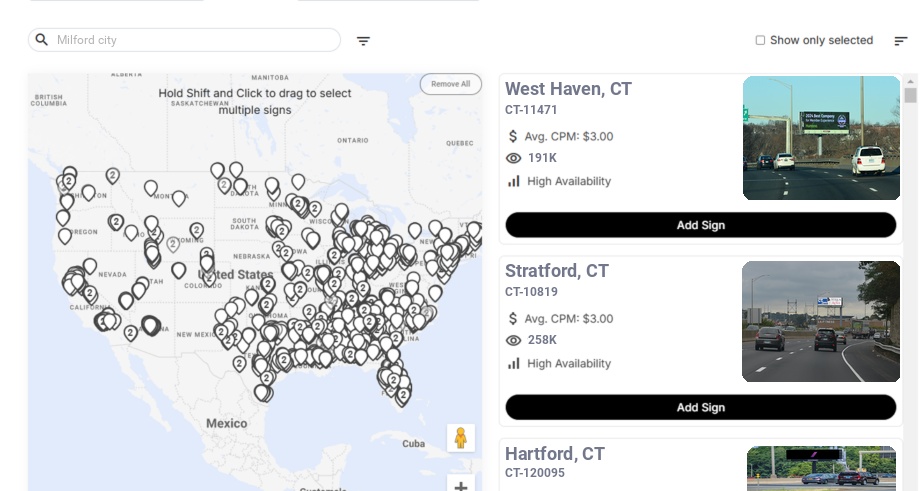



How much is a billboard near Milford city?
Why Choose Blip for Billboard Advertising near Milford city
-
Blip lets you launch fast in Milford city on I-95 and Route 1, reaching shoreline commuters and mall shoppers without a sales cycle.
-
Set any budget in Milford city and pay only for blips shown near I-95, Route 15, and Route 34—no minimums or contracts.
-
Use dayparting in Milford city to hit beach traffic in summer and weekday commuters year-round on the shoreline corridors.
-
Track results in real time across Milford city so you can shift spend between commuter routes and retail zones as demand changes.
-
Build and update creative in Blip for Milford city, with ads that fit the Milford Oyster Festival, coast, and Connecticut Post Mall traffic.
Frequently Asked Questions About Billboard Advertising near Milford city
How much does a billboard cost in Milford city with Blip?
You only pay when your ad actually appears, with each 7.5-to-10-second display, or “blip,” starting at just $0.01 per display. Because pricing changes based on time of day, location, and demand, your cost stays tied to real opportunity rather than a fixed rate. There are no minimums or contracts, so you can start small, adjust your budget anytime, and keep control of your total spend as the sum of your individual blips.
Where can I advertise with Blip in Milford city?
Blip puts your brand on digital billboards serving the Milford city area, and the network follows the roads people actually use, including Interstate 95, U.S. Route 1, Route 15, and Route 34. We can reach this market through 34 digital billboards positioned across nearby locations within 10.0 miles of Milford city. The closest nearby board cluster sits about 3.1 miles from Milford city.
Why is billboard advertising in Milford city effective?
Advertising near Milford works especially well because the Milford area sits on one of Connecticut’s busiest shoreline corridors, with Interstate 95 segments near Milford carrying roughly 140,000 to 160,000 vehicles per day, between Bridgeport and New Haven. The area also blends shoreline lifestyle with year-round commerce, including retail, healthcare, education, dining, and recreation. That combination of commuter traffic, shoreline activity, retail draw, and cross-county movement is unusually strong.
What kind of audience can I reach in Milford city with Blip?
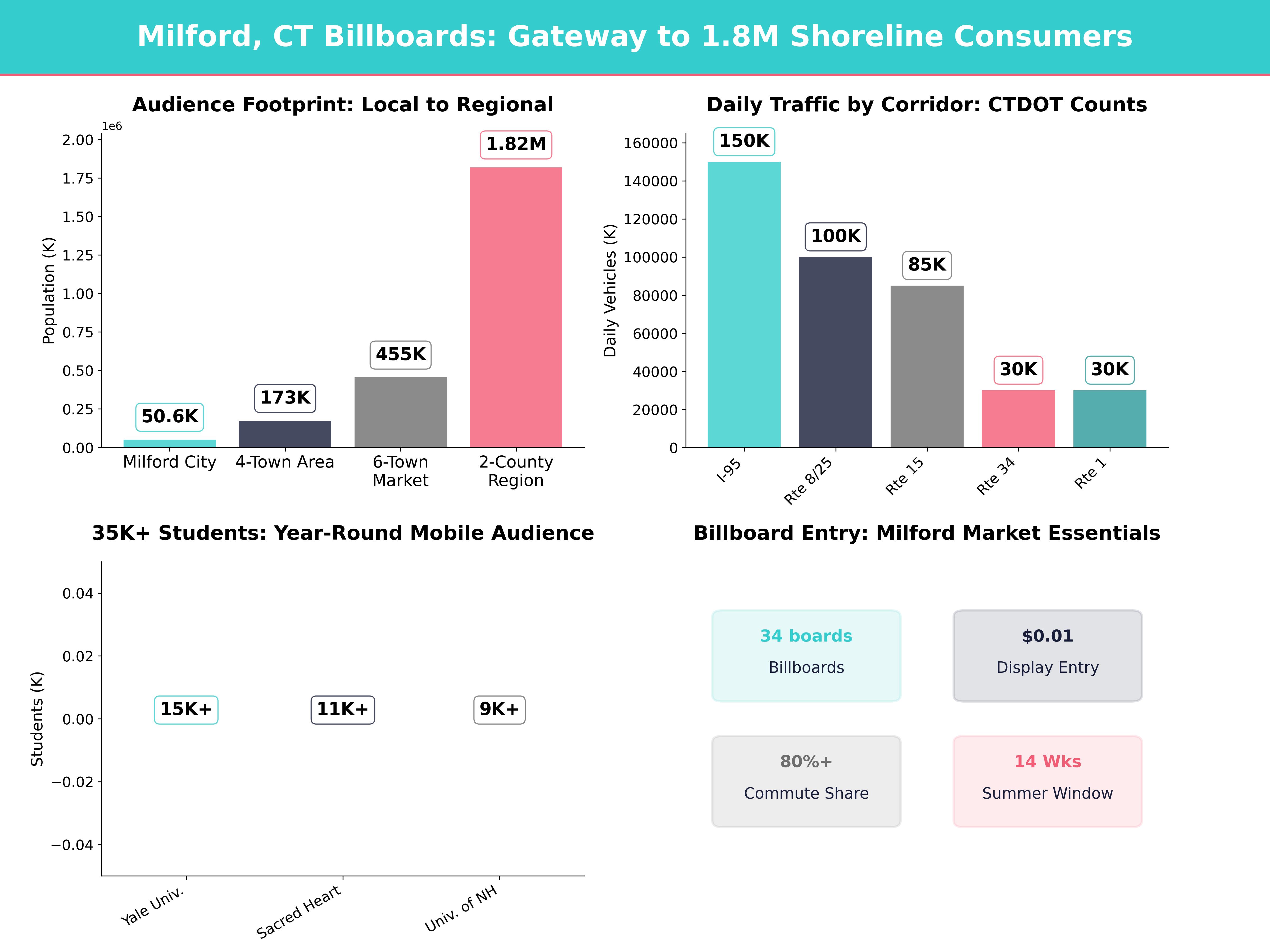
The Milford area is large enough to support sustained billboard advertising, yet compact enough that nearby boards can cover the market efficiently. Milford had a 2020 population of 50,558, and the nearby six-town core totals 455,454 people. The area also includes commuters, families, homeowners, shoppers, students, faculty, young adults, visitors, and recreation seekers.
When is the best time to advertise in Milford city?
From Memorial Day through Labor Day, a roughly 14-week stretch, the Milford area benefits from shoreline travel, beach activity, and weekend recreation. Late July through September is also one of the best campaign windows of the year because the Milford Oyster Festival overlaps with back-to-school planning and return traffic for Yale University and the University of New Haven. Spring and the holiday season are also strong for home-focused offers and retail activity.
Do I need a contract to advertise with Blip near Milford city?
No, Blip has no long-term contracts or minimum commitments. You can start, pause, or stop your campaign at any time.
How fast can I launch a billboard campaign with Blip near Milford city?
You can have your campaign live in minutes. Create a free account, select your locations, set your budget, upload your design, and start running once approved.
Where can I advertise with Blip near Milford city?
Blip has digital billboards near Milford city. You can browse available locations on a map, choose the ones that fit your audience, and start advertising right away.
Still have questions? Launch a campaign in minutes — no contracts, no commitments.
Start Your CampaignMilford city Billboard Advertising Guide
Advertising near Milford Interstate 95 segments near Milford carrying roughly 140,000 to 160,000 vehicles per day, between Bridgeport and New Haven 34 digital billboards positioned across nearby locations within 10.0 miles of Milford city, which gives us strong coverage without straying far from the audience we want. That network follows the roads people actually use, including Interstate 95, U.S. Route 1, Route 15, and Route 34. For brands that want flexible, repeated visibility serving the Milford area, this combination of commuter traffic, shoreline activity, retail draw, and cross-county movement is unusually strong.
Milford area market overview
The Milford area has meaningful scale in a compact radius
The Milford area is large enough to support sustained billboard advertising, yet compact enough that nearby boards can cover the market efficiently. Milford 2020 population of 50,558, which makes it one of the larger shoreline communities in Connecticut. The surrounding nearby municipalities also add substantial scale, including Orange 14,280 residents, Stratford at 52,355, West Haven 55,584, Bridgeport at 148,654, and New Haven 134,023.
When we total those six nearby municipalities, we get an immediate market footprint of 455,454 people. The broader two-county catchment is even larger, with 957,419 residents in Fairfield County and 864,835 in New Haven County, for a combined 1,822,254 residents. Connecticut as a whole had 3,605,944 residents in 2020, which means the Milford area sits within a significant share of the state’s overall population and economic activity.
Our current digital inventory serving the Milford area is also geographically tight:
- The closest nearby board cluster sits about 3.1 miles from Milford city.
- Additional nearby inventory sits about 3.8 miles away in Orange
- Additional nearby inventory sits about 4.8 miles away in Stratford.
- Additional nearby inventory sits about 5.9 miles away in West Haven
- Additional nearby inventory sits about 9.1 miles away in Bridgeport.
- Additional nearby inventory sits about 9.2 miles away in New Haven
That matters because it lets us build campaigns with both frequency and regional spillover. We can stay very close to Milford city for local service brands, or we can widen the mix to catch commuters entering and leaving the Milford area from both directions.
The Milford area blends shoreline lifestyle with year-round commerce
The Milford area is not just a bedroom community. It is a year-round retail, healthcare, education, dining, and recreation market serving 50,558 Milford residents and a nearby 455,454-person six-town core. The City of Milford 17 miles of coastline, which helps explain why the area attracts residents, visitors, and leisure traffic well beyond summer weekends.
Retail is also a major part of the market story. Connecticut Post Mall spans roughly 1.3 million square feet, making it one of the major shopping anchors serving the Milford area and nearby shoreline communities. That mall corridor, together with Boston Post Road, gives advertisers consistent access to shoppers who are making errands, dining trips, and comparison-shopping visits throughout the week.
The employment base around Milford is also diverse. Nearby institutions such as Yale New Haven Health Bridgeport Hospital, Milford Hospital Yale University, the University of New Haven, and Sikorsky
Travel behavior near Milford strongly favors roadside advertising
For most of the Milford area, the car is still the dominant way people get around. In suburban Connecticut communities like Milford, Orange, and Stratford, commuting by car, truck, or van typically lands at roughly 80% or more of workers, which helps explain why roadway-based advertising performs so well here. Even when nearby rail matters, most trips still involve driving to work, school, stores, appointments, or transit stations.
Rail adds reach rather than replacing roadway exposure. Metro-North Railroad serves the shoreline through the New Haven Line, with stations in Milford and nearby communities, but the road network still does most of the market-building work for billboards serving the Milford area. That is why the best billboard strategies near Milford usually start with I-95, Route 1, and Route 15, then layer in retail and event timing.
Milford area key traffic corridors
Interstate 95 is the primary spine serving the Milford area
If we want broad awareness serving the Milford area, Interstate 95 is the first corridor to study. Recent Connecticut Department of Transportation traffic counts commonly place I-95 segments near Milford at roughly 140,000 to 160,000 vehicles per day. That is the corridor that ties together Milford-area residents, Bridgeport-side workers, New Haven-side institutions, shoreline shoppers, and through-travelers.
For advertisers, I-95 works because it captures multiple kinds of intent at once. Eastbound traffic often reflects trips toward West Haven, New Haven, Yale, hospitals, and entertainment. Westbound traffic often reflects movement toward Stratford, Bridgeport, Fairfield County jobs, and longer-distance commuter flows. If we want awareness, recall, and repeat exposure, I-95 is the backbone.
Route 1 reaches local shoppers and everyday decision-makers near Milford
U.S. Route 1, known locally as Boston Post Road in many segments, is one of the most valuable retail corridors serving the Milford area. Recent CTDOT counts on Route 1 segments near the retail core commonly fall around 25,000 to 35,000 vehicles per day. That traffic is slower and more locally intentional than freeway traffic, which makes Route 1 especially useful for restaurants, medical practices, home services, retail offers, and destination-based businesses.
This is also where the Milford area’s shopping identity becomes very visible. The Connecticut Post Mall, adjacent big-box retail, restaurants, and service businesses create a corridor where people are already primed to make decisions. When we want to influence a same-day visit or a near-term action, Route 1 boards near Milford often deserve priority.
Route 15 and Route 34 help us reach suburban commuters and inland households
The Merritt Parkway, Route 15, is another important corridor serving the Milford area, especially via nearby Orange. Recent CTDOT counts commonly put Route 15 segments near Orange around 80,000 to 90,000 vehicles per day. That audience tends to skew toward suburban commuters, homeowners, professionals, and people moving between coastal towns and inland job centers.
Route 34 also matters more than many advertisers expect. Traffic counts on key segments in Orange commonly rise above 30,000 vehicles per day, and the road functions as a connector between I-95, Route 15, and inland communities. For businesses that serve homeowners, healthcare patients, business travelers, or regional service territories, Route 34 can be a smart complement to the more obvious shoreline routes.
Bridgeport and New Haven approaches expand reach without losing Milford focus
We should not think of the Milford area as an isolated local market. It sits between two larger cities that together total 282,677 residents, counting 148,654 in Bridgeport and 134,023 in New Haven. That positioning gives us extra leverage when we use boards on the west and east approaches.
From the west, nearby Bridgeport and Stratford boards help us intercept Fairfield County traffic before it reaches the Milford area. Route 8/25 near Bridgeport also carries heavy regional volumes, commonly around 100,000 or more vehicles per day on key segments. From the east, nearby West Haven
Milford area audience segments
Commuters are the foundation of Milford area billboard reach
Commuters are the most reliable audience segment near Milford because their travel is repeated and predictable. The area’s strongest roadways carry six-figure traffic volumes on I-95, five-figure volumes on Route 1, and robust suburban flow on Route 15 and Route 34. That creates the kind of repeated weekly exposure that billboard campaigns need.
This segment is especially valuable for categories like healthcare, banking, insurance, legal services, auto dealerships, home improvement, fitness, and local retail. When people see a message several times during regular commuting, recall builds quickly. That is why a Milford-area campaign often performs best when we focus first on routes people use 5 days a week, then add weekend and seasonal layers.
Families, homeowners, and shoppers are a strong core audience near Milford
The Milford area is also a strong family and homeowner market. Milford Orange Stratford, and West Haven 172,777 residents, which gives local-service advertisers a sizable nearby base even before we add Bridgeport and New Haven.
This audience responds well to messaging about convenience, trust, savings, and proximity. Home services, medical specialists, urgent care, orthodontics, tutoring, grocery, family dining, storage, and retail categories all fit naturally here. Because families make recurring trips along the same corridors, we can build strong local frequency with a relatively tight geographic buy.
Students, faculty, and young adults add year-round movement
The education audience around Milford is larger than many advertisers assume. Yale University enrolls more than 15,000 students. The University of New Haven enrolls more than 9,000 students. Sacred Heart University enrolls more than 11,000 students. Those institutions help create year-round movement for dining, apartments, entertainment, health services, banking, transportation, and recruiting.
We can also reach this audience at different moments of intent. Late summer and early fall are strong for move-in, furnishing, mobile plans, food, and student services. Midyear terms and spring events create additional bursts. Because many of these students and staff travel through New Haven, West Haven, Bridgeport, Stratford, and Orange on the way to or from the Milford area, nearby boards can influence them effectively.
Visitors and recreation seekers matter, especially from late spring through fall
Tourism is not the whole Milford story, but it is meaningful. Milford’s shoreline identity, beaches, harbor activity, and parks attract visitors from across the region. Silver Sands State Park alone covers 297 acres, which gives the Milford area a well-known recreational anchor for beach days, walking, birding, and family outings.
Visitor traffic is especially important for restaurants, seasonal retail, entertainment, hospitality, local attractions, and impulse stops. Because shoreline leisure trips often overlap with shopping trips on Route 1 and commuter routes on I-95, the same billboard campaign can speak to both residents and visitors if we time it well.
Seasonal timing near Milford
Summer is the clearest seasonal opportunity near Milford
From Memorial Day through Labor Day, a roughly 14-week stretch, the Milford area benefits from shoreline travel, beach activity, and weekend recreation. That period is especially strong for restaurants, ice cream, beverage brands, convenience retail, tourism, family entertainment, automotive services, and mobile apps tied to local activity. Creative that references summer, the coast, or quick-access convenience usually feels natural here.
The summer calendar is also supported by destination behavior. Silver Sands State Park, the harbor area, and shoreline dining all help lift local movement. If we are trying to reach both residents and day visitors, summer weekend dayparts on Route 1 and I-95 are often worth increasing.
Late August and fall create excellent local timing windows
The Milford Oyster Festival Milford Public Schools and with move-in and return traffic for Yale University and the University of New Haven
Fall is also strong because routines become more predictable again. Commuting normalizes after summer vacations, family schedules stabilize, and regional shopping remains active. This is a good period for healthcare, education, financial services, legal services, home services, and local retail campaigns that need repeated weekday exposure.
Holiday retail and winter service categories perform well too
The Milford area stays commercially active in November and December thanks to the Connecticut Post Mall corridor and surrounding retail. Holiday gift buying, dining, events, and family travel keep Route 1 and I-95 valuable. We usually see this as a strong window for retail promotions, quick-service dining, entertainment, and time-sensitive offers.
Winter also favors practical categories. Healthcare, urgent care, tax preparation, plumbing, HVAC, snow-related services, vehicle maintenance, and indoor entertainment all benefit from steady local need. Because winter days are shorter and weather can reduce decision time, clear, high-contrast creative becomes especially important.
Spring is ideal for reset campaigns and home-focused offers
Spring is an underrated billboard season serving the Milford area. Home improvement, landscaping, roofing, windows, patios, moving, storage, weddings, and graduation-related services all gain momentum from March through May. Spring also gives us a good chance to refresh creative before summer leisure traffic ramps up.
Design tips for ads serving the Milford area
We should design for both shoreline identity and commuter speed
The Milford area rewards creative that feels local without becoming cluttered. Coastal blues, whites, sandy neutrals, and crisp contrast often fit naturally because the market is strongly associated with beaches, the harbor, and shoreline lifestyle. At the same time, highway audiences still need instant readability, so local flavor should support the message, not bury it.
A good Milford-area design usually does three things well:
- It uses 1 dominant visual.
- It delivers 1 core message.
- It gives viewers 1 easy next step.
That simplicity works especially well on I-95 and Route 15, where attention windows are short and repetition does the heavy lifting.
We should match copy style to the road and the audience
Route choice should influence the creative. On I-95, we usually want broad awareness copy such as brand name, category, and a very short value proposition. On Route 1, we can be slightly more direct because people are already closer to stores, restaurants, and service locations. On Route 15 and Route 34, we often see stronger performance from professional, trust-based, or homeowner-oriented messaging.
As a rule, we recommend keeping billboard copy near 7 to 10 words whenever possible. We also recommend using a single URL, a short brand name, or a clear call to action rather than multiple phone numbers or dense lists. Because Blip displays run for 7.5 to 10 seconds, simple creative is usually the best fit.
Local references work best when they feel practical
We do not need to overdo hometown references, but practical local cues can help. Phrases like “Serving the Milford Area,” “Off Route 1,” “Near the Shoreline,” or “Easy from I-95” usually work better than generic national copy. For family-oriented brands, imagery that reflects coastal Connecticut life often feels more relevant than stock visuals that could belong anywhere.
Seasonal creative also matters here. Summer visuals can lean into shoreline leisure. Fall creative can shift toward school, healthcare, or routine-driven services. Holiday creative can emphasize shopping and gatherings. If we change the message with the calendar, the campaign feels more current and more local.
Regional strategies around Milford
Closest-to-Milford boards are best for frequency and local action
When our goal is store visits, appointments, or local awareness, we should start with the boards closest to Milford city. The nearby clusters closest to the market, especially those around the Milford and Orange approaches, help us build repetition among residents who travel the same retail and commuter corridors all week.
This strategy is especially useful for:
- Medical and dental practices that want nearby patient volume.
- Restaurants and retailers that want same-week response.
- Home-service companies that serve the Milford area directly.
- Community organizations, schools, and event promoters targeting local households.
Stratford and Bridgeport boards strengthen westbound reach
The west side of the market matters because Fairfield County traffic often approaches Milford from Stratford and Bridgeport. Boards on that side help us intercept commuters and shoppers before they enter the core Milford area. This is a strong strategy for brands that pull customers from beyond Milford itself, such as large retailers, hospitals, colleges, entertainment venues, and multi-location businesses.
If we are serving Fairfield County households as well as Milford-area residents, the west approach can add meaningful scale without losing relevance. It is also useful when we want stronger exposure to regional traffic using Route 8/25 and I-95.
West Haven and New Haven boards strengthen eastbound reach
The east side gives us access to students, hospital visitors, Yale-related audiences, downtown workers, and New Haven-bound event traffic. Boards in nearby West Haven
This approach works well because many eastern travelers still pass through the same shoreline routes that serve the Milford area. We can keep the primary focus on Milford while still benefiting from New Haven-side travel volume.
Orange and inland connectors are valuable for homeowner and suburban targeting
We should not overlook Orange-side inventory. Nearby Orange
Blip tools for Milford area campaigns
We can use scheduling to match Milford-area travel patterns
Blip’s flexibility is especially useful near Milford because different corridors behave differently. We can run heavier morning and evening schedules on I-95 and Route 15, stronger midday and weekend schedules on Route 1, and event-focused bursts around beach season, back-to-school, or holiday shopping. That makes the campaign feel more intentional and usually helps budget efficiency.
We can test the market without overcommitting
Because pricing is pay-per-play and starts at $0.01 per display, we can test the Milford area in a measured way rather than committing to a rigid traditional package. We can start with a small cluster of boards, watch which corridors deliver the best response, and expand from there. For local businesses, that is often the smartest way to learn the market.
We can optimize as we learn which nearby routes perform best
The Milford area is ideal for iterative optimization because the nearby network includes close-in boards, commuter corridors, retail routes, and east-west regional approaches. If one message performs better near Route 1 and another performs better near I-95, we can adjust. If weekday commuting outperforms weekend leisure traffic, we can shift spend. Real-time analytics make those decisions much easier.
Getting started with billboard rental near Milford
We should begin by choosing the right campaign objective
Before renting any billboard near Milford, we should decide what success looks like. If we want broad awareness, we should prioritize I-95 and Route 15. If we want store traffic or appointments, we should prioritize Route 1 and the closest nearby boards to Milford city. If we want regional spillover, we should add Stratford, Bridgeport, West Haven, or New Haven based on where our audience is coming from.
A useful planning framework is to sort boards into 3 roles:
- Core local boards should build frequency close to the Milford area.
- Commuter boards should catch weekday travel on I-95 and Route 15.
- Regional expansion boards should pull in Bridgeport-side or New Haven-side audiences.
We should launch a focused first test and evaluate fit
For many advertisers, a smart first move is a 2- to 4-week test using 5 to 10 boards across the most relevant nearby corridors. That is usually enough time to learn which geography, schedule, and message are doing the most work. We can then expand the winning parts of the campaign instead of guessing.
When we evaluate which billboard locations fit our goals, we should ask a few practical questions:
- Are we trying to reach daily commuters, weekend shoppers, or seasonal visitors?
- Are we targeting the closest Milford-area households, or a wider cross-county audience?
- Does our message need fast awareness, or a near-term visit?
- Would our business benefit more from shoreline retail traffic, suburban homeowner traffic, or university and hospital traffic?
Those questions usually point us toward the right mix of corridors.
Blip simplifies the rental process compared with traditional buying
Traditional billboard buying can feel slow, inflexible, and oversized for advertisers who just want to test a market. Blip simplifies that process because we can choose boards on a map, control our budget directly, upload creative, and adjust timing without a long negotiation cycle. That matters in the Milford area, where the best campaign often evolves as we learn whether commuters, shoppers, students, or seasonal visitors are responding most strongly.
For advertisers serving the Milford area, the path is usually straightforward. We start with the audience, choose the nearby corridors that match that audience, launch simple creative, and then optimize based on real results. With 34 digital billboards positioned within 10.0 miles of Milford city, we can build anything from a close-in local campaign to a broader shoreline strategy without making the process unnecessarily complicated.