Billboards near Plum, PA
No Minimum Spend. No Long-Term Contracts. Just Results.
Trusted by Leading Brands


Billboard advertising
near Plum has never been easier



How much is a billboard near Plum?
Why Choose Blip for Billboard Advertising near Plum
Blip lets you launch on Plum’s Route 28 and PA 286 corridors in minutes, reaching commuters heading to Pittsburgh and Monroeville without buying a long-term package.
Set a Plum budget that fits your goals and pay only for each blip—ideal for testing around school traffic, river-town shoppers, and weekend event crowds.
Use dayparting on Blip to hit Plum’s peak windows: 6–9 a.m., 3–7 p.m., and Friday nights when school and commuter traffic surge.
No contracts means you can scale Plum campaigns up for back-to-school, holidays, or summer festivals, then adjust fast as demand changes.
Track Plum performance in real time and shift spend toward Verona, Cheswick, or Tarentum boards that best reach Allegheny River commuters.
Blip’s creative tools make it easy to tailor Plum ads with short, bold messages for 45–65 mph drives on PA 28 and Golden Mile Highway.
Frequently Asked Questions About Billboard Advertising near Plum
How much does a billboard cost near Plum, Pennsylvania with Blip?
With Blip, you can advertise on digital Plum billboards on any budget, choosing exactly how much you want to spend each day while Blip automatically keeps your campaign within that amount. You’ll only pay for the individual “blips” your ad receives—each 7.5 to 10-second display on digital billboards near Plum, Pennsylvania—so your total cost is just the sum of those blips over time. Because pricing is based on when and where you run your ad and current advertiser demand, you can start small, test what works in the Plum area, and scale up confidently.
Where can I advertise with Blip near Plum, Pennsylvania?
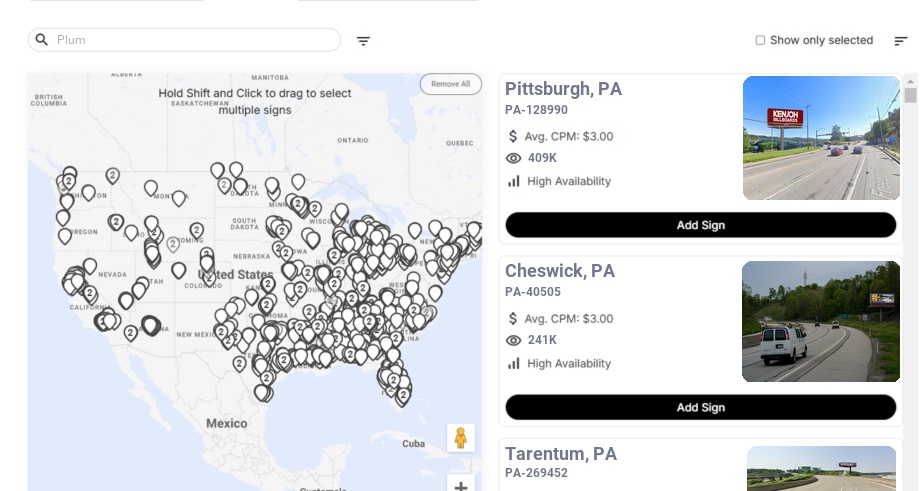
We have 14 digital billboards serving the Plum area, located in nearby communities that share key travel corridors and shopping patterns. These include Verona, New Kensington, Cheswick, and Tarentum. These communities form a dense ring of river towns and suburbs around Plum, ideal for billboard advertising near Plum that reaches residents on all major approach routes.
What kind of audience do Plum, Pennsylvania billboards reach?
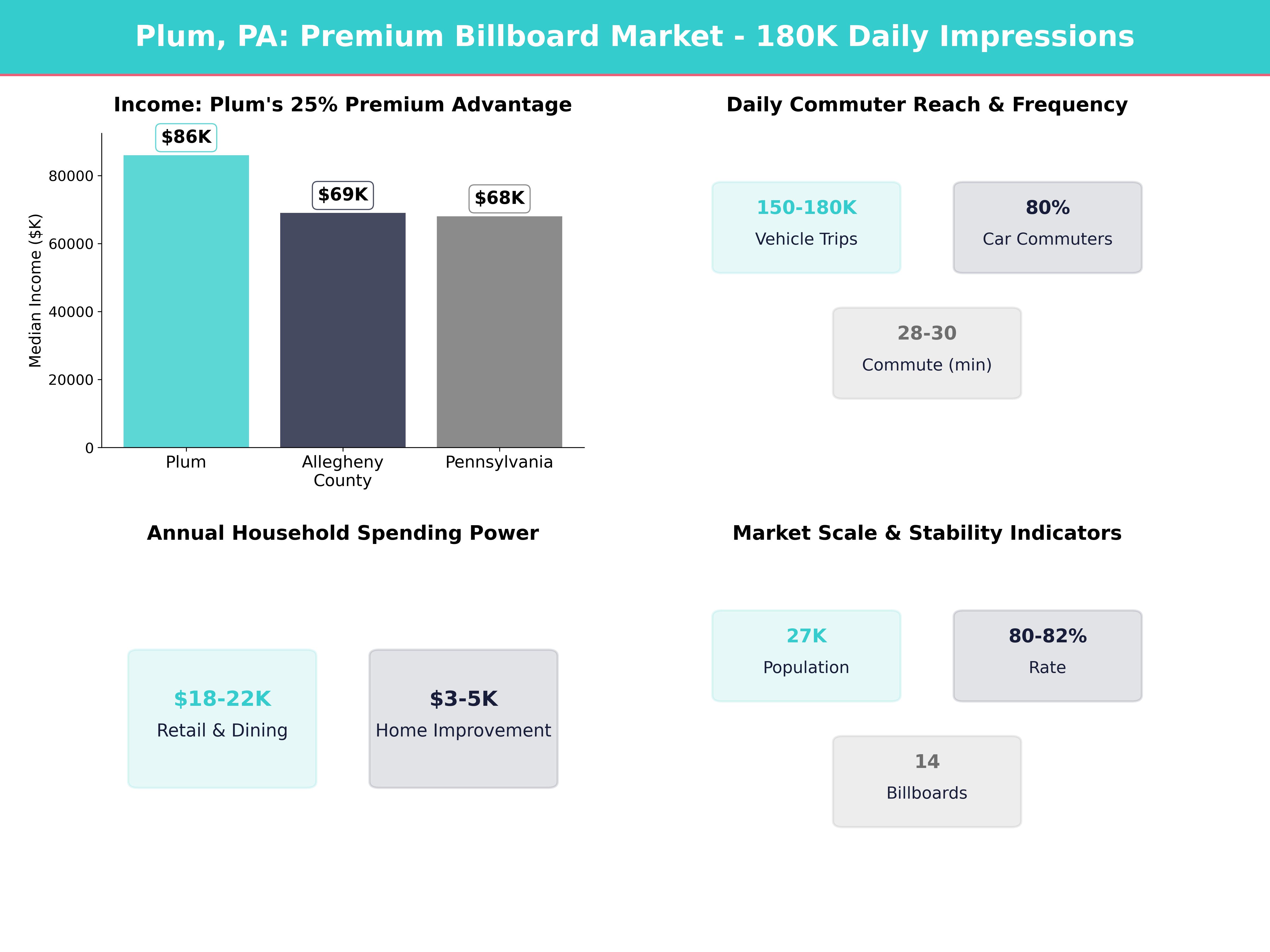
Plum, Pennsylvania is a growing, upper–middle-income suburb on the eastern side of the Pittsburgh region, with strong schools, stable neighborhoods, and steady commuter traffic moving toward major job centers. Key indicators include a population of about 27,000, a median household income of approximately $86,000, and roughly 80–82% homeownership. The broad age mix and higher education levels support demand for family-oriented messaging, youth activities, senior services, professional services, and higher-end retail.
When is the best time to run Blip billboards near Plum, Pennsylvania?
Use weekday morning (6–9 a.m.) and evening (4–7 p.m.) dayparts to reach commuters when road volumes are at their highest. For family and after-school businesses, emphasize 3–6 p.m. windows, particularly during the school year. For nightlife, entertainment, and dining, run heavier Thursday–Saturday evening flights near high-traffic corridors serving Plum area residents.
How much traffic do Plum, Pennsylvania billboard locations get?
Between Plum and its neighboring communities, daily road volumes on nearby state routes and interstates routinely exceed 150,000 vehicles per day, giving advertisers repeated opportunities to reach residents as they move through the area. Regional data indicate that PA Route 28 near the Cheswick and Tarentum area carries roughly 55,000–65,000 vehicles per day, while the Pennsylvania Turnpike can see 80,000–100,000+ vehicles per day on heavily traveled stretches in Allegheny County. Together, these corridors easily exceed 150,000–180,000 vehicle trips per day within the broader Plum travel shed.
Do I need a contract to advertise with Blip near Plum?
No, Blip has no long-term contracts or minimum commitments. You can start, pause, or stop your campaign at any time.
How fast can I launch a billboard campaign with Blip near Plum?
You can have your campaign live in minutes. Create a free account, select your locations, set your budget, upload your design, and start running once approved.
Where can I advertise with Blip near Plum?
Blip has digital billboards near Plum. You can browse available locations on a map, choose the ones that fit your audience, and start advertising right away.
Still have questions? Launch a campaign in minutes — no contracts, no commitments.
Start Your CampaignPlum Billboard Advertising Guide
Plum, Pennsylvania is a growing, upper–middle-income suburb on the eastern side of the Pittsburgh region, with strong schools, stable neighborhoods, and steady commuter traffic moving toward major job centers. Between Plum and its neighboring communities, daily road volumes on nearby state routes and interstates routinely exceed 150,000 vehicles per day, giving advertisers repeated opportunities to reach residents as they move through the area. With 14 digital billboards serving the Plum area from nearby Verona, New Kensington, Cheswick, and Tarentum, we can help advertisers reach residents as they commute, shop, and enjoy the Allegheny River corridor. If you’re looking for billboards near Plum to reach these on-the-go audiences, this guide walks through how to design and time a high-performing digital billboard campaign near Plum using Blip’s flexibility.
Plum Area Market Snapshot: Who You’re Reaching
Plum is one of Allegheny County’s larger suburban communities and a high-value audience for regional and local brands.
Key demographic and economic indicators (latest available data, rounded):
- Population: About 27,000 residents in Plum Borough, making it one of the 10 largest municipalities in Allegheny County by population
- Median household income: Approximately $86,000, about 25–30% higher than Pennsylvania’s statewide median (around $68,000) and notably above the overall Allegheny County median (roughly $69,000)
- Homeownership: Roughly 80–82% of households are owner-occupied, compared with about 69–70% statewide, indicating long-term, stable residents and strong attachment to the community
-
Age distribution:
- Around 21% under age 18 (families with children)
- Around 58–60% ages 18–64 (working-age adults)
- Around 19–21% age 65+ (a sizable and growing retiree population)
- Education: Around 60–65% of adults have at least some college, and roughly 30–35% hold a bachelor’s degree or higher, supporting demand for professional services and higher-end retail
- Commuting: Average one-way commute times are close to 28–30 minutes, with more than 80% of workers commuting by car and a significant share traveling toward Pittsburgh, Monroeville, Oakmont, and other employment hubs
- Household spending: Higher-income suburban households in eastern Allegheny County typically spend $18,000–22,000+ per year on retail, dining, and entertainment combined, based on regional planning and consumer expenditure estimates
Locally, Plum is known for its strong public schools and suburban quality of life. The Plum Borough School District serves roughly 3,500–3,800 students across multiple schools, with daily bus and parent-commute patterns generating thousands of vehicle trips during school days. The district consistently reports high graduation rates (around the low- to mid-90% range) and participation in athletics and activities that draw regular crowds to evening and weekend events.
The borough itself provides detailed local information and community updates at plumboro.com, including meeting notices, park information, and public safety updates. Broader context on population, housing, and economic conditions is available through Allegheny County planning and community data resources.
What this means for advertisers:
- Higher incomes and homeownership support discretionary spending on retail, home services, dining, healthcare, and financial products. A typical Plum-area homeowner can spend $3,000–5,000+ per year on home maintenance and improvement alone.
- A broad age mix makes Plum area billboards effective for family-oriented messaging, youth activities, and senior services. With roughly 1 in 5 residents under 18 and about 1 in 5 age 65+, multigenerational campaigns perform especially well.
- Stable, long-term residents (many homes are owned 10+ years) make brand-building campaigns especially powerful: repeated Blip impressions can create high local recall over time, especially when campaigns run for 8+ weeks.
Where Our Billboards Reach Near Plum
We have 14 digital billboards serving the Plum area, located in nearby communities that share key travel corridors and shopping patterns, giving advertisers multiple options for Plum billboards that align with their goals:
- Verona – about 4.9 miles from Plum
- New Kensington – about 5.0 miles from Plum
- Cheswick – about 5.2 miles from Plum
- Tarentum – about 8.2 miles from Plum
These communities, each detailed on their local municipal sites such as Verona Borough, New Kensington, Cheswick Borough, and Tarentum Borough, form a dense ring of river towns and suburbs around Plum, ideal for billboard advertising near Plum that reaches residents on all major approach routes.
These locations cover major approaches along the Allegheny River and key east–west and north–south roadways that Plum residents regularly use for:
- Commuting toward Pittsburgh and other job centers like Monroeville and Oakmont
- Shopping and dining in nearby river towns and commercial corridors such as Freeport Road, the Golden Mile Highway (PA 286), and retail clusters in New Kensington and Penn Hills
- Accessing healthcare (UPMC and AHN facilities throughout the region, including hospitals and outpatient centers within 15–25 minutes of Plum)
- Traveling to regional attractions and big-box retail such as Waterworks Shopping Center, Monroeville Mall, and destinations highlighted by VisitPITTSBURGH
Nearby municipal and regional resources, such as Allegheny County and the tourism and event listings at VisitPITTSBURGH, highlight how integrated these communities are within the broader Pittsburgh metro. The Pittsburgh metro draws more than 10 million visitors per year, according to regional tourism estimates, many of whom pass through or near Plum’s travel corridors en route to downtown, stadiums, and cultural districts—expanding the reach of billboard advertising near Plum beyond just local residents.
Because Blip allows us to buy time on individual boards or across multiple locations, advertisers can:
- Focus spending on specific boards closest to their storefronts or service areas, enabling hyper-local reach within a 5–10 minute drive of their business
- Spread impressions across Verona, New Kensington, Cheswick, and Tarentum to blanket the Plum area, reaching commuters from multiple directions
- Test different creative messages or offers on different boards to see what resonates best, then shift budget to top performers
Traffic & Commuter Patterns in the Plum Area
Successful billboard campaigns near Plum start with understanding how residents move through the area.
Key Corridors and Estimated Volumes
While exact traffic counts vary by segment and year, regional transportation data and planning reports from agencies like PennDOT District 11 and the Southwestern Pennsylvania Commission indicate:
- PA Route 28 near the Cheswick and Tarentum area carries roughly 55,000–65,000 vehicles per day on busy segments, connecting river communities toward Pittsburgh and key interchanges.
- The Pennsylvania Turnpike (I-76), just north of Plum and overseen by the Pennsylvania Turnpike Commission, can see 80,000–100,000+ vehicles per day on heavily traveled stretches in Allegheny County, with a significant share of commuters and truck traffic.
- Local arterials like PA 380 (Saltsburg Road) and PA 286 (Golden Mile Highway), commonly used by Plum residents, typically carry daily traffic in the 15,000–30,000 vehicles per day range on key segments.
- Nearby bridge and river crossings—such as the Hulton Bridge (linking Oakmont and Harmar/Plum) and connections to Freeport Road—carry tens of thousands of vehicles daily and funnel traffic toward billboard locations.
Together, these corridors easily exceed 150,000–180,000 vehicle trips per day within the broader Plum travel shed, creating strong opportunities for repeated billboard exposures among the same commuters over the course of a week.
The PennDOT District 11 site publishes regular updates on regional road projects and traffic trends, confirming the steady commuter flows in the eastern suburbs and highlighting construction schedules that can temporarily shift traffic volumes and patterns.
Commuting Behavior
Regional data and local employer patterns show that:
- Many Plum area residents commute toward Pittsburgh, Monroeville, Oakmont, and other employment centers, with average commute times close to 28–30 minutes and a meaningful share (often 35–40%) commuting 30+ minutes.
-
Rush-hour patterns are pronounced:
- Westbound and southbound morning traffic toward job centers
- Eastbound and northbound evening traffic returning to Plum and nearby suburbs
- A sizable student population and active school district create morning and afternoon school-traffic peaks on weekdays, often adding 20–30% more vehicles on key local roads around 7–9 a.m. and 2–4 p.m. during the school year.
- Car ownership is high, with most households having 2 or more vehicles, which supports frequent local driving for shopping, activities, and services.
Implications for scheduling with Blip:
- Use weekday morning (6–9 a.m.) and evening (4–7 p.m.) dayparts to reach commuters when road volumes are at their highest. Concentrating 60–70% of your impressions in these windows can significantly increase relevant exposure.
- For family and after-school businesses (gyms, childcare, quick-service restaurants), emphasize 3–6 p.m. windows, particularly during the school year.
- For nightlife, entertainment, and dining, run heavier Thursday–Saturday evening flights near high-traffic corridors serving Plum area residents, when regional entertainment venues and restaurants see strong spikes in demand.
Seasonality and Local Events Around Plum
Plum experiences four distinct seasons, each influencing traffic, activities, and consumer behavior. Eastern Allegheny County typically sees 40–45 inches of precipitation per year and notable temperature swings from winter lows in the 20s to summer highs in the 80s, affecting outdoor activity and shopping patterns.
Spring (March–May)
- Warmer temperatures and longer daylight hours increase recreational trips, house-hunting, and home-improvement spending. Regional retail and home improvement outlets typically report double-digit percentage increases in lawn and garden, paint, and exterior services sales between March and May.
- Residents gear up for youth sports, landscaping, construction projects, and graduation planning, with local parks and ballfields—listed on Plum Borough’s Parks & Recreation pages—seeing heavier use.
Recommended campaigns:
- Home services (roofing, HVAC, landscaping, remodeling), timed around the first 60°F+ weekends when project inquiries tend to spike
- Automotive (inspection, tires, car sales ahead of summer travel), especially before Memorial Day
- Outdoor recreation, sports leagues, and local attractions promoted regionally through sites such as VisitPITTSBURGH
Summer (June–August)
- School is out; families travel more and visit parks, pools, and regional attractions. Public pools, splash pads, and county parks—highlighted by Allegheny County Parks—see attendance grow significantly, often doubling or tripling compared with off-season months.
-
Plum’s community calendar (highlighted on Plum Borough’s website and local news outlets like TribLIVE’s Plum/Oakmont coverage) typically includes:
- Community days and festivals (often in late summer), drawing hundreds to several thousand attendees depending on the event
- Youth sports tournaments and local events that generate steady weekend car traffic
- Traffic remains steady with vacation travel layering on top of normal commuting; PennDOT tracking often shows 5–10% higher volumes on major routes near holiday weekends.
Recommended campaigns:
- Attractions, festivals, and events in the Pittsburgh region, including riverfront and downtown events promoted by VisitPITTSBURGH
- Restaurants, ice cream shops, and family entertainment centers targeting families traveling with kids
- Colleges and universities running late-summer enrollment pushes and open houses
Fall (September–November)
- Back-to-school brings structured routines and heavy school-commute traffic, with thousands of daily trips linked to Plum schools and extracurriculars.
- Friday nights are dominated by high school football and fall sports; a typical local game night can draw 1,000–3,000 spectators between students, families, and community members.
- Homeowners focus on maintenance and winter prep, with regional spending on heating services, insulation, and weatherization increasing sharply (often 20–30%+) over late summer levels.
Recommended campaigns:
- Education (tutoring centers, after-school programs, private schools) around the start of the school year and grading periods
- Financial services (open enrollment messaging, retirement planning, end-of-year tax planning)
- Retailers promoting fall sales and early holiday messaging beginning in late October, when consumers begin shifting toward holiday shopping
Winter (December–February)
- Holiday shopping and travel peak in November–December, when regional malls and shopping centers can see traffic increases of 30–50% compared with typical months.
- Weather can slow some discretionary travel, but main arteries remain active, especially near shopping areas and major employers. Snow and ice events can temporarily extend drive times by 15–30%, increasing billboard viewing time on congested routes.
- Sports viewing (Steelers, Penguins, college basketball) keeps people going out to restaurants and sports bars, particularly on weekends and game nights. Local broadcasters like WTAE and KDKA help fuel interest with heavy sports coverage.
Recommended campaigns:
- Retail and e-commerce gift promotions targeting last-minute shoppers in early to mid-December
- Healthcare (urgent care, flu shots, senior services) as respiratory illnesses and slip-and-fall risks rise
- Gyms and wellness centers (New Year’s resolutions), with membership inquiries often spiking 30–50% in January versus other months
With Blip, we can scale budgets up during high-opportunity windows (e.g., back-to-school, holidays, community festivals) and pull back during slower periods, rather than paying for the same level of exposure year-round. Seasonal pacing aligned to these patterns can make the same annual budget deliver 20–40% more impact than flat spending.
Crafting High-Impact Creative for Plum Area Audiences
To win attention on digital billboards serving the Plum area, we should tailor artwork to local behavior and viewing conditions.
Design Principles for Commuter Corridors
- Large, bold typography: Use 6–8 words max for your main message; legibility studies show that short, simple messages are recognized 30–50% faster at highway speeds.
- High contrast colors: Dark backgrounds with bright text or vice versa work well in the often overcast Pittsburgh climate, improving readability in both daylight and dusk.
- Single focal image: One strong photo or icon; avoid clutter that can reduce recall.
- Logo + clear call-to-action: “Exit at…”, “5 minutes from Plum,” “Scan to save 20%.”
Given typical highway speeds of 45–65 mph, drivers have about 3–7 seconds to absorb your message. Prioritize:
- One main benefit (“Same-day HVAC service,” “Plum’s trusted dentist”)
- One next step (visit, call, website, or QR code if location permits)
Well-designed digital billboard ads can achieve aided recall rates in the 40–60% range among frequent commuters when seen multiple times per week, according to industry research, especially when creatives remain consistent over 4+ weeks.
Localized Messaging That Resonates
Plum residents are community-oriented and closely follow local news via outlets like WTAE, KDKA, and TribLIVE, along with area-specific coverage such as TribLIVE’s Plum/Oakmont section and the Pittsburgh Post-Gazette. Local references increase trust and recall; campaigns that mention neighborhood-specific details can outperform generic creative by 10–20% in response metrics like clicks or coupon redemptions.
Consider:
-
Mentioning proximity:
- “Serving Plum area families for 25+ years”
- “Minutes from Plum on Route 28”
-
Referencing schools and activities:
- “Perfect for Plum Mustangs game nights”
- “After-school snacks on your way home”
-
Including hyper-local offers:
- “Plum-area residents: show this ad for 10% off”
- “Free estimate for Plum and surrounding neighborhoods”
Multiple Creatives for Different Times & Audiences
Blip lets us rotate different creatives by time of day and day of week:
- Morning commute: “Need coffee? Exit now.” / “Schedule today, service by tonight.”
- Midday: “Lunch specials” / “Same-day appointments available.”
- Afternoon school rush: “After-school classes enrolling now.” / “Kids eat free 4–6 p.m.”
- Evening: “Tonight’s dinner solved.” / “Open late for urgent care.”
Advertisers who run 2–4 creative variants and adjust based on performance often see 10–30% better outcomes (more calls, visits, or web traffic) versus running a single static design for an entire campaign.
We can test 2–4 variations to see which achieves the best response (web traffic, calls, walk-ins), then keep top performers in rotation longer.
Using Blip’s Flexibility to Target the Plum Area
Because Blip sells digital billboard space by the “blip” (a single display of your ad), we can tailor campaigns to the unique rhythms of the Plum area. This approach makes billboard rental near Plum straightforward, scalable, and accessible for businesses of many sizes.
Geographic Targeting
- Choose boards in Verona, New Kensington, Cheswick, and Tarentum to cover the main approach routes Plum residents use. Many commuters will pass 1–2 of these locations daily, creating multiple weekly exposures.
- Prioritize boards closest to your business for direct-response campaigns, or spread across multiple boards for brand awareness.
Example strategies:
- A Plum-area HVAC contractor might concentrate 70–80% of impressions on the two or three boards closest to its service radius, with the rest used to extend reach along regional corridors where emergency calls often originate.
- A regional healthcare provider or university might distribute impressions relatively evenly across all 14 boards for maximum market saturation, ensuring potential patients or students see the brand several times per week.
Daypart & Day-of-Week Controls
We can align spend with the highest-intent times:
- B2B services: Weekdays, 7 a.m.–6 p.m., when decision-makers are commuting or at work
- Family activities: After-school and weekend daytime, especially 3–7 p.m. on weekdays and 10 a.m.–6 p.m. on weekends
- Dining & nightlife: Evenings and late nights, Thursday–Sunday, when restaurants and bars typically see 40–60% of weekly traffic
- Religious or community events: Heavier flights Thursday–Sunday, plus event-day pushes aligned with schedules posted by local congregations and community centers
Because Plum has a strong commuter base, concentrating 60–70% of impressions in peak commute windows can significantly increase relevant exposure compared with evenly spreading impressions across low-traffic overnight hours.
Budgeting and Frequency
In a suburban market like the Plum area, effective campaigns often aim for multiple daily exposures among regular commuters over several weeks:
- For a local launch or promotion, plan for 4–8 weeks with consistent daily presence so a typical driver can see your message 15–30+ times during the campaign.
- For ongoing brand-building, maintain a smaller but steady budget year-round, then double or triple spending during key seasons (e.g., back-to-school, holidays, tax season) when conversion likelihood increases.
Blip’s flexibility means we can start with a modest daily budget, learn which boards and times perform best, then reallocate for greater efficiency. Iterative optimization can often reduce your cost per response (call, click, or visit) by 20–40% over the first few months, making billboard rental near Plum increasingly efficient over time.
Campaign Ideas by Business Type
To make planning easier, here are Plum-area–specific strategies for common business categories.
Retail & Local Shops
Audience insights:
- Higher household incomes and homeownership in the Plum area support home décor, furniture, apparel, and specialty retail. Households with incomes above $75,000 typically spend $4,000–6,000 per year on clothing and personal items and $2,000–4,000 on furnishings and décor.
- Residents frequently travel to regional shopping centers and big-box locations in Monroeville, Penn Hills, New Kensington, and along major corridors like PA 28 and PA 286.
Campaign tips:
- Promote time-limited sales: “This Weekend Only – 25% Off All Flooring,” driving urgency that can lift short-term traffic by 20–30% compared with evergreen messaging.
- Use countdown creatives: “Sale ends in 3 days / 2 days / today.” Sequential messaging helps increase recall and intent.
- Include distance or direction: “Just 10 minutes from Plum on Route 28,” helping commuters quickly understand how convenient your location is.
Restaurants, Coffee Shops, and Bars
Audience insights:
- Commuters frequently stop before and after work; breakfast and drive-thru visits can represent 15–25% of daily volume for quick-service locations.
- Families look for quick, convenient options on busy weeknights, especially during sports seasons when practices and games cluster between 5–8 p.m.
- Sports culture is strong; many go out to watch Steelers, Penguins, and college games at local bars and restaurants promoted by outlets such as KDKA and WTAE.
Campaign tips:
- Rotate creatives: lunch specials (10 a.m.–2 p.m.), family dinner offers (3–7 p.m.), game-night promos (Thu–Mon evenings). Time-specific offers often see higher redemption rates because they match real-world routines.
- Use mouth-watering images with very few words: “Wings + Game Tonight,” “Drive-Thru Breakfast 5 Min Ahead.” Strong visuals can lift spontaneous visits by 10–20%.
- Tie into local sports or school events: “Show your Plum Mustangs gear for 10% off,” especially on Friday nights or playoff weeks.
Home Services & Contractors
Audience insights:
- High homeownership and aging housing stock in parts of the region drive demand for HVAC, roofing, windows, remodeling, landscaping, and similar services. Many homes in the greater Plum area are 30–50+ years old, increasing the need for upgrades.
- Many purchase decisions are triggered by weather events (storms, extreme temperatures) or seasonal needs (spring cleanups, pre-winter prep).
Campaign tips:
- Use bold claims: “Roof Leak? We’re There Today,” “New Furnace, No Money Down.” Clear benefit statements can increase call rates by 15–25%.
- Run weather-reactive flights: increase impressions during heat waves or cold snaps when search and call volumes for HVAC and related services often spike 50–100% over average days.
- Highlight local trust: “Serving Plum area homeowners since 1995,” “Rated 4.9★ by your neighbors,” leveraging social proof to stand out in a competitive category.
Healthcare & Senior Services
Audience insights:
- Nearly 1 in 5 residents is 65+, and many more are caring for aging parents, creating steady demand for primary care, specialty services, and senior living options.
- Proximity to major health systems (UPMC, AHN) and regional clinics means residents can choose from multiple providers within 15–30 minutes, increasing the importance of brand awareness and perceived convenience.
Campaign tips:
- Emphasize access: “Same-Day Appointments – 10 Minutes from Plum,” or “Walk-in Urgent Care, Open 8 a.m.–8 p.m.” Access-based messages resonate strongly with busy families and caregivers.
- For senior living/assisted living: “Plum area seniors deserve comfort close to home,” paired with calls to schedule tours. Many communities find that inquiry volumes rise 20–30% during well-executed awareness campaigns.
- Schedule heavier daytime impressions when caregivers and retirees are more active—often 9 a.m.–3 p.m. on weekdays.
Education, Camps, and Youth Activities
Audience insights:
- Around 1 in 5 Plum area residents is under 18; the community is highly engaged with school and extracurricular activities.
- Parents strongly value education and structured activities and may spend $1,000–3,000 per child per year on camps, sports, arts, and tutoring.
Campaign tips:
- Time campaigns around key decision windows: spring/summer for camps, late summer and January for enrollment, aligning with schedules promoted on Plum Borough School District calendars.
- Speak directly to parents: “After-School STEM Classes Near Plum – Enrolling Now.” Clear, benefit-focused messaging typically improves response rates.
- Rotate age-specific creatives (preschool, K–5, teens) to match different programs and adjust based on which segments generate more inquiries.
Measuring and Improving Your Plum-Area Campaign
To get the most from digital billboards serving the Plum area, we should treat campaigns as test-and-learn programs rather than one-time placements.
Define Clear, Trackable Goals
Examples:
- “Increase website traffic from the Plum area by 20% in 60 days.”
- “Generate 100 new calls to our Plum-area location during our 4-week campaign.”
- “Drive 15% more foot traffic during our summer festival,” as measured by ticket scans or POS counts.
Having numeric goals allows you to quickly see whether adjustments to boards, budgets, or creative are working.
Connect Billboards to Measurable Actions
- Use vanity URLs (e.g., YourBrand.com/Plum) or unique promo codes only shown on billboards, then track visits and redemptions.
- Track direct call volume to numbers featured in your creative; some advertisers find that 25–40% of new callers mention having seen an outdoor ad when asked.
- Encourage “show this ad” offers at the point of sale and tally redemptions. Even a 1–3% redemption rate on a high-traffic route can represent a strong return on investment.
Optimize Over Time
Every few weeks, review:
- Which boards (Verona vs. New Kensington vs. Cheswick vs. Tarentum) perform best based on directional metrics like web traffic by ZIP code, call origin, or redemption patterns.
- Which creatives drive more web visits, calls, or redemptions; often 1–2 versions will clearly outperform the rest.
- Which dayparts or days of week correspond with spikes in response (for example, Thursday evening vs. Sunday afternoon).
Then:
- Shift impressions toward the top-performing boards; reallocating even 20–30% of impressions can meaningfully improve results.
- Retire weaker creatives and produce new variants of winners with small tweaks to offers or headlines.
- Reallocate budget to high-performing times (e.g., evening commute) and reduce low-impact times, improving your effective cost per response.
Local news and public sources, such as Allegheny County’s data and community resources and updates from regional agencies like the Southwestern Pennsylvania Commission, can also provide context on population changes, new developments, and infrastructure projects that might influence where we focus future campaigns and which Plum billboards we prioritize.
By combining Plum’s strong household demographics, commuter-heavy roadways, and community-focused culture with Blip’s flexible targeting and scheduling, we can build billboard campaigns near the Plum area that are both efficient and impactful. With 14 digital billboards serving the market from Verona, New Kensington, Cheswick, and Tarentum, advertisers have a powerful platform to earn attention, drive action, and grow brand presence across this high-value suburban audience—reaching residents where they live, work, shop, and travel every day, and giving businesses reliable options for billboard advertising near Plum that fit their budget and objectives.