Billboards near Montgomeryville, PA
No Minimum Spend. No Long-Term Contracts. Just Results.
Trusted by Leading Brands


Billboard advertising
near Montgomeryville has never been easier
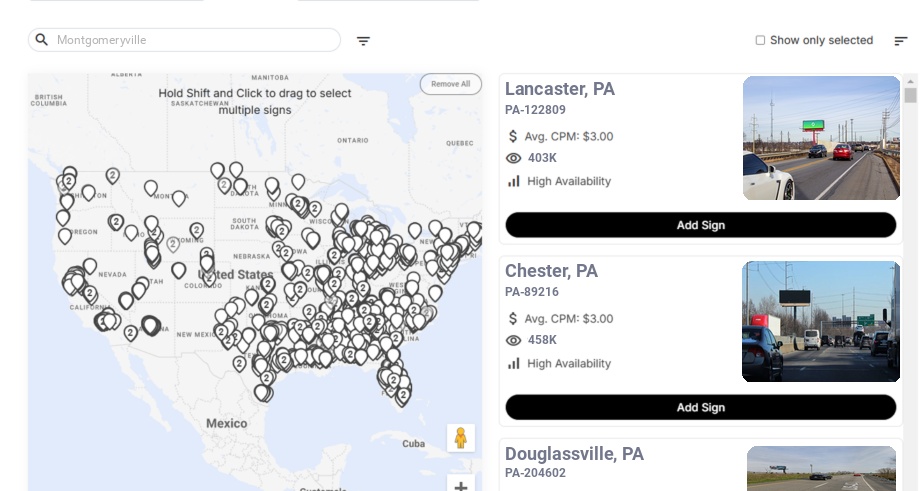



How much is a billboard near Montgomeryville?
Why Choose Blip for Billboard Advertising near Montgomeryville
Blip lets you launch fast on Montgomeryville's Route 309 and U.S. 202 corridors, reaching shoppers and commuters without a long buy-in.
Set a flexible budget in Montgomeryville and pay only when ads play, ideal for testing retail traffic near Montgomery Mall.
Daypart your Montgomeryville ads for 6-9 a.m., 10-2, or 3-7 to match commuter, shopper, and school pickup traffic.
No contracts make it easy to try Blip in Montgomeryville, then pause or shift spend as traffic changes on Route 463 and 309.
Real-time analytics help you tune Montgomeryville campaigns by corridor, so you can spot what works on 202 and the retail core.
Use Blip's creative tools to refresh Montgomeryville ads for holiday shopping, back-to-school, or local family services quickly.
Frequently Asked Questions About Billboard Advertising near Montgomeryville
How much does a billboard cost in Montgomeryville with Blip?
Pricing starts at just $0.01 per display, with the cost of each blip changing based on time of day, location, and advertiser demand. That pay-per-play model makes it easy to start small, control your spend, and pause or adjust your budget anytime. Your total cost is simply the sum of the blips you receive.
Where can I advertise with Blip in Montgomeryville?
Route 309, also known locally as Bethlehem Pike in this area, is the primary billboard spine in Montgomeryville. U.S. 202 is the second major regional corridor, and Route 463 is the local frequency corridor. South and southeast of Montgomeryville, Route 63 also helps connect this area to nearby townships and access toward the Pennsylvania Turnpike.
Why is Montgomeryville a strong billboard market?
Montgomeryville is one of southeastern Pennsylvania’s stronger suburban billboard markets because we can reach both everyday commuters and destination shoppers in the same drive, with nearby corridor traffic commonly ranging from about 15,000 to 55,000+ AADT. It sits at the junction of 3 major routes, Route 309, U.S. 202, and Route 463, which gives repeated exposure instead of one-time impressions. That combination of suburban households, regional retail pull, and dependable road traffic makes Montgomeryville a practical place to build awareness and drive action.
What kinds of people will see Blip billboards in Montgomeryville?
Montgomeryville works because it is not a one-audience market, and we can reach commuters, families, shoppers, students, and professional households with different motivations throughout the day. The North Penn School District serves more than 12,000 students, and family traffic is especially strong in the late afternoon from about 3 p.m. to 7 p.m. Montgomeryville’s retail strength also creates a distinct shopper audience, with Montgomery Mall and surrounding retail turning the corridor into a destination rather than a simple commuter route.
When is the best time to run billboards in Montgomeryville with Blip?
We often divide Montgomeryville campaigns into 3 practical windows: morning commute from 6 a.m. to 9 a.m., midday shopper and errand traffic from 10 a.m. to 2 p.m., and afternoon and evening family traffic from 3 p.m. to 7 p.m. Holiday retail season is strongest from November through December, and back-to-school campaigns work well from late July through September. From March through June, we usually see strong relevance for home improvement and other spring service offers.
Do I need a contract to advertise with Blip near Montgomeryville?
No, Blip has no long-term contracts or minimum commitments. You can start, pause, or stop your campaign at any time.
How fast can I launch a billboard campaign with Blip near Montgomeryville?
You can have your campaign live in minutes. Create a free account, select your locations, set your budget, upload your design, and start running once approved.
Where can I advertise with Blip near Montgomeryville?
Blip has digital billboards near Montgomeryville. You can browse available locations on a map, choose the ones that fit your audience, and start advertising right away.
Still have questions? Launch a campaign in minutes — no contracts, no commitments.
Start Your CampaignMontgomeryville Billboard Advertising Guide
Montgomeryville is one of southeastern Pennsylvania’s stronger suburban billboard markets because we can reach both everyday commuters and destination shoppers in the same drive, with nearby corridor traffic commonly ranging from about 15,000 to 55,000+ AADT. We are advertising into a community of roughly 25,000 people in Montgomery Township, while the broader Montgomery County 856,553 residents in 2020. The area is highly car-oriented, and it sits at the junction of 3 major routes, Route 309, U.S. 202, and Route 463, which gives us repeated exposure instead of one-time impressions. That combination of suburban households, regional retail pull, and dependable road traffic makes Montgomeryville a practical place to build awareness and drive action.
Montgomeryville Market Overview
We usually think about Montgomeryville less as a single neighborhood and more as a north-suburban trade area that pulls from central Montgomery County and southern Bucks County. That framing matters because billboard performance here comes from both local frequency and regional circulation.
Population, growth, and trade-area scale in Montgomeryville
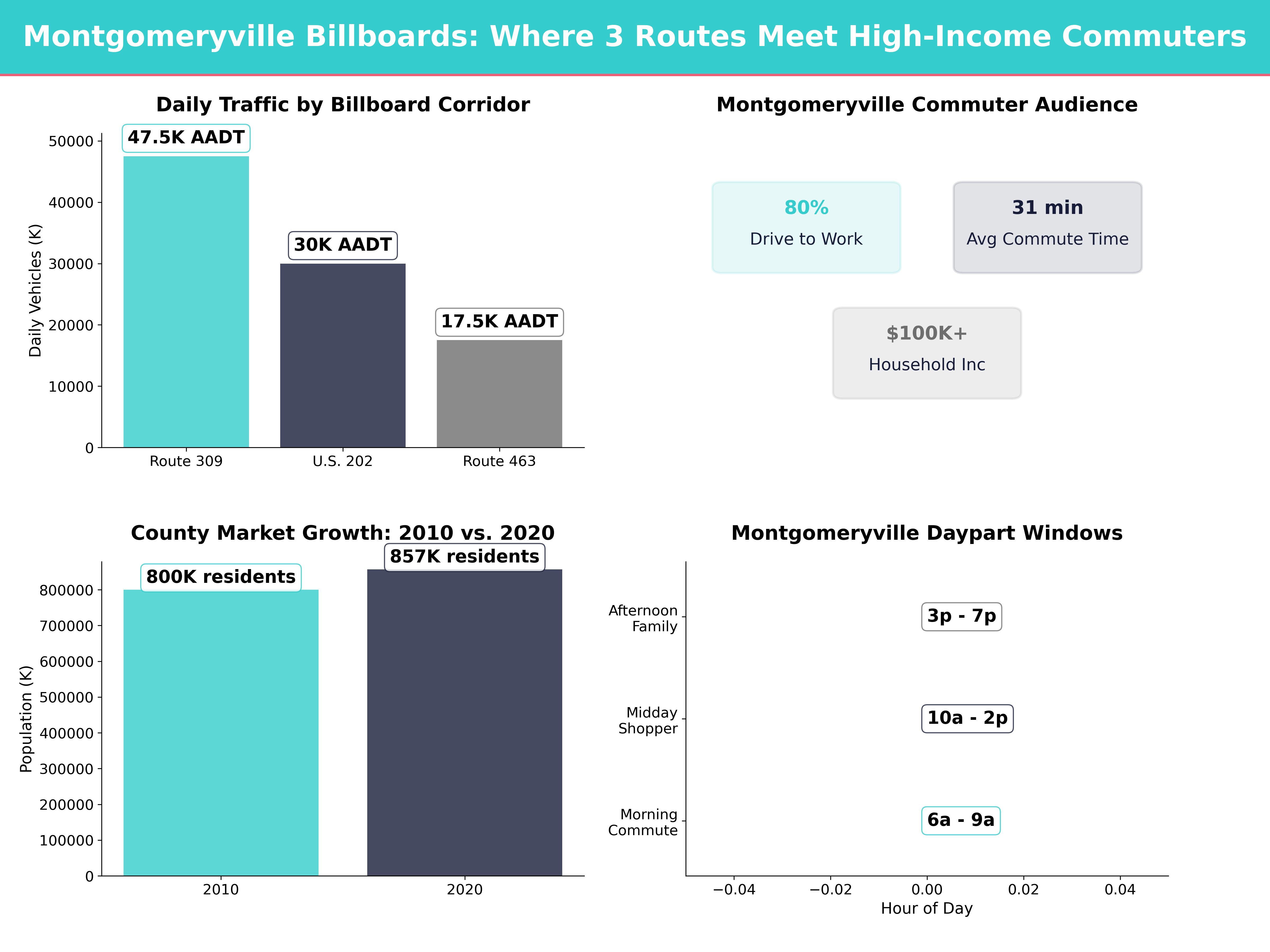
Montgomery County 799,874 residents in 2010 to 856,553 in 2020. That was an increase of 56,679 people, or about 7.1%, over the decade. Growth at the county level supports billboard value because it expands the pool of households, workers, and errand traffic moving through suburban commercial corridors.
Montgomeryville also benefits from its location. It sits roughly 30 miles north of Center City Philadelphia 5 miles from Lansdale Borough 10 miles from Doylestown Borough. That puts the area close enough to larger employment and cultural centers to attract regular through-traffic, while still functioning as a destination for shopping, dining, healthcare, and family services.
Economic strength and consumer behavior around Montgomeryville
We see strong economic fundamentals in this market. Montgomery County’s median household income is above $100,000, which supports spending in categories like healthcare, home improvement, education, financial services, automotive, and premium retail. Montgomeryville’s commercial identity reinforces that purchasing power because major shopping centers, national chains, and service businesses cluster around its main intersections.
The biggest retail anchor is Montgomery Mall 1.1 million square feet of retail space. That single number tells us a lot. It shows that Montgomeryville is not just a pass-through suburb. It is a place where people intentionally drive to browse, compare, shop, eat, and complete multiple errands in one trip.
Car dependence and why it matters for billboard advertising in Montgomeryville
This is still a road-first market. In Montgomery County, roughly 4 in 5 workers commute by car, whether driving alone or carpooling, and average travel time is about 31 minutes. Those are useful billboard conditions because they create repeated weekday visibility and strong recall over time.
We also have a favorable roadway pattern. Instead of many small parallel streets dispersing attention, Montgomeryville concentrates movement onto a few major corridors. When we advertise on those corridors, we are tapping into a large share of the area’s practical daily travel.
Key Traffic Corridors for Montgomeryville Billboards
When we plan billboard campaigns in Montgomeryville, we focus first on the roads that carry the area’s attention, with key routes often running from about 15,000 to 55,000 AADT on nearby segments. PennDOT traffic maps and DVRPC regional planning data consistently show that a handful of routes dominate local movement.
Route 309 through Montgomeryville
Route 309, also known locally as Bethlehem Pike in this area, is the primary billboard spine in Montgomeryville. PennDOT traffic count maps commonly place this corridor in the 40,000 to 55,000 AADT range through the retail core, and some nearby segments exceed 50,000 vehicles per day depending on the count location and year.
That volume makes Route 309 the best reach play for many advertisers. We especially like it for these categories: Retail and dining advertisers benefit because Route 309 carries shoppers already in purchase mode near Montgomery Mall Healthcare and urgent care advertisers benefit because the corridor captures repeat local residents who may need same-day or next-day appointments. Automotive, home services, and financial services advertisers benefit because the route delivers high weekday frequency and strong household coverage.
We also like Route 309 for campaigns that need broad awareness fast. If we want scale in Montgomeryville, this is usually where we start.
U.S. 202 around Montgomeryville
U.S. 202 is the second major regional corridor. Near Montgomeryville, PennDOT counts commonly land in the 25,000 to 35,000 AADT range, again depending on the exact segment. This road is especially useful because it links Montgomeryville with Doylestown Township, Doylestown Borough, and other Bucks County communities to the north, while also connecting south toward the broader suburban employment belt.
We often recommend U.S. 202 for advertisers that need a slightly more regional, destination-oriented audience. It is a strong fit for: Medical specialists who draw patients from multiple towns. Colleges and training programs that recruit beyond one ZIP code. Legal, real estate, and professional services that rely on consideration and trust, rather than impulse.
Because 202 blends commuter traffic with destination travel, it can be effective for both weekday frequency and weekend trip planning.
Route 463 in Montgomeryville
Route 463 is the local frequency corridor. In and around Montgomeryville, PennDOT counts on this road typically fall around 15,000 to 20,000 AADT, which is lower than Route 309 but often more targeted. This is where we reach nearby families making routine trips between neighborhoods, schools, stores, and appointments.
We usually like Route 463 for: Childcare, tutoring, and family entertainment campaigns. Banks, dentists, and neighborhood medical providers that want local repetition. Grocery, fitness, and restaurant messages that benefit from proximity and familiarity.
Lower traffic does not mean lower value. In suburban markets, a corridor with 15,000 to 20,000 vehicles per day can outperform a bigger road when the audience match is tighter.
PA 63 and the southbound commuter belt from Montgomeryville
South and southeast of Montgomeryville, Route 63 helps connect this area to Horsham Township Lower Gwynedd Township, Upper Moreland Township Pennsylvania Turnpike. PennDOT counts on key stretches of this belt often land in the low-to-mid 20,000s.
We use this route when we want to intercept weekday commuters headed toward office, industrial, healthcare, or logistics employment centers. It is especially helpful for B2B services, recruiting campaigns, automotive repair, and after-work retail or dining.
Montgomeryville Audience Segments
Montgomeryville works because it is not a one-audience market. We can reach commuters, families, shoppers, students, and professional households with different motivations throughout the day.
Commuters and routine errand traffic in Montgomeryville
Commuters are the first major segment. With roughly 80% of workers traveling by car and average commutes near 31 minutes, roads remain the primary media environment for a large share of the market. In practice, that means we can reach the same drivers multiple times per week on 309, 202, and nearby feeder roads.
Montgomeryville is also an errand hub. Many trips here are not one-stop journeys. Drivers often combine shopping, dining, school pickup, banking, and healthcare in the same outing, which increases the value of billboard visibility near major retail intersections.
Families and school communities around Montgomeryville
Families are another core audience. The North Penn School District 12,000 students, and that does not include nearby private-school and Bucks County households that also use the Montgomeryville commercial corridor. Family traffic is especially strong in the late afternoon, from about 3 p.m. to 7 p.m., and on Saturdays.
This audience is ideal for advertisers in these categories: Pediatrics, orthodontics, and family healthcare providers. Tutoring, enrichment, camps, and youth sports organizations. Restaurants, grocery, and household retail brands.
In a family-oriented suburb, convenience messaging usually wins. We generally see stronger response when the billboard makes the next step feel easy and nearby.
Regional shoppers and diners in Montgomeryville
Montgomeryville’s retail strength creates a distinct shopper audience. Montgomery Mall
We tend to like this audience for: Retail promotions with limited-time offers. Quick-service and casual dining that can intercept in-motion decisions. Entertainment, fitness, and service retail that benefits from high frequency.
This is also where weekend advertising becomes important. We often treat Saturday traffic differently from Tuesday traffic because the mindset is less rushed and more purchase-oriented.
Students, healthcare users, and professional audiences near Montgomeryville
Montgomeryville also sits within reach of multiple institutions. Delaware Valley University, Gwynedd Mercy University, and Montgomery County Community College are all within roughly 15 miles or less of Montgomeryville. Nearby healthcare systems, including Grand View Health, Jefferson Health, and Doylestown Health, bring additional patient, staff, and visitor traffic into the market.
We also get support from employment centers in surrounding communities such as Upper Gwynedd Township Merck reinforce daily commuter flow. That makes Montgomeryville useful for recruiting, healthcare, continuing education, and business services.
Rail users and park-and-ride households near Montgomeryville
Even though Montgomeryville is fundamentally a driving market, nearby SEPTA Regional Rail stops add another layer of mobility. We have 2 especially relevant stations close by, Colmar and Link Belt, and both support park-and-ride behavior that still begins and ends with a car trip.
For billboard planning, that means roadside media remains relevant even when some workers finish the journey by train.
Seasonal and Timing Opportunities in Montgomeryville
Montgomeryville is active year-round, but we get better results when we match campaign timing to local behavior. Seasonality here is driven more by shopping cycles, school calendars, and suburban routines than by one giant tourist season.
Holiday retail season in Montgomeryville
The biggest retail window is November through December. During the holiday period, the Montgomery Mall
For many advertisers, holiday creative should be live before Thanksgiving and stay active through at least December 24. Messages that emphasize convenience, giftability, or proximity often resonate best.
Back-to-school timing in Montgomeryville
Back-to-school campaigns work well from late July through September. This window is strong for family healthcare, vision, tutoring, child care, youth programs, apparel, and restaurants. With more than 12,000 students in the North Penn School District
We often prioritize these dayparts during this season: 6 a.m. to 9 a.m. for school-and-work commute traffic. 10 a.m. to 2 p.m. for parent errands and midday appointments. 3 p.m. to 7 p.m. for pickup, practice, dinner, and after-school routines.
Spring home-services season around Montgomeryville
From March through June, we usually see strong relevance for home improvement, landscaping, HVAC, roofing, paving, windows, outdoor furniture, and garden-related offers. Suburban homeowners are highly active in this period, and Montgomery County’s high household incomes support larger-ticket service decisions.
This is also a good season for financial services, elective medical, and real estate marketing because households are often in planning mode.
Summer and fall destination traffic near Montgomeryville
Summer and fall broaden the audience mix. Montgomeryville is a natural pass-through for trips toward Visit Bucks County attractions, Merrymead Farm, Discover Lansdale events, and the Doylestown Arts Festival. We do not treat Montgomeryville like a pure tourism market, but these seasonal outings add valuable discretionary traffic.
Fall is especially good for family entertainment, cider and farm-market promotions, healthcare enrollment, and home winterization campaigns. Winter, meanwhile, is practical and service-driven. From December through February, urgent care, flu shots, tire shops, heating companies, pharmacies, and takeout-friendly restaurants often have a strong billboard case.
Billboard Design Tips for the Montgomeryville Market
Montgomeryville creative should feel suburban, useful, and immediately legible. We are talking to drivers who know the corridor, recognize the landmarks, and value convenience.
Use Montgomeryville location shorthand
We generally get better performance when we make the geography obvious. Phrases like “On 309,” “Near Montgomery Mall 202,” or “Minutes from Lansdale Borough
Because many drivers are moving through signalized but still fast traffic, we usually keep the message to 1 core idea and roughly 6 to 8 words of headline copy. Route-aware shorthand helps us do that without losing context.
Match the Montgomeryville audience tone
This market tends to respond to polished, trustworthy creative more than edgy or abstract concepts. We usually prefer: Clean color palettes such as blue, green, white, and deep red that align with healthcare, finance, education, and family retail. Real-world imagery such as storefronts, smiling households, home exteriors, or products in use. Clear proof points such as same-day care, weekend hours, easy parking, or nearby location references.
Montgomeryville is suburban-commercial, not rural and not urban-core. Creative that feels overly gritty, overly luxury-coded, or too clever to read quickly can miss the audience.
Emphasize convenience, trust, and the next step
We often see stronger local-market performance when the billboard answers one practical question. That question might be “How close is it,” “Why should I trust it,” or “What should I do next.” In Montgomeryville, “Close,” “Open late,” “Now hiring,” “Free estimate,” and “Book today” tend to align with actual driver intent.
For healthcare, home services, and education, we usually favor proof-over-poetry. For dining and retail, we usually favor appetite, urgency, and familiarity.
Refresh creative with Montgomeryville’s calendar
This market rewards seasonal relevance. We like to swap artwork every 4 to 6 weeks when possible, especially across spring service season, summer family outings, back-to-school, and the holiday shopping cycle. Even small visual updates can make repeat commuters notice the message again.
Regional Strategies Around Montgomeryville
The best Montgomeryville campaigns usually combine more than one sub-area. We want the billboard mix to mirror how people actually move across this part of the suburbs.
The Montgomeryville retail core
The Route 309 and U.S. 202 retail cluster is our broadest-reach zone. We use it for awareness, weekend promotions, grand openings, product launches, and any campaign that benefits from high shopper intent. This area is particularly effective for retail, restaurants, entertainment, consumer healthcare, and quick-turn service offers.
The North Penn residential belt around Montgomeryville
Lansdale Borough Lower Gwynedd Township give us dense residential and commuter repetition. We like these areas for healthcare, schools, child-focused services, home improvement, and local institutions that need trust over time rather than a single impulse response.
The Bucks County approach from Montgomeryville
Northbound and eastbound travel toward Doylestown Township, Doylestown Borough, and adjacent Bucks County communities works well for higher-consideration services. We often use this regional strategy for elective healthcare, legal services, premium dining, arts and culture, and destination retail.
The southbound employment belt below Montgomeryville
Corridors moving toward Horsham Township Upper Moreland Township Pennsylvania Turnpike are strong on weekdays. We like this zone for recruiting, B2B messaging, automotive, and after-work retail or dining. If the customer base includes office workers, technicians, healthcare staff, or shift-based employees, this approach often adds useful weekday reach.
Using Blip Tools in Montgomeryville
Montgomeryville is a strong fit for a flexible digital approach because traffic patterns shift by corridor, daypart, and season. We can learn quickly here if we set the campaign up around local behavior.
Dayparting for Montgomeryville commuters and shoppers
We often divide Montgomeryville campaigns into 3 practical windows. Morning commute usually runs from 6 a.m. to 9 a.m. Midday shopper and errand traffic often runs from 10 a.m. to 2 p.m. Afternoon and evening family traffic usually builds from 3 p.m. to 7 p.m.
That structure lets us emphasize Route 309 during shopper-heavy windows and test neighborhood-supporting roads during family and appointment hours. In a market with both commuter and retail traffic, time targeting matters.
Testing multiple Montgomeryville corridors with modest budgets
Because digital billboard plays can start at $0.01 each, we can test Montgomeryville without committing the entire budget to one board on day one. We usually learn more by comparing 2 or 3 location clusters, such as the 309 retail core, a 202 regional corridor, and a 463 local-frequency play, than by guessing which one will win.
Creative rotation and local relevance in Montgomeryville
A 7.5-to-10-second digital spot works best here when the message is simple, route-aware, and seasonal. We can use Blip’s artwork tools to swap from spring services to summer family creative, then move into back-to-school or holiday retail without rebuilding the whole campaign strategy.
Real-time optimization for Montgomeryville performance
Real-time reporting is especially useful in Montgomeryville because different boards can behave differently even within a few miles. We can watch where budget spends fastest, which dayparts clear inventory most efficiently, and whether weekday or weekend emphasis produces the right reach for the category. That feedback helps us refine the local mix instead of locking into assumptions.
Getting Started with Billboard Rental in Montgomeryville
Renting a billboard in Montgomeryville starts with the same question we ask in any local market. We need to decide whether the goal is broad awareness, store traffic, lead generation, recruiting, or seasonal promotion. Once we know the objective, the geography becomes much easier to map.
Choose Montgomeryville locations based on customer journey
We usually evaluate boards in Montgomeryville by asking 4 practical questions: Where is the audience coming from. What road are they on when they are most receptive. How fast are they traveling when they see the board. What action can they realistically take after the message.
A board near the 309 retail core may deliver stronger shopper intent. A board on 202 may be better for regional service providers. A board closer to residential feeders may be stronger for family services or local healthcare. The best location is not always the biggest road. It is the road that lines up with the decision moment.
Expect a simpler process than traditional billboard buying
Traditional billboard rentals often involve back-and-forth availability checks, fixed packages, and slower creative changes. In Montgomeryville, where conditions differ between commuter routes and shopper corridors, that rigidity can be limiting. A self-serve digital workflow lets us choose boards on a map, launch faster, and make changes as local patterns emerge.
Start small, learn, and scale in Montgomeryville
We usually recommend launching with 2 or 3 strategically different boards and running long enough to capture both weekday and weekend behavior. In many cases, that means at least 2 weeks of data before we judge performance. Once we see which corridor best matches the objective, we can increase spend, narrow dayparts, or rotate new artwork.
Montgomeryville rewards practical billboard planning. A few roads carry a large share of the market’s attention, the retail base keeps the area active year-round, and the surrounding suburban population creates dependable repetition. When we combine those local realities with flexible digital buying, we can build campaigns that feel more targeted, more measurable, and more usable than a one-size-fits-all suburban billboard buy.