Billboards in Kingston, PA
No Minimum Spend. No Long-Term Contracts. Just Results.
Trusted by Leading Brands


Billboard advertising
in Kingston has never been easier
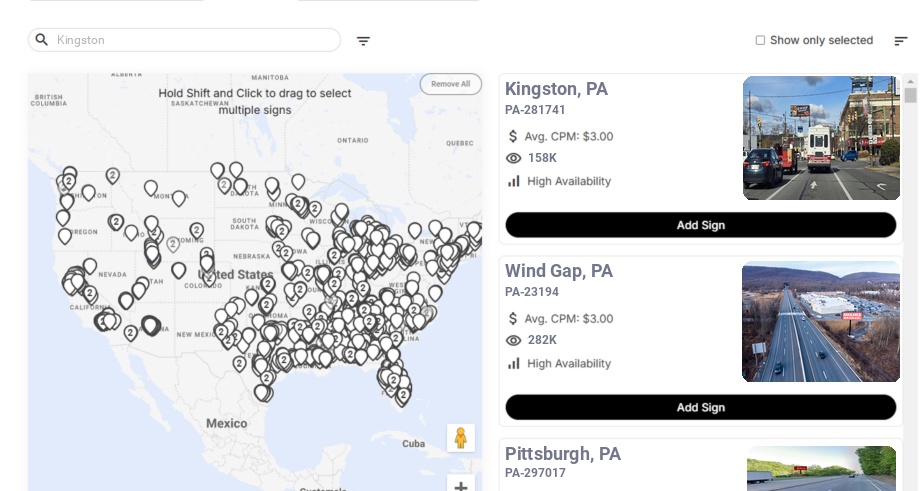



How much is a billboard in Kingston?
Why Choose Blip for Billboard Advertising in Kingston
Blip lets Kingston advertisers launch fast and self-serve, reaching I-81 and the Cross Valley Expressway without the usual billboard hassle.
Use a Blip-optimized campaign in Kingston to auto-place ads where commuter and arena traffic is strongest, from Wyoming Avenue to PA 309.
Kingston budgets stay flexible with Blip, so you can scale around Penguins games, Mohegan Arena nights, or peak morning commutes.
Daypart your Kingston ads for 6-9 a.m. and 3-7 p.m. to match the borough's car-heavy commuter flow and after-work trips.
Track Kingston results in real time and shift spend quickly as demand changes across Luzerne County's colleges, healthcare, and retail corridors.
Frequently Asked Questions About Billboard Advertising in Kingston
How much does a billboard cost in Kingston, Pennsylvania with Blip?
With Blip, billboard advertising in Kingston can be surprisingly affordable because you only pay when your ad actually appears. Each “blip” is a 7.5-to-10-second display on a rotating digital billboard, and pricing starts at just $0.01 per display. Since cost per blip can change based on time of day, location, and demand, you stay in control while Blip works to maximize your visibility.
Where can I advertise with Blip in Kingston, Pennsylvania?
Kingston gives us an unusually efficient billboard market because a borough of roughly 13,000 residents sits at the center of a much larger Wyoming Valley audience. The borough sits immediately beside Wilkes-Barre and connects quickly to major retail and commuter routes, while I-81, the Cross Valley Expressway, US 11, PA 315, and I-476 all carry important local and regional traffic. That mix makes Kingston a strong place to build both local frequency and broader Northeast Pennsylvania reach.
What kinds of drivers will see my Blip billboard in Kingston, Pennsylvania?
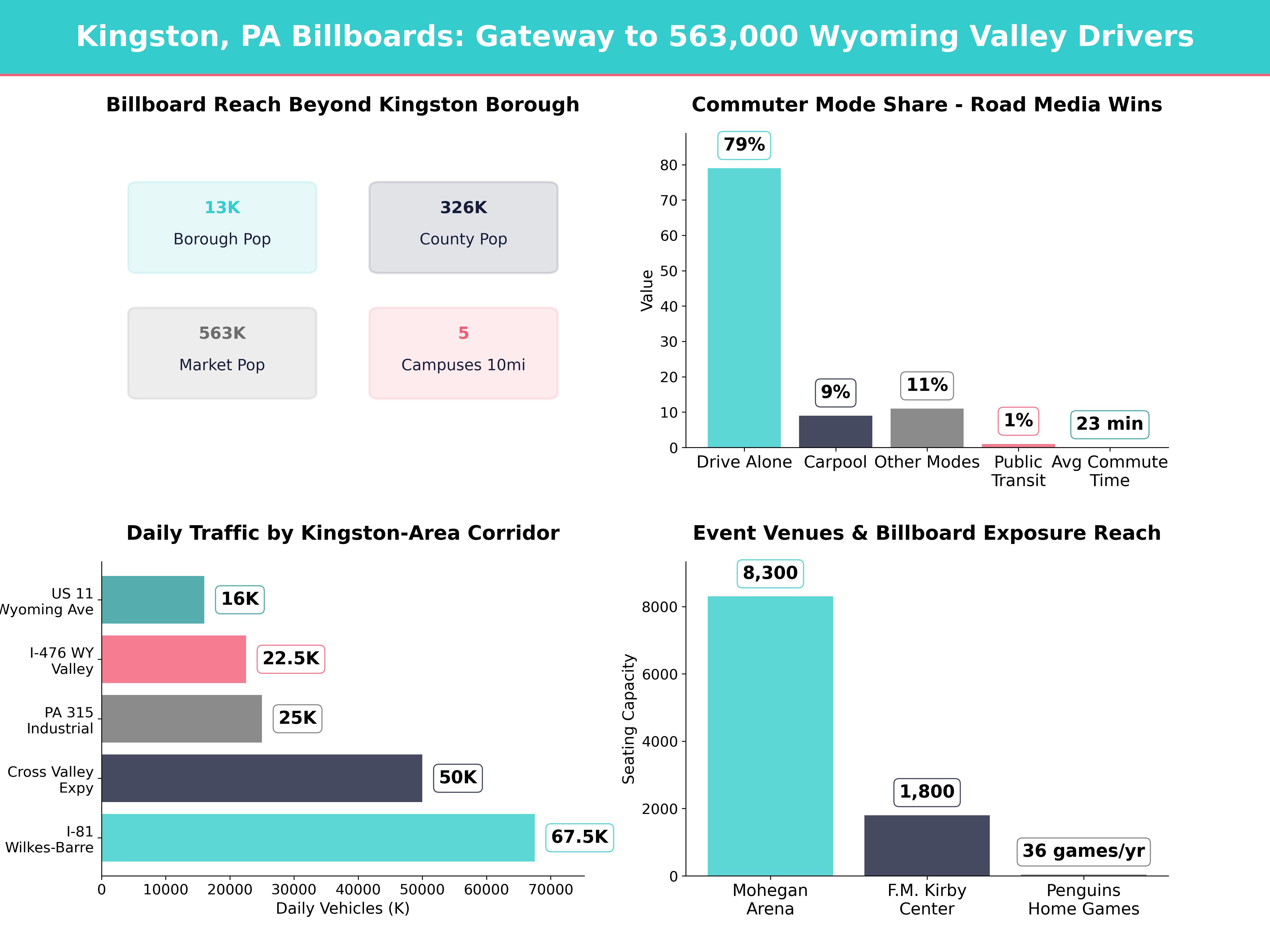
Recent county-level commuter estimates show roughly 79% of workers drive alone, about 9% carpool, and only around 1% use public transit. Average commute times are about 23 minutes, which is long enough for repeated roadside exposure, but short enough that advertisers still need concise, fast-reading creative. That points to high repeat exposure, strong local intent, and useful daypart control.
What are the busiest billboard roads in Kingston, Pennsylvania for Blip ads?
I-81 is the dominant regional spine, and core segments in the Wilkes-Barre area generally carry about 60,000 to 75,000+ vehicles per day. The Cross Valley Expressway typically falls in the 45,000 to 55,000 vehicles per day range on busy segments, while US 11 through Kingston commonly runs around 14,000 to 18,000 vehicles per day. PA 315 and Interstate 476 also provide valuable traffic for recruiting, hospitality, and regional campaigns.
When is the best time to run billboard ads in Kingston, Pennsylvania with Blip?
Kingston is a strong daypart market. Morning windows from 6 a.m. to 9 a.m. are useful for coffee, breakfast, healthcare, and recruiting, while afternoon windows from 3 p.m. to 7 p.m. fit restaurants, retail, and home services. Evening windows from 7 p.m. to 10 p.m. work well around arena nights, casino traffic, and entertainment.
Do I need a contract to advertise with Blip in Kingston?
No, Blip has no long-term contracts or minimum commitments. You can start, pause, or stop your campaign at any time.
How fast can I launch a billboard campaign with Blip in Kingston?
You can have your campaign live in minutes. Create a free account, select your locations, set your budget, upload your design, and start running once approved.
Where can I advertise with Blip in Kingston?
Blip has digital billboards in Kingston. You can browse available locations on a map, choose the ones that fit your audience, and start advertising right away.
Still have questions? Launch a campaign in minutes — no contracts, no commitments.
Start Your CampaignKingston Billboard Advertising Guide
Kingston gives us an unusually efficient billboard market because a borough of roughly 13,000 residents sits at the center of a much larger Wyoming Valley audience. Kingston Borough borders Wilkes-Barre across the river, connects quickly to major retail and commuter routes, and benefits from the steady circulation of local drivers rather than depending on one single destination. In Luzerne County, where the 2020 population was 325,594, daily life is still highly car-oriented, and recent commuter estimates show roughly 79% of workers drive alone. That mix of compact neighborhoods, repeat commuter traffic, colleges, entertainment, and regional highway access makes Kingston a strong place for us to build both local frequency and broader Northeast Pennsylvania reach.
Market Overview for Kingston, Pennsylvania
Kingston is small on paper, but its effective advertising footprint is much larger than its municipal boundary. The borough sits immediately beside Wilkes-Barre, whose 2020 population was 44,328, and it functions as part of a dense chain of communities that includes Forty Fort Edwardsville Plymouth Plains, Pittston 563,000 people across the broader Scranton Wilkes-Barre- Hazleton
Kingston's scale and the wider trade area
Kingston works best when we think of it as the western gateway to the Wyoming Valley. A business based in Kingston can realistically pull customers from a regional market of roughly 563,000 people across the broader Scranton Wilkes-Barre- Hazleton 12 miles from Wilkes-Barre/Scranton International Airport, which adds business travelers, rental-car users, and out-of-town visitors to the audience mix.
Because Kingston is a built-out, established borough, the market is less about explosive population growth and more about predictable repetition. That is often ideal for billboards. When people take the same roads to work, school, medical appointments, shopping, and events several times each week, our message gets more chances to stick.
Commuting patterns and what they mean for advertisers
Recent county-level commuter estimates show roughly 79% of workers drive alone, about 9% carpool, and only around 1% use public transit, even with service from the Luzerne County Transportation Authority 23 minutes, which is long enough for repeated roadside exposure, but short enough that advertisers still need concise, fast-reading creative. For us, those numbers point to three practical advantages:
- High repeat exposure. A car-dependent market lets us reach the same residents multiple times each week on the same corridors.
- Strong local intent. Many trips are short and purposeful, which is useful for healthcare, restaurants, home services, retail, and banking.
- Useful daypart control. Morning and late-afternoon commute windows are especially important because the audience is concentrated in vehicles.
Economic drivers around Kingston
The Greater Wyoming Valley Chamber of Commerce and the Northeastern Pennsylvania Alliance both highlight the region's role in logistics, distribution, education, healthcare, gaming, and small-business services. Kingston benefits directly from that diversity. We are not limited to one seasonal employer base or one downtown employment center.
The local economy is supported by a mix of institutions and destinations, including Mohegan Pennsylvania, Mohegan Arena at Casey Plaza Wilkes University, King's College, Misericordia University, Penn State Wilkes-Barre Luzerne County Community College. For advertisers, that means we can build campaigns that serve both daily household demand and regional destination traffic.
Key Traffic Corridors Around Kingston
Kingston's real billboard value comes from how efficiently it touches several of Luzerne County's most important roads. According to traffic mapping from the Pennsylvania Department of Transportation, a small number of corridors carry the bulk of local and regional vehicle flow.
Interstate 81 near Kingston and Wilkes-Barre
I-81 is the dominant regional spine, and core segments in the Wilkes-Barre area generally carry about 60,000 to 75,000+ vehicles per day. This route links Kingston's market to Scranton, Pittston, Wilkes-Barre, Hazleton, and the broader Northeast Pennsylvania logistics belt.
This corridor is especially effective for:
- Regional employers. Warehouses, hospitals, colleges, and skilled-trades recruiters can reach drivers coming from multiple counties.
- Healthcare systems. Hospitals, urgent care groups, specialists, and dental networks benefit from broad regional visibility.
- Destination retail. Auto dealers, furniture stores, and big-box brands can use I-81 to pull customers from outside Kingston itself.
The Cross Valley Expressway, carrying US 11 and PA 309
The Cross Valley Expressway is one of the most important billboard corridors for Kingston because it connects the West Side directly to Wilkes-Barre Township, major retail, the arena district, and I-81. PennDOT counts on this route typically fall in the 45,000 to 55,000 vehicles per day range on busy segments.
This corridor works especially well for:
- Entertainment and dining. Drivers heading toward Mohegan Arena at Casey Plaza
- Casinos and hospitality. Mohegan Pennsylvania benefits from proximity and impulse relevance.
- Consumer services. Healthcare, banking, quick-service restaurants, and telecom offers perform well when we need reach plus frequency.
US 11, especially Wyoming Avenue through Kingston
US 11 through Kingston, including Wyoming Avenue, functions more like a high-value local main street than a purely regional highway. Traffic volumes here commonly run around 14,000 to 18,000 vehicles per day, which is lower than I-81 but often better for neighborhood businesses because drivers are moving at local speeds and making nearby decisions.
This corridor is ideal for:
- Restaurants and local retail. Drivers can act quickly on a lunch, dinner, or shopping message.
- Home and professional services. Attorneys, realtors, HVAC companies, plumbers, clinics, and financial advisors gain strong local relevance here.
- Community-oriented brands. Messaging that references Kingston, West Side, or Wyoming Valley tends to feel especially credible on this road.
PA 315 and the airport-industrial corridor
PA 315 connects the valley to Wilkes-Barre/Scranton International Airport, major industrial parks, and a large concentration of employers. Depending on the segment, traffic often lands in the 20,000 to 30,000 AADT range.
This route is valuable for:
- Staffing and recruiting. Shift workers, warehouse employees, and industrial staff are a major audience here.
- Hotels, car rentals, and restaurants. Airport users and business travelers create demand that is different from Kingston's neighborhood trips.
- B2B brands. Equipment suppliers, payroll providers, training programs, and commercial services can justify placements on this corridor.
Interstate 476, the Northeast Extension
The Pennsylvania Turnpike Northeast Extension is lighter than I-81 in raw volume, but near the Wyoming Valley interchange it still carries roughly 20,000 to 25,000 vehicles per day. Those drivers are valuable because many are traveling longer distances and often have higher intent around leisure, lodging, gaming, or destination retail.
This corridor is most useful for:
- Weekend tourism. Casinos, hotels, attractions, and restaurants can capture inbound leisure traffic.
- Regional healthcare and education. Long-distance travelers often make planned visits for appointments, tours, or events.
- Pocono-linked travel. Campaigns tied to the Pocono Mountains Visitors Bureau footprint can extend naturally into this route.
Audience Segments We Can Reach in Kingston
Kingston is strong because it is not a one-audience market. We can reach several overlapping groups with different motivations and different timing.
Commuters and shift workers in Kingston
Commuters are the backbone of the market. With about 79% of workers driving alone and average one-way commutes around 23 minutes, road-based media fits naturally into daily routines. The region's healthcare facilities, schools, warehouses, and service businesses also create early and late shift patterns, which makes nontraditional time windows useful for recruiting, breakfast traffic, and after-work promotions.
For this audience, billboard ads tend to work best when they offer one practical benefit, such as price, convenience, location, or hours.
Students and young adults near Kingston
Within roughly 10 miles of Kingston, we can reach students and staff from Wilkes University, King's College, Misericordia University, Penn State Wilkes-Barre Luzerne County Community College. That gives us at least 5 higher-education campuses in the immediate trade area.
This audience responds especially well to:
- Affordable food and beverage offers. Convenience and late hours matter.
- Healthcare and wellness services. Urgent care, dental, vision, and fitness brands can perform well.
- Entertainment and events. Concerts, hockey, nightlife, and streaming-related promotions fit the market.
Families and established households in Kingston
Kingston and the surrounding West Side communities contain dense residential neighborhoods, school traffic, and established households that value convenience. Local recreation adds to that family audience. The well-known Kirby Park area in Wilkes-Barre spans about 52 acres, and nearby Frances Slocum State Park covers 1,035 acres with a 165-acre lake, which helps keep outdoor and family-oriented movement steady across warmer months.
This segment is a strong fit for grocery, healthcare, home improvement, youth programs, financial services, and community events.
Eventgoers, tourists, and destination traffic around Kingston
Kingston advertisers also benefit from several major regional draws. Mohegan Arena at Casey Plaza 8,300 people, and the F.M. Kirby Center seats roughly 1,800. The Wilkes-Barre/Scranton Penguins 36 regular-season home games to the arena calendar, creating repeat evening traffic from fall through spring.
On the gaming side, Mohegan Pennsylvania features more than 1,700 slot machines, which makes it a year-round draw for both locals and out-of-town visitors. On the recreation side, Montage Mountain Resorts adds winter and summer travel with 27 ski trails and a 1,000-foot vertical drop. Together, those destinations create a dependable stream of visitors who are responsive to dining, lodging, retail, and entertainment messages.
Seasonal and Timing Opportunities in Kingston
The Kingston market is active year-round, but our best timing changes with weather, sports, school calendars, and tourism patterns.
Winter in Kingston: January through March
Winter campaigns in Kingston should account for darker commutes, snow, and a stronger focus on indoor destinations. This is a strong period for healthcare, tax preparation, comfort food, home services, gyms, and casinos. It is also prime time for Wilkes-Barre/Scranton Penguins Mohegan Arena at Casey Plaza
We usually see good winter opportunities when we emphasize:
- Morning visibility. Messages running from 6 a.m. to 9 a.m. can reach drivers before weather and workday stress peak.
- After-work convenience. Creative that mentions dinner, appointments, or same-day service fits the 3 p.m. to 7 p.m. window well.
- Warm, indoor experiences. Casinos, theaters, restaurants, and healthcare providers often have strong seasonal relevance.
Spring in Kingston: April through June
Spring brings graduation, tax refunds, home improvement planning, wedding season, and more outdoor movement. With 5 colleges nearby, commencement and end-of-semester traffic matter. This is a smart time for furniture, apartments, moving services, restaurants, florists, med spas, home improvement brands, and financial services.
Spring also rewards hopeful, forward-looking creative. In Kingston, that often means practical optimism rather than flashy hype.
Summer in Kingston: July and August
Summer broadens the audience. Families move more, teens are out of school, weekend trips increase, and leisure destinations matter more. DiscoverNEPA
This is a strong season for:
- Restaurants and frozen treats. Short-drive impulse stops work well.
- Outdoor recreation and tourism. Frances Slocum State Park, Montage Mountain Resorts, and casino entertainment all contribute.
- Back-to-school preview campaigns. Late July and August are useful for colleges, dentists, eye care, clothing, and family retail.
Fall in Kingston: September through December
Fall combines back-to-school traffic, football routines, healthcare enrollment windows, early holiday shopping, and the return of the hockey season. This is one of the best all-around billboard windows in the market because routines tighten back up after summer.
We often like to build fall campaigns in two stages. We can run practical family and education messaging from September into October, then switch to holiday retail, events, and hospitality from November through December. Evening placements from 7 p.m. to 10 p.m. can become especially valuable once arena events, shopping trips, and early darkness overlap.
Billboard Design Tips for Kingston Campaigns
Kingston drivers are exposed to both neighborhood-speed roads and faster expressways, so our creative should reflect the route, not just the brand.
Use Kingston-specific shorthand
Local audiences respond when we sound like we know the market. References to Kingston, West Side, Wyoming Valley, Back Mountain, near the arena, or off 309 can instantly improve relevance. A local phone number with the 570 area code also helps service businesses feel established and nearby.
Distance-based language works particularly well here because people think in bridges, exits, and familiar corridors. Phrases such as “5 minutes from Kingston” or “Next stop off 309” match how drivers actually navigate.
Design for gray skies, glare, and fast reads
Northeast Pennsylvania weather is not gentle on weak creative. Gray winter skies, rain, road spray, and early darkness all reward strong contrast. In Kingston, we usually want bold backgrounds, bright text, and one dominant focal point rather than layered imagery.
On faster roads such as I-81 and the Cross Valley Expressway, 6 words or fewer often works best. On slower local roads like Wyoming Avenue, we can sometimes support a second line, but the main offer should still be obvious in a glance.
Lead with usefulness, not abstraction
Kingston is a practical market. Ads that promise convenience, savings, local trust, or immediate value usually outperform vague brand campaigns. That does not mean we cannot build awareness. It means we should anchor awareness to a useful reason to act now.
Strong local examples include:
- Healthcare brands can highlight same-day appointments, walk-ins, or specialty access.
- Restaurants can push one menu item, one time window, or one location cue.
- Home-service companies can emphasize emergency response, financing, or seasonal needs.
Use imagery that fits the region
We generally see better response when the creative feels rooted in the Wyoming Valley. Mountain silhouettes, recognizable local references, sports-season energy, and family-oriented visuals often feel more authentic than generic stock imagery. We do not need to overdo local symbolism, but a campaign that feels at home in Northeast Pennsylvania usually lands better than one that could belong anywhere.
Regional Strategies Beyond Kingston's Core
A Kingston campaign gets stronger when we match the message to the sub-area rather than treating all nearby roads as interchangeable.
Kingston, Forty Fort, and the West Side
This cluster is best for local frequency. We should prioritize neighborhood businesses, healthcare practices, quick-service dining, banks, and home services here. The audience is highly repetitive, and familiarity matters.
If our goal is store visits or calls within a few miles, West Side placements often deserve the first share of budget.
Wilkes-Barre core and the arena district
Downtown Wilkes-Barre, the river crossings, and the arena-shopping area are better for event-driven and higher-energy campaigns. We can use these placements for entertainment, nightlife, colleges, hospitals, legal services, and destination retail. Organizations such as the Diamond City Partnership
This area also supports stronger evening and weekend scheduling than Kingston neighborhood boards do.
Pittston, Dupont, PA 315, and the airport corridor
This is where recruiting, logistics, hospitality, and business travel become more important. If we serve industrial employers, trade schools, staffing firms, fleet services, or airport-related traffic, this corridor can outperform more residential routes.
The airport's roughly 12-mile proximity to Kingston makes this extension especially useful for regional brands that want both local and traveler exposure.
Back Mountain and wider Luzerne County reach
If our customer base extends west toward Dallas and north toward suburban neighborhoods, we should add boards that capture family retail, healthcare, education, and higher-income household traffic. If our market extends south on I-81 toward Hazleton, then a Kingston campaign can become the northern anchor of a longer countywide strategy.
The key idea is simple. We should not ask one billboard to do every job. Kingston can anchor local credibility, while surrounding corridors add scale.
Using Blip Tools Effectively in Kingston
Blip's value in Kingston comes from how easily we can match local insight to flexible execution.
We can split local and regional objectives
If our main goal is neighborhood response, we can manually select boards around Kingston and Wyoming Avenue. If our goal is broader reach, we can let a Blip-optimized campaign spread budget across Kingston, the Cross Valley corridor, I-81, and nearby regional boards.
That flexibility matters in a market where one advertiser may need local calls, while another needs countywide awareness.
We can daypart around actual Kingston behavior
Kingston is a strong daypart market. Morning windows from 6 a.m. to 9 a.m. are useful for coffee, breakfast, healthcare, and recruiting. Afternoon windows from 3 p.m. to 7 p.m. fit restaurants, retail, and home services. Evening windows from 7 p.m. to 10 p.m. work well around arena nights, casino traffic, and entertainment.
Because Mohegan Arena at Casey Plaza Mohegan Pennsylvania, and local college calendars create demand spikes, we can shift timing without rebuilding an entire campaign structure.
We can test creative by corridor
The Kingston market is compact enough that creative testing is practical. We can run one version focused on local trust on neighborhood roads, then a different version focused on urgency or destination appeal on I-81 or PA 309. Real-time analytics help us see which message is worth expanding.
That is especially useful for advertisers with mixed audiences, such as colleges, hospitals, restaurants, and staffing companies.
We can stay responsive to weather, events, and news cycles
A traditional static campaign can feel slow in a market where snow, concerts, sports schedules, and local headlines quickly change what people care about. With Blip, we can increase spend around a big Wilkes-Barre/Scranton Penguins
Local outlets such as The Times Leader and WNEP can also help us monitor what is driving local attention when we plan creative rotations.
Getting Started with Billboard Rental in Kingston
Renting a billboard in Kingston does not have to start with a huge market buy. In fact, we usually get better results by beginning with a clear objective and a small, focused footprint.
Start with one goal, not five
Before we choose locations, we should decide whether the campaign is meant to drive visits, calls, applications, event attendance, or brand awareness. A restaurant opening near Kingston needs different roads than a regional hospital recruiting nurses. A law firm needs different timing than a casino promotion.
When the goal is clear, location choice gets much easier.
Match the board to the trip type
In Kingston, we usually evaluate locations in three buckets:
- Neighborhood trips. These boards are best for restaurants, clinics, banks, and home services.
- Cross-valley commuter trips. These boards are best for retail, entertainment, and repeated regional awareness.
- Regional highway trips. These boards are best for recruiting, healthcare systems, destination retail, and hospitality.
We also want to consider traffic speed, approach angle, nearby exits, and whether drivers can act immediately or need to remember the message for later.
Launch small and learn quickly
For many advertisers, a strong first test in Kingston might be 3 to 5 digital billboards for 2 weeks, mixing one or two neighborhood placements with one or two regional connectors. After 7 to 14 days, we can review performance and either concentrate spend on the best boards or broaden the campaign into Wilkes-Barre, Pittston, or I-81.
That approach is often easier than the older billboard buying model, which can involve more calls, longer lead times, and less room to test multiple corridors.
Build from Kingston outward
Kingston is a smart starting point because it gives us local credibility and access to larger traffic systems at the same time. We can begin with the roads closest to the store, office, or venue, then add broader corridors once we know which audience is responding.
For advertisers who want flexibility, speed, and the ability to align budget with real local behavior, Kingston is one of the most practical digital billboard markets in Northeast Pennsylvania.