Billboards in Dunmore, PA
No Minimum Spend. No Long-Term Contracts. Just Results.
Trusted by Leading Brands


Billboard advertising
in Dunmore has never been easier
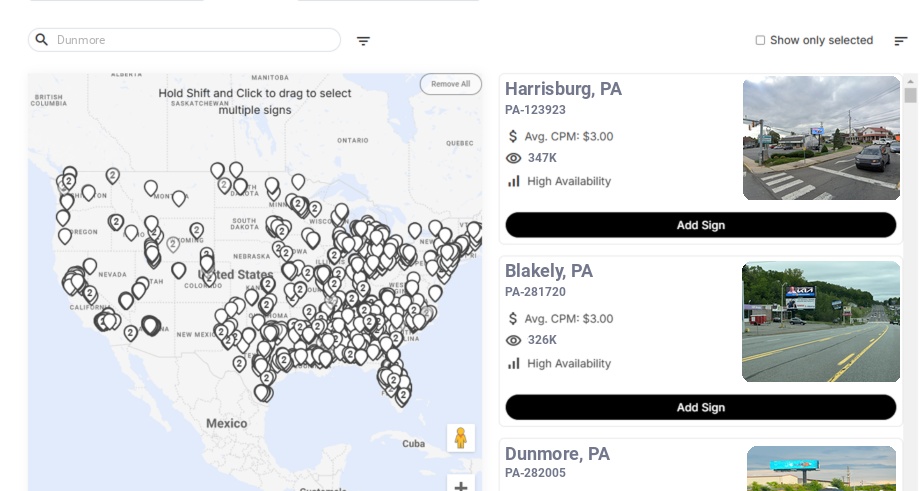



How much is a billboard in Dunmore?
Why Choose Blip for Billboard Advertising in Dunmore
Blip lets you launch on Dunmore’s I-81, I-84, and I-380 corridors in minutes—perfect for reaching NEPA commuters on your terms.
Set any budget in Dunmore and pay only when your ad blips, so you can test routes near Viewmont Mall or Montage without contracts.
Use dayparting on Blip to hit Dunmore’s 85%+ car commuters at rush hour and weekend travelers headed to the Poconos or Montage.
Track Dunmore campaign results in real time and shift spend toward the boards that move Scranton-area shoppers, students, and workers.
Blip’s creative tools make it easy to tailor Dunmore ads for hospitals, colleges, and seasonal traffic from Montage Mountain to PNC Field.
Frequently Asked Questions About Billboard Advertising in Dunmore
How much does a billboard cost in Dunmore with Blip?
With Blip, billboard advertising in Dunmore is designed to fit a range of budgets. You set a daily budget, and Blip’s system uses it to bid on open ad slots on rotating digital billboards, so you only pay when your ad actually appears. Each “blip” is a 7.5-to-10-second display, and pricing starts at just $0.01 per display, with the cost per blip changing based on time of day, location, and advertiser demand.
Where can I advertise with Blip in Dunmore?
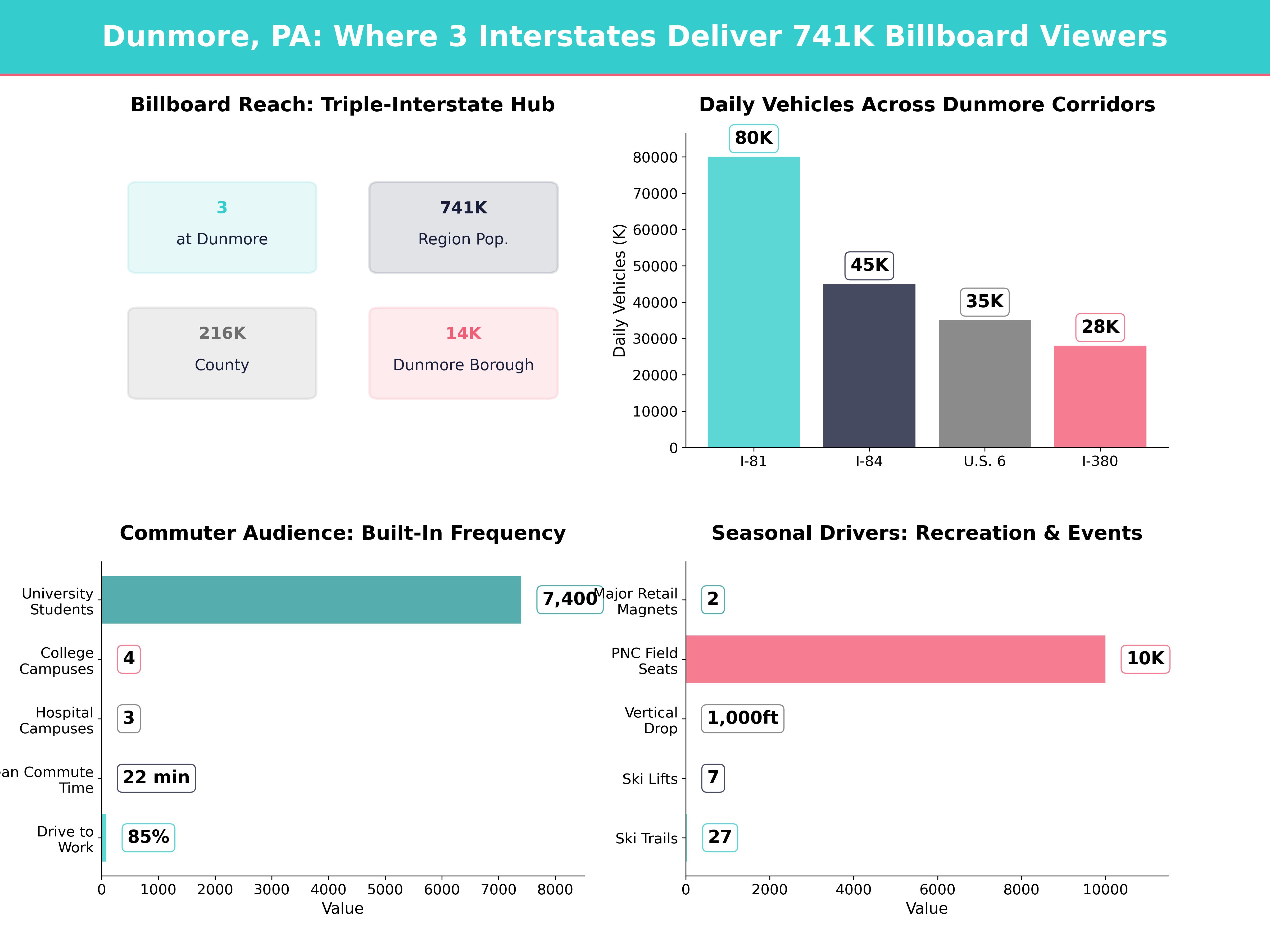
Dunmore sits at the meeting point of 3 major interstates, so billboard placements here can reach drivers on several important routes. Core segments of I-81 through the Scranton and Dunmore area commonly carry about 70,000 to 90,000+ vehicles per day, while I-84 near Dunmore is often in the range of 40,000 to 50,000+ AADT and nearby I-380 segments are roughly 20,000 to 35,000 AADT. U.S. 6 and the Casey Highway area also provide a useful layer for retail and destination-focused campaigns.
Why is Dunmore a strong billboard market for Blip?
Dunmore Borough gives us a small-borough setting with big-market billboard potential because it sits at one of northeastern Pennsylvania’s most important highway junctions, where 3 major interstates meet. The practical advertising trade area is far larger, reaching 215,896 people in Lackawanna County and a combined 741,394 residents across the four-county region. More than 85% of workers in Lackawanna County commute by car, truck, or van, so roadside media can build frequent exposure on repeat travel patterns.
Who can Blip billboards in Dunmore reach?
The Dunmore audience includes daily commuters, students, healthcare workers, industrial employees, and weekend travelers. The region has about 3 hospitals, 4 colleges, and 2 major retail magnets, which creates a broad mix of everyday and destination-driven traffic. That makes it a strong market for healthcare, recruiting, retail, dining, and event campaigns.
When is the best time to run billboards in Dunmore with Blip?
Seasonal timing matters in Dunmore because winter, summer events, back-to-school, and holiday shopping each create different traffic patterns. From late October through March, tire shops, auto dealers, urgent care, heating and plumbing services, pharmacies, winter apparel, and insurance are especially relevant. From mid-November through December, boards near Viewmont Mall and The Shoppes at Montage are often valuable for retailers, gift-driven services, restaurants, and entertainment venues.
Do I need a contract to advertise with Blip in Dunmore?
No, Blip has no long-term contracts or minimum commitments. You can start, pause, or stop your campaign at any time.
How fast can I launch a billboard campaign with Blip in Dunmore?
You can have your campaign live in minutes. Create a free account, select your locations, set your budget, upload your design, and start running once approved.
Where can I advertise with Blip in Dunmore?
Blip has digital billboards in Dunmore. You can browse available locations on a map, choose the ones that fit your audience, and start advertising right away.
Still have questions? Launch a campaign in minutes — no contracts, no commitments.
Start Your CampaignDunmore Billboard Advertising Guide
Dunmore Borough (https://www.dunmorepa.gov/) gives us a small-borough setting with big-market billboard potential because it sits at one of northeastern Pennsylvania’s most important highway junctions, where 3 major interstates meet. The borough itself had 14,042 residents in 2020, but our practical advertising trade area is far larger, reaching 215,896 people in Lackawanna County and hundreds of thousands more in nearby counties, for a combined 741,394 residents across the four-county region. More than 85% of workers in Lackawanna County commute by car, truck, or van, so roadside media can build frequent exposure on repeat travel patterns. When we add year-round trips tied to Scranton 4 colleges, 3 hospital campuses, retail, and recreation like Montage Mountain Resorts, we get a market where digital billboards can influence both everyday purchases and destination-driven decisions.
Dunmore Market Overview
Dunmore’s Core Trade Area and Population Base
When we advertise in Dunmore, we are not buying visibility in only one borough. We are buying into a regional gateway that touches Scranton’s urban core, older inner-ring neighborhoods, suburban retail zones, and multiple interstate travelers at once.
A few population anchors show why that matters:
- Dunmore’s population was 14,042 in 2020, which was essentially flat from 14,057 in 2010.
- Scranton’s population was 76,328 in 2020, up slightly from 76,089 in 2010.
- Lackawanna County’s population was 215,896 in 2020, up from 214,437 in 2010.
- Nearby Luzerne County had 325,594 residents in 2020.
- Nearby Monroe County had 168,327 residents in 2020.
- Nearby Wayne County 31,577 residents in 2020.
- Those four counties together totaled 741,394 residents in 2020.
That stability is useful for billboard advertisers. Fast-growing markets can be exciting, but stable markets often produce better repeat exposure because households, employers, and daily routes change more slowly. In Dunmore, we can build recognition over time with consistent commuter visibility rather than depending on one-time event traffic alone.
Dunmore’s Commuting Patterns and Car Dependence
The Dunmore market is highly road-oriented. American Community Survey estimates for Lackawanna County show that more than 85% of workers commute by car, truck, or van, and the mean travel time is about 22 minutes. Even with service from COLTS, personal vehicle travel remains the dominant way people move between Dunmore, Scranton, Dickson City Jessup Moosic
For billboard advertisers, that matters in three ways:
- We get repeat impressions from the same commuters on the same corridors, which is ideal for brand recall.
- We can target short-decision purchases like food, urgent care, auto service, banking, and retail because many local trips are practical and immediate.
- We can use different boards for different jobs, with one board driving awareness on an interstate and another board closing the loop closer to the destination.
What Dunmore’s Economy Means for Billboard Advertisers
The local economy is broader than many outsiders assume. The Greater Scranton Chamber of Commerce and NEPA Alliance promote the area around healthcare, education, manufacturing, logistics, warehousing, and professional services. That mix gives us a billboard audience that is not limited to one industry or one season.
Major employment and trip generators include Geisinger Community Medical Center, Moses Taylor Hospital, Regional Hospital of Scranton, The University of Scranton, Marywood University, Lackawanna College Penn State Scranton Viewmont Mall The Shoppes at Montage 3 hospitals, 4 colleges, and 2 major retail magnets.
That combination favors several advertiser categories:
- Healthcare advertisers can reach patients, caregivers, and shift workers repeatedly.
- Colleges, trade schools, and recruiters can reach both traditional students and working adults.
- Retail, dining, entertainment, and family services can pair broad interstate awareness with close-in directional messaging.
- Employers can use boards for recruiting in industrial and warehouse corridors where workers already drive every day.
Key Traffic Corridors for Dunmore Billboards
Dunmore’s strongest billboard advantage is geography. The borough sits at the meeting point of 3 major interstates, and few places in northeastern Pennsylvania give us that many route options in such a small footprint.
Interstate 81 Through Dunmore and Scranton
According to PennDOT traffic maps, core segments of I-81 through the Scranton and Dunmore area commonly carry about 70,000 to 90,000+ vehicles per day. That makes I-81 the region’s main high-frequency awareness corridor.
This route is especially valuable because it ties together residential areas, downtown Scranton jobs, healthcare campuses, Moosic retail and entertainment, and southbound travel toward Luzerne County. On I-81, we usually favor advertisers that benefit from repeated commuter exposure, including healthcare, personal injury law, financial services, colleges, auto dealers, QSRs, and major employers.
We also like I-81 for campaigns that need both scale and familiarity. A board here is less about one exit and more about becoming known across the wider Scranton-area market.
Interstate 84 and Interstate 380 at the Dunmore Gateway
The eastern end of I-84 and the northern start of I-380 meet the Dunmore area, which gives us a rare decision point for traffic moving toward New Jersey, New York, the Poconos, and the broader Scranton market. PennDOT counts on these approaches are often in the range of 40,000 to 50,000+ AADT on I-84 near Dunmore, and roughly 20,000 to 35,000 AADT on nearby I-380 segments.
This corridor tends to be especially effective for:
- Tourism and hospitality brands that want to capture weekend and seasonal travelers heading toward or from the Pocono Mountains.
- Convenience, fuel, and quick-service advertisers that benefit from road-trip decisions.
- Healthcare, legal, and repair services that want visibility at a high-attention interchange.
- Regional employers that recruit from a wider commuting radius than Scranton alone.
Because Dunmore sits at this split, billboard placements here can function like gateway media. We can intercept traffic before drivers commit to a route, which is a major advantage for destinations and services with multiple customer origins.
U.S. 6, the Casey Highway, and Dunmore Retail Connectors
U.S. 6, including the Governor Robert P. Casey Highway area north and east of Dunmore, gives us a second important east-west layer. PennDOT traffic counts on key segments near Dunmore and Dickson City often land around 30,000 to 40,000+ vehicles per day. Closer-in commercial routes, including portions of U.S. 6 Business and the O’Neill Highway corridor, often operate in the roughly 15,000 to 25,000 AADT range depending on the segment.
These roads are useful when we care less about broad market fame and more about purchase intent. Drivers on these routes are often headed to shopping, dining, errands, or specific local destinations. That makes them well suited for:
- Retailers near Viewmont Mall
- Restaurants, furniture stores, and home improvement brands.
- Medical groups and urgent care providers.
- Local attractions and event venues.
- Auto repair, tire, insurance, and home services advertisers.
For many Dunmore campaigns, the strongest setup is not one board. It is a corridor mix, with an interstate board building top-of-mind awareness and a local commercial board reinforcing the action closer to the point of purchase.
Dunmore Audience Segments We Can Reach
Daily Commuters and Household Decision-Makers
The backbone of the Dunmore audience is the daily driver. With 85%+ of workers using a car, truck, or van for commuting, and an average commute of about 22 minutes, this is a market where frequency matters. Many residents make short, repeated trips between borough neighborhoods, medical offices, schools, offices, and shopping centers.
That pattern is ideal for advertisers selling routine needs, including dentists, banks, insurance agencies, grocery-adjacent retail, fitness clubs, auto care, and family restaurants. When the same people pass a board several times per week, simple offers and strong branding tend to compound.
Students, Faculty, and Education-Oriented Audiences
Higher education is a meaningful audience in and around Dunmore. The University of Scranton enrolls about 4,700 students, and Marywood University enrolls about 2,700. Those two schools alone represent roughly 7,400 students, before we add Lackawanna College Penn State Scranton
That student-and-staff audience creates strong billboard opportunities for:
- Apartments and student housing.
- Food delivery, coffee, and quick-service dining.
- Career training and continuing education.
- Healthcare, urgent care, counseling, and wellness services.
- Entertainment and event promotions.
Because many college trips overlap with commuter corridors, we can often reach students and working adults with the same board while rotating creatives by time of day.
Healthcare Workers, Industrial Employees, and Recruitable Labor
Dunmore sits near healthcare campuses, municipal employment, and the industrial valley communities around Jessup Throop, Archbald Blakely. That makes the area especially useful for recruitment campaigns and B2B messages aimed at shift workers, warehouse employees, tradespeople, and service technicians.
Recruiting billboards tend to work especially well here when we include practical specifics. In this market, clear signals like shift availability, location, benefits, sign-on bonuses, or same-week interviews usually outperform abstract employer branding.
Tourists, Eventgoers, and Weekend Travelers
Tourism is not the whole Dunmore story, but it is absolutely part of it. Montage Mountain Resorts offers 27 trails, 7 lifts, and a 1,000-foot vertical drop, which makes winter recreation and shoulder-season entertainment part of the regional travel mix. PNC Field Scranton/Wilkes-Barre RailRiders, seats about 10,000.
The Pavilion at Montage Mountain La Festa Italiana Scranton St. Patrick’s Parade Scranton Cultural Center add more calendar-driven traffic. For advertisers, that means we can layer in weekend, event, and visitor messaging without abandoning the commuter base. The result is a market that supports both evergreen campaigns and tactical bursts.
Seasonal and Timing Opportunities in Dunmore
Winter in Dunmore and the Ski-Season Window
The Scranton-area climate creates real winter advertising opportunities. The region typically sees roughly 40 to 45 inches of snowfall in a normal year, and that changes both travel behavior and purchase priorities. From late October through March, we usually see strong relevance for tire shops, auto dealers, urgent care, heating and plumbing services, pharmacies, winter apparel, and insurance.
Winter is also when Montage Mountain Resorts becomes especially useful for tourism-oriented campaigns. If we are promoting dining, hotels, events, or family recreation, boards on I-81, I-84, and I-380 can capture travelers before they finalize plans.
Spring and Summer in the Dunmore-Scranton Area
From April through September, the market shifts toward baseball, concerts, home improvement, moving, landscaping, and family entertainment. PNC Field The Pavilion at Montage Mountain
This is also a strong season for hospitals, colleges, and employers that recruit graduates or seasonal workers. We often like to increase Thursday-through-Sunday exposure during these months, especially on boards that face entertainment routes and retail corridors.
Back-to-School, Fall, and Holiday Timing in Dunmore
Late August and early September are excellent for family services, retail, food, and education campaigns because school calendars restart and college traffic returns. That is especially relevant near Dunmore School District Scranton School District, Marywood University, The University of Scranton, and Penn State Scranton
Labor Day weekend gets an extra boost from La Festa Italiana Viewmont Mall The Shoppes at Montage
Billboard Design Tips for the Dunmore Market
Creative Approaches That Feel Right in Dunmore
Dunmore responds well to practical, local, trustworthy messaging. This is not a market where vague lifestyle language does the heaviest lifting. We usually do better when we lead with a concrete promise, a recognizable place name, and an easy next step.
In this area, creative often performs best when we use local anchors such as Dunmore, Scranton, Dickson City Jessup
We also like creative that reflects northeastern Pennsylvania visually. Forested hillsides, neighborhood streets, college campuses, work vehicles, winter weather readiness, baseball, and mountain recreation all feel more authentic than generic national stock imagery.
Color, Contrast, and Message Structure for Dunmore Roads
The Dunmore area has gray winters, wooded backdrops, early seasonal darkness, and several fast interchanges. Because of that, we usually prefer high-contrast palettes and clean layouts. Deep blues, greens, black, white, and bright accent colors can read well against both snow and hillside scenery.
We also recommend simple message architecture:
- We keep the primary headline short, often around 6 to 8 words, because interstate viewers need instant comprehension.
- We use one main offer or one main benefit rather than stacking multiple ideas.
- We include directional cues when location matters, such as “Off I-81,” “Near Viewmont Mall,” or “Minutes from Downtown Scranton.”
- We use phone numbers only when recall is realistic, and we prefer short URLs or brand names when the goal is later search.
What Resonates with Dunmore’s Local Audience
Local credibility matters here. Messages like “family-owned,” “same-day appointments,” “open late,” “easy parking,” “serving NEPA,” and “now hiring in Jessup” align with the market’s practical mindset. Recruiting campaigns often perform better when we state a real reason to apply, such as pay transparency, schedule flexibility, or benefits.
For retail and service ads, we usually avoid trying to sound too polished or overly corporate. In Dunmore, clarity and usefulness often beat cleverness.
Regional Strategies Around Dunmore
Dunmore and the Scranton Core
The Dunmore-Scranton core is where we go for broad local relevance. This area works well for healthcare, legal, education, government-adjacent services, restaurants, and city-centered events. If our goal is general market awareness, this is usually where we start.
Boards here should emphasize recognition and trust. We want the brand to feel established, nearby, and easy to access.
Dickson City, Viewmont, and North-End Retail Strategy
North of Dunmore, the Dickson City and Viewmont area is one of the region’s strongest retail zones. Viewmont Mall
This submarket is ideal for action-oriented messaging. Here we can be more direct with price, promotion, inventory, limited-time offers, and store proximity because many drivers are already in shopping mode.
Jessup, Throop, Archbald, and Industrial Valley Positioning
The valley communities east and north of Dunmore support industrial, logistics, and workforce-oriented campaigns. If we are advertising jobs, B2B services, equipment, truck maintenance, uniforms, or trade education, these sub-areas can outperform more general-purpose locations.
This is also where precise relevance matters most. We should match the creative to the worker audience, the shift pattern, and the likely route rather than relying on broad consumer language.
The I-380, I-84, and Poconos Gateway Strategy
When we want regional travel visibility, the Dunmore gateway toward I-380 and I-84 is especially attractive. This strategy works for hotels, attractions, convenience retail, healthcare systems, regional colleges, legal services, and any advertiser that benefits from intercepting travelers before they disperse.
If we are targeting weekend traffic, we usually increase emphasis from Friday afternoon through Sunday evening. If we are targeting business travel or airport-related movement, boards with visibility tied to Wilkes-Barre/Scranton International Airport
Using Blip Tools for Dunmore Campaigns
How We Can Match Blip to Dunmore’s Travel Patterns
Dunmore is a strong market for route-based digital billboard planning because so much movement funnels through a few predictable corridors. With Blip, we can choose boards on a map and build a campaign that mirrors actual travel behavior instead of buying a one-size-fits-all package.
For example, we can run commuter-heavy exposure on I-81 during weekday mornings and evenings, then shift more of our budget toward I-84 or I-380 approaches on weekends when tourism and regional leisure traffic matter more. That kind of timing is especially useful in a place where weekday and weekend audiences differ meaningfully.
How We Can Test Creative by Corridor
Blip also fits Dunmore because the market naturally supports multiple creative versions. We can run one message on interstate boards for broad awareness, another on retail-route boards for immediate action, and a third on job-heavy corridors for recruiting.
In practice, we might test versions such as:
- “Now Hiring in Jessup” on workforce-oriented routes.
- “Near Viewmont Mall” on retail corridors.
- “Minutes from Downtown Scranton” near the urban core.
- “On Your Way to Montage” during event and ski seasons.
Because we can adjust campaigns quickly, we do not have to guess once and live with the decision for months.
How We Can Use Analytics to Improve a Dunmore Buy
Real-time campaign data is especially helpful in a market like Dunmore, where route intent varies so much by corridor. We can review delivery, compare boards, and move budget toward the locations and times that align best with our goals.
If a brand needs awareness, we may keep leaning into high-volume interstate boards. If a brand needs store visits or applications, we may shift more weight to closer-in locations that reach consumers nearer the decision point.
Getting Started with Billboard Rental in Dunmore
What to Expect When We Rent a Billboard in Dunmore
The first thing we should expect is that location strategy matters more than borough boundaries. A “Dunmore” campaign often works best when it includes a mix of boards in Dunmore itself, nearby Scranton, and the retail or industrial corridors that Dunmore feeds.
We should also expect demand to vary by route and daypart. Boards on I-81 during peak commuter windows are usually more competitive than off-peak or secondary-road inventory. That does not make secondary locations worse. It simply means each board should match a job, whether that job is awareness, direction, recruiting, or conversion.
How Blip Simplifies the Dunmore Rental Process
Traditional billboard buying can be slow, fixed, and difficult to test. In a market like Dunmore, that is a disadvantage because the best strategy often involves trying multiple corridors, comparing performance, and changing timing around school calendars, weather, or local events.
Blip makes that easier because we can launch online, control budget and scheduling, upload creative, and refine the campaign without long-term lock-in. That flexibility is valuable in Dunmore, where a winter service campaign, a spring recruiting push, and a summer entertainment promotion may all need different board mixes.
How We Should Evaluate Which Dunmore Billboards Fit Our Goals
When we choose Dunmore-area boards, we should start with the objective.
- If we want broad awareness, we should prioritize high-volume interstate visibility on I-81, I-84, and major gateway routes.
- If we want store traffic, we should add boards near retail connectors like U.S. 6, the Viewmont area, or routes feeding The Shoppes at Montage
- If we want applicants, we should focus on worker corridors near industrial valleys, hospitals, campuses, and commuter approaches.
- If we want event or tourism traffic, we should emphasize weekend timing and routes tied to Montage Mountain Resorts, PNC Field
A practical way to begin is to launch with 2 to 4 well-matched boards, use 2 or 3 creative variations, and run long enough to learn which routes produce the best response. From there, we can expand the boards that are building recall, trim the ones that are less relevant, and keep the campaign aligned with how Dunmore actually moves.