Billboards in Stroudsburg, PA
No Minimum Spend. No Long-Term Contracts. Just Results.
Trusted by Leading Brands


Billboard advertising
in Stroudsburg has never been easier
How much is a billboard in Stroudsburg?
Why Choose Blip for Billboard Advertising in Stroudsburg
Blip lets you launch fast in Stroudsburg, reaching I-80's 60,000-80,000 AADT traffic without contracts or delays.
Set flexible daily budgets in Stroudsburg and tap PA 33 commuter flow or U.S. 209 local drivers when it matters most.
Use Blip's dayparting in Stroudsburg to hit Friday resort arrivals, weekday commuters, or ESU students on campus schedules.
Track Stroudsburg ad performance in real time, then shift spend from downtown to the Pocono resort corridors as traffic changes.
Create and test seasonal Stroudsburg creatives in Blip, from winter ski trips to summer outlet shopping and fall foliage weekends.
Frequently Asked Questions About Billboard Advertising in Stroudsburg
How much does a billboard cost in Stroudsburg with Blip?
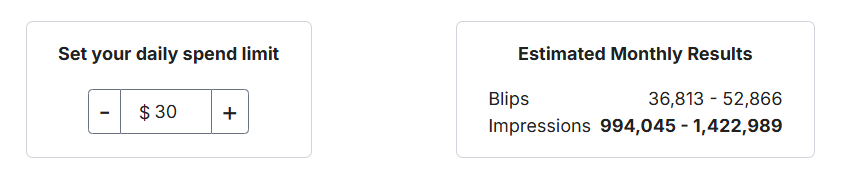
With Blip, billboard advertising in Stroudsburg can be surprisingly affordable because you only pay when your ad actually displays. Pricing starts at just $0.01 per display, and each “blip” is a 7.5-to-10-second spot on a rotating digital billboard. Costs can change based on time of day, location, and advertiser demand, so you stay in control while still getting real visibility.
Where can I advertise with Blip in Stroudsburg?
Stroudsburg’s billboard value comes from a handful of corridors that carry very different kinds of intent. I-80 through the Stroudsburg core is the backbone of the market, while PA 33 connects Stroudsburg to the Lehigh Valley commuter shed. U.S. 209 and Business 209 are better for slower-moving, more local traffic, and I-380, PA 611, and the resort feeders are useful for destination-oriented advertisers.
Why is Stroudsburg a strong billboard market for Blip advertisers?
Stroudsburg gives us an unusually strong billboard market because it combines a compact downtown, a county-seat business core, heavy regional driving, and year-round Pocono visitor traffic. The broader Pocono Mountains destination attracts more than 30 million visitors annually, and Monroe County reached 168,327 residents. That mix gives us the rare ability to build campaigns for both everyday frequency and high-intent visitor traffic.
What kind of traffic do Stroudsburg billboards on I-80 get?
I-80 is the backbone of the market. PennDOT traffic maps commonly place key Monroe County segments around Stroudsburg and East Stroudsburg in the 60,000 to 80,000 AADT range, with some sections topping 70,000 vehicles per day. That makes it a strong route for scale, commuter repetition, and traveler reach in a single buy.
When is the best time to run a billboard campaign in Stroudsburg?
Seasonality is one of Stroudsburg’s biggest advantages because the market gives us several distinct demand waves instead of one short peak. From December through March, winter traffic supports lodging, restaurants, urgent care, tire dealers, cold-weather apparel, and indoor attractions, while May through August brings warm-weather travel, rafting, hiking, outlet shopping, and family lodging. Fall is also efficient because local and visitor traffic overlap during late September and October.
Do I need a contract to advertise with Blip in Stroudsburg?
No, Blip has no long-term contracts or minimum commitments. You can start, pause, or stop your campaign at any time.
How fast can I launch a billboard campaign with Blip in Stroudsburg?
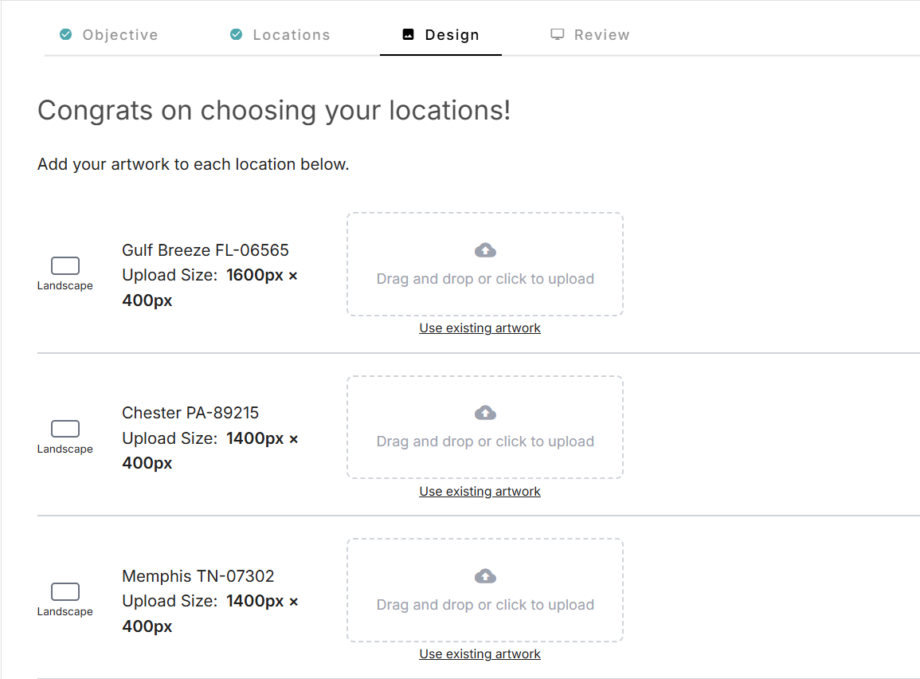
You can have your campaign live in minutes. Create a free account, select your locations, set your budget, upload your design, and start running once approved.
Where can I advertise with Blip in Stroudsburg?
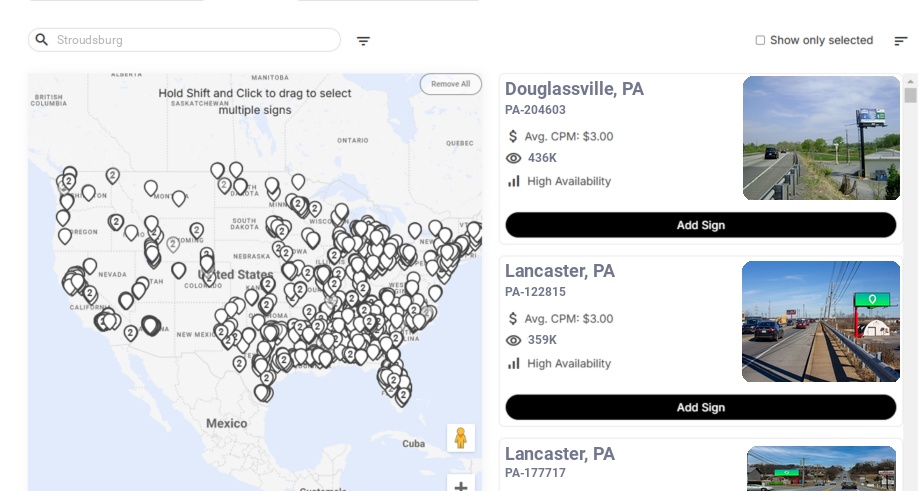
Blip has digital billboards in Stroudsburg. You can browse available locations on a map, choose the ones that fit your audience, and start advertising right away.
Still have questions? Launch a campaign in minutes — no contracts, no commitments.
Start Your CampaignStroudsburg Billboard Advertising Guide
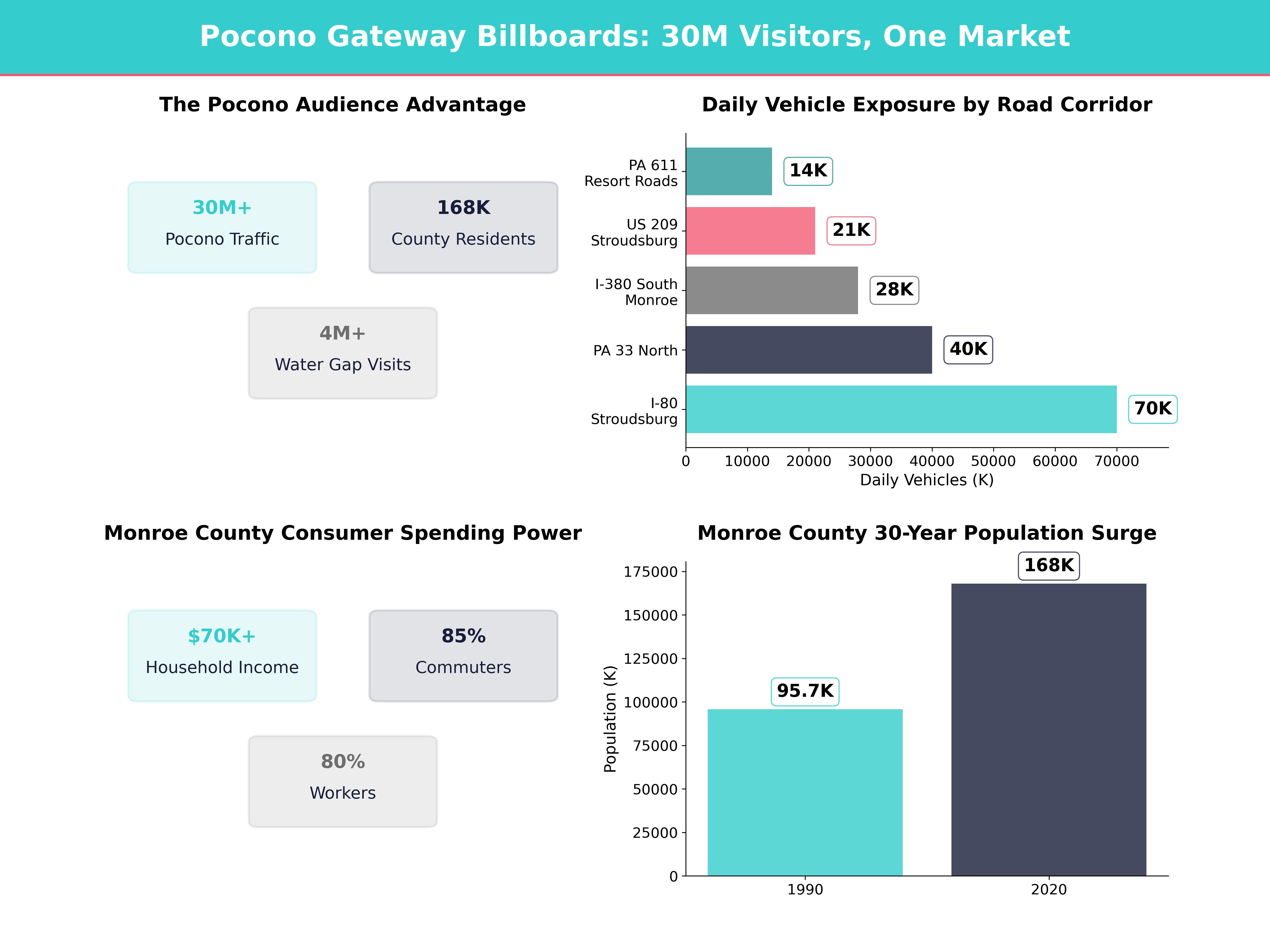
Stroudsburg gives us an unusually strong billboard market because it combines a compact downtown, a county-seat business core, heavy regional driving (with key Interstate 80 segments in the area often running around 60,000 to 80,000 AADT), and year-round Pocono visitor traffic (the broader Pocono Mountains destination attracts more than 30 million visitors annually). Stroudsburg Borough itself had 5,927 residents in the 2020 Census, but the real advertising footprint is much larger because Monroe County reached 168,327 residents and functions as one of Pennsylvania’s best-known drive-in leisure regions. We also benefit from the area’s road network, with Interstate 80, U.S. 209, and PA 33 funneling commuters, shoppers, students, and tourists through the same corridor system. That mix gives us the rare ability to build campaigns for both everyday frequency and high-intent visitor traffic.
Stroudsburg Market Overview
Stroudsburg is the administrative and commercial heart of Monroe County, and that matters for billboard strategy. The borough’s population of 5,927 is small enough to feel local, but it anchors a broader Stroudsburg-East Stroudsburg trade area that serves much of the county. Monroe County grew from 95,709 residents in 1990 to 168,327 residents in 2020, which is an increase of roughly 76% over three decades. That long-run growth helps explain why the market supports healthcare, education, housing, retail, dining, and tourism advertisers all at once.
The county is still highly auto-oriented. Recent ACS estimates put drive-alone commuting at roughly 4 out of 5 workers, and car, truck, or van commuting overall above 85%. Monroe County Transit Authority provides valuable local service, but most daily movement still happens by personal vehicle. For billboard advertisers, that means repeated exposure is built into normal life rather than dependent on occasional transit use.
The local economy is more diversified than many small markets. Stroudsburg serves as the county seat, so government, legal, and professional services are concentrated near downtown and the courthouse. Healthcare is anchored by systems such as Lehigh Valley Health Network, and St. Luke’s University Health Network. Education adds another layer through East Stroudsburg University and Northampton Community College. Tourism adds the fourth leg of the stool through resorts, shopping, outdoor recreation, and events.
Tourism is the local multiplier that turns Stroudsburg from a small-town buy into a regional opportunity. The Pocono Mountains Visitors Bureau promotes a 4-county, 2,400-square-mile destination that attracts more than 30 million visitors annually. Within Monroe County, that includes resort traffic for Camelback Resort, Kalahari Resorts & Conventions Great Wolf Lodge Pocono Mountains Mount Airy Casino Resort Shawnee Mountain Ski Area The Crossings Premium Outlets
Recent income estimates also support consumer spending. Monroe County’s median household income is above $70,000, which gives local service, retail, healthcare, and home-improvement advertisers a practical base of purchasing power. Combined with sustained population growth, that makes Stroudsburg a good market for advertisers who want both local familiarity and regional scale.
Key Traffic Corridors for Stroudsburg Billboards
Stroudsburg’s billboard value comes from a handful of corridors that carry very different kinds of intent. PennDOT traffic data consistently shows that the area’s main routes produce strong daily visibility, while weekend and seasonal travel adds incremental reach.
Interstate 80 through the Stroudsburg Core
I-80 is the backbone of the market. PennDOT traffic maps commonly place key Monroe County segments around Stroudsburg and East Stroudsburg in the 60,000 to 80,000 AADT range, with some sections topping 70,000 vehicles per day. That is the route we should prioritize when we want scale, commuter repetition, and traveler reach in a single buy.
This corridor works especially well for several advertiser types.
- Healthcare, legal, and home services brands benefit because I-80 reaches residents making repeated weekday trips and returning home in the evening.
- Retail, restaurant, and entertainment brands benefit because the route captures both local shoppers and out-of-town visitors approaching retail clusters and resort areas.
- Regional employers and schools benefit because the highway is used by job seekers, commuters, and prospective students moving across Monroe County and beyond.
PA 33 South toward the Lehigh Valley
PA 33 is one of the most useful targeting tools in the market because it connects Stroudsburg to the Lehigh Valley commuter shed. PennDOT counts near the northern end of PA 33 often fall around 30,000 to 50,000 AADT, with the heaviest movement closest to the I-80 interchange. That gives us a highly directional audience of southbound commuters in the morning, and northbound return traffic in the evening.
PA 33 is a strong fit when we want to reach people who are making work-related trips and larger planned purchases.
- Auto dealers, financial services, colleges, and healthcare providers perform well here because commuters have higher message repetition and strong household decision-making power.
- Recruiting campaigns fit this corridor because it reaches workers traveling between Monroe County, Northampton County, and the broader Lehigh Valley economy.
- Business-to-business advertisers can also benefit because this route is used by service professionals, contractors, and field crews.
U.S. 209 and Business 209 in Stroudsburg and East Stroudsburg
U.S. 209 and its business routing carry slower-moving, more local traffic. Depending on the segment, PennDOT counts in the Stroudsburg-East Stroudsburg area commonly run in the 12,000 to 30,000 AADT range. That lower-speed environment matters because drivers have more time to absorb location details, promotions, and directional cues.
This corridor is ideal for advertisers that need specificity rather than only raw volume.
- Downtown dining, retail, and entertainment benefit because we can direct drivers to Downtown Stroudsburg, Sherman Theater
- Medical practices, urgent care, dentists, and legal firms benefit because local drivers are more likely to act on services located within a few miles.
- Community institutions such as schools, churches, nonprofits, and municipal events benefit because the audience is closer to home and more locally anchored.
I-380, PA 611, and the Resort Feeders
The wider Monroe County resort economy depends on more than one road. I-380 segments in southern Monroe County often land in the 20,000 to 35,000 AADT range, while PA 611 and resort feeders can range from roughly 8,000 to 20,000 AADT, depending on location and season. Those counts are lower than I-80, but the intent can be extremely strong because travelers are en route to lodging, attractions, and shopping.
These routes are particularly useful for destination-oriented advertisers.
- Hotels, waterparks, ski resorts, and attractions benefit because the audience is already traveling for leisure.
- Restaurants, breweries, and family entertainment venues benefit because travelers are actively deciding where to stop next.
- Outlet retail and casino brands benefit because the trip itself often includes shopping and entertainment planning.
Audience Segments We Can Reach in Stroudsburg
Stroudsburg is not a one-audience market. We can build very different campaigns depending on whether we want commuters, tourists, students, or local households.
Commuters and Daily Drivers
The first core audience is the commuter base. Monroe County’s driving culture is shaped by long-distance work patterns, and recent ACS estimates show car-based commuting above 85%. That gives us a large audience that sees the same corridors repeatedly during the week. For frequency-driven categories such as insurance, healthcare, legal services, home improvement, and recruiting, that kind of repetition is exactly what digital billboards do best.
Tourists, Weekend Visitors, and Day Trippers
The second audience is the visitor economy. The Pocono Mountains Visitors Bureau promotes a destination with more than 30 million annual visitors, and Monroe County is one of its best-known gateways. The Delaware Water Gap area alone typically records more than 4 million annual recreation visits, which creates seasonal spikes for lodging, dining, rafting, outdoor gear, and local attractions.
The tourism product is also unusually broad for one county.
- Kalahari Resorts & Conventions 220,000-square-foot indoor waterpark.
- Great Wolf Lodge Pocono Mountains 79,000-square-foot indoor waterpark.
- Camelback Resort adds year-round resort traffic, including indoor waterpark demand.
- The Crossings Premium Outlets 100-plus stores.
- Pocono Raceway adds event traffic around its 2.5-mile tri-oval.
That combination means we are not just reaching vacationers in one season. We are reaching different kinds of visitors across all 12 months.
Students and Young Adults
Education gives the market a third audience layer. East Stroudsburg University enrolls about 5,000 students, and Northampton Community College maintains a local campus presence as well. Students and university employees support apartments, food service, healthcare, retail, fitness, mobile services, and entertainment spending.
This audience matters most along local roads, near downtown, and around campus-adjacent retail. Student-focused advertisers should think in semester rhythms rather than annual averages. August move-in, late August through early December, January return, spring sports, and May graduation each create different message needs.
Families and Year-Round Residents
A fourth audience is local households. Monroe County’s population of 168,327 supports daily demand for grocery, healthcare, schools, banking, auto repair, real estate, childcare, and family entertainment. Because county median household income is above $70,000, many campaigns can justify a mid-market offer rather than bargain-only creative. Family-oriented advertisers often do best with clear value statements, recognizable local cues, and easy-to-remember phone or web actions.
Seasonal and Timing Opportunities in Stroudsburg
Seasonality is one of Stroudsburg’s biggest advantages because the market gives us several distinct demand waves instead of one short peak.
Winter in Stroudsburg and the Poconos
Winter matters because Monroe County is a ski and indoor-waterpark destination. Shawnee Mountain Ski Area 23 trails, while Camelback Resort and Kalahari Resorts & Conventions December through March, we should expect stronger messaging opportunities for lodging, restaurants, urgent care, tire dealers, cold-weather apparel, snow removal, and indoor attractions.
For local service advertisers, winter also creates practical urgency. Furnace repair, roofing, plumbing, urgent care, and collision repair messages all become more relevant when road conditions worsen. Campaigns that mention speed, availability, or same-day help often fit this season especially well.
Spring and Summer Visitor Traffic
From May through August, warm-weather travel expands the audience. Rafting, hiking, outlet shopping, casino trips, family lodging, golf, and festival traffic all build volume. The Delaware Water Gap recreation draw becomes more visible, while Shawnee Inn and Golf Resort, Skytop Lodge
Summer is also when family messaging can broaden from hyperlocal to regional. If we are promoting attractions, restaurants, or retail, weekend dayparting can be especially productive on I-80 and resort feeders. If we are promoting healthcare, insurance, or home services, weekday commuters still matter more than weekend tourists.
Fall Foliage, Back-to-School, and University Traffic
Fall is one of the most efficient times to advertise in Stroudsburg because local and visitor traffic overlap. Late September and October bring foliage-driven travel, college traffic is fully active, and K-12 routines are back in place. This is a strong window for banks, healthcare systems, civic campaigns, universities, home improvement, and local retail. It is also a good time for event-driven entertainment creative tied to Sherman Theater
Event-Based Buys
Event spikes are an important local tactic. Pocono Raceway weekends, university move-in and graduation periods, holiday shopping at The Crossings Premium Outlets
Billboard Design Tips for the Stroudsburg Market
Stroudsburg creative should feel local, legible, and timely. The market includes fast highway travel, slower in-town driving, tourists who are deciding on the fly, and residents who respond to familiarity.
Use Poconos Visual Cues, Not Generic Northeast Creative
Creative that reflects the local setting usually feels stronger here than generic suburban imagery. Mountain silhouettes, river or forest cues, snowy scenes in winter, and family recreation visuals fit the way people already think about the Poconos. That does not mean every ad should look like a tourism brochure. It means the visual language should feel at home in Monroe County.
Write for Drivers Who Are Deciding Between the Next Few Exits
Because so much traffic is route-based, location cues matter. We should favor concise lines such as distance, travel time, direction, or “next exit” logic rather than abstract branding alone. On I-80 and PA 33, drivers are making rapid decisions, so a billboard should usually communicate one offer, one destination, and one reason to care in a few words.
Match the Tone to the Corridor
Creative should change by road type.
- On I-80, we should use bold type, short copy, and category-level clarity because vehicles are moving quickly.
- On U.S. 209 or Business 209, we can include slightly more specific calls to action because drivers have more reading time.
- On resort feeders, we should lean into spontaneity with messages tied to dining, lodging, attractions, weather, or same-day plans.
Respect the Market’s Mix of Locals and Visitors
Stroudsburg ads work best when they avoid insider shorthand that outsiders would miss. At the same time, they should not sound so generic that locals tune them out. The sweet spot is practical specificity. “Downtown Stroudsburg,” “near ESU,” “off I-80,” or “minutes from Camelback” are more useful than broad claims with no local anchor.
Use Seasonal Versions of the Same Campaign
This market rewards seasonal creative swaps. A winter version might feature warm dining rooms, indoor waterparks, snow services, or urgent care access. A summer version might feature rafting, patios, outlet shopping, or family packages. If we keep the brand structure consistent and rotate the imagery and offer, we can stay recognizable while matching the season.
Regional Billboard Strategies Around Stroudsburg
The best Stroudsburg campaigns usually treat the area as a set of sub-markets rather than one undifferentiated zip code.
Downtown Stroudsburg and the Borough Core
The Downtown Stroudsburg area is best for local credibility. Restaurants, law firms, healthcare practices, real estate teams, community institutions, and event venues all benefit from proximity messaging here. If our goal is foot traffic or appointment generation, local-road visibility often matters more than broad county reach.
East Stroudsburg and the University Side
East Stroudsburg Borough and the university area are useful for student services, rentals, quick-service dining, convenience retail, entertainment, and healthcare. This side of the market also helps brands speak to younger adults without losing access to county residents and pass-through traffic.
I-80 and the Regional Commuter Belt
When our priority is scale, we should build around I-80 first. This is where regional healthcare systems, colleges, auto groups, insurance brands, casinos, and major retail concepts can justify more consistent exposure. We should think directionally here, because eastbound morning traffic can serve a different objective than westbound afternoon traffic.
Tannersville, Mount Pocono, and the Resort Corridor
The western and central resort corridor is where tourism-specific strategy gets more aggressive. Camelback Resort, Great Wolf Lodge Pocono Mountains Mount Airy Casino Resort The Crossings Premium Outlets
Delaware Water Gap, Shawnee, and River Recreation
The eastern edge of the county is different from the outlet-and-waterpark corridor. The Delaware Water Gap and Shawnee area supports a more scenic, outdoor, and boutique-travel audience. Shawnee Inn and Golf Resort, Shawnee Mountain Ski Area
Using Blip Tools in Stroudsburg
Blip is especially useful in a market like Stroudsburg because conditions change by corridor, season, and even daypart. We can use map selection to separate commuter boards from resort boards instead of buying the whole market the same way. We can daypart morning eastbound commuter routes differently from Friday afternoon leisure routes. We can also test whether a local-road screen near downtown outperforms a broader-reach interstate screen for the same business.
Budget flexibility matters here because tourism demand is uneven. We may want a steady weekday presence for a hospital, law firm, or home-service company, but only a burst campaign around holiday shopping, ski weekends, or race weekends for a restaurant or attraction. Blip’s bidding and pacing tools let us adapt to those shifts without locking ourselves into a one-size-fits-all monthly buy.
Real-time reporting is also valuable in this market. If a Stroudsburg campaign is generating better results on I-80 than on U.S. 209, we can shift spend. If a weekend hospitality campaign performs best from Thursday through Saturday, we can lean into that pattern. If one creative version with outdoor imagery beats another version with price-led copy, we can update the artwork quickly rather than waiting out a long contract cycle.
The creative tools are also practical for local advertisers that do not have agency resources. In a market where seasonal swaps make sense, it helps to build a winter version, a summer version, and an event version without creating a heavy production burden.
Getting Started With Billboard Rental in Stroudsburg
The easiest way to start in Stroudsburg is to define the audience before we define the board. If we want local households, we should look harder at U.S. 209, Business 209, and borough-area screens. If we want regional commuters, we should start with I-80 and PA 33. If we want tourists, we should evaluate resort corridors, outlet routes, and event-driven travel paths.
Choose the Right Goal First
We should decide whether the campaign is built for reach, frequency, directional traffic, or seasonal demand. A healthcare system, for example, may want year-round commuter repetition. A restaurant near Downtown Stroudsburg may want lunch, dinner, and weekend visibility. A resort-area attraction may want Friday arrival traffic and Saturday family traffic.
Evaluate Locations Like a Driver Would
When we compare screens, we should ask practical questions.
- Is the board on a high-speed route, or a slower local road?
- Is the audience arriving, departing, or simply passing through?
- Is the message tied to a nearby exit, downtown district, campus, or resort cluster?
- Is the board better for broad branding, or for a specific action within the next few miles?
Those questions often matter more than raw geography alone.
Start With a Focused Test
Traditional billboard buying can push advertisers toward larger commitments than the market really requires. In Stroudsburg, we can often learn a lot faster by testing a few well-matched boards, one or two dayparts, and two creative approaches. Once we see which route, time window, and message combination fits the goal, we can expand with more confidence.
Refine Based on Local Patterns
The best Stroudsburg campaigns usually improve after launch. We should watch for weekday-versus-weekend differences, weather-sensitive demand, and seasonal visitor spikes. A board that is merely good in February can become excellent in July, and a commuter-heavy placement can outperform a tourism placement for categories that rely on repeat exposure. The market is dynamic enough that optimization is not optional. It is where much of the value comes from.
For advertisers who want a Pennsylvania market with local trust, regional road reach, and year-round visitor energy, Stroudsburg is one of the more versatile digital billboard opportunities in the state. If we match the corridor, season, and message to the right audience, we can build campaigns here that feel both efficient and highly relevant.