Billboards in Glendon, PA
No Minimum Spend. No Long-Term Contracts. Just Results.
Trusted by Leading Brands


Billboard advertising
in Glendon has never been easier
How much is a billboard in Glendon?
Why Choose Blip for Billboard Advertising in Glendon
Blip lets you launch in Glendon fast, reaching I-78 and Route 22 commuters with self-serve digital billboards—no contracts, no hassle.
In Glendon, flexible budgets help you test ads on Route 33 and Easton bridges, then scale only what drives response.
Use Blip dayparting in Glendon to hit 6-9am commuters and weekend visitors headed to Easton events and Crayola.
Glendon's road-heavy market makes real-time analytics valuable—Blip shows what works on I-78, Route 22, and Route 33 so you can adjust fast.
Blip's creative tools make it easy to tailor Glendon ads for healthcare, hiring, or retail traffic across Northampton County and the Lehigh Valley.
Frequently Asked Questions About Billboard Advertising in Glendon
How much does a billboard cost in Glendon, Pennsylvania with Blip?
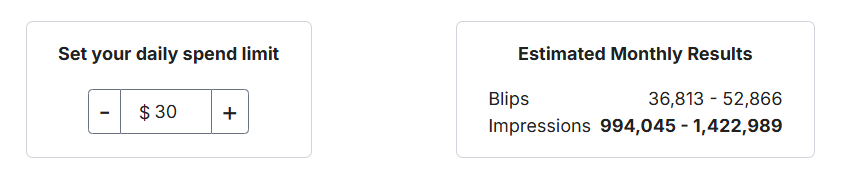
In Glendon, billboard advertising with Blip can be surprisingly affordable because you only pay when your ad actually displays. Each blip is a 7.5-to-10-second spot on a rotating digital billboard, and pricing starts at just $0.01 per display. You set a daily budget, and Blip’s algorithm uses it to bid on open ad slots, adjusting to factors like time of day, location, and demand to help stretch your spend further.
Where can I advertise with Blip in Glendon, Pennsylvania to reach the most drivers?
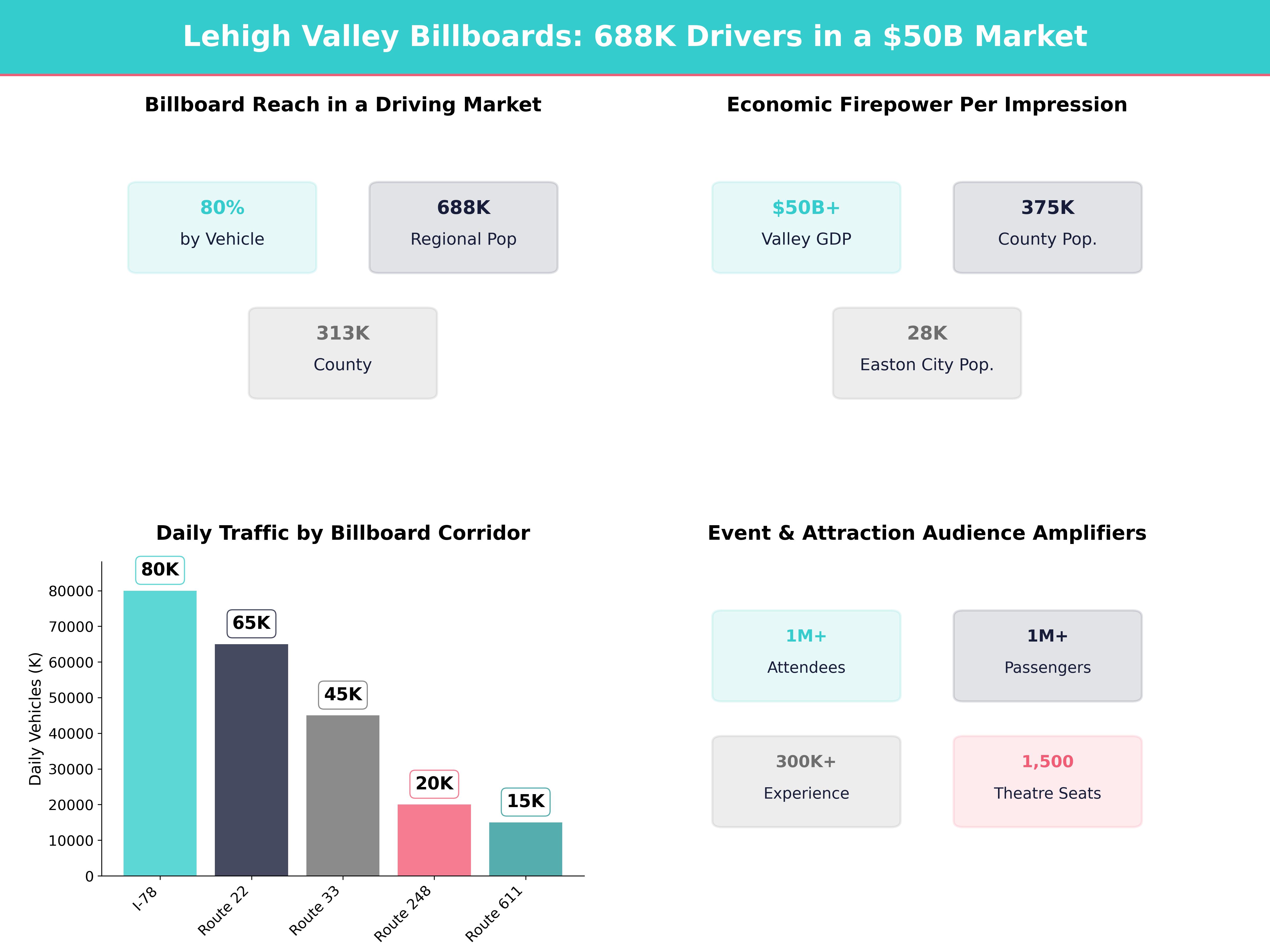
Glendon’s billboard value comes from its access to a tight cluster of high-function transportation routes. Nearby segments commonly carry roughly 70,000 to 90,000 AADT on I-78, 50,000 to 80,000 vehicles per day on Route 22, and 35,000 to 55,000 AADT on Route 33. These routes are especially useful for regional retail, healthcare systems, logistics employers, and attractions that want broad reach.
Is Blip good for advertising in Glendon, Pennsylvania even though the borough is small?
Yes — Glendon is a small borough, but it sits inside a much larger and very advertisable trade area anchored by Easton, Northampton County, and the broader Lehigh Valley. While Glendon itself has fewer than 500 residents, it is minutes from a city of about 28,000, a county of 312,951, and a two-county region of roughly 688,000 people. That means Glendon becomes far more valuable than its municipal size suggests.
What kind of audience can a Glendon, Pennsylvania billboard reach with Blip?
The Easton-Glendon market works well because it is not dependent on a single demographic. We can build campaigns around daily mobility patterns and local institutions rather than one narrow audience profile. Roughly 80% of workers in the surrounding counties commute by personal vehicle, and the area also reaches families, students, healthcare workers, industrial workers, and cross-border commuters.
When is the best time to run billboard ads in Glendon, Pennsylvania with Blip?
Glendon rewards advertisers who schedule to the calendar rather than running one flat message all year. Late summer and fall are especially strong in the Easton market, and winter shifts the strongest categories toward holiday shopping, medical services, indoor attractions, restaurants, and hiring. For dayparting, the page recommends 6 a.m. to 9 a.m. for commuter messaging and 3 p.m. to 7 p.m. for family dining, shopping, schools, entertainment, and after-work errands.
Do I need a contract to advertise with Blip in Glendon?
No, Blip has no long-term contracts or minimum commitments. You can start, pause, or stop your campaign at any time.
How fast can I launch a billboard campaign with Blip in Glendon?
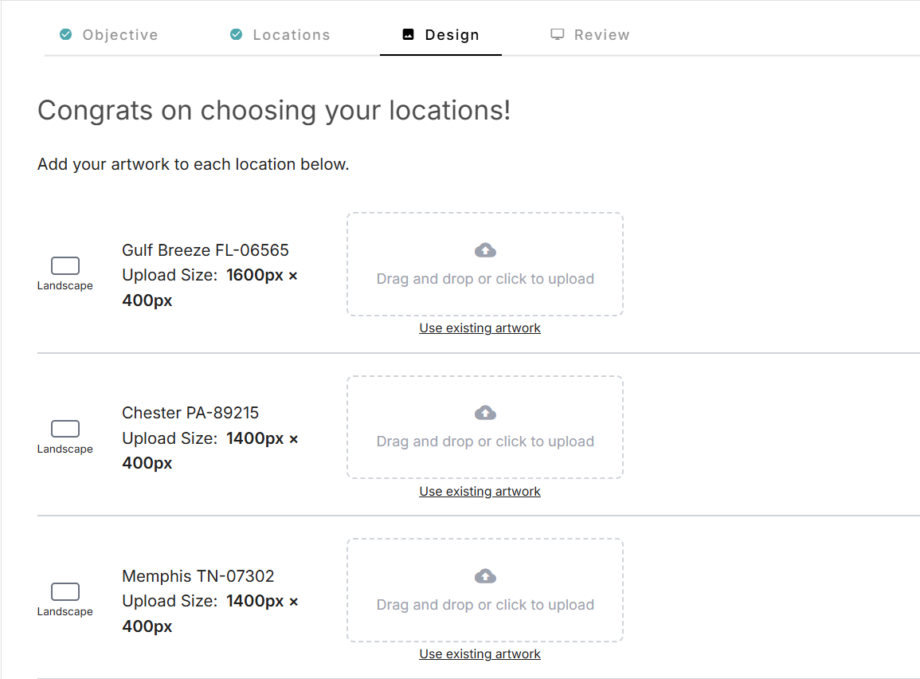
You can have your campaign live in minutes. Create a free account, select your locations, set your budget, upload your design, and start running once approved.
Where can I advertise with Blip in Glendon?
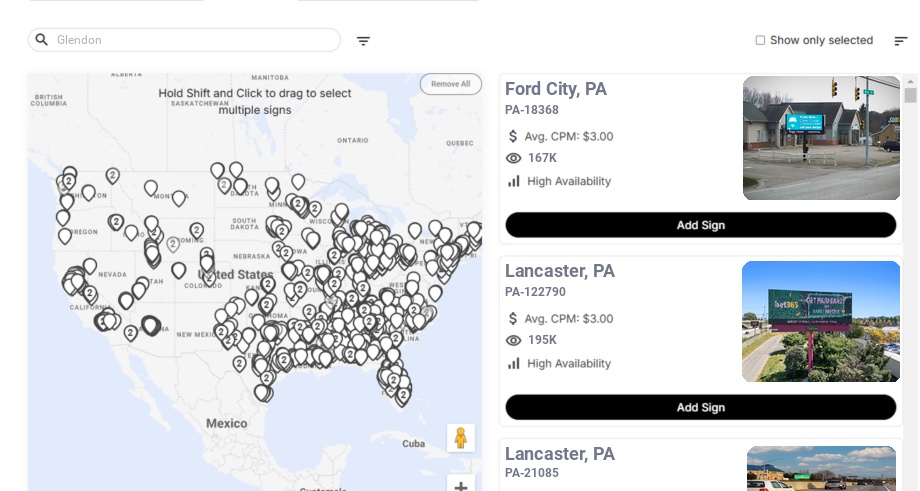
Blip has digital billboards in Glendon. You can browse available locations on a map, choose the ones that fit your audience, and start advertising right away.
Still have questions? Launch a campaign in minutes — no contracts, no commitments.
Start Your CampaignGlendon Billboard Advertising Guide
Glendon Easton Northampton County Lehigh Valley. While Glendon itself has fewer than 500 residents, it is minutes from a city of about 28,000, a county of 312,951, and a two-county region of roughly 688,000 people (Lehigh County: 374,557 plus Northampton County 4 in 5 workers commuting by car in the surrounding counties, which gives billboard advertising unusually strong daily visibility. When we add in family tourism, college traffic, healthcare employment, and heavy regional highway use, Glendon becomes far more valuable than its municipal size suggests.
Market Overview for Glendon and Greater Easton
When we plan billboard campaigns for Glendon, we should think in concentric circles rather than borough limits. The borough functions as part of the Easton-area consumer market, which includes Palmer Township Forks Township
Why the Glendon market is bigger than Glendon
Glendon is best understood as a strategic location on the south side of Easton rather than as an isolated small town. Easton 28,000 residents in the 2020 Census, and Northampton County 312,951. When we combine Northampton and Lehigh counties, the regional population is about 687,500 to 688,000, which is large enough to support layered billboard strategies for local services, destination retail, colleges, events, healthcare systems, and employers.
That scale matters because Easton is not a one-audience market. We can reach local residents, Delaware River cross-border commuters, students, parents, day-trippers, warehouse workers, and tourists moving across the Lehigh Valley. A board that looks “local” on a map can still perform regionally because traffic is constantly feeding in from Interstate 78, U.S. Route 22, and Pennsylvania Route 33, where nearby segments commonly carry roughly 70,000 to 90,000 AADT on I-78, 50,000 to 80,000 vehicles per day on Route 22, and 35,000 to 55,000 AADT on Route 33.
What the local economy means for billboard advertisers in Glendon
The Easton area benefits from the Lehigh Valley’s diversified economy. According to the Lehigh Valley Economic Development Corporation $50 billion, which is substantial economic output for a market of this size. That diversification matters because it gives us multiple advertising use cases at once:
- Retail and restaurants can target Easton, Palmer, and cross-river New Jersey shoppers.
- Healthcare organizations can reach employees, patients, and caregivers traveling to campuses like St. Luke’s Anderson Campus
- Education brands can speak to college students, faculty, and parents.
- Industrial and logistics employers can recruit along the I-78 and Route 33 employment corridors.
- Entertainment and tourism brands can capture families already heading toward Easton and the Lehigh Valley.
Even though LANTA provides transit service across the region with more than 20 routes, the market still behaves primarily like a driving market. For billboard advertisers, that means repetition and route relevance matter more than neighborhood walkability.
Key Traffic Corridors for Digital Billboards in Glendon
Glendon’s billboard value comes from its access to a tight cluster of high-function transportation routes. PennDOT, and the Lehigh Valley Transportation Study
Interstate 78 near Glendon and Easton
Interstate 78 is the region’s premier east-west freight and commuter spine. On busy Northampton County segments near Easton and the Route 33 interchange, PennDOT traffic counts commonly land in roughly the 70,000 to 90,000 AADT range. This is one of the best corridors for:
- Regional retail that wants reach across the Lehigh Valley and western New Jersey.
- Healthcare systems that need broad awareness.
- Logistics and industrial employers looking for shift workers and CDL talent.
- Attractions and hospitality brands trying to intercept travelers before they choose a destination.
Because drivers are moving at highway speed, we should keep I-78 creative especially simple. Exit references, strong brand color, and one clear action usually outperform crowded layouts.
U.S. Route 22 in the Glendon trade area
U.S. Route 22 is a powerful Easton-area retail and commuter corridor. Depending on the segment near Easton and Palmer Township, traffic volumes often fall around 50,000 to 80,000 vehicles per day.
Route 22 is excellent for campaigns that need both frequency and local buying intent. We typically favor it for:
- Auto dealers, tire shops, and repair services.
- Retail centers and big-box shopping destinations.
- Medical groups with broad outpatient service areas.
- Quick-service restaurants, convenience stores, and fuel brands.
This route also helps us reach drivers moving between Easton, Bethlehem, Allentown, and the New Jersey border, which makes it one of the most flexible placements in the market.
Pennsylvania Route 33 for Glendon’s regional reach
Pennsylvania Route 33 is the north-south connector that ties Easton to the Poconos, Monroe County, and southern employment zones. Near the U.S. 22 and I-78 interchanges, volumes often run in the 35,000 to 55,000 AADT range.
That mix creates a valuable split audience:
- Weekday commuters heading to industrial parks, offices, and healthcare jobs.
- Weekend leisure travelers heading north for recreation.
- Families making seasonal trips toward attractions and outdoor destinations.
- Higher-education advertisers trying to stay visible to regional students.
If we want one corridor that supports both weekday hiring and weekend tourism messaging, Route 33 is usually the cleanest fit.
Pennsylvania Route 248, 25th Street, and the Palmer retail corridor
Pennsylvania Route 248, often experienced locally as William Penn Highway and nearby arterial retail routes, carries solid local-commercial traffic. Depending on segment, these roads commonly post about 15,000 to 25,000 vehicles per day.
These are strong placements for advertisers who care more about shopping intent than long-distance exposure. We usually use this zone for:
- Retail launches and sales promotions.
- Urgent care, dental, and specialty medical campaigns.
- Home services such as HVAC, roofing, flooring, and remodeling.
- Family entertainment and kid-focused attractions.
Because speeds are lower than on I-78, we can support slightly more detail here, including price points, event dates, or neighborhood references.
Pennsylvania Route 611, Lehigh Drive, and the Easton river approach
Pennsylvania Route 611 and Lehigh Drive 10,000 to 20,000 range.
This corridor is especially useful for:
- Local restaurants, breweries, and downtown destinations.
- Municipal events and community institutions.
- Service businesses that depend on Easton-side residents.
- Cross-river campaigns aimed at drivers moving toward New Jersey.
The compact geography also helps us build directional messaging around the Delaware crossings.
Delaware River bridges and cross-border traffic
The Delaware River Joint Toll Bridge Commission maintains 3 closely clustered Easton-Phillipsburg crossings: the Easton-Phillipsburg Toll Bridge, the Northampton Street Bridge Easton-Phillipsburg Free Bridge
Audience Segments We Can Reach Around Glendon
The Easton-Glendon market works well because it is not dependent on a single demographic. We can build campaigns around daily mobility patterns and local institutions rather than one narrow audience profile.
Commuters and cross-border workers in Glendon
Auto commuting is the foundation of local billboard performance. In the counties around Glendon, roughly 80% of workers commute by personal vehicle, which means a large share of the market sees outdoor ads in repeated daily patterns. That is especially true for travel moving between Easton, Palmer Township, Bethlehem, Allentown, and western New Jersey.
Cross-border workers are a particularly useful audience here. Easton and Phillipsburg function as a shared labor shed, so a Pennsylvania board can influence New Jersey shoppers, employees, and service buyers before they make their next stop.
Families and day-trip visitors in the Glendon area
Easton is one of the Lehigh Valley’s strongest family destinations. The Crayola Experience in downtown Easton draws more than 300,000 visitors per year, which creates a steady flow of family traffic into the city. The State Theatre Center for the Arts adds another audience stream with its 1,500-seat venue, and the Easton Farmers’ Market has operated since 1752, giving downtown exceptional local brand recognition.
For billboard planning, that means family entertainment, restaurants, museums, youth programs, and seasonal promotions all have a realistic audience here. We are not advertising into a purely commuter-only market.
Students, parents, and education households near Glendon
Lafayette College is one of the clearest education anchors in the market, with roughly 2,700 students on College Hill. That population brings faculty, staff, visiting parents, alumni, and eventgoers into the same traffic pattern. The nearby Easton Area School District serves roughly 7,800 students, which expands the audience for tutoring, healthcare, sports programs, family dining, and back-to-school retail.
If we widen the lens to the Lehigh Valley, the region’s colleges and universities represent tens of thousands of additional students. That is why Easton-area billboards can perform well for apartment communities, banking, wireless, insurance, entertainment, and healthcare campaigns targeted at younger adults and parents.
Healthcare, industrial, and logistics workers around Glendon
Healthcare is a large and visible employment category in the region. St. Luke’s University Health Network now includes 15 campuses, and Easton-area boards can support both patient acquisition and hiring campaigns. Industrial and logistics employment is equally important because the I-78 and Route 33 corridors have become major warehousing and distribution routes for eastern Pennsylvania.
This matters creatively. For a hiring campaign, a Glendon-area board should often lead with the wage, shift, signing incentive, or location cue rather than a broad employer-brand message. Drivers in this corridor respond well to clear practical value.
Tourists and eventgoers in Glendon’s regional orbit
Even if Glendon itself is quiet, it benefits from Lehigh Valley tourism flow. ArtsQuest reports that Musikfest runs for 10 days and draws more than 1 million attendees in Bethlehem. The Lehigh Valley International Airport also handled more than 1 million passengers in 2023, which is another sign of regional visitor activity and business travel.
Those visitors do not stay in one municipality. They drive across the valley, use the same highways, and often bundle multiple stops into a trip. That is good news for restaurants, hotels, event venues, attractions, and retail advertisers using Easton-area inventory.
Seasonal and Timing Opportunities for Billboard Campaigns in Glendon
Glendon rewards advertisers who schedule to the calendar rather than running one flat message all year. The local rhythm changes with school terms, festivals, family travel, and winter daylight.
Spring and summer in Glendon
From late spring through summer, Easton becomes more active with outdoor dining, family outings, college visits, and regional leisure traffic. This is the ideal period for campaigns tied to:
- Family attractions and children’s programming.
- Outdoor dining, breweries, and downtown events.
- Home improvement and seasonal services.
- Summer camps, youth sports, and enrichment programs.
Summer also aligns with stronger family visitation to the Crayola Experience, especially during school breaks.
Late summer and fall around Glendon
Late summer and fall are especially strong in the Easton market. We can align campaigns with student move-in, college sports, harvest-season events, and weekend drives. Musikfest in August, college return at Lafayette College, and fall event traffic into downtown Easton create repeated reasons to be visible.
This is also a good period for local retailers and service providers because family routines reset. We often see strong relevance for:
- Back-to-school campaigns in August and September.
- Healthcare enrollment and appointment reminders in the fall.
- Home services before winter.
- Restaurants and entertainment around football weekends and festivals.
Holiday and winter timing in Glendon
Winter changes the market, but it does not weaken it. It simply shifts the strongest categories toward holiday shopping, medical services, indoor attractions, restaurants, and hiring. In late December, sunset in the Easton area arrives before about 4:45 p.m., which means evening visibility starts early and can help illuminated digital boards work even harder during the commuter window.
Winter is also useful for frequency-based campaigns. Fewer leisure distractions and more repetitive daily driving can help simple, trust-building messages perform well.
Dayparting strategies for Glendon campaigns
The local road network responds well to time-based planning. We usually think about these windows first:
- 6 a.m. to 9 a.m. for commuter messaging, coffee, breakfast, healthcare, and hiring.
- 11 a.m. to 2 p.m. for lunch, urgent care, retail, and same-day services.
- 3 p.m. to 7 p.m. for family dining, shopping, schools, entertainment, and after-work errands.
- Friday afternoons and weekends for event, tourism, and destination campaigns.
Because Blip lets us adjust schedules quickly, we can match these windows to specific Easton-area behavior instead of buying one broad pattern and hoping it fits.
Billboard Design Tips for the Glendon Market
Creative that works in Glendon should reflect Easton-area movement, not generic small-town advertising. The strongest boards here usually feel local, practical, and easy to process at speed.
What visual styles resonate in Glendon and Easton
The market includes families, students, commuters, and blue-collar workers, so polished simplicity tends to win. We usually recommend:
- Bold color contrast for fast corridors like I-78 and Route 22.
- Friendly, family-forward imagery for Easton destination campaigns.
- Professional and trust-oriented layouts for healthcare, banking, insurance, and education.
- Direct hiring language for industrial and warehouse recruitment.
A useful local cue is to reference the destination type visually. Downtown Easton campaigns can lean into walkable urban energy, while Route 33 and I-78 campaigns should feel more directional and utility-focused.
Messaging that fits Glendon’s commuter culture
Because surrounding traffic is highly repetitive, we should favor concise messaging that drivers can remember after a few exposures. In this market, location cues often help. Phrases such as “Easton,” “Palmer,” “Next Exit,” or “Minutes from Route 22” are often more valuable than abstract slogans.
For cross-river campaigns, Pennsylvania–New Jersey clarity matters. If a business serves both sides of the Delaware, we should say so directly. That reduces friction for commuters who may not know whether the offer is most convenient from Pennsylvania or New Jersey.
Creative ideas tailored to Easton-area audiences
Different Glendon-area audiences respond to different hooks:
- Families respond to color, fun, convenience, and weekend relevance.
- Students and parents respond to deadlines, events, and service credibility.
- Commuters respond to convenience, speed, and route familiarity.
- Job seekers respond to wages, shifts, benefits, and location.
- Healthcare audiences respond to trust, specialty, and immediate accessibility.
When we build for slower local roads, we can include one extra detail, such as a limited-time offer or event date. On high-speed highways, we should resist that temptation and keep the message cleaner.
Regional Strategies for Different Parts of Glendon’s Market
A strong Glendon campaign usually includes more than one type of board because the surrounding sub-areas serve different purposes.
Glendon and downtown Easton
This zone is best for local relevance, events, dining, arts, and community-facing brands. We should emphasize familiarity, personality, and immediate destination appeal. Campaigns tied to the Greater Easton Development Partnership
Palmer Township and the eastern retail belt
Palmer Township
Forks Township and northern residential growth
Forks Township
Interstate 78 and Route 33 for regional scale
When we need reach beyond Easton, we should extend into the I-78 and Route 33 funnel. This is the right move for hospitals, colleges, casinos, major attractions, regional retail centers, and employers recruiting at scale. The creative should be broader and more directional because the audience is less hyperlocal.
Cross-river strategy into Phillipsburg and western New Jersey
Glendon’s position near Easton gives us a built-in cross-state advantage. If our business serves Phillipsburg, Warren County
Using Blip Tools Effectively in Glendon
Glendon is the kind of market where flexible execution matters more than a one-size-fits-all buy. The area has commuter traffic, event spikes, family attractions, and seasonal shifts, so we benefit when we can make adjustments quickly.
How we can use Blip in the Glendon market
We can use Blip’s map-based buying to build clusters instead of relying on a single board. For example, we might combine an I-78 board for broad reach, a Palmer-area board for shopping intent, and an Easton-facing board for local relevance. That structure often gives us better market coverage than putting the entire budget in one corridor.
Dayparting is also especially valuable here. We can push harder during 6 a.m. to 9 a.m. and 3 p.m. to 7 p.m. for commuters, then shift toward weekends for family attractions or event promotions. Around festival periods, school calendars, or college move-in, we can update timing and creative without having to rebuild a long traditional contract.
How analytics help us optimize around Glendon
Real-time performance feedback matters because submarkets behave differently. We may discover that a healthcare campaign gets stronger exposure from Route 22 frequency, while a family attraction campaign performs better from Easton proximity and weekend timing. With Blip, we can respond to those signals and move budget toward what the local pattern actually supports.
The same principle applies to creative. If one version with an Easton-specific location cue outperforms a generic version, we can adjust quickly and keep improving.
Getting Started with Billboard Rental in Glendon
Renting a billboard around Glendon is much easier when we start with travel behavior instead of municipal boundaries. The right question is rarely “Should we advertise in Glendon?” The better question is “Which Glendon-area routes carry the audience we want most often?”
Step 1: Define the real trade area around Glendon
We should first decide whether our audience is primarily local, Easton-wide, Lehigh Valley regional, or cross-river. A local restaurant may only need Easton and Palmer visibility, while a hospital system or college may need I-78, Route 22, and Route 33 coverage.
Step 2: Choose boards based on audience intent
Not every road serves the same purpose. We should match the board to the goal:
- Use I-78 for scale and regional reach.
- Use Route 22 for heavy commuter and retail traffic.
- Use Route 33 for north-south commuters and seasonal travel.
- Use Palmer and Easton arterials for local action and destination response.
- Use bridge-adjacent routes for Pennsylvania–New Jersey crossover.
This is also where Blip simplifies the process compared with many traditional billboard companies. Instead of negotiating a broad long-term package, we can inspect locations on a map, test smaller groups of boards, and learn which ones actually fit our goals.
Step 3: Build a schedule that reflects local rhythm
A flat schedule can work, but Glendon often rewards smarter pacing. We should consider:
- commuter-heavy weekdays for services and hiring,
- weekends for family attractions and events,
- back-to-school timing for education and healthcare,
- holiday periods for retail and entertainment,
- and weather-sensitive winter adjustments.
Because Blip does not force us into rigid long commitments, we can start modestly, see what the Easton-area pattern tells us, and scale from there.
Step 4: Evaluate success the right way in Glendon
The best board is not always the one with the biggest highway number. We should evaluate locations by what they produce for our business, whether that is store visits, website traffic, appointment volume, ticket sales, applications, or branded search lift. In Glendon, a lower-speed local board can outperform a giant commuter route if the message depends on immediate action.
For most advertisers, the smartest path is to begin with a small but intentional mix of corridors, test creative built for Easton-area behavior, and optimize from real local results. That approach turns Glendon from a tiny borough on the map into a highly usable gateway to Easton, Northampton County, and the broader Lehigh Valley.