Billboards in Taylor, PA
No Minimum Spend. No Long-Term Contracts. Just Results.
Trusted by Leading Brands


Billboard advertising
in Taylor has never been easier
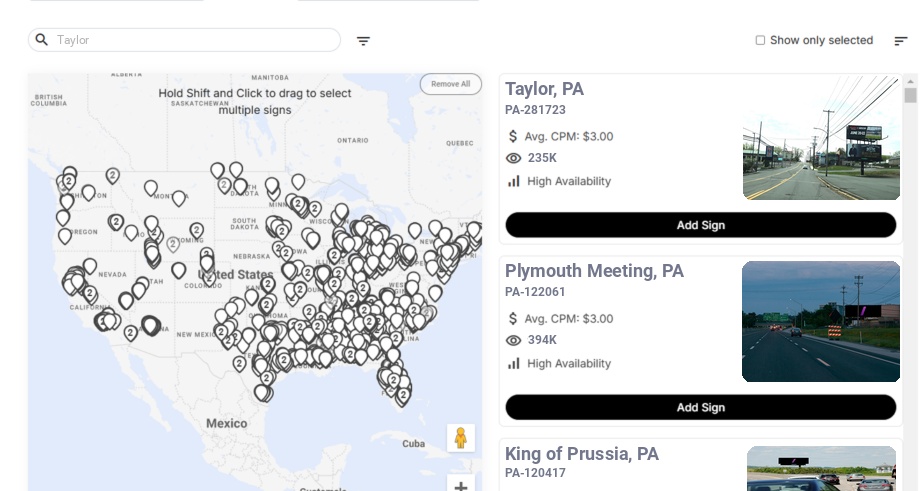



How much is a billboard in Taylor?
Why Choose Blip for Billboard Advertising in Taylor
Taylor, Pennsylvania commuters on I-81 see Blip ads when it matters—daypart your message for rush hour and capture repeat drive-alone traffic.
Blip in Taylor, Pennsylvania fits any budget with no contracts or minimums, so you can test around Exit 182 and Montage Mountain traffic.
Taylor, Pennsylvania campaigns can let Blip optimize timing and placement for your goals, from PNC Field game days to weekend resort visits.
Track Taylor, Pennsylvania performance in real time and shift fast as I-81, I-476, and ski-season traffic patterns change.
Use Blip's creative tools to build bold, local ads for Taylor, Pennsylvania—perfect for the Shoppes at Montage, Scranton commuters, and event crowds.
Frequently Asked Questions About Billboard Advertising in Taylor
How much does a billboard cost in Taylor, Pennsylvania with Blip?
With Blip, billboard advertising in Taylor can fit a wide range of budgets because you only pay when your ad actually appears. Each “blip” is a 7.5-to-10-second display on a rotating digital billboard, with prices starting at just $0.01 per display. You set a daily budget, and Blip’s algorithm uses it to bid for available ad slots, adjusting to factors like time of day, location, and advertiser demand.
Where can I advertise with Blip in Taylor, Pennsylvania?
Taylor’s billboard strength comes from geography as much as population. The borough is about 5 miles southwest of downtown Scranton, about 18 miles north of the Wilkes-Barre area, and roughly 11 miles from Wilkes-Barre/Scranton International Airport. That placement gives us access to local residents, pass-through regional drivers, and travelers moving between business, retail, recreation, and air service.
Why is Taylor, Pennsylvania a strong billboard market for local advertisers?
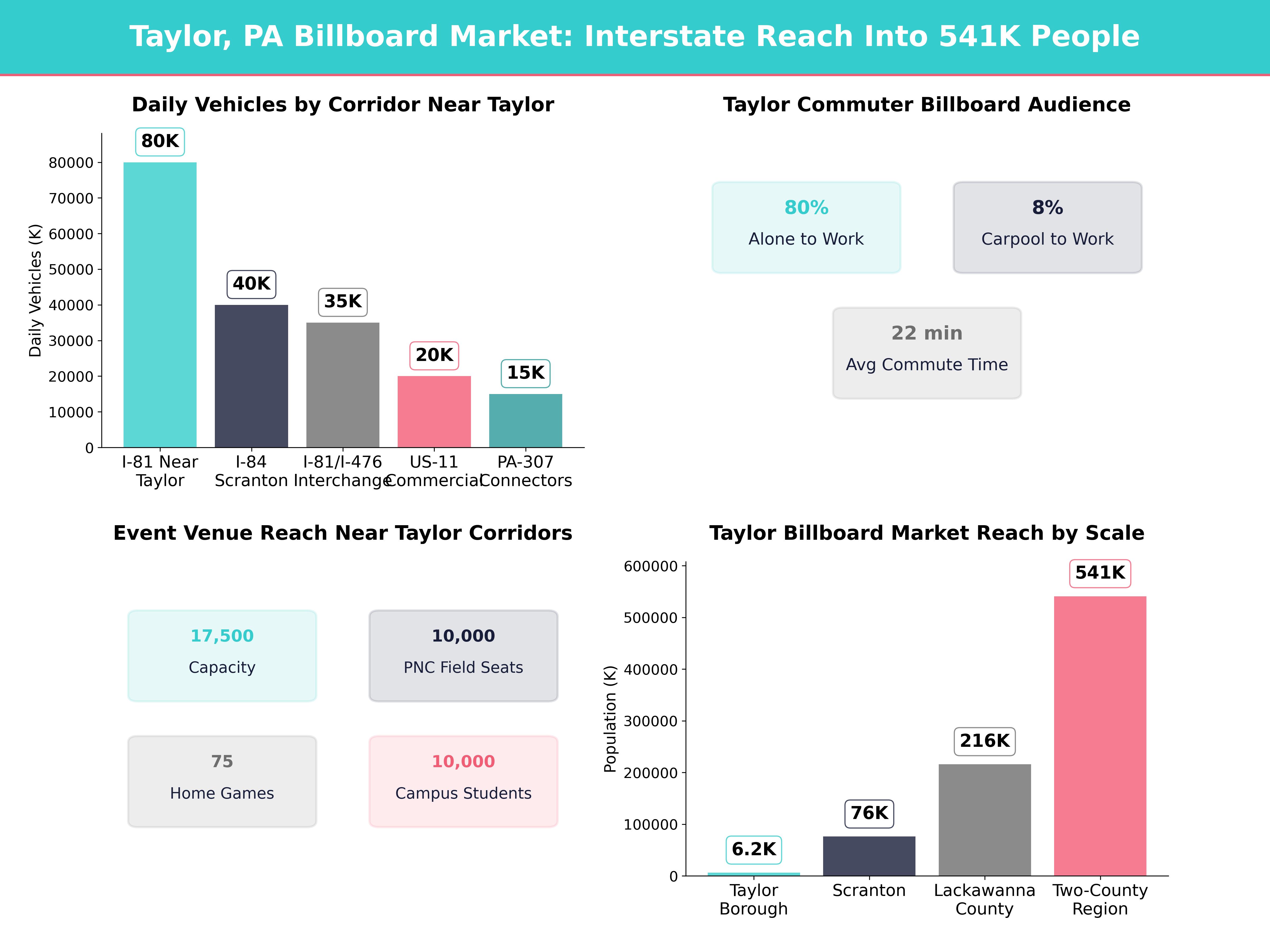
Taylor is a small borough, but it sits in one of the strongest roadside advertising positions in Northeast Pennsylvania. We are working with a local population of about 6,200 people in Taylor, a county base of 215,896 residents in Lackawanna County, and a broader two-county market of 541,490 people when we include neighboring Luzerne County. For advertisers, that combination creates a practical billboard market built on repeat commuter exposure, regional shopping trips, and seasonal entertainment demand.
What roads get the most billboard visibility in Taylor, Pennsylvania with Blip?
I-81 is the backbone corridor for this market, with nearby segments around Taylor, Moosic, and Scranton in the 70,000 to 90,000+ vehicles per day range. The I-81 interchange at Exit 182 for Montage Mountain Road is particularly important. I-476, I-84, and local routes like PA 307 and US 11 also add reach for regional travelers, shoppers, and event traffic.
When is the best time to run billboards in Taylor, Pennsylvania?
Taylor is not a one-season market. Winter matters here, with campaigns often considered from roughly December through March, while spring, summer, and fall each bring their own traffic patterns from baseball, concerts, shopping, and back-to-school demand. Because the area has commuters, families, students, and visitors, Taylor is a good place to test multiple messages and shift timing around local events and weather.
Do I need a contract to advertise with Blip in Taylor?
No, Blip has no long-term contracts or minimum commitments. You can start, pause, or stop your campaign at any time.
How fast can I launch a billboard campaign with Blip in Taylor?
You can have your campaign live in minutes. Create a free account, select your locations, set your budget, upload your design, and start running once approved.
Where can I advertise with Blip in Taylor?
Blip has digital billboards in Taylor. You can browse available locations on a map, choose the ones that fit your audience, and start advertising right away.
Still have questions? Launch a campaign in minutes — no contracts, no commitments.
Start Your CampaignTaylor Billboard Advertising Guide
Taylor, Pennsylvania is a small borough, but it sits in one of the strongest roadside advertising positions in Northeast Pennsylvania. We are working with a local population of about 6,200 people in Taylor, a county base of 215,896 residents in Lackawanna County, and a broader two-county market of 541,490 people when we include neighboring Luzerne County. We also benefit from a highly car-oriented region, where roughly 8 in 10 workers commute by driving alone, and from year-round visitor traffic tied to Montage Mountain Resorts, PNC Field, and the retail concentration around The Shoppes at Montage PNC Field seats about 10,000 fans, and Montage Mountain Resorts offers 26 trails across about 140 skiable acres with a 1,000-foot vertical drop. For advertisers, that combination creates a practical billboard market built on repeat commuter exposure, regional shopping trips, and seasonal entertainment demand.
Taylor, Pennsylvania Market Overview
Taylor’s billboard strength comes from geography as much as population. The borough is about 5 miles southwest of downtown Scranton 18 miles north of the Wilkes-Barre area, and roughly 11 miles from Wilkes-Barre/Scranton International Airport. That placement gives us access to local residents, pass-through regional drivers, and travelers moving between business, retail, recreation, and air service.
Taylor’s local scale and regional reach
Taylor itself is not a massive municipality, which is often a benefit for billboard planning. Instead of relying on a single dense urban core, we can reach consumers flowing through the wider I-81 corridor that connects Taylor with Scranton Moosic, Old Forge, Pittston three-interstate cluster formed by I-81, I-84, and I-476.
The surrounding population base is meaningful for advertisers that need scale without paying for a major coastal metro. Lackawanna County had 215,896 residents in 2020, and Luzerne County had 325,594. Together, that gives us a combined two-county audience of 541,490 people who routinely share retail, healthcare, education, and entertainment destinations.
Taylor’s commuting patterns favor billboard visibility
This is a road-driven market. In Lackawanna County, roughly 80% of workers drive alone to work, and about 8% carpool. The average commute is around 22 minutes, which is long enough for repeated roadside exposure to matter, but short enough that route-based message timing still feels local and relevant.
That commuting pattern matters because billboard advertising works best where audiences return to the same corridors again and again. In Taylor, we are not chasing only one-time tourism. We are also building frequency with people who make the same drive to work, school, shopping, appointments, and recreation several times each week.
What Taylor’s economy means for advertisers
The local economy around Taylor is diversified in a practical, advertiser-friendly way. The Greater Scranton Chamber of Commerce and NEPA Alliance consistently position the region as a hub for logistics, distribution, healthcare, education, manufacturing, and small business services. That mix gives billboard advertisers a wide set of viable categories, including:
- Retail and restaurants that depend on regional trips.
- Healthcare providers serving both local residents and commuters.
- Colleges and training programs recruiting across county lines.
- Employers hiring for logistics, trades, healthcare, and service roles.
- Entertainment venues promoting event dates and seasonal attractions.
- Professional services such as legal, financial, insurance, and home services.
The county has also been relatively stable rather than boom-and-bust. Lackawanna County grew by about 0.7% from 2010 to 2020, which tells us this is a repeat-exposure market more than a speculative growth market. For billboards, that usually means dependable impressions and stronger familiarity over time.
Key Traffic Corridors for Taylor, Pennsylvania Billboards
Taylor’s roadside advertising power is concentrated along several high-volume corridors tracked by PennDOT and the Pennsylvania Turnpike Commission. These are the routes we should understand first, because they shape both reach and creative strategy.
Interstate 81 near Taylor and Moosic
I-81 is the backbone corridor for this market. PennDOT traffic maps typically show nearby I-81 segments around Taylor, Moosic, and Scranton in the 70,000 to 90,000+ vehicles per day range, with some urbanized stretches pushing toward the top end of that band. This is the route that carries daily commuters, airport traffic, shoppers, healthcare travelers, and visitors heading to the Montage Mountain district.
This corridor is especially strong for:
- Retail, quick-service food, and fuel, because drivers are already in trip-planning mode.
- Healthcare and urgent care, because I-81 links multiple residential and employment centers.
- Higher education, because students and families often travel the corridor for campus visits.
- Live entertainment, because it feeds PNC Field, Montage Mountain Resorts, and nearby venues.
The I-81 interchange at Exit 182 for Montage Mountain Road is particularly important. When we place ads near this decision point, we can influence immediate actions such as dining, shopping, event attendance, and same-day visits.
Interstate 476 and the Northeast Extension south of Taylor
The Pennsylvania Turnpike Commission makes I-476, the Northeast Extension, one of Taylor’s most useful regional connectors. Near the I-81/I-476 system interchange, traffic generally lands in the 30,000 to 40,000 vehicles per day range. That is lower than I-81, but it is still highly valuable because it includes longer-distance, higher-intent travelers.
We should favor this corridor for:
- Hotels and hospitality targeting overnight or weekend travelers.
- Regional attractions that draw from beyond Lackawanna County.
- Casinos and entertainment such as Mohegan Pennsylvania.
- Auto dealers, healthcare systems, and home improvement brands that can justify a wider trade radius.
Turnpike traffic is also more seasonal and weekend-sensitive than everyday commuter traffic. That makes I-476 a strong candidate for flexible scheduling, especially during holiday travel windows and summer weekends.
Interstate 84 and east-west traffic into the Scranton area
I-84 adds an east-west audience that complements Taylor’s north-south interstate exposure. PennDOT counts around the Scranton-area I-84 approaches often run in the 40,000+ vehicles per day range, depending on segment. This route helps us reach drivers arriving from the Poconos, eastern Pennsylvania, and New York-bound or New York-origin travel flows.
For advertisers, I-84 is useful when we want to broaden beyond the immediate Scranton commuter base. It works well for:
- Tourism and entertainment tied to overnight or weekend trips.
- Healthcare systems drawing patients from a wider region.
- Universities recruiting out-of-town students.
- Regional employers with multiple sites across Northeast Pennsylvania.
PA 307, US 11, and local Taylor retail routes
Not every campaign in Taylor needs interstate-scale exposure. PennDOT traffic maps on roads such as PA 307 and US 11 typically show local volumes ranging from the low teens to the mid-20,000s depending on the exact segment. Those numbers are smaller than interstate counts, but they often provide better relevance for advertisers that need proximity more than pure reach.
PA 307 and the Montage Mountain approach are useful for visitors heading to the mountain, the ballpark, and the shopping district. Local counts can often fall in the 10,000 to 20,000 vehicles per day range on these connectors. US 11 and other commercial routes closer to Scranton and Moosic can move into the 15,000 to 25,000 range.
These roads are ideal for:
- Restaurants, bars, and family entertainment near Montage.
- Medical offices and service businesses that need nearby appointment traffic.
- Apartment communities and storage facilities targeting local movers.
- Schools, daycares, and family services appealing to neighborhood households.
Taylor, Pennsylvania Audience Segments We Can Reach
Taylor gives us a mix of practical everyday audiences and event-driven traffic spikes. That balance is useful because we can run always-on campaigns for core demand and then layer seasonal bursts on top.
Daily commuters and working households in Taylor
The first audience is the daily commuter base traveling through Taylor, Scranton Moosic, and nearby suburbs. With about 80% of workers driving alone and another 8% carpooling, we are speaking to an audience that sees outdoor ads repeatedly on familiar roads. These are strong prospects for:
- Healthcare.
- Banking and insurance.
- Trades and home services.
- Auto repair and dealerships.
- Grocery, fuel, and quick-service food.
This audience often responds best to direct, useful messages. In Taylor, that means ads that emphasize convenience, location, price, trust, and a clear next step.
Shoppers, diners, and entertainment visitors near Montage Mountain
The Taylor-Moosic area punches above its residential size because of the destination cluster around The Shoppes at Montage PNC Field, and Montage Mountain Resorts. PNC Field seats about 10,000 fans, and the Scranton/Wilkes-Barre RailRiders typically host 75 regular-season home games each year. That creates recurring spring and summer surges for food, beverage, lodging, and family entertainment advertisers.
The mountain adds still more audience variety. Montage Mountain Resorts operates 26 trails across about 140 skiable acres with a 1,000-foot vertical drop, and it also supports warm-weather attraction traffic. Those numbers matter because they indicate a real regional draw rather than a purely neighborhood amenity.
Students and education audiences around Taylor
Taylor is also within easy reach of 4 higher-education campuses: The University of Scranton, Marywood University, Lackawanna College Penn State Scranton 10,000 students, plus faculty, staff, visiting families, and alumni audiences.
That makes Taylor billboards effective for:
- Apartment and student housing promotions.
- Colleges and career training.
- Coffee, restaurants, and nightlife.
- Healthcare, dental, and vision care.
- Seasonal employment and internships.
Education advertisers should also remember that this audience is not limited to students themselves. Parents and guardians often make decisions during campus-visit periods, move-in windows, and graduation season.
Families, local residents, and community buyers
Taylor’s surrounding residential communities include Scranton 76,000 residents, Dunmore 14,000, Moosic with about 6,000, Old Forge with about 8,500, and suburban neighborhoods stretching north and south along I-81. These households support year-round demand for grocery, pediatric care, orthodontics, legal services, tax preparation, childcare, home remodeling, and local events.
Because this is a stable market, families often favor businesses that look established and familiar. Billboards that reinforce local presence over several weeks can outperform one-time bursts that disappear too quickly.
Tourists, airport users, and weekend travelers
Taylor also captures visitors moving through Northeast Pennsylvania. Wilkes-Barre/Scranton International Airport is about 11 miles away, and the broader region is promoted by Discover NEPA Lackawanna Heritage Valley, and Visit Luzerne County
That audience is particularly valuable for:
- Hotels and short-term lodging.
- Attractions and ticketed events.
- Casinos and nightlife.
- Restaurants near interchanges.
- Medical specialists drawing patients from beyond the immediate county.
Seasonal and Timing Opportunities in Taylor, Pennsylvania
Taylor is not a one-season market. We can align billboard schedules with weather, sports, campus activity, concerts, shopping periods, and regional driving behavior.
Winter in Taylor: ski traffic and weather-driven demand
Winter matters here. Montage Mountain Resorts draws skiers and snowboarders when the cold-weather season is active, and the region’s snow and early darkness make high-contrast digital creative especially noticeable. We should think about winter campaigns from roughly December through March, depending on conditions.
Strong winter categories include:
- Ski, apparel, and sporting goods.
- Auto service, tires, and batteries.
- Healthcare, urgent care, and pharmacy.
- Heating, plumbing, and emergency home repair.
- Restaurants and comfort-food offers near key routes.
Weather sensitivity also creates timing advantages. Short bursts before weekends, storms, or holiday travel periods can feel more relevant than broad generic winter messaging.
Spring in Taylor: baseball, graduation, and home-improvement season
Spring is one of Taylor’s best transition periods. The Scranton St. Patrick’s Parade adds March energy, baseball returns at PNC Field, and higher-education calendars push families into campus, moving, and graduation decisions.
From March through May, we should consider:
- Colleges and career programs.
- Apartments and storage.
- Home improvement and landscaping.
- Tax, legal, and financial services.
- Restaurants and retail tied to game days and weekend outings.
Because the RailRiders bring 75 home dates in a typical season, spring campaigns can build momentum that carries naturally into summer.
Summer in Taylor: concerts, shopping, and regional road trips
Summer expands Taylor’s audience mix. The entertainment district around Montage becomes especially active, and the nearby amphitheater adds event surges. The Pavilion at Montage Mountain 17,500, which means a single sold-out show can create a major spike in pre-event and post-event traffic.
Summer is ideal for:
- Restaurants, bars, and rideshare-related brands.
- Hotels and local lodging.
- Retail at The Shoppes at Montage
- Water- and outdoor-recreation offers.
- Family attractions and destination marketing.
For timing, we should emphasize Thursday through Sunday and strengthen evening dayparts when concerts, games, and leisure travel are most active.
Fall in Taylor: back-to-school and holiday ramp-up
Fall gives us one of the most balanced media windows of the year. College campuses refill in August and September, football and community activities increase, and holiday planning starts earlier than many advertisers expect. This is a strong period for healthcare enrollment, education recruitment, seasonal employment, home services, and retail.
From late August through December, we should watch for:
- Back-to-school and off-campus housing demand.
- Early holiday shopping traffic.
- Flu-shot and healthcare reminders.
- Recruitment for logistics, retail, and seasonal service jobs.
- Financial services before year-end planning.
Billboard Design Tips for the Taylor, Pennsylvania Market
Taylor audiences respond best when creative feels local, direct, and useful. We should avoid overdesigned concepts that look generic or “big city” without local relevance.
In Taylor, straightforward value often beats cleverness
Northeast Pennsylvania audiences are often practical buyers. Price, convenience, trust, and familiarity matter. We should favor messages like “Minutes from Exit 182,” “Open Late,” “Book Today,” “Now Hiring,” or “Game Day Specials” over vague brand poetry.
This is also a market where local names help. Referencing “Scranton,” “Montage,” “Taylor,” or “Old Forge” can improve recognition when those place cues are truly relevant to the offer. A restaurant near the mountain should sound like it belongs there.
Taylor creative should be built for changing weather and fast driving conditions
Between winter weather, cloud cover, and early nightfall, readability matters. We should use:
- High contrast color pairings.
- Short headlines of 6 to 8 words when possible.
- Large numerals for prices, dates, or exit references.
- One clear action rather than multiple offers.
This is especially important on I-81, where traffic is faster and viewing windows are shorter. On local approach roads near retail and entertainment, we can include a bit more specificity, but we should still keep the message tight.
Local imagery should match Taylor’s real audience motivations
The best visual cues here are not abstract lifestyle tropes. We should think in terms of:
- Mountain and outdoor imagery for winter and summer recreation.
- Baseball and live-event cues near PNC Field and Montage.
- Family dining and everyday convenience for neighborhood routes.
- Professional, trustworthy visuals for healthcare, education, and legal services.
For recruiting campaigns, the local audience often responds to specifics. Showing wages, benefits, shift information, or location distance can work better than broad “Join Our Team” messaging.
Regional Strategies for Taylor, Pennsylvania Billboard Campaigns
Taylor works best when we treat it as part of a layered regional system rather than a single isolated borough.
Taylor and the Montage Mountain district
This submarket is ideal for high-intent consumer activity. People here are often headed somewhere specific, including The Shoppes at Montage PNC Field, Montage Mountain Resorts, dining clusters, and nearby hotels. We should use this area for:
- Event promotion.
- Restaurants and nightlife.
- Hospitality.
- Same-day entertainment.
- High-visibility retail offers.
Campaigns in this district can be more action-oriented because the audience is already mobile and ready to spend.
Scranton’s urban core and medical-education zone
Downtown Scranton 5 miles away, and it adds office, courthouse, healthcare, university, and neighborhood density to a city of about 76,000 residents. We should use Taylor-facing and Scranton-adjacent boards when we want to reach workers, students, and residents with more service-oriented messages.
This area is especially effective for:
- Healthcare systems and specialists.
- Legal and financial services.
- Higher education and continuing education.
- Apartments and lifestyle services.
- Local institutions building brand familiarity.
Suburban connectors around Moosic, Old Forge, and nearby neighborhoods
Boards on local commercial routes can outperform interstate boards for some categories because they catch people closer to decision time. In and around Moosic, Old Forge, and adjoining neighborhoods, we should prioritize advertisers that depend on convenience and repeat local traffic, such as dentists, pediatricians, auto care, home improvement, grocery, and neighborhood dining.
These placements often work best with location-forward creative and simple calls to action.
Regional north-south reach beyond Taylor
For broader campaigns, Taylor is a launch point rather than the whole strategy. We can combine Taylor-area boards with placements toward Dickson City Clarks Summit Pittston Wilkes-Barre to build a true I-81 regional presence. That is especially useful for colleges, healthcare systems, major employers, casinos, and multi-location retailers.
When we do that, we can tailor creative by corridor. An ad facing airport and Turnpike traffic may emphasize regional access, while an ad near Montage may focus on immediate action tonight or this weekend.
Blip Tools and Capabilities for Taylor, Pennsylvania Campaigns
Blip is especially useful in Taylor because this market has several distinct traffic patterns rather than one single all-day audience. We can use those differences to our advantage.
We can match Taylor dayparts to actual local movement
For commuter-heavy boards, we should emphasize weekday windows such as 6:00 to 9:00 a.m. and 3:00 to 6:00 p.m. For entertainment and restaurant boards near Montage, we should shift weight into 5:00 to 11:00 p.m., especially from Thursday through Sunday. For winter recreation, we can concentrate on Fridays and weekend mornings when ski traffic builds.
This kind of dayparting is valuable in Taylor because morning commuters, lunch-hour shoppers, and evening event crowds are not the same audience.
We can use manual and optimized approaches differently in Taylor
A manual campaign makes sense when we know exactly which corridor matters, such as the I-81 approach to Montage or a local retail road near a specific business. A Blip-optimized campaign is useful when we want broader reach across Taylor, Scranton, and nearby regional routes without micromanaging each board.
In practice, we often get the best results by starting with a clear geographic priority and then expanding only after we see which route clusters deliver the strongest engagement and recall.
Taylor is a strong market for creative testing
Because this region includes commuters, families, students, and visitors, Taylor is a good place to test multiple messages. We can compare a price-led version against a convenience-led version, or a general brand message against an event-specific version, and then use real-time performance data to decide where to scale.
The built-in artwork tools are also helpful for local advertisers that need quick turnarounds for game schedules, concert nights, hiring pushes, or weather-responsive offers.
Getting Started with Billboard Rental in Taylor, Pennsylvania
Renting a billboard in Taylor is easier when we begin with the route, not the format. We should first decide whether our goal is commuter awareness, event traffic, local store visits, hiring, healthcare demand, or regional branding. Once that objective is clear, the right corridor usually becomes much more obvious.
Start with the Taylor objective and travel pattern
If our goal is broad awareness, we should lean toward I-81 and regional connectors. If our goal is immediate retail or entertainment traffic, the Taylor-Moosic-Montage area is often stronger. If our goal is education, healthcare, or service appointments, a mix of interstate and local commercial routes can work better than either one alone.
A good first test in this market is often 2 to 4 weeks across a small cluster of relevant digital boards rather than a long traditional commitment on a single location.
Evaluate Taylor billboard locations like a local buyer would
When we compare billboard options, we should ask:
- Is the board on a commute route, an event route, or a shopping route?
- Is the audience moving fast or approaching a decision point?
- Does the creative need to drive action today, or build familiarity over time?
- Is the board close enough to the destination to matter?
- Does the timing align with game days, concerts, ski weekends, or back-to-school traffic?
In Taylor, a board with slightly lower traffic can outperform a bigger-count location if it sits closer to the moment of action.
Blip simplifies the Taylor rental process
Traditional billboard buying in a market like Taylor can be slow, opaque, and overbuilt for small or mid-sized advertisers. Blip simplifies that process by letting us launch, adjust, and pause campaigns without locking ourselves into the rigid structure that has historically defined outdoor advertising.
That flexibility matters here because Taylor is a market of changing rhythms. We may want one strategy for winter weekends, another for RailRiders season, and another for back-to-school. With digital billboard access and responsive scheduling, we can build around those local patterns instead of forcing every campaign into the same fixed plan.
Build, learn, and expand from Taylor
The smartest way to enter this market is usually to start focused. We can launch with 2 or 3 creative variations, watch which routes and times perform best, and then expand into nearby Scranton, Moosic, or I-81 regional coverage once we have evidence. That approach keeps the campaign grounded in actual Taylor travel behavior.
For many advertisers, Taylor is not just a borough buy. It is the doorway to repeated visibility across one of Northeast Pennsylvania’s most active roadside corridors.