Billboards in Denver, PA
No Minimum Spend. No Long-Term Contracts. Just Results.
Trusted by Leading Brands


Billboard advertising
in Denver has never been easier



How much is a billboard in Denver?
Why Choose Blip for Billboard Advertising in Denver
Blip lets you launch Denver, Pennsylvania billboards in minutes, reaching US-222 commuters and Turnpike travelers without a long setup.
Set flexible budgets for Denver, Pennsylvania and focus spend on rush hour or weekend shopping traffic from Lancaster, Reading, and Ephrata.
No contracts means you can test Denver, Pennsylvania digital billboards on PA-272 or I-76, then scale when it works.
Blip real-time analytics help you track Denver, Pennsylvania campaigns and adjust for tourist spikes, holiday traffic, or commuter peaks.
Use Blip's creative tools to tailor Denver, Pennsylvania ads with exit-based messages for truckers, shoppers, and local families on the move.
Frequently Asked Questions About Billboard Advertising in Denver
How much does a billboard cost in Denver, Pennsylvania with Blip?
With Blip, you control exactly what you spend on Denver billboards by setting a daily budget that can be as small or as large as you like, and Blip automatically keeps your campaign within that limit. Each 7.5–10 second “blip” on digital billboards in Denver, Pennsylvania is individually priced based on when and where your ad runs, plus real-time advertiser demand, so you only pay for the impressions you actually receive. That means the total cost is simply the sum of all your blips over time, giving you clear, predictable spending.
Where are the best places to advertise with Blip in Denver, Pennsylvania?
Around Denver, three corridors dominate, and each one offers slightly different benefits for Denver billboards. US‑222 connects Lancaster–Ephrata–Denver–Reading, the Pennsylvania Turnpike (I‑76) carries long-distance and logistics traffic, and local routes like PA‑272 and PA‑897 reach nearby communities. Well-placed Denver billboards along these corridors help local businesses extend their reach far beyond the borough itself.
Who do Denver, Pennsylvania billboards reach most often?
Because Denver sits between multiple micromarkets, billboards in Denver and the surrounding corridors routinely reach blue-collar and skilled trade commuters, family shoppers and suburban households, and visitors and travelers. Many residents in northern Lancaster and southern Berks Counties work in manufacturing, construction, logistics, and agriculture. Lancaster County is also a tourism powerhouse, with 8–10 million visitors per year.
When should I run Blip ads in Denver, Pennsylvania for the best results?
Morning commutes from 6–9 a.m. capture workers heading toward industrial, office, and healthcare hubs in Lancaster, Ephrata, and Reading. Afternoon and evening from 3–7 p.m. are prime for restaurant, retail, and family-focused services, while evening and late night are ideal for hospitality and shift-work recruiting. We can concentrate budget on the 2–3 most relevant dayparts rather than spreading thinly across 24 hours.
What kinds of businesses work well on Denver, Pennsylvania billboards?
Retailers, restaurants, auto and home services, healthcare practices, hiring campaigns, and tourism businesses all fit well on Denver billboards. Local businesses benefit from the commuter traffic, regional shoppers, and visitors moving through Lancaster, Reading, Ephrata, and nearby towns. Many advertisers also use simple, directional messages like “Next Exit” or “Exit Denver” to prompt quick action.
Do I need a contract to advertise with Blip in Denver?
No, Blip has no long-term contracts or minimum commitments. You can start, pause, or stop your campaign at any time.
How fast can I launch a billboard campaign with Blip in Denver?
You can have your campaign live in minutes. Create a free account, select your locations, set your budget, upload your design, and start running once approved.
Where can I advertise with Blip in Denver?
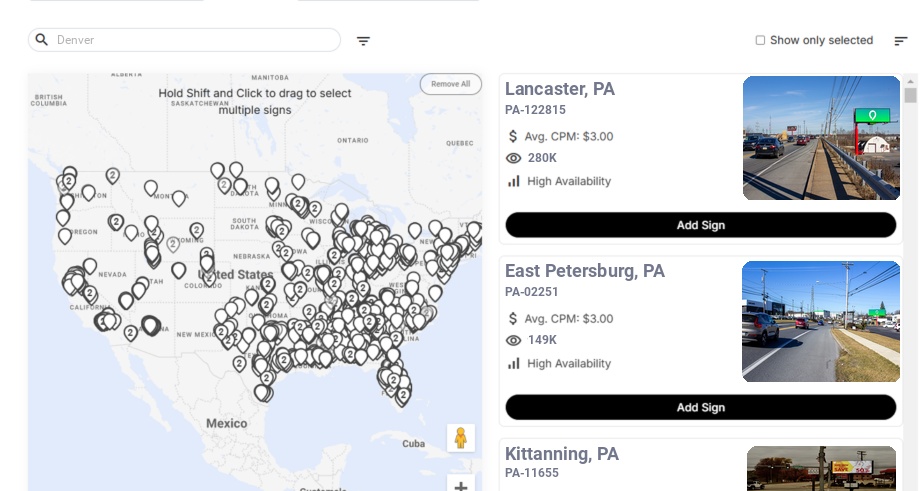
Blip has digital billboards in Denver. You can browse available locations on a map, choose the ones that fit your audience, and start advertising right away.
Still have questions? Launch a campaign in minutes — no contracts, no commitments.
Start Your CampaignDenver Billboard Advertising Guide
Denver, Pennsylvania may be a small borough, but it sits at a powerful crossroads for reaching Lancaster County, Berks County, and long-distance Turnpike travelers. With digital billboards, we can punch far above the town’s population and speak to daily commuters, regional shoppers, and visitors moving between Reading, Lancaster, and beyond. Well-placed Denver billboards along these corridors help local businesses extend their reach far beyond the borough itself.
Understanding the Denver, PA Market
Denver’s borough population is just under 4,000 people, but it lives inside a much larger economic ecosystem that makes Denver billboard advertising unusually efficient for such a small town:
- Denver borough population: roughly 3,900–4,000 residents, according to recent borough and county planning estimates.
- Lancaster County population: about 555,000+ residents, per county demographic reports from Lancaster County.
- Nearby anchors: Reading (approx. 95,000 residents, per City of Reading), Lancaster City (approx. 58,000 residents, per the City of Lancaster).
Zooming out even further:
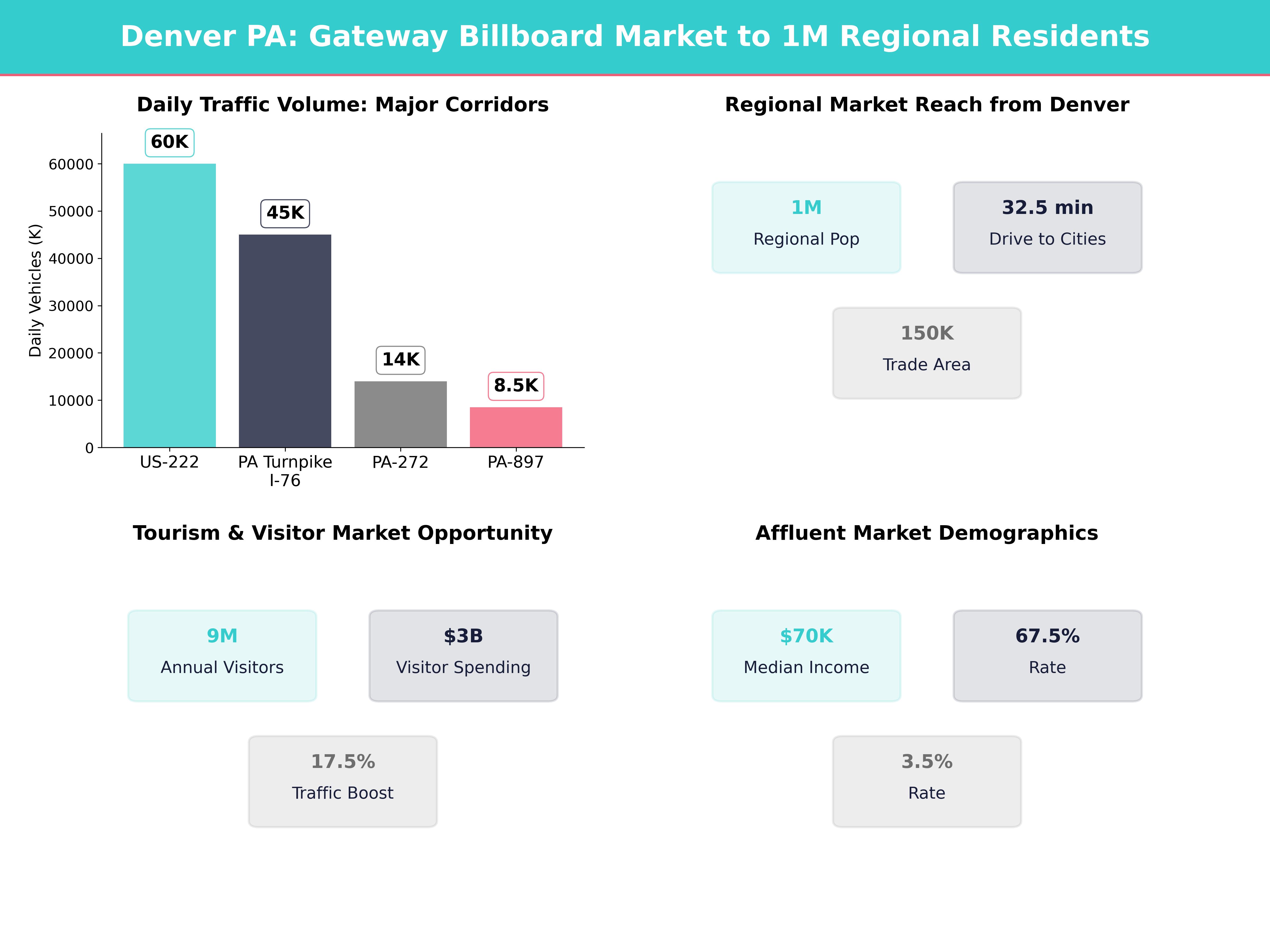
- Neighboring Berks County has more than 430,000 residents (per County of Berks), creating a combined Lancaster–Berks regional population of nearly 1 million people.
- Within a 30–35 minute drive of Denver, you can reach major population centers including Lancaster, Reading, Ephrata, Lititz, and Lebanon, giving billboards multiple overlapping commuter sheds.
This means the real opportunity isn’t just “Denver”; it’s the traffic flowing through the Denver area and constantly passing billboards in Denver:
- US‑222 connects Lancaster–Ephrata–Denver–Reading, with many drivers commuting to work, school, and shopping. Segments near Ephrata/Denver typically see 50,000–70,000 vehicles per day in Annual Average Daily Traffic (AADT), based on recent counts from PennDOT’s Traffic Information Repository.
- The Pennsylvania Turnpike (I‑76) between the Reading and Lancaster/Lebanon interchanges carries 40,000–50,000 vehicles per day, including a high proportion of commercial vehicles, according to the Pennsylvania Turnpike Commission.
- State Routes 272 and 897 carry lower, but still meaningful, volumes—often in the 8,000–18,000 vehicles per day range depending on the segment—primarily local and regional shoppers between smaller communities, per PennDOT.
Local economic context is favorable for out-of-home advertisers:
- Lancaster County’s unemployment rate has frequently tracked 0.5–1.0 percentage points below the statewide unemployment rate and often hovers in the 3–4% range in recent years, according to summaries published by the Lancaster County Workforce Development Board. This reflects a stable labor market and consistent consumer spending.
- Lancaster County routinely ranks among Pennsylvania’s strongest small-business regions. The Lancaster Chamber highlights thousands of small and mid-sized employers across manufacturing, logistics, agriculture, retail, and hospitality—industries that benefit heavily from geographically targeted advertising, including focused billboard rental in Denver.
- Tourism is significant: the wider Lancaster County area sees roughly 8–10 million visitors annually and more than $3 billion in visitor spending, according to Discover Lancaster.
For Denver-area advertisers, this combination of local residents, regional commuters, and tourists makes digital billboards an efficient way to extend reach far beyond what traditional local media alone can do. When managed strategically, Denver billboard advertising can function like a regional media buy at a local price.
Key Traffic Corridors and Where to Focus
To get the most from Blip’s location and scheduling tools, it helps to think in terms of corridors, not just town names. Around Denver, three corridors dominate, and each one offers slightly different benefits for Denver billboards:
1. US‑222: Commuter & Shopping Traffic
US‑222 is the backbone between Reading and Lancaster:
- Daily traffic volumes (AADT) along US‑222 between Ephrata and Reading are commonly in the 50,000–70,000 vehicles per day range, according to PennDOT traffic data.
- In peak commuting segments near Ephrata and Denver, heavy morning and evening flows can push hourly volumes above 3,000 vehicles per direction, meaning a well-placed digital face can be seen by tens of thousands of drivers each weekday.
- Traffic profile: heavy morning/evening commute flows, plus weekend shoppers heading to outlets, malls, and big-box retail in Lancaster, Ephrata, and Reading.
Strategic implications:
- Weekday morning (6–9 a.m.) and late afternoon (3–6 p.m.) are prime times to target commuters, especially for service businesses and hiring campaigns that want to reach workers from Lancaster County and southern Berks County.
- Weekends are ideal for retail, dining, and entertainment offers, as families and visitors move between communities. Saturday volumes on US‑222 often approach or exceed typical weekday traffic during key shopping seasons (back-to-school, holidays).
2. Pennsylvania Turnpike (I‑76): Long-Distance & Logistics
The PA Turnpike near Denver is a major east–west artery:
- Daily traffic in this stretch can approach 40,000–50,000 vehicles per day, with some segments carrying 30–40% commercial truck traffic, per PA Turnpike Commission freight and traffic summaries.
- Travelers include long-haul truckers, regional distributors, business travelers, and vacationers crossing the state. Many of these drivers are on trips of 100+ miles, making rest, fuel, and meal decisions while they’re on the road.
Strategic implications:
- Perfect for logistics, warehousing, industrial suppliers, truck stops, and travel services (hotels, fuel, quick-service restaurants). Logistics and industrial employers in the Lancaster–Reading corridor draw from a labor pool of tens of thousands of workers commuting via the Turnpike and US‑222.
- Use directionally relevant messaging: “Next Exit,” “1 Mile Ahead,” or “Exit at Denver/Reading” to capture spontaneous decisions. Highway research consistently shows that simple “Next Exit” style directions can increase response rates by 20–40% versus generic branding alone.
- Daytime weekday schedules effectively reach commercial drivers; evening and weekend schedules capture leisure travelers, including family trips and long-weekend getaways.
3. Local Connectors: PA‑272, PA‑897, and Surrounding Roads
Denver sits near a network of local routes tying together nearby boroughs:
- PA‑272 connects Denver to Ephrata, Adamstown, and larger retail clusters, carrying 10,000–18,000 vehicles per day on key segments, according to PennDOT.
- PA‑897 links Denver with Reinholds, Schoeneck, and other smaller communities and typically sees 7,000–10,000 vehicles per day in the Denver–Reinholds stretch.
Traffic on these routes is lower than on US‑222 or I‑76 but is highly local and repeat. Many drivers use these roads 5 days a week, 2 trips per day for work and school, which is extremely valuable for:
- Local restaurants and coffee shops
- Auto services, HVAC, home repair
- Local healthcare and dental practices
- Schools, churches, and community organizations
These are ideal placements for high-frequency, relationship-building campaigns that keep your brand top of mind and can be seen dozens of times per month by the same households. For smaller advertisers testing billboard rental in Denver for the first time, these hyper-local routes can be a cost-effective starting point.
Who We’re Reaching: Core Audience Profiles
Because Denver sits between multiple micromarkets, we can think in terms of three dominant audience types that billboards in Denver and the surrounding corridors routinely reach:
-
Blue-Collar & Skilled Trade Commuters
- Many residents in northern Lancaster and southern Berks Counties work in manufacturing, construction, logistics, and agriculture—all sectors that have grown employment by 10–20% over the past decade in the broader Lancaster–Reading area, according to regional workforce and economic development reports.
- Large industrial parks near Ephrata, Denver, and Reading mean thousands of workers use US‑222 and the Turnpike daily. Average one-way commutes in the region frequently fall in the 20–30 minute range, giving billboards multiple impressions each week.
- Effective verticals: tools and equipment, training programs, job openings, auto service, quick dining, and workwear.
-
Family Shoppers & Suburban Households
- The region’s median household incomes sit in the $65,000–75,000 range for many Lancaster County communities, with homeownership rates often exceeding 65–70%, per county planning and housing data.
- A significant share of households have children at home, driving frequent trips for groceries, school activities, medical visits, and recreation. Many families report making 3–5 shopping or errand trips per week, often along US‑222 and PA‑272.
- Effective verticals: grocery and farm markets, pediatric and family health, local attractions, after-school activities, and financial services.
-
Visitors & Travelers
- Lancaster County is a tourism powerhouse. Discover Lancaster reports 8–10 million visitors per year, supporting tens of thousands of tourism-related jobs and more than $3 billion in annual visitor spending on lodging, food, shopping, and attractions.
- The PA Turnpike and US‑222 feed tourists from Philadelphia, New York, New Jersey, and Maryland into the area; on peak summer and fall weekends, visitor traffic can increase by 10–25% over non-peak periods.
- Effective verticals: hotels, campgrounds, attractions, local dining, antique shops, and specialty retailers (e.g., outlets, Amish goods).
When we design creative and schedule campaigns, we want to match our messaging to these audiences, their travel patterns, and their decision-making windows so that every Denver billboard advertising impression has a clear purpose.
Seasonality in Denver and How to Use It
Lancaster County’s seasonal rhythms strongly influence traffic and consumer behavior. Tapping into these patterns can significantly boost campaign relevance and improve performance for billboards in Denver and nearby towns.
Spring (March–May)
- Gradual increase in tourist and weekend traffic as weather warms; many attractions see visitation climb 20–40% between March and May, according to seasonal trends reported by Discover Lancaster.
- Home improvement and landscaping activity spikes; regional home and garden businesses often report spring sales volumes 30–50% higher than winter months.
- Local events and school activities pick up across districts like the Cocalico School District
Best uses for spring campaigns:
- Home services (roofing, HVAC tune-ups, landscaping, remodeling).
- Garden centers, farm markets, and nurseries.
- Spring enrollment for private schools, camps, and youth sports.
Use messages like “Book Before Summer,” “Spring Tune-Up Special,” or “Planting Season Is Here.”
Summer (June–August)
- Peak tourism season in Lancaster County; Discover Lancaster highlights a full calendar of family-friendly attractions. Some attractions report summer visitation doubling compared to off-season months.
- Heavy weekend and holiday traffic on US‑222 and the PA Turnpike, with holiday weekends (Memorial Day, July 4th, Labor Day) pushing traffic volumes 10–30% above average.
- More local festivals, church picnics, and outdoor events across the Denver, Ephrata, and Adamstown areas, promoted through outlets such as Denver Borough and Ephrata Review.
Best uses for summer campaigns:
- Attractions, amusement centers, and family entertainment.
- Restaurants, ice cream shops, and outdoor dining.
- Hotels, campgrounds, and short-term rentals.
Lean into bright visuals, simple offers (“Kids Eat Free Tonight”), and location cues (“Exit at Denver, 5 Minutes Away”).
Fall (September–November)
- Back-to-school routines bring structured commuting patterns; area schools educate tens of thousands of K–12 students, increasing morning and afternoon trip regularity.
- Fall foliage and harvest events keep tourism strong into October; farm-based attractions and foliage tours often see some of their highest per-day visitation during peak color weeks.
- Local farm stands and orchards are in high season; Lancaster County is one of Pennsylvania’s top agricultural counties by sales value, and autumn is a critical revenue period.
Best uses for fall campaigns:
- Back-to-school retail, tutoring, and youth activities.
- Harvest and fall festivals, pumpkin patches, and corn mazes.
- Financial services and healthcare (open enrollment, Medicare, etc.).
Back-to-school and harvest themes perform well: “After-School Care on Your Way Home,” “Fall Specials on Tires Before Winter.”
Winter (December–February)
- Holiday shopping and travel in December create strong retail and highway traffic; some retailers report 20–30% of annual sales in the November–December period.
- The PA Turnpike and US‑222 see elevated long-distance trips for Thanksgiving and Christmas/New Year’s, with winter-weather events sometimes compressing travel into narrow windows and boosting volumes.
- January and February can be slower but offer opportunities for health, finance, and home services to stand out when advertising clutter drops.
Best uses for winter campaigns:
- Retailers and outlets (especially around holidays).
- Gyms, wellness, and medical practices (New Year’s resolutions, flu season).
- Emergency and essential services: plumbers, HVAC, auto repair (snow, freezes, and road conditions).
Blip’s flexibility allows us to ramp up spending around holidays and special events, then dial back during natural lulls—something traditional static boards, often locked in 4-, 8-, or 12-week contracts, can’t do as easily. This flexibility is particularly helpful if you’re experimenting with Denver billboard advertising for the first time and want to test performance before committing to longer runs.
Crafting Effective Creative for Denver-Area Drivers
Digital billboards close to Denver are typically seen at highway speeds, often 55–70 mph. At those speeds, drivers have roughly 6–8 seconds to process your message. We should design creative with these constraints and audiences in mind, whether the sign is on US‑222, I‑76, or a more local stretch of Denver billboards on PA‑272.
Key design principles:
-
One Main Idea Per Blip
- Aim for 6–8 words or fewer, plus a logo and a short call-to-action. Studies of roadside readability show comprehension drops sharply beyond 7–10 words at highway speeds.
- Example: “Family Dentist – Exit Denver – Call Today.”
-
Local & Directional References
- Use place names drivers recognize: “Denver,” “Ephrata,” “Reading,” “Lancaster,” “Adamstown.”
- Directional cues increase response: “Next Exit,” “½ Mile on Right,” “Across from [Landmark].” Advertisers frequently see 10–30% higher call or visit rates when distance and exit numbers are clearly included.
-
High-Contrast Colors
- Many drives occur during dawn, dusk, or less-than-ideal weather; PennDOT crash data shows a substantial share of incidents occurring in low-visibility conditions, underscoring the need for clarity.
- Use bold contrast (dark background with light text or vice versa) and avoid tiny details.
-
Emphasize What Matters to Commuters
- Fast, convenient, trustworthy, near their route.
- Messages like “In & Out in 30 Minutes,” “Open at 7 a.m.,” or “Open Late After Work” resonate on US‑222 and PA Turnpike, where many workers spend 10+ hours per week commuting.
-
Use Multiple Creatives for Multiple Audiences
-
With Blip, we can run different designs in different dayparts or on different days:
- Weekday commute designs focused on workers and parents.
- Weekend designs focused on families, tourists, and leisure.
- Rotating 2–4 creatives instead of just one allows simple A/B testing; many advertisers find that a top-performing design can generate 20–50% more inquiries than an average one.
-
With Blip, we can run different designs in different dayparts or on different days:
Because digital creative can be updated quickly, we can also:
- Swap in weather-based messages (“Rainy Day? Indoor Fun 10 Min Ahead”).
- Change offers week by week to test which promotions draw more response.
Dayparting and Budget Strategy with Blip
Blip lets us buy brief ad “blips” instead of renting an entire board for weeks or months. For Denver-area campaigns, we can use this flexibility to focus where it counts most and treat billboard rental in Denver as a precision tool instead of a blunt instrument.
Daypart Recommendations
-
Morning Commutes (6–9 a.m.)
- Captures workers heading toward industrial, office, and healthcare hubs in Lancaster, Ephrata, and Reading.
- Best for: coffee shops, breakfast options, gas stations, service businesses, hiring ads, day-of service reminders.
- Example: “Need a Job? Apply in Denver – Exit Today.”
-
Midday (10 a.m.–2 p.m.)
- Reaches a mix of retirees, stay-at-home parents, tradespeople, and logistics. Many service calls and appointments are scheduled in this window.
- Best for: healthcare appointments, senior services, B2B, and industrial services.
-
Afternoon & Evening (3–7 p.m.)
- Prime for restaurant, retail, and family-focused services. This period overlaps school pickup, after-school activities, and the evening shopping and dining window.
- Use “Tonight,” “On Your Way Home,” and similar quick-decision language.
-
Evening & Late Night (7 p.m.–Midnight)
- Ideal for restaurants that stay open late, entertainment venues, and hospitality.
- Also valuable for logistics and shift-work recruiting; many warehouses and distribution centers run 2nd and 3rd shifts, so late-night impressions are not “wasted.”
We can concentrate budget on the 2–3 most relevant dayparts rather than spreading thinly across 24 hours. Even focusing spend on just 6–10 key hours per day can significantly increase your share of voice in those periods.
Geographic Targeting
Even within the limited geography, we should think about which direction traffic is heading:
- Toward Reading: Emphasize destinations and services in Reading, Denver, and northern Lancaster County. Reading is a major retail and employment hub for 95,000 residents and many surrounding townships.
- Toward Lancaster: Focus on services and locations along the southern stretch—Ephrata, Lancaster, and intermediate stops. Lancaster City draws visitors for dining, arts, and healthcare, including major providers like Penn Medicine Lancaster General Health.
When possible, align creative with traffic direction: show Reading-focused offers to northbound drivers, Lancaster-focused offers to southbound drivers, etc. Directional relevance can improve ad recall by double-digit percentages compared to generic messaging and helps your Denver billboard advertising stand out from other roadside clutter.
Budget Phasing
For many local businesses, a practical strategy might be:
- Always-on baseline: A small, steady budget to maintain visibility in key commute hours (for example, morning and afternoon commuting windows Monday–Friday).
-
Tactical boosts: Short-term budget increases for:
- Seasonal promotions (e.g., back-to-school, holidays)
- Major local events (festivals, fairs, parades)
- Business milestones (grand openings, new services, limited-time discounts)
Because Blip pricing fluctuates based on demand and location, we can start modestly, measure impact, then expand the most effective placements and times. Even an incremental 10–20% shift of budget toward your best-performing dayparts or corridors can noticeably improve results and make your billboard rental in Denver more cost-effective over time.
Local Business Playbook: What Works Well in Denver
Let’s translate all of this into specific strategies for common business types in and around Denver. These examples reflect how Denver billboards can support different goals, from awareness to direct response.
Retail & Outlets
With shoppers traveling between Lancaster, Ephrata, Reading, and Denver:
- The combined retail trade area within a 20–25 minute drive of Denver includes well over 150,000 residents, creating a strong base for recurring sales.
-
Highlight “limited time” offers and exit-based directions:
- “Outlet Savings – 10 Min from This Exit”
- “Today Only: 20% Off Work Boots – Exit Denver.”
- Use weekend-heavy schedules when retail traffic peaks; many stores see 20–40% higher foot traffic on Saturdays compared to midweek days in peak seasons.
Restaurants, Coffee, and Quick-Service
-
Use proximity and convenience:
- “Hungry? 2 Minutes Off This Exit – Denver Diner.”
- “Locally Roasted Coffee – Next Exit Right.”
- Align dayparts with mealtimes and commuting; commuters often decide where to eat within a few minutes of passing an exit.
- Emphasize fast service, parking, and family-friendliness. Quick-service and casual restaurants in highway-adjacent locations often derive 30–50% of sales from travelers and commuters.
Auto & Home Services
- Ideal for blue-collar commuters and homeowners across Lancaster and Berks Counties, where homeownership rates typically exceed 65%.
-
Use repeated exposure along US‑222 to build trust:
- “Need New Tires Before Winter? Denver Auto – Exit Here.”
- “Flooded Basement? 24/7 Emergency Service – Call Now.”
- Many service businesses find that a 3–6 month consistent billboard presence helps drive steady call volume and word-of-mouth, especially when paired with a clear phone number or URL.
Healthcare, Dental, and Vision
-
Emphasize local convenience and family care:
- “New Patients Welcome – Family Dental in Denver.”
- “Same-Week Appointments – Primary Care Near You.”
- Health systems like WellSpan Ephrata Community Hospital and Penn Medicine Lancaster General Health draw patients from across northern Lancaster County; billboards help local practices stand out in that competitive context.
- Promote phone numbers and simple URLs; keep text short and legible. Many practices track 5–15% of new-patient inquiries from out-of-home when they add a dedicated phone line or landing page.
Hiring & Workforce Campaigns
With strong manufacturing, logistics, and warehouse activity in the broader region:
- Regional industrial parks and logistics hubs employ thousands of workers on multiple shifts, many commuting on US‑222, I‑76, and PA‑272.
-
Use direct calls to apply:
- “CDL Drivers: Up to $X/hr – Apply in Denver.”
- “Now Hiring – Benefits Day One – Exit at Denver.”
- Target weekday morning and late afternoon to capture commuters. Employers often see spikes in application volume when billboard hiring campaigns coincide with pay periods or seasonal workforce demand (e.g., pre-holiday ramp-ups).
Tourism, Attractions, and Hospitality
With Lancaster County’s tourism draw:
-
Help travelers decide where to stop next:
- “Family Fun This Exit – Mini Golf & Ice Cream.”
- “Amish Country Stay – 10 Min from Denver Exit.”
- Many attractions and lodging providers report that 10–30% of their guests discover them while already in the region, making on-the-road advertising critical.
- Emphasize distance and exit numbers, especially along the PA Turnpike; travelers are more likely to stop if they know a destination is within 5–10 minutes of the exit.
Leveraging Local Media and Community Context
To keep campaigns relevant, we should stay plugged into local conversations and integrate Denver billboard advertising with what residents and visitors are already hearing elsewhere:
- Denver Borough official site – for borough news, events, and local infrastructure updates.
- Lancaster County government – for county-wide initiatives and public information.
- Discover Lancaster – for tourism trends, events, and seasonal activities that drive visitor traffic.
- Berks County government – for economic development and transportation updates impacting Reading and surrounding communities.
- Local news outlets, including:
These sources can inform:
- Event-timed campaigns (fairs, parades, school events, tourism weekends).
- Community-oriented messaging (“Proud to Serve Denver and Northern Lancaster County”).
- Seasonal or issue-based messaging (e.g., winter road safety, back-to-school promotions).
Measuring Success and Optimizing Over Time
Billboard campaigns in a rural–suburban corridor like Denver require practical, grounded measurement.
We recommend:
-
Track Inquiry Sources
- Train staff to ask, “How did you hear about us?” for 100% of new inquiries where possible.
- Add “Mention ‘Denver Billboard’ for [Incentive]” to measure direct response; even if only 5–15% of customers mention it, you gain a clear signal.
-
Use Unique URLs or Phone Extensions
- Create simple, billboard-specific landing pages or tracking numbers.
- Example:
YourBrandDenver.comor a dedicated call extension. Businesses routinely see noticeable increases in direct-traffic and branded-search metrics during active billboard flights.
-
Watch Web Analytics During Campaign Windows
- Note changes in direct visits, branded searches, and calls from nearby ZIP codes (e.g., 17517, 17522, 196xx).
- Look for week-over-week or month-over-month lifts during the periods when your Blip campaign is active.
-
Run A/B Creative Tests Using Blip’s Flexibility
- Test different offers or headlines in alternating weeks or dayparts.
- Compare which creatives coincide with higher call volumes, appointment requests, or store traffic; many advertisers find that their best-performing headline can drive 20–50% more response.
-
Adjust by Corridor and Daypart
- If weekend spikes are stronger than weekday commutes (or vice versa), reallocate budget accordingly.
- Shift budget between US‑222, Turnpike-adjacent boards, and more local routes like PA‑272 depending on where you see the best return.
Because we control where, when, and how often our messages appear with Blip, we can continuously refine campaigns based on observed performance—especially valuable in a market where many customers pass our boards multiple times each week. Over time, this approach turns simple billboard rental in Denver into a measurable, optimizable marketing channel rather than just a static branding expense.
By understanding Denver not as an isolated small town, but as a strategic junction in the Lancaster–Reading corridor, we can build digital billboard campaigns that are both cost-effective and highly impactful. With precise targeting by route, time of day, and season—and with creative that speaks directly to commuters, families, and travelers—we put our messages in front of the right people at the exact moments they’re ready to act, maximizing the value of every impression on Denver billboards.