Billboards near Bethel Park, PA
No Minimum Spend. No Long-Term Contracts. Just Results.
Trusted by Leading Brands


Billboard advertising
near Bethel Park has never been easier



How much is a billboard near Bethel Park?
Why Choose Blip for Billboard Advertising near Bethel Park
Blip lets you launch fast in Bethel Park and reach commuters on US-19 and PA-88 without traditional media hassle.
Use Bethel Park billboards to target morning and evening rushes for South Hills workers, school drop-offs, and park-and-ride traffic.
With Blip, Bethel Park advertisers can start small, pause anytime, and shift spend around South Hills Village weekends or game days.
Track Bethel Park campaign results in real time and fine-tune creative as traffic changes across Castle Shannon, Scott Township, and Canonsburg.
No contracts means you can test Bethel Park's affluent, family-heavy audience and scale only when your message performs.
Blip's creative tools make it easy to localize ads for Bethel Park families, homeowning suburbs, and seasonal needs like back-to-school or winter prep.
Frequently Asked Questions About Billboard Advertising near Bethel Park
How much does a billboard cost near Bethel Park, Pennsylvania with Blip?
With Blip, you choose exactly how much you want to spend promoting your message on Bethel Park billboards by setting a daily budget that Blip automatically follows. Each 7.5–10 second “blip” is a brief ad display on digital billboards near Bethel Park, Pennsylvania, and you only pay for the individual blips you receive. Pricing is flexible because each blip’s cost depends on when and where you choose to advertise and on advertiser demand in the Bethel Park area.
Where can I advertise near Bethel Park, Pennsylvania with Blip?
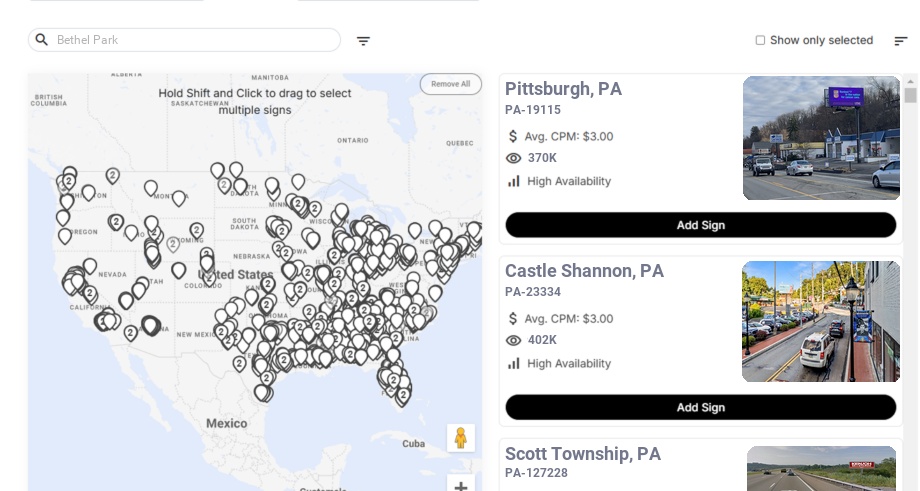
With 12 digital billboards serving the Bethel Park area from nearby Castle Shannon, Scott Township, Canonsburg, and Pittsburgh, you can reach commuters, shoppers, and local families where they spend their time and dollars. These boards sit about 2.9 miles to 8.6 miles away from Bethel Park and can be used as a connected network rather than isolated placements. This gives advertisers a turnkey way to blanket the South Hills.
What kind of audience do Bethel Park, Pennsylvania billboards reach?
Bethel Park is described as an affluent, family-oriented, and highly mobile suburban market in greater Pittsburgh. The area has roughly 33,500–34,000 residents, median household income around $89,000–$91,000, and about 75–80% homeownership, which supports strong demand for retail, automotive, healthcare, home services, and discretionary spend. The audience is also made up of established families, commuter professionals, and long-term residents.
When should I run Blip ads in Bethel Park, Pennsylvania for the best results?
The page says the Bethel Park area has strong daily commuting and shopping rhythms, with 60–70% of weekday traffic on major corridors occurring during morning and evening peaks. Typical weekday patterns are about 6:30–9:00 a.m. and 3:30–7:00 p.m., with midday travel from about 11:00 a.m.–1:30 p.m. For commuters and transit riders, early morning and evening windows are especially effective.
What roads around Bethel Park, Pennsylvania get the most traffic for billboard advertising?
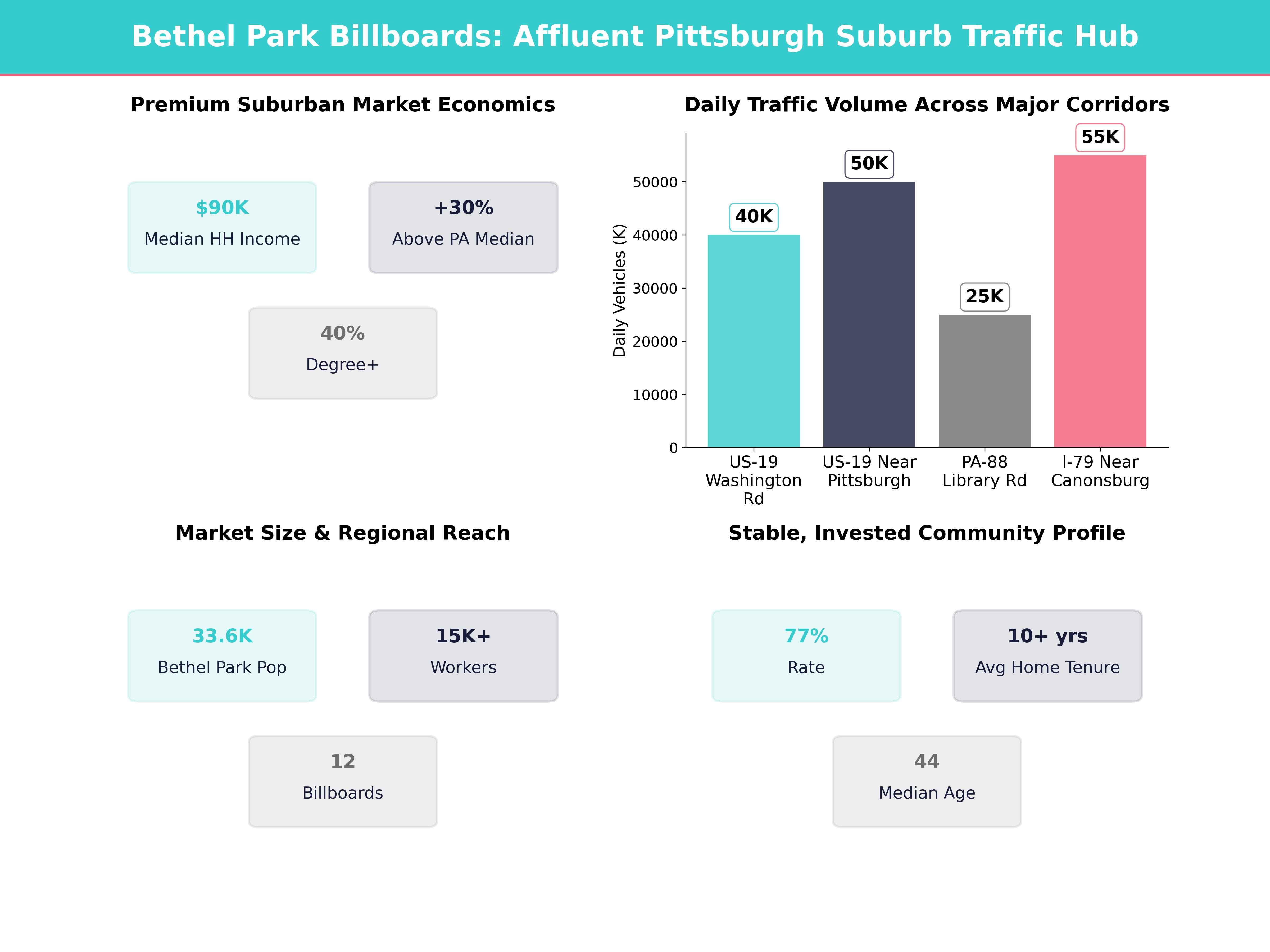
Major corridors serving the Bethel Park area include US-19 (Washington Road), PA-88 (Library Road), and I-79 near Canonsburg. US-19 often carries 35,000–45,000 vehicles per day on key segments, PA-88 regularly records 20,000–30,000 vehicles per day, and I-79 near Canonsburg sees roughly 50,000–60,000 vehicles per day. Nearby feeder roads such as Route 51, Baptist Rd, and Bethel Church Rd also handle thousands of additional local trips daily.
Do I need a contract to advertise with Blip near Bethel Park?
No, Blip has no long-term contracts or minimum commitments. You can start, pause, or stop your campaign at any time.
How fast can I launch a billboard campaign with Blip near Bethel Park?
You can have your campaign live in minutes. Create a free account, select your locations, set your budget, upload your design, and start running once approved.
Where can I advertise with Blip near Bethel Park?
Blip has digital billboards near Bethel Park. You can browse available locations on a map, choose the ones that fit your audience, and start advertising right away.
Still have questions? Launch a campaign in minutes — no contracts, no commitments.
Start Your CampaignBethel Park Billboard Advertising Guide
The Bethel Park area is one of the most attractive suburban advertising markets in greater Pittsburgh: affluent, family-oriented, and highly mobile. With 12 digital billboards serving the Bethel Park area from nearby Castle Shannon Scott Township Canonsburg Pittsburgh, we can help you reach commuters, shoppers, and local families where they spend their time and dollars. For advertisers looking specifically for high-visibility billboards near Bethel Park, this cluster of locations offers a turnkey way to blanket the South Hills.
Understanding the Bethel Park Area Market
Bethel Park is a large, stable suburb in Allegheny County with the scale and spending power to support serious growth campaigns, making Bethel Park billboards especially valuable for brands that serve the South Hills.
Key market facts (latest available data):
- Population: about 33,500–34,000 residents (2020 counts list roughly 33,577), making it one of the larger South Hills communities compared with nearby suburbs like Mount Lebanon Upper St. Clair (~20,000).
- Median household income: roughly $85,000–$90,000 (recent estimates place it around $89,000–$91,000), which is more than 30% higher than the Pennsylvania median (in the mid‑$70,000s). This signals strong purchasing power for retail, automotive, healthcare, home services, and discretionary spend.
- Median age: around 43–45 years, several years higher than the national median (around 38), reflecting a strong mix of established families with children and older homeowners with higher equity and discretionary income.
- Homeownership: roughly 75–80% of households own their homes, compared with about 66% nationally, which aligns with high interest in home improvement, landscaping, financial services, and local professional services.
- Education: more than 40% of adults hold at least a bachelor’s degree, supporting demand for professional services, financial planning, advanced healthcare, and enrichment programs.
- Commute: average one-way commute times run about 25–30 minutes, with a large share of residents commuting into job centers in downtown Pittsburgh, Oakland, and Southpointe.
The municipality’s official site, bethelpark.net alleghenycounty.us, and feeds into the Bethel Park School District, which serves roughly 4,000–4,500 students across its schools. Advertisers can treat the Bethel Park area as a high-intent, high-loyalty local audience that tends to support nearby businesses and values convenience and trust, making billboard advertising near Bethel Park an efficient way to stay top of mind.
Because our digital billboards are positioned in nearby Castle Shannon (about 2.9 miles away), Scott Township (5.4 miles), Canonsburg (8.2 miles), and Pittsburgh (8.6 miles, administered by pittsburghpa.gov), we reach residents as they:
- Commute toward downtown Pittsburgh and Oakland
- Shop in South Hills retail corridors such as South Hills Village
- Travel to entertainment, sports, and medical appointments across the South Hills and the city (including major hospitals anchored in Oakland and Uptown)
This combination lets us build campaigns that saturate the full daily journey of Bethel Park area residents, from neighborhood streets to regional highways, using boards that function like a connected network of billboards near Bethel Park rather than isolated placements.
Where Your Audience Travels: Key Corridors and Traffic Patterns
Bethel Park area residents move along a few dominant roadways and transit paths. Placing your messages on digital billboards in nearby cities aligned with these paths maximizes impressions and ensures your Bethel Park billboards are seen where they matter most.
High-Impact Roadways
According to PennDOT traffic count data (summarized on PennDOT’s Traffic Information), major corridors serving the Bethel Park area see heavy daily volumes:
- US-19 (Washington Road) through nearby Upper St. Clair and into Scott Township often carries 35,000–45,000 vehicles per day on key segments, with some stretches exceeding 50,000 vehicles per day closer to Pittsburgh. This corridor connects Bethel Park area residents to South Hills Village, major chain retailers, and onward toward downtown.
- PA-88 (Library Road) through Castle Shannon and toward Pittsburgh regularly records 20,000–30,000 vehicles per day, depending on the segment, with weekday peaks aligned to commuting hours. This is a primary route for Bethel Park–to–city commuting and local errands.
- I-79 near Canonsburg sees roughly 50,000–60,000 vehicles per day, capturing longer-distance commuters, logistics, and regional travel. This is valuable if you want to reach Bethel Park area residents who work in the southern and western suburbs, at the Southpointe business park, or in Washington County.
- Nearby feeder roads such as Route 51, Baptist Rd, and Bethel Church Rd handle thousands of additional local trips daily, feeding into the higher-volume corridors where your billboards appear.
Altogether, it is realistic for a Bethel Park–based commuter to encounter 50,000+ cumulative daily traffic volume across the routes they use, which underscores the scale of potential impressions when your creative is placed strategically on billboards near Bethel Park travel corridors.
Our digital billboards in Castle Shannon, Scott Township, Canonsburg, and Pittsburgh can be scheduled to intersect these daily flows. For example:
- Castle Shannon boards can catch Bethel Park area residents heading north on PA-88 or through the Bethel Church Rd / Library Rd corridor before they connect to city-bound routes.
- Scott Township and Pittsburgh boards aligned with US-19 can reinforce your message as the same drivers continue toward major employment centers and the city, providing two to three touchpoints within a single commute.
- Canonsburg placements let you reach a broader South Hills and Washington County audience that still includes many Bethel Park area commuters, as Southpointe alone hosts 15,000+ workers across energy, finance, and technology firms.
Transit Use and Park-and-Ride Behavior
Pittsburgh Regional Transit (formerly Port Authority), documented at www.rideprt.org, reports strong ridership on the light rail (“T”) and key bus routes in the South Hills:
- System-wide, Pittsburgh Regional Transit carries on the order of 120,000–140,000 average weekday riders, with the light rail system contributing tens of thousands of those weekday trips.
- The South Hills Village and Library branches pass through or near the Bethel Park area, with multiple park-and-ride lots that can each accommodate hundreds of vehicles on busy weekdays.
- Regular riders often drive from neighborhoods to transit stops, passing nearby digital billboards along PA-88 and US-19. A typical park-and-ride user generates 4 billboard exposure opportunities per day (outbound + inbound, morning + evening).
If your target includes commuters who ride the T or buses, focusing your impressions during early morning (5:30–8:30 a.m.) and evening (4:00–7:00 p.m.) windows on boards near these corridors can efficiently capture that audience on both legs of their trip, generating dozens of impressions per person per month even at modest budgets. This is where flexible billboard rental near Bethel Park really shines: you can dial up exposure exactly when those riders are on the road.
Audience Profile: Who You’re Reaching in the Bethel Park Area
To craft effective creative and scheduling, it helps to understand how Bethel Park area residents live and spend:
-
Family-Focused Households
- Roughly two-thirds of local households are family households, and a significant share include children under 18, participating in Bethel Park School District activities, youth sports, and local events.
- Median household income near $90,000 supports regular spending on childcare, tutoring, youth sports, dining out, and family entertainment.
- Messaging that references schools, family routines, or weekend plans resonates strongly.
-
Commuter Professionals
- A large share of residents work in management, business, science, and arts occupations, with major employment destinations in downtown Pittsburgh, Oakland’s “eds and meds” district, and corporate campuses along I‑79 and I‑376.
- With 25–30 minute average commute times, commuters see roadside media consistently, giving your messages repeated exposure.
- Industries include healthcare, education, finance, technology, and energy. Offerings related to professional services, insurance, financial planning, and B2B awareness campaigns can gain strong traction.
-
Stable, Long-Term Residents
- High homeownership (around 75–80%) and limited new construction indicate a mature, stable housing stock, with many owners in their homes for 10+ years.
- This translates into durable demand for remodeling, roofing, HVAC, landscaping, mobility modifications, and eldercare services.
- Repetition over time (even at modest budgets) builds the familiarity that this audience equates with trust—especially when paired with “years in business” messaging.
-
Health, Education, and Sports Enthusiasts
- Proximity to major medical centers administered through systems headquartered in Pittsburgh, plus local parks and facilities, contributes to high engagement with health, wellness, and fitness brands.
- Bethel Park High School and its athletic programs attract thousands of attendees across football, basketball, and other sports seasons, creating spikes in local traffic on game days.
- Residents are receptive to preventative care, orthopedic, dental, and vision services, as well as youth programs and adult fitness.
Local media such as the Pittsburgh Post-Gazette (post-gazette.com), KDKA (kdka.com), WPXI (wpxi.com), WTAE (wtae.com), and TribLIVE ( triblive.com The Almanac (thealmanac.net) focus specifically on South Hills communities, including Bethel Park. Aligning your messaging with those community values can significantly improve recall and favorability and make your Bethel Park billboards feel like a natural part of the local landscape rather than generic ads.
Seasonal and Event-Driven Opportunities
The Bethel Park area follows a pronounced seasonal rhythm that you can tap into with flexible, short-term digital billboard campaigns. Western Pennsylvania’s four-season climate—roughly 160–170 days of measurable precipitation per year, average January highs in the low 30s°F, and July highs in the low 80s°F—directly influences consumer behavior and travel patterns, and should shape how you structure billboard advertising near Bethel Park.
Spring (March–May)
- Home improvement, landscaping, roofing, and exterior services demand spikes as temperatures rise and snow risk falls. Regional retailers often report double-digit percentage sales increases in outdoor and garden categories between March and May.
- Youth sports, school activities, and graduation planning increase family spending. High schools across Allegheny County graduate thousands of seniors every spring, creating needs for catering, apparel, photography, and event services.
Strategy with Blip:
- Increase impressions on evenings and weekends when families are out at practices, games, and shopping—especially Fridays (after-school traffic) and Saturdays (errand runs).
- Use creative like “Get your home ready for summer in the Bethel Park area” or “Graduation party catering near you this season,” and consider adding a graduation date countdown for increased urgency.
Summer (June–August)
- Families travel more frequently on US-19 and PA-88 to access South Park, local pools, and regional attractions promoted by VisitPITTSBURGH. South Park alone encompasses more than 2,000 acres of recreational space and draws hundreds of thousands of visits annually across trails, fields, and events.
- VisitPITTSBURGH reports that the Pittsburgh region welcomes 10–14 million visitors per year, who generate billions of dollars in direct visitor spending. Summer is a peak period for hotel stays, sports tourism, and cultural events.
- Tourism into the Pittsburgh area rises, adding out-of-town impressions on top of local traffic, especially along routes to downtown, the Cultural District
Strategy:
- Run awareness campaigns for attractions, summer camps, and quick-service restaurants on high-volume corridors leading toward parks and the city.
- Highlight limited-time offers and events: “This weekend only,” “Summer special,” or “On your way to the game?”—especially on boards drivers see en route to PNC Park, Acrisure Stadium, or concerts.
Fall (September–November)
- Back-to-school, football season, and preparation for colder weather dominate. Retailers typically see a significant sales spike in apparel, school supplies, and electronics in August–September, followed by increased spending on heating and home maintenance in October–November.
- Heating, insulation, and weatherization services see increased interest as average daily lows fall from the 50s°F to the 30s°F.
Strategy:
- Align campaigns with local high school football and college football weekends by increasing frequency on Fridays and Saturdays, especially around South Hills stadiums and city-bound routes.
- Use creatives focused on back-to-school deals, home maintenance checks, tire changes, or financial planning before year-end, when many households revisit budgets and benefits.
Winter (December–February)
- Holiday shopping and New Year’s resolutions are the primary themes. Nationally, November–December can generate 20–25% of annual retail sales for many stores, and South Hills shopping corridors are no exception.
- Weather can be challenging, but digital billboards remain visible and dynamic when other formats are limited. Pittsburgh typically sees 40+ inches of snow per year, and shorter daylight hours mean a greater share of driving occurs in low light, where illuminated digital boards stand out.
Strategy:
- Promote holiday offers, gift cards, and healthcare/fitness campaigns like “Start 2026 healthier in the Bethel Park area.”
- Leverage daypart scheduling around shopping peaks and commute times, when drivers are more alert to signs due to weather conditions. Evening and early night impressions carry particular weight during this season.
Crafting Effective Creative for the Bethel Park Area
Digital billboards serving the Bethel Park area are often viewed at 40–55 mph on major roads. Industry research suggests that drivers typically have 6–8 seconds to process a billboard message at these speeds, so creative must be simple, bold, and hyper-relevant.
Visual Best Practices
- Use high contrast: Dark backgrounds with bright text or vice versa. South Hills roads often include shady stretches; strong contrast remains visible in varied lighting, including the overcast conditions common to the region (Pittsburgh averages around 160 cloudy days per year).
- Limit to 7 words or fewer: Residents are usually commuting; aim for a primary message plus a short call-to-action like “Exit at South Hills Village” or “Call Today.” Studies of out-of-home recall show that ads with 7 words or fewer significantly outperform cluttered designs.
- Leverage local cues: Include phrases like “South Hills,” “near South Hills Village,” or “serving the Bethel Park area” to signal that your business is close and convenient. Local references can lift response and recall by 10–20% versus generic wording and help viewers immediately associate your message with Bethel Park billboards they see every day.
- Feature recognizable icons: For example, a football graphic during Steelers season, a snowflake for winter service deals, or a graduation cap in May/June. Visual anchors help drivers understand your category in under a second.
Messaging Angles that Work Locally
- Convenience & Proximity: “Just 10 minutes from the Bethel Park area” or “On your way home on Library Rd.” With average commutes near half an hour, this audience values time savings and easy access.
- Trust & Longevity: “Serving South Hills families since 1995” or “Trusted by your Bethel Park area neighbors.” In mature suburbs with high homeownership, brands with a long local track record often see higher conversion rates.
- Offers & Deadlines: Clear, time-bound offers (“This week only,” “Through Sunday”) create urgency and align with weekly shopping patterns—particularly Thursday–Sunday peaks.
- Family Value & Safety: For healthcare, financial services, and home improvement, language around protecting family and home aligns with local priorities and the strong presence of family households.
Because Blip allows you to upload multiple creatives, we can:
- Test two or three variations that reference different landmarks (e.g., “Near South Hills Village” vs. “Near Route 88”) and compare performance via web traffic, calls, or redemptions.
- Rotate seasonal messages without new production or placement contracts, allowing you to switch from, say, “Spring tune‑up” to “Summer A/C special” in a single campaign.
- Localize creative by board cluster (e.g., using “Canonsburg” cues on southern boards and “City” cues on Pittsburgh boards) for more relevant messaging to each micro‑audience and to make each board feel like a tailored piece of billboard advertising near Bethel Park.
Smart Scheduling: When to Run Your Ads
The Bethel Park area exhibits strong daily commuting and shopping rhythms that you can exploit with precise scheduling. Regional traffic studies show that 60–70% of weekday traffic on major corridors occurs during combined morning and evening peaks, with additional spikes around lunch.
Commute-Focused Targeting
Typical weekday patterns:
- Morning peak: ~6:30–9:00 a.m. (school traffic plus work commuters)
- Midday: ~11:00 a.m.–1:30 p.m. (errands, appointments, lunch)
- Evening peak: ~3:30–7:00 p.m. (school pickup, return commute, shopping, activities)
With Blip’s flexible budgeting and scheduling, we can:
- Concentrate impressions during morning and evening peaks on Castle Shannon and Pittsburgh boards catching Bethel Park area commuters to/from the city, capturing the highest-traffic 4–5 hours of the day.
- Shift budget to midday on Scott Township and Canonsburg boards if your business relies more on daytime errands (e.g., medical, retail, quick-service restaurants), when appointment-based travel is more common.
Weekend vs. Weekday Strategies
- Weekdays: Prioritize commuters and parents managing school and work routines. Ideal for financial services, B2B awareness, healthcare, and professional services that benefit from consistent daily exposure.
- Weekends: Shift to leisure, dining, events, and retail. Traffic increases toward malls, big-box centers, and entertainment venues; many retailers report that 30–40% of their weekly foot traffic occurs on Saturday and Sunday.
You can run weekday-only or weekend-only flights, or allocate different budgets to each, which lets you avoid paying for lower-value impressions for your specific business model. For example, a restaurant might push 60–70% of its impressions from Thursday evening through Sunday, while a medical office might invest more heavily Monday–Thursday mornings. This kind of fine-tuned scheduling is one of the biggest advantages of modern billboard rental near Bethel Park compared with static, fixed-schedule media.
How to Use Our 12 Digital Billboards Strategically
Our 12 digital billboards serving the Bethel Park area from nearby cities can be used as a coordinated network instead of isolated placements. Treating them as a single system can dramatically increase frequency (how often the same person sees your ad) and reach (how many unique people see it).
Example Coverage Strategies
-
Full Commuter Funnel (Brand Awareness)
- Use Castle Shannon and Scott Township boards along PA-88 and US-19 to hit Bethel Park area residents as they head toward Pittsburgh.
- Add Pittsburgh boards closer to the city for a “bookend” effect: people see your message leaving home and approaching work. Repeated exposures can increase unaided brand awareness by 20–40% over a few months, according to industry benchmarks.
- Ideal for large service areas (healthcare systems, universities, banks, regional retail chains) that draw from the broader metro and want Bethel Park billboards to work together with other city placements.
-
Local Retail & Service Saturation
- Focus primarily on Castle Shannon and Scott Township boards that sit closest to primary shopping and service hubs in the South Hills.
- Schedule heavier on weekends and late afternoons when errand runs peak, matching the hours when household decision-makers are on the road together.
- Great for independent retailers, restaurants, auto repair, salons, and home services that rely on a 3–7 mile drive-time radius and need billboards near Bethel Park neighborhoods rather than across the whole metro.
-
Southpointe & Regional Worker Targeting
- Combine Canonsburg and Pittsburgh boards to capture Bethel Park area residents who work along I‑79 or in Southpointe and travel into the city or airport area managed by the Allegheny County Airport Authority
- Helpful for B2B campaigns, higher-end automotive, and specialty medical providers drawing from a larger region where daily I‑79 volumes exceed 50,000 vehicles on key stretches.
Because Blip operates on flexible, pay-per-“blip” (per display) pricing, you can:
- Start with a modest daily budget and scale once you identify boards and time slots with the best response—many advertisers begin with $10–$20 per day and increase as ROI becomes clear.
- Allocate more of your budget to specific boards that serve your ideal customer neighborhoods, essentially building custom “clusters” around Bethel Park, Castle Shannon, or Canonsburg.
- Temporarily increase your budget around key dates (grand openings, sales weekends, events) without long-term commitments, mimicking the “flighted” strategy traditional media uses but with day‑by‑day control.
Industry-Specific Tips for the Bethel Park Area
Different industries can tailor campaigns using what we know about local behavior and demographics.
Home Services & Contractors
- Focus on spring and fall, when exterior work and winter prep ramp up and homeowners are more likely to schedule projects; regional contractors often see 30–50% of annual leads originate in these seasons.
- Use reassuring, longevity-based messages: “Trusted heating & cooling in the Bethel Park area since 1998.” Highlight years in business, local licensing, and satisfaction guarantees.
- Schedule heavier in early evenings and weekends, when homeowners are more likely to call or submit online requests after work, and lean on billboard advertising near Bethel Park corridors they already use to shop for materials or visit home centers.
Healthcare & Wellness
- Use boards near major commuting corridors into Pittsburgh’s medical centers to promote clinics, urgent care, dental, and specialty practices. Healthcare accounts for more than 15% of regional employment, making it a top category for both workers and patients.
- Reference convenience: “Same-day appointments – minutes from the Bethel Park area.” Many patients select providers within a 20–30 minute drive time, which your boards effectively cover.
- Target January–March for wellness and elective procedures (when New Year’s resolutions and new insurance benefits kick in) and late summer for back-to-school physicals and immunizations.
Restaurants, QSR, and Retail
- Emphasize exit-based and time-specific calls-to-action: “Dinner tonight? Exit at [landmark] in 2 miles.” Out-of-home research shows that directional cues (“next exit,” “right on [road]”) can boost conversion rates substantially over generic branding.
- Increase impressions Thursday evening through Sunday, when dining out and shopping frequency is highest; many quick-service restaurants see 40–50% of weekly sales in this window.
- Highlight local angle: “Family-owned, serving South Hills for 20 years,” and consider featuring local media mentions from outlets like The Almanac or Pittsburgh Magazine. Pairing these cues with Bethel Park billboards near key shopping routes helps capture hungry commuters and families already in the car.
Education, Camps, and Youth Programs
- Use March–May and late August heavily for enrollment pushes; parents typically finalize summer plans 6–10 weeks in advance and after-school activities just before school starts.
- Connect to schools and local identity: “STEM camps for Bethel Park area kids” or “After-school tutoring near South Hills Village.” Mention proximity to Bethel Park, Castle Shannon, or nearby districts to reassure parents about travel time.
- Focus on boards nearest family commuting routes and shopping hubs that parents already frequent for groceries, sports, and errands to get maximum value from billboard rental near Bethel Park.
Events, Entertainment, and Attractions
- Coordinate with local sports seasons, festivals, and cultural events highlighted on VisitPITTSBURGH and regional calendars promoted by outlets like WPXI (wpxi.com) and WTAE (wtae.com).
- Run countdown creatives (“3 days left,” “Final weekend”) to drive urgency; countdown messaging is associated with significantly higher response rates for time-limited events.
- Concentrate impressions in the 7–10 days preceding your event, especially evenings and weekends, when most discretionary trips are planned and taken.
Measuring and Optimizing Your Campaign
Digital billboards are top-of-funnel by nature, but in the Bethel Park area you can still measure and optimize performance using several practical methods.
Trackable Elements
- Dedicated URLs or landing pages for billboard campaigns (e.g.,
yourbrand.com/bethelpark), monitored via web analytics for traffic lifts from South Hills ZIP codes. - Promo codes unique to out-of-home (e.g., “Use code PARK20”) to isolate redemptions from billboard viewers.
- Call tracking numbers that appear only on billboard creative; even a 10–20% lift in calls during your flight window is a valuable signal.
- Time-windowed offers that align with your ad schedule (e.g., “Mention this ad this weekend only”) so you can correlate redemptions with your impression schedule.
Monitor:
- Website visits by geography (South Hills, Bethel Park area ZIP codes like 15102)
- Call volume and form submissions during and after campaign flights, with attention to days/hours when your ads run most heavily
- In-store traffic changes during scheduled board times and days, comparing to baseline periods
Continuous Improvement with Blip
Because you can adjust your campaign quickly, we recommend:
- Start broad: Run across multiple boards and time slots for 2–4 weeks to gather directional feedback. Even with a modest spend, you can generate tens of thousands of impressions in this period.
- Analyze response: Which days, times, and locations correlate with measurable lifts in traffic, calls, or sales? Look for patterns such as higher web sessions during weekday evenings or stronger weekend store visits when boards near South Hills Village are active.
- Refine: Shift a higher share of your budget to the boards and periods with the best performance, and iterate creative (color, headline, offer) one variable at a time so changes are easier to interpret.
By combining flexible Blip scheduling with the strong demographics and defined travel patterns of the Bethel Park area, you can build billboard campaigns that behave more like a highly targeted digital channel—while still capturing the mass visibility that only outdoor media can deliver.
With the right message, placed on the right boards at the right times, you can turn daily drives through Castle Shannon, Scott Township, Canonsburg, and Pittsburgh into a powerful, consistent reminder of your brand for thousands of Bethel Park area residents every single day, and hundreds of thousands of cumulative impressions each month. For any business that depends on South Hills customers, strategically planned billboard advertising near Bethel Park is one of the most efficient ways to stay in front of this high-value audience.