Billboards in Ashley, PA
No Minimum Spend. No Long-Term Contracts. Just Results.
Trusted by Leading Brands


Billboard advertising
in Ashley has never been easier



How much is a billboard in Ashley?
Why Choose Blip for Billboard Advertising in Ashley
Blip lets you self-serve Ashley billboards fast, then reach I-81 commuters and Wilkes-Barre drivers without a long buying process.
Set flexible budgets in Ashley and only pay when ads play—ideal for testing PA 309 local traffic and the PA 315 airport-casino corridor.
Use Blip-optimized campaigns in Ashley to auto-pick timing for commuters, students, and event-goers headed to Mohegan Arena or Mohegan Pennsylvania.
Daypart Ashley ads for 6-9 a.m. and 3-6 p.m. commutes, or pre-event hours, so your message hits the Wyoming Valley at the right moment.
Track Ashley results in real time and shift spend as winter, back-to-school, or summer PNC Field traffic changes across the valley.
Blip's creative tools help Ashley advertisers build clear, high-contrast ads for fast roads like I-81 and the region's snowy, low-light winters.
Frequently Asked Questions About Billboard Advertising in Ashley
How much does a billboard cost in Ashley, Pennsylvania with Blip?
With Blip, billboard advertising in Ashley is designed to be affordable and flexible. You set a daily budget, and Blip’s algorithm uses it to bid for available ad slots, so you only pay when your ad actually appears. Each “blip” is a 7.5-to-10-second display on a rotating digital billboard, with pricing that starts at just $0.01 per display and can vary based on time of day, location, and advertiser demand.
Where can I advertise with Blip in Ashley, Pennsylvania?
Ashley’s billboard value is driven by a handful of high-volume corridors. Interstate 81 is the backbone corridor, PA 309 is a powerful route for strong urban-suburban reach, and PA 315 connects the valley to the airport, casino, and arena district. US 11 and nearby arterials matter for local frequency and repeated exposure.
What kind of audience can Ashley, Pennsylvania billboards reach?
Ashley gives advertisers access to several overlapping audiences, which is one of the main reasons billboard advertising performs well here. These include daily commuters across the Wyoming Valley, students and parents from nearby colleges, tourists and event-goers, families and healthcare users, and logistics or warehouse workers. More than 90% of local workers travel by vehicle, and the average commute is about 23 minutes.
When is the best time to run billboard ads in Ashley, Pennsylvania with Blip?
Ashley campaigns perform best when we align them with how the valley actually moves throughout the year. Winter supports tire, healthcare, HVAC, and indoor entertainment messages, while spring is a great time for home improvement and graduation traffic. Summer brings about 14 weeks of higher leisure activity, and late summer and early fall create one of the best timing windows for college move-in, football traffic, and fall shopping.
Do I need a contract to advertise with Blip in Ashley?
No, Blip has no long-term contracts or minimum commitments. You can start, pause, or stop your campaign at any time.
How fast can I launch a billboard campaign with Blip in Ashley?
You can have your campaign live in minutes. Create a free account, select your locations, set your budget, upload your design, and start running once approved.
Where can I advertise with Blip in Ashley?
Blip has digital billboards in Ashley. You can browse available locations on a map, choose the ones that fit your audience, and start advertising right away.
Still have questions? Launch a campaign in minutes — no contracts, no commitments.
Start Your CampaignAshley Billboard Advertising Guide
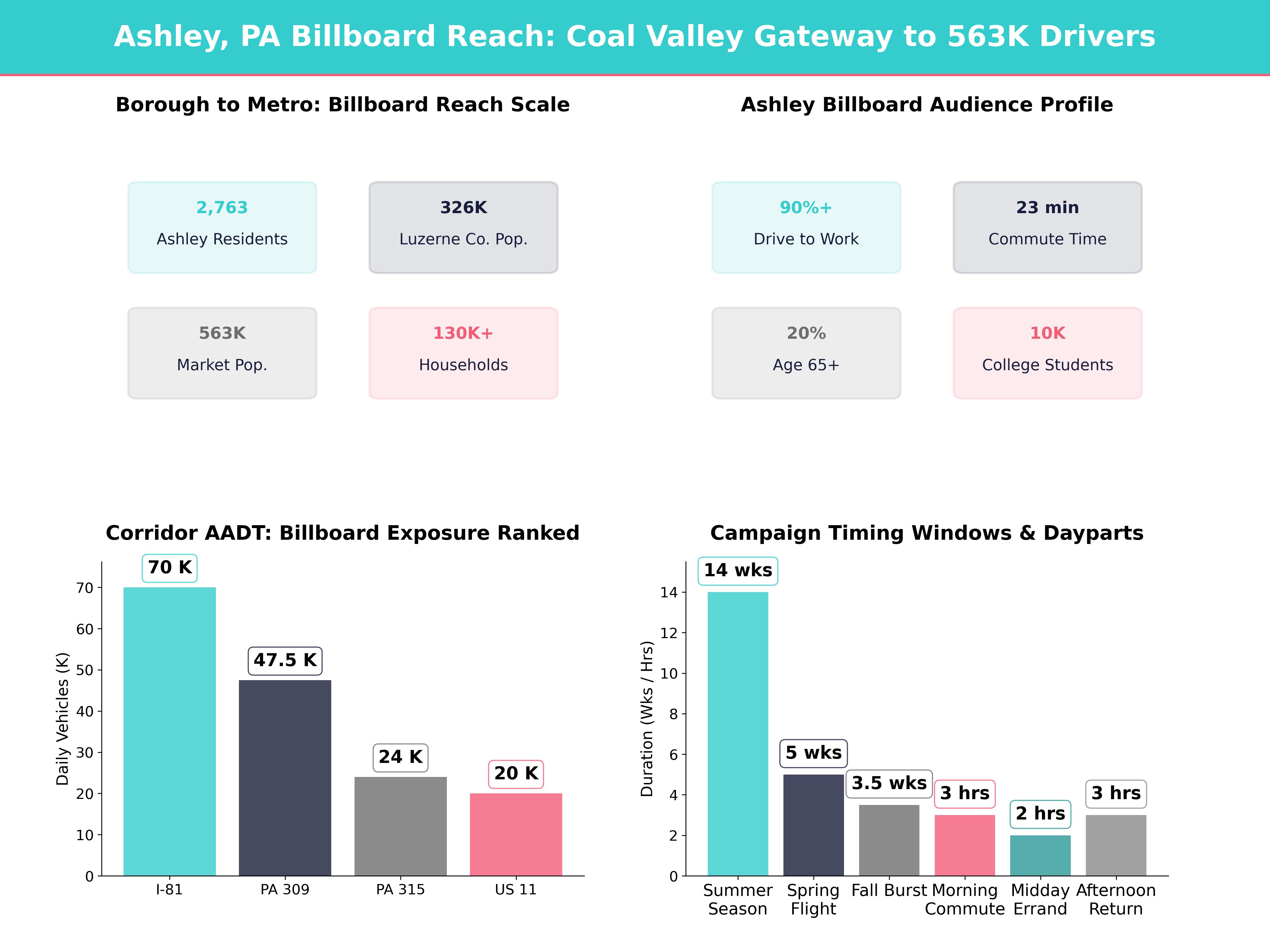
Ashley, Pennsylvania, is a small borough with a strong regional advertising advantage. While Ashley itself had 2,763 residents in the 2020 Census, it sits inside Luzerne County, which had 325,594 residents, and within the broader Scranton-Wilkes-Barre-Hazleton metro, which has about 563,000 people. That matters because billboard campaigns here are not limited to one borough block or one main street. We can reach daily drivers, casino visitors, college students, healthcare users, and Wyoming Valley shoppers by focusing on the road network that funnels traffic past Ashley every day.
Ashley, Pennsylvania Market Overview
Ashley works best as a regional billboard market rather than a stand-alone borough buy. The borough is immediately tied to Wilkes-Barre, Hanover Township Nanticoke
Ashley’s position inside the Wyoming Valley economy
Ashley is only about 3 miles from downtown Wilkes-Barre, and roughly 12 miles from Wilkes-Barre/Scranton International Airport. That puts it near employment centers, colleges, hospitals, gaming, logistics, and regional retail.
Luzerne County grew by about 1.5% from 2010 to 2020, which tells us the market is stable enough to support sustained out-of-home visibility. Ashley itself is small, but it benefits from being plugged into a larger valley where people move constantly between home, work, school, and entertainment.
Several economic anchors support repeat vehicle traffic in this part of Northeastern Pennsylvania. Major institutions include Geisinger Wyoming Valley Medical Center, Commonwealth Health Wilkes-Barre General Hospital, Wilkes University, King's College, Misericordia University, and Penn State Wilkes-Barre Mohegan Pennsylvania and Mohegan Arena at Casey Plaza adds another steady stream of discretionary travel.
Demographics, household mix, and mobility
For advertisers, Ashley is useful because the audience is broad. Luzerne County has more than 130,000 households, and about 20% of residents are age 65 or older, which makes healthcare, home services, financial services, and retail strong billboard categories.
At the same time, nearby colleges and event venues keep younger adults and students moving through the same road network. The county is also highly vehicle-oriented. Recent census-based commuting data show that more than 90% of local workers travel by car, truck, or van, and the average commute is about 23 minutes.
That is an ideal setup for billboard repetition because the same audience sees the same boards over and over on weekday patterns. Transit exists through the Luzerne County Transportation Authority
That means billboard campaigns in Ashley are especially effective for businesses that rely on habitual visitation, including restaurants, urgent care, auto service, banks, retail, colleges, and hiring campaigns.
What the regional economy means for billboard advertisers
Ashley sits inside a corridor that benefits from Northeastern Pennsylvania’s location advantage. NEPA Alliance promotes the region as being within a 500-mile drive of more than one-third of the U.S. population and about one-half of the Canadian population. That logistics profile helps explain why the I-81 and I-80 systems continue to matter so much here.
For advertisers, that translates into three practical strengths:
- We can reach local repeat customers in the Ashley-Wilkes-Barre-Hanover pattern.
- We can reach regional decision-makers moving between Scranton Pittston Wilkes-Barre, and Hazleton
- We can reach high-intent visitors headed to healthcare, education, gaming, sports, and airport destinations.
Key Traffic Corridors for Ashley, Pennsylvania Billboards
Ashley’s billboard value is driven by a handful of high-volume corridors. According to PennDOT District 4 traffic maps, the roads around Ashley and Wilkes-Barre provide enough daily volume to support both awareness and action-oriented creative.
Interstate 81 near Ashley and Wilkes-Barre
Interstate 81 is the backbone corridor. PennDOT traffic counts on nearby I-81 segments around Ashley, Hanover Township, and Wilkes-Barre commonly fall in the 60,000 to 80,000+ AADT range. That makes I-81 the best choice when we want scale.
This corridor is especially effective for:
- Regional healthcare campaigns aimed at patients across Luzerne County.
- Colleges and trade schools recruiting from multiple towns.
- Casinos, arenas, and hotels targeting visitors before they arrive.
- Hiring and workforce campaigns for logistics, manufacturing, and healthcare employers.
- Auto dealers and major retail looking for broad market coverage.
I-81 works well because it captures both local and through traffic. Drivers use it for weekday commuting, airport access, college trips, and trips north toward Scranton Hazleton
PA 309 and the Cross Valley connection
PA 309 is the next critical billboard corridor. PennDOT counts on major PA 309 segments through the Wilkes-Barre area often run about 40,000 to 55,000 AADT. This is a powerful route for advertisers who need strong urban-suburban reach inside the valley rather than pure interstate scale.
PA 309 is a strong fit for:
- Retail and dining near commercial districts.
- Legal, financial, and medical practices that serve the valley.
- Family entertainment and service businesses.
- Local colleges and continuing education providers.
- Home improvement companies that rely on household decision-makers.
Because PA 309 ties together dense local movement, it is often a better performance corridor than a pure interstate board for businesses that want same-day response from nearby residents.
PA 315, the airport, and the casino-entertainment corridor
PA 315 connects the valley to Wilkes-Barre/Scranton International Airport, the Plains Township commercial area, Mohegan Pennsylvania, and the arena district. PennDOT volumes on key PA 315 stretches in this broader corridor commonly land between 18,000 and 30,000 AADT.
That traffic may be lower than I-81, but the intent is often stronger. This corridor is valuable for:
- Hotels and hospitality businesses.
- Event promotion around concerts, hockey, and special shows.
- Casino-adjacent dining and nightlife.
- Business services that want airport and executive traveler visibility.
- Regional employers targeting logistics and warehouse workers.
The venue concentration matters here. Mohegan Pennsylvania offers about 1,700 slot machines and more than 70 table games, while Mohegan Arena at Casey Plaza seats roughly 8,000 for major events. Those are meaningful audience generators in a market Ashley can reach quickly.
US 11, Sans Souci Parkway, and local valley arterials
For local frequency, US 11 and nearby arterials matter. PennDOT counts on valley routes such as US 11 and related commercial approaches often fall in the 15,000 to 25,000 AADT range. These roads are useful when our goal is to stay in front of nearby residents several times per week.
These boards tend to work best for:
- Quick-service restaurants and convenience stores.
- Auto repair, tire, and collision shops.
- Grocery and pharmacy brands.
- Home services, including HVAC, plumbing, roofing, and pest control.
- Community events and localized hiring pushes.
If we want Ashley residents, Hanover Township households, and Wilkes-Barre commuters to remember a name, local arterial coverage is often the smartest complement to one or two interstate boards.
Audience Segments We Can Reach from Ashley
Ashley gives us access to several overlapping audiences, which is one of the main reasons billboard advertising performs well here.
Daily commuters across the Wyoming Valley
The first and most obvious audience is the commuter base. With more than 90% of workers traveling by vehicle and a typical commute of around 23 minutes, we can count on repeated exposure throughout the workweek. This group includes people driving between Ashley, Wilkes-Barre, Pittston, Nanticoke, Plains Township, and the airport corridor.
Commuter-oriented billboard categories include:
- Healthcare.
- Insurance.
- Legal services.
- Coffee, breakfast, and quick lunch offers.
- Automotive maintenance.
- Hiring and staffing.
Because commuters see the same routes repeatedly, Ashley campaigns benefit from consistency more than novelty.
Students, faculty, and parents
The second major audience is higher education. Nearby institutions such as Wilkes University, King's College, Misericordia University, and Penn State Wilkes-Barre 10,000 students when undergraduate and graduate enrollment are combined. Luzerne County Community College in nearby Nanticoke adds another important commuter-student audience.
This audience matters for:
- Apartments and student housing.
- Food delivery and restaurants.
- Financial services.
- Healthcare and urgent care.
- Telecommunications.
- Retail during move-in, move-out, and graduation periods.
Parents also create valuable seasonal traffic, especially in August, December, and May.
Tourists, event-goers, and entertainment seekers
Ashley also benefits from the region’s entertainment economy. Mohegan Pennsylvania, Mohegan Arena at Casey Plaza, PNC Field Wilkes-Barre/Scranton Penguins
Some of the clearest advertising numbers in this audience are venue-based:
- Mohegan Pennsylvania has about 1,700 slot machines.
- The same property offers more than 70 table games.
- Mohegan Arena at Casey Plaza accommodates about 8,000 attendees.
- PNC Field 10,000.
That makes the Ashley market useful for hotels, restaurants, entertainment brands, liquor retailers, rideshare alternatives, and premium retail.
Families, homeowners, and healthcare users
Luzerne County’s 130,000+ households create a dependable base for family-oriented advertising. The county’s older age profile, including about 1 in 5 residents age 65+, also supports strong demand for healthcare, prescriptions, vision care, hearing care, dental, senior living, and home accessibility services.
This segment is especially responsive on routes that connect neighborhoods to:
- Geisinger Wyoming Valley Medical Center.
- Commonwealth Health Wilkes-Barre General Hospital.
- Shopping corridors in Wilkes-Barre and Plains Township.
- Schools, grocery corridors, and local sports facilities.
Logistics, warehouse, and industrial workers
Ashley’s regional location also allows us to reach industrial and distribution workers moving along I-81 and the airport corridor. Northeastern Pennsylvania’s location within 500 miles of major population centers is one reason warehousing and distribution remain major employment drivers.
That makes billboard campaigns useful for:
- Staffing firms.
- CDL and skilled-trades recruitment.
- Workforce training.
- Payroll and HR services.
- Health systems recruiting nurses, technicians, and support staff.
Hiring campaigns can be especially effective here because road-based repetition helps build trust over time.
Seasonal and Timing Opportunities in Ashley, Pennsylvania
Ashley campaigns perform best when we align them with how the valley actually moves throughout the year.
Winter in Ashley and the Wyoming Valley
Winter matters more here than in many billboard markets. The Wilkes-Barre area typically sees roughly 40 to 50 inches of snow in a year, and weather can change travel behavior quickly. From December through March, indoor entertainment, healthcare, auto service, heating, and winter retail become more urgent.
Strong winter categories include:
- Tire and auto service.
- Urgent care and healthcare.
- HVAC and plumbing.
- Casinos, concerts, and indoor family attractions.
- Insurance and legal services tied to storm season.
In winter, brighter colors and short, high-contrast messages tend to outperform softer creative because skies are often gray and darkness comes early.
Spring events, home services, and graduation timing
Spring in Ashley is a great time for home improvement, healthcare appointments, and education campaigns. We can build around Fine Arts Fiesta May.
This is a smart season for:
- Roofing, landscaping, and remodeling.
- Enrollment campaigns for colleges and training programs.
- Bridal, event, and hospitality promotions.
- Tax, legal, and financial messaging.
A 4- to 6-week spring flight often works well because it covers both ordinary commuting and event-driven weekend traffic.
Summer tourism, baseball, and festival travel
From Memorial Day to Labor Day, we get about 14 weeks of higher leisure activity. Scranton/Wilkes-Barre RailRiders baseball at PNC Field Montage Mountain Resorts, and regional family travel all support billboard demand.
Summer also brings strong local events, including the Pittston Tomato Festival and the Luzerne County Fair. This season is ideal for restaurants, attractions, beverage brands, outdoor recreation, and retail.
Back-to-school and holiday windows
Late summer and early fall create one of the best timing windows in Ashley. We can target college move-in, K-12 routines, football traffic, and fall shopping in a concentrated 3- to 4-week burst. Then we can shift creative again for holiday retail, healthcare enrollment, and year-end entertainment.
Holiday campaigns do especially well when they emphasize convenience, proximity, and giftability. In a market like Ashley, people often make purchases while already in motion, so “near you now” language is more persuasive than abstract branding.
Billboard Design Tips for the Ashley Market
Ashley does not reward generic creative. We get better results when we design for Northeastern Pennsylvania habits, weather, and geography.
Use local geography in the message
Ashley drivers respond well to directional confidence. We should use place names people recognize, such as Wilkes-Barre, Pittston, Nanticoke, Plains, the airport, or the arena district.
Messages like “Minutes from Wilkes-Barre,” “Near Mohegan,” or “On Your Way to the Airport” feel immediately relevant. Specificity helps because this is a regional movement market. People are not wandering. They are usually headed somewhere.
Design for fast roads and winter visibility
On I-81, speeds are typically 65 mph. On many nearby arterials, practical travel speeds are often 45 to 55 mph.
That means we should keep the main line to about 6 to 8 words, use large type, and prioritize one idea per board. For Ashley campaigns, strong design choices include:
- High-contrast color combinations for cloudy or snowy days.
- Bold pricing or offer language for value-conscious households.
- Large logos for repeat-recognition categories.
- Clean wayfinding cues for destination businesses.
Muted creative can disappear in the valley, especially from November through March.
Match the culture of the market
Ashley sits in a practical, price-aware, community-driven region. Messaging that feels too polished or too vague can underperform.
We usually do better with creative that signals:
- Value.
- Trust.
- Convenience.
- Local roots.
- Clear reasons to act now.
Local pride can help too. References to “NEPA,” “Wyoming Valley,” or recognizable regional destinations often feel more authentic than generic “Poconos” branding for businesses that are really serving valley residents.
Regional Strategies for Ashley, Pennsylvania Campaigns
Because Ashley is small, the best campaigns usually layer sub-areas instead of treating the borough as a stand-alone market.
Ashley, Hanover Township, and the South Valley
This zone is best for frequency. If our business depends on nearby residents, including auto service, quick dining, dental, HVAC, or local retail, we should prioritize boards that repeat exposure close to home and work.
A hyperlocal South Valley approach is often the best fit for businesses that want same-week response rather than broad brand lift.
Wilkes-Barre core and central valley coverage
The Wilkes-Barre core is where we reach dense service demand. This is the right strategy for hospitals, universities, attorneys, financial services, and major retailers.
It is also where local events and downtown activity can amplify billboard frequency. If we want Ashley residents plus a wider valley audience, Wilkes-Barre-facing boards are usually essential.
Pittston, PA 315, and the airport corridor
This sub-area is more destination-driven. It is useful for business travelers, casino visitors, concert attendees, and logistics workers.
Campaigns near Wilkes-Barre/Scranton International Airport, Mohegan Pennsylvania, and Mohegan Arena at Casey Plaza are good fits for hospitality, restaurants, event promotion, transportation, and recruiting.
North toward Scranton, west toward the Back Mountain, and south toward Hazleton
Ashley also benefits from directional expansion. Northbound coverage toward Scranton
Westward routes toward Dallas Borough and Kingston Township can be effective for family-oriented brands and home services. Southbound exposure toward Hazleton
A useful rule is to think in travel sheds rather than municipal lines. Ashley’s value comes from where people are going next.
Using Blip Tools for Ashley Billboard Campaigns
Blip is especially useful in Ashley because the market rewards timing and corridor selection more than one static, long-term guess.
How we can use Blip for local timing
For Ashley, we can daypart around the times that matter most:
- 6 a.m. to 9 a.m. for commuter and breakfast traffic.
- 11 a.m. to 1 p.m. for lunch, errands, and quick-service retail.
- 3 p.m. to 6 p.m. for return commutes and school pickups.
- 2 to 4 hours before major arena or casino events for hospitality and entertainment.
That flexibility helps us avoid wasting spend on low-value hours.
How we can use Blip for corridor testing
Ashley is a strong market for side-by-side testing. We can compare I-81 reach, PA 309 local response, and PA 315 event traffic without locking into one traditional billboard package.
Real-time analytics make it easier to see whether a healthcare message works better on a commuter corridor, or whether a restaurant offer performs better near entertainment destinations.
How we can use Blip’s creative support
Because Ashley creative should be localized, Blip’s artwork tools are practical here. We can build one version for commuters, another for event nights, and another for winter weather or back-to-school timing.
That is particularly useful for businesses that want to speak differently to Ashley residents than to airport or casino traffic.
Getting Started with Billboard Rental in Ashley, Pennsylvania
Renting a billboard in Ashley is easiest when we begin with a clear audience and a clear travel pattern.
Start with the trip, not the borough line
We should first ask where the customer is coming from and where they are headed. In Ashley, that usually means choosing among:
- I-81 for broad regional reach.
- PA 309 for dense valley frequency.
- PA 315 for airport, arena, and casino traffic.
- Local arterials for neighborhood repetition.
A board is a good fit when it matches the customer’s route and the decision window for the category.
What to expect in this market
Ashley is not a place where one board does everything. Most effective campaigns use 2 to 3 strategic corridors, then adjust based on performance.
Local service brands often start with a 2-week test in the South Valley or Wilkes-Barre area. Regional brands often benefit from a 4- to 6-week run that layers interstate and local coverage.
Compared with traditional billboard buying, Blip makes it much easier to start small, shift geography, and tighten timing once we learn which roads deliver the right audience.
How to evaluate billboard locations in Ashley
When we compare locations, we should look at:
- Direction of travel.
- Nearby exits and destinations.
- Traffic speed and likely dwell time.
- Proximity to retail, hospitals, campuses, or venues.
- Whether the audience is local-repeat or regional-intent.
For example, a healthcare advertiser may prioritize commuter-heavy I-81 and PA 309 placements. A restaurant near the casino may care more about PA 315 and pre-event timing.
A home-services company may want repeated neighborhood exposure instead of airport traffic.
A practical way to launch
For most advertisers, a strong Ashley launch plan looks like this:
- Choose 1 primary goal, such as awareness, store visits, leads, or hiring.
- Pick 2 audience clusters, such as commuters and families, or students and event-goers.
- Run on 2 to 3 corridors that match those trips.
- Keep the headline to 6 to 8 words.
- Let the campaign run long enough to gather meaningful data, usually at least 2 to 4 weeks.
- Adjust geography and timing once we see which boards and dayparts perform best.
That approach fits Ashley well because the market is compact, drivable, and highly repetitive. When we align message, road, and timing, Ashley can deliver far more impact than its borough population alone would suggest.