Billboards in Georgetown, PA
No Minimum Spend. No Long-Term Contracts. Just Results.
Trusted by Leading Brands


Billboard advertising
in Georgetown has never been easier



How much is a billboard in Georgetown?
Why Choose Blip for Billboard Advertising in Georgetown
Georgetown, Pennsylvania businesses can launch on Blip self-serve in minutes—ideal for testing Route 30 and PA 41 traffic without sales friction.
Use Blip-optimized campaigns in Georgetown, Pennsylvania to let the platform place ads for Lancaster County commuters, shoppers, and tourists automatically.
No contracts or minimums make Georgetown, Pennsylvania billboard ads flexible for seasonal peaks on U.S. 30, from summer family travel to holiday shopping.
Blip's real-time analytics help Georgetown, Pennsylvania advertisers track what works on commuter corridors like U.S. 222 and PA 283, then adjust fast.
With Blip's creative tools, Georgetown, Pennsylvania brands can build bold ads that stand out for local drivers moving between Christiana, Gap, and Chester County.
Frequently Asked Questions About Billboard Advertising in Georgetown
How much does a billboard cost in Georgetown, Pennsylvania with Blip?
With Blip, billboard advertising in Georgetown can be surprisingly affordable because you only pay when your ad actually appears. Each blip is a 7.5-to-10-second display on a rotating digital billboard, and prices start at just $0.01 per display. You set a daily budget, and Blip’s algorithm uses it to bid on open ad slots, helping you get the most reach for your spend.
Where can I advertise with Blip in Georgetown, Pennsylvania?
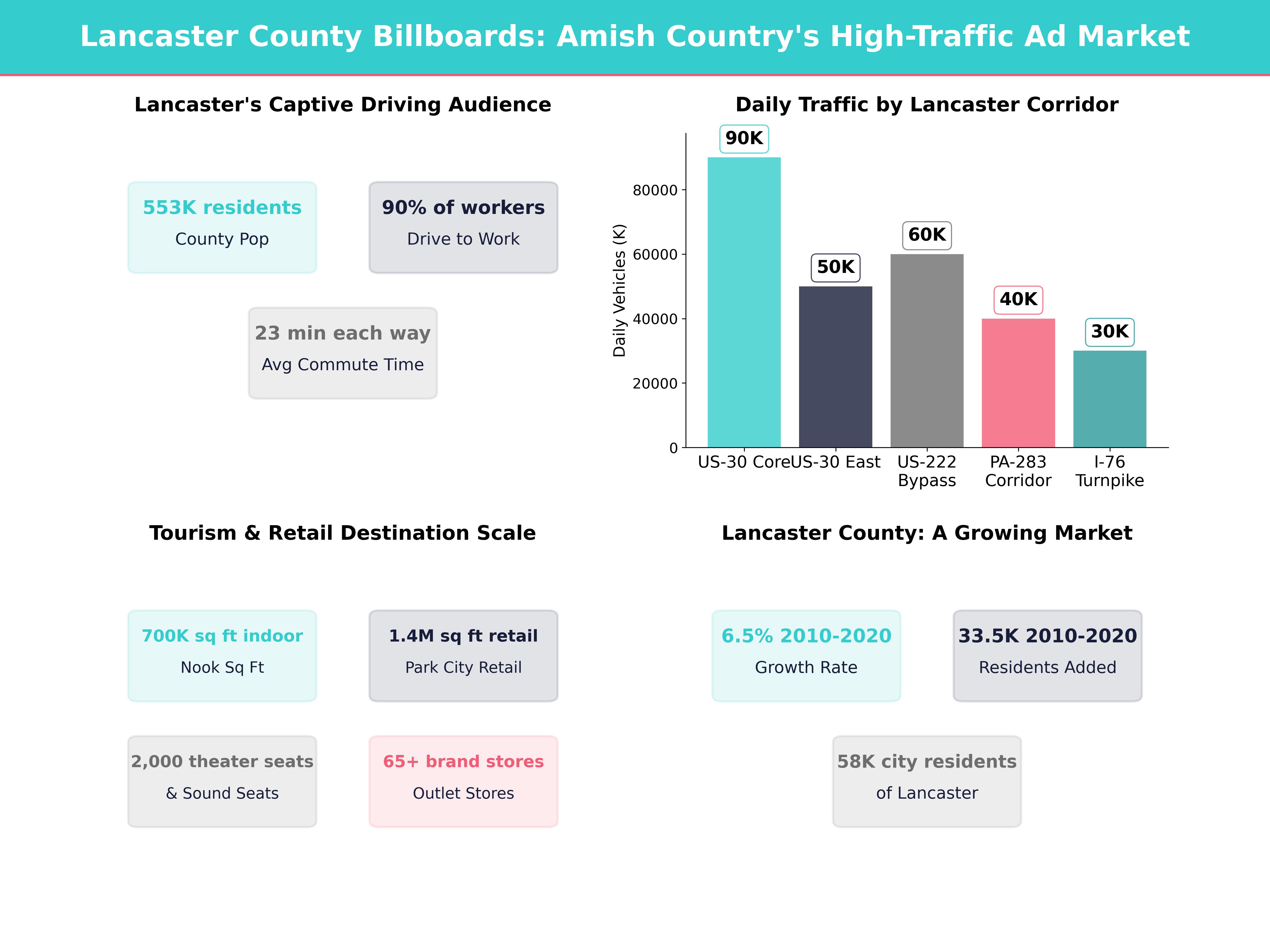
The most effective Georgetown-area billboard strategies usually follow the county’s major road network. U.S. 30 around Lancaster can exceed 90,000 vehicles per day on major sections, while U.S. 222 is one of the county’s most important commuter and business corridors with 60,000-plus vehicles per day on major stretches. PA 41 is also important for eastern Lancaster County because it connects Georgetown into the Christiana and Gap trade area.
What kind of audience can billboards reach in Georgetown, Pennsylvania?
Georgetown benefits from local families, weekday commuters, students, shoppers, and visitors. Roughly 90% of workers in Lancaster County commute by car, truck, or van, and the county’s average commute is about 23 minutes. That mix makes the market strong for repeated roadway exposure and local recall.
Is Georgetown, Pennsylvania a good market for Blip billboard ads during tourist season?
Yes, Lancaster County’s visitor economy is large and family-oriented, which makes the area unusually strong for attraction, lodging, dining, and shopping campaigns. Summer is the biggest billboard season for family entertainment and hospitality, and Route 30, tourist corridors, and nearby attractions all feed that traffic. Winter and holiday shopping also remain strong because the county’s retail base stays active.
What areas around Georgetown, Pennsylvania should I target if I want local repeat exposure with Blip?
For Georgetown, Christiana, and the Octorara Area, the goal is local repetition and familiarity with nearby households, school families, and regular drivers. The page says this is where community businesses, medical practices, banks, auto repair, roofing, plumbing, legal services, childcare, and local dining often benefit most. If your business is based in or near Georgetown, this should usually be the foundation zone.
Do I need a contract to advertise with Blip in Georgetown?
No, Blip has no long-term contracts or minimum commitments. You can start, pause, or stop your campaign at any time.
How fast can I launch a billboard campaign with Blip in Georgetown?
You can have your campaign live in minutes. Create a free account, select your locations, set your budget, upload your design, and start running once approved.
Where can I advertise with Blip in Georgetown?
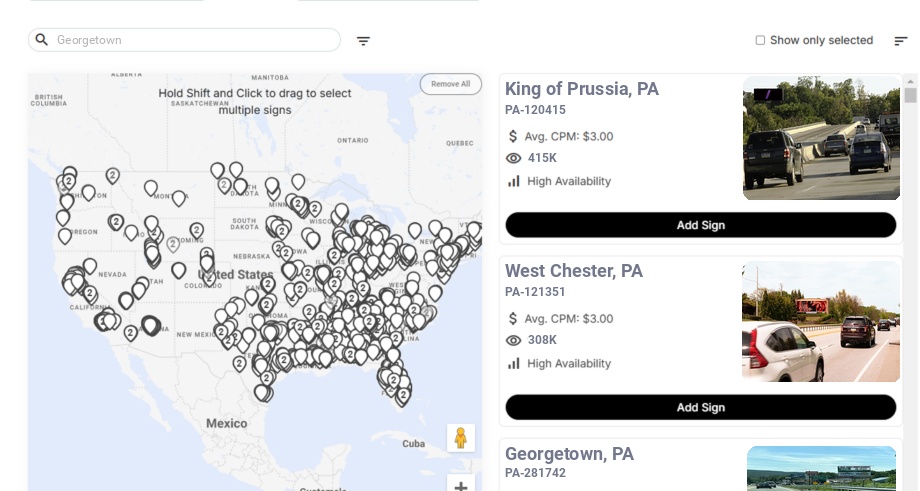
Blip has digital billboards in Georgetown. You can browse available locations on a map, choose the ones that fit your audience, and start advertising right away.
Still have questions? Launch a campaign in minutes — no contracts, no commitments.
Start Your CampaignGeorgetown Billboard Advertising Guide
Georgetown, Pennsylvania sits in eastern Lancaster County 552,984 residents across 60 municipalities. The county had a 2020 population of 552,984, and it added 33,539 residents from 2010 to 2020, which was a healthy 6.5% increase during the decade. We also benefit from a travel pattern that is still overwhelmingly road-based, with roughly 9 in 10 workers commuting by car, truck, or van. That combination of 552,984 residents, car dependence, retail concentration, and year-round tourism makes Georgetown a strong market for digital billboard advertising.
Georgetown, Pennsylvania Market Overview
Georgetown itself is a small place, but the ad market around it is much larger than the community’s footprint, with 552,984 county residents and the 58,039-person City of Lancaster anchoring demand. We are really working inside the broader Lancaster County Chester County, the City of Lancaster, and the county’s major retail and tourism corridors.
Lancaster County’s 552,984 residents are spread across 60 municipalities, including 1 city, multiple boroughs, and a wide set of townships. That matters for billboards because it creates a steady pattern of inter-municipal driving for work, school, shopping, healthcare, youth sports, and errands. The City of Lancaster alone had 58,039 residents in 2020, which gives the county a genuine urban core in addition to suburban, rural, and tourist-heavy areas.
From an advertiser’s perspective, Georgetown benefits from three overlapping demand sources.
Georgetown’s Local Base and Eastern Lancaster County
The Georgetown area pulls from eastern Lancaster County communities that make frequent car trips toward Christiana Strasburg
Lancaster County’s Diverse Economy
Lancaster County is not a one-industry market. It combines agriculture, manufacturing, healthcare, education, tourism, food production, construction, logistics, and retail across 60 municipalities. The county is home to more than 5,000 farms, and it also supports major institutions such as Penn Medicine Lancaster General Health, WellSpan Health, Millersville University, Franklin & Marshall College, Elizabethtown College, and Thaddeus Stevens College of Technology.
That mix is helpful because it broadens the advertiser pool. We can use billboards here for home services, attractions, colleges, legal services, healthcare, furniture, restaurants, local retail, destination shopping, and business-to-business brands.
Car Dependence and Commute Behavior
Lancaster County remains a driving market first. Roughly 90% of workers commute by car, truck, or van, and the mean travel time to work is about 23 minutes. That is long enough for repeated roadway exposure to matter, but short enough that many drivers follow consistent routines on the same routes. For billboard advertisers, that usually means better frequency and better local recall than in markets where travel is more fragmented.
Key Traffic Corridors Around Georgetown, Pennsylvania
The most effective Georgetown-area billboard strategies usually follow the county’s major road network. We should think in layers: hyperlocal roads for community relevance, regional arterials for daily frequency, and destination corridors for tourism and retail intent.
U.S. 30 in the Lancaster Market
According to PennDOT, core segments of U.S. 30 around Lancaster are among the county’s busiest roads, with major sections exceeding 90,000 vehicles per day. Even farther east, the corridor around the tourism and shopping district remains a very heavy-travel environment, with important segments still above 50,000 vehicles per day.
This is the corridor we should favor for broad consumer reach. U.S. 30 is especially strong for the following categories.
- Retail and outlet advertisers do well here because the road feeds Tanger Outlets Lancaster, the Route 30 restaurant cluster, and major shopping trips.
- Tourism and hospitality brands benefit because families use this route for attractions such as Dutch Wonderland, American Music Theatre, and Sight & Sound Theatres.
- Healthcare, furniture, and home services perform well because U.S. 30 reaches dense residential areas and cross-county traffic at the same time.
U.S. 222 for Commuters and Regional Reach
U.S. 222 is one of the county’s most important commuter and business corridors. PennDOT traffic counts on the Lancaster bypass reach 60,000-plus vehicles per day on major stretches. The route connects Lancaster to Berks County, Reading-area employment, north-county communities, and regional freight movement.
We should look to U.S. 222 when we want a slightly more work-oriented audience. This corridor is well suited to banks, auto dealers, contractors, healthcare providers, colleges, legal services, staffing firms, and business services. It is also useful when we want to connect Lancaster County messaging with broader southeast Pennsylvania coverage.
PA 283 Toward Harrisburg
PA 283 gives us a direct commuter and logistics connection west toward Dauphin County and the Harrisburg area. Busiest Lancaster County stretches typically fall in the 40,000 to 60,000 vehicles per day range. That is a strong level of daily exposure, especially for advertisers that need weekday reach.
For Georgetown-area advertisers, PA 283 helps us extend beyond local households and into regional business travel. We should prioritize it for insurance, healthcare, B2B services, higher education, events, and brands with multiple locations.
The Pennsylvania Turnpike for Cross-State and Long-Distance Traffic
The Pennsylvania Turnpike gives us a different kind of audience. In Lancaster County, I-76 carries tens of thousands of vehicles per day, with many segments above 30,000 AADT. Those drivers are less local, but they are valuable when we want to capture destination intent, travel spending, and regional awareness.
Turnpike-adjacent boards are often a smart fit for hotels, family attractions, destination retail, colleges, healthcare systems, and statewide service brands. If we want to pull visitors into Lancaster County rather than just reach local residents, this is one of the first corridors we should evaluate.
PA 41 and the Eastern Lancaster County Gateway
For Georgetown itself, PA 41 matters because it is one of the most important eastern Lancaster County connectors into Chester County. PennDOT traffic maps show five-figure daily traffic on key stretches, with some busy segments in the 10,000 to 15,000 vehicles per day range near the Georgetown, Christiana, and Gap trade area.
These are not U.S. 30 numbers, but they are still very valuable because the traffic is highly local and highly repeated. We should use this corridor for the following types of campaigns.
- Community businesses can build familiarity with nearby households and routine drivers.
- Home service brands can target homeowners before they reach larger shopping destinations.
- Medical, legal, and financial advertisers can stay visible to residents who prefer local providers over longer trips into larger commercial districts.
Audience Segments We Can Reach in Georgetown, Pennsylvania
One of the best things about Georgetown is that we are not limited to a single audience profile. The market blends local families, weekday commuters, students, shoppers, and visitors.
Commuters and Working Adults
Because roughly 9 in 10 workers in Lancaster County commute by car, truck, or van, we can reliably reach people during daily travel rather than hoping they see a message online. The county’s average commute of about 23 minutes is long enough for repeated billboard exposure to register, especially on routes such as U.S. 30, U.S. 222, PA 283, and PA 41.
This audience is ideal for healthcare, banking, auto, quick-service restaurants, legal services, grocery, urgent care, and home services. It is also a strong audience for local employers that need to recruit within commuting distance.
Family Tourists and Leisure Travelers
Lancaster County’s visitor economy is large and family-oriented. That makes the area unusually strong for attraction, lodging, dining, and shopping campaigns.
We can point to several major draw points.
- Dutch Wonderland markets 35-plus rides, attractions, and shows.
- Sight & Sound Theatres has a 2,000-seat theater in the county.
- American Music Theatre seats about 1,600 guests.
- Strasburg Rail Road 4.5-mile heritage rail excursion.
- Kitchen Kettle Village features 40-plus shops and restaurants.
- Cherry Crest Adventure Farm promotes 50-plus farm fun activities.
- Tanger Outlets Lancaster offers 65-plus brand-name stores.
That cluster creates a powerful family-travel audience, especially on spring weekends, summer weekdays, fall weekends, and holiday shopping trips.
Shoppers and Destination Retail Audiences
Lancaster County is also a serious shopping market. Park City Center alone contains roughly 1.4 million square feet of retail space, which keeps regional shopping traffic flowing well beyond the local trade area. Route 30, Lincoln Highway East, and nearby arterials see a mix of planned shopping trips and impulse stops.
For advertisers, that means we can use billboards to catch consumers while they are already in buying mode. Furniture stores, jewelry, mattresses, home improvement, outlet retail, restaurants, and seasonal promotions all benefit from this environment.
Students, Parents, and Education-Focused Households
The broader Lancaster market contains at least 5 notable higher-education institutions, including Millersville University, Franklin & Marshall College, Elizabethtown College, Thaddeus Stevens College of Technology, and Pennsylvania College of Art & Design Octorara Area School District, which gives us a strong parent and school-calendar audience in eastern Lancaster County.
We should consider this audience for tutoring, childcare, youth sports, family dining, healthcare, orthodontics, broadband, schools, colleges, and apartment or student-housing marketing.
Sports, Event, and Weekend-Trip Audiences
Spooky Nook Sports is a major regional traffic generator with 700,000 square feet of indoor sports space. Rock Lititz has developed a live-events campus on about 96 acres, bringing in production professionals and industry traffic that is unusual for a county of this size. Those two venues broaden the audience beyond traditional tourism.
If our offer works for tournament families, event crews, or weekend visitors, we should not treat Georgetown as only a rural local market. It functions as part of a much larger destination ecosystem.
Seasonal and Timing Opportunities in Georgetown, Pennsylvania
Seasonality matters in Lancaster County because traffic purpose changes by season even when traffic volume stays strong.
Spring in Georgetown and Lancaster County
Spring is a strong setup period for home improvement, landscaping, HVAC, lawn and garden, patio furniture, weddings, graduation services, and tourism teasers. As weather improves, weekend driving increases and local families begin planning day trips. This is also when we can start building awareness ahead of summer attraction season rather than waiting until everyone else is competing for the same audience.
For Georgetown-area advertisers, spring is also useful for tax services, farm and garden retail, nurseries, equipment dealers, and healthcare providers looking to increase preventive-care appointments.
Summer Tourism and Family Travel
Summer is the biggest billboard season for family entertainment and hospitality. Dutch Wonderland, Sight & Sound Theatres, American Music Theatre, Strasburg Rail Road Kitchen Kettle Village, and Tanger Outlets Lancaster all feed summer traffic in different ways.
We should increase activity on high-intent routes such as U.S. 30 and nearby tourist connectors when school is out. We should also test dayparts around late morning and early afternoon, because visitor trips in this market are often not tied to a strict commute window.
Back-to-School and Fall Harvest
Late August through October gives us a very useful overlap of school traffic, college activity, harvest-season tourism, and early holiday shopping. Lancaster County’s agricultural identity becomes even more visible in fall, and that makes local, food-oriented, home-oriented, and family-oriented creative especially effective.
This is a great time for colleges, apparel, healthcare, urgent care, seasonal attractions, heating services, financial services, and community events. It is also a good season for local businesses in Georgetown that want to remind residents they do not need to drive all the way into larger retail districts for every purchase.
Holiday Shopping and Winter Visibility
Holiday retail is a major opportunity because Lancaster’s shopping base remains strong in winter. Park City Center at 1.4 million square feet, plus Tanger Outlets Lancaster with 65-plus stores, supports strong gift-buying traffic. Winter also makes billboard visibility especially important because digital boards cut through darker commutes and poorer weather conditions.
We should use winter creative that is bold, bright, and direct. This is also a good season for healthcare, legal services, tax prep, fitness, furniture, and restaurants.
Billboard Design Tips for Georgetown, Pennsylvania Campaigns
Creative that works in Philadelphia or Pittsburgh does not automatically work in Georgetown. We should adapt our design to Lancaster County’s mix of local pride, family travel, practical buying behavior, and fast-moving regional roads.
Use Local Place Names That Drivers Actually Recognize
Drivers in this area respond well to familiar geographic cues. Names such as Lancaster, Strasburg, Gap, Christiana, Lititz, Route 30, and Octorara often do more work than abstract branding alone. If our location or service area is relevant, we should say so clearly.
A message like “Now Open on Route 30” or “Serving Georgetown, Christiana, and Gap” feels more immediate than a generic regional slogan. Local specificity matters even more on eastern Lancaster County boards, where residents often choose businesses based on convenience and familiarity.
Match the Creative to the Corridor
On U.S. 30 and U.S. 222, traffic speed is high, so we should keep our copy extremely tight and our visual hierarchy obvious. On local roads near Georgetown, we can sometimes use one extra piece of information, such as a phone number, short URL, or directional cue, because the context is more community-based.
We should also match the emotional tone to the corridor.
- On tourist corridors, brighter colors, smiling families, food, entertainment imagery, and clear offers tend to fit the environment.
- On commuter corridors, practical value, trust, urgency, and convenience often perform better.
- On local eastern-county boards, service radius, reliability, and familiarity are usually stronger than flashy brand language.
Lean Into Lancaster County’s Character Without Overdoing It
Lancaster County has a strong visual identity built around craftsmanship, agriculture, family traditions, and authenticity. We can use that to our advantage with warm colors, natural textures, food imagery, handmade cues, and local references. At the same time, we should avoid turning every brand into a cliché.
For example, a restaurant can use farm-fresh imagery effectively, but a law firm probably does better with a clean, trustworthy layout and a highly legible call to action. We should borrow the market’s sense of place, not costume our brand in it.
Make the Offer Feel Practical
Lancaster County consumers are often highly value-aware. They respond to straightforward offers, clear benefits, and concrete reasons to act. “Free estimate,” “same-day appointments,” “family packages,” “save 20%,” and “just off Route 30” are usually stronger than vague aspirational copy.
Regional Strategies for Georgetown, Pennsylvania Advertisers
A smart Georgetown campaign usually works best when we divide the market into sub-areas rather than treating all of Lancaster County as one audience.
Georgetown, Christiana, and the Octorara Area
This is where we should build local repetition. The goal here is not maximum scale. The goal is familiarity with nearby households, school families, and regular drivers. Medical practices, community banks, auto repair, roofing, plumbing, legal services, childcare, and local dining often benefit most from this approach.
If our business is based in or near Georgetown, this should usually be our foundation zone.
The Route 30 Retail and Tourism Belt
This is our scale zone. U.S. 30 and the surrounding commercial district give us some of the county’s heaviest traffic, with top stretches above 90,000 AADT and strong secondary sections still above 50,000 AADT. We should use this zone for awareness, destination offers, family attractions, shopping, dining, and broad consumer services.
For many Georgetown businesses, this is the best place to find new customers who do not already know the brand.
Lancaster City, U.S. 222, and PA 283
This is our commuter-professional zone. We should use it when we want weekday reach, business-oriented traffic, college visibility, healthcare exposure, or westbound regional coverage. Because Millersville University, Franklin & Marshall College, Penn Medicine Lancaster General Health, and major employment centers sit closer to this side of the county, the audience mix shifts toward professionals, students, and service seekers.
North County Event and Sports Traffic
The Manheim Lititz Spooky Nook Sports at 700,000 square feet and Rock Lititz at about 96 acres create high-value niche traffic that can be excellent for hotels, restaurants, entertainment, sports medicine, team retail, and family-focused offers.
Using Blip Tools in Georgetown, Pennsylvania
Blip is especially useful in a market like Georgetown because the right campaign often mixes local boards with countywide reach. We do not always need a single all-or-nothing buy.
Use Blip-Optimized Campaigns for Broader Lancaster Reach
If our goal is general awareness across Lancaster County, a Blip-optimized campaign is often the easiest place to start. It can spread budget across commuter and destination routes, which is helpful when we want exposure in Georgetown, the Route 30 corridor, and other high-traffic areas without manually managing every placement.
Use Manual Selection for Precision Around Georgetown
If we care most about eastern Lancaster County, manual selection lets us concentrate on the boards that best match Georgetown, Christiana, Gap, and Chester County spillover traffic. This approach is especially useful for local service businesses, schools, clinics, churches, community events, and retailers with a tight trade area.
Daypart Around Real Local Behavior
We should daypart differently depending on the audience.
- Morning and late-afternoon windows, such as 6 a.m. to 9 a.m. and 3 p.m. to 6 p.m., are usually best for commuter-heavy routes.
- Late morning through early evening often works better for Route 30 tourism and shopping traffic.
- Friday afternoons and Saturdays are important when we want weekend leisure travelers, event visitors, and family shoppers.
Test Creative Variations by Corridor
Because Georgetown sits near both local and destination traffic, we should not use the same creative everywhere by default. Blip makes it practical to run one version aimed at families on tourist routes and another version aimed at convenience or trust on commuter routes. We can also localize the message with references to Route 30, Lancaster, Octorara, or Georgetown when that makes the call to action stronger.
Getting Started with Billboard Rental in Georgetown, Pennsylvania
The best way to start is to define what success means in this market. We should decide whether we want local foot traffic, countywide awareness, tourist visibility, event-season demand, or a steady commuter audience. Once we know that, the right boards usually become much easier to spot.
Start With Trade Area, Not Just City Limits
Because Georgetown is small, many successful campaigns will extend beyond the immediate community. A Georgetown restaurant may still want strong local visibility, but it may also need Route 30 exposure to reach visitors or new households. A contractor based near Georgetown may care more about eastern Lancaster County and western Chester County than about downtown Lancaster.
We should map where our real customers come from, then choose boards that intercept those trips.
Evaluate Boards Based on Direction, Speed, and Intent
When we compare billboard locations, we should ask a few practical questions. Are drivers commuting, shopping, or traveling for leisure? Are they moving fast on a bypass, or are they approaching a decision point near exits and retail clusters? Is the board reaching local households repeatedly, or is it introducing the brand to new people?
In Georgetown, local boards often win on repetition. Route 30 boards often win on scale. U.S. 222 and PA 283 boards often win on weekday professional reach.
Expect More Flexibility Than Traditional Billboard Buying
Traditional billboard buying often pushes advertisers into long commitments, limited testing, and slower changes. Blip simplifies the process by letting us launch faster, adjust creative, change budgets, shift timing, and compare locations without waiting through a full traditional sales cycle.
That is especially valuable in a market like Georgetown, where seasonality and corridor choice can make a major difference. We can start with a narrower plan, learn what works, and scale into stronger-performing boards.
Launch, Measure, and Refine
Our best first campaign is usually not the biggest one. It is the one that tests the right audience with the right message on the right routes. In Georgetown, that often means starting with a focused local-and-regional mix, then using performance data to increase frequency on the strongest corridors.
If we stay disciplined about audience, timing, and local relevance, Georgetown can deliver far more billboard value than its small size might suggest.