Billboards in Hazleton, PA
No Minimum Spend. No Long-Term Contracts. Just Results.
Trusted by Leading Brands


Billboard advertising
in Hazleton has never been easier



How much is a billboard in Hazleton?
Why Choose Blip for Billboard Advertising in Hazleton
Blip lets you launch Hazleton billboard ads yourself in minutes, with no contracts or minimums.
Use Blip-optimized campaigns in Hazleton to auto-target I-81, I-80, and PA 924 around your goals and budget.
Hazleton shifts fast with school, warehouse, and downtown traffic; Blip dayparting helps you hit the right hours.
Track Hazleton billboard results in real time and adjust as commuter and Pocono-bound traffic changes.
Create Hazleton-ready creative fast with Blip tools, including bilingual ads for the city’s Hispanic audience.
Frequently Asked Questions About Billboard Advertising in Hazleton
How much does a billboard cost in Hazleton with Blip?
With Blip, billboard advertising in Hazleton can fit a wide range of budgets because you only pay when your ad actually appears. Pricing starts at just $0.01 per display, and each “blip” is a 7.5-to-10-second display on a rotating digital billboard. Cost per blip changes based on time of day, location, and advertiser demand, so you can start small, adjust anytime, and pause whenever you need to.
Where can I advertise with Blip in Hazleton to reach local commuters and drivers?
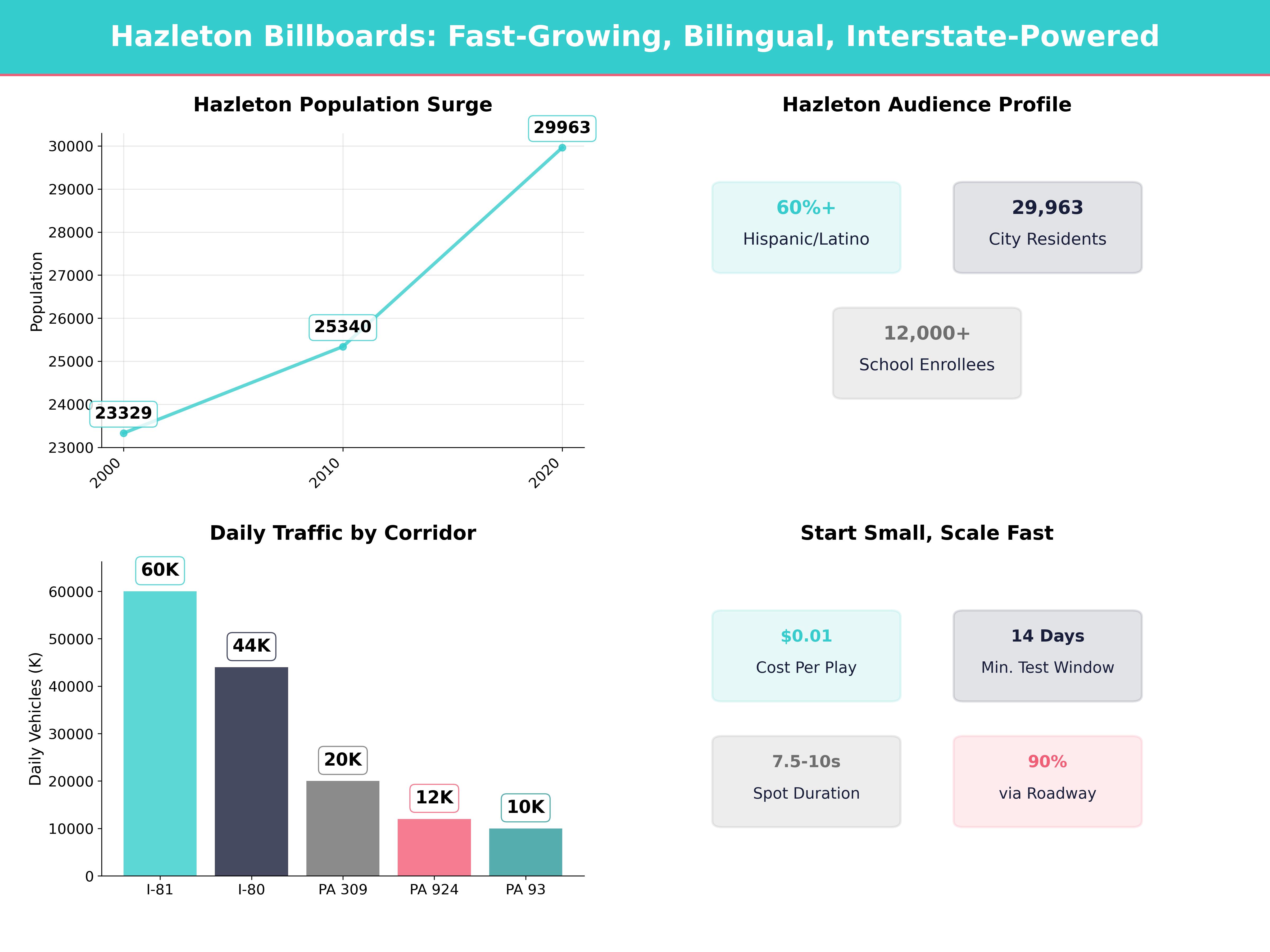
Hazleton sits inside a compact city market with outsized regional reach, and billboard campaigns can speak to city households and a much larger commuting labor shed at the same time. Interstate 81 segments around Hazleton commonly run in the range of roughly 55,000 to 65,000 vehicles per day, while nearby Interstate 80 often sees around 40,000 to 47,000 vehicles per day. PA 309, PA 924, and PA 93 also provide useful local reach depending on whether you want neighborhood frequency, industrial traffic, or surrounding community drivers.
Why is Hazleton a good market for billboard advertising with Blip?
Hazleton’s population grew from 23,329 in 2000 to 29,963 in 2020, which is notable in Northeastern Pennsylvania. The city is also unusually important from a language and culture standpoint, with more than 60% of residents identifying as Hispanic or Latino. That makes Hazleton a strong market for bilingual, Spanish-first, or culturally specific billboard creative when the product and audience fit.
What kinds of traffic and audience can Hazleton billboards reach?
Hazleton’s mobility pattern matters just as much as its economy, with roughly 4 in 5 Luzerne County workers driving alone to work and close to 1 in 10 more carpooling. In practical terms, nearly 9 in 10 workers are still reached through roadway travel. The market also includes industrial workers, students, bilingual households, and travelers headed toward the Pocono Mountains.
When is the best time to run a billboard campaign in Hazleton with Blip?
Hazleton is a market where seasonality is visible on the road, so timing matters. In most months, the strongest recurring time windows are 6 a.m. to 9 a.m. for commuter awareness, 11 a.m. to 2 p.m. for food and errands, and 3 p.m. to 7 p.m. for return commutes and family-decision messaging. For warehouse and distribution shift changes, the page also highlights 5 a.m. to 7 a.m., 1 p.m. to 3 p.m., and 9 p.m. to 11 p.m.
Do I need a contract to advertise with Blip in Hazleton?
No, Blip has no long-term contracts or minimum commitments. You can start, pause, or stop your campaign at any time.
How fast can I launch a billboard campaign with Blip in Hazleton?
You can have your campaign live in minutes. Create a free account, select your locations, set your budget, upload your design, and start running once approved.
Where can I advertise with Blip in Hazleton?
Blip has digital billboards in Hazleton. You can browse available locations on a map, choose the ones that fit your audience, and start advertising right away.
Still have questions? Launch a campaign in minutes — no contracts, no commitments.
Start Your CampaignHazleton Billboard Advertising Guide
Hazleton City of Hazleton 29,963 residents in 2020, and it sits inside Luzerne County, which had 325,594 residents, so our campaigns can speak to city households and a much larger commuting labor shed at the same time. Because Hazleton is built around the crossroads of two major interstates (with nearby I-81 segments carrying roughly 55,000 to 65,000 vehicles per day and I-80 around 40,000 to 47,000), and because recent ACS estimates show roughly 4 in 5 county workers drive alone to work, billboard advertising benefits from high repeat exposure. We also gain seasonal lift from industrial shift traffic, school-year routines, downtown events supported by the Greater Hazleton Chamber of Commerce Downtown Hazleton Alliance for Progress, and leisure travel moving toward the Pocono Mountains.
Hazleton Market Overview
Hazleton is one of those Pennsylvania markets where local density and regional mobility work together. We are not buying attention in a place where people can easily avoid roads. We are buying attention in a market where daily life still happens in vehicles, on repeat routes, and across a compact set of high-value corridors.
Hazleton demographics and growth
Hazleton’s population grew from 23,329 in 2000 to 25,340 in 2010, and then to 29,963 in 2020. That means the city added 6,634 residents over 20 years, for total growth of about 28.4%, including another 4,623 residents, or roughly 18.2%, in the most recent decade. That kind of growth is notable in Northeastern Pennsylvania, where many older industrial communities have been flat or slower-growing.
The city is also unusually important from a language and culture standpoint. Recent census data show that more than 60% of Hazleton residents identify as Hispanic or Latino, which gives us a strong case for bilingual, Spanish-first, or culturally specific billboard creative when the product and audience fit. That is especially valuable for healthcare, education, telecom, legal services, grocery, financial services, restaurants, and recruiting.
Hazleton’s economy and mobility
Hazleton’s economy is broader than its city size suggests. The market is supported by logistics and industrial development from CAN DO, Inc. Lehigh Valley Hospital-Hazleton, education through Penn State Hazleton Luzerne County Community College, and the Hazleton Area School District, and continued downtown activity driven by the Downtown Hazleton Alliance for Progress. Regional business development is also reinforced by the NEPA Alliance, which promotes the larger Northeastern Pennsylvania economy.
From a billboard perspective, the mobility pattern matters just as much as the economy. Recent commuting estimates consistently put roughly 4 in 5 Luzerne County workers in the drive-alone category, while close to 1 in 10 more carpool. In practical terms, that means nearly 9 in 10 workers are still reached through roadway travel. Hazleton also sits about 30 minutes from the Wilkes-Barre 45 minutes from Scranton 45 minutes from the Lehigh Valley, and about 2 hours from Philadelphia
For us, the message is clear. Hazleton is not just a city campaign. It is a commuter, workforce, and gateway campaign.
Key Traffic Corridors for Hazleton Billboard Campaigns
Hazleton’s traffic is concentrated into a handful of corridors that do most of the market’s heavy lifting. When we understand which routes carry commuters, industrial workers, and leisure travelers, we can match creative and budget to the audience with far more precision.
Interstate 81 through Hazleton
According to traffic maps from PennDOT, Interstate 81 segments around Hazleton commonly run in the range of roughly 55,000 to 65,000 vehicles per day. This is the market’s most important north-south artery, linking Hazleton to the Wilkes-Barre area to the north and to Schuylkill County and the Lehigh corridor to the south.
This corridor is especially effective for several advertiser types.
- Healthcare systems benefit because I-81 reaches patients traveling in from southern Luzerne County and neighboring counties.
- Staffing firms and employers benefit because I-81 captures warehouse, manufacturing, and transportation workers moving into shift-based jobs.
- Auto dealers, insurance providers, banks, and legal services benefit because commuters see the same message repeatedly during the workweek.
- Hotels, casinos, and restaurants benefit because the corridor also carries pass-through regional traffic.
If our goal is broad reach, I-81 usually belongs near the top of the Hazleton plan.
Interstate 80 near the I-81 interchange
The nearby Interstate 80 interchange gives Hazleton strong east-west visibility. PennDOT counts around this area often land around 40,000 to 47,000 vehicles per day, depending on the exact segment. That flow matters because it mixes local travel with regional leisure trips, freight, and cross-state movement.
This is one of the best placements when we want to catch travelers headed toward the Pocono Mountains, ski resorts like Jack Frost Big Boulder and Blue Mountain Resort Mohegan Pennsylvania. It is also strong for convenience retail, fuel, roadside dining, hotels, tourism, and statewide brands that need efficient reach rather than neighborhood-level frequency.
PA 309 and the downtown Hazleton spine
PA 309 is a core city-and-suburban route through Hazleton. PennDOT traffic data on busier local stretches commonly sit in the neighborhood of 17,000 to 23,000 vehicles per day, which is lower than the interstates but far more localized and frequent. This is where we can build repetition among residents who live, work, shop, and attend school in the immediate Hazleton area.
PA 309 is especially useful for:
- Retailers and restaurants that depend on local household traffic rather than regional pass-through drivers.
- Healthcare clinics, dentists, urgent care centers, and pharmacies that need proximity messaging.
- Community organizations, schools, and public-service campaigns that need broad local recognition.
- Bilingual advertisers that want to connect with city residents in English, Spanish, or both.
When our objective is neighborhood familiarity instead of interstate scale, PA 309 is a high-priority route.
PA 924 and the Hazle Township logistics belt
PA 924 is critical for the industrial side of the market. Key segments often run around 10,000 to 14,000 vehicles per day, and those counts are meaningful because the route serves Hazle Township, industrial parks associated with CAN DO, Inc.
This is one of the best places for job recruitment, shift-specific hiring, B2B services, fleet maintenance, workwear, training programs, quick-service restaurants, c-stores, and service businesses that want visibility with working adults on a routine commute. Because many warehouse and distribution operations run 24 hours a day, PA 924 also supports nontraditional dayparts better than many local roads.
PA 93 and west-south local approaches
PA 93 is another useful local approach into the Hazleton area, with typical traffic volumes on many nearby segments in the 8,000 to 12,000 vehicles per day range. While that is more modest than I-81, it still offers strong value when we want to reach residents in surrounding communities and everyday local drivers entering the city for shopping, services, and school activity.
PA 93 works well for grocery, family dining, home services, urgent care, local events, and political or civic campaigns that depend on community familiarity rather than statewide scale.
Hazleton Audience Segments We Can Reach
Hazleton gives us several overlapping audiences, and that overlap is exactly what makes the market efficient.
Commuters and regional drivers in Hazleton
The first audience is the daily commuter. With roughly 80% of county workers driving alone, and another roughly 8% to 9% carpooling, roadway advertising remains a practical medium for weekday frequency. We can use interstate boards for awareness and city-route boards for reinforcement.
Bilingual households and families in Hazleton
The second audience is local households, especially bilingual and Hispanic families. Because Hazleton’s population now exceeds 29,000, and because more than 60% of residents identify as Hispanic or Latino, we can justify creative that is more locally fluent than what we would run in a generic small Pennsylvania city. The Hazleton Area School District serves more than 12,000 students, which creates year-round demand for education, healthcare, grocery, telecom, family entertainment, tutoring, and youth programs.
Industrial and warehouse workers near Hazleton
The third audience is the industrial workforce. Hazleton’s location near I-81 and I-80 has made the area a logistics hub, and CAN DO, Inc.
Students, faculty, and education-minded households in Hazleton
The fourth audience is the education segment. Penn State Hazleton Luzerne County Community College, and the larger K-12 system create demand for apartments, internet, healthcare, banks, insurance, food, bookstores, and event promotion. This audience is especially responsive during late summer, semester starts, and graduation periods.
Tourists and pass-through visitors near Hazleton
The fifth audience is the leisure traveler. The Pocono Mountains Visitors Bureau promotes a region that attracts roughly 30 million visitors annually, and Hazleton benefits from some of that flow because of its interstate position. Resorts such as Jack Frost Big Boulder and Blue Mountain Resort 1 hour of Hazleton, which makes I-80 and I-81 boards especially useful for tourism, dining, entertainment, and convenience-based messages.
Seasonal and Timing Opportunities in Hazleton
Hazleton is a market where seasonality is visible on the road. Weather, school calendars, outdoor recreation, and warehouse demand all change traffic patterns enough that timing matters.
Winter in Hazleton
From November through February, winter travel becomes a major opportunity. Hazleton sits at roughly 1,800 to 1,900 feet of elevation, so snow, fog, and early darkness are more common than in lower-elevation valley markets. By about 4:30 p.m. in December, we are already operating in low-light conditions, which makes bright, high-contrast creative especially effective.
Winter is ideal for:
- Ski and snow-related travel messaging along I-80 and I-81.
- Healthcare campaigns that emphasize urgent care, orthopedics, imaging, and winter illness.
- Holiday retail, quick-service dining, and convenience messages.
- Employer campaigns tied to peak 4th-quarter logistics demand.
We usually see the best winter dayparts on Friday from 2 p.m. to 8 p.m., Saturday from 6 a.m. to noon, and Sunday from 2 p.m. to 8 p.m. for leisure travel, plus the standard commuter windows on weekdays.
Spring and summer in Hazleton
From May through August, we can pivot to home services, family attractions, local dining, and community events. Warm-weather campaigns also benefit from downtown foot traffic and event promotion by the Greater Hazleton Chamber of Commerce Downtown Hazleton Alliance for Progress. Nearby heritage attractions such as Eckley Miners' Village
Back-to-school and fall in Hazleton
From August through October, Hazleton becomes especially active for school, college, healthcare, and family spending. This is when we should think about campaigns for pediatric care, dental care, eye exams, telecom, quick-service restaurants, apparel, financial aid, continuing education, and youth activities. Fall is also a strong recruiting period for many employers and a good window for community campaigns tied to downtown events and chamber programming.
Best daily timing for Hazleton billboards
In most months, the strongest recurring time windows are:
- 6 a.m. to 9 a.m. for commuter awareness.
- 11 a.m. to 2 p.m. for food, errands, and healthcare reminders.
- 3 p.m. to 7 p.m. for return commutes and family-decision messaging.
- 5 a.m. to 7 a.m., 1 p.m. to 3 p.m., and 9 p.m. to 11 p.m. for warehouse and distribution shift changes.
Billboard Design Tips for the Hazleton Market
Hazleton responds best when our creative feels local, practical, and culturally aware.
Use bilingual or Spanish-language creative when the audience calls for it
Because more than 60% of Hazleton residents identify as Hispanic or Latino, bilingual strategy is not a niche tactic here. It is often a core market decision. For many advertisers, we will get better results by running 2 separate creatives, one in English and one in Spanish, instead of trying to cram 2 languages into 1 crowded layout. That approach is especially useful on local routes like PA 309 and for categories such as healthcare, education, grocery, telecom, financial services, and family dining.
Lean into practical value and local route familiarity
Hazleton is a working market. Messages about hiring, price, speed, convenience, open-late hours, same-day service, and simple directions tend to fit the local rhythm. We should reference recognizable roads and areas, such as I-81, I-80, PA 309, PA 924, downtown Hazleton, or Hazle Township, when that helps the audience place the offer quickly.
Design for mountain weather and low-light conditions
Hazleton’s elevation and winter weather make visual clarity more important than in some flatter metro markets. Bold contrast, large text, and simple backgrounds perform well because snow glare, rain, fog, and early darkness can reduce readability. In winter, bright whites, yellows, reds, and deep blues often hold up better than muted palettes.
Match the imagery to Hazleton’s real economy
Creative should reflect the lives people actually lead in this market. Industrial and recruiting campaigns should show real work settings, uniforms, forklifts, distribution environments, or team culture. Family services should use parents, school-age children, and practical household imagery. Healthcare should emphasize trust, availability, and local access. Downtown brands can use more aspirational or lifestyle-oriented visuals, but even then, the message should stay concrete.
Because a digital billboard spot is only 7.5 to 10 seconds, we should usually aim for 1 main offer, 1 brand cue, and 1 call to action.
Regional Strategies for Different Parts of Hazleton
Hazleton works best when we think in zones instead of treating the whole market as one undifferentiated buy.
Downtown Hazleton and city neighborhoods
In downtown Hazleton, we should prioritize repetition and community relevance. This area is strongest for local retail, restaurants, bilingual brands, clinics, legal services, schools, faith-based outreach, and civic messaging. Boards tied to city routes can build familiarity fast because residents see them again and again during ordinary errands.
Hazle Township, PA 924, and the industrial parks
In Hazle Township, especially along PA 924 and the industrial belt, we should think workforce-first. This is where staffing companies, logistics employers, technical schools, c-stores, quick-service restaurants, fleet services, and B2B suppliers can speak directly to workers on the move. Messages about pay, shifts, benefits, certification, and commute convenience fit especially well here.
The I-81 and I-80 gateway around Hazleton
At the interstate gateway, we are buying reach. These boards are best for regional hospitals, casinos, destination retail, auto dealers, colleges, tourism, and state or multi-county service brands. If we need to pull from Hazleton, southern Luzerne County, and nearby counties at once, interstate placements are usually the most efficient starting point.
South and east of Hazleton toward the Poconos and Lehigh Valley
Toward the Poconos and Lehigh Valley, we should think about leisure and destination intent. This zone is strong for resorts, attractions, hotels, entertainment, and big-ticket retail. It is also useful for colleges and healthcare systems trying to attract patients or students from a broader 30- to 60-minute drive radius.
How Blip Fits Hazleton Advertising Strategy
Blip’s tools are especially useful in a market like Hazleton because the audience changes by corridor, season, and time of day.
We can use Blip to match Hazleton’s corridor mix
When we want broad regional reach, we can let a Blip-optimized campaign spread budget across interstate inventory and then learn which corridors deliver the best exposure. When we want more control, we can use a manual campaign to separate downtown Hazleton boards from I-81, I-80, or PA 924 boards and assign different creative to each zone.
We can use dayparting to follow Hazleton’s real traffic patterns
Hazleton is not a one-schedule market. Commute traffic, warehouse shifts, school activity, and winter leisure travel all happen at different times. With Blip, we can concentrate spend during 6 a.m. to 9 a.m., 3 p.m. to 7 p.m., or shift-specific windows, rather than paying evenly across lower-value hours.
We can test creative quickly in Hazleton
Because Hazleton supports bilingual messaging and multiple audience types, testing matters. We can compare English versus Spanish creative, recruiting versus brand-focused creative, or interstate versus local-route placements in near real time. We can also build fast seasonal swaps with Blip’s artwork tools, which is useful when we need to pivot from winter healthcare to spring hiring or back-to-school promotions.
We can start small and scale in Hazleton
Hazleton is a good market for controlled testing. Since plays can start at $0.01 each, we can launch a focused test without a traditional long-term commitment, learn which routes and time windows work, and then scale the winners.
Getting Started with Billboard Rental in Hazleton
Renting a billboard in Hazleton is easier when we start with the route logic, not just the map pin.
Start with the objective for our Hazleton campaign
Before we choose boards, we should decide whether our real goal is awareness, store traffic, recruiting, event attendance, or lead generation. A local restaurant opening near downtown Hazleton needs a different placement strategy than a regional hospital, a warehouse employer, or a resort headed toward the Poconos.
Choose Hazleton boards by travel behavior
A simple planning framework usually works best.
- If we want regional awareness, we should begin with I-81 and the I-80 interchange.
- If we want local household frequency, we should focus on PA 309 and the city routes.
- If we want hiring and workforce visibility, we should emphasize PA 924 and industrial approaches.
- If we want community familiarity in surrounding neighborhoods, we should add PA 93 and other local feeders.
Expect more flexibility than with traditional billboard buying
Traditional billboard companies often push fixed terms, limited inventory conversations, and slower creative changes. Blip makes Hazleton easier to enter because we can launch without a long contract, adjust targeting as data comes in, and swap creative when weather, hiring needs, or seasonal events change. That flexibility matters in a market where winter travel, school calendars, and shift schedules all affect performance.
Evaluate Hazleton results with a short test window first
We usually recommend starting with a focused 2- to 4-week test. In many Hazleton campaigns, even a 14-day run is enough to show whether interstate reach, local frequency, or shift-timed exposure is driving the best response. We should watch analytics, compare dayparts, and line billboard performance up with web traffic, calls, coupon redemptions, foot traffic, or hiring inquiries.
Build the Hazleton plan around relevance, not just volume
The busiest board is not always the best board. A healthcare brand may perform better on commuter-heavy I-81. A bilingual grocery or telecom brand may win on city routes. A warehouse employer may get more value from PA 924 than from a broader interstate play. When we match the message to the route and the route to the audience, Hazleton becomes a very efficient digital billboard market.