Billboards in Village Green, PA
No Minimum Spend. No Long-Term Contracts. Just Results.
Trusted by Leading Brands


Billboard advertising
in Village Green has never been easier
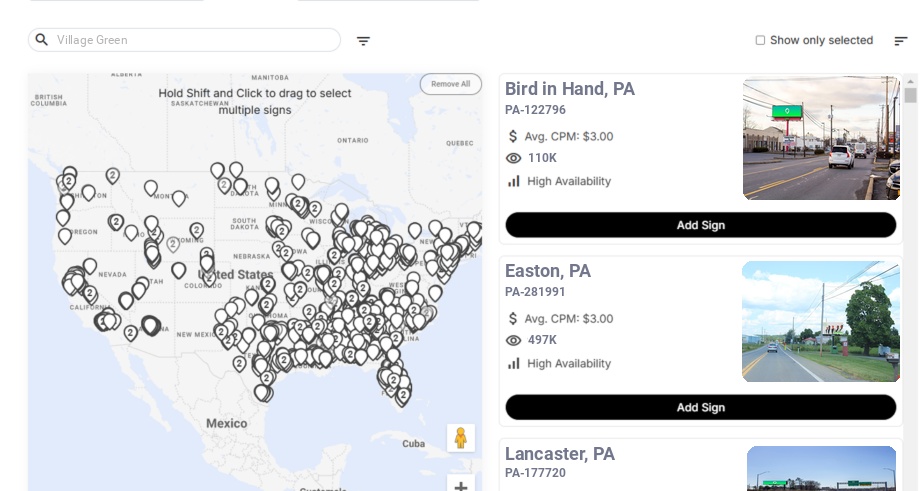



How much is a billboard in Village Green?
Why Choose Blip for Billboard Advertising in Village Green
Choose Blip in Village Green to launch fast on PA 452 and US 322, reaching Aston commuters without the slow traditional billboard process.
Village Green advertisers can use Blip-optimized campaigns to auto-pick timing and boards near I-95, I-476, and Route 1 based on your goals.
No contracts or minimums in Village Green mean you can test budget-friendly ads on Delco commuter routes and scale only what works.
Use Blip dayparting in Village Green to hit rush hour on I-95 and I-476, then shift to weekend traffic for Subaru Park and Rose Tree Park.
Blip real-time analytics help Village Green campaigns track response across airport, school, and shopping traffic near PHL and US 1.
Frequently Asked Questions About Billboard Advertising in Village Green
How much does a billboard cost in Village Green with Blip?
With Blip, billboard advertising in Village Green is built to fit a range of budgets because you only pay when your ad actually appears. Each "blip" is a 7.5-to-10-second display on a rotating digital billboard, and pricing starts at just $0.01 per display. Your daily budget guides Blip’s algorithm as it bids for open ad slots, and the cost per blip can change based on time of day, location, and advertiser demand.
Where can I advertise with Blip in Village Green, Pennsylvania?
Village Green’s travel patterns are shaped by a handful of high-volume corridors, including I-95, I-476, US 1, US 322, and PA 452. I-95 is the strongest pure-reach corridor in the market, while I-476 gives exposure to regional travelers and US 1 and US 322 are especially useful for local and commercial trips. PA 452 is the closest everyday visibility play for many Village Green businesses.
Why is Village Green, Pennsylvania a good place for billboard advertising?
Village Green sits in Aston Township in Delaware County, which gives a rare mix of neighborhood-level relevance and regional reach. More than 80% of Delaware County workers commute by car, and roads like PA 452, US 322, US 1, I-95, and I-476 shape daily travel. That combination of suburban households, strong commuter flow, airport access, and year-round events makes Village Green an excellent digital billboard market.
What kinds of businesses work best for Blip billboards in Village Green?
Village Green can support campaigns for local dentists and roofers, but it can also support regional hiring, healthcare, tourism, higher education, and event-driven advertisers. The market also fits home services, healthcare, legal services, retail, restaurants, colleges, and airport-related businesses. Because the area has both suburban households and strong commuter traffic, it works well for a wide range of advertiser types.
When is the best time to run billboard ads in Village Green with Blip?
Spring is strong for healthcare, home services, lawn care, real estate, and education campaigns, while late August and September are major reset months for back-to-school and college traffic. Winter shifts the market toward holiday shopping, airport travel, indoor entertainment, urgent care, tax preparation, and HVAC services. Morning and late-afternoon windows are usually strongest on commuter routes such as I-95, I-476, US 322, and PA 452.
Do I need a contract to advertise with Blip in Village Green?
No, Blip has no long-term contracts or minimum commitments. You can start, pause, or stop your campaign at any time.
How fast can I launch a billboard campaign with Blip in Village Green?
You can have your campaign live in minutes. Create a free account, select your locations, set your budget, upload your design, and start running once approved.
Where can I advertise with Blip in Village Green?
Blip has digital billboards in Village Green. You can browse available locations on a map, choose the ones that fit your audience, and start advertising right away.
Still have questions? Launch a campaign in minutes — no contracts, no commitments.
Start Your CampaignVillage Green Billboard Advertising Guide
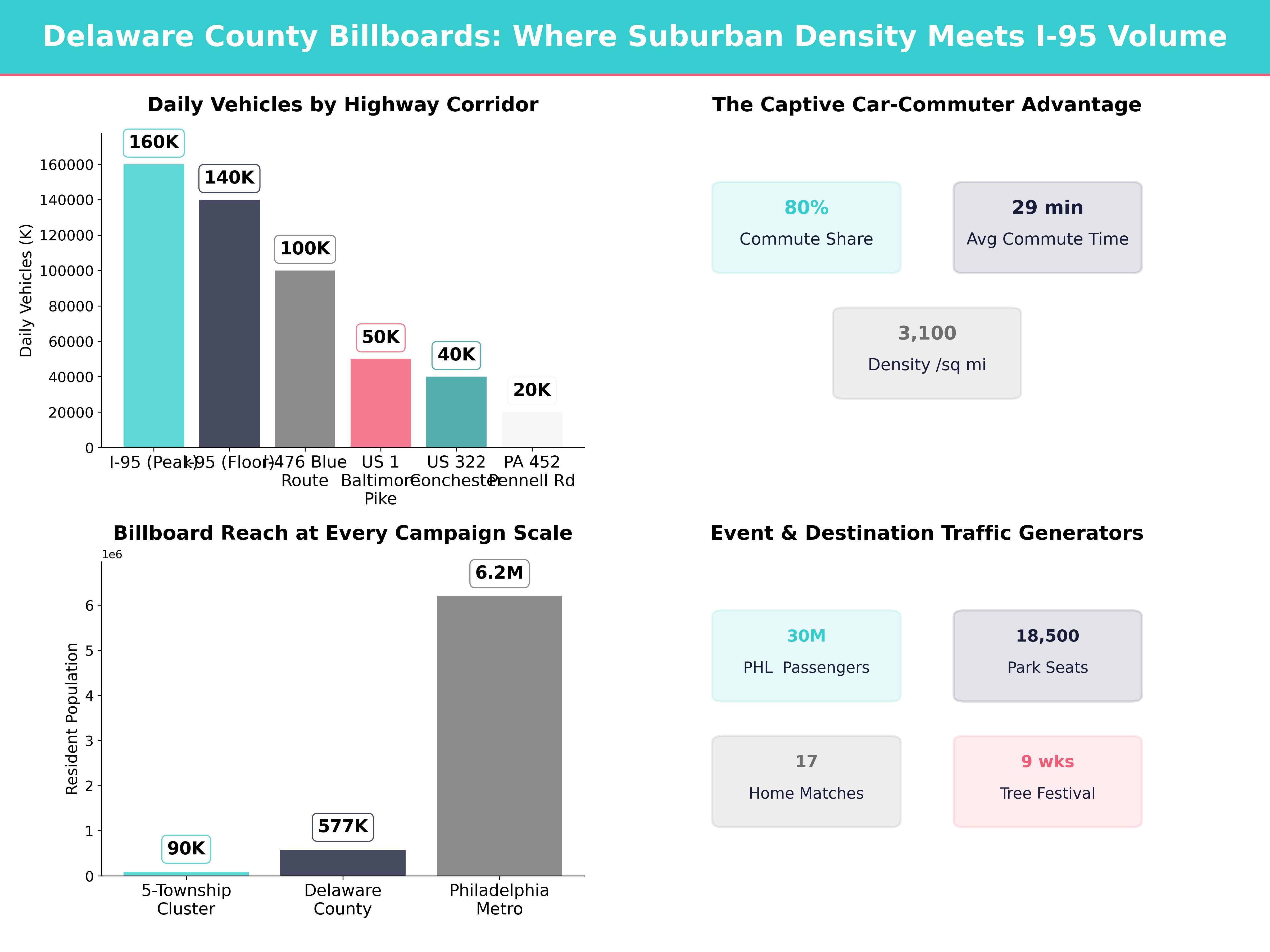
Village Green sits in Aston Township in Delaware County, which gives us a rare mix of neighborhood-level relevance and regional reach. Aston Township has about 16,700 residents, Delaware County has 576,830 residents, and the broader Philadelphia 6.2 million, so even a local campaign can tap a much larger audience. This is also a car-oriented part of southeastern Pennsylvania, with more than 80% of Delaware County workers commuting by car and PA 452, US 322, US 1, I-95, and I-476 shaping daily travel. For us, that combination of suburban households, strong commuter flow, airport access, and year-round events, including the 18,500-seat Subaru Park and 30+ million annual PHL passengers, makes Village Green an excellent digital billboard market.
Village Green Market Overview
Village Green benefits from a dense Delaware County position
Village Green is small, but its ad market is not. We are advertising inside one of Pennsylvania’s most compact suburban counties, where 576,830 residents live across about 184 square miles of land, or roughly 3,100 residents per square mile. Delaware County also includes 49 municipalities, which creates a steady pattern of short local trips, cross-town errands, school drop-offs, and regional commuting.
From Village Green, we can realistically reach residents in Aston Township, Middletown Township, Concord Township, Upper Chichester Township, and Springfield Township without stretching our geography too far. Those five nearby municipalities alone account for well over 90,000 residents. That gives local advertisers enough scale for frequency, while still keeping the audience highly relevant.
Delaware County travel habits favor billboard visibility
For billboard advertisers, the biggest advantage is movement. DVRPC and recent commuter data consistently show that more than 80% of Delaware County workers get to work by car, whether they drive alone or carpool. Average one-way commute time in the county is about 29 minutes, which gives digital billboards repeated weekday exposure during meaningful trip windows.
That matters in Village Green because this is not a market where people disappear underground into a subway system. They drive to work, to school, to shopping centers, to youth sports, to Philadelphia International Airport, and to nearby towns such as Media Borough Chester. When we buy digital boards here, we are buying into routine visibility.
The local economy supports both consumer and business-to-business campaigns
Village Green also benefits from Delaware County’s economic diversity. Healthcare, education, logistics, retail, municipal services, aviation, and professional services all have a visible footprint nearby. Wawa 1,000 stores, and its presence reinforces the area’s strong convenience-retail culture.
The airport is a particularly important economic anchor. PHL handled more than 30 million passengers in 2023, which helps sustain hotel demand, restaurant traffic, ground transportation, parking services, and staffing needs across the county’s eastern side. For us, that means Village Green can support campaigns for local dentists and roofers, but it can also support regional hiring, healthcare, tourism, higher education, and event-driven advertisers.
Key Traffic Corridors for Village Green Billboard Campaigns
Village Green’s travel patterns are shaped by a handful of high-volume corridors. We should think about these roads less as lines on a map and more as audience streams with different intentions, speeds, and commercial opportunities.
I-95 and the Chester-airport spine
According to PennDOT traffic information, major I-95 segments in Delaware County regularly carry well above 140,000 vehicles per day, and some stretches near the airport and Chester approach or exceed 160,000 daily vehicles. That makes I-95 the strongest pure-reach corridor in the market.
This corridor connects Tinicum Township, Essington, Chester, and the airport area. It also serves traffic heading toward Subaru Park, which seats 18,500, and Harrah’s Philadelphia. We generally like I-95 for these advertiser types:
- Hotels, parking operators, and travel services can reach airport-bound travelers and out-of-town visitors.
- Healthcare systems, legal services, and insurers can build broad regional awareness along a high-frequency commuter route.
- Entertainment venues, restaurants, and sports promotions can time messages around match nights, concerts, and weekend traffic.
I-476, the Blue Route, and north-south regional flow
The Blue Route, or I-476, is another major opportunity. PennDOT counts show key Delaware County segments above 100,000 vehicles per day. This corridor links Delaware County to the Main Line, Montgomery County, and I-95, so it gives us exposure to travelers who are not just local, but regionally mobile.
For Village Green advertisers, I-476 works best when we want reach beyond Aston itself. A medical practice in Media Borough Chester, or a home-services company serving the wider county can all benefit from this route. Because drivers on I-476 are often in commute mode rather than neighborhood mode, we usually favor brand-first messaging and a single strong call to action.
US 1, Baltimore Pike, and the Route 1 retail belt
US 1, commonly known as Baltimore Pike in much of Delaware County, is one of the most commercially useful roads near Village Green. Depending on the segment, PennDOT traffic maps typically show volumes from roughly 30,000 to more than 50,000 vehicles per day. The road ties together Springfield Township, Media Borough Concord Township, and the larger Glen Mills retail area.
We usually favor US 1 for advertisers that depend on intent-rich trips rather than just broad awareness. Examples include the following categories:
- Retailers and restaurants can capture shoppers already headed toward commercial destinations.
- Healthcare providers can promote urgent care, specialty clinics, imaging, or elective services to households making practical daily trips.
- Colleges, training programs, and childcare brands can speak to parents and students moving between residential areas and service hubs.
US 322, Conchester Highway, and the state-line approach
US 322, or Conchester Highway, is one of the most relevant roads for Village Green itself. Near the I-95 approach and across southern Delaware County, volumes commonly exceed 40,000 vehicles per day. The road connects Aston Township, Upper Chichester Township, and the Delaware state line, while also feeding traffic toward Concord Township and Chester.
This is a strong corridor for local service businesses, automotive brands, restaurants, banks, and value-oriented retail. It is also useful for advertisers in northern Delaware that want to pull Pennsylvania residents south with price, tax, or convenience messaging.
PA 452, Pennell Road, and Village Green’s closest local corridor
PA 452, or Pennell Road, is the closest everyday visibility play for many Village Green businesses. In and around Aston, PennDOT counts on key stretches are commonly in the 20,000-plus vehicles-per-day range. That is lower than the interstates, but it is often more actionable because the audience is local and the decision window is immediate.
We especially like PA 452 for:
- Home services that want to stay top of mind with nearby homeowners.
- Healthcare, dental, and urgent care advertisers that need relevance and repeat frequency.
- Local retail, gyms, restaurants, and community events that benefit from neighborhood familiarity.
Audience Segments We Can Reach Around Village Green
A strong Village Green campaign works best when we match the board to the audience’s reason for being on the road. This market gives us several distinct segments.
Village Green commuters and suburban households
The first and largest audience is the daily suburban household. Between Delaware County’s 576,830 residents and the more than 90,000 people in the immediate Aston-Concord-Middletown-Upper Chichester-Springfield area, we can build consistent reach without leaving the county. Because more than 80% of county workers commute by car, local boards can generate high repeat exposure over time.
This audience responds well to offers that fit real life, such as healthcare appointments, grocery-adjacent retail, youth activities, insurance, legal help, HVAC, roofing, banking, and auto services. We are usually speaking to families juggling work, school, errands, and recreation, not to tourists wandering on foot.
Students and education-focused households
Village Green also sits near a meaningful education cluster. Neumann University in Aston enrolls roughly 3,000 students, Widener University in Chester serves about 6,000, and Penn State Brandywine 1,200. Together, those nearby campuses represent well over 10,000 students before we even add Delaware County Community College and local K-12 districts such as Penn-Delco School District.
That matters for apartment communities, telecom providers, healthcare, food brands, part-time hiring, tutoring, career programs, and entertainment. Education audiences also bring family traffic, especially at semester starts, graduation season, and move-in periods.
Sports fans, eventgoers, and leisure traffic
The event audience is another valuable layer. Subaru Park seats 18,500, and the Philadelphia Union play 17 regular-season MLS home matches each year before any cup games, friendlies, or playoff dates. Nearby entertainment assets such as Harrah’s Philadelphia, Rose Tree Park Linvilla Orchards
The Rose Tree Summer Festival 9 weeks, which creates a reliable seasonal window for restaurants, healthcare, family attractions, and local services. These audiences are often more open to dining, entertainment, and impulse decisions than weekday commuters are.
Airport, logistics, and shift-based workers
The eastern side of Delaware County adds a different audience profile: airport travelers, warehouse employees, industrial workers, hospitality staff, and transportation workers. With PHL processing more than 30 million passengers in 2023, the airport economy spills into Tinicum, Essington, Chester, and nearby highway corridors.
This audience is especially good for hiring campaigns. When we want to recruit for healthcare, logistics, skilled trades, airport parking, hospitality, or delivery operations, boards on I-95, I-476 connectors, US 322, and airport-adjacent roads can deliver repeated exposure during shift changes and commute hours.
Seasonal and Timing Opportunities in Village Green
Village Green is not a market where the same message should run at the same intensity every month. Timing matters here because local traffic mixes change with sports, school, weather, and family routines.
Spring and early summer in Village Green
Spring is strong for healthcare, home services, lawn care, real estate, and education campaigns. College decision season and graduation planning begin to influence household behavior, while warmer weather increases local trip frequency. This is also when Philadelphia Union home matches return, creating fresh evening and weekend visibility opportunities around Chester and I-95.
By June, the 9-week Rose Tree Summer Festival
Late summer and fall around Village Green
Late August and September are major reset months. Colleges such as Neumann University, Widener University, and Penn State Brandywine
Fall is also one of Delaware County’s strongest family-outing periods because destinations such as Linvilla Orchards
Winter, holidays, and weather-triggered campaigns
Winter shifts the market toward practicality. Holiday shopping, airport travel, indoor entertainment, urgent care, tax preparation, and HVAC services all become more relevant. The airport remains a major advantage in this season, because travel messaging near I-95 and airport approaches can stay useful even when outdoor leisure traffic softens.
Weather can also improve billboard performance. Rain, snow, and early darkness tend to slow roads and increase dwell time, especially on I-95, I-476 connectors, and signalized suburban corridors. If we can update creative quickly, winter becomes a strong season for short-notice promotions and service-based campaigns.
Transit-adjacent timing still matters, even in a car market
Although Village Green is heavily car-oriented, SEPTA still affects regional movement. Rail service to Wawa Station resumed in 2022 after a 36-year absence, which has strengthened park-and-ride and reverse-commute patterns in western Delaware County. For us, that means the school-year and weekday commute rhythm remains especially important, even when the audience eventually finishes its trip by train.
Billboard Design Tips for the Village Green Market
Creative that works in Village Green usually feels practical, direct, and locally aware. We do not need to overcomplicate the message for this market.
Use Delaware County language and route-based wayfinding
In Village Green, route numbers often mean more than neighborhood branding. Copy such as “Off 322,” “Near 452,” “Minutes from Media Borough
Local identity matters too. “Delco” language can resonate when the brand voice fits it, because Delaware County residents often identify strongly with the county itself. A straightforward headline with one benefit and one location cue is often more effective here than an abstract slogan.
Show convenience, value, and real-life usefulness
Village Green is a suburban decision-making market. Messages about free parking, same-day appointments, weekend hours, easy access, family pricing, or hiring bonuses often fit local behavior better than luxury positioning alone. If a driver can understand the benefit in 2 seconds, the billboard is doing its job.
We also like creative that reflects what people actually do here. Homes, families, healthcare settings, campus life, trade work, airport travel, and local sports energy all feel more believable than generic skyline imagery. If we are promoting a business south of the border, value-led messaging can work especially well because Delaware is a common shopping direction from southern Delaware County.
Design for quick reads on fast or signalized roads
Village Green campaigns usually live on a mix of interstates, arterials, and signalized suburban roads. On faster corridors such as I-95 and I-476, we should keep the message to a few words, a large logo, and one memorable offer. On roads such as PA 452 and US 322, we can still be concise, but we can lean slightly more into directional cues because local drivers may act on the message within the same trip.
Color choices should support legibility first. High-contrast combinations, bold numerals, and simple layouts generally outperform softer designs on these routes. We should also make sure any URL, phone number, or location cue is large enough to register at driving speed.
Regional Strategies for Village Green and Nearby Delaware County
A Village Green billboard plan works best when we divide the market into sub-areas rather than treating all of Delaware County the same.
Village Green and Aston Township
For the immediate Village Green area, we usually emphasize frequency over broad reach. PA 452, US 322, and nearby local connectors are best for home services, neighborhood healthcare, childcare, banks, local dining, gyms, and municipal or school-related campaigns. This is where repetition matters most.
This zone is also ideal for advertisers tied to Neumann University or Penn-Delco School District. If the goal is neighborhood recognition, we should stay close to the daily roads people already use.
Media, Springfield, and the Route 1 corridor
The Media Borough Springfield Township side of the market is more retail- and service-dense. US 1 campaigns are especially effective for healthcare, legal services, financial services, colleges, retail centers, and restaurants. This is also a good zone for campaigns that want to associate with trusted institutions, including Main Line Health Riddle Hospital and county-seat activity in Media.
We generally treat this corridor as a higher-intent shopping and appointment market. The audience is still local, but the trip purpose is often commercial.
Chester, the waterfront, and I-95 event traffic
Chester gives us a different strategy. Here, we usually think in terms of event spikes, broad commuter traffic, and shift-based employment. Campaigns around Subaru Park, Harrah’s Philadelphia, and I-95 work especially well for entertainment, dining, legal services, healthcare, and recruiting.
If the business depends on people making a choice the same day, event timing becomes essential. A match-night message should not be scheduled like a weekday dentist campaign.
Tinicum, Essington, and the airport-state-line corridor
To the east and south, Tinicum Township, Essington, and the Delaware-bound approaches are best for airport parking, hotels, logistics, transportation, and staffing campaigns. These areas also work for northbound advertisers in Delaware who want to pull Pennsylvania residents toward tax-free shopping or services.
This corridor is less about neighborhood intimacy and more about utility. The strongest offers are usually convenience, price, access, and urgency.
Using Blip Tools for Village Green Billboard Advertising
Blip is especially useful in Village Green because this market has clear traffic patterns and clear sub-regions. We can use that flexibility to match the strategy to the road.
Use dayparting to follow Village Green travel behavior
Morning and late-afternoon windows are usually strongest on commuter routes such as I-95, I-476, US 322, and PA 452. Midday can work better on US 1, where shopping, errands, and appointments generate steady traffic. Evening and weekend windows are often the right fit for Subaru Park, Rose Tree Park
We should let the road’s purpose shape the schedule. A hiring campaign can lean into shift changes, while a family attraction can concentrate spending closer to weekends.
Split Village Green campaigns by intent
When we want very local relevance, manual billboard selection around Aston, PA 452, and US 322 can make sense. When we want broader countywide reach, a Blip-optimized approach can help us spread budget across I-95, I-476, Route 1, and other Delaware County inventory more efficiently.
We can also run both approaches at once. For example, we might keep a local layer near Village Green for frequency and add a regional layer for awareness across Delaware County.
Refresh creative for sports, school, and seasonal shifts
Village Green is a good market for creative rotation. We can swap messaging for back-to-school, college move-in, Union match dates, holiday travel, or fall family activities without rebuilding an entire campaign from scratch. Real-time analytics also help us see whether the airport corridor, the Route 1 belt, or local Aston-area boards are producing the best response.
If we are unsure which part of the market will perform best, Village Green is a smart place to test. The county is compact enough that we can learn quickly, but varied enough that different corridors often produce noticeably different results.
Getting Started with Billboard Rental in Village Green
Renting a billboard in Village Green becomes much easier when we start with the business goal instead of the map. Once we know what success looks like, the right roads usually become obvious.
Start with the goal and the geography
We should first decide whether the campaign is meant to build awareness, drive store visits, recruit employees, support an event, or generate leads. A restaurant near Media Borough PHL, and a roofer serving Aston does not need the same footprint as a university recruiting across the county.
For most advertisers, the first useful question is simple: where do our best customers already travel? In Village Green, the answer is often one of these clusters:
- PA 452 and US 322 for nearby households and local services.
- US 1 for shoppers, healthcare users, and higher-intent suburban trips.
- I-95 and I-476 for regional awareness, airport traffic, and recruiting.
Evaluate billboard locations based on travel behavior
A strong location is not just a high-traffic location. We should also look at direction of travel, how close the board is to a decision point, whether the road is congested, and whether the audience is likely to care about our offer in that moment. In Village Green, a board with 20,000-plus daily local vehicles can outperform a much larger interstate board if the message is highly local and action-oriented.
We also like to think in terms of trip purpose. Commuters are ideal for repetition, shoppers are ideal for practical offers, and event traffic is ideal for timely calls to action. The best board is the one that matches both our audience and our timing.
Use Blip to avoid the slow, rigid traditional process
Traditional billboard buying often pushes advertisers toward larger commitments and fixed 4-week schedules, even when the business only needs selective timing or a small test. Blip makes Village Green easier because we can start with a modest budget, learn from the results, and expand only where the market responds.
That is especially helpful in a place like Village Green, where a local advertiser may want to compare 2 or 3 corridor strategies before scaling up. We can test Aston-area frequency, add Route 1 shopping exposure, or layer in I-95 reach without turning the campaign into a long-term administrative project.
Launch small, measure, and scale what works
For most businesses, the smartest Village Green approach is to launch a focused campaign, watch the analytics, and refine creative and placement quickly. We should track the response through website traffic, branded search lift, calls, appointment requests, promo codes, or hiring applications. Once we see which corridor is producing the best movement, we can put more budget behind it.
That is the real advantage of this market. Village Green gives us suburban consistency, regional access, and multiple traffic environments close together. When we combine that local knowledge with flexible digital billboard buying, we can build campaigns that are both efficient and highly relevant.