Billboards in McKees Rocks, PA
No Minimum Spend. No Long-Term Contracts. Just Results.
Trusted by Leading Brands


Billboard advertising
in McKees Rocks has never been easier



How much is a billboard in McKees Rocks?
Why Choose Blip for Billboard Advertising in McKees Rocks
Blip lets McKees Rocks brands launch fast on I-376 and airport corridors, reaching commuters and travelers without traditional billboard hassles.
No contracts in McKees Rocks means you can test PA 65 or Robinson traffic, then shift budget as results change.
Daypart your McKees Rocks campaign for 6-9 a.m. commuters, lunch shoppers, or 3-7 p.m. outbound traffic on I-79 and I-376.
Blip’s real-time analytics help McKees Rocks advertisers see what works near Downtown Pittsburgh, the airport, and North Shore event routes.
Use Blip’s creative tools to build clear, local ads for McKees Rocks that speak to river routes, Robinson shoppers, and Steelers or Pirates traffic.
Frequently Asked Questions About Billboard Advertising in McKees Rocks
How much does a billboard cost in McKees Rocks with Blip?
With Blip, billboard advertising in McKees Rocks can fit a wide range of budgets because you only pay when your ad actually displays. Pricing starts at just $0.01 per display, and the cost per blip can change based on time of day, location, and advertiser demand. Your daily budget tells Blip’s algorithm how much to bid for open ad slots, and there are no minimums or contracts to worry about.
Where can I advertise with Blip in McKees Rocks?
McKees Rocks works best when you think in corridors, not just ZIP codes. Key routes around the borough include I-376, I-79, PA 65, US 22/30, and PA 51, which connect commuters, shoppers, airport travelers, and eventgoers across western Allegheny County. A well-placed digital billboard here can build frequency with residents while also capturing regional travelers.
Why is McKees Rocks a strong billboard market with Blip?
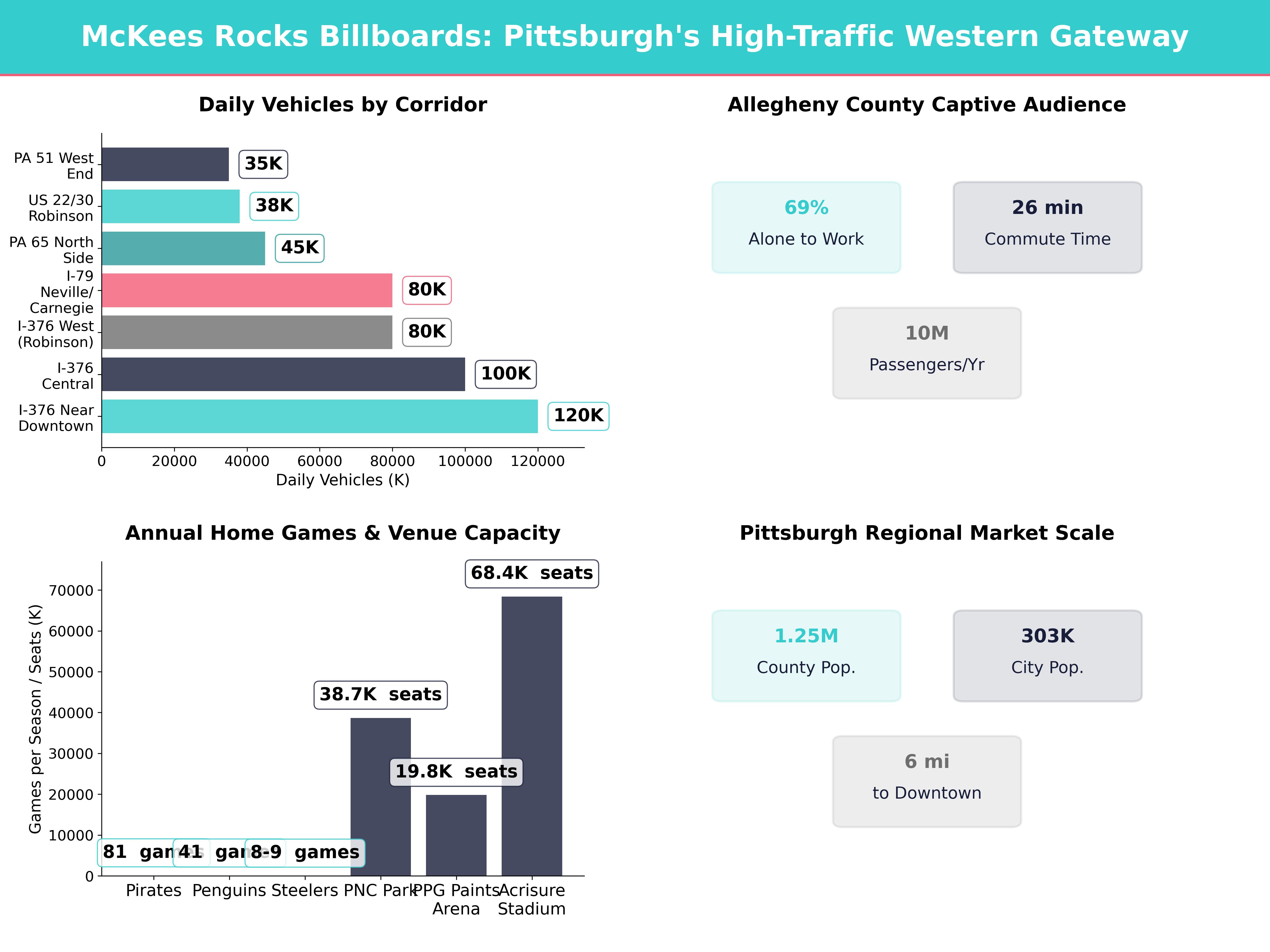
McKees Rocks gives us a compact borough with outsized regional reach. The borough itself had 5,920 residents in the 2020 Census, but it sits inside Allegheny County, which had 1,250,578 residents, and only about 6 miles from Downtown Pittsburgh. That location places billboard campaigns near river crossings, the three-river confluence, major commuter routes, the airport approach, and active retail and event districts.
What kind of drivers does McKees Rocks billboard advertising reach?
Roughly 69% of Allegheny County workers drive alone to work, so car travel still drives the market. The county’s mean travel time to work is about 26 minutes, which is long enough for repeated roadway exposure to matter, but short enough that route choice is often habitual. That makes the market useful for reaching the same commuters several times per week and matching creative to different dayparts.
When is the best time to advertise in McKees Rocks with Blip?
Spring and summer bring tax refunds, home projects, graduation planning, and more leisure traffic, while fall is strong for back-to-school and football. Winter also stays active thanks to holiday retail, restaurant gifting, seasonal entertainment, and airport travel. Because western Allegheny County has distinct sports, tourism, and school-year rhythms, flexible budgeting matters.
Do I need a contract to advertise with Blip in McKees Rocks?
No, Blip has no long-term contracts or minimum commitments. You can start, pause, or stop your campaign at any time.
How fast can I launch a billboard campaign with Blip in McKees Rocks?
You can have your campaign live in minutes. Create a free account, select your locations, set your budget, upload your design, and start running once approved.
Where can I advertise with Blip in McKees Rocks?
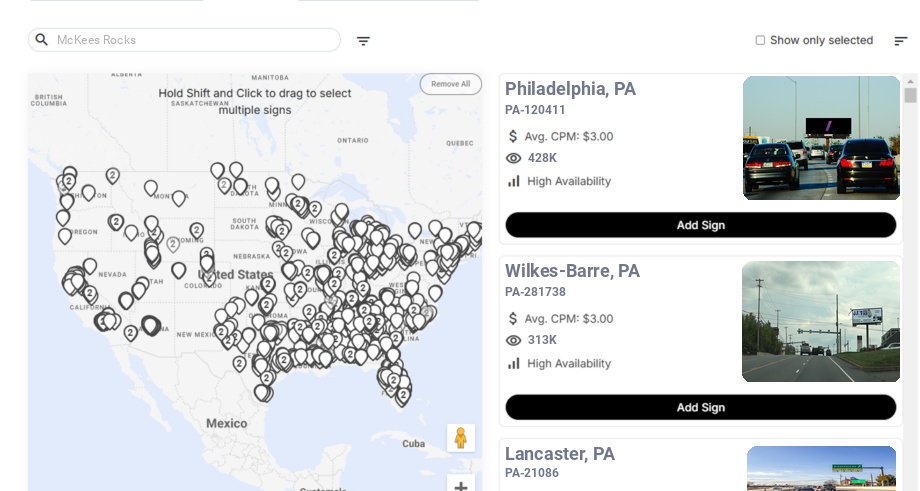
Blip has digital billboards in McKees Rocks. You can browse available locations on a map, choose the ones that fit your audience, and start advertising right away.
Still have questions? Launch a campaign in minutes — no contracts, no commitments.
Start Your CampaignMcKees Rocks Billboard Advertising Guide
McKees Rocks gives us a compact borough with outsized regional reach. The borough itself had 5,920 residents in the 2020 Census, but it sits inside Allegheny County, which had 1,250,578 residents, and only about 6 miles from Downtown Pittsburgh. That location places our billboard campaigns near river crossings, the three-river confluence, major commuter routes, the airport approach, and some of the most active retail and event districts in western Pennsylvania. For advertisers that want to influence drivers, eventgoers, shoppers, and airport travelers in one buy area, McKees Rocks is far stronger than its population alone suggests.
McKees Rocks Market Overview
McKees Rocks is small, but its trade area is large
When we advertise in McKees Rocks, we are not relying only on borough residents. We are tapping into a western Allegheny County movement pattern that includes the City of Pittsburgh, Robinson, Moon, the North Shore, and the airport corridor. Pittsburgh itself had 302,971 residents in the 2020 Census, and Allegheny County’s famously fragmented local landscape includes 130 municipalities, which means consumers regularly cross municipal lines for work, shopping, healthcare, and entertainment.
That matters for billboards because McKees Rocks functions as a pass-through and connector market. Drivers move between local neighborhoods, Robinson Township Moon Township, Downtown, and the North Side on a daily basis. A well-placed digital billboard here can build frequency with residents while also capturing regional travelers who may never think of themselves as “McKees Rocks consumers.”
Car travel still drives the market
Even with the presence of Pittsburgh Regional Transit and a more urban commute mix than many Sun Belt markets, recent ACS estimates still show that roughly 7 in 10 (about 69%) Allegheny County workers drive alone to work. The county’s mean travel time to work is about 26 minutes, which is long enough for repeated roadway exposure to matter, but short enough that route choice is often habitual.
For advertisers, that combination is valuable. We can use digital billboards to reach the same commuters several times per week, and we can also match creative to dayparts, such as morning inbound traffic, lunch-hour retail trips, and evening outbound traffic. In a market where route familiarity is high, recall compounds quickly.
The local economy supports diverse advertiser categories
McKees Rocks sits near several of the metro’s strongest demand generators. Pittsburgh International Airport 10 million passengers in 2023, and the airport campus covers about 8,800 acres. Nearby Robinson has become one of the region’s biggest suburban retail concentrations, with destinations such as The Mall at Robinson, IKEA Pittsburgh, chain restaurants, hotels, and service businesses clustered around interchange-heavy roadways.
At the same time, the broader Pittsburgh economy gives us a deep mix of healthcare, education, professional services, logistics, and light industry. That mix is ideal for billboard advertising because it supports both high-frequency local categories, such as injury law, urgent care, and home services, and destination categories, such as retail, casinos, entertainment, and event venues.
Key Traffic Corridors Around McKees Rocks
McKees Rocks advertising works best when we think in corridors, not just ZIP codes. According to PennDOT traffic count data, a handful of highways and arterial routes dominate regional movement around the borough.
I-376, the Parkway West, and the airport-to-downtown spine
I-376 is the most important corridor for many western Allegheny County campaigns. On western segments near Robinson and the airport approach, traffic commonly runs in the 70,000 to 90,000 AADT range. As the route approaches the urban core, central segments regularly top 100,000 AADT, and some stretches near Downtown and the Fort Pitt system are around 120,000 AADT.
This corridor is especially effective for the following advertiser types:
- Retailers, restaurants, and entertainment venues benefit because I-376 carries shoppers and leisure travelers between the airport, Robinson, and Downtown Pittsburgh.
- Healthcare providers, legal firms, and financial services brands benefit because the route reaches daily commuters headed toward the region’s largest job centers.
- Hotels, attractions, and visitor-oriented brands benefit because the corridor captures airport traffic and out-of-town drivers headed into the city.
I-79 and the regional interchange network
I-79 is another major influence on McKees Rocks-area billboard strategy because it feeds traffic into the airport corridor, Robinson retail, and connections north and south through the region. PennDOT counts on key western Allegheny County segments near the Neville Island and Carnegie interchanges typically fall in the 70,000 to 90,000 AADT range.
This route is especially useful when we want regional reach beyond the borough itself. It works well for:
- Auto dealers, home improvement brands, and furniture retailers because shoppers on I-79 often have a planned destination and a willingness to travel.
- B2B, staffing, logistics, and industrial advertisers because the corridor connects warehouse, office, and light manufacturing zones.
- Colleges, training programs, and healthcare systems because it reaches workers and families across multiple suburbs in one drive shed.
PA 65, Ohio River Boulevard, and the north river communities
PA 65 serves as a key route for audiences moving along the Ohio River corridor and into the North Side. Heavier sections near the Bellevue Avalon 40,000 to 50,000 AADT. For campaigns connected to McKees Rocks, this matters because the borough shares consumer movement with other river communities and with Downtown-bound traffic.
We like PA 65 for messages that need strong weekday repetition. It is often a strong fit for:
- Neighborhood healthcare, dental, and urgent care providers because patients usually choose convenient, familiar options close to home or work.
- Schools, childcare providers, and family services because parents repeat the same commuting and errand routes.
- Local retail, banking, insurance, and grocery-adjacent brands because the audience is highly local and frequency-driven.
US 22/30, PA 51, and the western decision corridors
The Robinson commercial district also depends on US 22/30, where busy segments often range from 30,000 to 45,000 AADT. South and southeast connections via PA 51 around the West End area commonly run around 30,000 to 40,000 AADT on major segments. These corridors matter because they capture active decision-makers who are choosing where to shop, eat, refuel, or stop next.
These roads are particularly strong for:
- Quick-service restaurants, fuel and convenience brands, and impulse retail because consumers are often making near-term decisions.
- Big-box retail and service clusters because the corridors feed destinations in Robinson and nearby commercial nodes.
- Event-driven campaigns because drivers use these routes to access stadiums, Downtown, and the airport.
Audience Segments We Can Reach in McKees Rocks
Commuters, shift workers, and local service buyers
The first core audience is the daily commuter. Western Allegheny County sends workers into Downtown, the North Shore, the airport area, healthcare campuses, and suburban office clusters. Because so much of that movement happens by car, billboard frequency can do a lot of work for brands that depend on top-of-mind recall.
This is the audience we want for categories such as personal injury law, HVAC, plumbing, roofing, urgent care, banking, and employment services. In these categories, consumers often act when a need appears, so repeated exposure on familiar routes can outperform one-time awareness alone.
Students, faculty, and young professionals
McKees Rocks is not a college town, but it is close to several major academic populations. The University of Pittsburgh serves more than 34,000 students, and Carnegie Mellon University enrolls about 16,000 students. Robert Morris University in Moon Township adds another western suburban student population to the market mix.
That gives us several useful segments at once. We can reach traditional college students, graduate students, faculty, hospital staff, and young professionals living in city neighborhoods and commuting across the metro. This audience responds well to healthcare, apartments, entertainment, fitness, telecom, financial products, and recruitment messaging.
Sports fans, concertgoers, and convention visitors
The Pittsburgh event economy meaningfully strengthens McKees Rocks-area billboard value. Acrisure Stadium seats 68,400, PNC Park seats 38,747, and PPG Paints Arena can hold about 19,758 for basketball-style seating and major events. The David L. Lawrence Convention Center adds 1.5 million square feet of event space to the Downtown visitor engine.
Those facilities bring in a mix of locals and visitors throughout the year. We can use McKees Rocks-area boards to intercept people traveling from the airport, from western suburbs, and from river communities into the city for games, concerts, trade shows, and festivals. Categories such as parking, bars and restaurants, attractions, hotels, rideshare-adjacent services, and sports-themed retail benefit from this movement.
Airport travelers, shoppers, and weekend family traffic
The corridor between McKees Rocks, Robinson, and Pittsburgh International Airport
For family-oriented categories, Robinson is especially important because it combines destination retail with dining and entertainment. A billboard campaign that pairs commuter-heavy placements with Robinson-facing boards can cover both weekday routine and weekend spending.
Seasonal Opportunities for McKees Rocks Campaigns
Spring and summer in McKees Rocks
Spring is a strong reset season for western Pennsylvania advertising. Tax refunds, home projects, graduation planning, and warmer weather all increase consumer movement. It is also the start of the Pittsburgh Pirates home slate, which gives us 81 home games at PNC Park and a long season of North Shore traffic opportunities.
Summer adds leisure traffic and city events. The Pittsburgh Marathon brings major regional attention in May, the Three Rivers Arts Festival activates Downtown in June, and Picklesburgh has become a major summer draw in July. This is an ideal period for campaigns tied to restaurants, attractions, hotels, family entertainment, home services, and healthcare practices that want to fill schedules before fall.
Fall football and back-to-school demand
Late August through November is one of the most advertiser-friendly windows in the market. Schools and universities return, routines become more fixed, and football lifts regional attention. The Pittsburgh Steelers play 8 or 9 regular-season home games each year, plus preseason games and possible postseason dates, which creates concentrated traffic around the North Shore and city approaches.
Back-to-school season is also a smart time for healthcare, dental, optical, tutoring, job training, and family retail messaging. We generally see strong performance when we use route-specific creative during this period, because drivers are re-establishing school-year habits and repeated exposure becomes more efficient.
Winter holidays and early-year service campaigns
Winter changes how we should use the market, but it does not reduce billboard value. Holiday retail, restaurant gifting, seasonal entertainment, and airport travel all intensify in November and December. The Pittsburgh Penguins deliver 41 regular-season home games, keeping event traffic active through the coldest part of the year.
January through March tends to favor practical categories. We can lean into tax preparation, legal services, insurance, healthcare, fitness, and trades that benefit from winter urgency, such as heating, plumbing, and emergency home repair. In a gray-weather market, concise copy and high-contrast design become even more important.
Billboard Design Tips for the McKees Rocks Market
Use geography the way locals use geography
In McKees Rocks, place matters. Western Allegheny County drivers think in exits, bridges, tunnels, river routes, and neighborhood names. Creative that says “Robinson next exit,” “minutes from Downtown,” “near the airport,” or “North Shore game-day parking” usually feels more useful than broad metro branding alone.
We should also remember that many impressions come from habitual drivers who know the road well. That means directional relevance can outperform cleverness. If the message helps someone act on the next decision point, it has a better chance of converting.
Reflect Pittsburgh identity without becoming generic
Pittsburgh’s black-and-gold visual shorthand is powerful, and it often works well in this market. We can use it, but we should anchor it to our category so the ad does not look like a sports promotion unless that is the point. River, bridge, skyline, steel, and neighborhood imagery can also resonate when used sparingly.
In McKees Rocks specifically, straightforward value messaging often fits the market. This is a place where trust, price clarity, reliability, and convenience matter. Messages such as “free estimate,” “same-day service,” “locally trusted,” or “easy parking” tend to align better with the audience than abstract brand language.
Design for speed, weather, and mixed audiences
Because the market blends highway traffic, arterial traffic, commuters, and visitors, we should keep creative highly legible. We recommend short headlines, bold contrast, and one clear takeaway. If we use a phone number, URL, or QR-related prompt, it should support a brand people can remember later rather than ask drivers to act instantly.
Weather is another local factor. Western Pennsylvania’s overcast days can flatten weak color palettes, so stronger contrast usually wins. If our campaign targets commuters on I-376 or I-79, we should assume short viewing windows and build creative that lands in one glance.
Regional Strategies Across McKees Rocks and Western Allegheny County
McKees Rocks, Stowe, and nearby river communities
For boards closest to McKees Rocks itself, we usually emphasize practical, trust-based, community-facing offers. Healthcare, legal services, discount retail, grocery-adjacent businesses, local dining, and trades often fit best here. Creative should feel local, direct, and useful.
If we are a regional brand, this is where we should localize the message. Mentioning nearby neighborhoods, access points, or service areas can improve relevance without making the campaign feel too narrow.
Robinson, North Fayette, and the airport corridor
The Robinson Township
For this area, we often do best with convenience-led messaging. Offers such as “book today,” “shop this exit,” “free parking,” “5 minutes from PIT,” or “open late” fit the travel intent of the corridor.
Downtown, the North Shore, and event traffic
If our goal is event-driven reach, we should pair western approach boards with city-facing boards that catch fans and visitors as they close in on the North Shore, Downtown Pittsburgh, and the David L. Lawrence Convention Center. This strategy works especially well for bars, restaurants, parking, attractions, legal services, healthcare systems, and nightlife brands.
This submarket is also where we can justify more timely creative. Event countdowns, game-day offers, and “before first pitch” or “after the show” messages can feel native to the audience.
North Hills and the PA 65 corridor
The PA 65 corridor gives us a strong family and neighborhood-service audience extending through river communities and the North Hills approach. We use this area when we want dependable weekday frequency rather than only event spikes. It is often a strong match for dentistry, pediatrics, K-12 education, home services, insurance, and everyday retail.
For many advertisers, the best strategy is not choosing one sub-area over another. The best strategy is combining a commuter corridor, a shopping corridor, and an event or destination corridor so the audience sees the brand in multiple contexts.
Using Blip Tools in McKees Rocks
Match dayparts to how the market actually moves
McKees Rocks campaigns benefit when we align scheduling to local traffic patterns. Morning weekday hours, such as 6:00 a.m. to 9:00 a.m., are useful for Downtown-bound commuters. Midday windows, such as 11:00 a.m. to 2:00 p.m., often work well for Robinson retail and restaurant traffic.
Late afternoon and early evening, such as 3:00 p.m. to 7:00 p.m., can be strong for outbound commuters, errands, and family decision-makers. For sports and entertainment, we can also tighten timing around event windows. Running heavier in the 2 to 3 hours before games, concerts, or major convention sessions helps us spend more efficiently than trying to own the entire day.
Test corridor-specific creative instead of forcing one message everywhere
Blip makes it practical for us to run different creative by location cluster. We can use one message for airport and Robinson boards, another for local community boards near McKees Rocks, and a third for event-facing boards near the city core. That is a major advantage in a market where traveler intent changes quickly from one corridor to the next.
We can also use analytics to identify which routes produce better performance for our category. If a healthcare campaign gets stronger traction on commuter-heavy boards than on retail-heavy boards, we can shift spend without rebuilding the entire campaign.
Scale around seasons, not fixed annual commitments
Because western Allegheny County has distinct sports, tourism, and school-year rhythms, flexible budgeting matters. We can stay visible year-round at a modest level, then increase weight during Pirates season, Steelers season, holiday shopping, or airport travel peaks. If we are testing a new service area, we can start small and expand only where results justify it.
That flexibility is especially helpful in McKees Rocks, where a small geographic footprint sits inside a much larger regional traffic system. We do not need to overbuy to gain traction if we choose timing and corridors intelligently.
Getting Started with Billboard Rental in McKees Rocks
Start with the business objective, not the board
Before we rent any billboard, we should define what success looks like in this market. If our goal is foot traffic, we should favor boards near decision points and destination corridors. If our goal is brand recall, we should favor high-frequency commuter routes. If our goal is event capture, we should emphasize airport-to-city and stadium-facing approaches.
This step matters because McKees Rocks can serve several different jobs at once. A local dentist, a regional personal injury firm, a Robinson retailer, and an airport hotel should not build the same billboard plan.
Evaluate locations by travel intent
When we compare boards, we should ask a few practical questions. We should ask whether the audience is commuting, shopping, traveling, or heading to an event.
We should ask whether the board is close enough to the action point for the message to influence behavior. We should ask whether the board faces inbound or outbound traffic at the time we care about most. We should ask whether the surrounding corridor matches our category, price point, and desired customer radius.
In McKees Rocks, a board that looks geographically close may be less useful than one farther away on I-376 or I-79 if the farther board reaches people with stronger purchase intent.
Use Blip to simplify the rental process
Traditional billboard buying can force us into long negotiations, fixed packages, and placements that are harder to test. Blip simplifies that process by letting us review available digital boards on a map, choose the ones that match our corridors, set budget guardrails, and refine timing without turning the campaign into a long-term commitment. That matters in a market like McKees Rocks because the best strategy often involves testing several sub-areas before settling on the strongest mix.
A smart starting plan is usually simple. We can launch with a small cluster of boards across one commuter corridor and one destination corridor, run for a few weeks, review performance, and then adjust. In most cases, the winning McKees Rocks strategy is not just “be near the borough.” It is “be present where western Allegheny County moves.”