Billboards in Delaware Water Gap, PA
No Minimum Spend. No Long-Term Contracts. Just Results.
Trusted by Leading Brands


Billboard advertising
in Delaware Water Gap has never been easier

How much is a billboard in Delaware Water Gap?
Why Choose Blip for Billboard Advertising in Delaware Water Gap
Blip lets you launch fast in Delaware Water Gap on I-80, reaching 50,000-70,000 AADT travelers without a long contract.
Use Delaware Water Gap's commuter flow—86% drive by car, truck, or van—to daypart ads for morning and late-afternoon drives.
In Delaware Water Gap, flexible budgets help you shift spend for ski weekends, river season, or fall foliage traffic as demand changes.
Blip's real-time analytics show what's working on Delaware Water Gap's I-80 and PA 33 corridors, so you can optimize on the fly.
Create and swap fresh ads in Delaware Water Gap for Camelback, Shawnee, or the Pocono resorts—Blip keeps your creative nimble.
Frequently Asked Questions About Billboard Advertising in Delaware Water Gap
How much does a billboard cost in Delaware Water Gap with Blip?
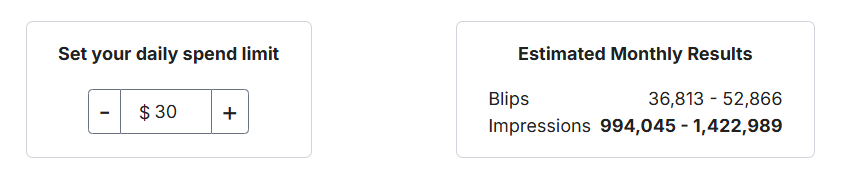
With Blip, billboard advertising in Delaware Water Gap can be surprisingly affordable and flexible. You set a daily budget, and Blip’s algorithm uses it to bid for open ad slots on rotating digital billboards. Pricing starts at just $0.01 per display, and cost per blip changes based on time of day, location, and advertiser demand.
Where can I advertise with Blip in Delaware Water Gap?
I-80 is the anchor corridor, with nearby segments through Delaware Water Gap and the Stroudsburg area commonly running roughly 50,000 to 70,000 AADT. PA 33 is another major route, often in the 35,000 to 50,000 AADT range near the interchange area. U.S. 209 and PA 611 are also useful for reaching destination travelers, local drivers, and visitors moving through the Poconos.
Why is Delaware Water Gap a good billboard market for Blip?
Delaware Water Gap is one of the most efficient billboard markets in the Pocono region because the borough is small, but it sits at the eastern gateway to Monroe County. The area is highly drive-oriented, and recent survey estimates have generally placed commuting by car, truck, or van in Monroe County at roughly 86% of workers. That combination gives us a rare chance to reach daily commuters, weekend travelers, college students, and family vacationers in the same market.
What kinds of businesses work best for Delaware Water Gap billboards?
The local economy blends tourism, healthcare, education, retail, dining, and services. For advertisers, that mix means we can use Delaware Water Gap boards for much more than tourism. We can also support urgent care, legal services, banks, colleges, restaurants, auto services, home services, retail promotions, and regional events.
When should I run billboard ads in Delaware Water Gap with Blip?
Timing matters in Delaware Water Gap because the market changes character by season. Morning and late-afternoon dayparting is a natural fit for commuter services, while leisure brands can put more weight on Thursday through Sunday windows, especially around arrival and return periods. The market also supports seasonal swaps, from ski and indoor-waterpark messaging in winter to hiking and rafting messaging in spring and summer.
Do I need a contract to advertise with Blip in Delaware Water Gap?
No, Blip has no long-term contracts or minimum commitments. You can start, pause, or stop your campaign at any time.
How fast can I launch a billboard campaign with Blip in Delaware Water Gap?
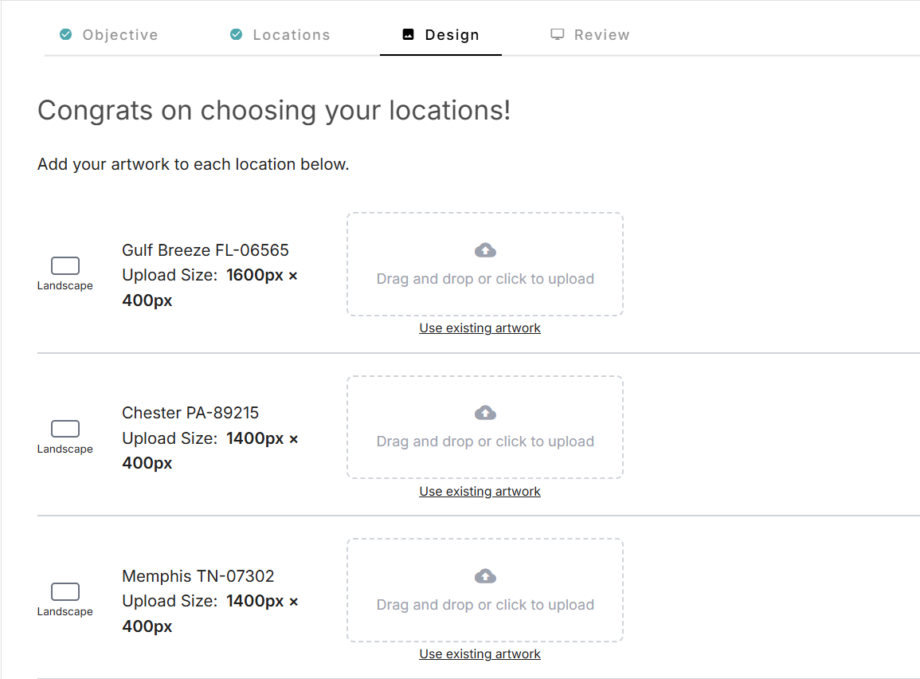
You can have your campaign live in minutes. Create a free account, select your locations, set your budget, upload your design, and start running once approved.
Where can I advertise with Blip in Delaware Water Gap?
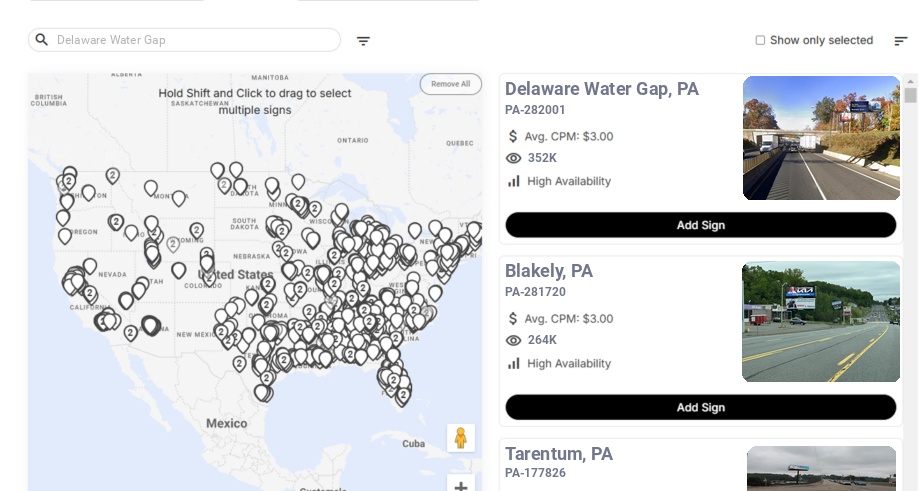
Blip has digital billboards in Delaware Water Gap. You can browse available locations on a map, choose the ones that fit your audience, and start advertising right away.
Still have questions? Launch a campaign in minutes — no contracts, no commitments.
Start Your CampaignDelaware Water Gap Billboard Advertising Guide
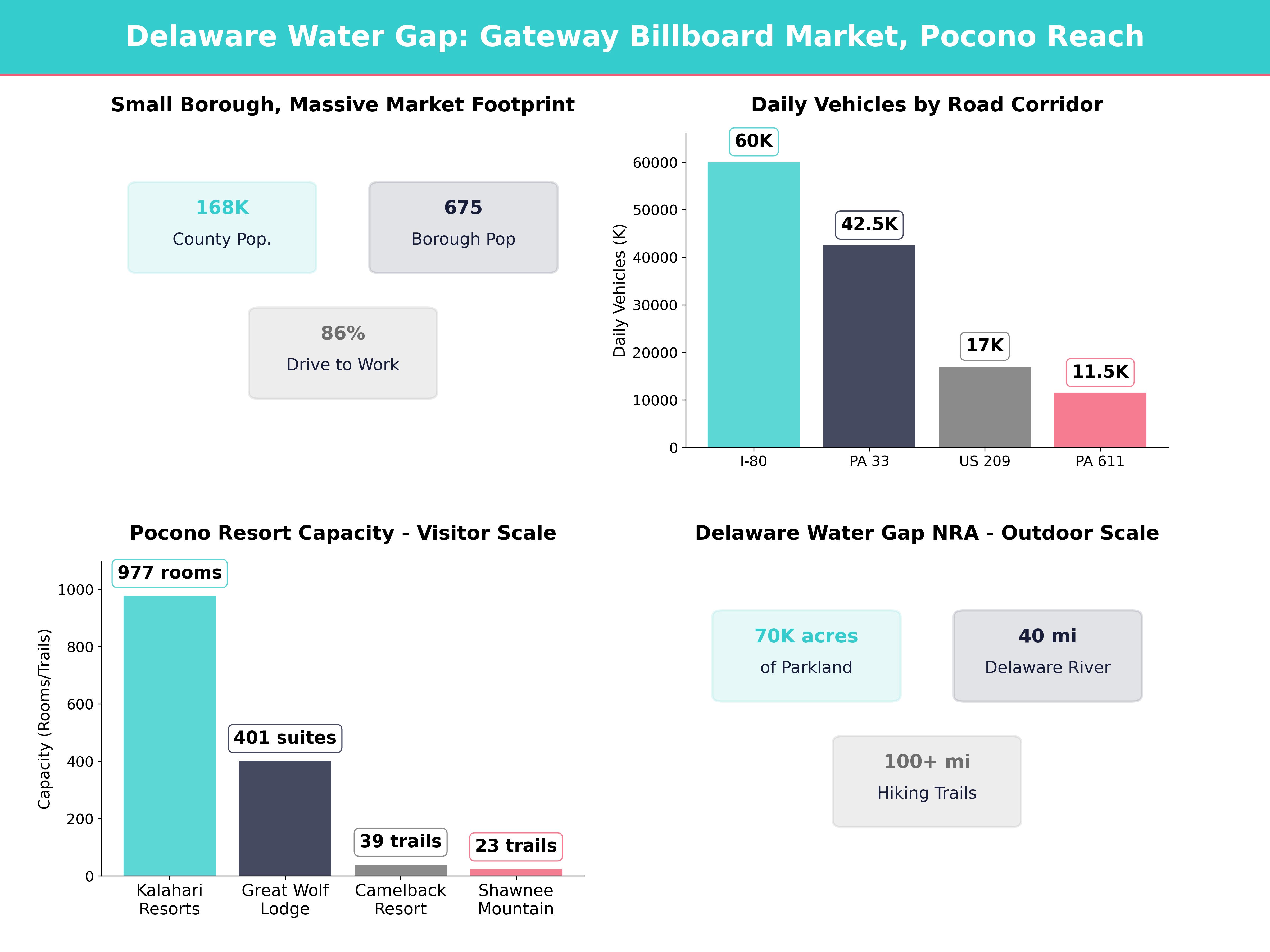
Delaware Water Gap 675 residents in 2020, but it sits at the eastern gateway to Monroe County, which had 168,327 residents in 2020. The area is highly drive-oriented, and recent survey estimates have generally placed commuting by car, truck, or van in Monroe County at roughly 86% of workers. We also benefit from year-round visitor traffic tied to the Delaware River, the Pocono resort economy, and nonstop I-80 movement between Pennsylvania and New Jersey, with nearby I-80 segments commonly running 50,000 to 70,000 AADT. That combination gives us a rare chance to reach daily commuters, weekend travelers, college students, and family vacationers in the same market.
Delaware Water Gap Market Overview
Delaware Water Gap is not a pure “local neighborhood” billboard market. It is a gateway market. That distinction matters because we are advertising to a flow of people moving through the borough, not only to the small number of people who live inside it.
Delaware Water Gap is small, but its trade area is much larger
The borough’s 2020 population of 675 is tiny on paper, but the immediate service area is much bigger. Monroe County grew from 138,687 residents in 2000 to 169,842 in 2010, which was a gain of about 22.5% in one decade. The county then eased to 168,327 residents in 2020, a modest decline of about 0.9%, which tells us the market has matured but remains sizable and active.
We should also think regionally. The Pocono Mountains Visitors Bureau promotes a 4-county destination covering about 2,400 square miles, and Delaware Water Gap sits at one of its most visible entry points. That means our boards can pull from local household demand, day-trip demand, and overnight tourism demand at the same time.
Delaware Water Gap is built around car travel
Billboard performance is strongest where road use is habitual, and Delaware Water Gap fits that pattern well. Monroe County’s commuting profile is heavily auto-based, with roughly 86% of workers traveling by car, truck, or van. Public transportation exists through the Monroe County Transit Authority and intercity carriers like Martz Bus, but the region still relies overwhelmingly on personal vehicles and interstate travel.
That matters for advertisers because it creates repeated exposure. We are not waiting for a narrow transit audience. We are speaking to drivers who use the same corridors for work, shopping, recreation, and regional travel.
The Delaware Water Gap economy supports multiple advertiser categories
The local economy blends tourism, healthcare, education, retail, dining, and services. Lehigh Valley Health Network operates Lehigh Valley Hospital–Pocono, a 257-bed hospital in East Stroudsburg. East Stroudsburg University enrolls more than 5,000 students, which adds a steady student and employee audience. The hospitality side is even more visible, with Kalahari Resorts & Conventions 977 guest rooms and a 220,000-square-foot indoor waterpark, and Great Wolf Lodge Pocono Mountains 401 suites.
For advertisers, that mix means we can use Delaware Water Gap boards for much more than tourism. We can also support urgent care, legal services, banks, colleges, restaurants, auto services, home services, retail promotions, and regional events.
Key Traffic Corridors for Delaware Water Gap Billboards
Delaware Water Gap’s billboard value is inseparable from its road network. We should choose locations based on how fast people are moving, why they are traveling, and whether they are arriving, commuting, or returning home.
Interstate 80 through Delaware Water Gap
I-80 is the anchor corridor. The Delaware River Joint Toll Bridge Commission manages the Delaware Water Gap Toll Bridge, which carries eastbound and westbound I-80 traffic between Pennsylvania and New Jersey. On PennDOT traffic-count maps, the I-80 stretch from Delaware Water Gap through the Stroudsburg area commonly falls in roughly the 50,000 to 70,000 AADT range, depending on segment and count year.
That scale makes I-80 the best corridor for broad-reach advertisers. We should favor it for these categories:
- Hospitals, urgent care centers, and legal services perform well here because commuters and regional travelers often make category decisions while already on the road.
- Hotels, casinos, ski resorts, and family attractions perform well here because visitors are still in trip-planning mode as they enter the Poconos.
- Retail, dining, and fuel-adjacent services perform well here because interstate travelers respond to convenience, distance, and timing.
PA 33 and the regional commuter funnel
PA 33 is the other major high-volume route feeding the market. Near the I-80 interchange area, PennDOT counts often place PA 33 in the 35,000 to 50,000 AADT band. That makes it especially valuable for reaching people moving between the Lehigh Valley, Monroe County, and the core Poconos.
We should treat PA 33 as a commuter-plus-regional-shopping corridor. It is well suited for:
- Healthcare systems and colleges because it captures repeat weekday travel from a broad radius.
- Auto dealers, financial services, and home improvement brands because those categories benefit from repeated frequency and larger-ticket consideration.
- Event venues and entertainment brands because the route carries both weekday workers and weekend leisure traffic.
U.S. 209 through the Delaware Water Gap area
U.S. 209 is more locally intentional than I-80. Depending on the exact segment around Delaware Water Gap, Smithfield, and the Marshalls Creek direction, PennDOT counts often fall around 12,000 to 22,000 AADT. That is lower than I-80, but the intent is stronger because travelers on 209 are often headed to a destination in the Poconos rather than simply passing through.
We should use U.S. 209 for advertisers that benefit from contextual relevance, including restaurants, rafting outfitters, lodging, wedding venues, outdoor recreation brands, and service businesses serving Monroe County residents.
PA 611 and the borough-to-Stroudsburg approach
PA 611 is one of the most useful local connectors for billboard strategy. In the Delaware Water Gap, Stroudsburg, and East Stroudsburg orbit, traffic counts often run in roughly the 8,000 to 15,000 AADT range, again depending on station and year. This route connects the borough with Stroudsburg Borough, East Stroudsburg Borough, and nearby tourism assets such as the Shawnee Inn and Golf Resort.
PA 611 is a smart corridor for:
- Restaurants, breweries, and boutique lodging because travelers are more likely to act on a near-term stop.
- Real estate, banks, and local service providers because the audience includes both residents and repeat local drivers.
- Arts and event promoters because people using 611 are closer to downtown decision points, including the Sherman Theater
Audience Segments We Can Reach Around Delaware Water Gap
A strong Delaware Water Gap campaign works best when we match the message to the traveler. The same board can reach several audiences, but our creative should still be built around the dominant use case.
We can reach daily commuters and cross-border workers
Monroe County’s vehicle-commute share of roughly 86% tells us that daily road exposure is the baseline here. Many workers move between Delaware Water Gap, Stroudsburg, East Stroudsburg, and New Jersey via I-80. That makes the market especially useful for insurance, healthcare, telecom, legal services, retail, and quick-service food.
Because so many trips repeat from Monday through Friday, commuter-focused campaigns benefit from consistency. We do not have to explain the whole brand story every time. We only need a memorable message that becomes familiar over multiple drives.
We can reach outdoor travelers and weekend adventurers
The Delaware Water Gap area is one of the best outdoor-adjacent billboard environments in Pennsylvania. The Delaware Water Gap National Recreation Area includes about 70,000 acres, nearly 40 miles of the Delaware River, and more than 100 miles of hiking trails. Those numbers matter because they translate into constant seasonal interest in rafting, hiking, paddling, scenic driving, and short getaways.
Outdoor retailers, restaurants, breweries, lodging brands, tour operators, campgrounds, and convenience-oriented services can all benefit from that audience. Creative that promises a nearby experience, a warm meal, a family stop, or an easier weekend plan tends to fit the traveler mindset well.
We can reach resort families, shoppers, and entertainment visitors
The broader Poconos draw a massive family and leisure audience. Camelback Resort offers 39 trails and an 800-foot vertical drop in winter. Shawnee Mountain Ski Area 23 trails and a 700-foot vertical. Kalahari Resorts & Conventions 220,000-square-foot indoor waterpark and 977 rooms, while Great Wolf Lodge Pocono Mountains 401 suites. The Crossings Premium Outlets 100-plus stores, and Mount Airy Casino Resort
This is why Delaware Water Gap works for family attractions, dining, lodging, outlet shopping, entertainment, and impulse-stop campaigns. We are not only reaching residents. We are reaching travelers who already expect to spend money.
We can reach students, families, and local service workers
East Stroudsburg University brings more than 5,000 students into the immediate market, and Northampton Community College also serves the region from its Monroe campus. Monroe County is served by 4 public school districts, which helps sustain a year-round family audience even when tourism softens.
Service-worker audiences are also meaningful here because healthcare, hospitality, education, and retail are major parts of the local economy. Lehigh Valley Health Network, the resort sector, downtown businesses, and shopping nodes all create a large employee base that sees the same roads repeatedly.
Seasonal and Timing Opportunities in Delaware Water Gap
Timing matters in Delaware Water Gap because the market changes character by season. A commuter message can run all year, but tourism-driven creative should flex with weather, school calendars, and event patterns.
Winter in Delaware Water Gap favors ski, lodging, dining, and indoor-fun campaigns
From late November through March, winter recreation becomes a major traffic driver. Camelback Resort and Shawnee Mountain Ski Area 39 and 23 trails, respectively. Indoor attractions become even more competitive during cold or wet weekends, which is why Kalahari Resorts & Conventions Great Wolf Lodge Pocono Mountains
We should emphasize warmth, convenience, indoor entertainment, dining, lodging, and “open today” messaging during this season. Weather-sensitive brands can also increase visibility ahead of holiday weekends and forecasted snow.
Spring and summer in Delaware Water Gap favor outdoor recreation and family travel
Once temperatures rise, the river and trail network become a major demand driver. The recreation area’s 70,000 acres, 40 miles of river, and 100-plus miles of trails support campaigns for rafting, casual dining, ice cream, lodging, gear, and family attractions. Summer is also the right time to lean into spontaneous messaging because many trips are day trips or short overnight stays.
Friday afternoon, Saturday morning, and Sunday return windows are especially valuable if our audience is leisure-oriented. Those time blocks align with the rhythm of weekend arrivals and departures.
Late summer and fall in Delaware Water Gap favor back-to-campus, events, and foliage travel
The return of East Stroudsburg University students creates a predictable late-summer and fall audience for apartments, banks, mobile carriers, food, and retail. Fall foliage drives scenic traffic, and regional entertainment venues stay active as the weather cools.
Pocono Raceway, with its 2.5-mile tri-oval, is another reminder that event weekends can change traffic patterns dramatically. Even if a brand is not event-focused, it should be aware of those surges and consider short budget boosts around major race or festival periods.
Daily timing in Delaware Water Gap should mirror trip purpose
We should schedule commuter campaigns heavier in the morning and late afternoon. We should schedule tourism and dining campaigns more aggressively from Thursday through Sunday, especially from midday into evening. We should also test weather-responsive bursts for indoor attractions, urgent care, auto services, and hospitality offers.
Billboard Design Tips for the Delaware Water Gap Market
Creative that works in downtown Philadelphia or Manhattan does not automatically work at the Delaware Water Gap gateway. Here, we need design choices that fit road speed, mountain tourism, and local practicality.
We should design for fast decisions on Delaware Water Gap roads
On I-80 and PA 33, our audience is moving quickly. That means our best creative usually includes one idea, one offer, and one action. Messages such as “Next Exit Dining,” “Family Suites Nearby,” “Outlet Deals Ahead,” or “Urgent Care Open Late” fit the market better than long brand storytelling.
Distance and travel-time cues are especially useful in this geography. Travelers entering the Poconos are often deciding where to stop next, not simply noticing the brand. If we can honestly say “5 Minutes Ahead” or “At Next Exit,” we should.
We should match color and imagery to the Pocono calendar
Deep greens, blues, river imagery, and mountain silhouettes feel native to the Delaware Water Gap area in spring and summer. In fall, oranges, reds, and golds align naturally with foliage travel. In winter, bright whites and blues, warm interior scenes, fireplaces, food, or family imagery can signal comfort immediately.
This market responds well to seasonally obvious creative because the environment is already seasonal. A winter board that looks like summer feels disconnected. A rain-day indoor-fun board in January or February feels useful.
We should reflect both local utility and getaway emotion
Delaware Water Gap audiences split into two broad mindsets. One group is commuting and wants practicality. The other group is escaping and wants experience. We should decide which mindset matters most before we design.
For practical audiences, we should emphasize convenience, trust, hours, location, parking, and speed. For getaway audiences, we should emphasize scenery, family memories, comfort, fun, and spontaneity. The strongest local campaigns usually pick one lane clearly rather than trying to speak to everybody at once.
We should localize the message to Delaware Water Gap and the Poconos
Local references matter here. “Minutes from the Gap,” “Near Shawnee,” “On the Way to Camelback,” or “Before Stroudsburg” feels more relevant than a generic statewide slogan. Because the market draws both Pennsylvania and New Jersey travelers, simple wording and strong visual hierarchy are more important than clever local jargon.
Regional Strategies Across Delaware Water Gap and the Central Poconos
A Delaware Water Gap strategy works best when we divide the market into sub-areas instead of treating the whole region as one undifferentiated audience.
Delaware Water Gap and the I-80 gateway should focus on arrival messaging
The borough and immediate I-80 gateway are ideal for capturing intent at the moment people enter the Poconos. This is where we should place directional messaging for lodging, dining, healthcare, convenience retail, and attractions that want a fast decision.
Arrival-zone boards are especially powerful for:
- Hotels and restaurants because travelers are still making stop decisions.
- Healthcare and roadside services because urgency matters when people are already driving.
- Tourism brands because first-impression visibility shapes the rest of the trip.
Stroudsburg and East Stroudsburg should focus on everyday local demand
Stroudsburg Borough and East Stroudsburg Borough form the area’s service core. This is where we should emphasize recurring local categories such as healthcare, education, legal services, banking, grocery-adjacent retail, and entertainment.
The presence of East Stroudsburg University, Lehigh Valley Health Network, downtown business districts, and civic activity makes this zone stronger for frequency-based campaigns than pure gateway boards.
Tannersville, Bartonsville, Pocono Manor, and Mount Pocono should focus on tourism spend
This westward band of the corridor is where resort, outlet, and entertainment spending intensifies. The Crossings Premium Outlets Camelback Resort, Kalahari Resorts & Conventions Mount Airy Casino Resort
We should lean into higher-intent leisure messaging here, including shopping, dining, gaming, family attractions, and overnight offers. This zone is also a strong place to test seasonal creative changes because the audience mix changes quickly by season.
Shawnee and the Route 209 recreation side should focus on scenic and destination-based brands
The Shawnee Inn and Golf Resort, Shawnee Mountain Ski Area
This is where we should highlight outdoor recreation, weddings, boutique lodging, dining, breweries, and experience-led offers.
Using Blip Tools in Delaware Water Gap
Blip works especially well in Delaware Water Gap because the market changes by corridor, by day of week, and by season. We do not need a rigid one-size-fits-all campaign.
We should separate commuter campaigns from visitor campaigns
Morning and late-afternoon dayparting is a natural fit for commuter services in the Delaware Water Gap area. Leisure brands can then put more weight on Thursday through Sunday windows, especially around arrival and return periods. This lets us align spending with actual travel behavior instead of spreading budget evenly across low-value times.
We should test Delaware Water Gap creative by corridor
A board on I-80 may need a very different message than a board on PA 611 or U.S. 209. With Blip, we can run one creative set for high-speed interstate boards and another for lower-speed local connectors. That helps us learn whether convenience, destination, price, or experience is driving more response.
We should use seasonal swaps instead of static year-round messaging
Delaware Water Gap is a textbook market for artwork rotation. We can move from ski and indoor-waterpark messaging in winter, to hiking and rafting messaging in spring, to family-vacation messaging in summer, to campus and foliage messaging in fall. We can make those changes without rebuilding our entire media plan.
We should watch analytics and reallocate quickly
Because traffic intent differs so much by route, real-time campaign data is useful here. If a Delaware Water Gap gateway board is outperforming a deeper-in-market board, we can shift spend. If a weekend tourism message is beating a weekday version, we can lean into that schedule. The ability to optimize in-market is one of the biggest advantages in a region with this much seasonal variation.
Getting Started with Billboard Rental in Delaware Water Gap
Renting a billboard in Delaware Water Gap is easiest when we start with the travel behavior we want to influence. The right board for a local dentist is not the same as the right board for a ski resort, a casino, or a hospital.
We should begin with one clear goal
Before we choose locations, we should decide whether we want more store visits, website traffic, bookings, calls, brand awareness, or event attendance. Delaware Water Gap can support all of those goals, but each one points us toward a different corridor and a different message.
We should choose Delaware Water Gap boards by movement pattern, not by municipal boundary
If we want scale, we should favor I-80 and PA 33 visibility. If we want more destination intent, we should favor U.S. 209 and PA 611 approaches. If we want local service frequency, we should emphasize the Stroudsburg and East Stroudsburg orbit.
That is one place where a map-based buying process helps. We can evaluate each digital board in context instead of buying a vague regional package.
We should test, learn, and expand
A practical way to start is with a focused test over 2 to 4 weeks using a small cluster of boards that match our primary audience. We can compare commuter timing against weekend timing, or compare a tourism message against a service-oriented message. Once we see which corridor and creative are strongest, we can scale up with more confidence.
We should value flexibility over traditional friction
Traditional billboard buying often involves slower negotiations, longer commitments, and less control over timing or creative changes. In Delaware Water Gap, where weather, weekends, tourism, and commute patterns all matter, flexibility is a real strategic advantage. Blip makes it easier for us to launch quickly, adjust creative, change schedules, and concentrate spend where the local travel patterns are actually strongest.
When we approach Delaware Water Gap this way, we do not have to guess. We can build around the region’s real strengths: 168,327 county residents, heavy vehicle commuting, 50,000-plus daily interstate traffic on key segments, and a tourism economy anchored by trails, ski slopes, resorts, shopping, and year-round attractions. That is exactly the kind of environment where smart digital billboard strategy can compound over time.