Billboards in Sciota, PA
No Minimum Spend. No Long-Term Contracts. Just Results.
Trusted by Leading Brands


Billboard advertising
in Sciota has never been easier



How much is a billboard in Sciota?
Why Choose Blip for Billboard Advertising in Sciota
Blip lets you launch in Sciota on U.S. 209 fast, reaching Monroe County commuters without contracts or setup delays.
Set flexible budgets in Sciota and scale around I-80, PA 33, and weekend Pocono traffic as demand shifts.
Use dayparting in Sciota to hit 35-minute commuters, ski arrivals, and Sunday returns at the right times.
Track Sciota campaigns in real time and shift spend from local U.S. 209 traffic to resort and outlet corridors when results improve.
Blip's creative tools help Sciota ads stand out with quick, bold updates for winter ski runs, summer visitors, and holiday shoppers.
Frequently Asked Questions About Billboard Advertising in Sciota
How much does a billboard cost in Sciota with Blip?
Billboard advertising in Sciota can be more affordable than you might expect with Blip because you only pay when your ad actually appears. Each blip is a 7.5-to-10-second display on a rotating digital billboard, and pricing starts at just $0.01 per display. There are no minimums or contracts, so you can set a budget, adjust it anytime, or pause whenever you want.
Where can I advertise with Blip in Sciota?
Sciota sits inside Monroe County on the important U.S. Route 209 spine between the Stroudsburg area and western Pocono communities, which gives access to both everyday local traffic and bigger regional travel flows. The page also highlights Interstate 80, Pennsylvania Route 33, and Pennsylvania Route 611 as key corridors around Sciota. These routes connect commuters, shoppers, tourists, and resort traffic across the Pocono region.
Who can a Sciota billboard reach besides local residents?
When we combine year-round local households with the Pocono Mountains' 30 million annual visitors, Sciota becomes a strong base for billboard campaigns that need repeated visibility. Monroe County is a drive-first region, with roughly 80% of workers commuting by car and many visitors arriving by highway rather than by rail or air. That makes roadside messaging effective for commuters, tourists, weekenders, and drive-market visitors.
What kind of traffic do Sciota billboards get on Blip's main routes?
Sciota’s home corridor is U.S. 209, and PennDOT traffic maps typically place Monroe County segments in the 10,000 to 20,000 AADT range, depending on the exact segment and nearby commercial activity. Interstate 80 is the region’s dominant high-volume corridor, with Monroe County segments commonly above 50,000 vehicles per day and some stretches near the Stroudsburg-area interchanges approaching or exceeding 60,000 AADT. PA 33 also matters, with traffic counts generally in the 30,000 to 40,000 AADT band near the I-80 connection and southbound toward the Lehigh Valley.
When is the best time to run billboard ads in Sciota?
One of the best things about Sciota is that you can advertise here year-round without forcing the same message every month. Winter brings ski and indoor attraction traffic, summer brings tourists and event travelers, and fall supports foliage travel, back-to-school routines, college move-in, football weekends, and early holiday shopping. The right timing strategy changes with weather, school calendars, and visitor surges.
Do I need a contract to advertise with Blip in Sciota?
No, Blip has no long-term contracts or minimum commitments. You can start, pause, or stop your campaign at any time.
How fast can I launch a billboard campaign with Blip in Sciota?
You can have your campaign live in minutes. Create a free account, select your locations, set your budget, upload your design, and start running once approved.
Where can I advertise with Blip in Sciota?
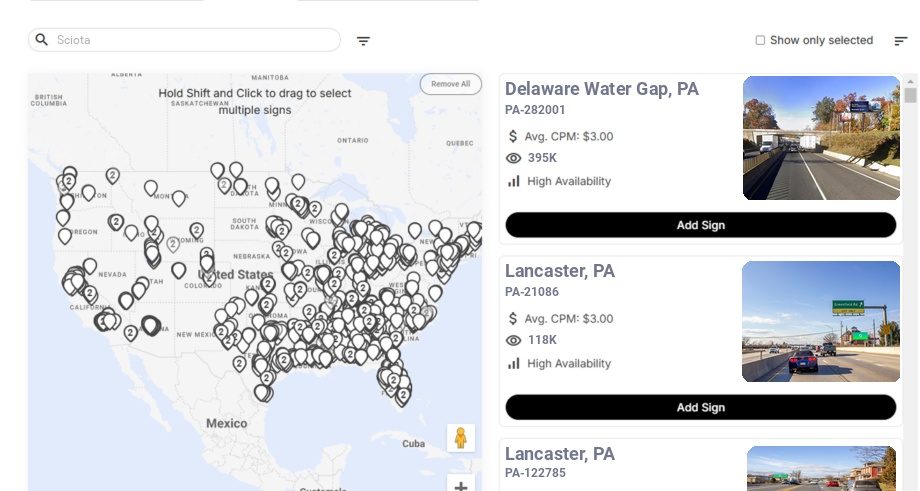
Blip has digital billboards in Sciota. You can browse available locations on a map, choose the ones that fit your audience, and start advertising right away.
Still have questions? Launch a campaign in minutes — no contracts, no commitments.
Start Your CampaignSciota Billboard Advertising Guide
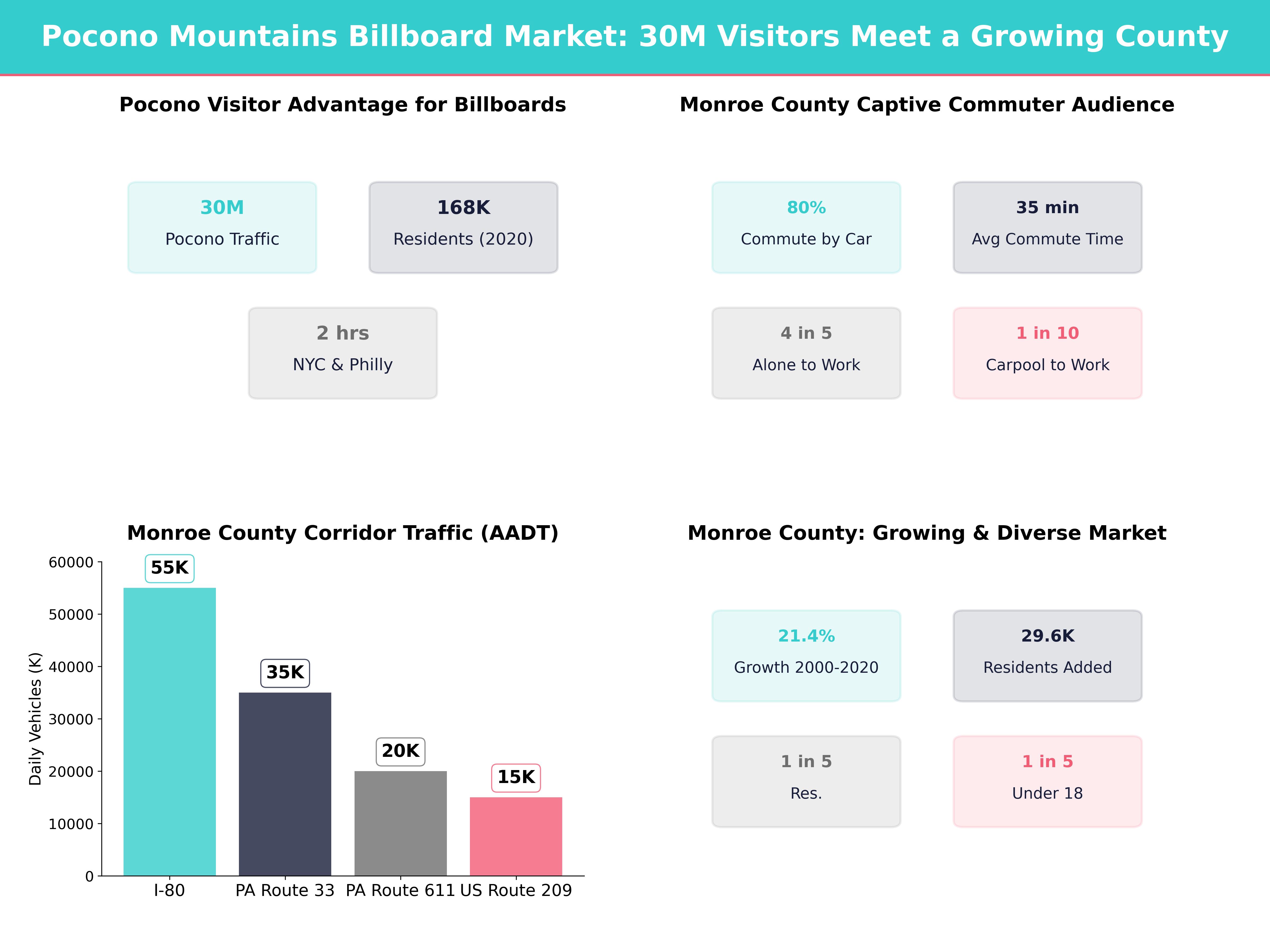
Sciota sits inside Monroe County on the important U.S. Route 209 spine between the Stroudsburg area and western Pocono communities, which gives us access to both everyday local traffic and bigger regional travel flows. The county reached 168,327 residents in 2020, up from 138,687 in 2000, so advertisers are working in a market that grew 21.4% over two decades. This is also a drive-first region, with roughly 80% of workers commuting by car and many visitors arriving by highway rather than by rail or air. When we combine year-round local households with the Pocono Mountains' 30 million annual visitors, Sciota becomes a strong base for billboard campaigns that need repeated visibility.
Sciota Market Overview
Sciota is part of a broader Monroe County market that blends commuter households, tourism, education, retail, healthcare, and hospitality. According to the Pennsylvania State Data Center, Monroe County’s 2020 population was 168,327, which represented an increase of 29,640 residents from 2000. That 21.4% growth matters because billboard advertising works especially well in markets where both rooftops and road volume have expanded over time.
The local economy is broader than many advertisers first assume. In and around Hamilton Township, Stroud Township, Stroudsburg, and East Stroudsburg, we see a mix of healthcare, education, tourism, retail, construction, and service businesses. Major anchors such as Lehigh Valley Hospital–Pocono, St. Luke’s Monroe Campus East Stroudsburg University, The Crossings Premium Outlets Camelback Resort, Kalahari Resorts & Conventions Poconos Mount Airy Casino Resort
For billboard advertisers, the most important behavior is still car dependence. Monroe County is a market where roughly 4 in 5 workers drive alone to work, and nearly 1 in 10 carpool. The average commute is about 35 minutes, which is long enough to make repeated roadside exposure valuable. Monroe County Transit Authority provides useful local service, but transit remains a secondary mode compared with private vehicles, which means roadside messaging reaches people where they actually spend time.
The county’s demographic mix also supports varied creative strategies. About 1 in 5 residents are under 18, and nearly 1 in 5 residents identify as Hispanic or Latino. That gives us room to build campaigns for families, schools, healthcare providers, quick-service restaurants, bilingual service businesses, and regional retailers. For advertisers in Sciota, the opportunity is not just “small-town advertising.” It is local access to a much larger Pocono travel shed.
Key Traffic Corridors Around Sciota
Sciota’s billboard value comes from how close it is to several of Monroe County’s most important travel routes. When we plan campaigns here, we should think in corridors rather than just municipal lines.
U.S. Route 209 through Sciota and Hamilton Township
Sciota’s home corridor is U.S. 209. PennDOT traffic maps typically place Monroe County segments of U.S. 209 in the 10,000 to 20,000 AADT range, depending on the exact segment and nearby commercial activity. That is ideal for advertisers who need dependable local frequency rather than one-time tourist impressions.
This corridor is especially strong for:
- Local restaurants, convenience stores, and fuel retailers that want to intercept routine errand traffic.
- Home services, auto repair, and healthcare providers that depend on nearby households in Hamilton Township, Stroud Township, and the Pleasant Valley area.
- Community institutions, such as schools, colleges, churches, and event venues, that need repeated exposure over several weeks.
Because U.S. 209 traffic in Sciota tends to be more local and more intentional than interstate traffic, we can use more precise calls to action here, such as a nearby turn, a distance marker, or a neighborhood reference.
Interstate 80 through Stroudsburg, Delaware Water Gap, and Bartonsville
Interstate 80 is the region’s dominant high-volume corridor. PennDOT counts around Monroe County commonly show I-80 segments above 50,000 vehicles per day, and some stretches near the Stroudsburg-area interchanges approach or exceed 60,000 AADT. That is the broad-reach route for advertisers that want countywide, regional, and visitor-heavy exposure.
I-80 is ideal for:
- Tourism and hospitality brands that want to reach weekenders coming into the Poconos.
- Retailers and dining brands that benefit from impulse stops near major exits.
- Healthcare systems, colleges, casinos, and entertainment venues that need regional awareness across Monroe County and beyond.
The key interchange cluster around exits 304, 306, and 307 is especially valuable because it connects travelers to Shawnee, downtown Stroudsburg, Bartonsville retail, and the Tannersville resort corridor.
Pennsylvania Route 33 and the Lehigh Valley connection
PA 33 gives Sciota advertisers access to a different type of mobility. Near the I-80 connection and southbound toward the Lehigh Valley, PennDOT traffic counts generally fall in the 30,000 to 40,000 AADT band. This route matters because Monroe County is not a closed local economy. Many households move between the Poconos and the Lehigh Valley for work, education, shopping, and healthcare.
Campaigns on or near PA 33 work well for:
- Auto dealers, banks, insurers, and healthcare providers that serve multi-county customers.
- Home improvement brands that follow suburban growth west and south of Stroudsburg.
- Regional employers, trade schools, and colleges that recruit from a broad commuter base.
If our goal is to reach people who live in Monroe County but do not spend all day inside Monroe County, PA 33 becomes a smart complement to Sciota-area U.S. 209 boards.
Pennsylvania Route 611, Bartonsville, and Tannersville retail traffic
PA 611 is one of the region’s strongest commercial corridors. In the Stroudsburg and Bartonsville area, segments often operate in the 15,000 to 25,000 AADT range, with traffic shaped by shopping, lodging, dining, and resort trips. This is where we reach consumers who are already in spending mode.
This corridor is particularly useful for advertisers tied to destinations such as The Crossings Premium Outlets 100 stores, Camelback Resort, Kalahari Resorts & Conventions Poconos Mount Airy Casino Resort
Audience Segments We Can Reach in Sciota
The strength of Sciota billboard advertising is that we are not limited to one audience. We can reach several distinct groups, often from the same corridor, if our timing and creative are aligned.
Commuters and everyday drivers
Monroe County’s commuter base is the foundation of year-round billboard performance. Roughly 4 in 5 workers drive alone, nearly 1 in 10 carpool, and the average commute is about 35 minutes. That pattern gives us two advantages. First, billboards can build frequency because the same drivers pass the same routes repeatedly. Second, longer commutes increase message exposure during morning and evening peak travel.
This audience responds well to practical categories, such as healthcare, finance, education, legal services, grocery, fuel, dining, home improvement, and automotive. For Sciota-based campaigns, U.S. 209 is often the best route for local repetition, while I-80 and PA 33 expand us into broader commuter awareness.
Tourists, weekenders, and drive-market visitors
The Pocono Mountains Visitors Bureau promotes a 2,400-square-mile region that attracts 30 million visitors annually and sits within about 2 hours of both New York City and Philadelphia. That is a billboard-friendly tourism profile because many of those visitors arrive by car and make decisions while already en route.
Several local attractions come with built-in volume and recognizable branding:
- Kalahari Resorts & Conventions Poconos 220,000-square-foot indoor waterpark.
- Great Wolf Lodge Pocono Mountains 120,000-square-foot indoor water park.
- Camelback Resort offers 39 trails and 16 lifts in winter.
- Shawnee Mountain Ski Area 23 trails and 11 lifts.
- Pocono Raceway is a 2.5-mile tri-oval that creates major summer event traffic.
For advertisers in dining, attractions, lodging, retail, nightlife, and family entertainment, this visitor stream is one of the most compelling reasons to buy digital billboard inventory near Sciota and the broader Stroudsburg-Tannersville corridor.
Students, families, and education-driven households
The market is not only about tourists. It is also a family-heavy place where school calendars strongly affect traffic patterns and spending. About 1 in 5 Monroe County residents are under 18, and East Stroudsburg University serves more than 5,000 students. Nearby institutions such as Northampton Community College, Stroudsburg Area School District East Stroudsburg Area School District, and Pleasant Valley School District add a steady education rhythm to the market.
This audience is attractive for:
- Pediatric and family healthcare.
- Youth activities, camps, and tutoring.
- Fast casual dining and convenience purchases.
- Back-to-school retail, financial services, and wireless plans.
If we want to speak to parents, school employees, and students, creative should feel useful and direct rather than flashy.
Workers, shoppers, and service users
Sciota also benefits from the wider Monroe County workday economy. We can reach hospital staff, retail workers, hospitality employees, construction crews, university staff, and shoppers moving between Stroudsburg, East Stroudsburg, Bartonsville, and Tannersville. Organizations such as the Greater Pocono Chamber of Commerce and the Pocono Mountains Economic Development Corporation reflect how diverse the regional business base has become.
For B2B advertisers, staffing firms, trade schools, and business services, this audience supports billboard campaigns that are not purely consumer-focused. Monroe County’s labor market is broad enough to justify recruiting, workforce, and healthcare employment messaging.
Seasonal and Timing Opportunities in Sciota
One of the best things about Sciota is that we can advertise here year-round without forcing the same message every month. The right timing strategy changes with weather, school calendars, and visitor surges.
Winter in Sciota and the surrounding Poconos
Winter is one of the clearest seasonal opportunities. Camelback Resort runs 39 ski trails with 16 lifts, and Shawnee Mountain Ski Area 23 trails with 11 lifts. At the same time, indoor attractions such as Kalahari Resorts & Conventions Poconos Great Wolf Lodge Pocono Mountains
In winter, we should consider:
- Running weather-aware creative for restaurants, auto care, urgent care, and retail.
- Increasing afternoon and early-evening visibility, when darkness arrives earlier and digital boards stand out.
- Using Friday and Sunday targeting to capture ski weekend arrivals and departures.
Spring in Sciota
Spring tends to favor local-service advertisers. Tax season, landscaping, home improvement, healthcare appointments, graduation planning, and wedding bookings all increase relevance. East Stroudsburg University, Northampton Community College, and local school districts drive a strong graduation and family-event cycle from April into June.
This is a good window for campaigns that need local trust. Healthcare systems, dental providers, nurseries, banks, colleges, and event venues often perform well in spring because consumer intent is practical and calendar-driven.
Summer in Sciota and Monroe County
Summer brings the region’s biggest mix of tourists, day-trippers, and event travelers. Pocono Raceway, with its 2.5-mile tri-oval, creates major traffic spikes on race weekends. The Crossings Premium Outlets Camelback Resort, Kalahari Resorts & Conventions Poconos Shawnee Inn & Golf Resort all help keep summer roads busy.
For summer campaigns, we should prioritize:
- Friday afternoon arrival traffic on I-80.
- Saturday family and leisure traffic near Bartonsville and Tannersville.
- Sunday return traffic, when food, fuel, last-stop retail, and event messaging can be especially effective.
Fall and holiday timing in Sciota
Fall is underrated in the Poconos. Foliage travel, back-to-school routines, college move-in, football weekends, downtown events at places like the Sherman Theater
This is a prime season for:
- Colleges, healthcare, and family services in August and September.
- Restaurants, breweries, and entertainment venues during foliage weekends.
- Retailers and outlets during November and December, especially around The Crossings Premium Outlets
Billboard Design Tips for the Sciota Market
Sciota is not a market where one creative style fits every board. We should design for the road, the audience, and the season.
Match the message to the road speed in Sciota
On I-80 and PA 33, drivers move fast and process messages quickly. We should use one offer, one brand cue, and one action. A clean headline, a bold logo, and a simple directional phrase usually beat a detailed list of services.
On U.S. 209 and commercial stretches of PA 611, we can be slightly more specific because traffic is more local and speeds are lower. In those areas, messages such as “5 minutes ahead,” “Next right on 209,” or “Near Bartonsville” can work well because they reflect how people actually navigate the market.
Use Pocono-specific imagery and seasonal cues
Creative should feel like it belongs in Monroe County. Mountain silhouettes, winter snow scenes, family indoor fun, outlet-shopping cues, and local dining imagery all resonate because they reflect how people use the area. If we are targeting visitors, “Poconos” is often more recognizable than a smaller town name alone.
Seasonal swaps are especially effective here. A winter creative set should look different from a summer creative set. Ski, snow, and warm indoor refuge work in January. Pools, racing, shopping, and family escape visuals work in July. Foliage and cozy dining imagery work in October.
Speak to a practical and diverse local audience
Monroe County is diverse enough to justify testing multiple creative approaches. With nearly 1 in 5 residents identifying as Hispanic or Latino, bilingual or Spanish-forward versions can be worthwhile for healthcare, financial services, telecom, grocery, and community campaigns.
Local audiences also respond to credibility. We should emphasize trust signals, location clarity, and value. In Sciota, “locally trusted,” “open daily,” “same-day appointments,” or “minutes from Exit 307” often fits the audience better than abstract branding language.
Regional Strategies Around Sciota
Sciota works best when we think in submarkets. Different parts of Monroe County support different campaign goals.
Sciota and Hamilton Township
For businesses that serve nearby households, Sciota and Hamilton Township are best approached as a frequency market. U.S. 209 boards here are strong for dentists, restaurants, banks, fuel stations, grocery, churches, fitness centers, and home-service companies. We should keep creative practical and distance-based because the audience is often making routine trips.
Stroudsburg and East Stroudsburg
Stroudsburg, East Stroudsburg, and Stroud Township form the closest thing Monroe County has to an urban core. This is where we find concentrated healthcare, university activity, county government, legal services, dining, and entertainment. Campaigns aimed at East Stroudsburg University, Lehigh Valley Hospital–Pocono, St. Luke’s Monroe Campus
Bartonsville, Tannersville, and the I-80 resort corridor
This is the best regional strategy for visitor-heavy campaigns. Between The Crossings Premium Outlets Camelback Resort, Kalahari Resorts & Conventions Poconos Mount Airy Casino Resort
Brodheadsville, Pleasant Valley, and westward residential areas
West of Sciota, the Brodheadsville and Pleasant Valley side is valuable for household-oriented categories. Pleasant Valley School District, Chestnuthill Township
Shawnee and the river-facing leisure corridor
The Shawnee side, anchored by Shawnee Mountain Ski Area Shawnee Inn & Golf Resort, is ideal for destination campaigns. We can use this area for weddings, golf, leisure dining, spa offers, and seasonal events. Messaging should feel more aspirational here because the audience is often traveling for recreation rather than routine errands.
Using Blip Tools for Sciota Campaigns
Blip’s tools are especially useful in a market like Sciota because traffic patterns change by corridor, season, and even weather. We can daypart for morning and evening commuters on U.S. 209, then shift budget toward Friday arrivals and Sunday departures on I-80. We can also increase presence around ski weekends, race weekends, outlet-heavy holiday shopping periods, and university calendar moments without rebuilding an entire campaign structure.
Creative testing is equally important here. We can run one version for locals on U.S. 209, another for broad awareness on I-80, and a third for tourism-heavy boards near Tannersville. If one message performs better with shoppers and another performs better with commuters, we can adjust quickly rather than waiting through a long fixed campaign cycle.
Sciota is also a good market for frequent refreshes. Because a digital billboard blip lasts only 7.5 to 10 seconds, clarity matters, and seasonal relevance matters even more. Blip’s artwork tools and analytics make it practical for us to rotate winter, summer, back-to-school, and holiday versions without turning the process into a major production project.
Getting Started with Billboard Rental in Sciota
Renting a billboard in Sciota starts with one basic question: who are we trying to reach? If the goal is local leads, we should start with U.S. 209 and nearby community traffic. If the goal is regional awareness, we should look at I-80 and PA 33. If the goal is tourism demand, we should focus on the Bartonsville, Tannersville, and Shawnee travel patterns that intensify on weekends and during peak seasons.
How we should evaluate Sciota billboard locations
We should compare locations using a few practical filters. We need to know the direction of travel, the likely purpose of the trip, the speed of the roadway, the distance from major exits or destinations, and the time of day when the audience is most active. A board near an interstate may deliver more raw reach, while a board on U.S. 209 may deliver better local intent.
It usually makes sense to start with 2 or 3 well-chosen boards rather than trying to cover every corridor at once. That lets us test whether commuters, tourists, or local households respond best to our offer. From there, we can expand the locations that match our real audience rather than our assumptions.
What to expect from billboard rental in Sciota
In a traditional billboard buying process, local advertisers often have to work through fixed packages, negotiated schedules, and slower revision cycles. Sciota is not a market where that rigidity always helps, because demand changes with seasons, weekends, weather, and event schedules. A flexible platform is better suited to a region where one month may be commuter-heavy and the next may be tourism-heavy.
With Blip, we can choose boards on a map, align them to Sciota’s actual travel patterns, upload creative built for each corridor, and adjust budget as we learn. That makes billboard rental feel less like a one-time commitment and more like an adaptable media channel. In a place like Sciota, where local roads connect directly to one of Pennsylvania’s most recognizable tourism regions, that flexibility is a real competitive advantage.