Billboards in Wilkes-Barre, PA
No Minimum Spend. No Long-Term Contracts. Just Results.
Trusted by Leading Brands


Billboard advertising
in Wilkes-Barre has never been easier



How much is a billboard in Wilkes-Barre?
Why Choose Blip for Billboard Advertising in Wilkes-Barre
Blip lets you launch fast in Wilkes-Barre and target I-81 commuters, where 4 in 5 workers drive alone and repeat your ad daily.
Use Blip-optimized campaigns in Wilkes-Barre to auto-place ads near PA 309, Mohegan Arena, and the casino for high-intent traffic.
No contracts in Wilkes-Barre means you can start small, flex budget, and scale around Penguins games, RailRiders nights, or holiday peaks.
Blip's dayparting helps your Wilkes-Barre ad hit morning commuters on I-81 and evening crowds heading to downtown, the arena, and Mohegan Pennsylvania.
Track Wilkes-Barre performance in real time and shift spend fast as college move-in, spring graduation, or winter road traffic changes.
Frequently Asked Questions About Billboard Advertising in Wilkes-Barre
How much does a billboard cost in Wilkes-Barre with Blip?
With Blip, billboard advertising in Wilkes-Barre can fit a wide range of budgets because you only pay when your ad actually appears. Each “blip” is a 7.5-to-10-second display on a rotating digital billboard, with pricing starting at just $0.01 per display. The cost per blip changes based on time of day, location, and advertiser demand.
Where can I advertise with Blip in Wilkes-Barre for the best local reach?
Wilkes-Barre’s billboard value is shaped by a handful of high-visibility routes, and I-81 through Wilkes-Barre is the backbone corridor for north-south movement between Scranton, Wilkes-Barre, Hazleton, and the wider NEPA distribution belt. PA 309, especially the Cross Valley Expressway, is one of the market’s strongest retail and daily-errand corridors. PA 315 is strategically powerful because it connects the airport area, business parks, arena traffic, casino traffic, and major commercial properties.
Why is Wilkes-Barre a strong market for Blip billboard ads?
Wilkes-Barre gives us a rare billboard market where everyday commuting, regional shopping, college activity, and year-round entertainment all overlap. The city has 44,328 residents, Luzerne County has 325,594, and the broader Scranton–Wilkes-Barre–Hazleton metro reaches 567,559, so the effective trade area is much larger than the city limits alone. This is also a strongly auto-oriented part of northeastern Pennsylvania, with about 4 in 5 workers driving alone and nearly 9 in 10 commuting by personal vehicle when carpools are included.
What kinds of audiences can Wilkes-Barre billboards reach?
A strong Wilkes-Barre campaign can reach daily commuters, college students, families, sports fans, and industrial workers all at once. The market includes nearby colleges like Wilkes University, King's College, Penn State Wilkes-Barre, and Luzerne County Community College, plus major entertainment draws like Mohegan Arena at Casey Plaza and the Wilkes-Barre/Scranton Penguins. It also supports warehouse, trucking, and skilled-trades audiences moving along I-81, I-80, and related connectors.
When is the best time to run Blip billboard ads in Wilkes-Barre?
Late August through November is one of the best timing windows in Wilkes-Barre because college students return, K-12 schedules restart, football season begins, and the Penguins home schedule gets underway. Winter campaigns should usually begin in late November or early December and often stay relevant through March, while the roughly 6-week stretch between Thanksgiving and New Year’s Day is especially valuable around the arena, casino, and retail corridors. Summer also expands the market for about 14 weeks with more local dining, shopping, and weekend events.
Do I need a contract to advertise with Blip in Wilkes-Barre?
No, Blip has no long-term contracts or minimum commitments. You can start, pause, or stop your campaign at any time.
How fast can I launch a billboard campaign with Blip in Wilkes-Barre?
You can have your campaign live in minutes. Create a free account, select your locations, set your budget, upload your design, and start running once approved.
Where can I advertise with Blip in Wilkes-Barre?
Blip has digital billboards in Wilkes-Barre. You can browse available locations on a map, choose the ones that fit your audience, and start advertising right away.
Still have questions? Launch a campaign in minutes — no contracts, no commitments.
Start Your CampaignWilkes-Barre Billboard Advertising Guide
Wilkes-Barre gives us a rare billboard market where everyday commuting, regional shopping, college activity, and year-round entertainment all overlap, with 36 Penguins 75 RailRiders home games, and venues ranging from about 1,800 to 8,300 seats. The City of Wilkes-Barre has 44,328 residents, Luzerne County has 325,594, and the broader Scranton Wilkes-Barre– Hazleton 567,559, so the effective trade area is much larger than the city limits alone.
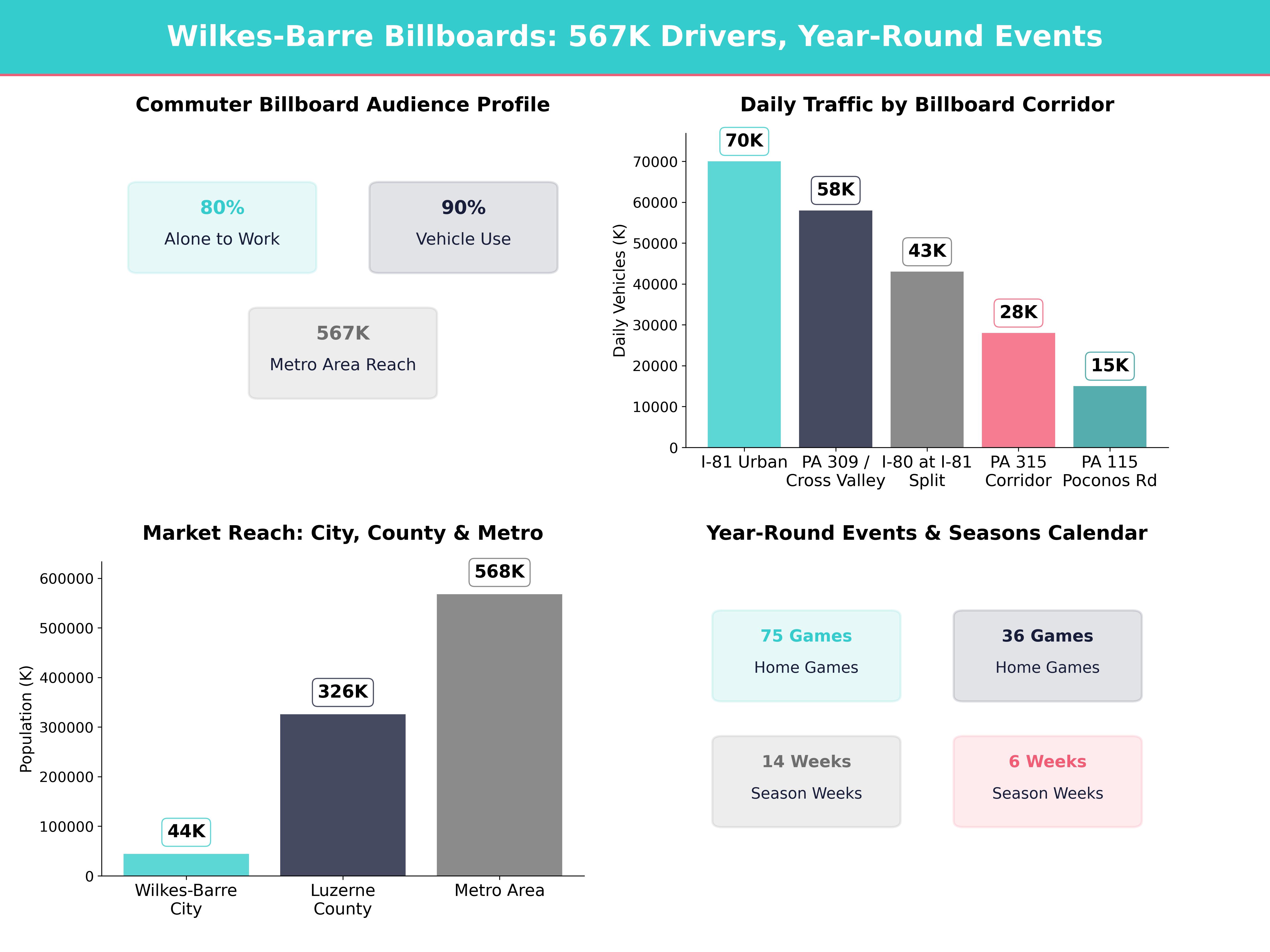
This is also a strongly auto-oriented part of northeastern Pennsylvania, with recent survey data showing about 4 in 5 workers drive alone and nearly 9 in 10 commute by personal vehicle when carpools are included. When we combine that driving culture with destination draws like Downtown Wilkes-Barre, Mohegan Pennsylvania, Mohegan Arena at Casey Plaza PennDOT, Wilkes-Barre becomes a very efficient place to build repeated digital billboard exposure.
Market Overview for Wilkes-Barre
Wilkes-Barre works best when we think of it as both a city and a regional hub. The local audience is not limited to downtown residents, because employers, colleges, medical systems, retail centers, and entertainment venues pull people in from across the Wyoming Valley every day, including 3 nearby colleges.
Population, trade area, and mobility in Wilkes-Barre
Wilkes-Barre added 2,830 residents between 2010 and 2020, which was a 6.8% increase. Over the same period, Luzerne County added 4,676 residents, or about 1.5%. Those gains matter because they show the local market has remained relevant even as many northeastern legacy cities have faced slower growth.
The geography also helps us. Wilkes-Barre sits about 20 miles south of Scranton 2 hours from both New York City and Philadelphia by car under normal conditions. The Wilkes-Barre/Scranton International Airport is only about 10 to 12 miles from downtown, which adds business travelers, visiting families, and airport employees to the advertising mix.
For billboards, the biggest mobility fact is simple: people here drive. Even though the Luzerne County Transportation Authority
Economy and consumer demand in the Wyoming Valley
Wilkes-Barre benefits from a diverse practical economy rather than a one-industry economy. Healthcare providers such as Geisinger, colleges such as Wilkes University, King's College, Penn State Wilkes-Barre Luzerne County Community College, public employers, hospitality venues, gaming, warehousing, trucking, and trade businesses all contribute to daily traffic.
Regional economic development groups such as the Greater Wyoming Valley Chamber of Commerce, the NEPA Alliance, and CAN DO, Inc. consistently position northeastern Pennsylvania as a logistics and distribution location because of its access to Interstate 81, Interstate 80, and the Pennsylvania Turnpike. For advertisers, that mix creates a healthy balance of weekday commuting, shift-based employment travel, student movement, weekend retail, and event traffic.
In practical terms, this means Wilkes-Barre rewards billboard campaigns built around convenience, location, urgency, and local relevance. Offers like “off Route 309,” “near the arena,” “minutes from downtown,” and “open late” fit how people actually navigate the market.
Key Traffic Corridors for Digital Billboards in Wilkes-Barre
Wilkes-Barre’s billboard value is shaped by a handful of high-visibility routes. When we understand which corridor carries which audience, we can match the board to the business instead of buying visibility in the abstract.
Interstate 81 through Wilkes-Barre
According to recent PennDOT traffic volume maps, urban segments of I-81 around Wilkes-Barre and nearby Pittston commonly fall in the 60,000 to 80,000+ AADT range. This is the backbone corridor for north-south movement between Scranton, Wilkes-Barre, Hazleton, and the wider NEPA distribution belt.
We usually like I-81 for advertisers that need broad regional reach, including these categories:
- Healthcare systems perform well here because patients often choose providers based on name recognition and convenience during familiar commute patterns.
- Colleges and trade schools benefit because I-81 links multiple student and family catchment areas across the valley.
- Auto dealers, insurance brands, and home services gain repeated exposure from drivers who use the same route every weekday.
- Staffing firms and industrial recruiters benefit because many warehouse, trucking, and shift workers use I-81 at predictable times.
If our goal is market-wide awareness, I-81 is usually the first corridor we evaluate.
PA 309 and the Cross Valley Expressway in Wilkes-Barre
PA 309, especially the Cross Valley Expressway, is one of the market’s strongest retail and daily-errand corridors. PennDOT counts often place key urban stretches in roughly the 45,000 to 70,000 AADT range, depending on the exact segment.
This route does more than move commuters. It connects Kingston, Wilkes-Barre, Plains Township Wilkes-Barre Township
- Retail, grocery, and quick-service restaurants benefit because people are already in a purchase mindset on this corridor.
- Entertainment venues gain traction because the road feeds directly into the arena, casino, and restaurant cluster.
- Urgent care, dentists, and specialty clinics fit well because convenience and route familiarity matter in healthcare decisions.
- Local political, legal, and service brands benefit from frequency because the corridor mixes residents, workers, and shoppers.
When we want a board that feels close to action rather than broadly regional, PA 309 is often the best fit.
PA 315, the airport corridor, and the arena-casino district
PA 315 is shorter than I-81 and PA 309, but it is strategically powerful. Recent PennDOT maps often show stretches in the 20,000 to 35,000 AADT range, and the road connects the airport area, business parks, arena traffic, casino traffic, and major commercial properties.
This is one of the best corridors in the market for high-intent audiences. It works especially well for:
- Hotels, restaurants, and hospitality brands because visitors arriving through AVP often pass through this zone.
- Casino, nightlife, and event promotions because the road serves Mohegan Pennsylvania and Mohegan Arena at Casey Plaza
- B2B, logistics, and staffing campaigns because nearby industrial and business properties generate daily employee traffic.
- Airport parking, car rentals, and travel services because the audience includes travelers, greeters, and frequent business drivers.
For advertisers who need intent rather than pure scale, PA 315 is a very efficient buy.
Interstate 80, PA 115, and southbound regional travel from Wilkes-Barre
Wilkes-Barre also benefits from being near east-west leisure and freight routes. Around the I-81/I-80 split, PennDOT counts on I-80 commonly land in the 35,000 to 50,000 AADT range. PA 115, the southbound route toward the Poconos, typically carries lower but still meaningful traffic, often around 10,000 to 20,000 AADT on relevant stretches.
These roads matter because they carry travelers beyond the daily work commute. We usually use them for:
- Tourism and recreation brands targeting weekend visitors headed toward the Pocono Mountains Visitors Bureau region.
- Snow tire, HVAC, and weather-sensitive services because drivers on these routes are very aware of seasonal road conditions.
- Destination retail and attractions because travelers are making active route choices and can still be redirected.
- Colleges and family destinations because move-in, graduation, and visitation periods create clear traffic spikes.
If our offer depends on travel planning or destination choice, these southbound and east-west feeders deserve attention.
Audience Segments We Can Reach with Wilkes-Barre Billboards
A strong Wilkes-Barre campaign usually works because it reaches more than one audience at once. The best boards here can touch commuters in the morning, shoppers in the afternoon, and eventgoers at night.
Daily commuters and errand traffic in Wilkes-Barre
This is the foundation audience. With about 4 in 5 workers driving alone and nearly 9 in 10 commuting by personal vehicle, repeated exposure is easy to build on major routes. We can use that repetition for categories that benefit from familiarity, such as healthcare, insurance, real estate, auto service, banking, and home improvement.
Because many errands also cluster along PA 309, PA 315, and local commercial strips, Wilkes-Barre supports billboard messaging that nudges immediate action. “Exit now,” “next right,” and “minutes away” style calls to action are unusually practical in this market.
College students, faculty, and visiting families in Wilkes-Barre
Wilkes-Barre has a bigger education footprint than many advertisers expect. Wilkes University has a 35-acre campus in the city, King's College has a 50-acre campus near downtown, and Penn State Wilkes-Barre 54-acre campus in nearby Lehman. Those campuses bring in students, faculty, staff, alumni, visiting parents, and event attendees through much of the year.
For billboard planning, the key moments are late summer move-in, fall athletics and campus events, spring open houses, and commencement season. Restaurants, apartments, banks, healthcare providers, tutoring services, and employers can all benefit from the academic calendar.
Sports, concerts, casino, and nightlife audiences around Wilkes-Barre
This is one of Wilkes-Barre’s biggest advantages over smaller Pennsylvania cities. Mohegan Arena at Casey Plaza 8,300 for hockey and can scale to roughly 10,000 for concerts and large shows. The Wilkes-Barre/Scranton Penguins 36 regular-season home games before playoffs, which creates a long run of evening and weekend visibility opportunities from October through April.
The city also has the F.M. Kirby Center, which seats about 1,800 and drives a steady calendar of performances downtown. At Mohegan Pennsylvania, the casino floor features more than 1,700 slot machines, which signals just how strong the regional entertainment draw is.
We can also think beyond the city core. The nearby Scranton/Wilkes-Barre RailRiders play 75 home games each season, which keeps the wider metro in a recreational mindset from April into September. When we align billboard timing with game nights, concerts, and casino peaks, we reach people who are out to spend.
Families, healthcare consumers, and local shoppers in the Wilkes-Barre area
Wilkes-Barre billboards are not only for destination traffic. They are also very effective for daily-life categories serving families in Wilkes-Barre, Kingston, Plains, Dallas, Back Mountain communities, Mountain Top, and Pittston. Healthcare, urgent care, pediatrics, orthodontics, childcare, supermarkets, furniture, and home services all fit the local audience profile.
This segment responds well to practical credibility. In our experience, messages that promise speed, trust, financing, same-day scheduling, or convenient locations usually fit the local market better than luxury-first messaging.
Industrial, warehouse, and skilled-trades workers near Wilkes-Barre
The broader Wyoming Valley and I-81 belt support major warehousing, trucking, and industrial activity. Organizations like the NEPA Alliance and CAN DO, Inc. highlight the region’s freight access and industrial park network for good reason.
For billboard advertisers, that means we can reach:
- Shift workers traveling early in the morning, late in the evening, or overnight.
- Commercial drivers moving along I-81, I-80, and related connectors.
- Skilled-trades audiences for tools, workwear, trucks, staffing, training, and financial services.
- B2B decision-makers who regularly move between business parks, plants, and offices.
Recruitment campaigns often do especially well when we focus on route relevance and start dates rather than brand storytelling alone.
Seasonal and Timing Opportunities for Wilkes-Barre Billboard Campaigns
Wilkes-Barre rewards timing. Weather, school schedules, sports, and regional leisure traffic all create predictable windows when certain categories become much easier to notice and much more likely to convert.
Winter in Wilkes-Barre
Winter campaigns should usually begin in late November or early December, and they often stay relevant through March. This is a strong period for heating oil, HVAC, urgent care, orthopedics, snow removal, auto service, and winter retail.
The local creative context matters. Gray skies, early darkness, and snowbanks make high-contrast boards easier to read. Winter also supports leisure traffic toward Montage Mountain Resorts and the Pocono Mountains Visitors Bureau area, so weekend-oriented hospitality and recreation campaigns can work well on southbound routes.
Spring events and graduation season in Wilkes-Barre
From late April through June, we get a useful mix of commencements, outdoor event traffic, and home-service demand. Fine Arts Fiesta 4-day Memorial Day weekend tradition in Wilkes-Barre, and it helps bring attention back to downtown just as graduation and warm-weather activity increase.
This is the season when we usually like to promote:
- Colleges and continuing education because families are already thinking about academic decisions.
- Restaurants, brunch spots, and event venues because spring social calendars grow quickly.
- Landscaping, patios, roofing, and home improvement because homeowners are ready to act after winter.
- Medical and wellness services because people often resume delayed appointments in spring.
Summer tourism, festivals, and baseball near Wilkes-Barre
Summer runs roughly from Memorial Day to Labor Day, and it expands the market in two directions at once, for roughly 14 weeks. First, local residents are out more often for dining, shopping, and weekend events. Second, regional travel toward recreation areas increases.
The RailRiders alone bring 75 home dates to the metro schedule, and that keeps sports and family entertainment top of mind for about 6 months. Summer is also strong for waterpark trips, outdoor concerts, furniture, home projects, moving, healthcare, and destination retail.
If we want to capture leisure traffic, we usually shift more spend into Friday afternoons, Saturdays, and holiday weekends. If we want local household demand, we often keep weekday rotations active because family errands remain constant.
Fall routines, campus return, and hockey in Wilkes-Barre
Late August through November is one of the best timing windows in the market. College students return, K-12 schedules restart, football season activates local attention, and the Wilkes-Barre/Scranton Penguins 7 months.
This is an excellent season for:
- Colleges, tutoring, and training programs because decision cycles restart with the academic year.
- Healthcare and family services because routines become structured again.
- Recruiting campaigns because employers often push hard in the fall.
- Restaurants, bars, and event promotions because hockey nights and weekend gatherings drive repeat traffic.
Holiday shopping and gaming in Wilkes-Barre
The roughly 6-week stretch between Thanksgiving and New Year’s Day is especially valuable around the arena, casino, and retail corridors. This is when we usually favor entertainment, jewelry, dining, giftable services, salons, party venues, gaming, and seasonal offers.
Because winter darkness arrives early, evening visibility becomes even more important. A billboard that feels merely adequate at 2 p.m. can become far more powerful at 6 p.m. during the holiday season.
Wilkes-Barre Billboard Design Tips That Feel Local
Creative matters everywhere, but local tone matters even more in Wilkes-Barre. We generally see better results when the design feels grounded in the Wyoming Valley rather than borrowed from a generic national campaign.
Use Wyoming Valley cues in Wilkes-Barre creative
Wilkes-Barre audiences respond well to messages that feel geographically familiar. References to NEPA, the Wyoming Valley, the Cross Valley, downtown, Back Mountain, Pittston, the arena district, and the Poconos make ads feel closer and more actionable.
We also like imagery that reflects how people actually live here. Family SUVs, pickup trucks, winter jackets, game-night energy, riverfront or mountain cues, and practical everyday scenes usually feel more authentic than subway, beach, or big-city luxury visuals.
Design for Wilkes-Barre weather, speed, and visibility
Many of the market’s best billboard routes move at 55 to 65 mph, especially on I-81 and faster portions of PA 309. That means our creative should usually lead with the brand, the offer, or the location immediately.
The local climate also influences readability. In winter, white backgrounds can wash out against snow and overcast skies unless contrast is very strong. In the arena and casino zone, night-friendly color palettes such as deep blue, black, gold, bright red, or high-contrast white often work better because so much of the audience arrives after dark.
Match the message to the Wilkes-Barre corridor
The same brand should not necessarily use the same message everywhere. We usually align copy to route context in the following ways:
- On I-81, we favor broad awareness, strong category cues, and simple trust-building lines.
- On PA 309, we favor location-driven retail and service offers that support immediate detours.
- Near PA 315, we favor entertainment, hospitality, recruiting, and travel messaging.
- On southbound leisure routes, we favor weekend, seasonal, and destination-focused language.
This market responds well to practical specificity. “Near Mohegan,” “minutes from downtown,” “off 309,” and “same-day appointments” are all stronger than abstract slogans.
Consider multiple creative versions for Wilkes-Barre audiences
Wilkes-Barre is diverse enough that one creative version is not always enough. If we serve both professionals and working families, or both English- and Spanish-speaking households, rotating variants can improve relevance without changing the media plan.
We also like to swap creative around the sports and academic calendar. A board that promotes “game night,” “move-in week,” or “holiday appointments” feels much more timely than one evergreen message left up all year.
Regional Strategies for Wilkes-Barre and Nearby Submarkets
A smart Wilkes-Barre billboard plan usually treats the market as a set of sub-areas with different jobs to do. That lets us build both scale and precision.
Downtown Wilkes-Barre
Downtown is where we usually focus on restaurants, nightlife, law firms, banks, colleges, medical offices, and event programming. Boards near the urban core can also support Downtown Wilkes-Barre foot traffic, F.M. Kirby Center attendance, and city events.
We generally like midday, late afternoon, and evening weight here because those periods align with lunch trips, after-work plans, and event arrivals.
Wilkes-Barre Township, Plains, and the arena-casino belt
This is one of the most commercially intense parts of the market. The area around Mohegan Arena at Casey Plaza Mohegan Pennsylvania is ideal for entertainment, chain retail, auto, dining, healthcare, and quick-turn promotions.
Night and weekend emphasis usually works well here. If we have a concert, seasonal retail push, or limited-time dining offer, this district often gives us the closest thing to destination-intent traffic in the market.
Pittston, Avoca, and the airport-logistics corridor near Wilkes-Barre
North of Wilkes-Barre, the airport and business-park corridor offers a different audience mix. This is where we often target airport users, logistics employees, staffing candidates, B2B services, hotels, and business travelers coming through AVP.
Because this submarket serves both commuters and travelers, it benefits from split scheduling. Morning and evening commute periods can handle workforce messaging, while late afternoon and evening can support hospitality and event offers.
Kingston, Back Mountain, and west-side residential communities
For home services, family healthcare, grocery, finance, schools, and local retail, the west side of the river and the residential communities beyond it can be very productive. This is where our billboard strategy should feel useful rather than flashy.
We usually favor trust-heavy messaging here. Price, reliability, family convenience, and neighborhood familiarity often outperform trend-based creative.
Southbound from Wilkes-Barre toward Mountain Top, Hazleton, and the Poconos
This corridor is best when we want to intercept travel decisions. Brands tied to recreation, lodging, winter sports, weekend dining, colleges, outlet shopping, and automotive needs can all benefit from southbound boards.
This is also a good place to extend a Wilkes-Barre campaign into neighboring markets when we want broader regional reach without abandoning local relevance.
Using Blip Tools Effectively in Wilkes-Barre
Blip works especially well in Wilkes-Barre because the market has clear route patterns, strong seasonal behavior, and several distinct demand zones. We can use those patterns to keep our campaigns flexible instead of overbuying static presence.
Pair broad reach with precise Wilkes-Barre targeting
We often get the best result by combining a broad reach layer on I-81 or PA 309 with a more precise layer near downtown, the arena district, or the airport corridor. In Blip, we can do that with a map-based manual setup or let a Blip-optimized campaign distribute budget across the market and then refine from there.
A good starting structure is often 2 to 3 corridor groups rather than trying to cover every board at once. That makes it easier to see which traffic environments actually match our objective.
Daypart around real Wilkes-Barre behavior
Wilkes-Barre has clear daypart opportunities. Morning and late-afternoon commuter periods often work best for healthcare, banking, home services, recruiting, and schools. Evening and weekend periods often work best for casinos, concerts, restaurants, bars, retail, and event promotions.
We can also use dayparting seasonally. For example, winter service brands may want heavier weight during dark afternoon commutes, while summer tourism brands may want stronger Friday and Saturday visibility.
Rotate creative by season, event, and audience
Because this market shifts from commuters to shoppers to eventgoers throughout the day, rotating creative is especially useful. We can run one version tied to hockey nights, another tied to student move-in, and another tied to winter weather or holiday shopping.
Blip’s artwork tools make that practical even when we want several local variations. That is important in Wilkes-Barre because a message near the arena should not always look or read like a message on I-81.
Use analytics to refine Wilkes-Barre campaigns quickly
The biggest advantage of a self-serve digital strategy in this market is that we do not have to guess for long. If one corridor starts outperforming another, or if weekends clearly beat weekdays for a hospitality brand, we can reallocate budget quickly.
That matters in Wilkes-Barre because local demand changes fast around sports schedules, college calendars, weather, and short event windows such as a 4-day festival or a concert-heavy month.
Getting Started with Billboard Rental in Wilkes-Barre
Renting a billboard in Wilkes-Barre is easiest when we begin with a concrete local objective. The right board for a regional hospital brand is not the same as the right board for a sports bar, trade school, or warehouse recruiter.
Start with one Wilkes-Barre goal
We usually begin by choosing a primary goal such as awareness, foot traffic, recruiting, event attendance, or lead generation. Once we know the goal, the location choice becomes much simpler.
For example:
- If we want regional awareness, we usually start with I-81 and large commuter corridors.
- If we want same-week foot traffic, we usually prioritize PA 309, PA 315, and destination zones.
- If we want recruiting, we usually focus on industrial and commuter routes with morning and evening weight.
- If we want event attendance, we usually concentrate on boards near the arena, casino, downtown, and key approach roads.
Evaluate Wilkes-Barre billboard locations like a local buyer
When we compare boards, we usually ask a short list of practical questions. Is the board on the correct side of the commute? Is the audience moving at high speed or slowing for merges and signals? Is the board close enough to the destination to trigger action? Does the surrounding context match the offer?
In Wilkes-Barre, proximity matters. A healthcare ad near a hospital corridor, a restaurant ad near the arena district, or a recruiting message near industrial traffic tends to feel more credible than the same message in a random location with decent traffic.
Use Blip to simplify Wilkes-Barre billboard rental
Traditional billboard buying can be slow, rep-driven, and rigid. Blip makes Wilkes-Barre easier because we can view digital inventory, choose locations ourselves or use optimization, set a budget that fits the campaign, and adjust quickly as local conditions change.
That is especially useful in a market with short timing windows. We may only want a push around 36 hockey home games, a spring graduation period, a 6-week holiday window, or a short recruiting drive. Blip lets us match the media plan to the local opportunity instead of forcing the opportunity to fit a long static contract.
Launch small, learn fast, and expand across Wilkes-Barre
Our best advice is to start with a focused first test. We can launch with a few boards or a few corridor clusters, run locally tailored creative, and watch how the campaign behaves by time, place, and season.
After that, expansion is straightforward. If downtown and the arena district perform best, we can add more entertainment-weighted inventory. If I-81 drives the strongest lift, we can broaden reach into nearby Scranton
In other words, Wilkes-Barre rewards advertisers who stay local, stay flexible, and let the road network guide the strategy. When we do that, digital billboards can become one of the most efficient ways to reach northeastern Pennsylvania audiences at scale.