Billboards in Blakely, PA
No Minimum Spend. No Long-Term Contracts. Just Results.
Trusted by Leading Brands


Billboard advertising
in Blakely has never been easier



How much is a billboard in Blakely?
Why Choose Blip for Billboard Advertising in Blakely
Blip lets Blakely brands launch fast and self-serve on U.S. 6 or the Robert P. Casey Memorial Highway without a sales cycle.
Use Blip-optimized buying in Blakely to auto-shift spend toward I-81, I-84, or I-380 traffic that matches your reach goals.
Blakely's 79% driver commute rate makes flexible dayparting powerful—run ads at 6-9 a.m. and 3-6 p.m. when locals are on the road.
No contracts mean Blip can scale with Blakely's seasonal surges, from Montage Mountain ski traffic to RailRiders and concert nights.
Track Blakely results in real time and refine creative for Dickson City shoppers, Scranton commuters, or Mid Valley service buyers.
Frequently Asked Questions About Billboard Advertising in Blakely
How much does a billboard cost in Blakely with Blip?
With Blip, billboard advertising in Blakely can fit a wide range of budgets because you only pay when your ad actually displays. Pricing starts at just $0.01 per display, and your daily budget guides Blip’s algorithm as it bids for open ad slots. Since costs can change based on time of day, location, and advertiser demand, you stay in control while Blip works to maximize visibility.
Where can I advertise with Blip in Blakely, Pennsylvania?
Because Blakely is only about 8 miles from downtown Scranton, and because the region is tied together by 4 interstates plus the U.S. 6 corridor, we can use digital billboards to reach neighborhood traffic, retail shoppers, and regional commuters at the same time. The market also includes key areas like Dickson City, Archbald, Jessup, Olyphant, and Moosic. A strong Blakely campaign can also stretch into Scranton, the Mid Valley, and nearby destination traffic around I-81 and Montage.
Who do billboard ads in Blakely reach with Blip?
Blakely gives us access to a surprisingly diverse audience mix for a borough of its size. Roughly 8 in 10 workers commute by personal vehicle, so repeated out-of-home impressions have room to build memory. The market also includes shoppers, students, families, sports fans, entertainment visitors, and industrial or warehouse workers.
What roads are best for billboard advertising in Blakely, Pennsylvania?
The Robert P. Casey Memorial Highway, U.S. 6, and I-81 are some of the most important routes for Blakely-area advertising. Local connectors such as PA 347 and Business U.S. 6 are also useful because they reach people when they are close to making practical decisions. Since the region sits at the intersection of 4 interstates, a campaign can reach both local and regional traffic.
When is the best time to run billboard ads in Blakely with Blip?
Blakely is not a flat, same-every-month market because weather, sports, school calendars, and regional events create clear timing opportunities. Winter is strong for billboard advertising, especially from December through March, while RailRiders baseball runs from April through September. Back-to-school season in late August and college moves in January are also clean timing windows in the area.
Do I need a contract to advertise with Blip in Blakely?
No, Blip has no long-term contracts or minimum commitments. You can start, pause, or stop your campaign at any time.
How fast can I launch a billboard campaign with Blip in Blakely?
You can have your campaign live in minutes. Create a free account, select your locations, set your budget, upload your design, and start running once approved.
Where can I advertise with Blip in Blakely?
Blip has digital billboards in Blakely. You can browse available locations on a map, choose the ones that fit your audience, and start advertising right away.
Still have questions? Launch a campaign in minutes — no contracts, no commitments.
Start Your CampaignBlakely Billboard Advertising Guide
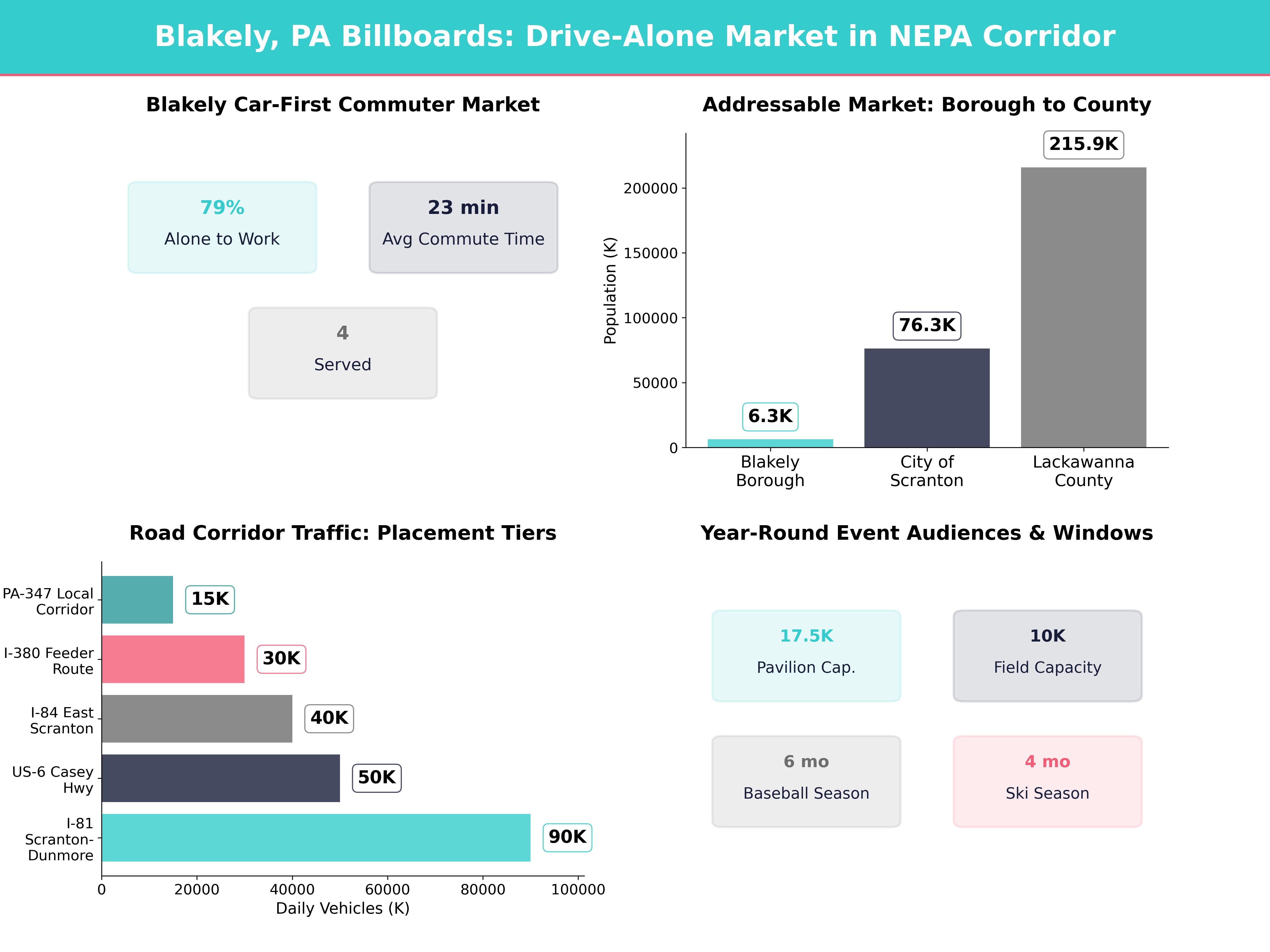
Blakely may be a small borough of roughly 6,300 to 6,500 residents (6,311 in the 2020 Census), but it sits inside a much larger Lackawanna County market of about 216,000 people (215,896 in the 2020 Census) and a broader Scranton trade area that reaches well beyond the Mid Valley. Because Blakely is only about 8 miles from downtown Scranton 4 interstates plus the U.S. 6 corridor, we can use digital billboards to reach neighborhood traffic, retail shoppers, and regional commuters at the same time. This is also a car-first market, with roughly 8 in 10 (about 79%) workers commuting by personal vehicle and typical one-way travel times around 23 minutes, so repeated out-of-home impressions have room to build memory. Tourism and event traffic strengthen the case even more, because baseball, skiing, concerts, gaming, colleges, and downtown events bring fresh audiences into the area year-round.
Market Overview for Blakely, Pennsylvania
Blakely works best when we think of it as both a borough and a gateway. On its own, it is a tight-knit Mid Valley community. In practice, however, it functions as part of a connected consumer zone that includes Scranton Dickson City Archbald, Jessup, Olyphant, Moosic Lackawanna County economy.
Blakely Demographics and Regional Scale
The borough’s local population is modest at roughly 6,300 to 6,500 residents, but the surrounding county adds about 216,000 people (215,896 in the 2020 Census), and the City of Scranton contributes another 76,000 or so (76,328 in the 2020 Census). That matters because consumers in Northeastern Pennsylvania do not confine their routines to municipal lines. We regularly see households living in Blakely, working in Scranton or Moosic, shopping in Dickson City, and attending events throughout the valley.
For billboard advertisers, that means even a locally focused campaign can generate regional value. A message aimed at Blakely residents can still be seen by healthcare workers commuting to Geisinger facilities, students heading toward The University of Scranton or Marywood University, and shoppers traveling toward Viewmont Mall
What the Blakely Economy Means for Billboard Advertisers
The Greater Scranton Chamber of Commerce, Penn’s Northeast, and the Northeastern Pennsylvania Alliance consistently position the region as a logistics, healthcare, education, and manufacturing hub. That description fits what we see on the ground. The strongest local advertising categories tend to include:
- Healthcare, because the Scranton market is anchored by major systems such as Geisinger and Commonwealth Health.
- Higher education, because the regional student population cycles in and out every semester.
- Retail and dining, because Dickson City and Scranton act as shared shopping destinations.
- Home services, automotive, insurance, legal services, and financial services, because households in the Mid Valley are repeat buyers in practical categories.
- Entertainment and hospitality, because venues in Moosic and Scranton attract audiences from across Northeastern Pennsylvania.
Population growth in this part of Pennsylvania is not explosive (Lackawanna County was 215,896 in 2020, up just 0.7% from 214,437 in 2010), but steady traffic and broad regional shopping patterns still create a strong billboard environment. In markets like Blakely, billboards often outperform more fragmented media because they reach the same drivers again and again across the same routes.
Car Dependence in Blakely and Lackawanna County
Car dependence is one of Blakely’s biggest out-of-home advantages. Roughly 80% (about 79%) of workers in the county commute by driving alone, and the average one-way commute is about 23 minutes. Even with transit options from COLTS, daily movement in the market is still overwhelmingly road-based.
For us, that translates into three useful advertising realities:
- We can build frequency quickly because drivers repeat the same trips during the workweek.
- We can separate commuter campaigns from shopper campaigns because weekday and weekend patterns differ.
- We can use digital creative to align with daily routines, such as morning coffee runs, after-work retail, or evening entertainment traffic.
Key Traffic Corridors Around Blakely
Blakely’s travel patterns are shaped by a handful of high-value roads. Some carry intensely local traffic. Others collect regional trips moving between Scranton, the Mid Valley, the Poconos, and the interstate system. When we understand the role of each corridor, we can match billboard locations to the right category and budget.
U.S. 6 and the Robert P. Casey Memorial Highway Near Blakely
The Robert P. Casey Memorial Highway is one of the most important routes for Blakely-area advertising. It connects the Mid Valley to Dickson City, Scranton’s outer retail belt, and communities farther northeast toward Carbondale. Depending on the interchange and count year, PennDOT traffic maps show segments of this corridor in the 20,000 to 50,000 AADT range.
This is a prime corridor for advertisers that want both local relevance and broader reach. We especially like it for:
- Retailers and restaurants, because the route captures routine shopping trips.
- Home service companies, because it links residential communities across the valley.
- Healthcare providers, because it moves patients and employees toward larger medical centers.
- Auto dealers, repair shops, and tire businesses, because the audience is heavily commuter-driven.
If we are trying to reach households in Blakely, Peckville, Olyphant, Archbald, and surrounding boroughs without paying strictly for downtown Scranton exposure, this corridor is often our first look.
I-81 Through Scranton, Dunmore, and Moosic
For pure regional scale, I-81 is the heavyweight. In the urban Scranton- Dunmore 90,000 AADT on some segments. That makes I-81 one of the best options for advertisers that need broad awareness rather than only neighborhood frequency.
This route is especially valuable because it ties together multiple destination zones, including downtown Scranton, PNC Field, Scranton/Wilkes-Barre RailRiders games, Montage Mountain Resorts, Mohegan Pennsylvania, and the approach to the Wilkes-Barre/Scranton International Airport.
We usually prioritize I-81 when we are promoting:
- Regional healthcare systems and specialty care.
- Universities and colleges that recruit from multiple counties.
- Casinos, hotels, attractions, concerts, and sporting events.
- Employment campaigns for logistics, manufacturing, and healthcare.
- Consumer brands that need fast, repeated commuter exposure.
I-84, I-380, and I-476 Connections for Blakely Campaigns
Blakely itself is not directly on all of these roads, but the market is shaped by them. Near Scranton’s eastern edge, I-84 traffic volumes are commonly around 40,000 AADT, while I-380 segments feeding the Scranton area are often above 30,000 AADT. The Northeast Extension of the Pennsylvania Turnpike, I-476, also brings in substantial regional traffic, with nearby segments exceeding 30,000 AADT.
These roads are useful when we want to intercept longer-distance travelers rather than only local residents. We typically use them for:
- Tourism and hospitality offers tied to concerts, gaming, and ski weekends.
- Regional event promotion in Scranton and Moosic.
- College recruitment and continuing education campaigns.
- Business-to-business messages aimed at employers, truck traffic, and industrial decision-makers.
Because the region sits at the intersection of 4 interstates—I-81, I-84, I-380, and I-476—we can stretch a Blakely-area campaign much farther than the borough’s size alone would suggest.
PA 347, Business U.S. 6, and Local Mid Valley Roads
Not every strong billboard plan in Blakely needs interstate traffic. Local connectors matter because they reach people when they are close to making practical decisions. On commercial stretches, roads such as PA 347 and Business U.S. 6 often fall in the 10,000 to 15,000 AADT band, depending on location and count year.
These are the roads we like for high-frequency, community-based advertising, including:
- Dentists, optometrists, chiropractors, and urgent care.
- HVAC, roofing, plumbing, and electrical services.
- Independent restaurants and neighborhood bars.
- Banks, insurance agencies, law firms, and real estate offices.
- Local schools, events, and nonprofit campaigns.
If interstate boards are about scale, these local roads are about repetition and familiarity. In a place like Blakely, that balance matters.
Audience Segments in the Blakely Market
Billboard performance improves when we know exactly who is on the road. Blakely gives us access to a surprisingly diverse audience mix for a borough of its size.
Blakely Commuters and Everyday Service Buyers
The first core segment is the daily commuter. With roughly 8 in 10 workers driving alone and average trips around 23 minutes, the area produces consistent weekday traffic patterns. These drivers are ideal targets for categories with frequent purchase cycles, such as coffee, convenience, grocery, healthcare, automotive, legal services, and home repair.
We also like commuter-oriented campaigns here because the same people often pass the same board multiple times per week. That repetition is useful for lower-consideration decisions, such as picking a quick-service restaurant, calling a contractor, or remembering a local medical office.
Retail Shoppers in Dickson City and the Scranton Trade Area
Blakely residents shop regionally, and the Dickson City Viewmont Mall
This shopper traffic is strongest for:
- Big-box and chain retail.
- Seasonal sales promotions.
- Furniture, mattresses, and home improvement.
- Family dining and entertainment.
- Healthcare, vision, and pharmacy messages tied to errands.
When we want to convert weekend shopping traffic, a board on the right approach route can be more actionable than a broad metro placement.
Students and Young Adults Near Blakely
The greater Scranton market has a meaningful student audience. The University of Scranton, Marywood University, Penn State Scranton Lackawanna College Johnson College together place well over 8,000 students, or roughly 10,000 when combined, into the local market each academic year.
That gives us several good billboard use cases:
- Student recruitment for colleges, trade schools, and certification programs.
- Housing, storage, moving, and telecom offers near semester starts.
- Fast-casual dining, fitness, and entertainment campaigns.
- Employer recruiting for part-time and entry-level roles.
Because the biggest student influxes happen in late August and again in January, we can time boards around two predictable enrollment and moving windows each year.
Families, Sports Fans, and Entertainment Visitors Around Blakely
Blakely also benefits from strong regional leisure traffic. PNC Field seats about 10,000 fans for Scranton/Wilkes-Barre RailRiders games. Montage Mountain Resorts offers 27 trails and about 1,000 feet of vertical drop in winter, while the Toyota Pavilion at Montage Mountain 17,500 in the warmer months. Mohegan Pennsylvania adds another year-round entertainment anchor.
That mix creates a strong audience for:
- Hotels, casinos, bars, and restaurants.
- Event promotion and ticketed entertainment.
- Sports-themed promotions and family attractions.
- Retail and QSR offers tied to game days and weekend outings.
Industrial, Warehouse, and Shift-Work Audiences
The Mid Valley and greater Scranton region also support industrial and logistics traffic. The area’s position at the convergence of 4 interstates makes it attractive for distribution and warehousing, and that means more early-morning, mid-shift, and overnight driving than many small towns produce.
For recruiting and B2B messages, we often emphasize:
- Early commute windows from 5 a.m. to 8 a.m.
- Shift-change visibility in the 2 p.m. to 4 p.m. range
- Clear wage, hiring, and benefit messages
- Directional copy tied to major routes rather than neighborhood landmarks
Seasonal and Timing Opportunities in Blakely
Blakely is not a flat, same-every-month market. Weather, sports, school calendars, and regional events create clear timing opportunities.
Winter in Blakely and the Mid Valley
Winter is a serious billboard season here because Northeastern Pennsylvania commonly sees more than 40 inches of snow in a year, and road visibility remains essential even when digital and mobile attention is fragmented. Ski traffic to Montage Mountain Resorts typically matters most from December through March, which gives us about 4 months of winter recreation messaging.
This is the season when we usually prioritize:
- Tire shops, auto repair, and towing.
- HVAC, generators, roofing, and emergency home services.
- Urgent care, pharmacies, and healthcare.
- Restaurants, delivery, casinos, and indoor entertainment.
- Ski, snowboard, and winter apparel campaigns.
We also like high-contrast creative in winter because darker afternoons mean many impressions occur before or after sunset, especially during the evening commute.
Spring and Summer Around Blakely
Spring and summer expand the market beyond pure commuting. RailRiders baseball runs from April through September, or roughly 6 months, and the concert calendar at the Toyota Pavilion at Montage Mountain
We usually see spring and summer as the best time for:
- Restaurants and beverage brands.
- Outdoor recreation and family attractions.
- Home improvement and landscaping.
- Apartment, storage, and moving offers.
- Live events, festivals, and entertainment venues.
Fall, Holidays, and School-Year Timing in Blakely
Back-to-school is one of the cleanest timing windows in the area. Valley View School District and local colleges reset family routines in late August, while colleges add another notable surge in January. Fall also brings football, foliage, and regional events that receive broad attention from outlets such as WNEP and The Times-Tribune.
We especially like fall boards for:
- Retail and apparel.
- Colleges and career programs.
- Healthcare checkups and flu-season reminders.
- Financial services and insurance.
- Holiday shopping pushes near Dickson City and Scranton.
Events at the Scranton Cultural Center, Scranton Jazz Festival, and Scranton Fringe Festival also create useful short-run bursts for arts, dining, and hospitality campaigns.
Billboard Design Tips for the Blakely Market
The best creative in Blakely feels local without becoming cluttered. We want people to recognize themselves in the message immediately.
Use Blakely and NEPA Geography in the Copy
In this market, local relevance matters. Terms such as “Mid Valley,” “NEPA,” “Scranton,” and “Dickson City” carry meaning because residents use them in everyday conversation. Discover NEPA
We usually recommend copy that signals location plainly, such as:
- “Minutes from Blakely.”
- “On the way to Dickson City.”
- “Serving the Mid Valley.”
- “Near Scranton and U.S. 6.”
That style works better here than generic slogans because the market is practical, local, and route-oriented.
Design for Fast Roads and Winter Visibility in Blakely
Because so much of the market moves along U.S. 6, I-81, and other high-speed roads, we should keep the main line to about 6 to 8 words on faster boards. We also want bold contrast, especially in winter and on overcast days.
For this geography, the most dependable design choices are:
- Dark text on bright backgrounds, or bright text on deep backgrounds.
- Large numerals for prices, distances, or phone-friendly offers.
- Clean directional cues, such as “next right,” “off U.S. 6,” or “near Viewmont.”
- Strong category imagery, such as a steaming coffee cup, a snow-covered roof, a baseball, or a medical cross.
Muted palettes can work for premium brands, but high-contrast colors usually perform better in NEPA’s gray winter light.
Match the Message to Blakely’s Local Mindset
Blakely is not a market where vague branding always carries the day. We usually see stronger response when creative emphasizes usefulness, trust, speed, and proximity. That is why categories such as healthcare, home services, automotive, legal services, and education often do well with direct, benefit-led messages.
Examples of locally aligned approaches include:
- Seasonal urgency, such as heating, snow, roofing, or allergy-related copy.
- Family-oriented language, because the Mid Valley remains household-driven.
- Regional pride, especially around school spirit, sports, and community identity.
- Practical value statements, such as hours, availability, convenience, or financing.
Regional Strategies Around Blakely
A strong Blakely campaign rarely relies on a single board type. We usually get better results by matching sub-areas to different goals.
Mid Valley Core Strategy for Blakely, Archbald, Jessup, and Olyphant
The Mid Valley core is where we focus on frequency. This is the right zone for service businesses that need repeated visibility among nearby residents. Here, local-road and U.S. 6 placements can outperform broader metro boards because they stay close to the purchase decision.
We most often use this approach for:
- Dentists, doctors, and urgent care.
- Contractors and home services.
- Local restaurants.
- Auto repair, tires, and towing.
- Community banks, real estate, and legal services.
Dickson City Retail Strategy Near Blakely
The Dickson City area is the shopping engine nearest Blakely. If we want retail traffic, family dining, or seasonal shopping response, this zone is essential. It is especially useful during weekends, holiday periods, and late-afternoon weekday shopping windows.
This regional strategy works well for:
- Apparel, footwear, and specialty retail.
- Mattress, furniture, and home stores.
- National chains entering the market.
- Entertainment and impulse dining.
- Health, beauty, and wellness offers tied to errands.
Downtown Scranton and University Strategy From Blakely
Downtown Scranton 8 miles from Blakely, so the audience overlap is real. We use this submarket when we want more professional, institutional, or destination-oriented reach.
This is usually the best zone for:
- Hospitals and specialty care.
- Colleges and graduate programs.
- Law firms and financial services.
- Downtown dining and event promotion.
- Arts and culture campaigns around the Scranton Cultural Center and The Marketplace at Steamtown.
Moosic, Montage, and I-81 Destination Strategy for Blakely Campaigns
The Moosic and Montage area sits roughly 12 to 15 miles from Blakely, but it attracts regional visitors far beyond that radius. This is where we go for destination entertainment and higher-intent travel audiences.
We prioritize this zone for:
- PNC Field events.
- Montage Mountain Resorts ski and waterpark traffic.
- Toyota Pavilion at Montage Mountain
- Mohegan Pennsylvania gaming and dining.
- Hotels and nightlife tied to weekend traffic.
Using Blip Tools Effectively in Blakely
Blakely is a good market for flexible digital buying because traffic patterns change by corridor, by season, and even by hour. We do not need one rigid schedule for the whole area.
Blip Timing Tactics for Blakely Corridors
For commuter-heavy campaigns, we usually concentrate on weekday windows such as 6 a.m. to 9 a.m. and 3 p.m. to 6 p.m. For retail and dining, we often add 11 a.m. to 1 p.m., Friday afternoons, and Saturday blocks. For entertainment, we shift toward Thursday through Sunday and lean into event nights.
That kind of timing matters in Blakely because a U.S. 6 commuter audience is not exactly the same as a Montage concert audience or a Dickson City weekend shopper.
Manual and Optimized Campaigns in the Blakely Market
When we already know the exact boards or corridors we want, a manual campaign makes sense. That is often the case for a Mid Valley service business that only wants U.S. 6, PA 347, or a few retail approaches.
When we want broader coverage across the Blakely-Scranton-Moosic ecosystem, an optimized campaign can be more efficient. It can spread budget across multiple corridors, react to availability, and balance weekday commuter reach with weekend destination traffic.
Creative Testing and Performance Adjustments in Blakely
Blakely is also a good place to test localized creative. We can run 2 or 3 versions of a message and compare route-specific performance. One version might emphasize “Mid Valley.” Another might emphasize “Scranton.” A third might focus on a seasonal trigger, such as snow, baseball, or back-to-school timing.
Because digital billboard campaigns can be adjusted quickly, we can update creative before a concert run, a holiday shopping window, a college semester start, or the first major snow event of the season.
Getting Started with Billboard Rental in Blakely
Renting a billboard in Blakely is usually simpler when we start with the geography of the customer rather than the geography of the municipality. The best board is not always the one closest to the storefront. It is the one that intercepts the right audience at the right moment.
How We Evaluate Billboard Locations in Blakely
We usually evaluate Blakely-area locations with five questions:
- Are we trying to reach Mid Valley residents, regional commuters, retail shoppers, or destination visitors?
- Is the board on a route people use every weekday, or only occasionally?
- Are drivers moving at local-road speeds or interstate speeds?
- Is the message better for weekday commuting, weekend shopping, or event-driven bursts?
- Does the board sit near decision points such as Dickson City retail, Moosic entertainment, or Scranton medical and university zones?
That framework helps us avoid wasting impressions on traffic that looks busy but does not match the goal.
What to Expect From Billboard Rental in Blakely
In a traditional outdoor buy, we often face fixed terms, slow changes, and less flexibility than we need in a market with changing weather, sports schedules, and seasonal retail peaks. Digital buying is easier because we can start smaller, shift faster, and test more precisely.
For a practical Blakely launch, we often begin with 3 to 5 well-matched digital boards rather than trying to blanket the region all at once. A neighborhood service brand might start with Mid Valley and Dickson City. A regional destination brand might combine I-81, Moosic, and Scranton. A college or healthcare campaign might blend commuter corridors with university-adjacent placements.
How Blip Simplifies Billboard Rental in Blakely
Blip fits this market well because we can choose a hands-on route or let the platform optimize across the area. We can upload art, adjust schedules, refine budgets, and review real-time analytics without waiting through a traditional sales cycle. We can also build local creative quickly with artwork tools instead of treating every change like a full production project.
That matters in Blakely because the strongest campaigns here are rarely static. Snow changes traffic. College calendars change audience mix. Game nights, concerts, and shopping weekends create short, high-value bursts. Flexible digital billboard buying lets us respond to those realities instead of planning around them.
A Smart First Step for Blakely Billboard Campaigns
If we are launching our first campaign in Blakely, the smartest first step is to pick one objective and one audience. We might choose commuter awareness on U.S. 6, retail activation near Dickson City, or destination traffic around I-81 and Montage. Once we see where impressions and response concentrate, we can expand confidently.
That is why Blakely is stronger for billboard advertising than its size might suggest. The borough gives us local trust, the county gives us scale, and the road network gives us repeated visibility. When we combine those strengths with flexible digital buying, we can build a campaign that feels both efficient and genuinely local.