Billboards near West Mifflin, PA
No Minimum Spend. No Long-Term Contracts. Just Results.
Trusted by Leading Brands


Billboard advertising
near West Mifflin has never been easier



How much is a billboard near West Mifflin?
Why Choose Blip for Billboard Advertising near West Mifflin
Launch with Blip in West Mifflin on any budget and reach PA-51, PA-885, and I-376 commuters without long-term contracts.
Time West Mifflin ads for Kennywood weekends or Waterfront evenings, so your message hits families, shoppers, and visitors when traffic peaks.
Blip’s real-time analytics let West Mifflin advertisers shift spend fast as commute patterns change on the Parkway East and Glenwood Bridge.
Use Blip’s creative tools to make bold, readable West Mifflin billboards that stand out on cloudy days and rush-hour drives.
No contracts means West Mifflin businesses can test short bursts around school traffic, holiday shopping, or home-service season, then adjust anytime.
Frequently Asked Questions About Billboard Advertising near West Mifflin
How much does a billboard cost near West Mifflin, Pennsylvania with Blip?
With Blip, you can advertise on digital West Mifflin billboards on any budget, choosing exactly how much you want to spend per day, and Blip automatically keeps your campaign within that limit. Each “blip” is a brief 7.5 to 10-second ad on rotating digital billboards near West Mifflin, Pennsylvania, and you only pay for the blips you receive. The price of each blip changes based on when and where you choose to advertise in the West Mifflin area and on current advertiser demand, so you stay in control.
Where can I advertise with Blip in West Mifflin, Pennsylvania?
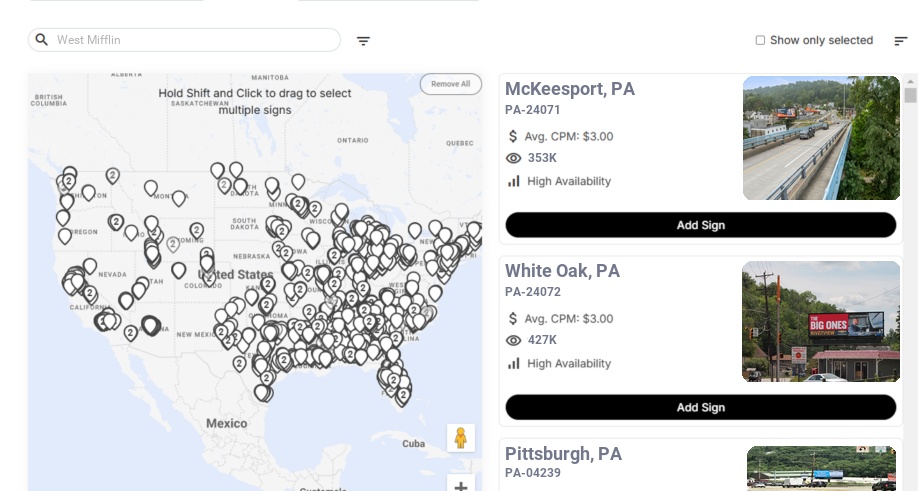
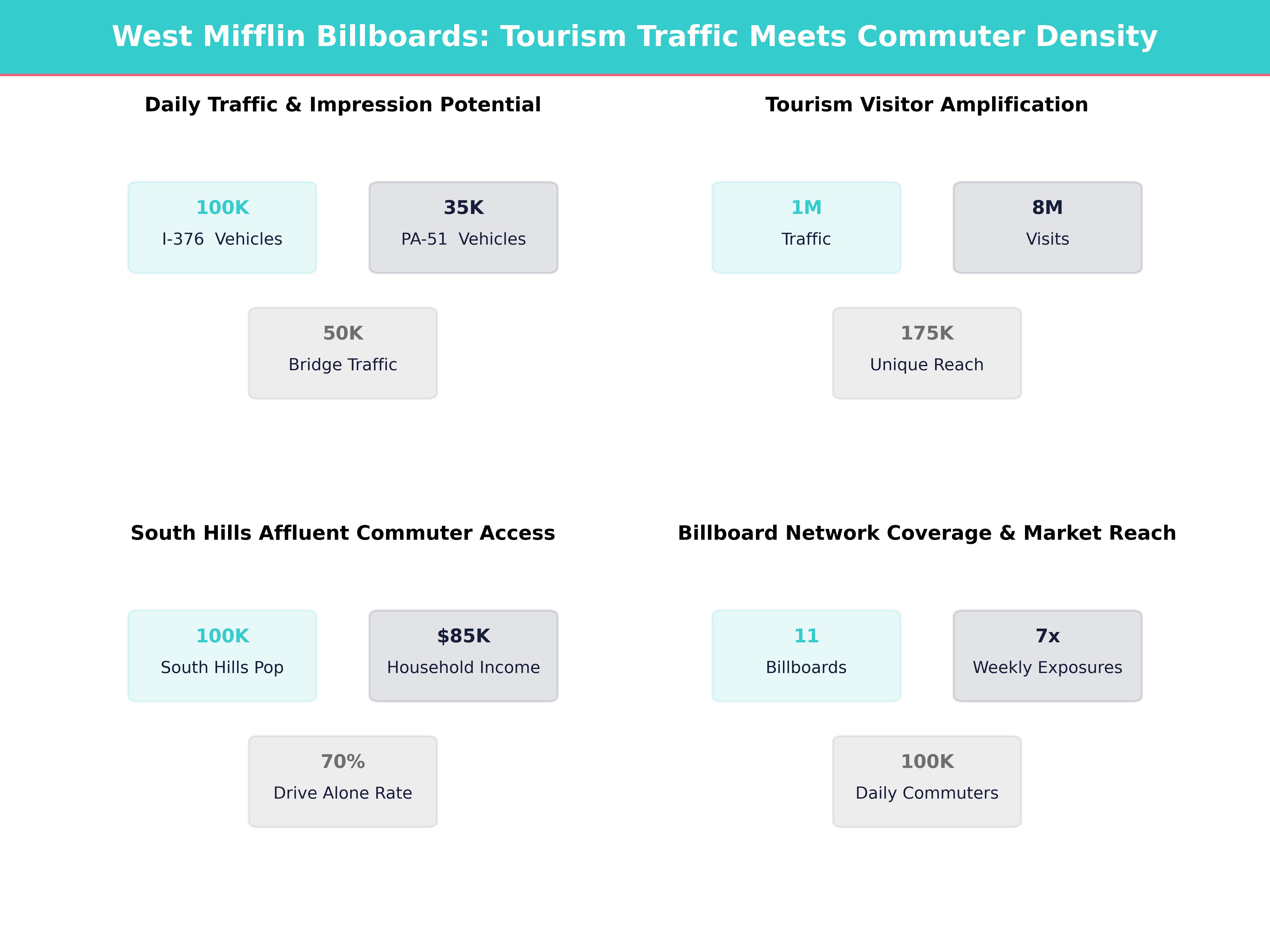
There are 11 digital billboards serving the West Mifflin area from nearby McKeesport, Pittsburgh, and Castle Shannon. Within a 15–20 minute drive, these locations together create a coverage ring around the West Mifflin area that captures different audience flows. Collectively, these corridors serve tens of thousands of vehicles per day, translating into hundreds of thousands of weekly impressions when campaigns are scheduled efficiently.
What kind of audience can West Mifflin billboards reach?
West Mifflin is a compact, high-activity suburb just southeast of downtown Pittsburgh, but the effective audience near West Mifflin is far larger because of regional attractions, proximity to Pittsburgh, and commuter traffic. Kennywood Park draws an estimated 1,000,000+ visitors per year, and The Waterfront brings in 7–9 million visits annually. The local and regional traffic adds up to a steady daytime and evening audience that goes well beyond the borough’s 19,000 residents.
When is the best time to run Blip ads near West Mifflin during commute hours?
The peak windows to target commuters are morning from 6:30–9:00 a.m. and evening from 3:30–6:30 p.m. During these windows, a driver on I-376 or PA-51 may see the same board 5–10 times per week, quickly building frequency. With Blip, ads can be heavily weighted or exclusively run during these high-traffic commute windows.
What seasonal changes should I know before advertising on West Mifflin billboards?
Seasonality is especially strong near West Mifflin because of Kennywood, outdoor shopping, and local high school and community events. Spring brings Kennywood opening days and early-season crowds, summer brings peak park traffic and The Waterfront events, fall brings football and Phantom Fall Fest, and winter brings holiday shopping and stronger visibility for illuminated digital billboards. These seasonal patterns make timing and creative changes especially important for West Mifflin campaigns.
Do I need a contract to advertise with Blip near West Mifflin?
No, Blip has no long-term contracts or minimum commitments. You can start, pause, or stop your campaign at any time.
How fast can I launch a billboard campaign with Blip near West Mifflin?
You can have your campaign live in minutes. Create a free account, select your locations, set your budget, upload your design, and start running once approved.
Where can I advertise with Blip near West Mifflin?
Blip has digital billboards near West Mifflin. You can browse available locations on a map, choose the ones that fit your audience, and start advertising right away.
Still have questions? Launch a campaign in minutes — no contracts, no commitments.
Start Your CampaignWest Mifflin Billboard Advertising Guide
The West Mifflin area sits at a powerful crossroads of suburban neighborhoods, major regional attractions, and commuter routes feeding Pittsburgh. With 11 digital billboards serving the West Mifflin area from nearby McKeesport, Pittsburgh, and Castle Shannon, we can reach local residents, shoppers, and visitors right where they travel, shop, and play—while using Blip’s flexibility to align your ads with precise times, locations, and audiences for highly efficient billboard advertising near West Mifflin.
Why the West Mifflin Area Is a High-Value Billboard Market
West Mifflin is a compact, high-activity suburb in Allegheny County, just southeast of downtown Pittsburgh. According to 2020 data, the borough’s population is roughly 19,000–20,000 residents, but the effective audience near West Mifflin is far larger because of:
-
Regional attractions
-
Kennywood Park draws an estimated 1,000,000+ visitors per year from across western Pennsylvania, Ohio, and West Virginia, and on peak midsummer Saturdays the park can see 10,000–15,000 daily visitors moving along nearby corridors such as PA-837 and PA-885.
- More info: Kennywood
-
The Waterfront outdoor shopping and entertainment complex in nearby Homestead/Munhall brings in 7–9 million visits annually across more than 1 million square feet of retail, dining, and entertainment space, including big-box anchors, specialty shops, and a 22-screen cinema.
- More info: The Waterfront
-
The Monongahela riverfront communities (Homestead, Munhall, West Homestead, and McKeesport) together account for more than 40,000 residents who regularly shop, dine, or work in the West Mifflin trade area.
- See local borough info: Homestead Borough and Borough of Munhall
-
Kennywood Park draws an estimated 1,000,000+ visitors per year from across western Pennsylvania, Ohio, and West Virginia, and on peak midsummer Saturdays the park can see 10,000–15,000 daily visitors moving along nearby corridors such as PA-837 and PA-885.
-
Proximity to Pittsburgh
-
Downtown Pittsburgh (about 6–8 driving miles from most West Mifflin neighborhoods) has roughly 300,000+ jobs in the urban core and nearby neighborhoods, with more than 100,000 daily inbound commuters from surrounding suburbs.
- City information: City of Pittsburgh
- Daily commuters travel through corridors that pass near West Mifflin, particularly via PA-51, PA-885, and I-376. In the South Hills and Mon Valley, several of these segments carry 30,000–100,000 vehicles per day, creating repeated exposure opportunities for digital billboards and traditional billboards near West Mifflin.
- Nearby employment hubs such as Oakland, the Strip District, and the South Side collectively host 80,000+ workers in healthcare, education, technology, and services, many of whom use the Parkway East or South Hills routes that feed the West Mifflin area.
-
Downtown Pittsburgh (about 6–8 driving miles from most West Mifflin neighborhoods) has roughly 300,000+ jobs in the urban core and nearby neighborhoods, with more than 100,000 daily inbound commuters from surrounding suburbs.
-
Stable local base
- Median age in the West Mifflin area is around 44–46 years, higher than the U.S. median of roughly 38–39 years, which means strong representation of established households, homeowners, and families.
- Allegheny County reports a homeownership rate near 60%, and in many South Hills/Mon Valley suburbs it exceeds 65%, aligning with a market that responds well to home services, healthcare, financial services, and big-ticket purchases that are often promoted on West Mifflin billboards.
- Typical household incomes in the West Mifflin trade area fall in the $55,000–$75,000 range, with significant segments of dual-income families, retirees with stable pensions, and middle-income professionals who prioritize convenience and value.
Layering the residential base with the visitor and commuter volume, the effective “audience cloud” around West Mifflin can easily reach 150,000–200,000 unique people per month who pass near local corridors like PA-51, PA-885, and the approaches to The Waterfront and Kennywood.
All of this creates a steady daytime and evening audience that goes well beyond the borough’s 19,000 residents, making digital billboards near West Mifflin a cost-efficient way to reach a dense, repeatedly-exposed audience. For advertisers seeking billboard rental near West Mifflin, this combination of local stability and regional draw offers strong value and consistent visibility.
For a broader regional context, see:
- Borough information and services: West Mifflin Borough
- County-wide demographics and planning: Allegheny County
- Regional tourism and visitor patterns: VisitPITTSBURGH
Understanding Local Audiences and Daily Movement Patterns
The key to a high-performing campaign near West Mifflin is matching your ad schedule and messaging to how people actually move through the area. Across the South Hills and Mon Valley, more than 70% of workers drive alone to work, and average commute times are typically 25–30 minutes, which means long, repeated exposure to roadside media and makes billboard advertising near West Mifflin especially effective for frequency.
Commuters and Workers
- Many West Mifflin–area residents commute toward Pittsburgh’s downtown, Oakland, and the Mon Valley industrial/warehouse zones. Nearby job centers like UPMC, Carnegie Mellon University, and University of Pittsburgh in Oakland collectively employ well over 50,000 people, many using I-376 and PA-885.
-
Major arteries include:
- PA-51 (Clairton Blvd) – a primary commercial strip with estimated Average Annual Daily Traffic (AADT) often in the 30,000–40,000+ vehicles per day range on key segments near shopping centers and big-box retailers, according to PennDOT traffic counts.
- PA-885 (Lebanon Rd / Glass Run Rd) – a connector toward the city and the South Side with typical AADT volumes of 15,000–25,000 vehicles per day on many stretches.
- I-376 (Parkway East) near the Squirrel Hill Tunnel and Waterfront interchange, where AADT can exceed 90,000–110,000 vehicles per day on some segments (PennDOT estimates), creating some of the highest daily impressions in the region.
-
The Glenwood Bridge and nearby Homestead Grays Bridge carry a combined 50,000+ vehicles per day, channeling Mon Valley and South Hills traffic toward the riverfront and city.
- Bridge and roadway info: PennDOT District 11
-
Many workers also commute into U.S. Steel’s Mon Valley facilities, local hospitals, and logistics/industrial parks along the rivers, including operations in Clairton, West Mifflin, and McKeesport.
- Local industry overview: U. S. Steel Mon Valley Works
-
Just west of West Mifflin, Allegheny County Airport (AGC) handles roughly 60,000–70,000 aircraft operations per year, attracting corporate travelers, aviation businesses, and support services that add to weekday traffic.
- Airport info: Allegheny County Airport
What this means for your campaign:
-
Peak windows to target commuters:
- Morning: 6:30–9:00 a.m.
- Evening: 3:30–6:30 p.m.
- During these windows, a driver on I-376 or PA-51 may see the same board 5–10 times per week, quickly building frequency.
-
Use short, high-impact commute messages:
- “Tonight Only – Happy Hour at The Waterfront”
- “Need a New Furnace Before Winter? Call Before 5 p.m.”
- “Skip Tunnel Traffic – Shop Local Near West Mifflin”
With Blip, we can heavily weight or exclusively run your ads during these high-traffic commute windows for boards serving the West Mifflin area, maximizing impressions per dollar and turning West Mifflin billboards into a reliable commuter touchpoint.
Shoppers and Errand-Runners
The West Mifflin area is anchored by shopping and big-box retail along PA-51 and The Waterfront:
- Within a 10–15 minute drive of central West Mifflin, residents can access multiple power centers, grocery stores, auto dealers, and The Waterfront, collectively representing hundreds of millions of dollars in annual retail sales.
-
Weekday retail and errand traffic peaks around:
- 11:00 a.m.–1:30 p.m. (lunch and errands)
- 4:00–7:00 p.m. (post-work shopping)
- Weekends (especially Saturday midday, roughly 10:00 a.m.–3:00 p.m.) often see some of the heaviest local volumes around retail corridors near West Mifflin, with parking lots at major centers approaching 80–90% capacity on busy days.
- The Waterfront’s event programming and movie releases can push evening traffic spikes to 8:00–10:00 p.m., especially on Fridays and Saturdays.
Campaign implications:
-
For retail, restaurants, auto services, and healthcare, we can emphasize:
- Friday–Sunday daytime schedules for family and leisure spending.
- Lunchtime windows earlier in the week for quick-service restaurants and service businesses.
- For many categories, focusing 60–70% of impressions on these shopper-heavy windows can increase walk-ins and calls without increasing overall spend, especially when paired with boards chosen specifically for billboard advertising near West Mifflin’s major shopping hubs.
Families, Schools, and Community Life
West Mifflin is served by the West Mifflin Area School District, which runs an elementary, middle, and high school for the surrounding neighborhoods. District enrollment is roughly 2,000–2,500 students, supported by hundreds of staff and faculty, generating consistent weekday traffic.
School-related traffic patterns include:
- Increased volumes around school zones and bus routes from roughly 7:00–8:30 a.m. and 2:30–4:00 p.m. on weekdays, when families are clustered on local arterials and residential connectors.
-
Seasonal spikes around:
- Back-to-school (late August–September), when retailers and services can see 10–20% sales lifts in school-related categories.
- Football and basketball seasons, bringing hundreds to low thousands of attendees to home games and events.
- Graduation (late May–June), when event venues, photographers, florists, and restaurants all experience short, intense demand.
Nearby community hubs such as public libraries, youth sports complexes, and churches host weekly events that can draw 100–500 people at a time, reinforcing predictable local travel patterns.
This environment favors campaigns for:
- Youth activities and sports
- Tutoring, childcare, and healthcare
- Family entertainment and events
- Faith communities and nonprofit outreach
Timing Your Blip Campaign Around West Mifflin’s Calendar
Beyond daily patterns, seasonality is especially strong near West Mifflin because of Kennywood, outdoor shopping, and local high school and community events.
Local weather adds another layer: the Pittsburgh region averages around 160–170 cloudy or partly cloudy days per year and roughly 40 inches of annual precipitation, making bright, high-contrast digital creative particularly valuable in all seasons and increasing the visibility of billboards near West Mifflin during darker, overcast days.
Spring (March–May)
- Kennywood’s opening days and early-season events attract regional crowds, with early weekends often drawing 5,000–8,000 visitors per day.
- Home improvement and landscaping projects ramp up as weather improves; hardware, garden, and home centers typically see double-digit percentage increases in traffic compared with winter months.
- Tax refund season boosts discretionary purchases; nationally, more than 70% of refunds are issued by late April, and many households in the region use these funds for cars, major appliances, and home projects.
- Spring sports (youth baseball, soccer, track) can involve hundreds of families per league, creating concentrated evening and weekend traffic near fields and parks.
Ideal advertisers:
- Home improvement, lawn care, roofing, HVAC tune-ups
- Auto dealers and repair shops
- Entertainment and attractions promoting early-season events
- Tax preparers, financial planners, and credit unions
Strategy:
- Increase bids and frequency in late March–April.
- Allocate 60–80% of impressions to afternoons and early evenings when people are out running errands and attending activities.
- Use countdown or urgency-based copy (“Season Pass Sale Ends May 31”) and emphasize “Book Before Memorial Day” or “Spring Only Pricing.”
Summer (June–August)
- Kennywood’s peak season with thousands of extra daily visitors near West Mifflin; on peak weekends, nearby roadways can see 10–20% traffic increases compared with off-season.
- The Waterfront’s patios, movies, and events draw evening and weekend traffic, with summer concert or event nights often filling large sections of the complex’s several thousand parking spaces.
- Many families stay local even when taking shorter regional trips; day trips to Kennywood, Sandcastle, and The Waterfront keep spending close to home.
- Back-to-school shopping starts in late July, and many retailers see 20–30% of their annual school-related sales in just a few weeks.
Ideal advertisers:
- Restaurants, ice cream, and quick-service food
- Regional attractions, festivals, and events
- Outdoor recreation, swimming pools, home cooling, and A/C services
- Retail sales and back-to-school promotions (late July–August)
- Automotive services (road-trip inspections, tires, oil changes)
Strategy:
- Heavier weekend and evening scheduling on billboards near Kennywood and The Waterfront.
- Consider dedicating 50%+ of your summer budget to Fridays–Sundays and after 3:00 p.m. slots.
- Use imagery that pops in sunlight: high contrast, bold colors, minimal text.
- Run “heat wave” or “summer storm” versions of creatives that can be swapped in quickly using Blip when temperatures spike above 85°F or major storms are forecast.
Fall (September–November)
- Back-to-school and Friday night sports drive regular community routines, with high school football games routinely drawing 1,000–3,000 spectators depending on matchups.
- Kennywood’s Phantom Fall Fest and special events continue to bring visitors into the corridor, extending theme-park-related traffic well into October.
- Home services shift toward heating and winter prep; HVAC and plumbing companies often see call volume spikes of 20–40% on the first major cold snaps.
- Retailers transition into early holiday promotions in late October and early November, capturing early-bird shoppers.
Ideal advertisers:
- Education services and extracurriculars
- Home heating, roofing, insulation, and weatherization
- Retailers promoting fall and early holiday sales
- Healthcare providers promoting flu shots and wellness visits
Strategy:
- Shift creative from “summer fun” to “prep for winter” and school messaging.
- Use Blip to gradually change creatives through the season rather than a single static fall design—e.g., one for back-to-school (September), one for home prep (October), and one for early holiday sales (November).
- Concentrate 30–40% of impressions on weekend afternoons when families attend games, festivals, and community events.
Winter (December–February)
- Holiday shopping at The Waterfront and nearby malls peaks in late November–December, with many retailers reporting 20–30% of annual sales in the November–December window alone.
- Black Friday and the two weekends before Christmas often see traffic increases of 20–40% at major retail corridors.
- Snow and winter weather can increase auto repair, towing, and emergency services needs; even a single storm producing 3–6 inches of snow can dramatically spike demand.
- Shorter daylight hours make illuminated digital billboards even more visible; from December to early February, sunset can fall as early as 4:50 p.m., which means evening drive-time is entirely in the dark.
Ideal advertisers:
- Retail and e-commerce
- Holiday events, religious services, and charity drives
- Auto repair, tire shops, and emergency services
- Gyms and wellness providers focusing on New Year’s resolutions
- Tax preparers and financial services starting in late January
Strategy:
- Increase impressions in evenings when it’s dark and digital boards stand out.
- Rotate creatives: one for holiday sales, one for gift cards, one for post-holiday clearance, and one for New Year wellness or financial goals.
- Consider heavy short bursts: for example, running at 2–3x your normal daily budget during the 10 days before Christmas or the first two weeks of January.
For local event calendars and seasonal insights, you can reference:
- VisitPITTSBURGH events
- Local news outlets such as the Pittsburgh Post-Gazette and TribLIVE
- Mon Valley–focused coverage: Mon Valley Independent
Crafting Effective Creative for the West Mifflin Area
The West Mifflin area audience is diverse: blue-collar and white-collar workers, families, older residents, and regional visitors. Your creative should reflect that mix and take into account that most viewers are passing at 35–55 mph, giving just a few seconds for your message to land on West Mifflin billboards and nearby corridors.
Visual Style and Readability
Drivers near West Mifflin typically have 3–7 seconds to absorb a billboard message. To maximize impact:
- Keep text to 7 words or fewer; aim for one clear idea. Tests in outdoor advertising often show 20–40% higher recall when copy is shortened to a single core message.
- Use font sizes of 18–24 inches equivalent (large, bold, sans-serif fonts) so that messages remain legible at 400–600 feet.
-
High-contrast color combinations:
- Light text on dark background (e.g., white/yellow on navy or black) works well for both day and night and maintains legibility on cloudy days, which occur nearly half the year in the Pittsburgh region.
- Avoid detailed photos; use one focal image that tells the story. Creative audits often show that simplifying layouts can improve comprehension by 15–30% at highway speeds.
- Limit calls-to-action to one or two elements: e.g., a URL or a short phone number plus a phrase like “Exit Now” or “5 Minutes Ahead.”
Example message formats:
- “New Patients: $0 Cleaning & Exam* – Dr. Smith”
- “Kennywood Day? Eat Local on PA-51 – Exit Now”
- “Waterfront Sale: 40% Off All Weekend”
Localized Messaging
Referencing specific local touchpoints can significantly boost relevance and response:
- Mention “near Kennywood,” “by The Waterfront,” or “on Clairton Blvd (PA-51)” when appropriate.
-
Highlight local identity:
- “Serving West Mifflin Families Since 1998”
- “Mon Valley’s Trusted HVAC Team”
- “South Hills & West Mifflin – Same-Day Service”
- Use travel-time language: “5 Minutes from The Waterfront,” “10 Minutes from Downtown,” or “2 Lights Ahead,” which helps visitors orient themselves quickly.
This kind of geo-specific messaging reassures viewers that your business is nearby and accessible, which is especially important for a market where 70%+ of trips are made in personal vehicles and where many of those trips pass billboards near West Mifflin.
Tailoring to Key Segments
-
Families
- Use friendly imagery, kids/family scenes, mentions of “family-owned,” “safe,” “trusted.”
- Promote education, healthcare, family entertainment, and budget-conscious offers (“Family 4-Pack,” “Kids Eat Free,” “Free Sports Physicals”).
- Emphasize proximity to schools or parks when relevant.
-
Commuters
- Emphasize speed and convenience: “Same-Day,” “Open Late,” “Online Check-In,” “Walk-In Clinic – No Appointment.”
- Target workday-related needs (coffee, car service, quick medical visits) and after-work activities (dining, fitness, errands).
- Provide simple next steps they can complete on a break or after arriving home (QR-friendly URLs, short phone numbers).
-
Visitors
- Use simple directions: “2 Miles Ahead on PA-51,” “5 Minutes from Kennywood.”
- Emphasize experiences: dining, entertainment, unique local attractions, or “hidden gem” positioning compared with downtown.
- Mention free parking, easier access, or shorter waits compared with city locations.
With Blip, we can also rotate multiple creatives within the same campaign—e.g., one aimed at locals, one at visitors—without any printing cost, and dynamically adjust which versions run based on time of day and day of week so your billboard advertising near West Mifflin always stays relevant.
Using Nearby Billboard Locations Strategically
Your 11 available digital billboards serving the West Mifflin area are positioned in nearby:
- McKeesport (about 5.3 miles away)
- Pittsburgh (about 5.6 miles away)
- Castle Shannon (about 6.1 miles away)
Within a 15–20 minute drive, these locations together create a coverage “ring” around the West Mifflin area that captures different audience flows. Collectively, these corridors serve tens of thousands of vehicles per day, translating into hundreds of thousands of weekly impressions when campaigns are scheduled efficiently and when billboard rental near West Mifflin is planned with clear geographic priorities.
McKeesport–Area Boards
McKeesport borders the Monongahela and Youghiogheny rivers and connects to West Mifflin via key bridges and corridors:
- Population in McKeesport is approximately 17,000–18,000 residents, and when combined with adjacent communities like Port Vue, White Oak, and Glassport, the immediate Mon Valley catchment exceeds 35,000 people.
-
Great for reaching:
- Residents of the Mon Valley who shop or work near West Mifflin, The Waterfront, or Pittsburgh.
- Industrial and warehouse workers commuting through the river corridors, including those tied to steel, fabrication, logistics, and river-related services.
-
Recommended advertisers:
- Industrial suppliers, trades, workforce recruiting.
- Healthcare providers and social services serving south and east Allegheny County.
- Retailers and restaurants positioned as a quick stop on the way home.
- Local perspective and news: City of McKeesport and Mon Valley Independent
Pittsburgh–Area Boards
Digital billboards near Pittsburgh serve:
- Downtown and Oakland commuters coming from or heading toward the West Mifflin area, part of the 100,000+ daily inbound city commuters.
- Visitors traveling between the city, The Waterfront, and Kennywood, especially during festivals, sports events, and convention weeks highlighted by VisitPITTSBURGH.
- Urban residents who may shop or dine near West Mifflin on weekends, when outbound trips to suburban retail can increase by 15–25%.
Use these boards to:
- Introduce your brand to a broader metro audience, building awareness among people who may not yet realize how close your location is to the city.
- Promote city-to-suburb trips (“Skip Downtown Prices – Shop 10 Minutes from the City”).
- Capture spillover from large downtown events (sports, concerts, conventions) that collectively bring millions of attendees per year into the metro.
Castle Shannon–Area Boards
Castle Shannon sits in the South Hills, connected via:
- Route 88, PA-51, and light rail (Pittsburgh Regional Transit).
- The South Hills communities (Castle Shannon, Bethel Park, Mt. Lebanon, Baldwin, and others) together represent well over 100,000 residents with strong household incomes, many in the $70,000–100,000+ range.
These boards are ideal for:
- Reaching South Hills residents who might not realize how close West Mifflin–area businesses are (often 10–20 minutes by car).
- Promoting services that draw from Bethel Park, Mt. Lebanon, and other South Hills communities—such as medical specialists, auto dealers, and destination retailers.
- Positioning your brand as a convenient alternative to crowded or higher-priced areas like the city core or major malls.
Strategy example:
- Run introductory branding ads near Pittsburgh and Castle Shannon to build name recognition and plant the idea of a quick, easy trip to your business.
- Run more “actionable” offer-based ads on McKeesport-facing boards and corridors that directly feed into West Mifflin shopping areas, focusing on deals, same-day service, and “Exit Now” messages.
- Over time, dedicate 40–60% of impressions to your top-performing sub-region while keeping 20–30% for broader awareness in surrounding corridors, creating a balanced footprint of West Mifflin billboards and nearby locations.
Sample Strategies by Business Type
Local Retailers and Restaurants
- Objective: Drive foot traffic and repeat visits.
-
Target times:
- Weekdays: 11:00 a.m.–2:00 p.m., 4:00–8:00 p.m.
- Weekends: 10:00 a.m.–9:00 p.m.
- For many restaurants, 60–70% of revenue is concentrated in evening and weekend periods—exactly when you should emphasize impressions.
-
Creative tips:
- Feature a hero product or signature dish, plus a simple offer:
“Kids Eat Free Tuesdays – Near Kennywood”
“Waterfront Date Night – Free Dessert with Entrée” - Incorporate weather-responsive concepts using multiple creatives (e.g., “Cool Off with a Milkshake Today” in summer, “Warm Up with Homemade Soup” in winter).
- If you are within 5 minutes of a major landmark (Kennywood, The Waterfront, PA-51), say so explicitly, and use billboards near West Mifflin that sit closest to those routes.
- Feature a hero product or signature dish, plus a simple offer:
Home Services (HVAC, Roofing, Lawn Care, Plumbing)
- Objective: Build top-of-mind trust and trigger calls when a need arises.
-
Target times:
- All week during commute and early evening (6:30–9:00 a.m., 3:00–7:00 p.m.).
- In many service categories, 70–80% of new customers come from a combination of word-of-mouth and local awareness, which billboards strongly support.
-
Creative tips:
- Focus on one service and one credibility cue:
“24/7 Emergency Plumbing – West Mifflin Area”
“Rated #1 by Your Neighbors in Allegheny County”
“0% Financing Up to 60 Months – New Furnace” - Rotate seasonal creatives (AC vs. heat vs. frozen pipes) tied to actual temperature swings.
- Highlight service radius: “Serving West Mifflin, Baldwin, and McKeesport” to reassure viewers in nearby communities, and choose billboard rental near West Mifflin that best matches your primary service zones.
- Focus on one service and one credibility cue:
Healthcare and Professional Services
- Objective: Establish authority and capture appointment bookings.
-
Target times:
- Commuter hours plus mid-morning (9:00–11:00 a.m.) when people can call offices.
- Healthcare decisions are often local; many patients prefer providers within 15–20 minutes of home or work.
-
Creative tips:
- Emphasize convenience: “Same-Day Appointments,” “Walk-Ins Welcome,” “Open Until 7 p.m. Weekdays.”
- Use local trust signals: “Serving Mon Valley and West Mifflin Area Families” or “Located Minutes from The Waterfront.”
- For professional services (law, accounting, financial planning), align messaging with key deadlines (tax season, year-end planning).
Events and Attractions
- Objective: Sell tickets and increase attendance for specific dates.
-
Target times:
- Heaviest push in the 7–14 days before the event.
- Focus on evenings and weekends, plus Friday commute windows.
- Many events sell a significant share (often 30–50%) of remaining tickets in the final week—exactly when flexible digital boards are most powerful.
-
Creative tips:
- Use countdowns: “3 Days Until Kickoff at [Venue]” or “This Saturday Only – Tickets Going Fast.”
- Run multiple versions as the date approaches to build urgency, gradually shifting language from “Coming Soon” to “Tomorrow Night.”
- Include simple directions from key landmarks (“5 Minutes from Kennywood,” “At The Waterfront by the Fountain”).
Practical Tips: Budgeting, Bidding, and Optimization with Blip
Digital billboards serving the West Mifflin area are especially powerful when we use Blip’s flexibility to treat them like a dynamic, data-informed channel.
Start with a Clear Objective and Geographic Focus
-
Decide whether you want:
- To saturate residents near West Mifflin and the immediate 5–7 mile radius.
- To introduce your brand to broader South Hills and Mon Valley audiences, extending your reach to 10–15 miles.
- To pull visitors from the city toward your business, focusing on Pittsburgh-facing boards and main commuter routes.
Define this first, then choose which boards (McKeesport, Pittsburgh, Castle Shannon) to prioritize. As a benchmark, many local campaigns start by dedicating 50–70% of their budget to their “home” corridor and 30–50% to surrounding areas for expansion, combining West Mifflin billboards with nearby inventory to form a cohesive footprint.
Budget and Frequency Benchmarks
While ideal budgets vary by category and competitive landscape, these rough guidelines help:
-
Local brand presence / always-on awareness:
- Aim for a steady baseline—e.g., a daily budget that gives consistent impressions during key commuting hours. Even a modest daily spend, if concentrated into 2–3 peak windows, can deliver tens of thousands of weekly impressions across multiple boards.
-
Short-term promotions or events:
- Concentrate budget into 7–21 day bursts with higher bids to dominate specific dayparts.
- Many advertisers see better lift by doubling or tripling daily spend for short windows, rather than spreading the same budget thinly across several months.
-
New business launches:
- Combine a 4–6 week heavier push with multiple creatives to establish name recognition, then taper into an “always-on” level.
- A common pattern is to spend roughly 50–60% of launch budget in the first month to quickly build awareness, then 40–50% over the following 1–2 months to reinforce it.
Because you pay per “blip” (each ad play), you can:
- Start small, observe performance, and scale up.
- Redistribute budget toward times and locations that perform best for your specific goals.
- Test multiple creatives without printing costs, allowing you to retire underperformers and expand winners.
Use Local Data for Ongoing Optimization
Monitor business metrics and local cues:
- Website traffic from Allegheny County and surrounding ZIP codes; note any 10–20% bumps during heavy billboard weeks.
- Call volume, quote requests, or appointment bookings during specific date ranges or dayparts.
- In-store questions like “I saw your sign near Kennywood” or “I saw you on the Parkway,” which can be tracked informally by staff.
- Social media engagement from users in nearby communities such as West Mifflin, Baldwin, McKeesport, Castle Shannon, and Homestead.
Then adjust:
- Increase bids before big Kennywood weekends, Waterfront events, or local festivals promoted by VisitPITTSBURGH.
- Shift more budget to commuting hours when response appears strongest, or to mid-day windows if lunchtime offers drive more redemptions.
- Test new creatives tailored to different corridors (e.g., “Minutes from Castle Shannon” vs. “Right off PA-51”) and compare results over 2–4 week intervals.
- Align messaging with key local dates covered by outlets like the Pittsburgh Post-Gazette and TribLIVE
By aligning your creative, timing, and location choices with how people actually live, work, and travel near West Mifflin, we can turn those 11 digital billboards serving the West Mifflin area into a precise, flexible, and measurable channel for growth. With Blip, you gain the ability to adjust in real time as seasons change, events pop up, and your business evolves—so your message is always in the right place at the right moment for your ideal customers, and your billboard rental near West Mifflin consistently delivers value.