Billboards in Hummelstown, PA
No Minimum Spend. No Long-Term Contracts. Just Results.
Trusted by Leading Brands


Billboard advertising
in Hummelstown has never been easier
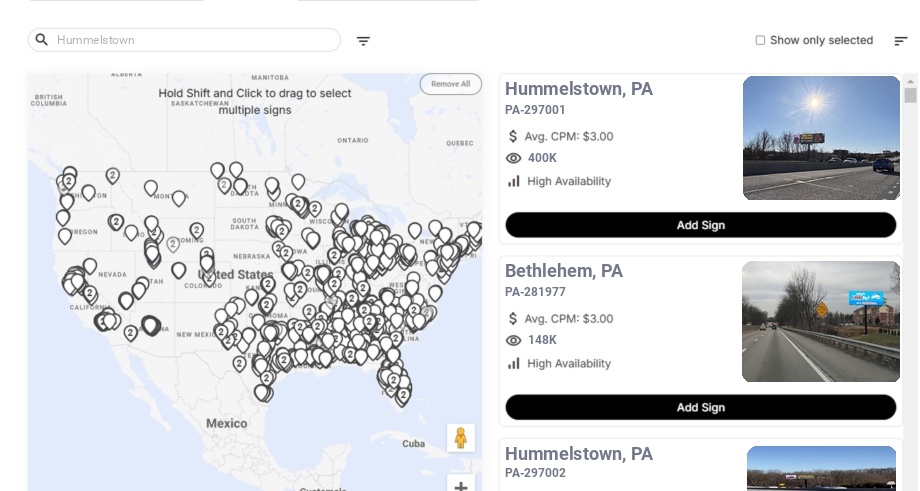



How much is a billboard in Hummelstown?
Why Choose Blip for Billboard Advertising in Hummelstown
Blip lets Hummelstown advertisers launch fast on Route 322 or PA 39, reaching commuters and Hershey visitors without contracts.
Set flexible budgets in Hummelstown and only pay when your ad plays, ideal for testing local traffic on 322, 743, or I-83.
Use Blip dayparting in Hummelstown to hit morning commuters, then evening Hershey event traffic after work.
Track Hummelstown campaigns in real time and shift spend as Route 322, airport, and holiday travel patterns change.
Blip's creative tools help Hummelstown brands tailor bold ads for Hershey tourists, Dauphin County families, and regional commuters.
Frequently Asked Questions About Billboard Advertising in Hummelstown
How much does a billboard cost in Hummelstown with Blip?
Blip lets you set a daily budget, and its algorithm bids for open ad slots on rotating digital billboards so you only pay when your ad actually appears. Each “blip” is a 7.5-to-10-second display, with pricing that can start at just $0.01 per display. Costs vary based on time of day, location, and demand, but there are no minimums or contracts.
Where can I advertise with Blip in Hummelstown to reach commuters and local residents?
Hummelstown offers strong repeat local impressions because it sits near Route 322, Route 39, and Route 743, plus larger regional feeders like Route 283, I-83, and I-81. PennDOT traffic maps generally place Route 322 around Hummelstown and Hershey in the 20,000 to 35,000 vehicles per day range. PA 743 is often in the 10,000 to 20,000 vehicles per day range, making it useful for advertisers that depend on nearby households.
Why is billboard advertising in Hummelstown good for Blip campaigns?
Hummelstown is a small borough, but the real advertising market is much larger because it sits in the Hershey-Harrisburg trade area. The county is highly auto-oriented, with about 84% of workers commuting by car, truck, or van, which creates strong roadside exposure. That combination gives advertisers repeat local impressions, steady commuter exposure, and tourism-driven surges throughout the year.
When is the best time to run Blip ads in Hummelstown?
Seasonally, late spring through summer is the most obvious tourism window because Hersheypark ramps into its busiest operating season. Fall is ideal for back-to-school and local-service campaigns, while winter stays active because of Hershey’s holiday draw and the Pennsylvania Farm Show. Dayparting matters too, with mornings favoring commuter messages and late afternoon or early evening working well for restaurants, entertainment, and event-night traffic.
What kinds of businesses should advertise on billboards in Hummelstown with Blip?
Hummelstown works well for commuter, visitor, student, and family-focused campaigns. The page highlights healthcare, home services, financial brands, hotels, restaurants, entertainment, attractions, recruiting, and schools as strong fits. It also notes that the market includes tourists, eventgoers, meeting travelers, and airport passengers, which creates multiple audience layers.
Do I need a contract to advertise with Blip in Hummelstown?
No, Blip has no long-term contracts or minimum commitments. You can start, pause, or stop your campaign at any time.
How fast can I launch a billboard campaign with Blip in Hummelstown?
You can have your campaign live in minutes. Create a free account, select your locations, set your budget, upload your design, and start running once approved.
Where can I advertise with Blip in Hummelstown?
Blip has digital billboards in Hummelstown. You can browse available locations on a map, choose the ones that fit your audience, and start advertising right away.
Still have questions? Launch a campaign in minutes — no contracts, no commitments.
Start Your CampaignHummelstown Billboard Advertising Guide
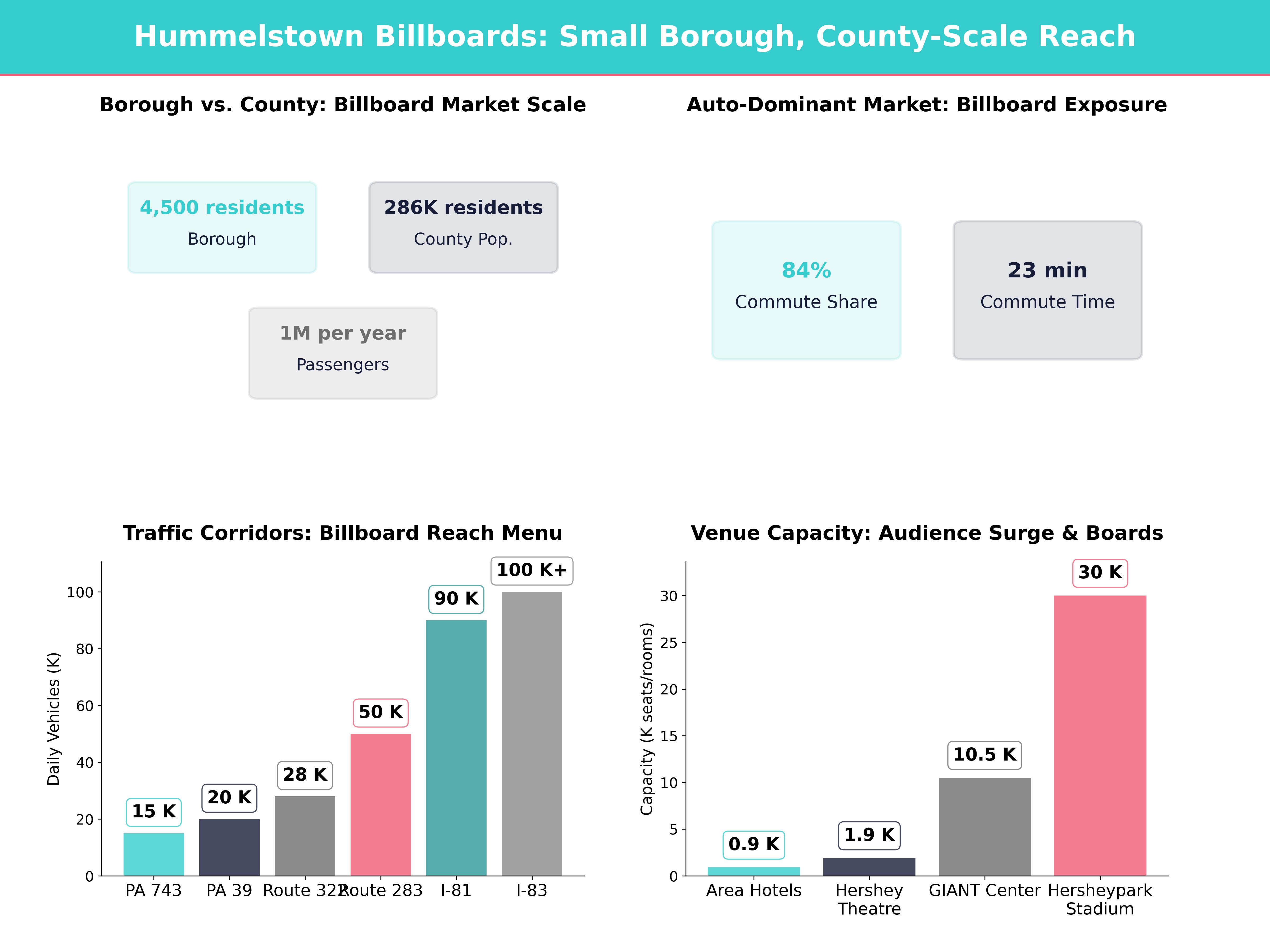
Hummelstown Borough is a small market with outsized billboard potential because it sits at the crossroads of local life in Hummelstown, destination travel in nearby Derry Township, and regional commuting into Harrisburg 4,500 residents, but it operates inside Dauphin County, which reached 286,401 people in the 2020 Census. We also benefit from a heavily auto-oriented travel pattern, with about 84% of county workers commuting by car, truck, or van, and from Hummelstown’s position roughly 5 miles from Hershey and about 15 miles from downtown Harrisburg. That combination gives us something advertisers love: repeat local impressions, steady commuter exposure, and tourism-driven surges throughout the year.
Market Overview for Hummelstown Advertising
Hummelstown is small, but the real advertising market is much larger
When we advertise in Hummelstown, we are not buying exposure only inside one borough. We are tapping a wider Hershey-Harrisburg trade area that includes Hummelstown, Harrisburg Derry Township, Lower Swatara Township
The 2020 Census counted 286,401 residents in Dauphin County, up from 268,100 in 2010. That is a growth rate of about 6.8% over the decade. Even if our storefront or service area is hyperlocal, our billboard audience is regional because Hummelstown sits near work centers, visitor attractions, and airport access.
The local economy is also more diversified than Hummelstown’s size suggests. We can reach healthcare workers connected to Penn State Health Milton S. Hershey Medical Center, hospitality guests staying at Hershey Lodge or The Hotel Hershey, students tied to Penn State Harrisburg
Hummelstown is an auto-first market, which is exactly what billboards need
Recent American Community Survey estimates show that roughly 84% of Dauphin County workers commute by car, truck, or van. Average travel times are around 23 minutes, which is long enough for repeated roadside exposure to matter, but short enough that we are usually catching people on familiar, habitual routes.
That matters because digital billboards work best where routine travel creates frequency. Hummelstown offers that on local roads like Route 322, Route 39, and Route 743, and on bigger regional feeders such as Route 283, I-83, and I-81. Capital Area Transit
Hummelstown sits beside major visitor and institutional demand drivers
The visitor economy around Hershey adds a second audience layer on top of the commuter base. Hersheypark features 70-plus rides, ZooAmerica covers 11 acres, and Hershey Gardens spans 23 acres. Those attractions bring families, group travelers, and seasonal visitors through the same road network that local residents use every week.
The meetings and events market is meaningful too. Hershey Lodge has 665 guest rooms and more than 100,000 square feet of meeting space, while The Hotel Hershey has 276 rooms. Harrisburg International Airport 1 million passengers annually, which adds business travelers, reunions, leisure visitors, and convention traffic to the mix.
Education also strengthens year-round reach. Penn State Harrisburg 5,000 students, and Milton Hershey School 2,000 students on a campus of more than 10,000 acres. That gives us dependable school-year traffic and a steady flow of families, faculty, staff, and service providers.
Key Traffic Corridors for Hummelstown Billboards
U.S. Route 322 is Hummelstown’s core visibility corridor
According to PennDOT, Route 322 is one of the most important roads for Hummelstown-area advertisers. Segment counts vary, but PennDOT traffic maps generally place Route 322 around Hummelstown and Hershey in the 20,000 to 35,000 vehicles per day range.
This corridor is ideal when we want to reach: Daily commuters, because Route 322 connects residential pockets with Hershey, Hummelstown, and regional job centers; Retail and dining advertisers, because drivers on 322 are often close to decision points; and Healthcare, home services, and financial brands, because the route carries both local and cross-town traffic with strong repeat frequency.
For many local businesses, Route 322 offers the best balance between raw volume and practical relevance.
PA 39 and Hersheypark Drive capture tourism and event traffic
PA 39, especially near Hershey attractions, is one of the best places to reach leisure travelers. PennDOT counts commonly place key segments in the 15,000 to 25,000 AADT range, with stronger surges around attraction access points and major event windows.
This route matters because it feeds some of the region’s most recognizable destinations, including Hersheypark, GIANT Center, Hersheypark Stadium, Hershey Theatre, ZooAmerica, and Hershey Gardens.
Advertisers that benefit most here include: Hotels and short-term lodging, because visitors are still making same-day booking and routing decisions; Restaurants, coffee shops, and dessert brands, because family travelers are highly responsive to immediate food cues; and Entertainment, museums, and attractions, because we can build on an existing leisure mindset.
PA 743 reaches local residents and practical spend
PA 743 is not always the highest-volume route, but it is often one of the most useful. PennDOT data typically places parts of the corridor in roughly the 10,000 to 20,000 vehicles per day range, depending on the segment.
That makes PA 743 especially strong for advertisers that depend on nearby households rather than broad regional awareness. We often like this route for: Dentists, urgent care, and family medicine, because proximity matters; Banks, insurance agencies, and real estate teams, because recognition compounds over repeated drives; and Home improvement, HVAC, and landscaping companies, because the route serves established residential areas.
PA 283, I-83, and I-81 extend Hummelstown campaigns into the regional commute
For larger-reach campaigns, we should think beyond Hummelstown’s immediate streets. PennDOT traffic maps commonly show Route 283 carrying about 40,000 to 60,000 vehicles per day near the airport and Harrisburg approaches. I-83 near the Harrisburg core regularly exceeds 100,000 vehicles per day, and major I-81 segments in the region often run in the 80,000 to 100,000 AADT range.
These corridors are valuable when we need scale. They work especially well for: Regional employers and recruiters, because they touch broad labor pools across Central Pennsylvania; Hospitals, colleges, and large service providers, because they need name recognition beyond one town; and Air travel, lodging, conventions, and logistics, because Route 283 and airport-area traffic include out-of-market visitors.
When we combine a broad-reach interstate or expressway board with a more local Hummelstown or Hershey board, we often get both awareness and action.
Audience Segments We Can Reach in Hummelstown
Commuters and regional workers are the foundation audience
The everyday audience in Hummelstown is remarkably dependable. With around 84% of workers commuting by car, truck, or van in Dauphin County, roadside media can build frequency fast. We are not waiting for people to opt in. We are meeting them where they already travel.
This commuter segment includes workers moving to Penn State Health Milton S. Hershey Medical Center, The Hershey Company, schools, state government offices in Harrisburg Harrisburg International Airport
Tourists and eventgoers expand the market well beyond local population
Tourism is one of Hummelstown’s biggest advantages. We can reach local residents year-round, but we can also layer in families, concertgoers, sports fans, and weekend travelers heading into Hershey.
The attraction stack here is unusually strong for a borough this size. Hersheypark brings in theme-park traffic with 70-plus rides. ZooAmerica adds an 11-acre walk-through zoo. Hershey Gardens adds a 23-acre destination. GIANT Center seats 10,500 people, Hersheypark Stadium holds roughly 30,000, and Hershey Theatre seats about 1,900.
Those numbers matter because they translate into real event-night and weekend surges. If we sell food, entertainment, lodging, healthcare, attractions, retail, or family services, Hummelstown gives us a realistic way to reach people who are already spending.
Students, families, and school-connected households create recurring demand
Hummelstown also has a strong family and education audience. We can reach households tied to Hummelstown Area School District, Derry Township School District Penn State Harrisburg Milton Hershey School
This segment is valuable for: Youth activities, tutoring, and family entertainment; Healthcare, pediatric care, orthodontics, and vision services; Grocers, quick-service restaurants, and everyday retail; and Apartment communities and student-friendly services. Because school calendars are predictable, this audience is also easier for us to time.
Meeting travelers and airport passengers bring higher-intent spending
The meetings and travel segment is easy to underestimate in Hummelstown. Hershey Lodge has 665 rooms and more than 100,000 square feet of meeting space. The Hotel Hershey adds 276 rooms. Harrisburg International Airport 1 million annual passengers.
That creates strong use cases for restaurants, legal services, healthcare systems, car dealerships, visitor attractions, and premium retail. These audiences are often away from home, compressed for time, and willing to act quickly when a message is clear.
Seasonal and Timing Opportunities in Hummelstown
Summer in Hummelstown is tourism season at full strength
Late spring through summer is the most obvious tourism window. When Hersheypark ramps into its busiest operating season, Hummelstown benefits from the spillover. We should expect more families on Route 39, Route 322, and surrounding roads from late May through August.
Summer is a great time for us to run: Family dining campaigns; Cold beverage, dessert, and convenience offers; Hotel, attraction, and event messaging; and Urgent care, pharmacy, and travel-oriented services.
If we are advertising to visitors, afternoon and early evening dayparts often work well because that is when families are still mobile and making last-minute decisions.
Fall is ideal for back-to-school and local-service campaigns
Late August and September bring school-year routines back into focus. Penn State Harrisburg Hummelstown Area School District, Derry Township School District Milton Hershey School
This is when we can pivot from visitor-heavy creative to messages about: Enrollment and after-school programs; Healthcare appointments and checkups; Home services and seasonal maintenance; and Recruiting and professional services.
Fall also pairs well with event-focused nightlife and entertainment creative, especially when GIANT Center, Hershey Theatre, and Hershey Bears schedules accelerate.
Holiday travel and winter events keep the market active
Winter is not a dead season here. Hershey’s holiday draw keeps destination traffic alive, and the broader Harrisburg region gets a major January boost from the Pennsylvania Farm Show Complex & Expo Center, which has about 1 million square feet under roof across 24 acres. The Pennsylvania Farm Show itself runs for 8 days every January and pulls visitors from across the state.
That gives us excellent timing for: Holiday retail and gifting; Heating, winterization, and home services; Auto service and tire shops; and Hotels, restaurants, and convenience brands serving event travel.
Winter weather also tends to slow traffic modestly, which can improve billboard noticeability when creative is bold and easy to read.
Dayparting matters in Hummelstown because audiences shift by hour
Hummelstown rewards time-based planning. Morning windows usually favor commuter messages. Midday works for healthcare, retail, and errands.
Late afternoon and early evening often perform best for restaurants, entertainment, and event-night traffic into Hershey. With Blip, we can separate those moments instead of running one static schedule all day. That is especially useful when we want one message for 7 a.m. to 9 a.m. commuters and a different one for 4 p.m. to 7 p.m. leisure and after-work traffic.
Billboard Design Tips for Hummelstown Campaigns
Hummelstown creative should feel local, warm, and instantly understandable
The Hummelstown market responds well to creative that feels approachable rather than overly slick. We are advertising in a place shaped by family travel, healthcare, schools, and destination leisure.
Warm colors, friendly photography, and a clear local value proposition often outperform messaging that feels too corporate or abstract. If we are targeting the Hershey visitor stream, visual cues that suggest fun, treats, comfort, or convenience fit naturally. If we are targeting residents, trust and usefulness usually matter more than novelty.
We should design differently for commuter routes and tourism routes
On higher-speed roads like I-83, Route 283, and larger stretches of Route 322, we should keep the message extremely tight. We generally want 1 core idea, 1 offer, and 1 action cue.
That could be “Now Hiring,” “Exit for Dinner,” or “Same-Day Appointments.” On slower, attraction-oriented routes near Hershey, we can use slightly more personality because drivers are often already in a leisure mindset. A family-friendly restaurant can lean into mood and appetite. A hotel can emphasize convenience and comfort. A museum or attraction can use imagery that helps us stand out from the entertainment clutter nearby.
Hummelstown advertisers should lean into relevance, not generic polish
Local specificity matters here. We should reference proximity when it helps, such as “minutes from Hershey,” “near the park,” or “off 322,” but only when the location claim is truly useful. We should also align our imagery with the audience on that road.
For example, near Penn State Health Milton S. Hershey Medical Center, more professional and reassuring creative usually makes sense. Near Hersheypark or Hersheypark Stadium, brighter, more emotional creative is often better.
Seasonal adjustments can make Hummelstown boards work harder
We should refresh creative as the market changes. Summer boards can use brighter palettes and family-oriented imagery.
Fall can shift to school, football, and local routines. Holiday creative can emphasize warmth, gifting, and events. Winter boards should prioritize contrast and legibility for darker commutes and gray weather.
If we run year-round, rotating creative 4 times a year is a practical starting point in this market.
Regional Strategies Around Hummelstown
Hummelstown Borough is best for precision and repeat frequency
Inside Hummelstown and its immediate approaches, we should focus on businesses that win with repeated local exposure. That includes dentists, home services, legal practices, gyms, quick-service restaurants, pharmacies, and community events.
The goal here is not just reach. The goal is recognition. When local drivers see us several times a week, billboard advertising starts to function like a visual shortcut to trust.
Hershey and Derry Township are best for tourism and entertainment-driven spend
The Derry Township side of the market is where we should lean into visitor intent. This is the best area for attractions, hotels, dining, dessert, family entertainment, retail, and event tie-ins.
Because the audience includes out-of-towners, concise direction and immediate benefit are especially powerful. If we want awareness plus action, a Hershey-facing board often pairs well with a second board on a commuter route.
Harrisburg-facing approaches are best for professional services and recruiting
As we move west toward Harrisburg
These routes also work well for brand campaigns that need scale across Central Pennsylvania, not just Hummelstown.
Airport and expressway approaches are best for travel, logistics, and meetings
Near Harrisburg International Airport
If our business serves both residents and travelers, this area can be an excellent bridge between local and regional strategy.
Using Blip Tools in Hummelstown
We can test Hummelstown, Hershey, and Harrisburg routes without overcommitting
One of the biggest advantages in this market is that we do not have to guess everything upfront. We can start with a small cluster of boards around Hummelstown, add a Hershey-oriented tourism board, and compare performance against a Harrisburg commuter placement.
That kind of market testing is difficult with traditional, fixed-term billboard buying.
We can use scheduling to match real local behavior
Blip’s time targeting is especially useful in Hummelstown because the audience changes so noticeably across the day. We can weight weekday mornings toward commuters, late afternoons toward errands and dinner traffic, and evenings toward concerts, hockey, theater, and stadium events in Hershey.
We can also shift budgets seasonally. Summer and holiday windows usually justify more tourism-oriented weight, while spring and fall often favor local services, schools, healthcare, and recruiting.
We can optimize creative based on submarket and season
Because Blip makes it easy to swap artwork, we can run different messages for different pockets of the same market. We might use one version for Route 322 local traffic, another for Route 39 tourism traffic, and a third for Route 283 business travel.
We can also refresh creative quickly when school starts, concert season ramps up, or winter weather changes driving conditions. That flexibility matters in Hummelstown because the market is not one audience. It is several audiences sharing the same roads at different times.
Getting Started with Billboard Rental in Hummelstown
We should begin with our real goal, not just the closest board
The best Hummelstown billboard is not always the one nearest our business. It is the one most aligned with our audience and timing.
If we need local households, we should prioritize local-frequency routes like 322 or 743. If we need visitors, we should look toward Hershey access points. If we need regional awareness, we should consider Route 283, I-83, or other higher-volume approaches.
A good first question is simple: are we trying to reach residents, commuters, visitors, or job seekers?
We should evaluate locations by traffic type, not traffic volume alone
High volume helps, but audience context matters just as much. A board near a theme-park route may have less volume than an interstate board, but it may still be better for a family restaurant or attraction because the mindset is more aligned.
Likewise, a commuter corridor may outperform a tourist corridor for healthcare, legal services, or recruiting. When we compare Hummelstown options, we should look at: The road’s primary audience; Nearby decision points and exits; Direction of travel; Time-of-day patterns; Whether our offer is immediate or long-consideration.
Blip simplifies the Hummelstown rental process
Traditional billboard buying in a market like Hummelstown can be slow, contract-heavy, and inflexible. Blip lets us choose locations on a map, set a budget that fits our campaign, launch quickly, and adjust without committing to a long fixed term.
That is especially useful in a mixed market where tourism, commuting, and event traffic all behave differently. Because pricing and availability can shift by board and time, we can also be more strategic. We can start lean, learn what resonates, and expand into the placements that actually move the needle.
A practical way to launch in Hummelstown
For many advertisers, a smart Hummelstown launch looks like this: We start with 2 to 4 boards that cover both local and regional movement; We run 2 creative versions, one aimed at commuters and one aimed at destination traffic; We test for 2 to 4 weeks; We review performance, then reallocate toward the best locations and times.
That process keeps risk manageable while giving us real local insight. In a market like Hummelstown, where a small borough sits inside a much larger travel ecosystem, that kind of flexibility is a major advantage.