Billboards in Hellertown, PA
No Minimum Spend. No Long-Term Contracts. Just Results.
Trusted by Leading Brands


Billboard advertising
in Hellertown has never been easier
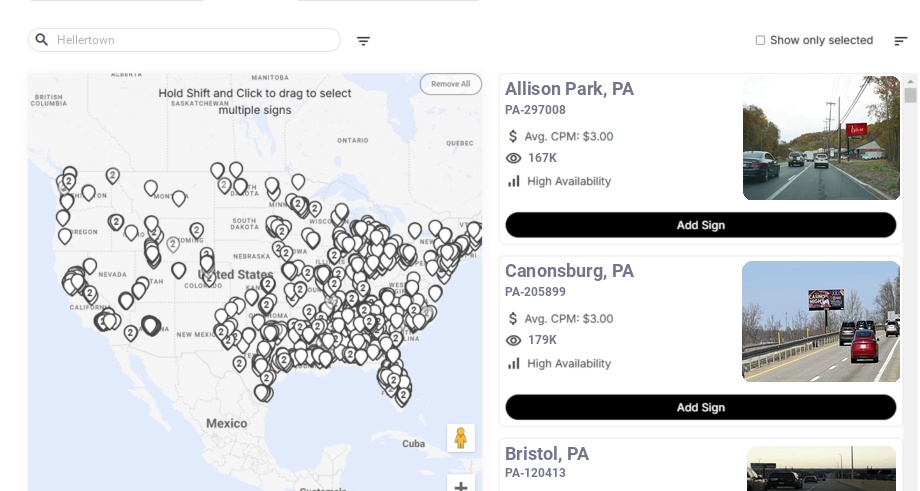



How much is a billboard in Hellertown?
Why Choose Blip for Billboard Advertising in Hellertown
Choose Blip in Hellertown to launch fast on I-78 and Route 412 with self-serve control, no contracts, and no upfront hassle.
Blip fits Hellertown budgets big or small—pay only when your ad runs, and scale up around Lehigh Valley commuter traffic.
Daypart your Hellertown campaign for 7-9 a.m. and 4-6 p.m. drives, plus weekend peaks near Bethlehem and Saucon Valley.
Use Blip's real-time analytics in Hellertown to see what's working on I-78, then shift spend as traffic or demand changes.
Create and test fresh Hellertown billboard creative quickly with Blip's tools—great for local offers aimed at car commuters and campus visitors.
Frequently Asked Questions About Billboard Advertising in Hellertown
How much does a billboard cost in Hellertown with Blip?
With Blip, billboard advertising in Hellertown can fit a wide range of budgets because you only pay when your ad actually appears. Each “blip” is a 7.5-to-10-second display on a rotating digital billboard, starting at just $0.01 per display. Pricing changes based on time of day, location, and advertiser demand, so your total cost is simply the sum of each blip over time.
Where can I advertise with Blip in Hellertown to reach local drivers?
Route 412 through Hellertown is the best fit for businesses that want repeated exposure in Hellertown itself, including restaurants, banks, dentists, fitness centers, local events, and home service companies. I-78 in the Hellertown and south Bethlehem area generally carries about 70,000 to 90,000 vehicles per day. Route 309 around Center Valley and Route 378 between south Bethlehem and I-78 also provide strong local and regional reach.
Why is Hellertown a good billboard market for Blip campaigns?
Hellertown sits inside one of eastern Pennsylvania’s strongest roadside advertising environments, with a local population of about 6,000 residents and a much larger Lehigh Valley audience around it. Roughly 85% of workers commute by car and average commute times are around 26 minutes, so repeated roadway exposure matters. A billboard campaign in the Hellertown area can reach people who live in one municipality, work in another, and shop or attend events in a third.
What kinds of people does billboard advertising in Hellertown reach?
The greater Hellertown market includes commuters, suburban households, students, faculty, campus visitors, tourists, sports fans, and eventgoers. The region also supports more than 340,000 jobs, which creates a large working audience for staffing, trade education, B2B services, workwear, quick meals, auto repair, financial services, and urgent care. This makes billboard advertising useful for both consumer campaigns and business-to-business recruiting or lead generation.
When is the best time to run a billboard campaign in Hellertown with Blip?
Spring is a strong season for home services, landscaping, outdoor retail, healthcare checkups, and family activities, while summer is one of the best periods for regional visibility. Fall is especially valuable because students return to campus, families reset routines, and employers often push hiring before the holiday season. Winter campaigns also work well for urgent care, pharmacies, heating services, tax preparation, auto service, restaurants, and gift-driven retail.
Do I need a contract to advertise with Blip in Hellertown?
No, Blip has no long-term contracts or minimum commitments. You can start, pause, or stop your campaign at any time.
How fast can I launch a billboard campaign with Blip in Hellertown?
You can have your campaign live in minutes. Create a free account, select your locations, set your budget, upload your design, and start running once approved.
Where can I advertise with Blip in Hellertown?
Blip has digital billboards in Hellertown. You can browse available locations on a map, choose the ones that fit your audience, and start advertising right away.
Still have questions? Launch a campaign in minutes — no contracts, no commitments.
Start Your CampaignHellertown Billboard Advertising Guide
Hellertown is a small borough, but it sits inside one of eastern Pennsylvania’s strongest roadside advertising environments. We are working from a local population of about 6,000 residents (5,898 in the 2020 Census), a Northampton County 312,951, and a two-county Lehigh Valley population of 687,508 when we combine Northampton and Lehigh County. Most households and workers in this part of the valley still depend heavily on personal vehicles, with roughly 85% of workers commuting by car and average commute times around 26 minutes, so repeated roadway exposure matters. When we add commuter traffic, regional retail, college audiences enrolling more than 12,700 students across Lehigh University, DeSales University, and Lafayette College, and year-round visitor activity in nearby Bethlehem, Allentown, and Easton
Hellertown Market Overview
Hellertown sits inside a much larger Lehigh Valley economy
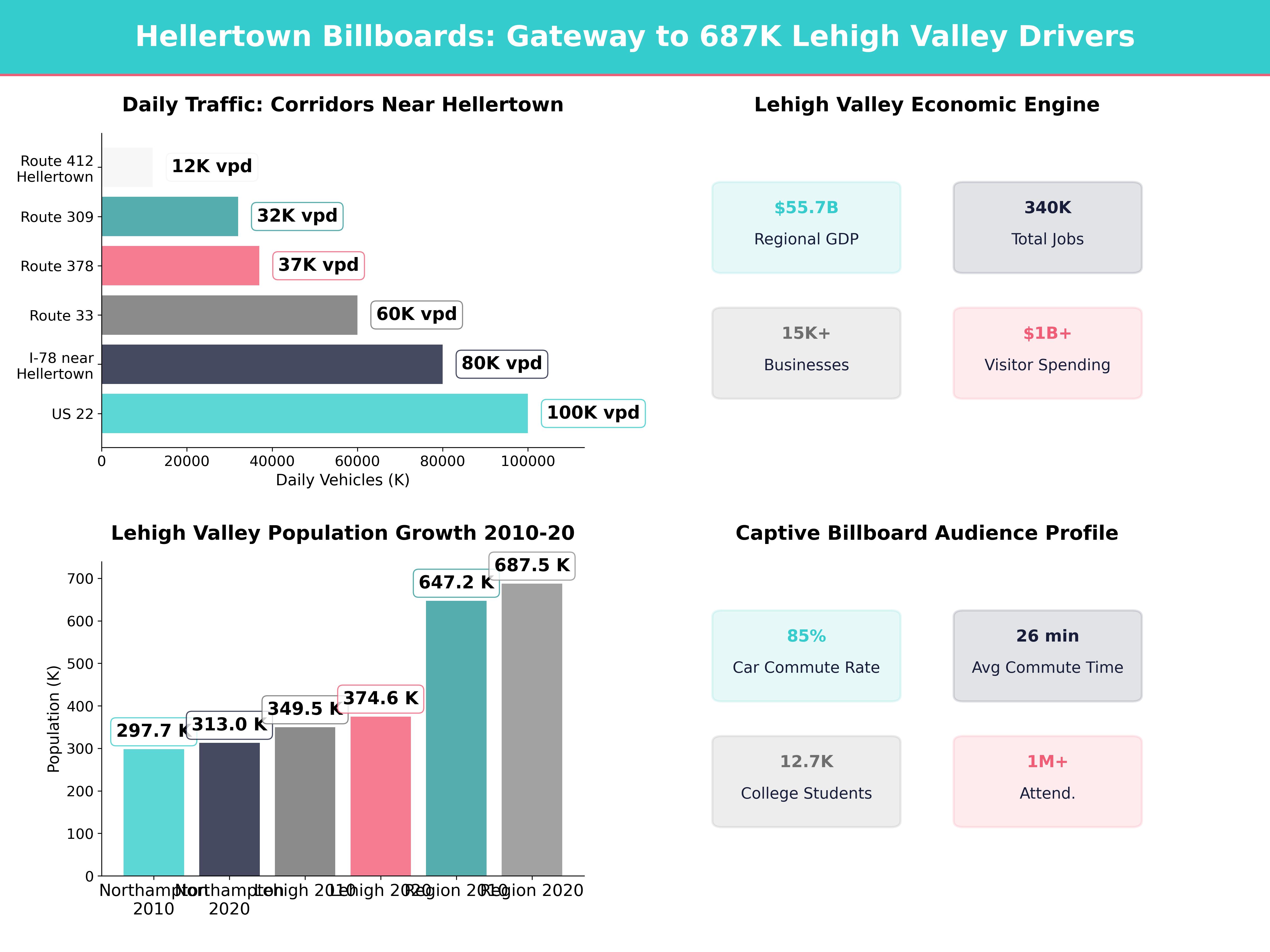
We should think about Hellertown as a gateway to the southern Lehigh Valley rather than as a standalone borough. Northampton County 312,951 residents in 2020, Lehigh County had 374,557, and the combined two-county region reached 687,508 people. The regional market grew from 647,232 to 687,508 residents between 2010 and 2020, which was an increase of about 6.2%. Northampton County alone added 15,216 residents during that decade, or about 5.1% growth, while Lehigh County added 25,060, or about 7.2% growth.
That growth matters because Hellertown is positioned near employment, education, healthcare, and entertainment centers rather than far from them. Bethlehem had 75,781 residents in 2020, Allentown had 125,845, and Easton 28,127, for a combined 229,753 residents. A billboard campaign in the Hellertown area can therefore reach people who live in one municipality, work in another, and shop or attend events in a third.
The economic base around Hellertown is broad and durable
The Lehigh Valley Economic Development Corporation $55.7 billion in gross domestic product. The same organization regularly highlights more than 15,000 businesses and more than 340,000 jobs across the valley. That is a useful mix for billboard advertisers because it supports both consumer campaigns and business-to-business recruiting or lead generation.
We also benefit from the region’s logistics position. Lehigh Valley Economic Development Corporation one-third of U.S. consumers. That helps explain the concentration of warehousing, manufacturing, trucking, and distribution activity along I-78 and the nearby Pennsylvania Turnpike, which in turn creates dependable commuter and shift-worker traffic.
Car-heavy travel patterns favor roadside media in Hellertown
Recent survey estimates for Northampton County show that roughly 85% of workers commute by car, whether driving alone or carpooling, and average commute times land around 26 minutes. LANTA serves the urban core well, but suburban travel in Hellertown, Lower Saucon Township, and Upper Saucon Township
Key Traffic Corridors Around Hellertown
PennDOT traffic volumes vary by segment and year, but the corridor ranges below are the most useful ones when we plan campaigns around Hellertown.
I-78 near Hellertown and the PA 412 interchange
According to PennDOT traffic mapping, I-78 in the Hellertown and south Bethlehem area generally carries about 70,000 to 90,000 vehicles per day. This is the dominant regional corridor for residents moving between the Saucon Valley, Bethlehem, Easton, New Jersey, and the larger eastern Pennsylvania highway network.
This corridor works especially well for advertisers that need scale and repetition.
- Healthcare systems such as St. Luke’s University Health Network and Lehigh Valley Health Network benefit because I-78 reaches patients, families, and healthcare employees across multiple municipalities.
- Retail and dining brands benefit because the highway feeds trips to The Promenade Shops at Saucon Valley, Wind Creek Bethlehem, and other major destinations.
- Employers and staffing campaigns benefit because this is one of the valley’s most important commuter and warehouse corridors.
US 22 and Route 33 for valley-wide reach
US 22 through Bethlehem and Allentown often exceeds 100,000 vehicles per day on busier segments, while Route 33 between I-78 and US 22 commonly runs around 50,000 to 70,000 AADT. These two roads give us some of the best regional reach in the Lehigh Valley because they connect suburban neighborhoods, industrial areas, airport traffic, and cross-valley commuters.
US 22 is especially valuable when we want broad awareness across the metro because it ties together the airport district, retail corridors, and dense residential areas. Route 33 is strong for advertisers that want to intercept east-west and north-south movement, especially travelers heading toward Easton, the Poconos, or I-78.
These corridors are strong matches for:
- Regional healthcare and legal services, because people routinely travel across county lines for these categories.
- Higher education, because prospective students and parents visit campuses from all directions.
- Travel, entertainment, and hospitality, because these roads pick up visitors heading to SteelStacks, Crayola Experience, and Lehigh Valley International Airport.
Route 309, Route 378, and Route 412 for local intent
Route 309 around Center Valley usually falls in the 25,000 to 40,000 vehicles per day range, Route 378 between south Bethlehem and I-78 often lands around 30,000 to 45,000, and Route 412 through Hellertown is more of a 10,000 to 15,000 vehicle local corridor depending on the segment. These are lower-volume roads than the interstates, but they often produce stronger intent because they catch drivers close to where they live, shop, or turn.
Route 309 is ideal for campaigns tied to The Promenade Shops at Saucon Valley, DeSales University, and Center Valley medical offices. Route 378 is useful when we want visibility around south Bethlehem, Lehigh University, and the hospital campuses. Route 412 is the best fit for businesses that want repeated exposure in Hellertown itself, including restaurants, banks, dentists, fitness centers, local events, and home service companies.
Audience Segments We Can Reach in Hellertown
Hellertown commuters and suburban households
Hellertown is well positioned to reach people whose daily routines cross municipal boundaries. Many residents of Hellertown, Lower Saucon, and Upper Saucon work in Bethlehem, Allentown, Easton, or along the I-78 industrial corridor, then return through the same road network each evening. That commuting pattern is exactly what makes digital billboards effective.
The local audience also skews toward practical household decision-makers. That is useful for advertisers in categories such as:
- Home improvement, because homeowners repeatedly travel the same suburban corridors.
- Healthcare and dental services, because family scheduling often follows commute routes.
- Banking, insurance, and legal services, because trust-based categories benefit from repeated roadside exposure near home.
Students, faculty, and campus visitors around Hellertown
The greater Hellertown market includes several colleges and universities within a short drive. Lehigh University enrolls more than 7,000 students, DeSales University serves about 3,000, and Lafayette College enrolls about 2,700. Northampton Community College, Moravian University, and Penn State Lehigh Valley
For advertisers, this creates several useful windows. We can target late-summer move-in, back-to-school demand, spring graduation, weekend sports traffic, and parents visiting from outside the region. Apartment communities, storage companies, quick-service restaurants, healthcare clinics, telecom providers, and graduate programs all fit this audience well.
Tourists, sports fans, and eventgoers in the Lehigh Valley
Tourism is a meaningful force in the local media environment. Annual visitor spending in the Lehigh Valley has been reported above $1 billion, and signature events create major bursts of roadway traffic. Musikfest alone draws more than 1 million attendees. PPL Center seats about 8,500, Wind Creek Event Center seats about 3,700, and the Lehigh Valley IronPigs bring fans to 75 regular-season home games each year.
That gives us a broad set of tourism-oriented audiences:
- Weekend visitors heading to ArtsQuest, SteelStacks, and Wind Creek Bethlehem.
- Family travelers going to Dorney Park, Crayola Experience, and seasonal attractions.
- Holiday shoppers visiting Christkindlmarkt Bethlehem and downtown Bethlehem during the winter season.
Healthcare, industrial, and logistics workers near Hellertown
The Lehigh Valley’s job base supports a large working audience beyond office commuters. St. Luke’s University Health Network, Lehigh Valley Health Network, higher education institutions, manufacturers, and logistics employers all contribute to steady traffic on I-78, Route 33, Route 309, and Route 22. Because the region supports more than 340,000 jobs, recruiting campaigns can perform well here year-round.
This matters for advertisers in staffing, trade education, B2B services, workwear, quick meals, auto repair, financial services, and urgent care. It also means shift-friendly dayparts can be just as important as classic 7 a.m. to 9 a.m. and 4 p.m. to 6 p.m. commuter windows.
Seasonal and Timing Opportunities in Hellertown
Spring in Hellertown brings household spending and graduation traffic
Spring is a strong season for home services, landscaping, outdoor retail, healthcare checkups, and family activities. The local calendar also picks up with college visits, school sports, and commencement season at Lehigh University, DeSales University, and Lafayette College. We should use March through May for categories that benefit from intent-based local action, including HVAC, roofing, dental care, and real estate.
Summer in Hellertown means festivals, family outings, and long-drive exposure
Summer is one of the best periods for regional visibility. Musikfest, Dorney Park, SteelStacks, and Lehigh Valley IronPigs all lift weekend and evening traffic. Longer daylight hours also help outdoor creative stay visible deeper into the evening.
We should plan summer boards for:
- Restaurants, breweries, and entertainment venues that want pre-event traffic.
- Hotels, attractions, and casinos that want to capture destination visitors.
- Retailers and family services that benefit from school break mobility.
Fall in Hellertown is prime time for back-to-school and recruiting
Late August through October is especially valuable because several demand cycles overlap. Students return to campus, families reset routines, football and youth sports pick up, and employers often push hiring before the holiday season. Fall is also a natural season for healthcare enrollment messaging, home maintenance, and financial services.
The Saucon Valley area is well suited to this type of campaign because we can reach both local households and valley-wide commuters. If we want strong frequency, fall is often more efficient than peak holiday weeks while still delivering dense local movement.
Winter around Hellertown favors holiday, healthcare, and weather-responsive messaging
Winter campaigns work well in this market when we use the season strategically. Bethlehem draws strong holiday traffic thanks to its Christmas reputation and Christkindlmarkt Bethlehem, while Blue Mountain Resort
Winter is a good time for urgent care, pharmacies, heating services, tax preparation, auto service, restaurants, and gift-driven retail. It is also a strong season for reminder messaging because drivers tend to make repeated local trips even when long-distance leisure travel softens.
Billboard Design Tips for the Hellertown Market
Use geography that Hellertown drivers recognize immediately
In the Hellertown market, place names matter. Copy like “Off 412,” “Near I-78,” “Minutes from Bethlehem,” or “At Saucon Valley” often performs better than generic branding because drivers understand those reference points instantly. That is especially true when we are reaching people headed to The Promenade Shops at Saucon Valley, south Bethlehem, or Center Valley.
Match Hellertown’s practical, quality-conscious audience
Hellertown and the Saucon Valley often respond well to messaging that balances value with credibility. We should emphasize convenience, trust, service quality, and local relevance rather than relying only on abstract brand slogans. A direct headline with one benefit usually fits the market better than a clever line that takes 2 reads to understand.
This region also rewards audience-specific creative. Allentown is majority Hispanic or Latino, and Bethlehem has a large Hispanic population as well, so bilingual or Spanish-language variants can make sense on broader Lehigh Valley boards. We do not need every board to carry the same message if the audience mix changes by corridor.
Build visuals around the Lehigh Valley’s identity
Creative that feels rooted in the Lehigh Valley tends to resonate more than generic stock imagery. We can borrow cues from the region’s industrial heritage, historic main streets, fall foliage, collegiate energy, and holiday atmosphere. Warm metallic tones, strong blues, deep greens, and crisp winter contrast often feel more native here than beachy or tropical palettes.
For faster roads such as I-78 and Route 33, we should keep copy extremely short and directional. For slower local roads such as Route 412, we can allow a little more personality if the message still reads instantly.
Regional Strategies Around Hellertown
Hellertown and Lower Saucon for frequency and local action
If our goal is immediate local response, we should prioritize the Hellertown and Lower Saucon Township area. These placements are best for restaurants, dentists, gyms, banks, real estate agents, daycare centers, and service businesses that want repeated weekly exposure rather than one-time regional reach.
This is also where community-based creative works best. Messages that mention Hellertown, Saucon Valley, or nearby landmarks often feel more trustworthy here than broad regional copy.
Center Valley and Upper Saucon for affluent shoppers and destination retail
The Upper Saucon Township The Promenade Shops at Saucon Valley includes more than 60 shops, restaurants, and service businesses, and the corridor also benefits from DeSales University and major healthcare traffic. This is a strong zone for retail, medical specialists, upscale dining, wellness, financial services, and home design categories.
If we are selling a higher-consideration service, this area often supports a more polished creative approach than a hard-discount message.
Bethlehem for entertainment, healthcare, and student reach
Nearby Bethlehem gives us access to a denser mix of students, eventgoers, and healthcare traffic. Lehigh University, ArtsQuest, SteelStacks, Wind Creek Bethlehem, and multiple hospital facilities create a layered audience throughout the day.
We should use Bethlehem-oriented boards when we want:
- Event and nightlife traffic in the afternoon and evening.
- Healthcare awareness close to decision-making moments.
- Recruiting and student messaging around semester and move-in periods.
Allentown and Easton for broader Lehigh Valley scale
When our objective is valley-wide awareness, we should expand beyond immediate Hellertown inventory. Allentown gives us the region’s largest city at 125,845 residents, and Easton 28,127 plus cross-river New Jersey influence. Combining Hellertown-area boards with US 22 or Route 33 placements often gives us a better balance of local relevance and metropolitan scale.
This wider strategy is especially effective for health systems, universities, dealerships, personal injury firms, staffing brands, consumer finance, and major entertainment venues.
Using Blip’s Tools in Hellertown
Daypart around Hellertown commutes and event surges
In Hellertown, dayparting should follow actual local behavior. We can emphasize early-morning and late-afternoon commuter windows on I-78, Route 309, and Route 378, then shift budget toward evenings and weekends when SteelStacks, Wind Creek Bethlehem, or PPL Center are active. This makes our spend more relevant without forcing us into an all-day schedule.
Use multiple creatives for different Hellertown corridors
The Hellertown market is ideal for message variation. We can run one creative on interstate boards that emphasizes brand, direction, or a simple offer, and another on slower local boards that highlights neighborhood credibility or a specific call to action. We can also localize artwork with references to Hellertown, Bethlehem, Center Valley, or the Saucon Valley depending on placement.
Watch performance and optimize quickly
Because this market has clear seasonal swings, quick optimization matters. If a creative starts to outperform during Musikfest, college move-in, or holiday shopping, we can lean into it while the demand window is live. If weather, traffic, or local events change behavior, we can adjust placement mix, timing, and artwork without rebuilding a traditional static-buy plan.
Getting Started with Billboard Rental in Hellertown
Start with the business goal before we pick Hellertown boards
The best Hellertown campaign starts with a clear objective. If we want local store visits, we should favor Route 412, Route 309, or nearby neighborhood approaches. If we want broad awareness, we should widen the plan to I-78, Route 33, and US 22. If we want event, dining, or entertainment traffic, Bethlehem-area boards are usually the stronger fit.
A simple planning framework helps:
- Local action usually points us toward Hellertown, Lower Saucon, and Center Valley.
- Regional awareness usually points us toward I-78, Route 33, and US 22.
- Tourism and entertainment usually point us toward Bethlehem and downtown Allentown.
Expect a simpler process than traditional billboard buying in Hellertown
Traditional billboard buying often requires long conversations about availability, fixed terms, and market packages that include locations we may not actually want. In Hellertown, that can be especially frustrating because the borough itself is small and the real opportunity often sits in nearby regional corridors. A self-serve digital approach is easier because we can evaluate boards on a map, align them to actual travel behavior, and start with a modest test instead of a long commitment.
That flexibility is valuable in a place like Hellertown where the best campaign may combine 2 or 3 adjacent submarkets rather than a single “local” board.
Evaluate Hellertown locations by intent, not just proximity
The closest board is not always the best board. A Route 412 placement may be perfect for a dentist or neighborhood restaurant, while an I-78 board may be better for a hospital service line, destination retailer, or recruiting campaign. We should judge each location by who is driving there, how fast they are moving, what they are likely thinking about, and how often they pass the board.
We can also make measurement more practical by pairing each campaign with a unique landing page, a short URL, a promo code, or an offer window tied to local events. In a market like Hellertown, success usually comes from matching the board to the travel pattern, then refining the campaign as real performance data comes in.
Build Hellertown campaigns as a local-plus-regional mix
The strongest billboard strategy for Hellertown is usually not “only Hellertown.” It is a layered plan that uses local boards for trust and repetition, then adds regional boards for scale. When we combine borough-level familiarity with the bigger Lehigh Valley roadway network, we give our campaign a much better chance to drive awareness, visits, and action.