Billboards in Orwigsburg, PA
No Minimum Spend. No Long-Term Contracts. Just Results.
Trusted by Leading Brands


Billboard advertising
in Orwigsburg has never been easier
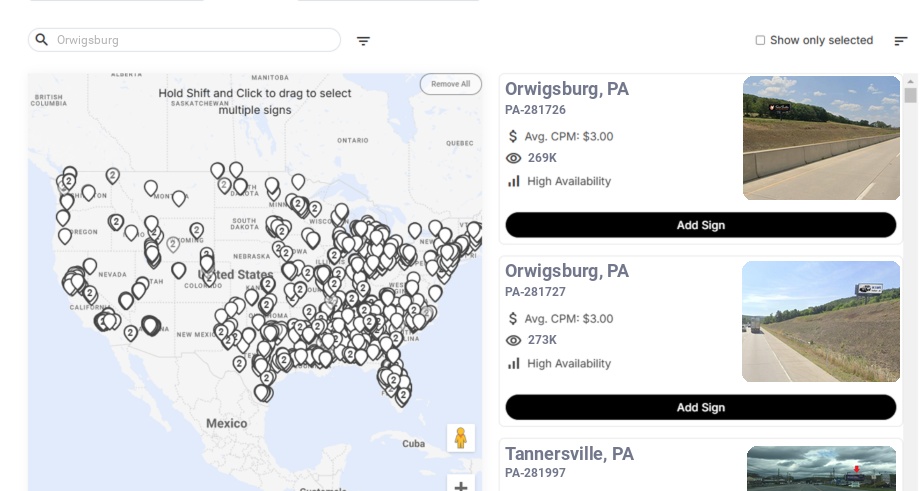



How much is a billboard in Orwigsburg?
Why Choose Blip for Billboard Advertising in Orwigsburg
Blip's self-serve setup lets you launch in Orwigsburg fast and reach PA 61 commuters without sales calls or contracts.
Use Blip-optimized campaigns in Orwigsburg to auto-pick timing and boards for PA 61, PA 443, and I-78 traffic around your goals.
In Orwigsburg, flexible Blip budgets help you start small, then scale for fall foliage, school traffic, or summer day trips.
Daypart your Orwigsburg ads for 6-9 a.m. and 3-6 p.m. commuter peaks, or shift to weekend visitors on Hawk Mountain routes.
Track Orwigsburg performance in real time with Blip and adjust for healthcare, hiring, or retail campaigns as traffic changes.
Blip's creative tools make it easy to build bold Orwigsburg ads for 65 mph drivers on I-78 and local runs on PA 443.
Frequently Asked Questions About Billboard Advertising in Orwigsburg
How much does a billboard cost in Orwigsburg with Blip?
Each “blip” is a 7.5-to-10-second display on a rotating digital billboard, starting at just $0.01 per display. Your daily budget guides Blip’s algorithm as it bids for open ad slots, and the cost per blip can change based on time of day, location, and advertiser demand. There are no minimums or contracts, so you can pause or change your spend at any time.
Where can I advertise with Blip in Orwigsburg for the most local traffic?
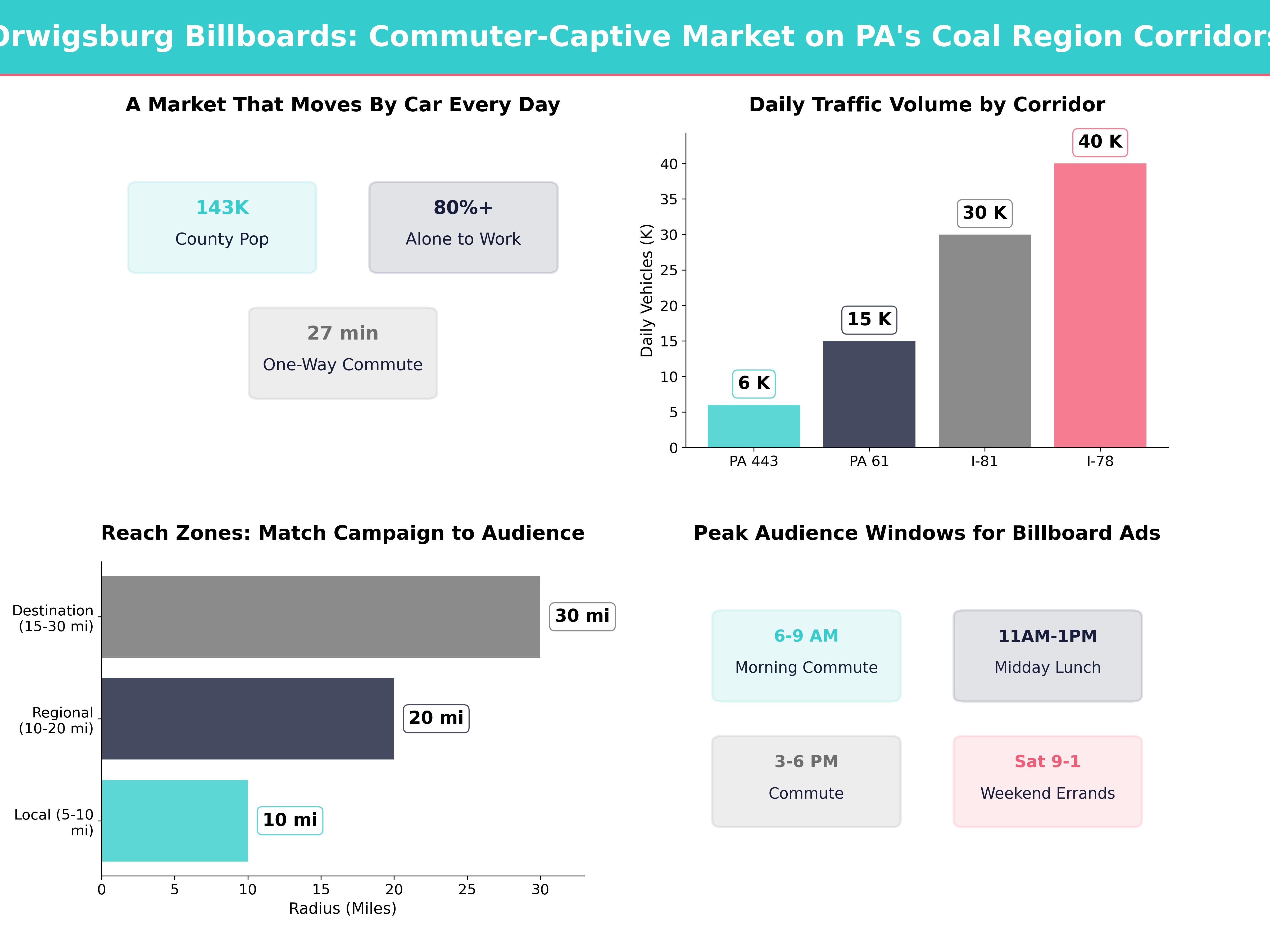
PA 61 through the Orwigsburg-Cressona area generally operates in the 10,000 to 20,000 AADT range, depending on the segment, and it is the core daily-reach road for southern Schuylkill County. PA 443 runs directly through Orwigsburg and is especially useful for highly local traffic, with segments commonly in the 4,000 to 8,000 AADT range. Nearby I-78 also expands campaigns beyond the borough with traffic counts that generally exceed 30,000 AADT.
Why is Orwigsburg a good billboard market for Blip?
Orwigsburg gives us a strong billboard market because it sits at the southern gateway to Schuylkill County, along the PA 61 corridor, and within easy reach of Berks County and the broader I-78 travel shed. The borough itself has roughly 3,000 residents, but the surrounding county market had 143,049 people in the 2020 Census, which is large enough to support regional retail, healthcare, education, and service advertising. Commute patterns in this part of Pennsylvania are overwhelmingly car-based, with more than 80% of workers driving alone countywide.
What kind of timing works best for billboard ads in Orwigsburg with Blip?
We usually see the best commuter relevance during 6 to 9 a.m. and 3 to 6 p.m. dayparts. Late August, early January, and May are especially useful times for family-focused advertising, while fall is arguably the strongest creative season in the area. From December through March, bright digital creative becomes more noticeable because daylight falls before 5 p.m. for much of the winter drive-home period.
What types of businesses should advertise in Orwigsburg?
Southern Schuylkill County is not a one-industry market, and the business base includes manufacturing, logistics, healthcare, retail, education, and tourism. That means Orwigsburg is useful for recruiting, healthcare awareness, education marketing, event promotion, and local services. It is also strong for destination retail, hospitals, colleges, tourism, and multi-location service brands.
Do I need a contract to advertise with Blip in Orwigsburg?
No, Blip has no long-term contracts or minimum commitments. You can start, pause, or stop your campaign at any time.
How fast can I launch a billboard campaign with Blip in Orwigsburg?
You can have your campaign live in minutes. Create a free account, select your locations, set your budget, upload your design, and start running once approved.
Where can I advertise with Blip in Orwigsburg?
Blip has digital billboards in Orwigsburg. You can browse available locations on a map, choose the ones that fit your audience, and start advertising right away.
Still have questions? Launch a campaign in minutes — no contracts, no commitments.
Start Your CampaignOrwigsburg Billboard Advertising Guide
Orwigsburg Schuylkill County, along the PA 61 corridor, and within easy reach of Berks County and the broader I-78 travel shed. The borough itself has roughly 3,000 residents, but the surrounding county market had 143,049 people in the 2020 Census, which is large enough to support regional retail, healthcare, education, and service advertising. Commute patterns in this part of Pennsylvania are overwhelmingly car-based, with more than 80% of workers driving alone countywide, and limited fixed-route coverage outside the Schuylkill Transportation System means drivers still spend a meaningful share of their week on the road. That mix of local frequency, corridor traffic, and seasonal tourism gives digital billboards around Orwigsburg unusual efficiency for both hometown businesses and regional brands.
Orwigsburg Market Overview
Orwigsburg is a small borough with a larger trade area
When we advertise in Orwigsburg, we are not buying only for borough residents. We are buying for the larger southern Schuylkill County trade area that moves between Pottsville Cressona, Hamburg Pennsylvania State Data Center figures show that Schuylkill County had 143,049 residents in 2020, down from 148,289 in 2010. That was a decline of 5,240 people, or about 3.5%, over the decade.
That population trend matters because it shifts our strategy from broad, wasteful reach to efficient, repeated exposure. Schuylkill County covers nearly 800 square miles (about 783 square miles), so the audience is spread out and strongly tied to road travel. Orwigsburg is also only about 7 miles south of Pottsville, which gives it access to county traffic while still sitting close to the southbound connection toward Hamburg and I-78.
Car dependence makes outdoor media especially useful in Orwigsburg
For billboard planning, the most important local behavior is driving. Data profiles compiled through Pennsylvania State Data Center show that more than 80% of workers in Schuylkill County drive alone to work, and the average commute is about 27 minutes. In a market with that much windshield time, digital billboards work as both a reminder medium and a directional medium.
We should also remember that public transportation plays a smaller role here than it does in larger metros. The Schuylkill Transportation System is important, but the region still functions primarily as a driving market. That means billboards can influence daily decisions about:
- Where we stop for food on the way home.
- Which healthcare provider we call after seeing the same message all week.
- Which dealership, bank, college, or employer stays top of mind during repeated commuter trips.
The Orwigsburg economy supports year-round campaigns
Southern Schuylkill County is not a one-industry market. The business base includes manufacturing, logistics, healthcare, retail, education, and tourism. Organizations such as the Schuylkill Chamber of Commerce Schuylkill Economic Development Corporation Blue Mountain School District, Penn State Schuylkill Lehigh Valley Hospital-Schuylkill, and St. Luke's University Health Network create steady year-round advertising demand.
For us, that means Orwigsburg is useful for more than one-off retail pushes. It is also strong for recruiting, healthcare awareness, education marketing, event promotion, and local services.
Key Traffic Corridors for Orwigsburg Billboards
PA 61 is the everyday frequency corridor
According to PennDOT traffic data tools, PA 61 through the Orwigsburg-Cressona area generally operates in the 10,000 to 20,000 AADT range, depending on the segment. That makes it the core daily-reach road for southern Schuylkill County. It handles school traffic, errands, healthcare trips, commuting toward Pottsville, and southbound movement toward Hamburg.
We like PA 61 for advertisers that benefit from repetition and local relevance. These categories usually fit especially well:
- Healthcare and urgent care advertisers can stay visible to people making routine weekday trips.
- Restaurants and convenience brands can catch both lunch traffic and the after-work drive.
- Banks, insurance agencies, and legal firms can build recognition through repeated weekly exposure.
- Home services companies can stay present until the household need appears.
Because PA 61 combines commuter traffic and local decision-making, it often produces a better balance of frequency and relevance than a pure interstate placement.
I-78 expands Orwigsburg campaigns beyond the borough
Nearby I-78 is the regional scale play. PennDOT counts on nearby segments generally exceed 30,000 AADT, and stronger approaches closer to the Berks County side can climb beyond 50,000 AADT. That gives us a much larger geography than Orwigsburg alone.
This corridor is especially valuable when we need to reach:
- Schuylkill County residents heading south to shop or work.
- Berks County drivers traveling north for attractions, employers, or events.
- Regional travelers making weekend leisure trips across eastern Pennsylvania.
We usually prefer I-78 for destination retail, hospitals, colleges, tourism, large events, and multi-location service brands. Because traffic often moves at 65 mph on rural interstate stretches, we need shorter, bolder creative here than we do on PA 61.
PA 443 captures hyperlocal Orwigsburg traffic
PA 443 runs directly through Orwigsburg and acts as the borough's east-west local spine. PennDOT traffic maps commonly place local segments in roughly the 4,000 to 8,000 AADT range. Those counts are lower than PA 61, but the audience is highly local and often closer to a purchase decision.
We find PA 443 especially useful for:
- Community banks and credit unions.
- Contractors, roofers, plumbers, and HVAC firms.
- Local restaurants, pharmacies, and hardware stores.
- Schools, nonprofits, and event organizers.
This is the kind of road where billboards can reinforce familiarity. Drivers on 443 are often not just passing through once. They are making the same practical trips week after week.
I-81 and U.S. 209 extend the industrial and commuter reach
To the west and north, I-81 and U.S. 209 help extend Orwigsburg campaigns into the broader Schuylkill logistics market. Many I-81 segments in Schuylkill County carry 30,000+ vehicles per day and include a meaningful truck share, according to PennDOT. That matters for recruiting, truck services, industrial suppliers, staffing agencies, and B2B campaigns.
When we think beyond consumer retail, this wider corridor becomes important. Employers connected to warehousing, manufacturing, transportation, and equipment sales can use Orwigsburg-area digital boards as part of a larger county strategy rather than treating the borough as an isolated small town.
Audience Segments We Can Reach Around Orwigsburg
Orwigsburg commuters and working households
The most dependable audience in this market is the daily commuter. With 80%+ drive-alone commuting and an average trip of about 27 minutes, the local audience sees the same corridors repeatedly. That gives us the frequency needed to move top-of-mind awareness.
We usually see the best commuter relevance during 6 to 9 a.m. and 3 to 6 p.m. dayparts. Those windows are especially effective for:
- Hiring campaigns.
- Quick-service restaurants and takeout.
- Primary care, urgent care, and dental services.
- Banks, insurance, and legal services.
- Auto repair, tires, and oil change brands.
Because many households in this region budget carefully and plan errands efficiently, convenience-focused messaging tends to work well.
Orwigsburg families, schools, and community buyers
Orwigsburg sits in the Blue Mountain School District, so the K-12 calendar strongly shapes local traffic and spending patterns. Late August, early January, and May are especially useful times for family-focused advertising. Parents are making repeated school trips, sports trips, and routine purchases.
For family and community audiences, billboards work well for:
- Pediatric and orthodontic care.
- Grocery and family dining.
- Home improvement and seasonal services.
- After-school programs, camps, and youth activities.
- Retail promotions tied to back-to-school and holiday shopping.
In this market, trust usually beats novelty. We generally get better traction with clear value, location, and reliability than with edgy or highly abstract branding.
Orwigsburg tourists and day-trippers
Southern Schuylkill County also attracts weekend and seasonal leisure traffic. Nearby Hawk Mountain Sanctuary protects 2,600 acres and dates to 1934, making it one of the region's best-known nature destinations. D.G. Yuengling & Son was founded in 1829, which gives Pottsville a nationally recognized tourism asset. The region also benefits from Reading Blue Mountain & Northern Railroad excursions, the Anthracite Outdoor Adventure Area, the annual Schuylkill County Fair, and shopping traffic connected to Cabela's Hamburg
That makes Orwigsburg useful for more than local-only businesses. We can also use billboards here for:
- Breweries, restaurants, and farm markets.
- Hotels, campgrounds, and attractions.
- Regional healthcare providers.
- Event venues and festivals.
- Destination retail and outdoor recreation brands.
Orwigsburg students, healthcare users, and service seekers
Penn State Schuylkill 4-year higher-education audience to the area, and Lehigh Valley Hospital-Schuylkill operates 2 Pottsville campuses. Along with St. Luke's University Health Network, those institutions create year-round movement by students, staff, patients, caregivers, and visitors.
This audience is especially valuable for:
- Colleges and career training programs.
- Apartments and telecom services.
- Healthcare specialties and elective procedures.
- Pharmacies and wellness brands.
- Employers recruiting nurses, technicians, and support staff.
For these advertisers, Orwigsburg can serve as part of a broader Pottsville-area awareness strategy.
Seasonal and Timing Opportunities in Orwigsburg
Spring and summer in Orwigsburg
From April through August, the local market becomes especially strong for home services, lawn and garden, auto care, family dining, and recreation. Warmer weather increases short local trips and weekend excursions. It also boosts interest in hiking, rail excursions, off-road recreation, and county events.
We usually like to weight budgets toward:
- Friday afternoon commuting.
- Saturday morning errands, especially 9 a.m. to 1 p.m..
- Pre-holiday weekends.
- Late-summer event promotion windows.
This is also a good time for healthcare groups, camps, educational programs, and local attractions to build awareness before the fall calendar gets crowded.
Fall is one of the best billboard seasons around Orwigsburg
Fall is arguably the strongest creative season in the area. Between September and November, we get foliage travel, high school sports, college recruiting, heating service demand, hunting-related retail, and holiday shopping preparation. Hawk Mountain Sanctuary also becomes even more top-of-mind during migration season.
We often recommend stronger fall schedules for:
- HVAC, roofing, and home exterior services.
- Hospitals, urgent care, and flu-season messaging.
- Colleges, workforce training, and hiring campaigns.
- Restaurants, breweries, and seasonal events.
- Retailers preparing for Black Friday and holiday traffic.
In visual terms, fall creative often feels especially native in Schuylkill County because the region's ridgelines, forests, and outdoor culture already align with autumn color palettes.
Winter and early-year timing in Orwigsburg
From December through March, bright digital creative becomes more noticeable because daylight falls before 5 p.m. for much of the winter drive-home period. We like this season for healthcare, tax services, tire shops, insurance agencies, gyms, and indoor entertainment.
Winter also gives us practical timing opportunities:
- January works well for self-improvement, education, and recruiting.
- February and March work well for tax preparation and spring-prep services.
- Snow and ice increase relevance for auto, towing, heating, and plumbing campaigns.
No matter the season, commuter-heavy dayparts of 6 to 9 a.m. and 3 to 6 p.m. usually produce the most efficient local audience mix.
Billboard Design Tips for the Orwigsburg Market
Use Orwigsburg route language, not vague branding language
In this market, drivers think in roads, towns, and landmarks. Copy such as “On 61,” “Minutes from I-78,” “South of Pottsville,” or “Near Hamburg” often lands better than generic metro-style branding. We should make location easy to understand in a single glance.
As a rule, we want 1 clear action, 1 core benefit, and about 6 to 8 words of primary copy on faster roads. That discipline matters even more on I-78, where traffic is moving at interstate speed.
Match the visual identity of Schuylkill County
Creative that feels at home in Schuylkill County usually beats designs that look imported from Philadelphia or New York. Forest green, navy, gold, white, brick red, and fall orange fit naturally with the area's ridgelines, high school sports culture, brick main streets, and outdoor recreation identity.
We often recommend using imagery such as:
- Real staff photos instead of overly polished stock models.
- Trucks, work uniforms, tools, exam rooms, or product close-ups.
- Mountain, woodland, or roadside scenery when it fits the brand.
- Family and community scenes that feel authentic to a small-town market.
That approach is especially important for healthcare, trades, education, and local-service advertisers.
Trust, longevity, and convenience resonate in Orwigsburg
Orwigsburg-area audiences respond well to signals of reliability. Phrases like “Family Owned,” “Serving Schuylkill County Since 19XX,” “Now Hiring,” “Open Late,” or “Same-Day Appointments” are often stronger here than clever slogan-first copy. This is a market where plainspoken messaging can feel more believable.
We should also lean into convenience. If a business is 5 miles away, 10 minutes off the route, or just past a familiar intersection, that can be a better hook than a broad branding statement. Drivers want to know what the offer is and how easy it is to act on it.
Design for weather, darkness, and highway speed
On roads where traffic is moving at 55 to 65 mph, low-contrast design gets lost quickly. Winter grime, rain, and overcast skies can mute weak color combinations, so strong contrast usually performs better. White type on dark blue, black, forest green, or deep red tends to read cleanly in this market.
We should also rotate creative by season. Snow service, cold-weather healthcare, and heating messages feel timely in January. Decks, roofing, camps, and outdoor dining feel timely in May. The ability to swap creative quickly is especially valuable in a four-season market like Orwigsburg.
Regional Strategies Around Orwigsburg
The Orwigsburg-Cressona core is best for local frequency
If our goal is hometown recognition, we should focus on the PA 61 and PA 443 crossroads area. This part of the market is ideal for repeat-visit businesses, such as restaurants, dentists, hardware stores, pharmacies, banks, and local contractors.
We usually think of this as a 5- to 10-mile trade area. In that zone, frequency often matters more than raw impression scale. We want the message to become familiar through repetition.
Pottsville adds countywide reach for healthcare, education, and services
When we need broader county relevance, moving north toward Pottsville makes sense. The presence of Lehigh Valley Hospital-Schuylkill, Penn State Schuylkill
This strategy works well when we are trying to influence bigger-ticket decisions rather than simple convenience purchases.
The southbound gateway opens Orwigsburg to Berks County traffic
If our goal is destination retail, event attendance, or regional awareness, we should extend the strategy toward the I-78 and Hamburg connection. That opens access to shoppers and commuters moving between Schuylkill County, Berks County, and even parts of Lehigh County.
We usually think of this as the 10- to 20-mile reach zone. It is especially strong for:
- Dealerships and major retail.
- Hospitals and specialty care.
- Colleges and training providers.
- Tourism and seasonal attractions.
- Event and entertainment promotion.
Western county routes are stronger for logistics and recruiting
If we are advertising to truck drivers, industrial workers, or B2B buyers, we should consider the broader county approach that includes I-81 and related industrial travel routes. In those areas, practical messaging usually outperforms lifestyle branding.
For example, “Hiring CDL Drivers,” “Apply in 5 Minutes,” or “Truck Service at Next Exit” is often a better use of space than a generic awareness headline. These audiences are route-driven and task-driven.
Using Blip Tools in Orwigsburg
We can daypart around Orwigsburg's actual traffic habits
Because Orwigsburg is so commute-oriented, time targeting matters. We can put more weight behind 6 to 9 a.m., 11 a.m. to 1 p.m., and 3 to 6 p.m. windows when local attention is most tied to work, lunch, errands, and the drive home. That is especially useful for restaurants, urgent care, retail, and hiring campaigns.
We should use manual placement when the route matters most
If we know we want only PA 61 commuters, only I-78 regional traffic, or only the Pottsville healthcare audience, manual campaign setup gives us tighter control. That is helpful when local context matters more than broad optimization.
Because the platform is flexible and pay-per-play, with bids starting at $0.01 per display, we can test a narrow corridor strategy without committing to a large traditional buy.
We can let optimization handle broader regional awareness
When our goal is wider awareness across Schuylkill County, Berks County, and nearby commuter corridors, a Blip-optimized campaign can usually allocate budget more efficiently than a hand-built list of every possible board. We can then monitor real-time analytics and shift toward the best-performing geography, time of day, and creative version.
That is especially useful when we are promoting a hospital system, college, event, or multi-location service brand.
We should build multiple creative versions for Orwigsburg
This market rewards relevance. We rarely want to run only 1 message all month. It is smarter to prepare separate versions for commuters, weekend travelers, recruits, and seasonal shoppers. Blip's artwork tools make it easier for us to rotate a fall version, a holiday version, and a winter service version without rebuilding the campaign from scratch.
Getting Started with Billboard Rental in Orwigsburg
We should begin with the real business goal
The first question is whether we want local frequency, regional awareness, destination traffic, or recruiting. A dentist, restaurant, or hardware store may only need a 5- to 10-mile trade area. A hospital, dealership, college, brewery, or county event may need a 15- to 30-mile audience that includes commuters and weekend visitors. Once we define the goal, choosing locations becomes much easier.
We should evaluate Orwigsburg billboards by context, not just cost
The best board is not always the cheapest board. We should judge every option by four practical factors:
- Route. PA 61 and PA 443 are better for local everyday traffic, while I-78 and I-81 are better for regional scale.
- Direction. A morning inbound audience is different from an evening outbound audience.
- Speed. A board near 65 mph traffic needs shorter copy and bolder design than one on a slower approach.
- Decision point. A location close to an exit, turn, store, or service area often converts better than a more distant board with higher theoretical reach.
We should also look for context near recognizable anchors, such as Hawk Mountain Sanctuary, Penn State Schuylkill Lehigh Valley Hospital-Schuylkill, Cabela's Hamburg
We can start small, learn quickly, and scale what works
Traditional billboard buying often starts with packaged inventory, sales calls, and limited flexibility. In Orwigsburg, we can move faster by launching a focused test, reading the results, and expanding only where the audience response makes sense.
A practical rollout often looks like this:
- We start with 2 to 4 boards across the most relevant corridor.
- We run for 2 to 3 weeks with strong commuter dayparts.
- We compare performance by route, direction, and creative.
- We shift more budget to the placements that align best with our real-world traffic pattern.
For most advertisers, Orwigsburg works best when we think beyond borough lines and buy the travel behavior. If we align the board, the route, the timing, and the message with how people actually move through southern Schuylkill County, we can generate reach that feels much larger than the town's population suggests.