Billboards in Eighty Four, PA
No Minimum Spend. No Long-Term Contracts. Just Results.
Trusted by Leading Brands


Billboard advertising
in Eighty Four has never been easier



How much is a billboard in Eighty Four?
Why Choose Blip for Billboard Advertising in Eighty Four
Blip lets Eighty Four advertisers launch fast on I-79 and PA 519, reaching Washington County commuters without traditional billboard hassles.
Set flexible budgets in Eighty Four and only pay when your ad blips, ideal for testing local traffic from Southpointe to Canonsburg.
Use dayparting in Eighty Four to hit the 6-9am and 4-7pm I-79 commute or weekend shoppers heading to Tanger Outlets.
No contracts means Eighty Four campaigns can scale around the Washington County Fair, PONY League World Series, or seasonal demand.
Track Eighty Four results in real time and shift spend as traffic changes on I-70, U.S. 19, or around South Strabane and Washington.
Blip's creative tools help tailor Eighty Four ads for commuters, Southpointe professionals, and family traffic with clear, local messaging.
Frequently Asked Questions About Billboard Advertising in Eighty Four
How much does a billboard cost in Eighty Four with Blip?
With Blip, billboard advertising in Eighty Four is designed to fit your budget. You set a daily budget, and Blip’s algorithm uses it to bid for open ad slots on rotating digital billboards, so you only pay when your ad actually appears. Each “blip” is a 7.5-to-10-second display, and pricing starts as low as $0.01 per display.
Where can I advertise with Blip in Eighty Four, Pennsylvania?
Eighty Four sits inside one of southwestern Pennsylvania’s most practical driving corridors, with nearby I-79 segments commonly in the 60,000 to 80,000 AADT range. I-70 is the main east-west route shaping traffic in the Washington area, and U.S. 19 and PA 519 also provide strong local and suburban reach. These roads connect the broader Washington County trade area, including Southpointe, Washington, Canonsburg, and Peters Township.
What kind of audience can I reach with Blip billboards in Eighty Four?
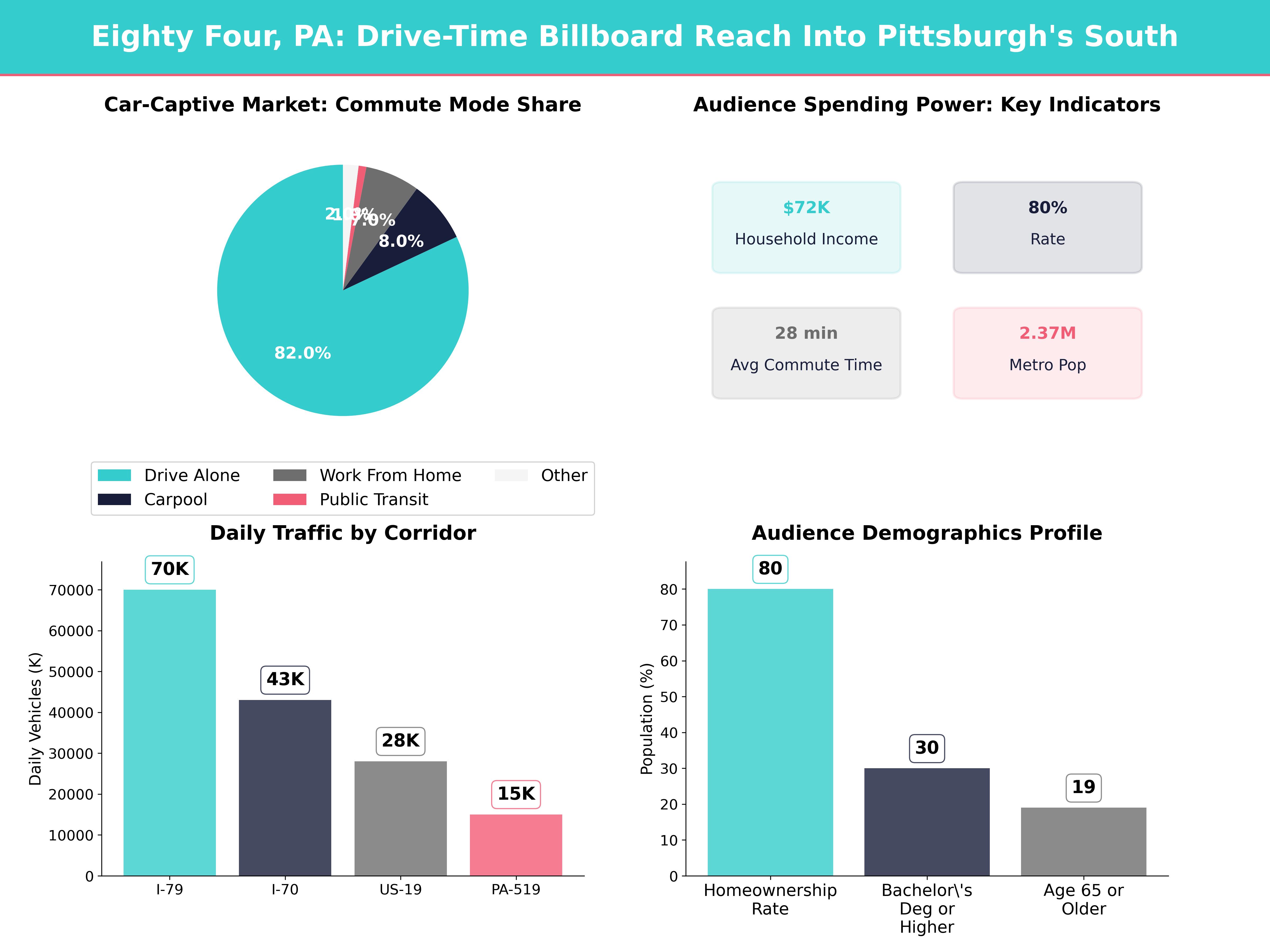
Washington County gives us a useful blend of suburban households, older homeowners, and professional commuters. About 1 in 5 residents is 65 or older, and about 3 in 10 adults hold a bachelor’s degree or higher. The county also has about 82% of workers driving alone, which gives digital billboards real staying power.
When is the best time to run billboard ads in Eighty Four with Blip?
Late summer is one of the best advertising windows in Washington County because the Washington County Agricultural Fair and the PONY League World Series both create strong seasonal traffic. Back-to-school also matters, as schools resume in late August and colleges restart. Shorter daylight hours make bright digital creative more noticeable during the afternoon commute, especially from roughly 4 p.m. to 7 p.m.
Why does billboard advertising work well in Eighty Four, Pennsylvania?
Eighty Four is a small community, but its trade area is far larger than the community’s size alone suggests. It sits roughly 25 to 30 miles south of Downtown Pittsburgh and is within an easy local drive of Cecil Township, South Strabane Township, Washington, and Canonsburg. The area also has stable, established commuting patterns, making repeat exposure valuable.
Do I need a contract to advertise with Blip in Eighty Four?
No, Blip has no long-term contracts or minimum commitments. You can start, pause, or stop your campaign at any time.
How fast can I launch a billboard campaign with Blip in Eighty Four?
You can have your campaign live in minutes. Create a free account, select your locations, set your budget, upload your design, and start running once approved.
Where can I advertise with Blip in Eighty Four?
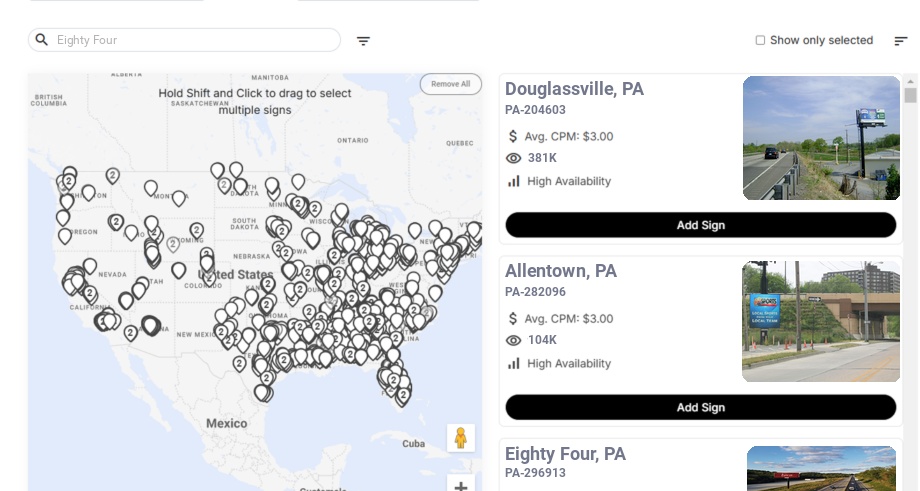
Blip has digital billboards in Eighty Four. You can browse available locations on a map, choose the ones that fit your audience, and start advertising right away.
Still have questions? Launch a campaign in minutes — no contracts, no commitments.
Start Your CampaignEighty Four Billboard Advertising Guide
Eighty Four, Pennsylvania, is a small community with outsized billboard value because it sits inside one of southwestern Pennsylvania’s most practical driving corridors, with nearby I-79 segments commonly in the 60,000 to 80,000 AADT range. Even though the local ZIP code is 15330, we are really advertising into a broader Washington County trade area that connects Southpointe, Washington Canonsburg Peters Township Pittsburgh region. Washington County 209,349 residents in 2020, and the seven-county Pittsburgh metro reaches about 2.37 million people, so the audience around Eighty Four is far larger than the community’s size alone suggests. We also benefit from a market where most daily movement still happens by car, with about 82% of workers driving alone and about 8% carpooling, which gives digital billboards real staying power.
Eighty Four Market Overview
Eighty Four is small, but its trade area is not
When we advertise in Eighty Four, we should think beyond the name on the map and focus on the corridor. Eighty Four sits roughly 25 to 30 miles south of Downtown Pittsburgh, and it is within an easy local drive of Cecil Township South Strabane Township Washington Canonsburg
State demographic profiles distributed through the Pennsylvania State Data Center show that Washington County grew only modestly from 207,820 residents in 2010 to 209,349 in 2020. That is an increase of less than 1%, which tells us this is not a boom-and-bust consumer market. It is a stable, established market with repeat travel habits, established neighborhoods, and predictable commuting flows.
Demographics and household characteristics that matter for billboard advertisers
Washington County gives us a useful blend of suburban households, older homeowners, and professional commuters. Recent state and ACS-based profiles place the county’s median household income around $72,000, which supports spending on healthcare, financial services, education, home improvement, and automotive categories. Homeownership is close to 4 in 5 occupied housing units, which is especially relevant for contractors, roofers, HVAC companies, landscapers, remodelers, and insurance brands.
The county also skews older than many fast-growth markets. About 1 in 5 residents is 65 or older (about 19%), which makes roadside advertising valuable for healthcare systems, specialty care, senior services, legal services, and financial planning. At the same time, about 3 in 10 adults hold a bachelor’s degree or higher (about 30%), which supports professional services and B2B messaging near the Southpointe office cluster.
Commuting behavior and economic structure in Eighty Four
Commuting habits are the clearest reason billboards work here. County-level commute data show that about 82% of workers drive alone, about 8% carpool, roughly 7% work from home, and only about 1% use public transportation. The average commute is about 28 minutes, which is long enough for repeated billboard exposure to build memory, but routine enough that timing and corridor selection matter.
That travel pattern aligns well with the local economy. We can reach workers tied to energy, engineering, healthcare, education, retail, logistics, and professional services. The Southpointe area alone puts our messaging near employers and corporate traffic connected to companies such as Ansys CNX Resources Range Resources. For local brands, that means Eighty Four is not just a residential audience. It is also a weekday business audience with strong commuter repetition.
Key Traffic Corridors Around Eighty Four
Interstate 79 near Eighty Four and Southpointe
Eighty Four’s billboard value comes from a few high-function roads that do most of the market’s work. When we match creative to corridor, we can reach very different audiences with the same geography. According to traffic maps from PennDOT, I-79 is the dominant north-south spine for the Eighty Four area. Segments around Southpointe, Canonsburg, and nearby interchanges commonly fall in the 60,000 to 80,000 AADT range, and the corridor gets even busier as it approaches Allegheny County. That gives us one of the strongest repeated-exposure routes in the local market.
This corridor is especially effective for several advertiser types.
- B2B and recruiting campaigns work well here because we can intercept office professionals, engineers, and skilled workers moving between Washington County and the Pittsburgh job base.
- Healthcare campaigns perform well here because I-79 connects the area to facilities such as AHN Canonsburg Hospital, UPMC Washington
- Restaurants, convenience brands, and retail offers benefit from clear exit-based messaging because commuters often make decisions on the fly during the drive home.
- Home services advertisers benefit because repeated weekday exposure builds trust before the homeowner is ready to search or call.
Interstate 70 through Washington County
I-70 is the main east-west route shaping traffic in the Washington area, and PennDOT counts generally place local Washington County segments in the 35,000 to 50,000 AADT range. This corridor matters because it captures more than local commuting. It also gathers regional shopping trips, freight traffic, event travel, and visitors moving between communities east and west of Washington.
For billboard strategy, I-70 is especially useful when we want broader trade-area reach.
- Retail and outlet campaigns can use I-70 to pull shoppers toward Tanger Outlets Pittsburgh, which features more than 70 stores.
- Entertainment and hospitality campaigns can reach travelers heading toward Hollywood Casino at The Meadows
- Auto dealers, banks, and family attractions can use this route because the audience includes planned trip-makers, not just habitual commuters.
- Regional service brands can use I-70 to build reach beyond a single town, especially when they serve the full Washington County market.
U.S. Route 19 in Peters Township, Canonsburg, and North Strabane
U.S. 19 gives us a different kind of billboard value. PennDOT traffic volumes on major southern suburban stretches of U.S. 19 often run in the 20,000 to 35,000 AADT range, depending on the segment. That traffic is slower, more retail-oriented, and often more decision-ready than pure interstate traffic.
This route is ideal when we want suburban frequency and strong local relevance.
- Medical practices, orthodontists, and elective care providers can use U.S. 19 because the route serves high-visibility suburban decision-makers.
- Home improvement and home furnishing brands benefit because the corridor reaches established homeowners in communities like Peters Township
- Schools, camps, and enrichment programs gain from repeated passes by parents running daily errands and after-school trips.
- Restaurants and personal services can use short-distance directional creative because the route supports immediate action.
PA 519 and local connectors near Eighty Four
PA 519 is one of the most important connector roads for the Eighty Four and Southpointe area. PennDOT maps commonly show sections of PA 519 in the 10,000 to 20,000 AADT band near key commercial areas. While those totals are smaller than interstate counts, they are often more intentional trips, which can make the advertising especially efficient.
PA 519 works well for hyperlocal advertisers that need relevance more than metro-wide scale.
- Lunch, coffee, and quick-service brands can target weekday office traffic around Southpointe.
- Local healthcare, urgent care, and dental providers can stay top of mind with nearby households and employees.
- Community events and seasonal attractions can use the route because it links neighborhoods to activity centers.
- Real estate and local service businesses can lean on familiarity, repetition, and directional copy.
PA 136 and related county roads also matter, even without interstate-level volume. Those routes connect neighborhoods, schools, parks, and fairgrounds, and they are useful when we want steady local frequency rather than broad commuter reach.
Audience Segments We Can Reach in Eighty Four
Commuters and office professionals
Commuters are the foundation of the Eighty Four billboard audience. With about 82% of workers driving alone and another 8% carpooling, the road network is where the market sees, repeats, and remembers messages. That is especially true around Southpointe, where office traffic peaks during weekday mornings, lunch periods, and the drive home.
We can use this audience for more than recruiting. It also works for banks, legal services, business software, coworking, networking events, healthcare specialists, and higher-value consumer services. In a corridor with a roughly 28-minute average commute, frequency compounds quickly.
Families, homeowners, and long-term residents
Washington County’s household profile is a strong fit for practical, high-consideration advertisers. Median household income sits around $72,000, homeownership is near 80%, and the area includes many long-established neighborhoods. That combination gives us a solid audience for home services, auto maintenance, insurance, family healthcare, and local retail.
School-centered messaging also matters. Families circulate between communities served by districts such as Canon-McMillan School District, Peters Township School District, and other Washington County schools. We can use boards on local commuter routes to align with school-year rhythms, sports seasons, and parent decision cycles.
Students and education households
Eighty Four is not a classic college town, but it benefits from nearby academic traffic. Washington & Jefferson College 1781, and PennWest California became part of the new PennWest University structure in 2022. Those institutions create movement tied to semesters, athletics, campus events, housing, and graduation periods.
That student and education audience is useful for apartment marketing, food and beverage, tutoring, healthcare, banking, and event promotion. It also broadens the age mix in a county that otherwise trends older.
Visitors, shoppers, and leisure travelers
Tourism and leisure traffic give Eighty Four campaigns another layer of value. Pittsburgh International Airport 9.95 million passengers in 2023, and some of that regional visitor flow spreads into Washington County for events, meetings, gaming, shopping, and family outings. Closer to Eighty Four, destination traffic concentrates around Hollywood Casino at The Meadows Tanger Outlets Pittsburgh, the Pennsylvania Trolley Museum Meadowcroft Rockshelter and Historic Village
We can also reach event-driven visitors through Visit Washington County, PA, which promotes festivals, sports, heritage tourism, and seasonal travel across the county. For restaurants, hotels, attractions, and service businesses, that visitor layer makes the market more dynamic than a simple residential map would suggest.
Seasonal and Timing Opportunities in Eighty Four
Spring and early summer in Eighty Four
Spring is a strong reset period in the Eighty Four market. Homeowners start outdoor projects, families plan camps and vacations, and schools move into testing, prom, graduation, and summer activity planning. This is a particularly good time for home improvement, lawn care, landscaping, urgent care, family entertainment, and real estate campaigns.
The spring calendar also supports heritage and leisure traffic. Attractions such as the Pennsylvania Trolley Museum Meadowcroft Rockshelter and Historic Village
Late summer and fall in Eighty Four
Late summer is one of the best advertising windows in Washington County. The Washington County Agricultural Fair dates back to 1798, which makes it one of Pennsylvania’s oldest fair traditions, and it draws significant seasonal traffic to the area each August. The PONY League World Series in Washington has been part of the local sports identity since 1953, creating another strong audience surge in August.
Back-to-school also matters. School districts resume in late August, colleges restart, and sports schedules return. That combination creates high-value windows for healthcare, orthodontics, restaurants, retail, family entertainment, and youth programs. Fall also tends to be ideal for political, issue-based, trade school, and recruiting campaigns because commuting is steady and local attention is high.
Holiday and winter timing in Eighty Four
Winter changes behavior, but it does not reduce billboard usefulness. Holiday shopping lifts traffic around Tanger Outlets Pittsburgh, the casino district, and main retail corridors in South Strabane Township Pennsylvania Trolley Museum
Shorter daylight hours make bright digital creative more noticeable during the afternoon commute, especially from roughly 4 p.m. to 7 p.m. Winter is also a strong time for healthcare, legal services, gyms, tax preparation, and New Year recruitment campaigns. If weather disrupts normal behavior, we can adjust timing and creative quickly rather than sitting in a fixed long-term schedule.
Billboard Design Tips for the Eighty Four Audience
Use place names that locals instantly recognize
In the Eighty Four market, local recognition matters more than abstract branding. Names such as Southpointe, Washington, Canonsburg, Peters Township, The Meadows Tanger are more actionable than broad regional references. If we can anchor the offer to a known place, we make the ad easier to process at driving speed.
A simple local formula works well here: 1 place name, 1 value point, and 1 action. For example, a healthcare provider can reference Washington or Canonsburg, state same-day availability, and add a short call to action.
Match creative to the corridor
The local market is not culturally uniform, so the design should shift with the road.
- On I-79, we should use cleaner layouts, stronger contrast, and more professional language because the audience includes office commuters and regional travelers.
- On U.S. 19, we can lean into family life, convenience, local offers, and practical services because trips are often retail or errand based.
- Near Southpointe, we can use polished business imagery, recruiting language, and trust signals because the audience skews more professional.
- Near The Meadows and outlet areas, we can emphasize entertainment, dining, events, and limited-time promotions because the trip purpose is more discretionary.
Design for western Pennsylvania weather and driving conditions
Southwestern Pennsylvania has frequent gray skies, rain, and early winter darkness, so high-contrast creative tends to stand out better than subtle palettes. Deep blues, bright whites, bold reds, and warm yellows usually read well against local conditions. We should also keep typography thick and uncluttered because interstate traffic is fast and suburban traffic is often busy with multiple visual inputs.
Lean into trust, utility, and community
Eighty Four is not a market where flashy creative always wins. Practicality often beats novelty. Messages about convenience, reliability, family value, local service, and reputation tend to resonate because the area includes established households and repeat commuters. Testimonials, years in business, local awards, and recognizable town names can all improve credibility.
Regional Strategies Around Eighty Four
Southpointe and Cecil Township strategy
When we target Southpointe and Cecil Township
This is also where polished creative matters most. Professional audiences often respond better to concise messages about outcomes, hiring, expertise, and convenience than to playful brand-only copy.
Washington and South Strabane strategy
The Washington South Strabane Township
Boards feeding this zone can also support Washington & Jefferson College UPMC Washington Hollywood Casino at The Meadows Tanger Outlets Pittsburgh. We should think in terms of audience stacking here, because students, patients, shoppers, and event-goers overlap.
Canonsburg, North Strabane, and Peters Township strategy
The suburban belt around Canonsburg Peters Township
We should also remember that suburban routes often reward repeated exposure more than single-pass impressions. If the goal is trust and recall, boards on everyday routes can outperform a more famous location that the target audience passes less often.
Rural and countywide strategy beyond the core
Outside the main interchanges, Washington County becomes more dispersed, and the strategy should change with it. Rural drivers often spend longer periods in the car, but they see fewer competing messages. That means clarity becomes even more valuable. We should shorten copy, keep one strong offer, and use local references people know immediately.
This broader county approach works well for fairs, festivals, healthcare systems, legal services, political campaigns, and regional brands that serve multiple towns instead of a single retail point.
Using Blip Tools for Eighty Four Campaigns
Test corridors instead of guessing
Eighty Four is a great market for testing because the audience changes so much by road. We can use Blip’s map-based selection to compare I-79 commuter inventory with U.S. 19 suburban inventory, then shift spend toward the corridor that produces the strongest response. That is especially helpful when we are deciding between broad awareness and location-specific traffic.
Daypart around local rhythms
The local rhythm is predictable enough that dayparting can add real efficiency. We should usually prioritize 6 a.m. to 9 a.m. for morning commuters, 11 a.m. to 2 p.m. for lunch and errand traffic near Southpointe and retail clusters, and 4 p.m. to 7 p.m. for the drive home. For entertainment and shopping campaigns, weekend blocks from around noon to 8 p.m. often make sense.
Rotate creative for different sub-audiences
Because Eighty Four sits between office, retail, residential, and leisure traffic, one creative execution is rarely enough. We can run one message for weekday professionals near Southpointe, another for family audiences near Washington retail corridors, and a seasonal version for tourism or event periods. Blip’s artwork tools and fast updates make that kind of localization much easier to manage.
Use analytics to sharpen the mix
Real-time results matter in a market with several viable corridor choices. If one board is excellent for commuter reach but weak for direct action, we can keep it for awareness and add a more directional board near a destination. If a seasonal event lifts traffic unexpectedly, we can lean into the opportunity while it is active instead of waiting for the next buying cycle.
Getting Started with Billboard Rental in Eighty Four
Start with the real objective
Before we rent a billboard in the Eighty Four area, we should decide whether the goal is awareness, foot traffic, recruiting, event attendance, or lead generation. Each goal points to a different part of the map. Awareness campaigns usually want the broad reach of I-79 or I-70, while foot-traffic campaigns often perform better on U.S. 19, PA 519, or routes close to retail and office destinations.
Evaluate locations by trip purpose, not just by fame
A well-known highway is not automatically the best board. We should ask what the audience is doing when it sees the ad. A commuter on I-79 may be ideal for a recruiting message. A shopper near Tanger Outlets Pittsburgh may be better for retail or dining. A parent on suburban routes may be ideal for healthcare, camps, or tutoring. In Eighty Four, context matters as much as raw traffic.
Expect a simpler process than traditional billboard buying
Traditional billboard buying in smaller regional markets often means sales calls, fixed terms, limited testing, and slower creative changes. Blip simplifies that process by letting us choose boards on a map, adjust budgets, change timing, and swap artwork without the usual back-and-forth. That flexibility is especially useful in a market like Eighty Four, where a campaign may need to shift between commuter, retail, and seasonal audiences.
Launch small, learn fast, and scale
We usually do not need to overbuild the first campaign. A focused 2-week test across 2 to 4 strategically different boards can teach us a lot about which parts of the Eighty Four market respond best. From there, we can scale into stronger dayparts, add seasonal creative, or expand from one corridor into the full Washington County mix.
If we treat Eighty Four as a strategic gateway rather than a tiny town, we can build billboard campaigns that reach stable households, professional commuters, shoppers, students, and event visitors with impressive efficiency. That combination is exactly what makes this corner of southwestern Pennsylvania so useful for digital out-of-home advertising.