Billboards in Mount Joy, PA
No Minimum Spend. No Long-Term Contracts. Just Results.
Trusted by Leading Brands


Billboard advertising
in Mount Joy has never been easier
How much is a billboard in Mount Joy?
Why Choose Blip for Billboard Advertising in Mount Joy
Blip lets Mount Joy advertisers launch fast on PA 283 and US 30, reaching commuters and Lancaster shoppers without traditional billboard hassles.
Set flexible budgets in Mount Joy and pay only when your ad runs, ideal for testing around Lancaster-Harrisburg traffic and school-season demand.
No contracts make it easy to pause or shift your Mount Joy campaign for fall sports, winter holiday traffic, or Hershey visitor spikes.
Use real-time analytics to see what works in Mount Joy on I-283, PA 772, and local connectors, then move spend toward the best-performing routes.
Blip's dayparting helps Mount Joy brands hit 6-9 a.m. and 3-6 p.m. commuters, plus Friday-Sunday family and tourism traffic.
Create and update billboard creative in Mount Joy quickly, so healthcare, recruiting, and home-service ads stay fresh for the region's car-first audience.
Frequently Asked Questions About Billboard Advertising in Mount Joy
How much does a billboard cost in Mount Joy with Blip?
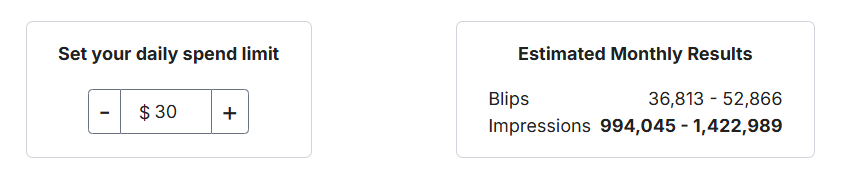
Pricing starts at just $0.01 per display, with the cost changing based on time of day, location, and advertiser demand. You set a daily budget, and Blip’s algorithm uses it to bid for open ad slots on rotating digital billboards, so you only pay when your ad actually appears. Your total cost is simply the sum of the blips you receive, making billboard advertising in Mount Joy accessible for a wide range of budgets.
Where can I advertise with Blip in Mount Joy?
Mount Joy is a smart billboard market because its local population of 8,346 sits inside a much larger Lancaster-Harrisburg travel shed anchored by 552,984 residents in Lancaster County. The area is still heavily road-driven, with PA 283, US 30, I-283, and local state routes carrying daily movement between jobs, schools, hospitals, stores, and attractions. Major corridors often handle 45,000 to 100,000+ vehicles per day.
Why is Mount Joy a strong Blip billboard market?
Mount Joy combines small-town identity with regional scale, sitting between the City of Lancaster and the City of Harrisburg. Daily life here is distributed across Lancaster County’s 60 municipalities, so people regularly cross municipal lines for work, youth sports, healthcare, dining, shopping, and school activities. That pattern is important for billboard strategy because it increases repeated drive-by exposure.
When is the best time to run billboard ads in Mount Joy?
From August through October, we enter one of the best windows of the year for Mount Joy advertising because public schools return, colleges restart, sports schedules fill up, and fall tourism rises. From November through January, Mount Joy becomes a strong market for holiday retail, restaurants, healthcare, winter services, and event-driven travel. We often like commuter windows from 6:00 to 9:00 a.m. and 3:00 to 6:00 p.m. for service brands, healthcare, and urgent seasonal needs.
What kind of people does Blip reach in Mount Joy?
The best Mount Joy campaigns are built around commuters, families, students, tourists, and industrial and healthcare audiences. Mount Joy sits between the City of Lancaster and the City of Harrisburg, and it is only about 8 miles from Elizabethtown Borough, which creates a broad commuter belt rather than a single-direction suburb. Within roughly 25 miles, we can also reach households connected to several colleges and universities, making Mount Joy useful for apartment communities, part-time hiring, food and beverage brands, banks, healthcare, and technology services.
Do I need a contract to advertise with Blip in Mount Joy?
No, Blip has no long-term contracts or minimum commitments. You can start, pause, or stop your campaign at any time.
How fast can I launch a billboard campaign with Blip in Mount Joy?
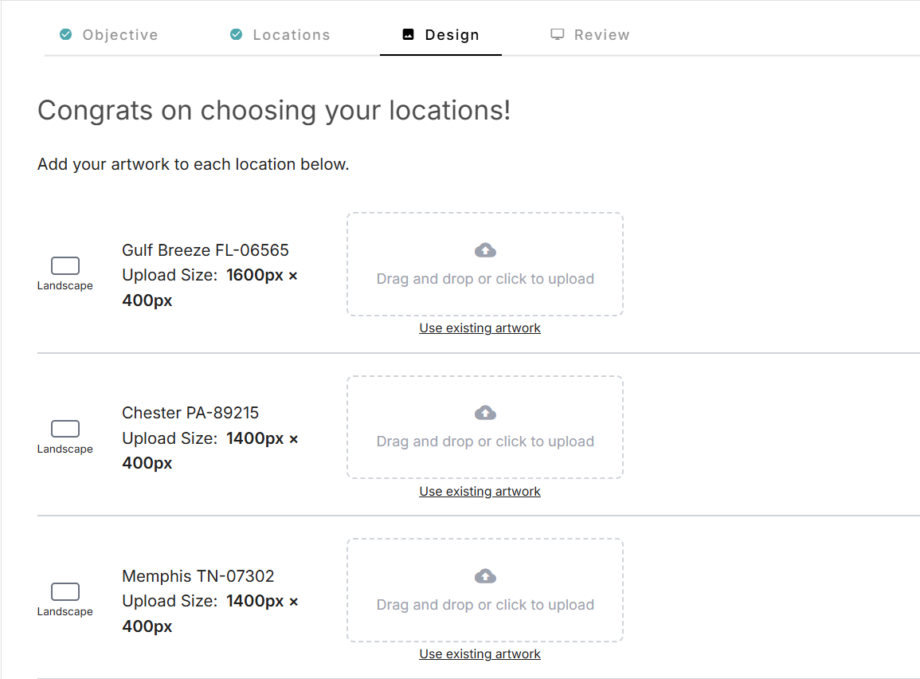
You can have your campaign live in minutes. Create a free account, select your locations, set your budget, upload your design, and start running once approved.
Where can I advertise with Blip in Mount Joy?
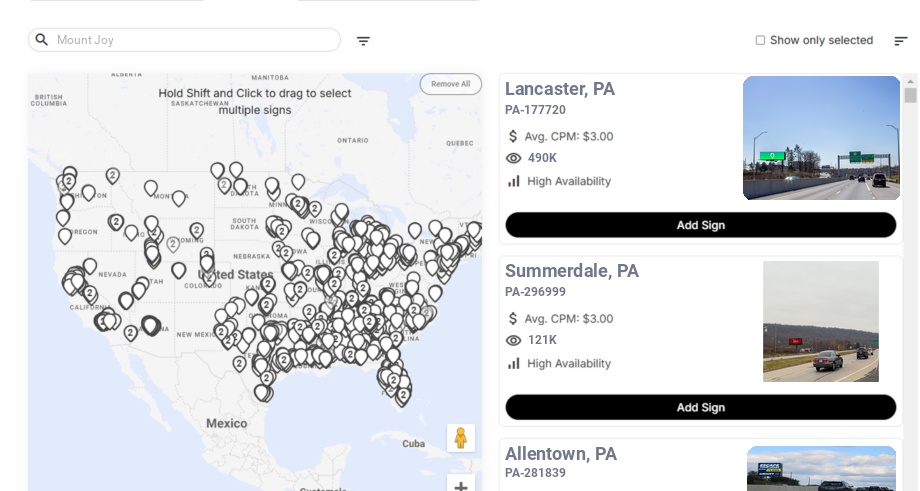
Blip has digital billboards in Mount Joy. You can browse available locations on a map, choose the ones that fit your audience, and start advertising right away.
Still have questions? Launch a campaign in minutes — no contracts, no commitments.
Start Your CampaignMount Joy Billboard Advertising Guide
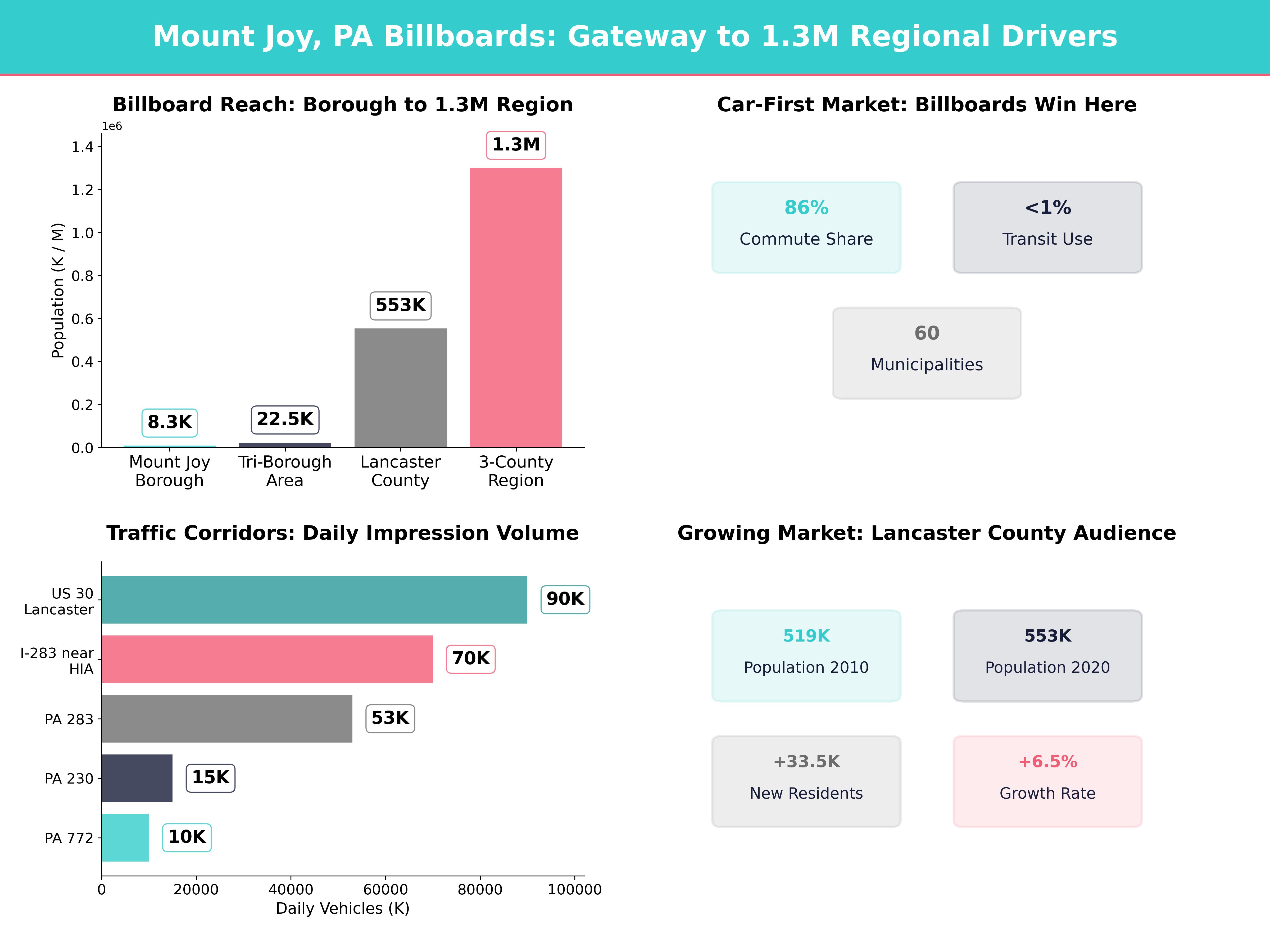
Mount Joy is a smart billboard market because its local population of 8,346 sits inside a much larger Lancaster-Harrisburg travel shed anchored by 552,984 residents in Lancaster County Mount Joy Borough, we are about 10 miles from the City of Lancaster and about 20 miles from the City of Harrisburg 1,295,823-person regional base. The area is still heavily road-driven, with PA 283, US 30, I-283, and local state routes carrying daily movement between jobs, schools, hospitals, stores, and attractions, with major corridors often handling 45,000 to 100,000+ vehicles per day. We also benefit from Lancaster County tourism, nearby Hershey travel, and Amtrak 1,295,823-person Lancaster-Dauphin-York regional base.
Mount Joy Market Overview
Mount Joy combines small-town identity with regional scale
When we advertise in Mount Joy, we are not buying only borough reach. We are buying a central position between two urban anchors, the City of Lancaster at 58,039 residents, and the City of Harrisburg 50,099 residents. To the west, Dauphin County adds 286,401 residents, and to the south, York County 456,438 more. That puts a three-county regional audience at 1,295,823 people.
The local borough network matters too. Elizabethtown Borough has 11,545 residents, Mount Joy has 8,346, and Marietta has 2,588, for a combined 22,479 residents in three compact communities alone. That pattern is important for billboard strategy because daily life here is distributed. People regularly cross municipal lines for work, youth sports, healthcare, dining, shopping, and school activities across Lancaster County's 60 municipalities.
What Mount Joy’s growth and commuting patterns mean for billboards
Lancaster County 519,445 residents in 2010 to 552,984 in 2020. That was an increase of 33,539 people, or 6.5% in a single decade. The county also includes 60 municipalities, which means consumer movement is spread across many roads rather than one single downtown core. For us, that fragmentation is an advantage because it increases repeated drive-by exposure.
Commuting behavior reinforces the value of out-of-home advertising here. County commute profiles show that about 86% of workers travel by car, whether driving alone or carpooling, while public transit accounts for less than 1% of commute share. Even with service from the Red Rose Transit Authority
Mount Joy’s economic mix supports year-round campaigns
We also like Mount Joy because the economy is diversified. Employers and institutions such as Lancaster General Health, Penn State Health, Donegal School District, Elizabethtown College, Millersville University, and Masonic Villages generate daily travel that is not tied to one single season. Add in manufacturing, agriculture, logistics, and tourism, and we get a market that supports healthcare advertising, recruiting, home services, retail, dining, and event promotion throughout the year.
Key Traffic Corridors Around Mount Joy
Mount Joy’s billboard value comes from a handful of routes that carry different kinds of intent. Some roads are built for speed and reach, while others are better for local frequency and neighborhood relevance.
PA 283 is Mount Joy’s primary commuter spine
According to the Pennsylvania Department of Transportation, traffic counts vary by segment, but nearby PA 283 sections generally carry about 45,000 to 60,000 vehicles per day. That makes PA 283 the most important east-west commuter corridor for Mount Joy. It links Lancaster County communities with Harrisburg-area employment centers, and it captures both morning and evening traffic in a market where people often travel in both directions.
This corridor is especially strong for the following categories:
- Healthcare systems can stay visible to patients traveling toward Lancaster, Elizabethtown, and Harrisburg.
- Home service brands can build frequency with homeowners who repeat the same commute several times each week.
- Employers and recruiters can reach warehouse, manufacturing, construction, and skilled-trade workers moving along the corridor.
US 30 extends Mount Joy campaigns into Lancaster’s retail engine
On the Lancaster side, key US 30 segments often run in the 80,000 to 100,000+ vehicles per day range. That is a different audience mix than Mount Joy’s immediate local roads. US 30 is where we see stronger regional retail, dining, family entertainment, and tourism traffic, especially near destinations such as Dutch Wonderland, Tanger Outlets Lancaster, and the broader visitor economy promoted by Discover Lancaster.
We should use US 30 when we need scale beyond Mount Joy itself. This corridor is well suited for restaurants, attractions, medical groups, colleges, entertainment venues, and broad regional brands that want reach across the Lancaster side of the market.
I-283 connects Mount Joy to airport and turnpike traffic
I-283 is a smart western extension for Mount Joy campaigns. Near Harrisburg International Airport 60,000 to 80,000 AADT band. It also connects to the Pennsylvania Turnpike, which adds business travel and long-distance vehicle movement that we do not get from Mount Joy local roads alone.
We typically like I-283 for these advertiser types:
- Hotels, parking, and travel services can reach airport users and overnight visitors.
- B2B advertisers can stay top-of-mind with decision-makers traveling between Lancaster County and the capital region.
- Recruiting campaigns can widen their labor pool toward Middletown, Harrisburg, and western Dauphin County.
PA 230, PA 772, and borough connectors deliver local repetition
Not every campaign needs interstate-style volume. PA 230 through Elizabethtown and into Lancaster County generally lands in the 10,000 to 20,000 vehicles per day range, while PA 772 around Mount Joy is often closer to 8,000 to 12,000 daily vehicles, depending on the segment. Those numbers are lower than PA 283, but they are often better for advertisers that need stronger local familiarity.
We usually favor these local connectors for the following goals:
- Restaurants, banks, dentists, and urgent care providers can build trust with people who live nearby and see the same board repeatedly.
- Community events and local retailers can stay close to the point of decision.
- Political, nonprofit, and civic messages can maintain visibility inside the immediate trade area.
Amtrak gives Mount Joy an added mobility layer
Mount Joy also has one advantage many small towns do not have. It is served by Amtrak 14 daily round trips between Harrisburg and New York. Travel time is about 12 minutes to Lancaster, and about 20 minutes to Harrisburg. Rail riders are not the dominant audience here, but the station creates pick-up, drop-off, and park-and-go behavior that broadens the daily travel pattern around the borough.
Mount Joy Audience Segments
The best Mount Joy campaigns are built around the audiences that actually move through the area, not just the people who live inside borough limits.
Mount Joy commuters and cross-county workers
Our first major audience is the daily commuter. Mount Joy sits between the City of Lancaster and the City of Harrisburg 8 miles from Elizabethtown Borough. That creates a broad commuter belt rather than a single-direction suburb. Some workers head east, some head west, and many travel to industrial parks, medical campuses, schools, and office clusters in between.
For these audiences, billboards work best when the message is practical. Recruitment, healthcare, auto services, insurance, financial services, and home improvement brands all benefit from repeated weekday exposure.
Mount Joy families and homeowners
Families are another core segment. Lancaster County’s 6.5% growth in the 2010s added more households, more errands, and more local decision-makers. Because the county is spread across 60 municipalities, many family routines involve driving between home, school, sports, shopping, and appointments. That pattern is ideal for home services, childcare, orthodontics, grocery, furniture, and family entertainment campaigns.
We should also remember that Mount Joy’s family audience is not limited to the borough. Households in nearby townships, Elizabethtown, Marietta, and the western Lancaster County suburbs often share the same routes and shopping habits.
Mount Joy’s student, faculty, and education households
Within roughly 25 miles, we can also reach households connected to Elizabethtown College, Franklin & Marshall College, Millersville University, Messiah University, and Penn State Harrisburg
Education audiences also create calendar-driven demand. Move-in periods, semester starts, sports seasons, performances, and campus visits all add traffic at predictable times of year.
Mount Joy tourists, sports visitors, and day-trippers
Tourism is one of the biggest reasons Mount Joy punches above its size. Spooky Nook Sports in nearby Manheim spans 700,000 square feet, making it a major draw for tournament traffic. Hersheypark advertises 70+ rides, which pulls family visitors through the western side of the region. The Pennsylvania Farm Show Complex & Expo Center has more than 1 million square feet under roof, and Dutch Wonderland features 35+ rides and attractions for family travelers.
Those numbers matter because they translate into real movement on roads around Mount Joy. Visitors heading to attractions, sports complexes, hotels, restaurants, and event venues create audience spikes that local advertisers can capture, especially on Thursdays through Sundays and during school breaks.
Mount Joy industrial, healthcare, and senior-service audiences
We also see strong value in industrial and healthcare targeting. Lancaster General Health, Penn State Health, and Masonic Villages bring in workers, patients, residents, and visiting families. Industrial and logistics employers around Elizabethtown, Middletown, Manheim, and the broader Lancaster County corridor create steady demand for recruiting, training, staffing, and B2B messaging.
Seasonal and Timing Opportunities in Mount Joy
Seasonality matters in Mount Joy because the market blends commuter behavior with tourism, sports, school calendars, and weather-driven needs. We usually get the best results when we shift our timing to match those rhythms.
Spring in Mount Joy brings home, health, and event demand
From April through June, we typically see strong opportunities for landscapers, HVAC companies, roofing, garden centers, healthcare practices, and wedding-related businesses. Lancaster County and the surrounding area have a deep wedding and event economy, and spring also marks the beginning of heavier weekend leisure travel.
For spring campaigns, we often like weekday commuter windows plus late-afternoon and Saturday exposure. Homeowners are actively planning projects, and families are back outside after winter.
Summer in Mount Joy is built for family fun and visitor traffic
From June through August, family attractions and hospitality brands gain momentum. Mount Joy benefits from tourism promoted by Discover Lancaster and Visit Hershey & Harrisburg, and it sits within easy reach of Hersheypark, Dutch Wonderland, and sports traffic moving to Spooky Nook Sports.
Summer is a good time to shift more impressions toward Friday afternoon, Saturday, and Sunday. Restaurants, attractions, hotels, ice cream shops, and retail brands can also benefit from longer evening activity, especially when families are deciding where to stop on the way to or from an outing.
Fall in Mount Joy aligns with back-to-school and harvest travel
From August through October, we enter one of the best windows of the year for Mount Joy advertising. Public schools return, colleges restart, sports schedules fill up, and fall tourism rises. The Pennsylvania Renaissance Faire adds destination traffic in nearby Manheim
For back-to-school, healthcare, or recruiting campaigns, we should start 2 to 3 weeks before classes and activities ramp up. Fall is also a strong season for family attractions, retailers, urgent care, and auto services because routines become more structured and more drive-heavy after summer.
Winter in Mount Joy rewards early visibility and commuter focus
From November through January, Mount Joy becomes a strong market for holiday retail, restaurants, healthcare, winter services, and event-driven travel. The Pennsylvania Farm Show is an 8-day January event that brings major regional movement through the Harrisburg side of the market. Holiday shopping and family gatherings also increase cross-county driving in late November and December.
Winter dayparting matters more because darkness arrives earlier. We often like commuter windows from 6:00 to 9:00 a.m. and 3:00 to 6:00 p.m. for service brands, healthcare, and urgent seasonal needs. When weather becomes a factor, the ability to update copy quickly is especially valuable.
Billboard Design Tips for Mount Joy
Mount Joy responds best to creative that feels regional, practical, and authentic. We do not need flashy big-city styling here. We need clean creative that respects how people actually move through Lancaster County.
Use Mount Joy visuals that feel local rather than generic
Lancaster County identity is real, but we should not reduce it to one stereotype. Barns, fields, brick storefronts, youth sports, farm markets, family dining, and scenic backroads can all feel relevant. Overused buggy imagery can feel lazy unless our offer is directly tied to heritage tourism. In many categories, a real storefront, a product shot, or a strong local landmark cue will outperform a cliché.
Write for Mount Joy’s fast-moving commuter environment
On PA 283 and other higher-speed roads, we should assume only a few seconds of reading time. In a 7.5- to 10-second digital spot, we usually want 1 clear idea, 1 brand cue, and 1 action. Distance-based or route-based copy works well here, especially when we reference familiar movement patterns such as “Next Exit,” “Near Route 283,” “Lancaster Side,” or “Toward HIA.”
Match the message to the Mount Joy corridor
Different roads support different creative styles. On PA 283, practical messages tend to win. Recruiting, healthcare, home services, and appointment-based ads fit the commuter mindset. On US 30, brighter creative and leisure-oriented messaging often work better because the audience mix includes shoppers, tourists, and families. On PA 230 and PA 772, community tone matters more, so local trust signals, town names, and neighborhood relevance become more important.
Build Mount Joy creative around seasonal color and behavior
Seasonal design choices matter more than many advertisers expect. Spring greens and bright whites feel natural in a market known for agriculture and renewal. Summer creative can handle stronger blues, oranges, and family-energy imagery. Fall campaigns should lean into harvest tones without sacrificing contrast. Winter creative should use bold, high-contrast color combinations that remain readable against gray skies and early darkness.
Regional Strategies Across the Mount Joy Area
Mount Joy works best when we treat it as a set of overlapping sub-markets instead of one uniform map pin. Each nearby area supports a different objective.
Mount Joy Borough and downtown are best for local frequency
Inside Mount Joy itself, we should think local and repeatable. This is where restaurants, service businesses, community events, boutiques, and neighborhood healthcare can stay familiar. Landmarks such as Bube’s Brewery
If our customer base is mostly within 5 to 10 miles, local boards usually deserve the first share of budget.
The PA 283 belt around Mount Joy is best for commuter reach
The next layer is the PA 283 commuter belt connecting Mount Joy, Salunga, Rheems, Elizabethtown Borough, and the Harrisburg side of the market. We should use this zone when our audience is broader than the borough, but still rooted in everyday travel. This is the sweet spot for healthcare systems, recruiting campaigns, insurance, legal services, banks, home improvement, and automotive brands.
If our service area stretches 15 to 25 miles, this corridor usually gives us the best balance of local relevance and regional scale.
Lancaster-side Mount Joy strategy should focus on retail and entertainment
On the eastern side, we should think about how Mount Joy feeds into Lancaster’s larger consumer economy. Boards tied to US 30, Spooky Nook Sports, Lancaster County Convention Center, Lancaster Airport City of Lancaster can help us reach shoppers, event attendees, and family visitors.
This side of the market is especially useful for attractions, entertainment venues, hotels, chain restaurants, medical specialists, and regional retail brands.
Western Mount Joy strategy should connect to Middletown, Hershey, and Harrisburg
To the west, we can extend campaigns toward Harrisburg International Airport Hersheypark, the Pennsylvania Farm Show Complex & Expo Center, and the City of Harrisburg
If our offering is regional, event-driven, or tourism-sensitive, we should not stop at Mount Joy’s borough line. We should build a layered plan that follows where people are actually going.
Using Blip Tools in Mount Joy
Mount Joy is exactly the kind of market where flexible digital planning helps us act on local insight instead of buying one rigid schedule.
We can daypart Mount Joy around real travel behavior
Because Mount Joy blends commuters, families, and visitors, we rarely need the same schedule all day. We can emphasize weekday windows such as 6:00 to 9:00 a.m. and 3:00 to 6:00 p.m. for healthcare, recruiting, financial services, and home services. We can then shift toward Friday through Sunday when we want to capture family entertainment, dining, sports traffic, or tourism.
We can test multiple Mount Joy messages without rebuilding the whole campaign
Mount Joy also rewards message testing. We can run 2 or 3 creative versions that speak to different audiences, such as a commuter-focused version on PA 283, a family-fun version closer to Lancaster, and a local-trust version near town. Blip’s artwork tools make that kind of local customization much easier than a traditional one-creative buy.
We can use Mount Joy analytics to compare corridors and seasons
Real-time analytics are especially helpful in a market with several distinct traffic patterns. We can compare local Mount Joy boards against Lancaster-side boards, or commuter-heavy placements against tourism-oriented placements, and then move budget toward what is actually producing reach. That is valuable in a place where summer weekends, fall school return, and winter event travel can each change the best-performing schedule.
Getting Started with Billboard Rental in Mount Joy
Renting a billboard in Mount Joy is most effective when we start with the business goal and then work backward to the route, audience, and timing.
We should define the Mount Joy goal before choosing the board
A local restaurant, dentist, or service company usually needs short-radius awareness, so boards near Mount Joy and the immediate commuter belt often make the most sense. A healthcare system, college, or recruiting campaign may need a wider draw, so PA 283, I-283, and Lancaster-side coverage become more important. A tourism or event brand may need the broadest regional footprint, which means layering Mount Joy with western and Lancaster placements.
As a simple rule, we should match our board radius to our business radius:
- If our customer base is within 5 to 10 miles, we should start close to Mount Joy.
- If our service area is closer to 15 to 25 miles, we should add the commuter corridors.
- If our draw is 20 to 30 miles or more, we should consider Lancaster-side and Harrisburg-side extensions.
We should evaluate Mount Joy boards by route context, not city name alone
The best location is not always the board nearest our address. We should look at direction of travel, proximity to exits, nearby trip generators, travel speed, and where the audience is mentally headed. A board on a high-speed corridor can be excellent for awareness, while a slower local road may be better for action-oriented offers, appointments, or neighborhood services.
We should expect a test phase in Mount Joy, then refine
Mount Joy is a strong market for testing because the geography is compact, but the audience mix is broad. We can start with a short test, watch how different corridors perform, and refine the plan as we learn. That process is much easier with a platform that lets us select boards on a map, adjust timing, swap artwork, and scale up only where the data supports it.
Blip makes Mount Joy billboard rental more practical than the old model
Traditional billboard buying can be slow, inflexible, and heavily committed up front. Mount Joy, by contrast, often rewards nimble decisions around school calendars, tournament weekends, tourist seasons, hiring pushes, and local events. Blip fits that reality well because we can launch quickly, tune our schedule to commuter or weekend traffic, and keep improving as the market changes.
For many advertisers, that is the biggest advantage of Mount Joy. It is a local market with regional movement, which means even modest campaigns can feel much bigger when we choose the right routes, the right timing, and the right creative.