Billboards near Progress, PA
No Minimum Spend. No Long-Term Contracts. Just Results.
Trusted by Leading Brands


Billboard advertising
near Progress has never been easier



How much is a billboard near Progress?
Why Choose Blip for Billboard Advertising near Progress
Blip lets you self-serve Progress billboards near I-81, I-83, and US-22/322, reaching Harrisburg commuters without downtown premiums.
Set flexible budgets for Progress and focus spend on rush hours, lunch, or weekend shopping trips from Colonial Park and nearby suburbs.
No contracts means you can test Progress's government, healthcare, and logistics audience, then shift fast as results roll in.
Blip's real-time analytics help you track Progress campaigns by commute peaks on I-81 and I-83, then optimize on the fly.
Use Blip's creative tools to tailor simple, local ads for Progress drivers headed to the Capitol Complex, Hershey, or Riverfront Park.
Frequently Asked Questions About Billboard Advertising near Progress
How much does a billboard cost near Progress, Pennsylvania with Blip?
With Blip, you set your own daily budget for Progress billboards, so you can start advertising in the Progress area with any amount that works for you. Each “blip” is a short 7.5 to 10-second ad display, and you only pay for the blips you receive, making it easy to control spend while reaching drivers on billboards near Progress, Pennsylvania. Prices per blip change based on when you run your ads, where they appear, and advertiser demand, but Blip automatically keeps your campaign within the budget you choose and lets you adjust it at any time.
Where can I advertise with Blip in Progress, Pennsylvania?
Blip makes it easy to launch flexible campaigns on billboards near Progress, Pennsylvania, using seven digital faces serving the Progress area—all on your budget, schedule, and creative terms. With 7 nearby digital billboards serving the Progress area—primarily in Harrisburg roughly 1–2 miles away—we can reach commuters, residents, and visitors with precise, data-driven campaigns that feel hyper-local while benefiting from big-city traffic volumes. In practice, this often means prioritizing boards along I‑81 near Progress Avenue/Exit 72, I‑83 approaching downtown Harrisburg, and US‑22/322 near Colonial Park and Susquehanna Township.
What kind of traffic do Progress, Pennsylvania billboards get?
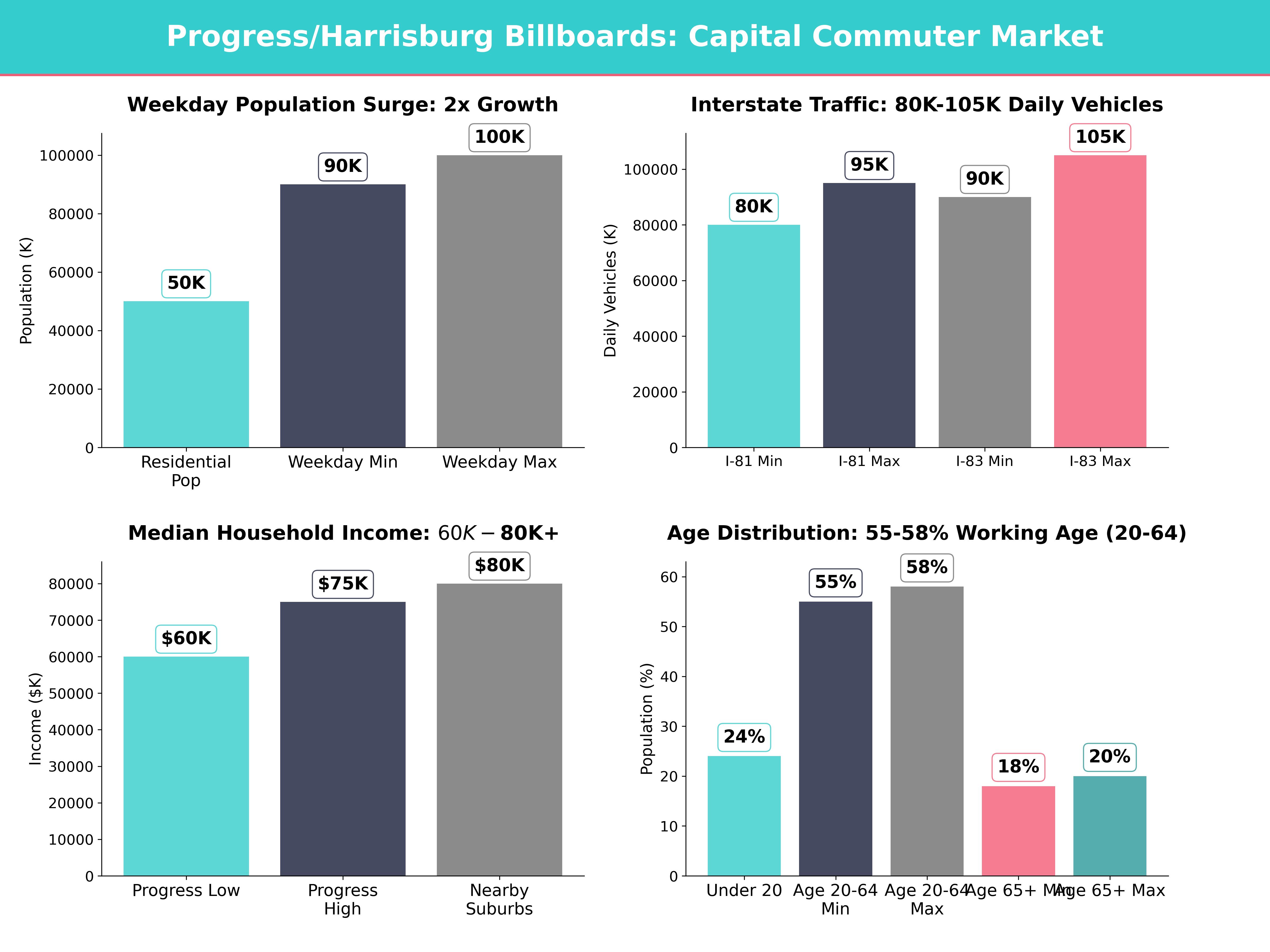
The Progress area sits just off several of the busiest routes in central Pennsylvania, which is why billboards near Progress routinely deliver both local and regional impressions. PennDOT traffic counts on I‑81 near the Progress-area interchanges (around Exit 72/Progress Avenue) typically show 80,000–95,000 vehicles per day (AADT), and segments of I‑83 near downtown often see 90,000–105,000 vehicles per day. US Route 22/322 on key segments between Colonial Park and downtown carries 30,000–45,000 vehicles per day, while Paxton Street and Cameron Street regularly carry 15,000–25,000 vehicles per day.
When is the best time to run billboard ads in Progress, Pennsylvania with Blip?
Smart scheduling can turn Progress billboards into an always-on presence during your highest conversion windows. Weekday morning commute, midday errands, and evening outbound traffic are all highlighted as strong times, and digital out-of-home lets us schedule more impressions during high-traffic periods. With Blip, we can concentrate your budget into these windows instead of paying for every minute of the day.
Do I need a contract to advertise with Blip near Progress?
No, Blip has no long-term contracts or minimum commitments. You can start, pause, or stop your campaign at any time.
How fast can I launch a billboard campaign with Blip near Progress?
You can have your campaign live in minutes. Create a free account, select your locations, set your budget, upload your design, and start running once approved.
Where can I advertise with Blip near Progress?
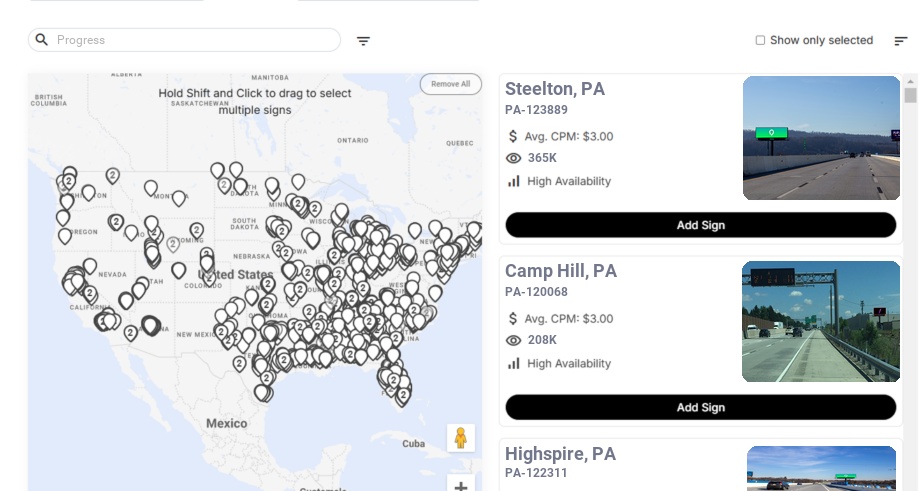
Blip has digital billboards near Progress. You can browse available locations on a map, choose the ones that fit your audience, and start advertising right away.
Still have questions? Launch a campaign in minutes — no contracts, no commitments.
Start Your CampaignProgress Billboard Advertising Guide
Nestled just northeast of downtown Harrisburg, Progress sits at the crossroads of state government, regional healthcare, and suburban neighborhoods. With 7 nearby digital billboards serving the Progress area—primarily in Harrisburg roughly 1–2 miles away—we can reach commuters, residents, and visitors with precise, data-driven campaigns that feel hyper-local while benefiting from big-city traffic volumes. For brands that need billboards near Progress without paying downtown premiums, this concentrated inventory creates an efficient, high-impact footprint.
Understanding the Progress Area Market
Progress is a dense, commuter-heavy community in Dauphin County, part of the broader Harrisburg–Carlisle metropolitan area
Key demographic and economic notes for the Progress area:
-
Population scale
- Progress and the immediately surrounding neighborhoods of Susquehanna Township 10,000–12,000 residents, depending on how you draw the boundaries.
- The City of Harrisburg 50,000 residents, but its daytime population rises to 90,000–100,000 people on a typical weekday as state workers and regional commuters arrive at the Pennsylvania State Capitol Complex and surrounding offices.
- Dauphin County has about 286,000 residents, and the Harrisburg–Carlisle metropolitan area is home to roughly 575,000–580,000 people, giving Progress-area advertisers metro-scale reach from a very local footprint.
-
Income and households
- Households in the Progress area and Susquehanna Township median household incomes in the upper-$60,000s, with many census tracts falling in the $60,000–$75,000 range.
- Nearby suburbs such as Lower Paxton Township $80,000 in median household income, bringing a strong base of middle- and upper-middle-income consumers into Progress-area traffic.
- About 60–65% of occupied housing units in the broader area are owner-occupied, supporting demand for home improvement, financial services, and family-focused retail that can be effectively reached with billboard advertising near Progress.
-
Age and lifestyle mix
- The Harrisburg region’s age profile is balanced: in Dauphin County, roughly 24% of residents are under 20, 55–58% are 20–64, and about 18–20% are 65+.
- A large share of residents in the urban core and inner suburbs are young professionals in their 20s and 30s, many employed in government, healthcare, logistics, and education.
- Stable, long-time homeowners in their 40s, 50s, and 60s dominate many neighborhoods in and around Progress, supporting consistent demand for healthcare, home services, and financial planning.
-
Education and workforce profile
- In the Harrisburg–Carlisle metro, more than 30% of adults 25+ hold at least a bachelor’s degree, with higher rates in close-in suburbs like Susquehanna and Lower Paxton.
- Roughly 1 in 4 jobs in the region are tied directly or indirectly to government, education, and healthcare, creating a large, relatively stable employment base.
-
Key employment sectors
- State and local government (anchored by the Commonwealth of Pennsylvania offices and Capitol Complex in downtown Harrisburg)
- Healthcare (regional employers like UPMC in Central Pa Penn State Health, and independent practices clustered along US‑22/322 and I‑81)
- Education (nearby institutions like Penn State Harrisburg
- Logistics and distribution hubs along the I‑81 and I‑83 corridors, with multiple industrial parks and warehouses within a 10–15 minute drive of Progress
Local information resources worth knowing:
- Dauphin County government
- City of Harrisburg
- Visit Hershey & Harrisburg
- Local news: PennLive / The Patriot-News CBS21 News
- Regional business & economic development: Harrisburg Regional Chamber & CREDC
This mix means campaigns serving the Progress area can effectively target:
- Commuters and state employees driving into Harrisburg (tens of thousands daily headed toward the Capitol Complex and state office buildings)
- Suburban families shopping, dining, and seeking services near home in communities like Progress, Colonial Park, Paxtang, and Penbrook
- Health and education workers who travel across the metro between hospitals, clinics, and campuses
How People Move Around the Progress Area
Traffic patterns are the backbone of an effective billboard strategy. The Progress area sits just off several of the busiest routes in central Pennsylvania, which is why billboards near Progress routinely deliver both local and regional impressions:
-
Interstate 81 (north–south bypass around Harrisburg)
- PennDOT traffic counts on I‑81 near the Progress-area interchanges (around Exit 72/Progress Avenue) typically show 80,000–95,000 vehicles per day (AADT).
- A significant share of this volume is commuter and freight traffic, giving high exposure for both consumer and B2B messages.
-
Interstate 83
- Links Harrisburg to York and the south; segments near downtown often see 90,000–105,000 vehicles per day.
- Carries heavy flows of state workers, hospital employees, and retail workers during the morning and evening peaks.
-
US Route 22 / 322 (Jonestown Road & Cameron Street corridors)
- A major arterial serving the Progress area, with 30,000–45,000 vehicles per day on key segments between Colonial Park and downtown.
- This corridor includes some of the region’s busiest retail and service clusters, making it ideal for point-of-sale and last-minute decision messaging.
-
Paxton Street and Cameron Street
- Connect suburban retail, warehouses, and downtown; several segments regularly carry 15,000–25,000 vehicles per day, including a high proportion of local residents and workers.
Traffic and transportation resources:
- PennDOT Traffic Information
- PennDOT District 8 (Harrisburg region)
- Capital Area Transit (CAT)
What this means for your campaign:
-
Commuter targeting:
In Dauphin County, over 80% of workers commute by car, truck, or van, with an average travel time of 20–25 minutes. Morning (6:30–9:00 a.m.) and afternoon (3:30–6:30 p.m.) drive times reach:- State employees traveling from suburbs like Progress, Lower Paxton, and Swatara into downtown Harrisburg
- Healthcare, logistics, and service workers heading to major campuses and industrial parks along I‑81/I‑83
-
Retail & services access:
US‑22/Jonestown Road is one of the region’s highest-density shopping corridors, with several big-box centers and specialty retail hubs drawing customers from a 10–15 mile radius. For many Progress-area residents, this is the default route for:- Weekly grocery trips
- Dining and entertainment
- Healthcare and banking
-
Regional reach:
Because I‑81 and I‑83 handle long-distance traffic across central Pennsylvania, your message can reach:- Travelers heading to Hershey Hersheypark (about 14 miles east of downtown Harrisburg)
- Visitors en route to Carlisle, York, Lancaster, and the broader Susquehanna Valley
- Commercial drivers and fleet vehicles that amplify B2B visibility
By placing campaigns on the Harrisburg billboards that serve the Progress area, we can align message timing with these flows—commute peaks, lunchtime errands, and evening shopping trips—and make your billboard advertising near Progress feel ever-present to your best prospects.
Why Digital Billboards Work Especially Well Near Progress
The Progress area sits at a unique junction of:
- High-volume commuter roads
- Dense residential neighborhoods
- Nearby retail centers and professional services
- Regional attractions like Hershey (about 14 miles east) and downtown Harrisburg’s Riverfront Park
Digital billboards amplify those advantages:
-
High frequency at local scale:
Seven digital billboards serving the Progress area mean typical drivers who use I‑81, I‑83, and US‑22/322 several times a week may see your message dozens of times per month, even at modest budgets. For advertisers exploring billboard rental near Progress, this network offers scalable frequency without overspending on boards far outside your trade area. -
Flexible scheduling:
Digital out-of-home (DOOH) lets us schedule more impressions during high-traffic periods. Industry studies show that over 60% of digital billboard impressions on commuter corridors occur during the morning and evening rush, when purchase intent for food, retail, and services is highest. -
Creative rotation:
Multiple creatives can run in rotation, letting you:- Test commuter-focused vs. family-focused messaging
- Align offers with state pay cycles (typically twice monthly), tax season, or open enrollment
- Highlight urgent, time-bound promotions (e.g., “Ends Friday,” “Tonight Only”)
This flexibility is particularly valuable in a market tied to:
- Government pay cycles (e.g., mid-month and end-of-month paydays for many state workers)
- Seasonal attractions such as Hersheypark, which draws 3+ million visitors annually, as well as summer tours and holiday events promoted by Visit Hershey & Harrisburg
- Weather-sensitive decisions (snow removal, HVAC, urgent care, car repair) that spike during storms and temperature swings
Digital billboards also perform strongly in recall and action:
- National research from out-of-home associations finds that 40–50% of adults notice digital billboards “most” or “all” of the time on their regular routes.
- More than 1 in 3 viewers report taking an action after seeing a digital billboard, such as visiting a website, searching for the advertiser, or visiting a physical location—key behaviors for local Progress-area businesses.
Timing Strategy: When to Run Your Campaign
To make the most of traffic patterns serving the Progress area, we recommend thinking in terms of dayparts and days of week. Smart scheduling can turn Progress billboards into an always-on presence during your highest conversion windows.
Weekday patterns
-
6:30–9:00 a.m.:
- Captures the bulk of inbound commuter traffic into Harrisburg—tens of thousands of vehicles across I‑81, I‑83, and US‑22/322.
-
Ideal for:
- Coffee shops, breakfast spots, and quick-service restaurants (Harrisburg workers average 5+ away-from-home meals per week, making repeat impressions valuable.)
- Healthcare clinics, dental, and vision practices promoting appointments before and after work
- Government-facing services (legal, consulting, HR, training) targeting the tens of thousands of state employees in the Capitol region
-
11:30 a.m.–1:30 p.m.:
- Midday errand and lunch trips from offices, agencies, and state buildings.
-
Ideal for:
- Restaurants and food delivery (downtown and Colonial Park areas have some of the metro’s highest lunchtime traffic densities)
- Banks and credit unions promoting convenient branches and ATMs
- Retail and auto services promoting quick stops (“Oil Change in 30 Minutes”)
-
3:30–6:30 p.m.:
- Evening outbound commuter traffic, plus after-school and after-work shopping.
-
Ideal for:
- Groceries and big-box retailers capturing daily or weekly shopping trips
- Childcare, tutoring, and extracurricular activities aligned with local school calendars (e.g., Susquehanna Township School District and Central Dauphin School District)
- Fitness centers, medical specialists, and elective healthcare when people are planning evening or next-day appointments
Weekend patterns
-
Saturday late morning through afternoon (10:00 a.m.–4:00 p.m.):
- Strong retail and dining traffic as families from the Progress area head to shopping corridors, downtown, and regional destinations.
-
Great for:
- Furniture, home improvement, and garden centers (home improvement spending often peaks in spring and summer weekends)
- Family entertainment, events, and local attractions promoted by Visit Hershey & Harrisburg
- Real estate open houses and new developments, especially during the heavy listing months of March–June and September–October
-
Sunday mid-day and early evening:
- Church, family gatherings, grocery trips, and leisure activities dominate.
-
Effective for:
- Religious or community organizations publicizing services or events
- Meal-prep, grocery, or restaurant specials targeting the 60–70% of households that do at least one grocery or big-box run on weekends
- Healthcare reminders (flu shots, urgent care, primary care) when families are planning the week ahead
With Blip, we can concentrate your budget into these windows instead of paying for every minute of the day. That’s crucial for smaller advertisers in the Progress area who want metro-level reach without metro-level costs from their billboard rental near Progress.
Seasonal Opportunities in the Progress Area
The Harrisburg–Progress area experiences pronounced seasonal shifts that we can build into your calendar:
Winter (December–February)
- Commuters remain consistent—state and local government continue operating—while weather impacts drive times and accident rates.
- PennDOT crash statistics typically show higher incident rates on I‑81 and I‑83 during winter storm days, increasing exposure time on digital billboards as traffic slows.
-
Opportunities:
- Auto repair, tires, and towing as snowfall and ice increase incidents.
- Tax preparation and financial services leading into tax season; roughly 70–75% of returns are filed between February and April.
- Healthcare messaging (flu, RSV, and COVID vaccinations), with flu activity often peaking in December–February.
- Creative angle: Bold, high-contrast visuals; simple calls to action people can remember in poor visibility—e.g., “Exit 72 – New Tires Today.”
Spring (March–May)
- Road construction season begins, altering traffic flows but also increasing drive times (and billboard exposure) on I‑81, I‑83, and major arterials.
- Home improvement spending typically increases as temperatures rise; local contractors often see inquiry volumes jump 20–30% vs. winter.
-
Opportunities:
- Home services (roofing, siding, landscaping, HVAC tune-ups).
- Colleges and training programs targeting high schoolers and career changers as graduation approaches.
- Outdoor recreation, sports programs, and festivals.
-
Leverage local events:
- Harrisburg-area festivals, St. Patrick’s Day events, and spring sports—check calendars via Visit Hershey & Harrisburg.
- City-sponsored events and riverfront activities listed on the City of Harrisburg events calendar
Summer (June–August)
-
Tourism peaks with visitors heading to Hersheypark, the Susquehanna Riverfront, and regional events.
- The broader Hershey–Harrisburg region draws several million visitors per year, many driving the same corridors that serve Progress.
-
Opportunities:
- Attractions, hotels, restaurants, and family entertainment.
- Youth camps, sports leagues, and recreational programs.
- Back-to-school promotions starting in late July and early August as local districts prepare for fall.
-
Strategy:
- Emphasize exits, directions, and proximity for travelers unfamiliar with the area: “Next Exit for Hershey – Lunch 5 Minutes Off I‑83.”
- Tie in to riverfront events and festivals promoted by the City of Harrisburg
Fall (September–November)
-
Back-to-school and legislative cycles restart; traffic stabilizes around predictable commuter patterns.
- School districts across Dauphin County send more than 20,000 students back to class, increasing AM/PM traffic around key corridors.
-
Opportunities:
- Schools, tutoring, test prep, and extracurriculars.
- Healthcare and insurance enrollment campaigns timed to open enrollment (Oct–Dec).
- Retail pushing pre-holiday and Black Friday deals.
-
Message focus:
- Reliability, planning, and “get ready before winter” themes for home and auto.
- Clear deadlines such as “Enroll by Nov 30” or “Sale Ends Sunday” to tap into seasonal urgency.
Because Blip allows you to adjust campaigns quickly, we can update creatives as seasons, school calendars, and legislative sessions change, keeping your message relevant to the rhythms of the Progress area and maximizing the value of your billboard advertising near Progress.
Crafting Effective Creative for the Progress Area
Drivers near Progress and Harrisburg make quick decisions, often at highway speeds. Strong creative must be:
- Legible at 55–65 mph (especially along I‑81 and I‑83, where typical speed limits are 55–65 mph)
- Instantly clear to commuters who may see your message daily but only for 3–6 seconds at a time
- Locally relevant, reflecting places and language residents recognize
We recommend:
-
Ultra-simple messaging
- Aim for 6–8 words or fewer.
- Use a single, strong call to action: “Exit 2B – Jonestown Rd,” “Call Today,” “Enroll by Sept 30,” etc.
- Emphasize one offer or benefit, not a menu of services. Studies show that creatives with one dominant message achieve significantly higher recall than cluttered designs.
-
Local cues
-
Mention widely known references:
- “Minutes from the Progress area”
- “Just off I‑81 near Harrisburg”
- “10 minutes from the Capitol Complex”
- Highlight landmarks or districts people recognize: “Colonial Park,” “Uptown,” “Downtown Riverfront.”
- Referencing familiar anchors (e.g., “Behind Colonial Park Mall”) helps drivers create a mental map in seconds and reinforces that these are true Progress billboards, not generic highway ads.
-
Mention widely known references:
-
Directional messaging
-
For location-based businesses, use:
- Arrows and clear exit numbers (e.g., “Exit 72 – 1 mile ahead”).
- Distance (“3 min from Progress area,” “2 lights ahead”).
- Directional OOH creatives typically see higher response for in-person visits because they guide immediate behavior.
-
For location-based businesses, use:
-
Color and contrast
- High-contrast combinations (e.g., dark background with white or yellow text).
- Avoid overly detailed images or small fonts—if it wouldn’t read on a phone at arm’s length, it’s too small for a driver at 65 mph.
- Maintain a minimum letter height equivalent of 12–18 inches on the board for primary text; this generally ensures readability at highway speeds.
-
Multiple creatives for different audiences
- One creative for weekday commuters (e.g., “State Employee Discounts – Show Badge”).
- Another for weekend families (e.g., “Kids Eat Free Sundays – 10 Minutes from Progress area”).
- A third for specific seasons or events (“Tax Help – Across from Capitol” during tax season).
- Blip can rotate these so that the right message appears at the right time, increasing relevance and recall.
Matching Your Industry to Progress Area Audiences
Because the Progress area sits between urban Harrisburg and suburban Dauphin County, many types of businesses can benefit from campaigns here and from strategic billboard rental near Progress:
Local retail & restaurants
-
Target:
- Residents in the Progress area and nearby neighborhoods like Colonial Park, Paxtang, and Penbrook.
- State workers and office employees heading home or seeking lunch; downtown Harrisburg alone supports tens of thousands of daytime workers.
-
Strategy:
- Heavy presence during lunch and PM commute, when local restaurant sales can spike 20–30% compared to off-peak hours.
- Prominent pricing or promotions (e.g., “$5 Lunch Specials,” “Happy Hour 4–6”).
- Use clear location cues, especially near US‑22/322 and I‑83 exits.
Healthcare and wellness
-
Audience:
- A region with a large healthcare workforce and aging population—nearly 1 in 5 residents in Dauphin County is age 60+.
-
Strategy:
- Emphasize convenience: “Same-Day Appointments,” “Walk-Ins Welcome,” “Open 7 Days.”
- Use calm, trustworthy imagery and minimal text.
-
Align campaigns with:
- Flu season (typically October–March)
- School physicals (July–September)
- Benefits and insurance enrollment windows (fall)
Professional services (legal, finance, insurance, home services)
-
Audience:
- State employees and professionals commuting through the Progress area, many with stable incomes and retirement benefits.
-
Strategy:
- Trust-building messages: “Serving Dauphin County for 25+ Years” or “Local Attorneys – Offices in Harrisburg & Progress.”
- Promote free consults or assessments to encourage first contact.
-
Run heavier during:
- Tax season (January–April) for CPAs and tax preparers
- Peak home-buying seasons (spring and early fall) for mortgage, title, and real estate services
Education & training
-
Potential students:
- Young adults, career changers, and parents of high schoolers within a 15–20 minute drive.
-
Strategy:
- Use clear calls like “Apply by Aug 1” or “Open House This Saturday.”
-
Concentrate impressions around:
- Graduation season (April–June)
- Late summer (July–September) as families finalize school decisions
- Early January for mid-year enrollments and New Year career changes
- Leverage proximity to institutions like HACC, Central Pennsylvania’s Community College and Penn State Harrisburg
Events, attractions, and tourism
-
Audience:
- Locals plus visitors heading toward Hershey, Lancaster, and central PA attractions.
-
Strategy:
- Directional creatives pointing to ticketing websites or exits.
- Date-anchored campaigns: “This Weekend Only,” “Fridays in July – Free Concerts,” aligning with event calendars from Visit Hershey & Harrisburg.
- Emphasize travel times (“8 Minutes from this Exit”) for out-of-town visitors who are unfamiliar with local roads.
Using Blip Tools to Optimize for the Progress Area
Blip’s model is ideal for advertisers targeting a specific zone like the Progress area without overspending.
Key tactics:
-
Focus on boards closest to the Progress area
-
Select the Harrisburg digital billboards within roughly 1–5 miles of Progress that align with:
- Your customer catchment (e.g., eastbound vs westbound commuters).
- Drive-time to your location (aim for under 10–15 minutes from board to business).
-
In practice, this often means prioritizing boards along:
- I‑81 near Progress Avenue/Exit 72
- I‑83 approaching downtown Harrisburg
- US‑22/322 near Colonial Park and Susquehanna Township
-
Select the Harrisburg digital billboards within roughly 1–5 miles of Progress that align with:
-
Daypart your buys
-
If you have a limited budget, concentrate blips in your prime windows:
- Breakfast/lunch/dinner for food and beverage.
- Commute hours for professional services and healthcare.
- Weekend late mornings and afternoons for retail, attractions, and real estate.
- This allows small businesses to “own” targeted windows rather than spreading impressions too thinly.
-
If you have a limited budget, concentrate blips in your prime windows:
-
Test and iterate creatives
-
Launch with 2–3 variations:
- One focused on price or offer.
- One focused on convenience or proximity.
- One focused on brand and trust.
-
After 2–4 weeks, align your spend toward creatives that correspond with:
- Higher web traffic during campaign windows.
- Increased calls or walk-ins from Progress-area ZIP codes.
- Promo-code redemptions tied to specific messages.
-
Launch with 2–3 variations:
-
Align with local news cycles
-
Watch local outlets like PennLive
- Major road projects that alter traffic patterns (lane closures on I‑81/I‑83, US‑22 construction).
- Big events (festivals, sports, political events) that increase travel into downtown and Hershey.
- Temporarily increase your presence during high-traffic or high-interest periods when more people are on the road and paying attention.
-
Watch local outlets like PennLive
-
Use tight geographic offers
-
Speak directly to locals:
- “Discount for Progress area residents.”
- “Show 17109 or 17110 ZIP for a special rate.”
- This reinforces that your message is meant for the local community, not just pass-through traffic, and helps staff easily track responses generated by billboard advertising near Progress.
-
Speak directly to locals:
Measuring Success in the Progress Area
Because digital billboard campaigns reach broad audiences, we recommend using multiple simple indicators of impact:
-
Web & digital metrics
- Watch for spikes in direct traffic to your website or brand-name searches, especially during your active Blip dayparts.
- Use short, memorable URLs or promo codes unique to your billboard campaign (e.g.,
YourBrandProgress.comor “Code: PROGRESS10”). - Compare on-site behavior (pages per session, calls from click-to-call buttons) during campaign vs. non-campaign periods.
-
Phone & walk-in tracking
- Train staff to ask, “How did you hear about us?” and tally “billboard” responses weekly.
- Use a phone number or extension unique to the campaign when possible to get hard numbers.
- Track changes in traffic from nearby ZIP codes like 17109, 17110, 17111, and 17112, which cover much of the Progress/Harrisburg east area.
-
Offer-based tracking
- Create a billboard-only offer: “Mention ‘Progress’ for 10% off” or “Show a photo of this billboard.”
-
Track redemptions by:
- Time period (before vs. during vs. after the campaign)
- Creative variation (if each uses a slightly different code or phrase)
-
Geographic performance
- Monitor which locations or services see increased activity near Progress versus other areas.
- If online, review where website visitors are coming from by city or ZIP.
- Adjust your board selection and schedule based on where you see the best lift, focusing more budget on boards that over-deliver.
Over time, this feedback loop lets us refine which billboards, dayparts, messages, and seasons deliver the best return for your specific business and your investment in billboards near Progress.
Bringing It All Together
The Progress area benefits from urban-level traffic and opportunity while retaining a close-knit, suburban character. With 7 nearby digital billboards serving the Progress area from Harrisburg corridors, we can:
- Reach tens of thousands of daily commuters and residents along I‑81, I‑83, and US‑22/322.
- Tailor messages to state workers, suburban families, healthcare and education staff, and regional travelers.
- Adjust timing and creative in real time to match seasons, events, and news across the Harrisburg–Hershey region.
By combining local insights, data-driven scheduling, and strong, simple creative, we can build a digital billboard campaign that makes your brand part of everyday life for people in the Progress area—on their way to work, to shop, to school, and back home again—while getting maximum value from targeted billboard rental near Progress.