Billboards near Carnot-Moon, PA
No Minimum Spend. No Long-Term Contracts. Just Results.
Trusted by Leading Brands


Billboard advertising
near Carnot-Moon has never been easier



How much is a billboard near Carnot-Moon?
Why Choose Blip for Billboard Advertising near Carnot-Moon
Blip lets Carnot-Moon advertisers launch fast on I-376 airport traffic and set their own budget—no contracts, no minimums.
Target Carnot-Moon commuters on I-79, PA 51, and PA 65 with dayparting that matches 6-9 a.m. and 3-7 p.m. rushes.
Track Blip results in real time for Carnot-Moon and shift spend as airport, Robinson, and Downtown Pittsburgh traffic changes.
Use Carnot-Moon's RMU students and PIT travelers to test campaigns flexibly, then pause or scale anytime.
Blip's creative tools make it easy to build bold, high-contrast ads for Carnot-Moon's fast highway reads and winter weather.
Frequently Asked Questions About Billboard Advertising near Carnot-Moon
How much does a billboard cost in Carnot-Moon with Blip?
Blip makes billboard advertising in the Carnot-Moon area flexible and accessible with pay-per-play pricing, so you only pay when your ad actually appears. Each “blip” is a 7.5-to-10-second display on a rotating digital billboard, with pricing starting at just $0.01 per display. Your daily budget tells Blip’s algorithm how to bid for open ad slots on billboards serving the Carnot-Moon area, and the cost per blip adjusts based on time of day, location, and advertiser demand.
Where can I advertise with Blip near Carnot-Moon, Pennsylvania?
We can reach the Carnot-Moon area through 4 digital billboards located in nearby Ambridge, McKees Rocks, and Sewickley, all within 10.0 miles of Carnot-Moon. That proximity matters because the local audience moves constantly between the airport corridor, Ohio River communities, Robinson retail, and Downtown Pittsburgh. For advertisers that want flexible reach near Carnot-Moon, this market offers repeated visibility to drivers making the same trips every weekday.
Why is billboard advertising in Carnot-Moon a good idea with Blip?
The area near Carnot-Moon is one of western Pennsylvania’s most practical billboard markets because it combines suburban households, airport traffic, university activity, and regional commuting on a compact set of roads centered on 5 primary corridors. The local audience moves through the airport corridor, Robinson retail, and Downtown Pittsburgh, creating repeated visibility. This market also sees meaningful seasonal spikes from travel, sports, campus events, and shopping.
What roads get the most traffic for Carnot-Moon billboard ads?
The most important routes are I-376, I-79, PA 51, PA 65, and the connecting local arterials that funnel drivers toward the airport, Moon Township, Robinson, Sewickley, and the Ohio River communities. I-376 is the defining corridor for the Carnot-Moon area, and PennDOT count stations on major segments of the corridor commonly reach 70,000 to 100,000+ vehicles per day. PennDOT counts on major I-79 segments in this part of the metro often exceed 90,000 vehicles per day, especially near large interchange zones.
Who can Blip reach around Carnot-Moon, Pennsylvania?
The Carnot-Moon area is attractive because it is not a one-audience market, and several dependable segments overlap throughout the week. The airport corridor creates daily traffic from workers, vendors, hotel guests, airline passengers, rental-car customers, and people meeting arriving travelers, while Robert Morris University adds a steady education audience of roughly 4,000 students. Families, commuters, visitors, sports fans, and convention traffic all contribute to the market.
Do I need a contract to advertise with Blip near Carnot-Moon?
No, Blip has no long-term contracts or minimum commitments. You can start, pause, or stop your campaign at any time.
How fast can I launch a billboard campaign with Blip near Carnot-Moon?
You can have your campaign live in minutes. Create a free account, select your locations, set your budget, upload your design, and start running once approved.
Where can I advertise with Blip near Carnot-Moon?
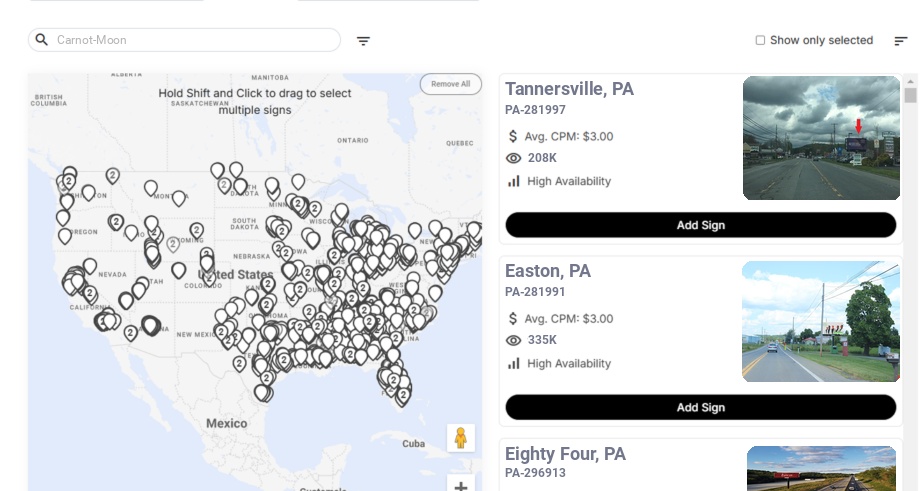
Blip has digital billboards near Carnot-Moon. You can browse available locations on a map, choose the ones that fit your audience, and start advertising right away.
Still have questions? Launch a campaign in minutes — no contracts, no commitments.
Start Your CampaignCarnot-Moon Billboard Advertising Guide
The area near Carnot-Moon is one of western Pennsylvania’s most practical billboard markets because it combines suburban households, airport traffic, university activity, and regional commuting on a compact set of roads centered on 5 primary corridors. We can reach the Carnot-Moon area through 4 digital billboards located in nearby Ambridge McKees Rocks Sewickley 10.0 miles of Carnot-Moon. That proximity matters because the local audience moves constantly between the airport corridor, Ohio River communities, Robinson retail, and Downtown Pittsburgh. For advertisers that want flexible reach near Carnot-Moon, this market offers repeated visibility to drivers making the same trips every weekday, plus meaningful seasonal spikes from travel, sports, campus events, and shopping.
Market Overview for the Carnot-Moon Area
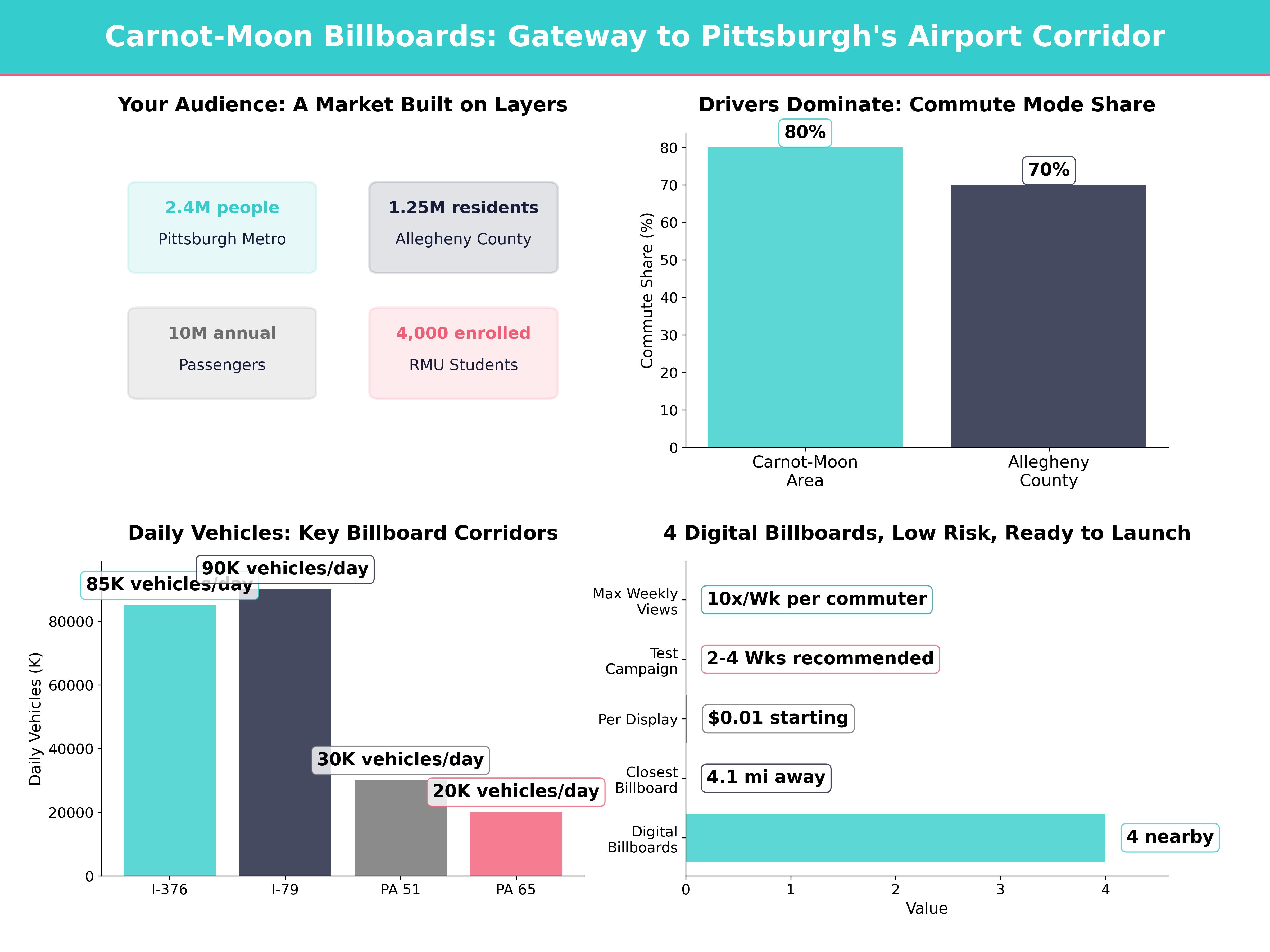
Carnot-Moon is part of the broader Moon Township and airport-corridor economy in western Allegheny County, with nearby influence from Beaver County. Allegheny County had 1,250,578 residents in the 2020 Census, Beaver County had 168,215 residents, and the broader Pittsburgh metro is home to roughly 2.4 million people. That gives advertisers near Carnot-Moon access to a local suburban customer base plus a much larger regional audience that passes through the area for work, school, travel, shopping, and events.
The economic story is stronger than a single residential suburb. Pittsburgh International Airport 10 million passengers in 2023, while the airport’s terminal modernization program $1.57 billion in infrastructure investment. Robert Morris University adds another dependable audience base, with roughly 4,000 students, plus faculty, staff, parents, athletes, and eventgoers. Nearby commercial districts in Robinson Township, Findlay Township 24/7 and major retail corridors drawing evening traffic.
Why the Carnot-Moon area is so vehicle-driven
For billboard advertisers, the most important local behavior is how people move. In the suburban airport corridor near Carnot-Moon, private-vehicle commuting comfortably exceeds 80% of work trips when drive-alone and carpool travel are combined. Even across all of Allegheny County, private vehicles still account for well over 70% of commuting. Pittsburgh Regional Transit does connect the airport and city, including the 28X route, but the Carnot-Moon area remains a strongly car-oriented market.
That matters because billboard effectiveness rises when audiences repeat familiar routes. Residents serving the Carnot-Moon area drive to the airport, to Robinson retail, to office parks, to schools, to sports facilities, and into Pittsburgh for work and entertainment. We are not depending on a one-time tourist crowd alone. We are reaching drivers who often see the same roads 5 days a week, and sometimes 2 times a day.
What advertisers can expect from this market
The audience near Carnot-Moon is broad enough to support many campaign goals at once:
- Local service brands can reach homeowners, families, and daily errand traffic.
- Regional brands can reach airport travelers, west-suburban commuters, and Downtown-bound drivers.
- Employers can reach job seekers across logistics, hospitality, education, retail, healthcare, and skilled trades.
- Event marketers can reach people heading toward campus venues, sports venues, and convention activity.
Because our billboard inventory sits in nearby cities rather than directly inside the Carnot-Moon area, advertisers get access to the routes that feed this market from multiple directions.
Key Traffic Corridors Serving the Carnot-Moon Area
The road network is the backbone of billboard performance near Carnot-Moon. The most important routes are I-376, I-79, PA 51, PA 65, and the connecting local arterials that funnel drivers toward the airport, Moon Township, Robinson, Sewickley, and the Ohio River communities. PennDOT traffic counts vary by exact segment, but the hierarchy is clear: the interstate approaches carry the largest daily volumes, while river-road and local feeder routes provide repeated neighborhood frequency.
I-376 and the airport gateway near Carnot-Moon
I-376 is the defining corridor for the Carnot-Moon area. It links the airport, Moon Township, Robinson, and Downtown Pittsburgh, and PennDOT count stations on major segments of the corridor commonly reach 70,000 to 100,000+ vehicles per day. That is exactly the kind of traffic mix that makes digital billboard advertising useful for both local and regional brands.
This corridor is also shaped by airport timing. Pittsburgh International Airport 2 hours before domestic flights and 3 hours before international flights, which creates meaningful early-morning and midday travel waves on top of standard commuter traffic. If we want to reach business travelers, parking customers, hotels, restaurants, car dealers, or B2B buyers serving the airport corridor, I-376 is the essential route.
I-79, Robinson, and the western suburban interchange network
The I-79 interchange area near Robinson is one of the most valuable highway filters serving the Carnot-Moon area. PennDOT counts on major I-79 segments in this part of the metro often exceed 90,000 vehicles per day, especially near large interchange zones. This route pulls traffic north and south from the South Hills, Washington County, Cranberry, and the rest of the north-south regional spine.
That interchange activity matters because many trips near Carnot-Moon are not purely local. Shoppers heading to The Mall at Robinson, workers heading to Moon or Findlay, and travelers heading for the airport often merge through the same limited set of ramps and connector roads. For broad awareness, especially if we want scale beyond the immediate Carnot-Moon area, this is one of the strongest circulation systems in western Pennsylvania.
PA 51, McKees Rocks, and city-bound commuter flow
Our nearby billboard presence in McKees Rocks is useful because PA 51 and its related approaches capture west-to-city movement and return traffic. Depending on the exact segment, PennDOT counts on this corridor often fall in the 25,000 to 35,000 vehicles per day range. That is lower than the core interstate numbers, but it is still substantial, and the audience tends to be highly repetitive.
This is a strong route for advertisers who want to reach:
- Weekday commuters headed between the western suburbs and Pittsburgh.
- Service businesses that benefit from repeated weekday exposure.
- Restaurants, healthcare providers, colleges, event venues, and retailers that need urban-suburban crossover traffic.
Because McKees Rocks sits only 7.1 miles from the Carnot-Moon area, it can act as a gateway board for campaigns that need wider regional circulation without losing the local Moon-market focus.
PA 65, Sewickley, Ambridge, and the Ohio River corridor
Our nearby billboards in Sewickley and Ambridge are especially valuable for the river-road audience. PA 65, also known as Ohio River Boulevard on parts of the route, commonly posts volumes in the 15,000 to 25,000 vehicles per day range depending on the segment. That traffic is slower and more community-oriented than interstate traffic, which makes it attractive for home services, healthcare, local retail, financial services, and family-oriented brands.
This corridor ties together Sewickley 7.4 miles from the Carnot-Moon area, and the Ambridge billboard is only 4.1 miles away, so both are close enough to influence the local decision cycle while still catching adjacent-market drivers.
Local feeders that strengthen repeat frequency
Routes such as University Boulevard, Beaver Grade Road, Brodhead Road, and the Pennsylvania Turnpike Commission network, including PA 576 10,000+ vehicles per day on important segments. While those roads are not where all of our billboard faces sit, they help explain why the nearby Ambridge, McKees Rocks, and Sewickley boards can repeatedly reach people serving the Carnot-Moon area.
Audience Segments We Can Reach Near Carnot-Moon
The Carnot-Moon area is attractive because it is not a one-audience market. Several dependable segments overlap throughout the week, and strong campaigns usually reflect that mix.
Commuters, airport employees, and business travelers
The airport corridor creates daily traffic from workers, vendors, hotel guests, airline passengers, rental-car customers, and people meeting arriving travelers. With nearly 10 million annual passengers moving through PIT, plus a large workforce spread across aviation, logistics, hospitality, food service, transportation, and office operations, this is a major weekday and weekend audience.
This segment responds well to messages about convenience, trust, timing, and location. Brands promoting parking, hotels, healthcare, telecom, business services, recruiting, restaurants, and automotive services all have a logical fit near Carnot-Moon.
Students, parents, and eventgoers tied to Robert Morris
Robert Morris University gives the area a steady education audience. The university serves roughly 4,000 students, and its UPMC Events Center 4,000 people for games, concerts, and special events. Nearby, the RMU Island Sports Center spans 32 acres and includes 2 NHL-sized ice rinks, which draws youth-sports families and tournament traffic from around the region.
That makes the Carnot-Moon area especially good for advertisers selling food, apartments, banking, healthcare, tutoring, wireless plans, recruiting, entertainment, and family recreation. It also creates reliable bursts around move-in, move-out, commencement, athletics, and youth tournaments.
Families and established suburban households
The western suburbs serving Carnot-Moon include a mix of long-established neighborhoods, newer residential development, and affluent river communities. Families make recurring trips for school, shopping, youth sports, dining, medical care, and home improvement. That is why brands such as dentists, HVAC companies, roofers, real estate agents, senior-care providers, urgent care clinics, banks, local restaurants, and grocery-adjacent retailers can work very well on these boards.
This audience often prefers direct, useful messaging over abstract branding. Clear value propositions such as “same-day service,” “minutes from PIT,” “free estimate,” or “now hiring” typically fit the local travel mindset better than vague image advertising.
Visitors, sports fans, and convention traffic
The Carnot-Moon area also sits on the western approach to Pittsburgh’s visitor economy. Visit Pittsburgh promotes a destination anchored by the David L. Lawrence Convention Center, a 1.5 million-square-foot facility, plus major sports and entertainment venues such as Acrisure Stadium with 68,400 seats, PNC Park with 38,747 seats, and PPG Paints Arena with 19,758 seats for hockey.
When conventions, concerts, and home games stack up, westbound and airport-bound traffic becomes especially attractive. Advertisers near Carnot-Moon can use that event calendar to align campaigns with sports weekends, hotel demand, nightlife, restaurants, and post-event return trips.
Seasonal and Timing Opportunities Near Carnot-Moon
Seasonality matters near Carnot-Moon because the audience changes shape during the year. The same boards can support very different strategies from January through December.
Winter and holiday travel windows
From mid-November through early January, airport travel becomes a bigger driver. Holiday flyers, family pickups, retail trips, and hospitality demand can all rise together. This is a strong time for parking, hotels, restaurants, gift promotions, telecom offers, healthcare, entertainment, and any brand that benefits from December urgency.
Winter weather also changes creative needs. Short days, gray skies, rain, snow, and wet pavement make high-contrast digital designs more important than usual. Campaigns with bold colors, simple layouts, and one unmistakable call to action usually perform best.
Spring education, housing, and home-service demand
From March through May, the Carnot-Moon area adds energy from spring travel, university activity, and home-improvement season. Moon Area School District families are moving into sports, graduations, and summer planning, while Robert Morris enters commencement and end-of-semester cycles. We often see spring work well for real estate, landscaping, medical services, dentistry, home services, camps, and family entertainment.
Spring is also a good time to test recruiting campaigns. Employers across logistics, trades, hospitality, retail, and service industries often need to staff up before summer demand peaks.
Summer travel and family mobility
June through August is one of the most dynamic stretches for the airport corridor. Leisure travel increases, road trips rise, and parents spend more time driving between camps, sports, shopping, and recreation. Nearby attractions such as Pittsburgh Botanic Garden and the Robinson retail corridor add leisure traffic to the market.
For timing, Thursday and Friday often matter for outbound weekend travel, while Sunday afternoon and evening can be effective for return traffic. We also like to watch midday airport movement during summer because the audience is not limited to standard 6 to 9 a.m. and 3 to 7 p.m. commute windows.
Fall commuting, football, and business activity
Late August through November brings one of the most consistent ad environments near Carnot-Moon. Schools are back, university life is active, business travel strengthens, Steelers and college football return, and conventions remain active Downtown. This is often the best season for brands that need predictable weekday frequency plus event-related surges on weekends.
For many advertisers, fall is the right time to concentrate spend on:
- Morning commuter hours from 6 to 9 a.m.
- Evening return hours from 3 to 7 p.m.
- Thursday and Friday airport-travel periods.
- Sunday late-day return traffic after sports, events, or weekend trips.
Billboard Design Tips for the Carnot-Moon Area
Strong local creative near Carnot-Moon should feel practical, direct, and geographically aware. The audience is moving quickly, but it is also highly local in how it interprets landmarks and offers.
Use local cues that make immediate sense
We usually recommend creative that feels native to the western Pittsburgh suburbs. References to “PIT,” “Airport Corridor,” “West Hills,” “Robinson,” “Sewickley Valley,” or “minutes from the airport” can make the message feel more relevant than a generic regional slogan. If the advertiser’s location truly is close, a distance-based message such as “10 minutes from PIT” or “next exit near Robinson” can be very effective.
Visuals can also reflect the geography. Airport imagery, bridges, rivers, hillside neighborhoods, campus energy, and suburban family scenes all feel more believable here than stock images that suggest a completely different market.
Design for fast highway reading
Our digital ads display for 7.5 to 10 seconds, so the creative needs to be instantly clear. We usually advise keeping the core message to 5 to 7 words, using one strong visual, one brand mark, and one action step. If drivers need several seconds to decode the headline, the board is doing too much.
This is especially true on I-376 and I-79, where travel speeds are higher and clutter tolerance is lower. On PA 65 and other community-oriented corridors, slightly more nuance can work, but clarity still wins.
Lean into contrast and regional color logic
Western Pennsylvania weather can flatten weak color palettes. Near Carnot-Moon, we generally favor bold contrast, strong typography, and simple backgrounds that stay legible in rain, dusk, and winter conditions. Black-and-gold accents can feel regionally familiar when they fit the brand, but they should support the message rather than overpower it.
For family and community offers, blues, greens, and clean whites often read well. For nightlife, events, or limited-time offers, warmer tones such as red or orange can add urgency. The key is visual separation from the gray roadway environment.
Match the message to the route
A travel-oriented ad often makes more sense on the faster commuter and airport-facing approaches. A home-service or community healthcare message often feels stronger on Sewickley and Ambridge routes, where repeated local traffic matters. We get the best results when the creative and the corridor agree on audience intent.
Regional Strategies Near Carnot-Moon
Because our inventory sits in 3 nearby municipalities rather than one single road segment, we can build smarter coverage around the Carnot-Moon market.
Use McKees Rocks for broader western-Pittsburgh scale
The nearby McKees Rocks board is helpful when we want reach beyond the immediate suburban core. It works well for brands that need higher commuter frequency, city-bound traffic, or broader western Allegheny visibility. If the goal is mass awareness, recruiting, healthcare branding, retail, or event promotion, this board often plays an important role.
Use Sewickley for high-frequency suburban and river-road relevance
The nearby Sewickley board is a strong fit for advertisers targeting established households, local professionals, parents, and service buyers. Brands such as financial advisors, healthcare systems, home remodelers, attorneys, local restaurants, and education providers often benefit from this type of environment. It is close enough to the Carnot-Moon area to feel local, but it also speaks to adjacent communities that influence spending patterns.
Use Ambridge to pull in Beaver County-side movement
The nearby Ambridge board is only 4.1 miles from the Carnot-Moon area, which makes it especially valuable for campaigns that want the Moon market plus the Beaver County approach. This is useful for employers, trade schools, auto dealers, regional healthcare groups, and service businesses that draw customers across county lines. If a brand serves both the airport corridor and the Ohio River communities, Ambridge helps close that gap.
Layer multiple nearby boards for stronger recall
The most effective regional strategy is often not choosing one board. It is combining the right boards for the trip pattern we want. We may use McKees Rocks for reach, Sewickley for suburban reinforcement, and Ambridge for cross-county follow-up. That creates multiple exposures across the same week, which is especially helpful for brands that are asking drivers to remember a name, compare options, or act later from home.
Using Blip Tools to Advertise Near Carnot-Moon
Blip’s platform is useful near Carnot-Moon because the market rewards flexibility. We can choose the nearby boards on a map, align them to the audience we want, and tighten the schedule around the road patterns that matter most.
Build the right local mix without overcommitting
Because we have 4 nearby digital billboards serving the Carnot-Moon area, we can start with a focused footprint instead of paying for a much larger regional package than the campaign needs. That is especially helpful for local businesses, test campaigns, seasonal promotions, and recruiting pushes.
Schedule around how this market actually moves
The Carnot-Moon area has multiple dayparts that matter. Morning airport runs, evening commuter traffic, Thursday-Friday leisure departures, Sunday return traffic, and event-driven weekends can all justify different schedules. With Blip, we can shift spend toward the windows that fit the campaign instead of treating every hour like it has equal value.
Test creative by corridor
This market is ideal for creative testing. A travel-focused message may outperform on the faster commuter routes, while a more community-oriented message may resonate better on Sewickley or Ambridge approaches. Since campaigns can be adjusted in real time, we can learn which message earns the best traction instead of guessing for an entire contract cycle.
Getting Started with Billboard Rental Serving the Carnot-Moon Area
Renting a digital billboard near Carnot-Moon should start with the trip, not the map pin. We first need to ask who the customer is, where that customer is driving, and what that person is doing when the ad appears.
Step 1: Define the result before choosing the board
We usually begin with one primary goal. That goal might be store visits, website traffic, phone calls, recruiting, event attendance, or general awareness. A restaurant near the airport, for example, needs a different location mix than a roofer serving Sewickley and Moon Township, or a college promoting enrollment across western Allegheny and Beaver counties.
Step 2: Match each nearby billboard to the audience journey
Here is a practical way to evaluate the boards serving the Carnot-Moon area:
- The nearby McKees Rocks option is often strongest for broad commuter reach and western-Pittsburgh circulation.
- The nearby Sewickley option is often strongest for affluent suburban households, local services, and community frequency.
- The nearby Ambridge option is often strongest for Beaver County crossover, recruiting, and regional service-area businesses.
When we evaluate a location, we look at direction of travel, distance from key interchanges, nearby decision points, road speed, and whether the audience is commuting, shopping, or traveling.
Step 3: Expect digital rotation, not a single static face
Digital billboard rental works differently from traditional static buying. Your ad appears in a rotating loop rather than occupying the face full time, and each blip lasts 7.5 to 10 seconds. The advantage is flexibility. We can enter the market without a long contract, test multiple boards, and scale up or down as results come in.
With Blip, pricing starts at $0.01 per display, and there are no minimums or long-term commitments. That makes it easier to launch a 2- to 4-week test campaign, compare several nearby locations, and learn what actually performs before we expand.
Step 4: Use data to refine the Carnot-Moon-area buy
Traditional billboard companies often require longer negotiations, larger commitments, and less day-to-day control. Blip simplifies that process by letting us choose boards online, set budgets, daypart campaigns, upload creative, and watch performance as the campaign runs. For the Carnot-Moon market, that matters because traffic patterns change by season, by route, and by audience segment.
If we start with a clear goal, choose the right nearby boards, and tailor the message to the corridor, billboard advertising near Carnot-Moon can be both efficient and scalable. The market has the right ingredients: 4 nearby digital boards, strong road repetition, airport-driven movement, campus activity, and a customer base that still spends a lot of time behind the wheel.