Billboards in Fairfield, CT
No Minimum Spend. No Long-Term Contracts. Just Results.
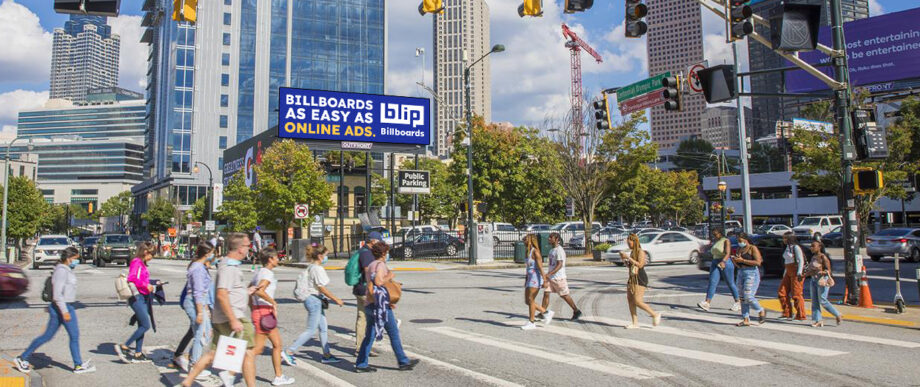
Turn heads with Fairfield billboards that shine brighter than your social feed. With Blip, you set the budget, timing, and message, making billboards in Fairfield, Connecticut an easy, flexible way to spotlight your business whenever you’re ready.
Trusted by Leading Brands


Billboard advertising
in Fairfield has
never been easier
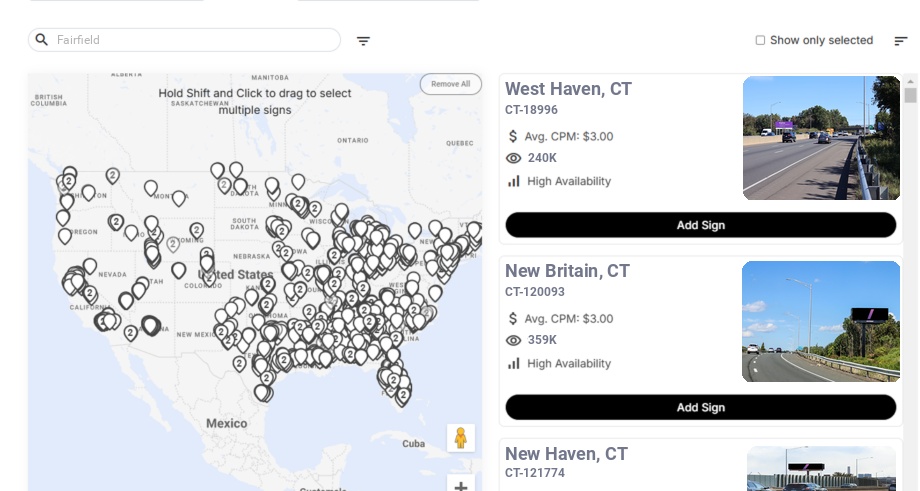
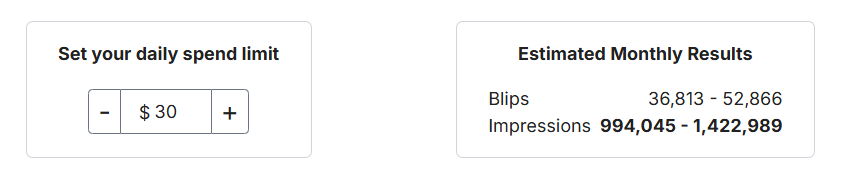
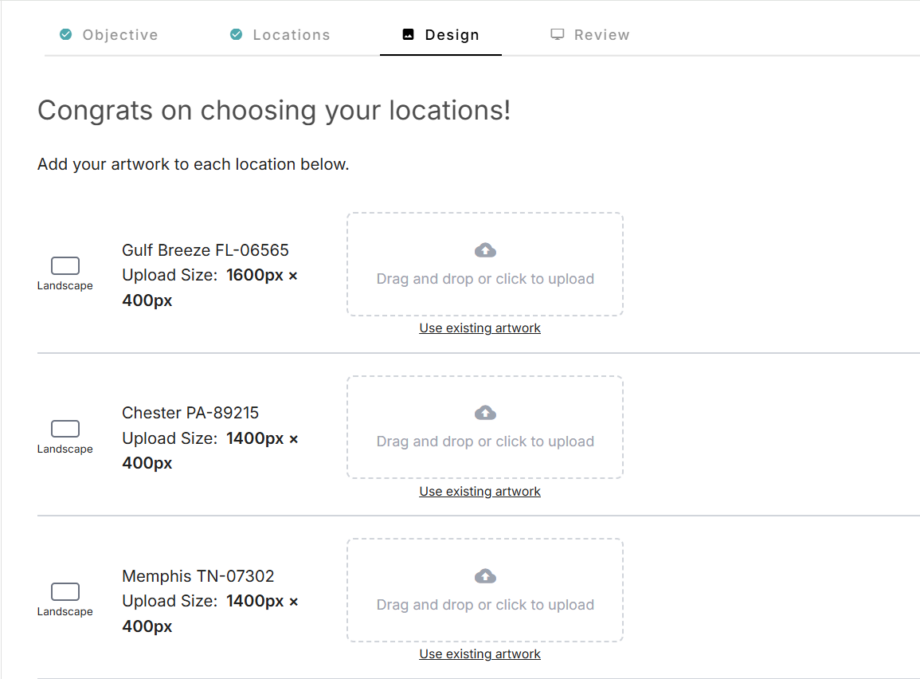
HERE'S HOW IT WORKS
How much is a billboard in Fairfield?
Billboards in other Connecticut cities
Fairfield Billboard Advertising Guide
Fairfield, Connecticut sits at a powerful crossroads of affluent suburban living, coastal tourism, and New York–bound commuter traffic. When we use digital Fairfield billboards strategically, we can tap into one of the most desirable consumer markets in New England, reaching both daily residents and high-intent visitors who are ready to spend. Smart Fairfield billboard advertising lets local and regional brands stay in front of these audiences year‑round.
Understanding the Fairfield Market
Fairfield is a high-income, highly educated community with a strong local identity—critical context for our billboard messaging and any billboard rental in Fairfield.
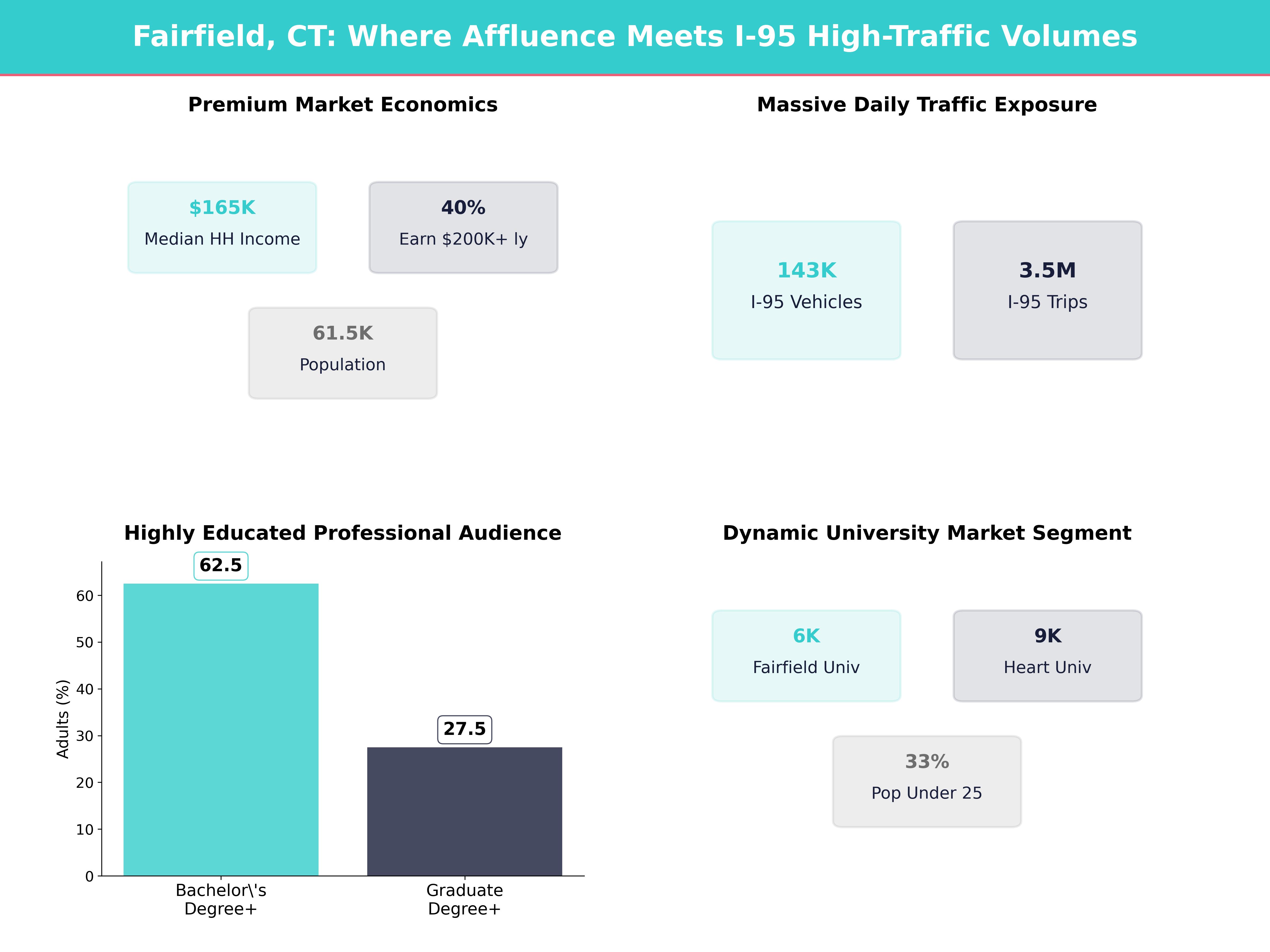
- Population: Recent estimates place Fairfield’s population at just over 61,000 residents (around 61,500–62,000), making it one of the larger communities in coastal Fairfield County.
- Affluence: Median household income is roughly $160,000–$170,000, more than double the U.S. median and significantly above the Connecticut median. In Fairfield County as a whole, median household income sits near $110,000, underscoring just how affluent Fairfield is even within a wealthy county.
- High-spend households: In many Fairfield neighborhoods, more than 40% of households earn $200,000+ annually, and a substantial share spend heavily on home improvement, financial services, private education, and travel.
- Education: Roughly 60%–65% of adults hold at least a bachelor’s degree, and around 25%–30% hold a graduate or professional degree. This means residents are generally information‑savvy and responsive to clear, benefits‑driven messaging rather than gimmicks.
- Housing & stability: Around 75%–80% of occupied housing units are owner‑occupied, and many residents have lived in town 10+ years. This reflects long‑term community ties, strong school engagement, and repeat local purchasing patterns.
- Family focus: About one‑third of Fairfield’s population is under age 25, and a high share of households include children under 18. School systems like Fairfield Public Schools are a major draw for families, while the presence of two universities adds a dynamic younger segment.
- Commuting: A large percentage of Fairfield’s workforce commutes out of town, with many traveling to Stamford Norwalk, and New York City. Average commute times often exceed 30 minutes, and thousands rely on the Fairfield Fairfield Metro Southport
Key local anchors and institutions we should consider in our targeting and messaging include:
- The Town of Fairfield: Local government, events, planning, and community info via the official site. Economic development, permitting, and business resources here are especially useful for understanding where growth is happening and where Fairfield billboards can have the most impact.
-
Business community:
- The Fairfield Chamber of Commerce supports hundreds of local businesses and regularly promotes networking events, retail initiatives, and restaurant weeks—ideal tie‑ins for billboard campaigns.
-
Universities:
- Fairfield University (around 4,800 undergraduates and 1,200 graduate students; total enrollment close to 6,000) draws students from across the U.S., plus visiting families and alumni.
- Sacred Heart University in neighboring Fairfield/Bridgeport, with roughly 9,000+ total students (including more than 6,000 undergraduates), adds a substantial student and young‑professional market.
-
Tourism and coastal recreation:
- Fairfield maintains multiple public beaches, marinas, and over 1,000 acres of open space and parks. Seasonal beach traffic and events promoted through CTvisit’s Fairfield page and the town’s own Parks & Recreation
-
Local news and community voice:
- Fairfield Citizen
- CTPost – Fairfield section
- Regional outlets frequently cover Fairfield’s schools, real estate trends, and local business openings, shaping community conversation and giving context for timely billboard themes.
The combination of high income, strong schools, and proximity to New York City makes Fairfield especially attractive for:
- Luxury goods and services (auto, jewelry, home improvement, travel). High‑income Fairfield County households typically spend thousands of dollars per year on home upgrades, high‑end dining, and premium vehicles.
- Financial services, legal, and professional services, with many households focused on wealth management, college planning, and estate planning.
- Education‑ and family‑oriented offerings (tutoring, camps, healthcare), aligned with a community where per‑student K–12 spending and extracurricular participation rates are well above national norms.
- Dining, entertainment, and leisure businesses looking to attract high‑value patrons from both Fairfield and nearby towns like Westport Norwalk, and Bridgeport.
Traffic Patterns and Where Your Message Matters Most
Fairfield’s outdoor impressions are driven by corridor traffic and commuting patterns more than by sheer population size. Understanding these patterns is essential when you’re planning billboard rental in Fairfield. The big levers:
1. Interstate 95 (I‑95) Corridor
I‑95 is the spine of the region, carrying local and through‑traffic between New Haven Bridgeport, Fairfield, Norwalk, Stamford
- Daily traffic volumes: In Fairfield County segments, I‑95 commonly handles about 130,000–155,000 vehicles per day, according to Connecticut Department of Transportation
-
Directional patterns:
- Morning (6:30–9:30 a.m.): Heavy southbound traffic toward Norwalk, Stamford, and New York City, including thousands of Fairfield residents commuting to corporate offices.
- Evening (4:00–7:00 p.m.): Heavy northbound traffic returning to Fairfield and further up the shoreline; Friday evenings can see notable spikes before weekends and holidays.
- Dwell time: Congestion is frequent, especially near exits serving Fairfield’s Post Road and commercial areas. Slow‑moving traffic increases the number of seconds drivers spend within view of a board, amplifying the impact of legible, high‑contrast creative.
-
Strategic use with Blip:
- For commuter‑focused offers (coffee, parking, quick food, commuter services), we can emphasize early morning and late‑afternoon dayparts when tens of thousands of workers pass daily.
- For business services and B2B, we can focus on weekday rush hours when decision‑makers are on the road and more likely to engage later via search or direct web visits.
For deeper route and volume insight, advertisers can cross‑reference locations with the Connecticut Department of Transportation traffic volume maps
2. Merritt Parkway (Route 15)
The Merritt Parkway is a major alternative to I‑95 and is heavily used by professionals who prefer a more scenic route.
- Traffic: Across Fairfield County segments, the Merritt often carries 60,000–80,000 vehicles per day, or roughly 1.8–2.4 million vehicles per month.
- Demographics: The Parkway draws a high share of white‑collar and professional commuters traveling between upper Fairfield County (Trumbull, Monroe, Shelton) and southern employment hubs like Stamford Greenwich. Median household incomes in many of the towns feeding into the Parkway exceed $140,000.
- Travel behavior: Speed limits are lower and curves are frequent, so drivers have limited time to absorb complex messages. Many are daily repeat commuters, making frequency and consistent branding especially powerful.
-
Creative implications:
- Clean, sophisticated designs and premium positioning (“elevate,” “upgrade,” “exclusive”) resonate here.
- Keep copy extremely short—drivers are moving quickly on a curving parkway; 5–7 words of core message plus brand is ideal.
3. U.S. Route 1 / Local Arterials
U.S. Route 1 (Post Road) cuts through Fairfield’s commercial district, with access to:
- Retail plazas, grocery stores, and restaurants.
- Fairfield’s town center and nearby neighborhoods.
- Local schools, town services, and the Fairfield Museum & History Center
Average daily traffic on these arterials typically ranges from 15,000–35,000+ vehicles, depending on the exact segment. This means a busy Post Road location can see close to 450,000–1,000,000 vehicle trips per month—highly valuable for local business visibility and hyperlocal Fairfield billboard advertising.
They are ideal for:
- Direct‑response local offers (“This week only,” “2 miles ahead,” “Turn left at XYZ Street”).
- Restaurant and retail campaigns targeting residents running errands, school pick‑ups, and weekend shopping.
- Hyperlocal professional services (dentists, attorneys, home services) whose customers live within a 3–5‑mile radius.
When we’re selecting Blip boards, we should think not only about total impressions, but also about the “mindset” of the driver on each corridor—commuting, shopping, entertainment, or leisure.
Timing: Seasonality and Dayparting in Fairfield
Blip’s flexibility shines in Fairfield, where seasonal and weekly rhythms are especially strong and where different times of year call for different Fairfield billboards and messages.
Seasonal Opportunities
- Late Spring & Summer (May–August)
Fairfield’s coastal setting and beaches attract both residents and visitors.
- The town’s beaches, marinas, and outdoor events promoted via CTvisit and the Town of Fairfield Recreation
- School calendars: Public schools in Fairfield typically let out in mid‑to‑late June, and local private schools follow similar schedules. This flips household routines almost overnight.
-
Families with school‑age children shift into “summer mode,” looking for:
- Camps and kids’ activities—many camps report filling 80%–100% of slots by mid‑spring.
- Home projects (renovations, landscaping, pools), with contractors booking weeks or months ahead.
- Dining, ice cream, and entertainment along coastal and commercial corridors.
-
With Blip, we can:
- Increase spending on sunny weekends and lighten up on rainy weekdays.
- Run special creative only on weekends targeting beachgoers (e.g., boards along access routes to Jennings Beach Penfield Beach
- Back‑to‑School & University Return (August–September)
Fairfield and Sacred Heart universities significantly spike local activity.
- Combined, Fairfield University and Sacred Heart University bring well over 10,000 students plus thousands of faculty and staff into the Fairfield/Bridgeport area.
- Move‑in weekends typically draw thousands of parents and family members, resulting in major surges at hotels, restaurants, and big‑box retailers along I‑95 and Route 1.
- Campus‑area restaurants, gyms, auto shops, banks, and mobile carriers compete intensely for these customers, especially in the first 2–3 weeks of the semester.
-
With Blip, we can:
- Run move‑in specific creative for 7–10 days focusing on “Students & Parents: Open Late,” “Student Discounts,” or “Set Up Your New Place.”
- Shift budgets to boards closest to campus and along main access routes during those key weeks, using university academic calendars posted on Fairfield University and Sacred Heart University as timing guides.
- Fall & Holiday Season (October–December)
Fall is prime time for:
- Family activities (pumpkin patches, fall festivals, local events shared on fairfieldct.org).
- Home improvement campaigns (roofing, heating, insulation, remodeling) as homeowners prepare for colder weather; energy‑efficiency upgrades often spike ahead of winter.
- Holiday shopping and dining: Retail studies consistently show November–December can account for 20%–30% of annual retail sales, and Fairfield’s affluent households are key contributors to this spending.
We can ramp up impressions around:
- Thanksgiving travel periods (heavy I‑95 traffic, often among the highest‑volume days of the year regionally).
- The first two weekends of December (shopping, events such as downtown tree lightings and holiday strolls promoted by the Fairfield Chamber of Commerce).
- End‑of‑year promotions for automotive, financial planning, and healthcare (open enrollment, year‑end appointments), when consumers are particularly responsive to “use it or lose it” and tax‑timing messages.
- Winter & Early Spring (January–March)
Colder months lend themselves to:
- Fitness, health, and wellness campaigns (“New Year, New You”) as gyms, studios, and medical offices see early‑year spikes in inquiries.
- Travel and escape messaging (warm‑weather vacations, weekend getaways) targeting residents who typically spend more on leisure travel than the national average.
- Tax preparation, financial planning, and home services booked before spring, as households organize paperwork and budgets.
During poor weather, people drive more cautiously but still spend significant time on main roads; clean, high‑contrast artwork is essential in low‑light or rainy conditions common in New England winters and should be a priority whenever you’re investing in billboard rental in Fairfield.
Weekly and Daily Timing
Using Blip’s dayparting controls, we can align our spend with Fairfield’s weekly rhythms:
- Weekday mornings (6:30–9:30 a.m.): Commute‑heavy, ideal for coffee, quick‑service restaurants, traffic‑dependent services, and productivity/business messaging. Thousands of vehicle trips funnel daily toward I‑95 and the Merritt Parkway during this window.
- Weekday midday (11:00 a.m.–2:00 p.m.): Errand and lunch runs—good for local dining, retail, and healthcare (urgent care, dental, optometry).
- Late afternoon to early evening (3:00–7:00 p.m.): Parents picking up kids, after‑school activities, and the evening commute—perfect for family‑oriented services and dinner messaging.
- Evenings (7:00–10:00 p.m.): Entertainment, delivery/online ordering, and brand awareness for nightlife or events; ideal for highlighting shows at venues like Fairfield Theatre Company.
- Weekends: Focus on retail, entertainment, real estate open houses, and leisure activities. Saturday mid‑day can be one of the heaviest local‑shopping periods along Post Road and Black Rock Turnpike.
We can also adjust our scheduling around local events such as town parades, university games, or performances at Fairfield‑area venues, using calendars on fairfieldct.org, Fairfield Theatre Company, and coverage in Fairfield Citizen CTPost
Crafting Creatives for Fairfield’s Audience
Because Fairfield’s residents are educated and media‑aware, the quality and tone of our creative matters.
Tone and Positioning
- Intelligent but approachable: Assume a savvy audience that appreciates clarity and respect, not gimmicks. Many are professionals used to evaluating offers quickly.
- Community‑aware: Referencing Fairfield landmarks (Post Road, beaches, town center, university areas) or local pride can increase resonance. Mentions of Fairfield’s strong schools, local sports, and coastal lifestyle often perform well.
- Value and lifestyle: High income doesn’t mean price‑insensitive; emphasize value, convenience, and lifestyle enhancement, not just luxury. Highlight time‑savings, family benefits, and quality guarantees.
Visual and Copy Best Practices
- Ultra‑clear copy: Aim for 6–10 words, max. Example:
“Fairfield’s Newest Family Dentist – 5 Minutes Ahead”
“Upgrade Your Kitchen Before Summer – Call Today” - High contrast: Dark text on light background or vice versa; Fairfield’s variable weather (fog, snow, rain) demands clarity for safety and readability.
-
Local cues: Use minimal but recognizable local imagery:
- Shoreline or beach silhouette for coastal businesses.
- Subtle nods to universities for student‑focused offers (colors or phrases, but avoid trademarked logos unless licensed).
- Imagery that reflects New England architecture and coastal living for real estate and home services.
-
Call to action aligned with drive context:
- On local roads: “Next Right,” “Across from Fairfield Metro,” “Exit 22 – Post Rd.”
- On I‑95 or Merritt: Brand, benefit, and a simple URL or short keyword; drivers have less time to process complex CTAs.
Creative Variations Leveraging Blip
Blip allows us to rotate multiple creatives at no additional placement cost, which we can use to:
-
A/B test offers:
- Creative A: “Free Consultation – Book Today.”
- Creative B: “$0 Down – No Obligation Quote.”
Track which message yields more calls, web visits, or code redemptions from the Fairfield area.
-
Segment by time:
- Morning: “Fuel Your Commute – Coffee & Breakfast Specials.”
- Evening: “Skip Cooking – Order Takeout from [Restaurant Name].”
-
Segment by audience:
- Family‑focused in afternoon and weekend slots.
- Professional/finance‑focused during weekday rush hours.
Aligning Campaign Strategies with Local Segments
Fairfield is not uniform; we should think in segments and tailor campaigns accordingly so that billboards in Fairfield speak directly to each audience.
Families and Homeowners
- Key traits: High involvement in schools, sports, and town activities; active in home improvement and children’s services. Many households allocate substantial budgets to education, tutoring, and extracurriculars.
-
Effective messaging:
- “Transform Your Backyard Before Summer – Call [Brand].”
- “After‑School Tutoring in Fairfield – Enroll Now.”
- “Reliable Heating & Cooling for Fairfield Homes – 24/7 Service.”
-
Timing:
- 7–9 a.m. and 3–7 p.m. on weekdays, aligned with school drop‑off and pick‑up.
- Weekends for big‑ticket home projects, furniture, and family activities.
College Students and Young Adults
- Locations: Fairfield University and Sacred Heart University, plus surrounding off‑campus housing, retail, and entertainment spots.
- Economic impact: Thousands of students represent millions of dollars in annual local spending on food, nightlife, transportation, and services.
- Effective categories: Dining, nightlife, gyms, mobile/tech, banking, transportation, and part‑time jobs.
-
Messaging examples:
- “Student Nights at [Restaurant] – 10% Off with ID.”
- “Walkable Apartments Near Campus – Visit [Short URL].”
- “Fast Phone Repairs – Fairfield & Bridgeport Locations.”
-
Timing:
- Afternoon and evenings, especially Thursday–Saturday.
- Move‑in, orientation, and graduation windows when family visitation spikes.
Commuters and Professionals
- Many residents work in nearby cities like Stamford, Norwalk, and New York, with Metro‑North Railroad ridership in the region numbering in the tens of thousands per weekday.
-
High relevance for:
- Financial advisors, legal services, healthcare, and professional development.
- Premium auto, business‑class travel, and time‑saving services (laundry, meal kits, concierge medicine).
-
Use I‑95 and Parkway boards with:
- “Take Control of Your Retirement – [Brand].”
- “Skip the Branch – Fairfield’s Online‑First Bank.”
- “Executive Coaching for Fairfield Professionals – Learn More.”
Visitors and Regional Shoppers
- Fairfield draws visitors from across Connecticut and neighboring states for beaches, events, and shopping. Coastal Fairfield County’s tourism economy generates hundreds of millions of dollars annually, and Fairfield benefits directly from this regional pull.
-
Perfect for:
- Hotels and lodging.
- Attractions, museums, theater, and festivals such as those highlighted by CTvisit and the Fairfield Museum & History Center
- Regional retail centers and destination restaurants.
-
Use weekend and summer‑boosted schedules with:
- “Stay Oceanside in Fairfield – Book at [Hotel Name].”
- “Discover Fairfield’s Dining Scene – Exit [X].”
- “Make Fairfield Your Beach Day Base – Parking, Dining, Shopping.”
Using Blip Tools to Maximize ROI in Fairfield
Blip’s model is especially powerful in a focused, high‑value market like Fairfield. We can combine smart geography with flexible timing to stretch our budget and make Fairfield billboard advertising more efficient.
1. Set Smart Budgets
- Start with a test budget that allows for daily learning—many advertisers begin with $20–$50 per day to identify high‑performing dayparts and locations.
-
Shift more budget to:
- High‑traffic boards with strong relevance to your audience, as indicated by CTDOT traffic data and local observation.
- Time windows where your conversions (calls, visits, website traffic) spike—often weekday evenings for B2C, mid‑day for healthcare, and mornings for coffee/quick‑service.
2. Target by Board and Corridor
-
Choose boards along:
- I‑95 for broad reach and commuters.
- Merritt Parkway for affluent, professional traffic.
- U.S. Route 1 and local arteries for hyperlocal offers and directional messaging.
-
Align each creative with where the viewer is going:
- “Turn Right at Next Light” on local roads.
- “Serving Fairfield & Surrounding Towns – Visit [URL]” on highways.
-
Consider proximity to key landmarks:
- Train stations (Fairfield, Fairfield Metro, Southport).
- Downtown and Post Road retail clusters.
- Beach access roads and university gateways.
By making these decisions intentionally, you turn billboard rental in Fairfield into a precise, data‑informed channel rather than a generic awareness play.
3. Use Dayparting and Calendar Control
-
Concentrate spend in:
- Business hours for B2B, professional services, and healthcare.
- Evenings and weekends for restaurants, entertainment, and retail.
-
Increase frequency around specific dates:
- School and university term starts and graduations (check calendars on Fairfield University and Sacred Heart University).
- Local events listed on fairfieldct.org or featured in Fairfield Citizen CTPost
- Seasonal promotions highlighted by the Fairfield Chamber of Commerce, such as restaurant weeks or business expos.
4. Test, Measure, Refine
-
Track outcomes:
- Use vanity URLs, unique promo codes, or “Mention this billboard” offers specific to the Fairfield campaign.
- Watch Google Analytics and call logs for direct/brand search spikes from Fairfield and nearby ZIP codes.
-
Compare:
- Which locations deliver more calls or web traffic?
- Which creatives produce stronger responses or higher average order values?
-
Iterate:
- Pause underperforming schedules or creatives.
- Double down on time/location combinations that correlate with better results, reallocating budget toward the top 20% of placements that drive the majority of your response.
Industry‑Specific Ideas for Fairfield Advertisers
Different sectors can leverage Fairfield’s dynamics in distinct ways, choosing Fairfield billboards that line up with where their ideal customers drive.
Local Retail & Restaurants
-
Promote:
- “Lunch Specials – 5 Minutes from Fairfield Metro.”
- “Family Dinner Tonight? Kids Eat Free on Tuesdays.”
- “Brunch on the Post Road – Reserve Now.”
-
Tactics:
- Rotate weekday vs. weekend promos and test which delivers higher ticket sizes.
- Highlight proximity to train stations, beaches, or town center.
- Tie into local events and tourist waves promoted by CTvisit and town event calendars.
Professional Services (Doctors, Dentists, Attorneys, Financial Advisors)
-
Messaging:
- “New Patients Welcome – Fairfield Family Dental.”
- “Local Estate Planning Attorney – Protect What Matters.”
- “Retirement Planning for Fairfield Families – Book a Free Review.”
-
Strategy:
- Focus on consistency and trust‑building over time rather than hard‑discount offers.
- Use headshots and professional branding to humanize services; local decision‑makers often prefer advisors with visible community presence.
Home Improvement & Real Estate
- Homeowners in Fairfield invest heavily in their properties; home values in many neighborhoods sit well above state and national averages.
-
Ideas:
- “Renovate Before Listing – Maximize Your Fairfield Home’s Value.”
- “Roofing & Siding Pros – Serving Fairfield County.”
- “Open House This Weekend – Waterfront Property in Fairfield.”
-
Seasonal push:
- Spring/summer for construction and landscaping when project inquiries spike.
- Fall/early winter for interior remodeling and energy efficiency (insulation, windows, heating system upgrades).
Education, Camps, and Youth Activities
- With strong school‑age populations and high educational expectations, parents look for enrichment and specialized programs.
-
Messaging:
- “STEM Summer Camp in Fairfield – Limited Spots.”
- “Music Lessons for All Ages – Enroll Now.”
- “College Prep & SAT/ACT Tutoring – Fairfield Location.”
-
Timing:
- Late winter/early spring for summer programs (many families complete registrations by March–April).
- Late summer for fall activities and tutoring.
Healthcare and Wellness
-
From pediatricians to physical therapists and specialty clinics:
- “Same‑Day Urgent Care in Fairfield.”
- “New Orthodontic Patients – Free Consultation.”
- “Pilates & Yoga – First Class Free.”
-
Consider weather and lifestyle:
- Winter: illness, indoor fitness, and seasonal affective wellness.
- Spring: sports injuries, allergy treatments, and pre‑summer fitness campaigns.
Bringing It All Together
When we advertise on Fairfield’s digital billboards through Blip, we’re not just buying impressions—we’re entering the daily routines of affluent, engaged residents and high‑intent visitors. By understanding:
- Who lives and works in Fairfield (affluent families, students, professionals),
- Where and when they drive (I‑95, Merritt Parkway, Post Road; rush hours, weekends, seasonal peaks),
- And what matters to them (family life, education, community, quality of services),
we can craft highly effective campaigns that reach the right people at the right time.
Using Blip’s flexible budgets, board‑level targeting, and precise scheduling, we can start small, learn quickly from Fairfield’s response patterns, and scale up only where it counts—turning billboard rental in Fairfield into a measurable, high‑ROI investment in one of Connecticut’s most valuable markets.