Billboards in Inkster, MI
No Minimum Spend. No Long-Term Contracts. Just Results.
Turn daily drivers into your new fans with eye-catching Inkster billboards powered by Blip. Launch flexible, budget-friendly campaigns on digital billboards near Inkster, Michigan, serving the Inkster area with real-time control, playful creative options, and measurable results.
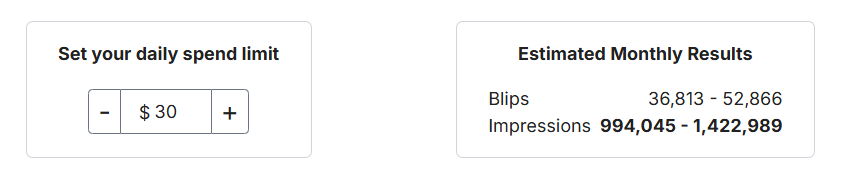
How much is a billboard in Inkster?
Billboards in other Michigan cities
Inkster Billboard Advertising Guide
The Inkster, Michigan area sits at the heart of western Wayne County, surrounded by high-traffic commuter corridors, major retail clusters, and one of the busiest airports in the United States. With 20 digital billboards serving the Inkster area from nearby Romulus, Westland, Allen Park, and Detroit, we can help you put your message in front of drivers, shoppers, airport travelers, and local residents with precision and flexibility. If you’re looking for billboards near Inkster that follow real commuter and shopping patterns, these placements provide efficient, targeted visibility across the west-suburban market.
Understanding the Inkster Area Market
The Inkster area is a compact, dense, working- and middle-class community embedded in the Detroit metro’s western suburbs, making it a prime zone for billboard advertising near Inkster that reaches both local households and regional commuters.
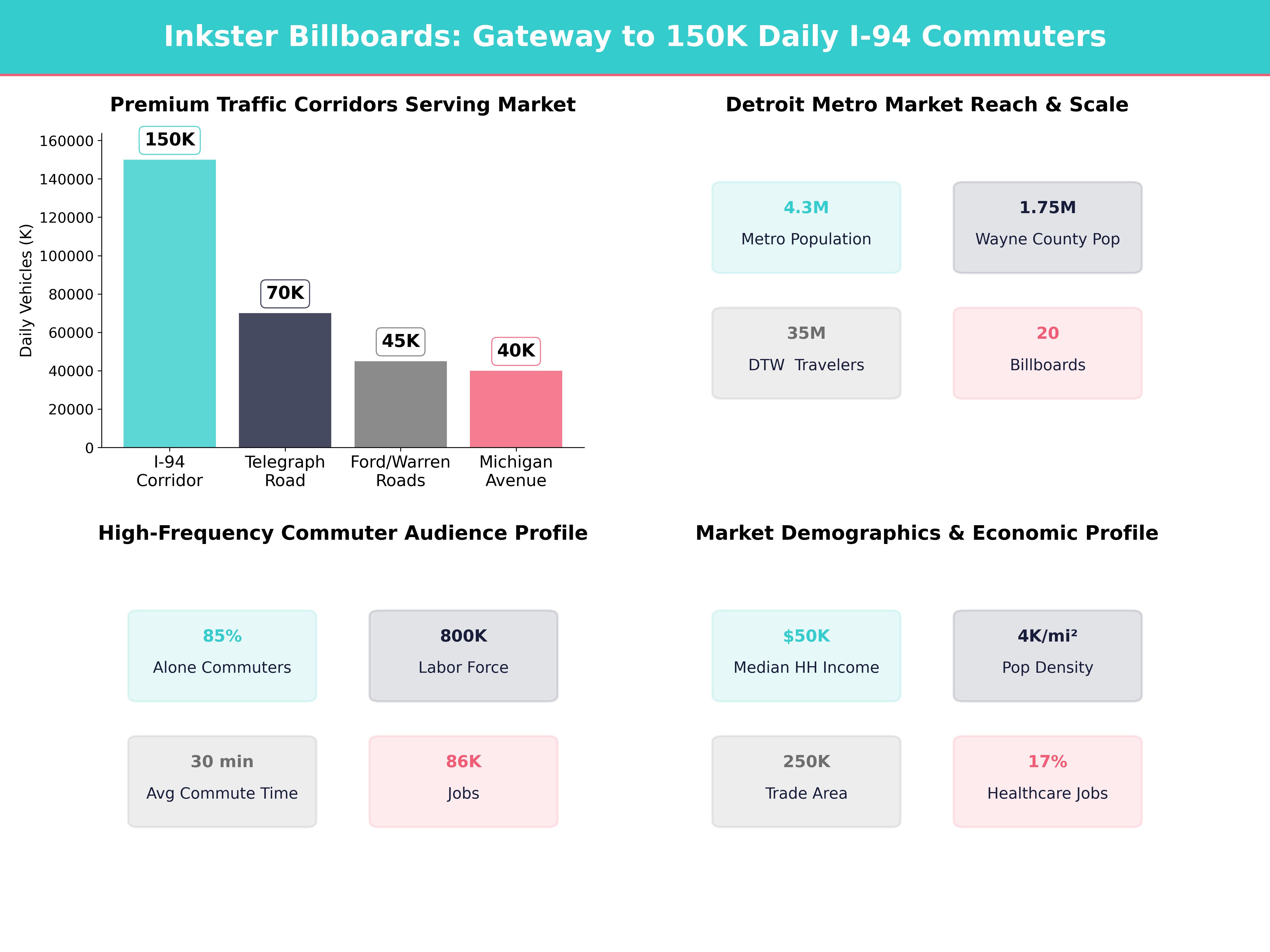
- The City of Inkster itself has about 24,000–25,000 residents in just over 6.2 square miles, for a population density around 3,800–4,000 residents per square mile—roughly 2.5–3 times higher than the Michigan statewide average density.
- Wayne County, where Inkster is located, has approximately 1.75 million residents, accounting for more than 40% of the Detroit–Warren–Dearborn metro area’s 4.3+ million residents. The county’s labor force is around 770,000–800,000 workers, creating substantial daily commuting flows.
- The city sits a few miles north of Detroit Metropolitan Wayne County Airport (DTW) in Romulus, where more than 35 million passengers traveled through in 2023 according to DTW’s official statistics. DTW supports over 86,000 direct and indirect jobs regionwide and generates billions of dollars in annual economic impact.
- Key neighboring communities include Westland (population about 84,000–85,000; City of Westland), Dearborn (approx. 108,000 residents; City of Dearborn), Romulus (around 24,000–25,000 residents; City of Romulus), Allen Park (roughly 28,000 residents; City of Allen Park), and Detroit (about 620,000–630,000 residents; City of Detroit), each contributing commuter and shopping traffic through and near Inkster.
- Wayne County’s median household income is in the mid‑$50,000s, with significant variation by community; Inkster itself trends below the county median, increasing the importance of value-focused messaging.
Regional traffic and mobility data from agencies such as the Michigan Department of Transportation SEMCOG
Helpful local resources for understanding the area:
- City of Inkster official site: cityofinkster.com
- Wayne County government: waynecounty.com
- Regional tourism and visitor information: Visit Detroit
- Detroit Metro regional data and business climate: Detroit Regional Chamber
- Local news coverage: Detroit Free Press, The Detroit News, ClickOnDetroit / Local 4, WXYZ 7 Action News
Who You’re Reaching Near Inkster
When we plan campaigns for the Inkster area, we think about overlapping audience segments so that billboard advertising near Inkster can touch all the major groups moving through the market:
-
Local residents and families
- Inkster’s median age is in the mid‑30s, similar to Wayne County overall, with a large share of residents under 45. Roughly one-third of households have children under 18, and multi-generational households are common.
- Median household income in Inkster is in the low‑ to mid‑$30,000s, versus roughly the mid‑$50,000s for Wayne County and mid‑$70,000s nationally. A significant share of households fall in the $30,000–$60,000 range, making price-sensitive messaging and strong value propositions especially effective.
- Inkster has a majority Black population (well over 70%), alongside growing Latino, Arab American, and other minority communities across nearby Westland, Dearborn, and Detroit. Culturally relevant imagery, community-focused themes, and inclusive language can materially improve engagement and recall.
-
Commuters and workers
- In many western Wayne County communities, 75%–85% of workers commute by car alone, with typical one-way commute times of 22–30 minutes. Many Inkster-area residents travel toward Dearborn auto facilities, Detroit’s downtown and midtown employment centers, and Romulus and Westland industrial zones.
- Major employment sectors within Wayne County include health care and social assistance (roughly 15%–17% of jobs), manufacturing (around 12%–14%), transportation and warehousing (about 7%–9%), and retail trade (10%–12%), according to county-level labor statistics. These sectors rely heavily on shift-based work.
- Shift work patterns (early mornings starting around 5–6 a.m., afternoon shifts around 2–3 p.m., and overnight shifts starting 10–11 p.m.) mean traffic is meaningfully elevated outside traditional peak hours—an ideal fit for flexible, time-targeted digital billboard campaigns.
-
Shoppers and daily errand traffic
- Westland’s major retail corridors—including the Ford Road and Warren Road areas and the Westland Shopping Center—draw shoppers from a trade area estimated at over 200,000–250,000 residents, many of whom pass through or live in the Inkster area.
- Typical big-box and power-center sites in Westland and Allen Park see daily traffic counts of 20,000–40,000 vehicles on adjacent arterials, according to MDOT traffic volume maps
- Campaigns that emphasize promotions, local services, and frequent-need categories (groceries, auto repair, quick-service restaurants, health clinics, and financial services) tend to perform well with value-conscious Inkster-area shoppers who may visit these corridors multiple times per week.
-
Airport and travel-related audiences
- DTW in Romulus serves 35+ million passengers annually plus tens of thousands of daily employees, according to Detroit Metro Airport and the Wayne County Airport Authority
- DTW-related parking facilities, on- and off-airport hotels, rental car operations, catering, and freight/logistics centers create dense clusters of travel and worker traffic on nearby I‑94, I‑275, and Eureka Road.
- Many residents in the Inkster area either work at or travel frequently through DTW; even a small share of the 35+ million passengers and tens of thousands of workers turning into customers can meaningfully impact sales for airport-facing businesses.
This mix makes the Inkster area a strong fit for both hyper-local campaigns (small businesses, city services, local events) and broader regional efforts (health systems, universities, automotive brands, financial institutions, and e-commerce) that want efficient billboard advertising near Inkster without paying for excess coverage far outside their core market.
Where Our Billboards Reach the Inkster Area
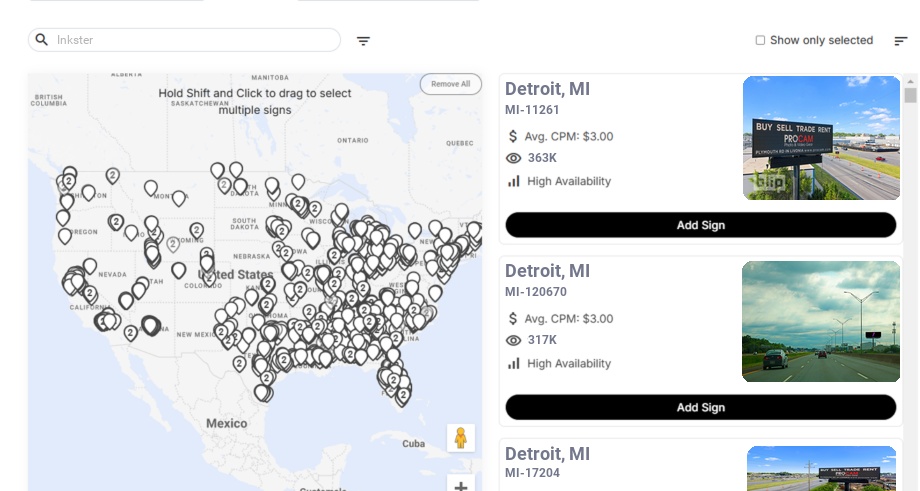
Our 20 digital billboards serving the Inkster area are placed in surrounding communities within roughly 10 miles, giving you practical access to billboards near Inkster that align with everyday driving routes:
-
Romulus (about 3.9 miles from Inkster)
- Ideal for reaching airport employees, travelers, and logistics workers who use I‑94, I‑275, and local arterials like Merriman and Middlebelt. Certain freeway segments near DTW carry upwards of 120,000–140,000 vehicles per day.
- Strong for hotel, parking, ride-share, car rental, and travel-related offers. Even capturing a fraction of DTW’s 35+ million passengers can yield substantial returns for hospitality, parking, and travel services.
- Connect with city resources at the City of Romulus and local news via outlets like Hometown Life.
-
Westland (about 5.8 miles from Inkster)
- A key retail and dining hub with more than 5 million square feet of retail and commercial space across the city, including regional shopping centers and power centers.
- Ford Road and Warren Road segments in Westland often see daily traffic volumes in the 30,000–45,000 vehicles-per-day range, according to MDOT traffic data
- Great for retailers, restaurants, personal services, and local events targeting Inkster-area residents. Coordinate with the City of Westland and local event calendars for seasonal promotions.
-
Allen Park (about 6.4 miles from Inkster)
- Strategic for reaching south-suburban commuters heading to and from Detroit and Dearborn via I‑94, Southfield Freeway (M‑39), and Telegraph Road (US‑24).
- Allen Park sits near major automotive and logistics facilities, including regional corporate offices and warehouses. This creates a high concentration of workers and business travelers.
- Use this coverage for brands looking to tap into broader downriver and west-suburban traffic. Learn more about the community at the City of Allen Park.
-
Detroit (about 9.7 miles from Inkster)
- Extends your reach into the urban core while still serving commuters from the Inkster area who travel into downtown and midtown for work, entertainment, and sporting events.
- Downtown Detroit attractions—including sports venues, casinos, theaters, and cultural sites—draw tens of millions of visits per year across the region, supported by tourism promotion from Visit Detroit.
- Perfect for larger campaigns (education, health care, automotive, entertainment) that want both local and citywide visibility. Explore city initiatives via the City of Detroit.
While billboards are not physically inside Inkster’s city limits, these placements hug the main commute and shopping patterns of residents in the Inkster area, allowing us to cover the real-world movements of your desired audience. In practice, that means Inkster billboards located just outside the city still capture the same drivers every day, giving your message consistent, repeat exposure.
Key Corridors and Traffic Patterns to Target
The Inkster area is framed by some of metro Detroit’s most important east–west and north–south routes. When we build campaigns, we consider how these produce repeated exposures and how specific boards function as billboards near Inkster for different use cases:
-
Michigan Avenue (US-12)
- A major east–west arterial connecting the Inkster area with Dearborn, Detroit, and Ypsilanti. In some stretches between Dearborn and west-suburban communities, daily traffic counts often exceed 30,000–40,000 vehicles.
- Carries a mix of commuters, industrial workers, university traffic (to and from Ann Arbor/Ypsilanti), and local shoppers.
- Excellent for campaigns that need broad reach across west-suburban neighborhoods and for directional messaging to nearby destinations such as Dearborn auto facilities and shopping districts. Local information is available from the City of Dearborn.
-
Telegraph Road (US-24)
- A critical north–south corridor used for both local errands and longer regional trips, connecting multiple downriver and western suburbs.
- Many segments of Telegraph in western Wayne County see daily traffic volumes in the 50,000–70,000 vehicles-per-day range, according to MDOT
- Frequented by auto shoppers, industrial traffic, and commuters headed to various suburbs and Detroit. Ideal for automotive, financial services, and destination retail messaging.
-
Interstates I-94, I-96, and I-275
- I‑94 between Detroit and Ann Arbor is among the region’s heaviest-traveled freeways, with certain segments near Romulus and Dearborn exceeding 130,000–150,000 vehicles per day.
- I‑96 (Jeffries Freeway) connecting Detroit to western suburbs like Livonia and Novi also consistently reports 100,000+ daily vehicles along key stretches.
- I‑275 functions as a major bypass and logistics corridor around the western side of the metro area, serving numerous industrial parks and distribution centers.
- Billboards near these routes are best for higher-level brand awareness, hiring campaigns, regional health systems, and campaigns covering multiple nearby suburbs at once.
-
Local arterials near Westland and Allen Park
- Busy surface streets feeding big-box retail centers, strip malls, and restaurant clusters in Westland and Allen Park often see 20,000–35,000 vehicles per day.
- Great for last-mile influence: “Turn left at next light,” “2 miles ahead,” and other call-to-action messages that capture shoppers who are already out and spending.
- These streets are also served by local transit such as SMART bus routes, adding visibility among transit riders and pedestrians.
We recommend mapping where your customers live and travel (for example, via ZIP codes in and around Inkster and Westland) and then matching them against these corridors. Because Blip allows us to choose exactly which boards you appear on, we can prioritize the locations that mirror your actual customer flows and fine-tune billboard advertising near Inkster to the segments that matter most.
When to Run Your Inkster-Area Campaigns
Digital billboards let us schedule ads by time of day and day of week, which is especially useful in a shift-heavy market like western Wayne County.
Transportation and mobility datasets show that weekday traffic in metro Detroit typically peaks between 7–9 a.m. and 3–6 p.m., with smaller “shoulder” peaks related to shift work at manufacturing and logistics facilities. Weekend traffic remains strong around mid-morning through evening, driven by retail and social activities.
Consider these timing patterns when you’re planning billboard advertising near Inkster:
-
Morning commute (6–9 a.m.)
- Heavy with workers heading toward Dearborn auto plants, downtown Detroit, and airport/logistics facilities in Romulus. In many corridors, more than 30% of daily traffic occurs before 10 a.m.
-
Best for:
- Coffee shops and breakfast QSRs
- Local radio, streaming, and news outlets (morning drive-time audiences)
- Hiring campaigns (“Start your new job this week”) timed before shift start
-
Midday and early afternoon (10 a.m.–3 p.m.)
- Strong for service businesses and errand-related traffic; this period can represent 25%–35% of daily volumes on retail arterials.
-
Best for:
- Medical, dental, and urgent care clinics promoting same-day or walk-in appointments
- Financial services (credit unions, tax prep, insurance)
- Retail and grocery promotions, especially in Westland, where mid-day shopping trips are common among retirees, at-home workers, and caregivers
-
Evening commute (3–7 p.m.)
- Commuters heading home and families picking up food and running errands. Evening peaks are often the single highest hourly volumes of the day on freeways and arterials.
-
Best for:
- Restaurants and delivery apps (dinner decision window)
- Gyms and fitness studios positioning around after-work traffic
- Education and training programs targeting working adults who commute through the area
-
Late night / overnight (9 p.m.–2 a.m.)
- Shift workers from automotive, logistics, and health care; plus airport staff from DTW and nearby facilities.
- In a logistics-heavy corridor like I‑94 near Romulus, late-night truck traffic can account for 20%–30% of total vehicles.
-
Best for:
- Hiring campaigns for 2nd and 3rd shifts
- 24-hour services (emergency vet, hospitals, casinos, late-night QSR)
- Ride-share, parking, and hotel offers near DTW
With Blip, you can dynamically adjust your schedule—concentrating budget into the highest-value hours for your audience and dialing back when your customers are less active.
Seasonality in the Inkster Area
Local seasonality in the Inkster area offers multiple windows for targeted messaging. Michigan’s climate features cold, snowy winters and warm, humid summers, with large swings that influence consumer behavior:
- Average winter temperatures in metro Detroit range from the low 20s to low 30s (°F), with frequent snow events.
- Summer highs often reach the low 80s, with heat waves into the 90s.
- Regional tourism agencies like Visit Detroit report strong seasonal swings in event attendance and visitor volumes, especially in summer and fall.
Use these patterns to shape campaigns:
-
Winter (December–February)
- Short days (as few as 9 hours of daylight) and snow/ice make clear, high-contrast creative especially important for visibility.
- Weather-related incidents and breakdowns often spike during winter storms, increasing demand for auto services.
-
Focus on:
- Auto repair, tires, batteries, and towing
- Heating, plumbing, and home services
- Flu shots, urgent care, and health-care campaigns timed to peak flu season
-
Spring (March–May)
- Home improvement, yard work, and tax season drive spending. Many households receive tax refunds in late February through April.
- Home and garden categories often see double-digit percentage increases in sales compared to winter months.
-
Strong for:
- Contractors, landscapers, and garden centers
- Tax preparation services and financial products (refund advances, savings accounts)
- Spring hiring and seasonal jobs for tourism, construction, and landscaping
-
Summer (June–August)
- School’s out; families travel more and attend local events and festivals across Wayne County and Detroit. Outdoor event calendars can include dozens of festivals, concerts, and community fairs each month.
- Regional attractions (museums, sports events, waterfront activities) draw visitors from across the Midwest; Visit Detroit reports millions of annual visitors to the wider metro area.
-
Strong for:
- Attractions and events promoted via Visit Detroit
- Summer programs, youth sports, and camps coordinated with local school districts such as Wayne-Westland Community Schools
- Cold beverages, ice cream, and quick-service dining
-
Fall (September–November)
- Back-to-school and early holiday shopping seasons overlap. Many retailers now launch holiday promotions as early as October.
- Health-care providers emphasize flu shots and checkups; gyms and wellness brands target “back on routine” behavior.
-
Strong for:
- Schools, colleges, and training centers targeting both K‑12 families and adult learners
- Retailers promoting early holiday sales, layaway, and financing
- Health care (checkups, flu shots) and fitness promotions
By aligning creative and offers with these seasonal shifts—and adjusting your Blip schedule in real time—you can keep your message relevant month-to-month without the cost of printing new vinyl. This is one of the key advantages of digital Inkster billboards versus traditional static placements.
Crafting Effective Creative for the Inkster Market
Because much of the traffic serving the Inkster area is local, practical, and value-conscious, we recommend:
-
Lead with value and clarity
- Use large, bold pricing or savings messages when applicable (“Oil Change $39.99,” “$0 Down,” “Free Consultation”).
- Research on outdoor advertising effectiveness suggests that viewers typically have 6–8 seconds to process a billboard at freeway speeds; aim for headlines 7 words or fewer.
- Explicit offers (“Save 25% This Week,” “Enroll by Friday”) tend to outperform generic branding among price-sensitive audiences.
-
Use simple, high-contrast design
- Dark backgrounds with light text (or vice versa) improve legibility in all weather, especially winter snow and low light when visibility can drop by 20%–40%.
- Limit yourself to 1 main image, 1 headline, and 1 call to action; cluttered creative significantly reduces recall rates.
- Ensure fonts are large enough to be read from 500–700 feet at typical travel speeds (usually 5–7% of the sign’s height).
-
Localize your message
- Reference recognizable destinations and corridors: “On Michigan Ave near Inkster Rd,” “5 minutes from DTW,” or “Next to Westland’s Ford Road shopping.”
- Consider including directional cues (“Next Exit,” “2 Miles Ahead”) when you have a physical location close to a board. Studies show directional billboards can increase store visits by 10%–20% compared to non-directional creative for the same advertiser.
- Incorporate local events, school names, or city references (Inkster, Westland, Dearborn, Romulus) to build affinity, especially when you’re running billboard advertising near Inkster to support in-person locations.
-
Be culturally relevant and inclusive
- Reflect the area’s diverse population in your imagery, especially the strong Black community in Inkster and multi-ethnic populations in Dearborn, Detroit, and Westland.
- For community-focused campaigns—schools, churches, nonprofits—use local faces, landmarks, and colors (for example, school colors or community sports teams). Local relevance has been shown to lift ad recall and favorability across many studies.
- Coordinate with local organizations and events listed via City of Inkster and neighboring city calendars.
-
Leverage motion carefully
- Blip’s digital boards support limited animation; subtle movement or rotating offers can increase attention by 10%–30% compared to static creative, when used correctly.
- Keep transitions simple and avoid fast, distracting flashes to maintain readability and comply with local and state regulations enforced by entities like MDOT
Smart Strategies for Different Advertiser Types
Different organizations can make especially strong use of digital billboards serving the Inkster area. Whether you’re testing a small campaign or planning larger billboard rental near Inkster, tailoring your strategy to your category matters:
-
Local small businesses (restaurants, salons, auto repair, clinics)
- Target boards in Westland and Romulus that match your customers’ usual travel routes from the Inkster area. For example, focus on Ford Road, Telegraph Road, and I‑94 segments that align with your ZIP code data.
- Use value-forward messaging (“Brake Special,” “Walk-Ins Welcome Today,” “No Insurance? No Problem.”). Research shows price and convenience are top decision drivers for households in income brackets common in Inkster.
- Concentrate spend on peak hours: commute times and weekends, when retail and dining trips can spike 20%–40% above weekday mid-day levels.
-
Recruiting and staffing firms
- Leverage Romulus- and Detroit-area boards to reach shift workers headed to and from DTW, auto plants, and industrial sites. Western Wayne County’s manufacturing and logistics sectors alone support tens of thousands of jobs.
- Use strong, specific offers: “Start at $22/hr,” “Weekly Pay,” “Benefits from Day 1.” Wage-specific ads often outperform generic “Now Hiring” messages in response rate.
- Run heavier at shift-change windows (5–8 a.m., 1–4 p.m., 9 p.m.–midnight), especially on corridors that connect residential neighborhoods like Inkster and Westland to industrial zones.
-
Health care providers and clinics
- Promote convenience (evening/weekend hours, walk-ins, same-day appointments) to time-strapped households; surveys indicate that extended hours are a top-three factor in choosing urgent care and primary care providers.
- Use boards on Michigan Avenue, Telegraph, and Westland arterials to highlight proximity and easy access from Inkster and surrounding neighborhoods.
- Tailor seasonal campaigns: sports physicals in late summer, flu shots in fall, chronic care and checkups in winter, and allergy/asthma campaigns in spring.
-
Education and training programs
- Target working adults in the Inkster area who commute to Detroit, Dearborn, and Romulus, as well as recent high school graduates across western Wayne County.
- Focus on outcomes: “Become a Medical Assistant in 9 Months,” “Electrician Apprenticeships Now Hiring,” “Finish Your Degree Online.” Outcome-focused messages typically generate higher inquiry rates.
- Increase exposure around back-to-school months (August–October) and early-year goal-setting (January–February), when interest in education and career changes spikes.
-
Events, entertainment, and tourism
- Coordinate with regional events promoted through Visit Detroit, Detroit’s sports teams, local concert venues, and city festivals in communities such as Inkster, Westland, and Dearborn.
- Use countdown messages (“This Weekend Only,” “3 Days Left”) and directional cues from Inkster-area corridors into Detroit or Dearborn; event campaigns that include both timing and direction often see stronger last-minute ticket sales.
- Highlight transit and parking information when promoting downtown Detroit events, referencing resources like DDOT or SMART for attendees traveling from western suburbs.
Using Blip’s Flexibility to Optimize Spend
Blip’s pay-per-“blip” model allows you to buy individual ad plays rather than committing to long, fixed-term contracts. For Inkster-area campaigns, that flexibility is especially powerful for advertisers seeking scalable billboard rental near Inkster:
-
Start with a test flight
- Run a 1–2 week test on a subset of our 20 digital billboards serving the Inkster area to gauge response. For instance, you might start with 5–8 locations focused on Westland and Romulus corridors where your customers are most likely to travel.
- Rotate multiple creatives: one focusing on price, another on convenience, another on brand/story. Compare performance based on web traffic, calls, in-store mentions, and coupon redemptions.
- Aim for enough impressions to achieve multiple exposures per driver per week along key routes; outdoor industry benchmarks often suggest 7–10 weekly impressions per viewer to build awareness.
-
Adjust locations dynamically
- If you notice more response from customers coming via Westland (for example, based on ZIP codes or store receipts), shift more of your budget there in real time.
- If you’re hiring near Romulus or Allen Park, increase your share of impressions on boards that capture workers using those corridors, particularly near industrial parks, warehouse clusters, and airport access roads.
- Monitor patterns weekly; small shifts of 10%–20% of your budget between corridors can significantly improve overall return.
-
Dayparting and day-of-week controls
- Concentrate budget on days when customers are most likely to act: Thursday–Sunday for restaurants and retail (often 50%+ of weekly sales volume), Monday–Wednesday for professional services and clinics.
- Reduce spend in low-value hours for your category, freeing budget for peak windows. For example, a breakfast-focused QSR might concentrate 70% of its spend between 6–10 a.m.
- Test “micro-dayparting” (e.g., running special offers only during lunch hours or after 8 p.m.) and compare results.
-
Creative rotation and seasonal refreshes
- Swap in new creative for tax season, back-to-school, or holiday shopping without printing costs, allowing more frequent updates than traditional vinyl campaigns.
- A/B test small differences in headlines or offers to see what resonates with Inkster-area drivers. Even a 10%–20% increase in response rate from better creative can translate into substantial incremental revenue at the same spend level.
- Use calendar events from city sites like City of Inkster or City of Westland to time local-themed creative.
Measuring and Improving Campaign Performance
To make the most of digital billboards serving the Inkster area, connect your campaign to measurable outcomes:
-
Use custom URLs or QR codes
- Even though drivers rarely scan at full speed, QR codes work well near slower local roads and parking-adjacent boards. On street-level billboards along retail arterials (where speeds may be 25–35 mph), QR codes can capture a measurable share of viewers.
- Custom URLs or promo codes like “INKSTER10” or “FORDROAD15” help you attribute web visits and sales back to specific creative or corridors.
-
Track geographic impact
- Monitor changes in customers from Inkster ZIP codes and nearby areas like Westland, Romulus, and Dearborn during your campaign. If your point-of-sale system tracks ZIP codes, compare pre-campaign and post-campaign periods.
- Ask “How did you hear about us?” at checkout or in intake forms and log “billboard” responses. Even a 3%–5% share of customers citing billboards can represent a strong payoff for many local businesses.
-
Watch for lift in branded search
- Use web analytics (search volume for your brand, direct website visits, Google Business Profile views) to detect spikes when your campaign is running.
- Studies of out-of-home advertising often show increases of 20%–40% in branded search activity during active campaigns; look for similar patterns during your Inkster-area flights.
-
Iterate based on results
- If one message (“Same-Day Appointments”) outperforms another (“New Location Now Open”) in terms of call volume or online bookings, shift more impressions to the winner.
- Trim underperforming boards or time slots and reinvest in the routes and periods that generate more calls, clicks, or visits. Even reallocating 15%–25% of spend based on performance data can noticeably improve ROI.
- Revisit your approach quarterly, aligning adjustments with seasonal shifts and new local events or developments.
Bringing It All Together for the Inkster Area
The Inkster area combines dense neighborhoods, strong commuter flows, and proximity to major economic engines like DTW and Detroit. With 20 digital billboards serving this area from Romulus, Westland, Allen Park, and Detroit, we can craft campaigns that:
- Match where Inkster-area residents actually drive, shop, and work, using high-traffic corridors that often see tens of thousands of vehicles per day.
- Focus budgets on the most valuable boards, hours, and seasons, guided by real traffic volume, commuting, and purchasing patterns.
- Refresh messages quickly to stay aligned with local conditions, events, and offers, from DTW travel waves to Westland retail peaks and Detroit event calendars.
Whether you need a short-term promotion or ongoing billboard rental near Inkster, pairing local insights—traffic patterns, demographics, and seasonality—with Blip’s flexible buying and scheduling tools allows advertisers to build efficient, data-driven campaigns that truly connect with the Inkster community and its surrounding market.