Billboards in Ecorse, MI
No Minimum Spend. No Long-Term Contracts. Just Results.
Trusted by Leading Brands


Billboard advertising
in Ecorse has never been easier
How much is a billboard in Ecorse?
Why Choose Blip for Billboard Advertising in Ecorse
Blip lets you launch Ecorse billboards self-serve and fast, reaching I-75 and Fort Street commuters without sales calls or delays.
Set a flexible budget in Ecorse and pay only for the blips you get—ideal for testing Downriver traffic without a big upfront commitment.
Daypart your Ecorse ads for 6-9 a.m. and 3-7 p.m. to catch shift workers driving the I-75, M-85, and Jefferson corridors.
No contracts means you can run Ecorse campaigns around Detroit Riverfront summer traffic, then pause or pivot when seasons change.
Use Blip’s real-time analytics and creative tools to tune Ecorse ads for industrial workers, families, and bilingual Downriver audiences.
Frequently Asked Questions About Billboard Advertising in Ecorse
How much does a billboard cost in Ecorse, Michigan with Blip?
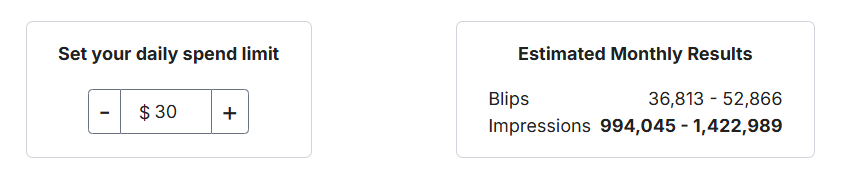
With Blip, you control exactly what you spend on Ecorse billboards by setting a daily budget that can be as small or as large as you like, and Blip automatically keeps your campaign within that amount. Each “blip” is a brief 7.5–10 second ad on digital billboards in Ecorse, Michigan, and you only pay for the blips you receive, similar to pay-per-click ads online. Costs per blip vary based on when and where your ad appears and current advertiser demand, but you can adjust your budget at any time to stay comfortable.
Where can I advertise with Blip in Ecorse, Michigan?
To maximize impressions, align Blip campaigns with the busiest roadways that serve Ecorse and the broader Downriver area. I‑75 is the arterial spine of the Downriver region, and nearby segments between Detroit and the Downriver suburbs routinely handle 70,000–100,000 vehicles per day. Fort Street (M‑85) also runs directly through Ecorse and neighboring River Rouge and Detroit, making it effective for neighborhood retailers and services.
What kind of audience can Blip reach in Ecorse, Michigan?
Ecorse sits in the heart of Detroit’s Downriver industrial and riverfront corridor, giving advertisers access to steady commuter traffic, blue-collar and service workers, and nearby regional visitors moving between Detroit, the suburbs, and the U.S.–Canada border. Within a 15-minute drive of Ecorse you tap into a trade area of well over 150,000 residents spread across multiple Downriver communities, and more than 80% of employed residents in this zone drive to work alone. The city is also part of a dense Downriver urban fabric near downtown Detroit.
When is the best time to run Blip ads in Ecorse, Michigan?
Winter is strongest for morning (6–9 a.m.) and evening (3–7 p.m.) dayparts that capture the majority of commuter flows, while spring is a good time to increase presence near detour-heavy segments of I‑75 and Fort Street. In summer, evening and weekend leisure traffic grows, so campaigns can extend into late evening (7–10 p.m.). Fall is a good window for weekday mornings and late afternoons, especially for parents and workers.
What should my Ecorse, Michigan billboard ad say if I use Blip?
Given Ecorse’s working-class, commuter-heavy audience, billboard creative should be direct and price-forward. Many households in the Ecorse/Downriver area are budget conscious, so offers that mention concrete value points perform better than vague branding. Include one primary number, such as a price, discount, or phone number, and avoid clutter.
Do I need a contract to advertise with Blip in Ecorse?
No, Blip has no long-term contracts or minimum commitments. You can start, pause, or stop your campaign at any time.
How fast can I launch a billboard campaign with Blip in Ecorse?
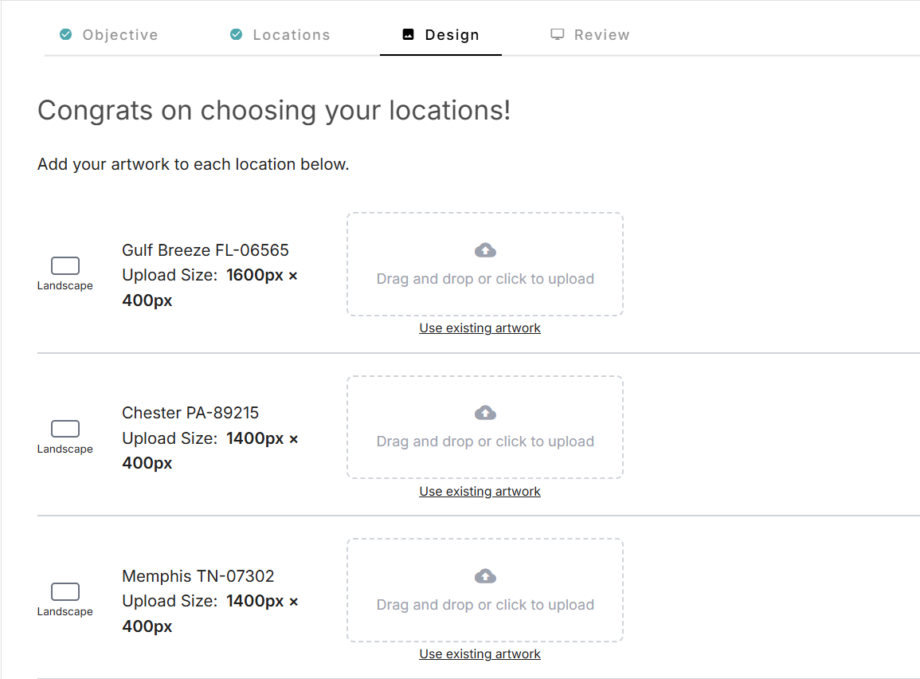
You can have your campaign live in minutes. Create a free account, select your locations, set your budget, upload your design, and start running once approved.
Where can I advertise with Blip in Ecorse?
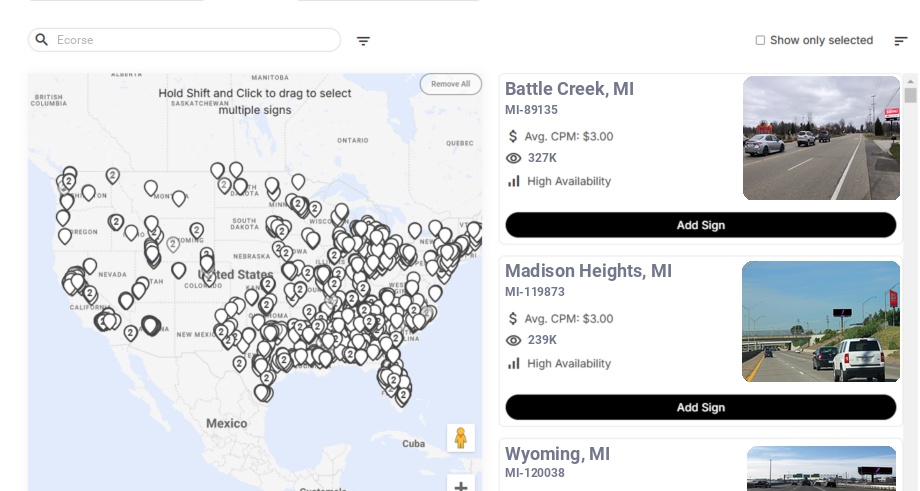
Blip has digital billboards in Ecorse. You can browse available locations on a map, choose the ones that fit your audience, and start advertising right away.
Still have questions? Launch a campaign in minutes — no contracts, no commitments.
Start Your CampaignEcorse Billboard Advertising Guide
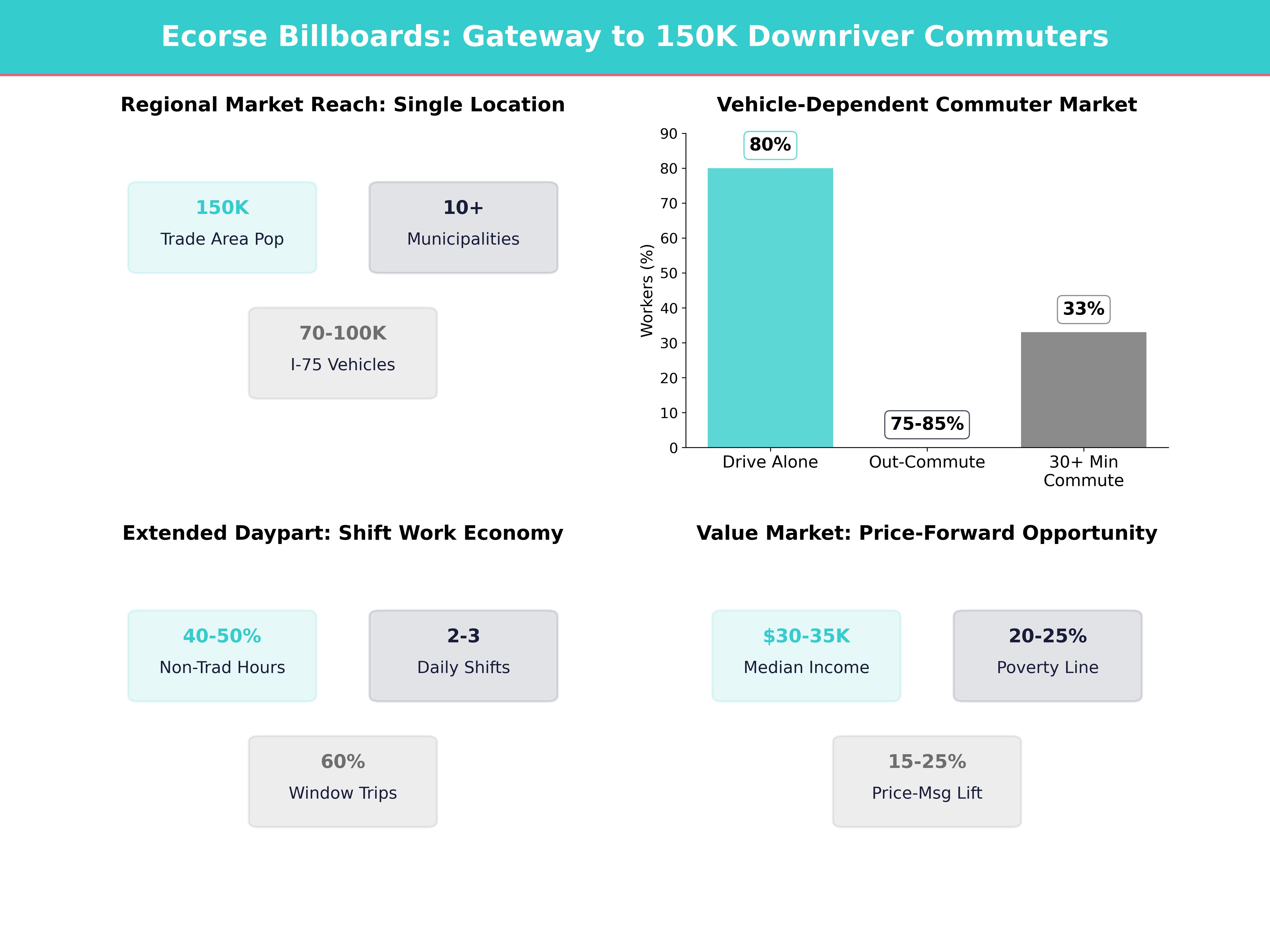
Ecorse sits in the heart of Detroit’s Downriver industrial and riverfront corridor, giving advertisers access to steady commuter traffic, blue‑collar and service workers, and nearby regional visitors moving between Detroit, the suburbs, and the U.S.–Canada border. Within a 15‑minute drive of Ecorse you tap into a trade area of well over 150,000 residents spread across multiple Downriver communities, and regional planning data shows that more than 80% of employed residents in this zone drive to work alone. With digital Ecorse billboards through Blip, we can tap into these flows with precise timing and locally tuned creative that speaks directly to how people live and travel in and around Ecorse.
Understanding the Ecorse Market
Ecorse is a compact riverfront city in southern Wayne County. According to recent estimates, the city’s population is just over 9,000 residents, within a county of about 1.75 million people and a Detroit metro area of more than 4.3 million. While Ecorse itself is small—about 2.3 square miles, giving it a residential density of roughly 3,900 people per square mile—it sits in the dense Downriver urban fabric, bordered by River Rouge, Detroit, Wyandotte, and Lincoln Park, and only about 8–9 miles from downtown Detroit via I‑75 or Jefferson Avenue.
Regional planning agencies such as SEMCOG
Key market characteristics to keep in mind:
- Commuter town: A large share of working residents commute daily to nearby industrial, logistics, and auto-related jobs. In many Downriver communities, 75–85% of workers leave their home city for work, and about 1 in 3 spend 30 minutes or more on their one‑way commute. Major employment hubs in short driving distance include the Ford Rouge complex in Dearborn (over 6,000 employees), the Marathon refinery in southwest Detroit (roughly 1,100 workers), logistics hubs near I‑75, and various steel and manufacturing sites Downriver. This means heavy weekday peak‑hour exposure for commuter‑oriented campaigns using billboards in Ecorse.
- Industrial + working‑class profile: Median household incomes in Ecorse and neighboring Downriver communities are well below the statewide median (around $68,000 for Michigan), often in the low‑ to mid‑$30,000s range. In several nearby cities, roughly 20–25% of residents are below the federal poverty line, and homeownership rates often hover around 55–60%, lower than the national average. Price‑sensitive messaging, clear value propositions, and practical offers resonate strongly.
- Diverse community: Ecorse and surrounding neighborhoods have a substantial Black population and growing Hispanic/Latino presence, alongside longstanding Polish, Arab‑American, and other ethnic communities typical of Wayne County. In many Downriver communities, people of color account for 45–60% of residents, and Hispanic/Latino residents have grown by 20–30% over the last decade. Bilingual or culturally aware creative can stand out.
- Housing stock and family structure: Much of the Downriver housing stock was built between 1940 and 1970, and in many nearby cities 60–70% of homes fall into this age range, driving steady demand for repair, roofing, HVAC, and insulation services. Family households still dominate; it’s common for 30–35% of households in the area to include children under 18, supporting campaigns for education, youth programs, healthcare, and family entertainment.
- Local civic anchors: City information, permits, and community updates flow through the City of Ecorse and Wayne County channels, as well as Ecorse Public Schools
For advertisers using Blip, the key implication is that we’re not just reaching 9,000 residents; we’re intersecting tens of thousands of daily vehicle trips moving along I‑75, Fort Street, and Jefferson Avenue between Detroit, Downriver suburbs, and the riverfront industrial strip. Within a typical weekday, a single well‑placed digital board on a major corridor can easily deliver 50,000–100,000 impressions, depending on traffic volumes and time of day, making billboard rental in Ecorse an efficient way to extend your Downriver footprint.
Traffic Patterns and High-Impact Placement
To maximize impressions, we want to align our Blip campaigns with the busiest roadways that serve Ecorse and the broader Downriver area. State transportation data and regional traffic studies show that roughly 9 in 10 trips in the Downriver area are made by private vehicle, making roadside media particularly efficient.
1. I‑75 (Fisher Freeway)
I‑75 is the arterial spine of the Downriver region. Nearby segments between Detroit and the Downriver suburbs routinely handle 70,000–100,000 vehicles per day according to counts published by the Michigan Department of Transportation (MDOT)
- Daily commuters between Downriver, Detroit, and the northern suburbs
- Freight and logistics traffic serving industrial facilities and border crossings
- Regional travelers moving between metro Detroit and Toledo/Ohio, including trips to and from Detroit Metropolitan Airport, which handles more than 33 million passengers annually via the Wayne County Airport Authority
Digital billboards near I‑75 are ideal for:
- Recruiting campaigns (“Now Hiring,” shift‑based work) in sectors where local unemployment often runs 1–2 percentage points above the national average, leaving a sizable pool of job‑seekers.
- Regional retail and services drawing from multiple Downriver cities; a single I‑75 board can realistically reach audiences from 10+ municipalities within a 20‑minute drive.
- Travel, hospitality, and gaming leveraging Detroit’s casinos and downtown attractions. The downtown area routinely hosts more than 15 million visitors per year, supported by marketing from Visit Detroit.
We can confirm local traffic data and construction disruptions via MDOT’s traffic and construction information
2. Fort Street / M‑85 Corridor
Fort Street (M‑85) parallels I‑75 and runs directly through Ecorse and neighboring River Rouge and Detroit. On comparable Downriver segments, average daily traffic volumes often fall in the 15,000–30,000 vehicles per day range, a mix of:
- Local residents on short trips
- Industrial workers moving between shifts
- Service and delivery vehicles
Because speeds are generally 30–40 mph, dwell time per board is higher than on freeways. Fort Street‑facing boards are especially effective for:
- Neighborhood retailers and restaurants that depend on a core trade radius of 1–3 miles
- Auto repair and tire shops, particularly during winter and spring, when pothole damage spikes and claims for tire and wheel repairs can increase by 20–30%
- Local health clinics, insurance agencies, and financial services that rely on being “top of mind” for residents living or working within a short drive
Because drivers are often traveling at lower speeds than on the freeway, we can get away with slightly more detailed messaging—still no more than 7–10 words—but we can highlight one extra benefit or supporting line.
3. Jefferson Avenue & Riverfront Routes
Jefferson Avenue hugs the Detroit River and passes near Ecorse’s riverfront. While typical daily traffic volumes are lower than I‑75 or Fort Street, these routes capture:
- Boaters, anglers, and recreational visitors along the river
- Residents moving between waterfront parks and marinas
- People attending riverfront events and festivals throughout the warm months
The Detroit Riverfront and Downriver waterfront parks draw hundreds of thousands of visits each warm season. Regional tourism organizations like Visit Detroit regularly highlight riverfront concerts, fishing tournaments, and waterfront festivals that cluster between May and September, when weekend traffic can exceed weekday volumes by 10–20%.
For boards visible from these routes, creative that references the Detroit River, boating, fishing, or “Downriver pride” can feel highly relevant and help capture a leisure‑oriented audience that typically spends more time out of home. When paired with targeted billboard rental in Ecorse, these riverfront routes help brands reach both daily commuters and seasonal visitors in one cohesive strategy.
Seasonality and Timing Strategy
Ecorse experiences four distinct seasons, and traffic behavior changes significantly across the year. In southeast Michigan, average annual snowfall is about 42 inches, and temperatures can swing from winter lows in the teens (°F) to summer highs in the mid‑80s. With Blip, we can adjust schedules and bids to reflect those shifts instead of locking into a one‑size‑fits‑all plan.
Winter (December–March)
- Short daylight hours—sunset as early as 5 p.m. in December—mean more rush‑hour driving in the dark.
- Weather can be harsh; snow and ice slow traffic and boost visibility windows. Accident rates on icy days can increase by 15–20% compared to dry days.
- People prioritize auto services, heating, emergency repairs, and nearby convenience.
Digital strategy:
- Focus on morning (6–9 a.m.) and evening (3–7 p.m.) dayparts that capture the majority of commuter flows; in many metro areas, over 60% of weekday trips fall in these windows.
- Promote winterization, tires, towing, and home heating. In colder months, search and call volumes for HVAC and plumbing emergencies typically jump by 20–40%.
- Use high‑contrast colors (white/yellow on dark backgrounds) for visibility against snow and gray skies.
Spring (April–May)
- Road construction season ramps up, altering commute routes; MDOT invests hundreds of millions of dollars annually in Southeast Michigan roadwork, often leading to lane closures along I‑75 or adjacent arterials.
- People start planning home improvement, yard work, tax refunds, and graduations. Nationally, spending on home improvement projects often rises by 15–25% from winter to spring.
Digital strategy:
- Increase presence near detour‑heavy segments of I‑75 and Fort Street where drivers have more dwell time. During construction, average speeds can drop from 65 mph to 35–45 mph, effectively doubling message exposure time.
- Rotate creatives: tax refund promos in early spring, when most refunds are issued between February and April; home services and landscaping in late spring.
Summer (June–August)
- Downriver riverfront activity peaks—boating, fishing, BBQs, and park visits. Michigan has more than 800,000 registered boats, and the Detroit River is one of the most heavily used waterways in the state.
- School is out; family‑oriented spending increases. Households with children typically increase entertainment and dining‑out expenditures by 10–15% in summer months.
- Evening and weekend leisure traffic grows, with some corridors showing 5–10% higher volumes on summer weekends versus winter weekends.
Digital strategy:
- Extend dayparting into late evening (7–10 p.m.) when families are driving to and from parks and events.
- Promote restaurants, ice cream, entertainment, festivals, marinas, and tourism.
- Use bright, saturated colors and simple, fun visuals to stand out against longer daylight hours.
Fall (September–November)
- Back‑to‑school traffic patterns re‑emerge. In many school districts, including Ecorse Public Schools
- Detroit sports seasons overlap (NFL, NBA, NHL) and college football is in full swing. Combined annual attendance for the Lions, Pistons, Red Wings, and Tigers runs into the millions of fans, many of whom travel along I‑75 and nearby routes.
- Home maintenance, insurance, and financial planning are top of mind as residents prepare for winter and year‑end.
Digital strategy:
- Target weekday mornings and late afternoons for parents and workers.
- Lean into sports‑themed creative timed around Detroit Lions and other major game days, using schedules from outlets like The Detroit News and Detroit Free Press.
- Promote fall‑specific offers—furnace tune‑ups, roof inspections, insurance reviews—during a window when service providers often see lead volumes increase by 20–30% before winter.
Crafting Effective Creative for Ecorse Audiences
Given Ecorse’s working‑class, commuter‑heavy audience, our billboard creative should be:
1. Direct and price‑forward
Many households in the Ecorse/Downriver area are budget conscious. In communities where a substantial share of households earn under $40,000 per year, offers that mention concrete value points perform better than vague branding:
- “Oil Change $39.99 – 5 Min from Ecorse”
- “Rent‑to‑Own Furniture $25/Week – No Credit Needed”
- “Auto Insurance from $39/Month – Call Today”
Include one primary number (price, discount, or phone) and avoid clutter. Outdoor industry testing consistently shows that ads with a single bold numeric offer can improve recall by 15–20% compared with text‑only brand messages.
2. Locally anchored
Referencing Ecorse and “Downriver” creates instant relevance:
- “Proudly Serving Ecorse & Downriver Since 1998”
- “Downriver’s Fastest Payday Loans – Fort St. Just South of Ecorse”
We can also subtly echo visual motifs present on City of Ecorse materials—river, bridges, industry—to strengthen local connection. Downriver pride is reinforced through community coverage by outlets like ClickOnDetroit and FOX 2 Detroit, which regularly feature local festivals, school achievements, and economic development stories. Incorporating these local references into Ecorse billboard advertising helps brands feel embedded in the community rather than distant or generic.
3. Optimized for drive‑time reading
On I‑75, drivers have 3–6 seconds to take in a message. Stick to:
- 6–8 words maximum
- A single focal image or icon
- Large, high‑contrast fonts (sans serif)
On slower corridors like Fort Street and Jefferson, we can sometimes stretch to 8–10 words or add one secondary information line. Research from out‑of‑home industry groups shows that readability drops sharply once you exceed about 7–9 words, so restraint directly translates into better performance.
4. Culturally and linguistically aware
Downriver’s diversity allows for targeted messaging:
- Bilingual English/Spanish creatives for services frequently used by Hispanic households. In some nearby ZIP codes, Spanish‑speaking households account for 10–15% of residents.
- Imagery that reflects the actual demographics seen in Wayne County, rather than generic stock visuals. In communities where more than 40% of residents identify as Black or African American, inclusive imagery can help increase perceived relevance and trust.
If we plan multiple creatives through Blip, we can A/B test language versions (e.g., English‑only vs. bilingual) and watch which correlates with more calls or web traffic.
Using Blip Tools to Target Ecorse and the Downriver Corridor
Blip’s flexibility lets us tailor campaigns specifically to the geographic and temporal reality of Ecorse.
1. Hyper‑local board selection
We can:
- Prioritize boards directly on Fort Street and near Ecorse city limits for businesses that draw primarily from Ecorse, River Rouge, and Detroit’s southwest side. For many everyday services, 70–80% of customers will come from within a 3–5‑mile radius.
- Layer in I‑75 boards when we want broader regional reach into Wyandotte, Lincoln Park, Trenton, Dearborn, and Detroit.
For example, a neighborhood pizza shop might choose only Fort Street and Jefferson boards within 5 miles, while a trade school or hospital system will use a wider I‑75‑centric footprint that reaches potential students or patients within 20–30 minutes of drive time. This kind of selective board mix is how we turn a single network of Ecorse billboards into a finely tuned coverage strategy.
2. Dayparting to match shift work
With many industrial and logistics employers in the area, shifts commonly start around:
- 6–7 a.m.
- 2–3 p.m.
- 10–11 p.m.
Manufacturing and warehouse jobs often operate 2–3 shifts per day, and in some plants as many as 40–50% of employees work non‑traditional hours. We can schedule Blips to spike 60–90 minutes before these times when workers are driving in:
- Morning: promote breakfast, coffee, auto repair, urgent care.
- Afternoon: promote fast‑casual meals, after‑school programs, retail.
- Late night: promote 24‑hour services, casinos, delivery, and convenience stores.
3. Budget control and “test‑then‑scale”
Because Blip allows us to set per‑blip bids and daily budgets, we can:
- Start small (e.g., $10–$20/day) to test creative across a few Ecorse‑adjacent boards. Even at this level, it’s realistic to achieve several thousand impressions per day on key corridors.
- Shift spend towards the boards and time blocks that produce the best response (measured via calls, site sessions, or in‑store redemptions). Many advertisers find that concentrating budget on the top 20–30% of best‑performing slots produces the majority of their results.
- Scale up around key weekends (e.g., payday Fridays, holidays, or big events downtown) when consumer spending can spike by 20–40% compared with non‑payday weeks.
4. Event‑aligned bursts
Detroit‑area events generate traffic surges on I‑75 and surrounding arterials:
- Sports events for the Lions, Tigers, Red Wings, and Pistons. A sold‑out Lions game at Ford Field brings in more than 65,000 fans, many traveling via I‑75.
- Concerts and festivals in downtown Detroit highlighted by outlets like ClickOnDetroit and FOX 2 Detroit, as well as major conventions promoted by Visit Detroit.
We can schedule short, high‑bid Blip bursts 2–3 hours before these events on north/south I‑75 boards drivers use to pass near Ecorse and Downriver, capturing both local residents heading downtown and out‑of‑towners returning through the corridor after events.
Industry-Specific Tips for Ecorse Advertisers
Different industries can leverage Ecorse’s market dynamics in distinct ways.
Auto Services & Dealerships
- Emphasize price, speed, and location: “Brakes $99 – Exit I‑75 at Schaefer” style messages. In price‑sensitive markets, clear dollar amounts can increase response by 15–25%.
- Time ads for morning and evening commute windows, when car issues are most salient. Industry data often shows that over 60% of auto service appointments are scheduled within 24 hours of noticing a problem.
- Use seasonal hooks: winter tire swaps, spring pothole damage, summer A/C checks. In Michigan, tire‑ and suspension‑related claims typically spike in late winter and early spring as freeze‑thaw cycles worsen road conditions.
Home Services (Roofing, HVAC, Plumbing)
- Many homes in Ecorse and Downriver are older—often 50–80 years—and need ongoing maintenance. Older homes are statistically 30–40% more likely to require major repairs in any given 10‑year period than homes built after 2000.
- Promote financing, low monthly payments, and emergency response times, since a portion of households live paycheck‑to‑paycheck.
- Run heavier campaigns during spring storms and late summer/early fall for HVAC tune‑ups and roof repair, when severe-weather events and temperature swings are most common in Southeast Michigan.
Healthcare, Dental, and Vision
- Highlight short wait times, same‑day appointments, and Medicaid/Medicare acceptance, which are major decision drivers in lower‑income communities where public insurance coverage rates can exceed 40% of residents.
- Use clear directional cues: “On Fort St., 3 Minutes from Ecorse City Hall.” The City of Ecorse landmark references help patients orient quickly.
- Consider bilingual elements if serving a broad Downriver audience, especially for pediatric care, urgent care, and community clinics that see a high share of Hispanic and multilingual families.
Restaurants & Local Retail
- Focus on lunchtime and evening rush hour for commuters and shift workers. In many metro areas, lunch and dinner dayparts together account for 70–80% of restaurant revenue.
- For riverfront or dine‑in concepts, use imagery of the Detroit River or patio scenes to differentiate from chain quick‑service. Waterfront and “experience” dining options often enjoy higher average ticket sizes—sometimes 20–30% above quick‑service meals.
- Rotate creatives: weekday lunch deals vs. weekend family specials. Data from loyalty programs and POS systems often shows weekend family visits can be 25–35% higher than weekday evenings.
Hiring & Workforce Recruitment
Neighboring industrial, logistics, and health facilities frequently need staff:
- Offer specific wage numbers, shift times, and benefits (“$20/hr + Benefits, 2nd Shift Openings”). Job ads with explicit pay ranges typically get 30–40% more responses than those without.
- Schedule ads around shift changes and Sunday evenings, when people think about work and job searches online often spike.
- Use short URLs or QR‑friendly landing pages for quick application starts, and consider linking to easy‑apply forms compatible with mobile devices, since more than 60% of job seekers now search primarily on smartphones.
Measuring and Optimizing Campaign Performance
A successful Ecorse campaign is iterative. We should actively measure and adjust:
1. Create a clear tracking mechanism
- Use unique URLs or landing pages for billboard traffic (e.g.,
yourbrand.com/ecorse). - Add promo codes tied to billboard creative (“Mention ‘Downriver20’ for 20% Off”). Retailers that track unique codes often find that out‑of‑home promotions can drive 5–15% of total redemptions during active campaign windows.
- Train staff to ask, “How did you hear about us?” and log “billboard – Ecorse/Fort” vs. “billboard – I‑75.”
2. A/B test creatives
Run two or three variants via Blip:
- Version A: price‑forward, bold text only.
- Version B: local pride plus offer (“Proudly Serving Downriver – $39.99 Oil Change”).
- Version C: bilingual or image‑heavy.
Monitor which version correlates with more calls, walk‑ins, or web actions during its run windows. Advertisers who consistently test 2–3 creatives often see 10–30% improvements in response over a few optimization cycles.
3. Optimize by time and board
After a few weeks:
- Shift budget toward boards and dayparts that coincide with measurable upticks in business. If one or two boards deliver 50%+ of redemptions, concentrate spend there.
- Reduce or pause underperforming segments and reallocate those dollars to your winners. This test‑and‑refine loop is particularly effective in corridor markets like Downriver, where small changes in placement can dramatically change who sees your message and how often billboards in Ecorse influence local response.
4. Sync with local news and conditions
Local coverage from sites like Detroit Free Press, The Detroit News, and ClickOnDetroit can signal events and issues that matter to Ecorse residents—plant expansions or closures, road construction, community festivals, and safety initiatives. Wayne County and city bulletins through Wayne County and the City of Ecorse also highlight infrastructure projects and public programs.
Aligning messaging with these realities (e.g., “New Jobs? We’re Hiring Too,” or “Avoid Construction Delays—We’re 5 Minutes Off I‑75”) keeps your creative timely and resonant and can significantly boost recall compared to generic, evergreen messages.
By understanding Ecorse’s role within the Downriver and Detroit ecosystem, leveraging the strongest traffic corridors, and using Blip’s scheduling and targeting flexibility, we can build digital billboard campaigns that punch far above the city’s population size. Smart timing, value‑driven offers, and local‑centric creative—grounded in data about traffic volumes, incomes, and commuting patterns—allow advertisers to turn Ecorse’s constant flows of workers, families, and riverfront visitors into consistent, measurable results. When you treat Ecorse billboard advertising as a strategic, testable channel and fine‑tune your billboard rental in Ecorse over time, you create an always‑on presence that reliably feeds awareness, leads, and in‑store traffic.