Billboards in Taylor, MI
No Minimum Spend. No Long-Term Contracts. Just Results.
Trusted by Leading Brands


Billboard advertising
in Taylor has never been easier



How much is a billboard in Taylor?
Why Choose Blip for Billboard Advertising in Taylor
Blip lets Taylor advertisers launch fast along I-94 and Telegraph, reaching commuters and airport traffic without buying traditional billboard packages.
Taylor campaigns fit any budget—run short blips near Southland Center, then scale up for holiday shopping or DTW travel peaks.
Daypart with Blip to hit Taylor rush hours on I-94 and M-39, or switch to weekends for Southland Center shoppers and family outings.
No contracts means Taylor brands can test a message near Romulus and Allen Park, then adjust as commuter patterns change.
Track Taylor billboard results in real time and refine creative for Downriver drivers, airport workers, and retail shoppers.
Use Blip's creative tools to make bold, fast-read ads for Taylor freeway traffic, from Eureka Road deals to DTW traveler offers.
Frequently Asked Questions About Billboard Advertising in Taylor
How much does a billboard cost near Taylor, Michigan with Blip?
With Blip, you control exactly how much you spend on Taylor billboards by setting a daily budget that can be as small or as large as you’d like, and Blip automatically keeps your campaign within that amount. Each ad plays in a short 7.5 to 10-second “blip,” and you only pay for the blips you receive, with prices varying based on when you run your ads, where the billboards near Taylor, Michigan are located, and current advertiser demand. You can start with a modest daily budget, adjust it anytime, and let Blip’s pay-per-blip model give your message flexible, cost-effective exposure on digital billboards serving the Taylor area.
Where can I advertise with Blip in Taylor, Michigan?
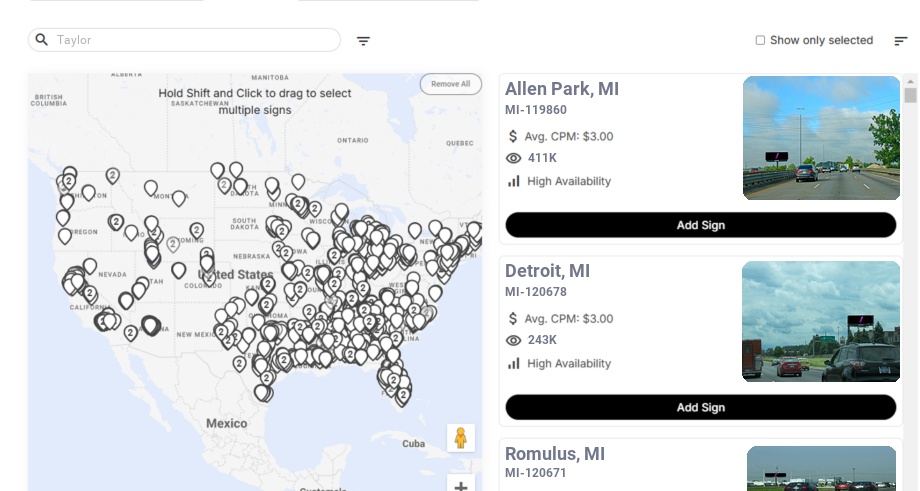
Our 16 digital billboards serving the Taylor area are positioned in nearby Allen Park and Romulus. These locations let us intercept Taylor residents and visitors at critical points in their daily journeys, while still sitting along some of the most heavily traveled corridors in southeast Michigan. This cluster of billboards near Taylor enables advertisers to build regional coverage without having to manage multiple separate buys.
What kind of audience do Taylor, Michigan billboards reach?
Taylor is a core city in western Wayne County, about 15 miles southwest of downtown Detroit, and the broader Downriver region exceeds 350,000–375,000 residents. That gives advertisers a substantial “local plus regional” audience within a 15–20 minute drive of most Taylor-area billboards. In many Taylor-area neighborhoods, over 80% of workers commute by car, truck, or van, which creates reliable weekday traffic along I-94, Telegraph Road, and connecting arterials.
When is the best time to run Blip ads near Taylor, Michigan?
Traffic data on I-94, I-275, and major arterials shows reliably higher volumes during weekday peaks. Morning traffic from 6:00–9:00 a.m. is often 30–40% higher than mid-day volumes on major freeways, while the evening window from 3:30–7:00 p.m. captures both traditional commuters and shift workers. Saturdays are also strong for shopping, auto dealerships, entertainment, and home services.
What roads and traffic areas around Taylor, Michigan are best for billboard advertising with Blip?
I-94 is the backbone corridor connecting Taylor with Detroit and Ann Arbor, and many segments in Wayne County see 90,000–140,000 vehicles per day. I-275 near Romulus often handles 80,000–100,000 vehicles per day, while Telegraph Road and Eureka Road are major local routes for shopping, services, and commuting. These corridors make the Taylor area especially strong for high-visibility digital billboard campaigns.
Do I need a contract to advertise with Blip in Taylor?
No, Blip has no long-term contracts or minimum commitments. You can start, pause, or stop your campaign at any time.
How fast can I launch a billboard campaign with Blip in Taylor?
You can have your campaign live in minutes. Create a free account, select your locations, set your budget, upload your design, and start running once approved.
Where can I advertise with Blip in Taylor?
Blip has digital billboards in Taylor. You can browse available locations on a map, choose the ones that fit your audience, and start advertising right away.
Still have questions? Launch a campaign in minutes — no contracts, no commitments.
Start Your CampaignTaylor Billboard Advertising Guide
Taylor sits at the crossroads of Downriver neighborhoods, Detroit, Detroit Metro Airport, and major freeways, making it a powerful market for digital billboard campaigns. With 16 digital billboards serving the Taylor area from nearby Allen Park and Romulus, we can help advertisers tap into a dense flow of commuters, airport travelers, shoppers, and local families with highly targeted, flexible messaging across some of the most visible billboards near Taylor.
Understanding the Taylor Area Market
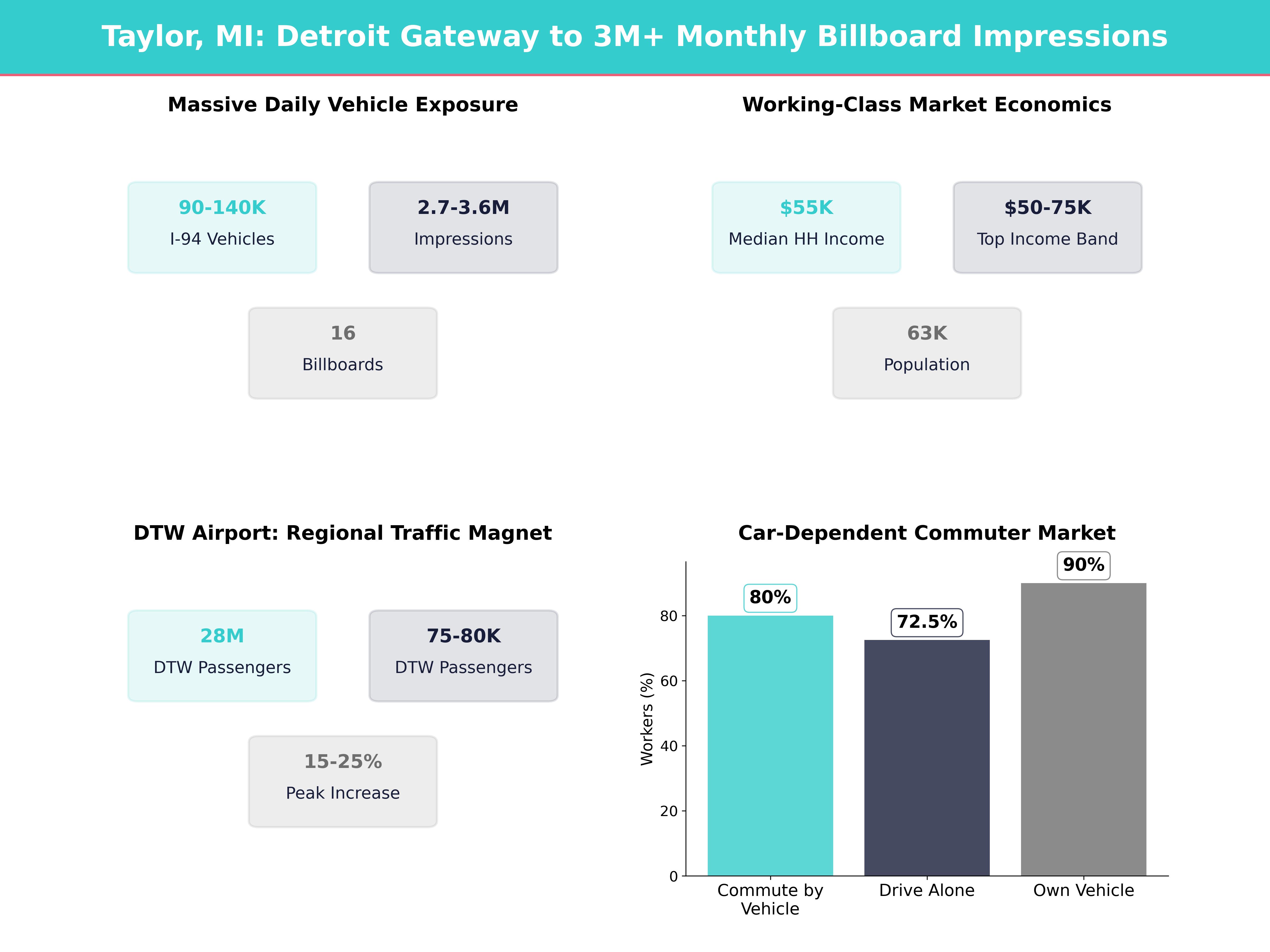
Taylor is a core city in western Wayne County, about 15 miles southwest of downtown Detroit. According to recent estimates from regional planning and local government sources, Taylor’s population is just over 63,000 residents, while the broader Downriver region (including nearby communities like Allen Park, Southgate, Woodhaven, Lincoln Park, and Wyandotte) exceeds 350,000–375,000 residents. That gives advertisers a substantial “local plus regional” audience within a 15–20 minute drive of most Taylor-area billboards, including Taylor billboards that catch both residents and pass-through traffic.
Key characteristics of the Taylor area that matter for billboard advertisers:
- Population density: Taylor covers about 24 square miles, meaning an average density of roughly 2,600–2,700 residents per square mile—dense enough that one message can reach a large local audience repeatedly, but still auto-centric enough that roadside media is a top awareness channel.
- Household profile: Local data shows a median household income in Taylor in the mid‑$50,000s, with a large concentration of households in the $50,000–$74,999 band and a meaningful tier in the $75,000–$99,999 range. Around 60–65% of occupied housing units are owner-occupied, a signal of stable, long-term residents who respond well to trusted, community-oriented brands—ideal for value-oriented offers, auto deals, big-box retail, and family entertainment.
- Commuter culture: In many Taylor-area neighborhoods, over 80% of workers commute by car, truck, or van, and typical one-way commute times average 24–27 minutes. A large share of residents commute to jobs in Detroit, Dearborn, Romulus, and other Wayne County employment centers. This creates reliable weekday traffic along I‑94, Telegraph Road (US‑24), and connecting arterials.
- Regional connectivity: Taylor sits between downtown Detroit and Detroit Metropolitan Wayne County Airport (DTW) in Romulus, with I‑94 as the chief connector. DTW serves over 28 million passengers per year and supports more than 86,000 regional jobs, according to the Wayne County Airport Authority
For local context and planning information, advertisers can review resources from the City of Taylor and Wayne County, Michigan, which regularly publish economic and community data that help illuminate who lives, works, and shops in the area and how Taylor billboards can fit into broader marketing plans.
Where Our Digital Billboards Reach the Taylor Area
Our 16 digital billboards serving the Taylor area are positioned in nearby Allen Park (about 3.2 miles away) and Romulus (about 3.3 miles away). These locations let us intercept Taylor residents and visitors at critical points in their daily journeys, while still sitting along some of the most heavily traveled corridors in southeast Michigan. This cluster of billboards near Taylor enables advertisers to build regional coverage without having to manage multiple separate buys.
Allen Park (approx. 3.2 miles from Taylor)
Allen Park is a high-traffic gateway between Downriver communities and Detroit. Key corridors likely reached by boards in this area include:
- I‑94 near Allen Park: Michigan Department of Transportation (MDOT) 90,000–120,000 vehicles per day, depending on the segment, capturing Detroit-bound commuters, sports traffic headed to downtown venues, and shoppers traveling between Downriver cities. Over the course of a month, that equates to roughly 2.7–3.6 million vehicle trips passing nearby billboard locations.
- Southfield Freeway (M‑39): A major north–south commuter route connecting to Dearborn and Southfield employment centers. Certain stretches of M‑39 near Allen Park and Dearborn commonly see 70,000–90,000 vehicles per day, making it a strong corridor for workday and shopping-related impressions.
- Telegraph Road (US‑24) nearby: A longstanding retail corridor connecting Taylor with Dearborn Heights 40,000–55,000 vehicles, supporting auto dealers, big-box retail, and service businesses that draw from multiple communities and benefit from billboard advertising near Taylor.
Romulus (approx. 3.3 miles from Taylor)
Romulus is home to DTW and several large industrial and logistics hubs, which together generate high and consistent traffic volumes.
Billboards serving this area can capture:
- Airport-bound traffic: DTW handled over 28 million passengers in 2023, averaging roughly 75,000–80,000 passengers per day when combining arrivals and departures. Peak holiday periods can see daily passenger volumes climb 15–25% above the annual average. Most passengers and airport workers rely on I‑94, I‑275, and Merriman Road, concentrating a vast number of potential impressions along a compact set of freeway segments.
- Regional freight and logistics: DTW’s cargo operations move over 300,000 metric tons of air freight annually, and I‑275 and I‑94 together carry heavy truck volumes that can exceed 15–20% of all lane traffic on some segments. This makes the Romulus–Taylor corridor a prime zone for B2B, logistics, trucking, warehousing, and industrial service advertisers.
- Park-n-ride and hotel visitors: The Romulus airport area includes dozens of hotels and park‑n‑fly lots representing thousands of rooms and parking spaces. Many Taylor residents and visitors stay in Romulus hotels or use airport parking lots, exposing them to repeated impressions over the course of multi‑day trips—especially effective for brands that benefit from frequency, like QSR, insurance, and hospitality.
By combining placements near Allen Park and Romulus, we can build campaigns that greet Taylor-area audiences:
- On commutes to Detroit, Dearborn, and Romulus.
- On shopping trips to malls like Southland Center in Taylor and big-box corridors along Eureka Road and Telegraph.
- On travel runs to DTW and back.
For a practical view of traffic flow near specific freeway segments, advertisers can reference real-time and historical travel data from MDOT Mi Drive when planning billboard rental near Taylor and surrounding corridors.
Demographics and Audience Segments in the Taylor Area
The Taylor area offers a diverse, multi-generational audience with strong family and working-class roots. Advertisers can sharpen their creative and scheduling by considering the following:
Age and family structure
- Local demographic estimates show a median age in Taylor of around 37–38 years, slightly younger than the statewide median, indicating a mix of young families, mid-career professionals, and older adults.
- Roughly 30–32% of residents are under age 25, while about 13–15% are age 65 or older, creating opportunities for both youth-oriented and senior-focused campaigns.
- Approximately 30–35% of households include children under 18, making family-centric messaging especially effective—think after-school programs, family dining, entertainment, and healthcare.
- Creative that speaks to parents making everyday decisions (groceries, auto repair, financial services, medical care) tends to resonate, especially when paired with clear savings or convenience messages.
Income and spending habits
- Median household income in Taylor sits in the mid‑$50,000s, with a large share of households in the $50,000–$75,000 band and a significant segment earning $75,000+.
-
A typical Taylor-area household spends a sizable share of its budget on transportation, housing, and food, with regional consumer expenditure profiles indicating:
- Around 16–18% of household spending on transportation (vehicles, fuel, maintenance).
- Roughly 12–14% on food at home and 5–7% on food away from home.
- 5–8% on healthcare-related expenses.
-
Big draws include:
- Auto and truck sales/leases, especially in a region where vehicle ownership is a necessity.
- Discount and value retail, including club stores and dollar formats.
- Quick-service and casual dining for busy families and shift workers.
- Healthcare and dental services positioned as convenient and affordable.
- Home improvement and trades, especially among owner-occupied households.
Offers that combine value with trust—“locally owned,” “Downriver trusted for 25+ years,” “0% APR,” or “$0 down” messaging—perform particularly well in this type of market and translate effectively into simple Taylor billboards.
Commuting and mobility
- Car ownership is very high; in many Downriver communities, over 90% of households have at least one vehicle, and more than two-thirds have two or more.
- In Taylor and neighboring cities, 70–75% of workers drive alone to work, with another 8–12% carpooling. Public transit usage is relatively low compared with more urban parts of Detroit, which increases the importance of billboard exposure.
-
Typical commuting flows:
- South and west along I‑94 and I‑275.
- North toward Dearborn and Detroit job centers.
- East toward industrial and logistics hubs along the Detroit River and Downriver manufacturing corridor.
- Campaigns that time messages to rush hours—rather than midday only—will reach more working adults and capture both outbound and inbound trips.
Key Corridors and Daily Travel Patterns
Even though our boards sit in nearby Allen Park and Romulus, they align closely with Taylor-area travel behavior and where residents actually drive each day. This makes them functionally equivalent to placing billboards near Taylor itself for many commuting and shopping patterns.
Freeways and major roads
- I‑94: The backbone corridor connecting Taylor with Detroit to the northeast and Ann Arbor to the west. Many segments in Wayne County see 90,000–140,000 vehicles per day, with weekday commuter traffic peaking between 6–9 a.m. and 3:30–6:30 p.m. This corridor also captures weekend leisure travel to downtown Detroit events, casinos, and sports venues.
- I‑275: Encircles the western side of the metro and ties into Romulus, Canton Township, and Novi. Sections near Romulus often handle 80,000–100,000 vehicles per day, including a high share of through-traffic and commercial vehicles. Ideal for advertisers drawing from a broader West Wayne and Downriver audience.
- Telegraph Road (US‑24): A primary north–south retail and auto-dealer corridor that many Taylor residents use daily for shopping, services, and commuting. High-visibility stretches can generate 40,000–55,000 daily vehicles, making it an ideal zone for location-based and directional creatives.
- Eureka Road: Taylor’s central commercial artery, connecting I‑75 and I‑94 and serving major retail, dining, and entertainment areas including Southland Center. Local planning documents and traffic studies often show 25,000–35,000 vehicles per day on key segments, with noticeable spikes during weekends and holiday shopping periods.
Implications for placement and scheduling
-
Morning inbound traffic:
- East/northeast on I‑94 toward Detroit, Dearborn, and major employers.
- North on M‑39 toward Southfield and job centers.
- Toward DTW for early flights, with airport employee shift changes producing additional peaks.
-
Evening outbound traffic:
- Returning south/west toward Taylor, Southgate, Woodhaven, and other Downriver communities.
- From DTW back to hotels and neighborhoods across the region.
-
Weekend spikes:
- Shopping trips to Southland Center and Eureka Road venues, where retailers can see 20–30% higher weekend foot traffic than weekdays.
- Airport traffic for weekend getaways and family visits, with some airlines concentrating departures and arrivals on Fridays and Sundays.
- Special events, festivals, and school sports that increase traffic around local parks and venues.
With Blip, we can selectively increase impressions during high-intent travel windows—for example, Friday evenings and Sunday afternoons for restaurants, or weekday mornings for commuter-focused services—maximizing the impact of billboard advertising near Taylor without overspending.
Seasonal Trends and Event-Driven Opportunities
The Taylor area has noticeable seasonal rhythms that advertisers can leverage through Blip’s flexible scheduling.
Winter and holiday season (November–January)
- Retail and gift-buying spike, particularly at Southland Center and big-box chains along Eureka Road and Telegraph. Many shopping centers report 20–40% of annual sales in the November–December window.
- DTW passenger volumes rise significantly around Thanksgiving, Christmas, and New Year’s, often 15–30% higher than non-peak weeks.
- Local communities, including the City of Taylor, host tree-lighting ceremonies, holiday parades, and indoor events that draw thousands of visitors.
-
Effective campaign types:
- Limited-time holiday sales and financing.
- Event promotions (holiday light shows, church events, New Year’s celebrations).
- Travel services: airport parking, hotels, rideshare promotions, luggage, and travel insurance.
Spring and early summer (March–June)
- Home improvement spending climbs as weather improves; regional data frequently shows double-digit percentage increases in lawn, garden, and renovation sales between March and June compared with winter months.
- Tax refund season (February–April) drives big-ticket purchases—auto, furniture, electronics—as many households receive refunds averaging several thousand dollars.
- Youth sports and school events increase evening and weekend driving, with local leagues bringing hundreds of families weekly to parks and recreation facilities.
-
Good fits:
- Contractors, landscapers, roofing, and HVAC.
- Auto dealers targeting “tax time” buyers with down-payment and trade-in messaging.
- Pediatric and family dental practices, urgent cares, and clinics promoting physicals, checkups, and spring wellness.
Mid-summer through early fall (July–October)
- Outdoor events, festivals, and sports leagues boost leisure driving. Downriver communities routinely host fairs, car shows, fireworks, and city festivals that draw thousands of attendees per event.
- Back-to-school shopping at local retailers and malls peaks in late July through August, when apparel, electronics, and school supply sales climb sharply—often 10–20% above average monthly levels for those categories.
- College and technical school enrollment campaigns ramp up before fall and winter semesters; community colleges and training programs in the metro Detroit area serve tens of thousands of students annually.
-
Smart plays:
- Restaurants, ice cream, and family entertainment.
- Tuition, training programs, and workforce development.
- Political and issue campaigns during election years, especially leading up to August primaries and November general elections.
Local news outlets such as The News-Herald, the Detroit Free Press, and WXYZ Detroit are excellent resources for tracking event calendars, school schedules, and local happenings that you can align your Blip campaign with and inform short-term billboard rental near Taylor.
Creative Strategy for Taylor-Area Billboards
To connect with audiences near Taylor, we recommend tailoring your creative to the area’s values, driving conditions, and viewing distances.
1. Reflect local identity and language
- Use terms like “Downriver,” “Taylor area,” or “near Southland Mall” to ground your message locally and tap into regional pride.
-
Reference recognizable landmarks:
- “5 minutes from Southland Center”
- “Just off Telegraph near I‑94”
- “On the way to DTW”
-
Emphasize community and reliability:
- “Family-owned in Downriver since 1995”
- “Trusted by Taylor-area families”
-
Consider highlighting local statistics when appropriate:
- “Serving 60,000+ Taylor neighbors”
- “Downriver trusted for 25+ years”
These details help your Taylor billboards feel relevant and familiar, increasing recall and response.
2. Design for fast-moving freeway traffic
Given that many impressions occur at 60–70 mph, drivers often have only 5–8 seconds of clear viewing time:
- Aim for 6–8 words max of core copy and keep supporting text minimal.
- Use large, high-contrast fonts (white/yellow on dark backgrounds or dark text on very light backgrounds) to maintain legibility at 400–600 feet.
- Feature one strong visual: a product shot, brand mark, or clear logo occupying a substantial portion of the creative.
- Avoid cluttered detail—direct viewers to a simple URL, short phone number, text keyword, or straightforward call to action.
3. Use urgency and clear offers
The Taylor market responds well to value-focused, time-bound messaging:
- “Oil change $39.99 – This Week Only”
- “Pre-Approval in 10 Minutes – Exit 202”
- “Kids Eat Free Tues–Thurs – Eureka Rd”
- “Fly Out of DTW? Park & Save 20%”
With digital, you can rotate time-sensitive creatives (for example, weekday lunch specials vs. weekend family deals) without printing costs and adjust offers in near real time as you see which ones perform best.
4. Consider bilingual or inclusive messaging where relevant
Wayne County is diverse, and some segments of the Taylor-area population speak multiple languages at home. In some neighborhoods, 10–15% of residents may speak a language other than English at home. For certain verticals—such as community services, healthcare, or education—experimenting with bilingual or culturally resonant messaging can increase response and signal inclusivity.
Timing and Dayparting: When to Run Your Blips
With Blip, you purchase “blips” (individual ad plays) and can decide when they appear. In the Taylor area, timing strategy is often as important as creative.
Weekday commuting windows
Traffic data on I‑94, I‑275, and major arterials shows reliably higher volumes during weekday peaks:
-
Morning (6:00–9:00 a.m.): Often 30–40% higher than mid-day volumes on major freeways. Ideal for:
- Coffee shops and breakfast options.
- Radio stations, streaming services, podcasts.
- Service businesses requiring daytime calls (HVAC, roofing, home services).
-
Evening (3:30–7:00 p.m.): Captures both traditional 9‑to‑5 commuters and shift workers. Strong for:
- Family and quick-service restaurants.
- Retailers with evening hours.
- Healthcare (urgent care, walk-in clinics, pharmacies).
- Auto service and car washes promoting “on your way home” offers.
Midday and off-peak
- Less total traffic, but often lower cost per blip and less congestion, which can increase dwell time at slower speeds on arterials.
-
Effective for:
- B2B campaigns targeting local businesses and daytime decision-makers.
- Seniors and stay-at-home parents, who may run errands outside of peak commuting hours.
- Testing new creative variations at lower budgets, then scaling winners into rush-hour windows.
Weekends
- Saturday: High retail and family traffic—great for shopping, auto dealerships, entertainment, and home services. Many retailers report 20–30% of their weekly foot traffic on Saturdays alone.
- Sunday: Strong for restaurants, churches, event venues, and last-chance promotions before the workweek. Airport and hotel-related travel also remains elevated.
Using Blip’s scheduling, we can:
- Focus spend on just a few high-value hours per day.
- Increase frequency during specific weeks (back-to-school, tax season, holiday shopping).
- Run A/B tests by assigning different creatives to different dayparts and measuring downstream response (web traffic, calls, coupon redemptions).
This approach ensures your billboard advertising near Taylor is visible when your ideal customers are most likely to be on the road.
Industry-Specific Recommendations for the Taylor Area
Because the Taylor area includes strong retail, auto, and travel corridors, some verticals can see especially strong returns from digital billboards.
Auto dealers and repair shops
The Downriver region is known for heavy auto traffic and multiple dealership clusters along Telegraph, Eureka, and surrounding corridors.
- In a market where more than 90% of households own a vehicle and average commute times approach 25 minutes, auto-related messaging aligns directly with local needs.
- Target morning and evening commuters on routes toward and from Detroit and Romulus.
-
Feature simple, high-impact offers:
- “New Trucks from $299/mo”
- “Bad Credit / No Credit OK – Apply Online”
- “Brake Special $199 – Exit Near Telegraph”
- Coordinate creative with local auto events, seasonal tire changes (late fall and early spring), and model-year clearance periods, often occurring late summer and early fall.
Digital Taylor billboards along these corridors can support both brand awareness and immediate response for service specials.
Retail and shopping centers
With Southland Center and surrounding big-box retailers drawing shoppers from multiple neighboring cities:
- Southland Center and nearby plazas collectively attract thousands of shoppers per day, with weekend and holiday foot traffic often doubling weekday averages.
-
Promote:
- Seasonal sales (back-to-school, Black Friday, spring clearance).
- New store openings or remodels.
- Limited-time promotions (“This Weekend Only”).
- Use countdown creatives (“Ends in 3 Days”) to create urgency, updating easily through Blip as dates change.
- Tie campaigns to major retail peaks—such as November–December, back-to-school, and tax refund season—when discretionary spending is highest.
For chains evaluating billboard rental near Taylor, these patterns help justify concentrated short bursts of high-frequency messaging.
Restaurants and QSR
For restaurants near Taylor, Allen Park, and Romulus:
- Regional consumer spending data shows households allocating 5–7% of total expenditures to dining out, with higher shares among younger and dual-income households—both of which are well represented in Taylor.
-
Run meal-specific creatives:
- Breakfast deals in the morning.
- Lunch specials mid-day targeting office workers and airport staff.
- Family combos and happy hour evenings.
-
Target travelers heading to/from DTW with:
- “Exit before the Airport – Sit-Down Dining”
- “Drive-Thru Open Late – 5 Min from DTW”
- Emphasize speed, convenience, and family value: “Feed 4 for $24,” “Kids Eat Free,” or “Open 24 Hours Near I‑94.”
Positioning these as easy stops visible on billboards near Taylor helps capture spontaneous decisions from hungry commuters and travelers.
Healthcare, dental, and urgent care
Many Taylor-area residents look for convenient, nearby care, especially along Eureka and Telegraph corridors.
- In Wayne County, tens of thousands of ER visits annually are related to non-emergency conditions, underscoring demand for urgent care and walk-in clinics.
-
Highlight:
- “Walk-Ins Welcome – Open 7 Days”
- “Same-Day Dental Appointments”
- “Near Eureka & Telegraph”
-
Run heavier schedules:
- During flu season (Oct–Mar), when illness-related care rises.
- At back-to-school physical time (late summer), when clinics often see patient volumes spike.
- Consider bilingual or culturally sensitive messaging in neighborhoods with diverse populations.
Education and training
Technical schools, community colleges, and workforce programs can reach a large pool of working adults and recent graduates across the Taylor and Downriver area.
- Metro Detroit community colleges and training centers together enroll tens of thousands of students annually, many of whom commute by car through Taylor-area corridors.
-
Focus on:
- Short programs, job placement rates, and local employer ties (“80% job placement,” “Partnered with 50+ local employers”).
- Flexible schedules (“Evening & Weekend Classes”).
-
Time campaigns around:
- Spring and fall enrollment cycles.
- Layoff or hiring cycles reported by local media such as WXYZ Detroit and The News-Herald.
Consistent exposure on Taylor billboards and nearby airport/commuter boards can support both brand recognition and application volume.
Political, advocacy, and public service
Taylor and the surrounding Downriver communities are politically active and often targeted during local, county, and statewide races.
- Local turnout in major elections frequently reaches 50–65% of registered voters, making the area important for persuasion and GOTV campaigns.
- Use high-frequency bursts just before absentee ballot mailings and election days, coordinating with election calendars from the Wayne County Clerk’s Office.
-
Tailor messages by corridor:
- Commuter-focused issues near Allen Park (taxes, roads, jobs).
- Jobs, transportation, and airport-related issues near Romulus.
- Keep creatives simple and bold: candidate name, office, short slogan, and election date, as most viewers will only have a few seconds to absorb the message.
Using Blip’s Tools to Optimize for the Taylor Area
Digital billboards serving the Taylor area give advertisers the flexibility to start small, learn fast, and scale what works.
1. Start with geographic focus
- Select boards near Allen Park and Romulus that align with your likely customers’ daily routes to and from the Taylor area, using your customer ZIP codes or loyalty data to prioritize corridors.
- Combine an airport-facing location with a commuter-facing one to cover both local residents and regional visitors.
- Consider layering in proximity to key anchors—such as Southland Center, DTW, or major auto corridors along Telegraph—to maximize relevance and get the most from your billboard rental near Taylor.
2. Set budget and bidding intelligently
- Allocate a core budget to weekday rush hours on key boards first, where traffic counts are highest and impressions are most concentrated.
-
Use additional budget for:
- Weekend pushes for retail, entertainment, and restaurants.
- Special sales windows (holiday promotions, tax-refund sales, back-to-school).
- Testing new creatives or calls to action during lower-cost, off-peak windows.
3. Rotate creatives strategically
-
Run 2–3 variations at the same time:
- One brand-focused (“Trusted in the Taylor Area Since 1985”).
- One offer-focused (“$500 Off Installation This Month”).
- One directional (“Next Exit on I‑94, Follow Signs to Eureka Rd”).
-
Monitor performance indicators such as:
- Website traffic from the Taylor and Downriver area (using analytics by city or ZIP).
- Call volume during campaign windows.
- In-store mentions, coupon redemptions, or promo-code usage tied to billboard copy.
- Over time, shift more impressions to the creatives and dayparts that correspond with the strongest measurable response.
4. Align with local calendars
Using information from the City of Taylor events calendar, Visit Detroit, Taylor School District and other local school district calendars, and news outlets:
-
Boost impressions around:
- Major community events and festivals that can draw thousands of visitors in a single weekend.
- School breaks and graduations.
- Sporting events and concerts that increase freeway travel into and out of Detroit and Downriver.
- Consider micro-campaigns (3–10 days) around specific happenings—fairs, tournaments, or grand openings—to concentrate impressions when attention is highest.
5. Keep optimizing
- Adjust which boards you use as you learn where your customers come from (for example, more exposure near Romulus if you see strong response from airport travelers, or near Allen Park if you draw Detroit-bound commuters).
- Update creatives quickly to keep messages timely, relevant, and reflective of what’s happening in the Taylor area right now.
- Incorporate simple tracking mechanisms—unique URLs, promo codes, or dedicated phone numbers—to continuously refine your Blip strategy based on actual customer behavior.
By combining local insight into Taylor’s demographics, travel patterns, and seasonal rhythms with the flexibility of Blip’s 16 digital billboards serving the Taylor area from nearby Allen Park and Romulus, we can build campaigns that are not only visible, but genuinely effective. With the right mix of placements, timing, and creative, advertisers can turn everyday commutes and airport runs into consistent, measurable opportunities to grow their business using billboards near Taylor.