Billboards in Pontiac, MI
No Minimum Spend. No Long-Term Contracts. Just Results.
Trusted by Leading Brands


Billboard advertising
in Pontiac has never been easier



How much is a billboard in Pontiac?
Why Choose Blip for Billboard Advertising in Pontiac
Blip lets Pontiac advertisers launch fast on I-75 and M-59, reaching commuters without long-term hassle.
Set a flexible budget for Pontiac billboards and test weekday drive times, weekend shopping runs, or summer up-north traffic.
No contracts means Pontiac businesses can run short flights tied to Oakland University calendars, Great Lakes Crossing, or local events.
Use Blip's real-time analytics to see how Pontiac campaigns perform across Auburn Hills and Orion Township traffic corridors.
Create bold Pontiac creative in minutes with Blip tools—perfect for fast-moving drivers, students, and shoppers on I-75.
Frequently Asked Questions About Billboard Advertising in Pontiac
How much does a billboard cost near Pontiac, Michigan with Blip?
With Blip, you control exactly what you spend on Pontiac billboards by setting a daily budget that can be adjusted anytime, so you only pay for the exposure you actually receive. Each ad display, or “blip,” is a brief 7.5 to 10-second slot on rotating digital billboards near Pontiac, Michigan, and the price of each blip changes based on when you run your ad and overall advertiser demand. Your total cost is simply the sum of all the blips your campaign receives, making it easy to start small, test different times, and then increase your budget as you see results.
Where are Blip's Pontiac, Michigan billboards located?
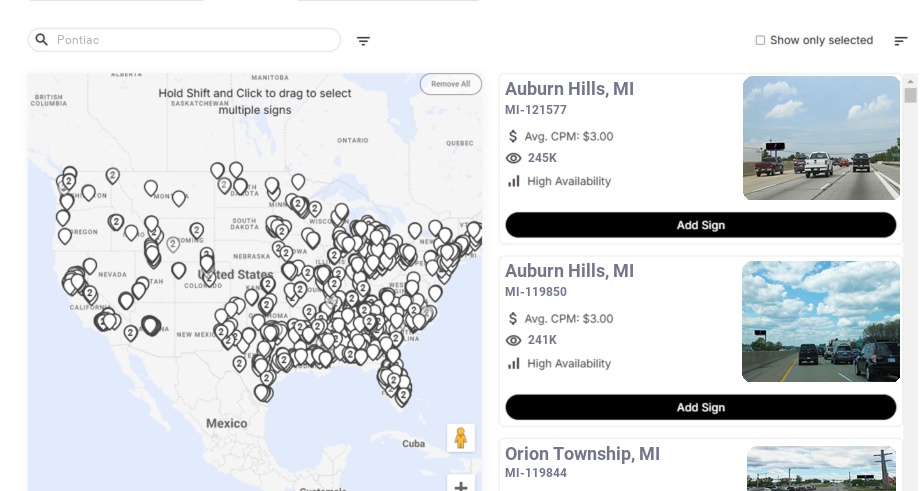
Our 12 digital Pontiac billboards serving the area are concentrated in Auburn Hills and Orion Township. These locations give us excellent coverage of high-flow commuting and shopping corridors that naturally feed into Pontiac and make billboard advertising near Pontiac highly efficient. Key roadways near these boards include I‑75 through Auburn Hills / Orion Township, M‑59, Telegraph Road, and local arterials like Baldwin Road, Joslyn Road, and Squirrel Road.
What kind of traffic do Pontiac, Michigan billboards with Blip reach?
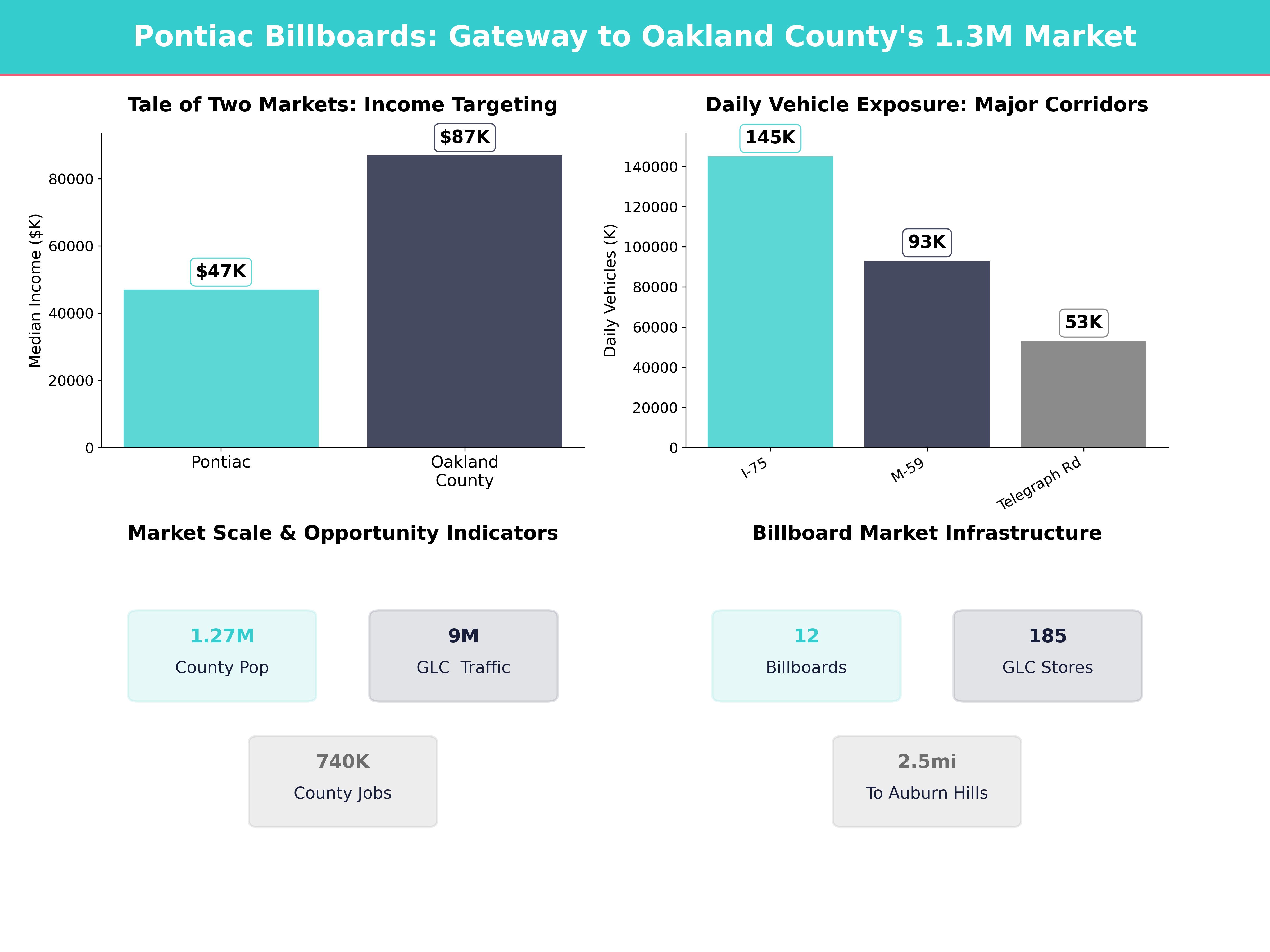
I‑75 through Auburn Hills / Orion Township carries roughly 130,000–160,000 vehicles per day in this stretch, according to Michigan Department of Transportation estimates, with 160,000 vehicles on the busiest days. M‑59 near Auburn Hills sees 75,000–110,000 vehicles per day, and Telegraph Road south of Pontiac often sees 45,000–60,000 vehicles per day. These routes help reach daily commuters, shoppers headed to major retail centers, students and staff traveling to Oakland University, and weekend leisure traffic moving between metro Detroit and northern Michigan.
When is the best time to run a Pontiac, Michigan billboard campaign with Blip?
Morning drive from 6–9 a.m. on I‑75 and M‑59 captures workers heading to manufacturing plants, office parks, and educational institutions around Pontiac and Auburn Hills. Evening drive from 3:30–6:30 p.m. reaches them again as they return to Pontiac, Waterford, Clarkston, Rochester Hills, and other nearby communities. Midday can also be efficient for campaigns aimed at stay-at-home parents, shift workers, and seniors, while late-night impressions are ideal for 24-hour services.
Who can I reach with Pontiac, Michigan billboards near Blip locations?
The Pontiac area pulls in multiple overlapping audience segments, including local Pontiac residents, affluent nearby suburbs, the automotive and manufacturing workforce, students and young professionals, and regional visitors and shoppers. Pontiac itself has around 61,000 residents, while Oakland County is home to about 1.27 million people and more than 740,000 jobs overall. The area is also commuter-heavy, with well over 80% of workers driving alone to work and an average commute time of roughly 26–28 minutes.
Do I need a contract to advertise with Blip in Pontiac?
No, Blip has no long-term contracts or minimum commitments. You can start, pause, or stop your campaign at any time.
How fast can I launch a billboard campaign with Blip in Pontiac?
You can have your campaign live in minutes. Create a free account, select your locations, set your budget, upload your design, and start running once approved.
Where can I advertise with Blip in Pontiac?
Blip has digital billboards in Pontiac. You can browse available locations on a map, choose the ones that fit your audience, and start advertising right away.
Still have questions? Launch a campaign in minutes — no contracts, no commitments.
Start Your CampaignPontiac Billboard Advertising Guide
Pontiac sits at a critical crossroads in Oakland County Auburn Hills Orion Township, we can help you reach commuters, shoppers, and residents moving through some of metro Detroit’s highest-traffic suburban routes—without paying downtown Detroit prices. Below, we’ll break down how to build an efficient, data-driven digital billboard strategy for reaching audiences with billboard advertising near Pontiac using Blip.
Understanding the Pontiac Area Market
Pontiac is the county seat of Oakland County City of Pontiac reports a population of roughly 61,000 residents, while Oakland County as a whole is home to about 1.27 million people, making it Michigan’s second-most populous county after Wayne County. Median household income in Pontiac is around $47,000, compared with roughly $87,000 countywide, reflecting a mix of working-class residents and higher-income commuters nearby.
Oakland County consistently ranks among the state’s economic engines. County economic development reports indicate:
- More than 740,000 jobs in Oakland County overall, with unemployment rates often 1–1.5 percentage points lower than the state average.
- A diversified economy: roughly 20–25% of jobs in professional and business services, 15–20% in manufacturing (heavily automotive and advanced manufacturing), and strong representation in healthcare, education, and retail.
- Over 40,000 businesses operating in the county, including multiple Fortune 500 and major regional headquarters concentrated along the I‑75 corridor.
Key demographic and economic points that matter for billboard advertisers:
- Young, working-age population: Pontiac’s median age is about 33–34 years, younger than the Michigan median (around 40.5 years). Roughly 60–65% of residents fall between 18 and 64, with strong representation in the 25–44 and 45–64 workforce brackets—prime targets for automotive, education, financial services, and healthcare campaigns that rely on Pontiac billboards to build awareness.
- Diverse community: Pontiac is one of Oakland County’s more racially and ethnically diverse cities. Local profiles show a majority-minority population, with sizable African American and Hispanic communities. This supports campaigns that feature inclusive visuals and bilingual (especially English/Spanish) messaging.
- Commuter-heavy region: According to commuting patterns reported by Oakland County and regional transportation planners, well over 80% of workers in the county drive alone to work, with an average commute time of roughly 26–28 minutes. Thousands of Pontiac residents commute daily to jobs in Auburn Hills, Troy, Southfield, and Detroit, while workers from surrounding suburbs drive into Pontiac’s industrial, office, and service centers.
- Regional draw: Major attractions such as Great Lakes Crossing Outlets in Auburn Hills, Oakland University in nearby Rochester/Auburn Hills, and access to Up North routes via I‑75 bring shoppers and travelers through the corridor serving the Pontiac area. Oakland County’s visitor economy generates well over $1 billion in direct tourism spending annually, much of it tied to shopping, sports, and entertainment accessible from the I‑75/M‑59 network.
For background on the community and civic priorities, it’s worth exploring the City of Pontiac and Oakland County The Oakland Press. For regional visitor insights and event calendars, see Visit Detroit – Oakland County Oakland County Economic Development & Community Affairs
Where Our Billboards Are and the Traffic They Reach
Our 12 digital Pontiac billboards serving the area are concentrated in Auburn Hills (about 2.5 miles from Pontiac) and Orion Township (about 4.2 miles away). These locations give us excellent coverage of high-flow commuting and shopping corridors that naturally feed into Pontiac and make billboard advertising near Pontiac highly efficient.
Key roadways and estimated average daily traffic (ADT) near these boards include:
-
I‑75 through Auburn Hills / Orion Township
- Carries roughly 130,000–160,000 vehicles per day in this stretch, according to Michigan Department of Transportation (MDOT) 160,000 vehicles on the busiest days.
- I‑75 is the primary north–south freeway connecting Detroit, the Pontiac area, and northern vacation destinations, giving access to both daily commuters and weekend travelers.
- Visit MDOT
-
M‑59 (Highland Road) / Hall Road Corridor
- Portions of M‑59 near Auburn Hills see 75,000–110,000 vehicles per day, acting as an east–west spine across northern suburban Detroit.
- This route ties Pontiac to Waterford Township, Rochester Hills, and Macomb County's dense retail corridor, with M‑59 carrying more than 200,000 residents’ daily trips across multiple communities when aggregating east–west flows.
-
Telegraph Road (US‑24) and local arterials
- Telegraph Road south of Pontiac often sees 45,000–60,000 vehicles per day, capturing drivers connecting from M‑59, Woodward Avenue, and neighborhoods west of downtown Pontiac.
- Key arterials like Baldwin Road, Joslyn Road, and Squirrel Road near Auburn Hills commonly register 20,000–35,000 vehicles per day, driven by retail, office, and campus traffic.
-
Retail and destination traffic
- Great Lakes Crossing Outlets in Auburn Hills is one of Michigan’s largest outlet centers, with over 185 stores and drawing an estimated 8–10 million visitors annually, many arriving via I‑75 and Baldwin Road. Learn more about visitor mix and events at the Great Lakes Crossing Outlets site.
- Oakland University enrolls around 16,000–18,000 students, plus thousands of faculty and staff, creating steady weekday travel along I‑75 and Squirrel/Adams roads. Campus data show that more than 80% of students commute rather than live on campus, which translates into consistent, repetitive impressions for roadside signage. Visit Oakland University for campus maps and event calendars.
- Nearby entertainment venues (e.g., multi-screen theaters, family entertainment centers, and seasonal attractions) add evening and weekend volume, pushing certain segments to noticeably higher traffic counts on Fridays and Saturdays.
By placing boards along these arteries, we continuously reach:
- Daily commuters to and from Pontiac and surrounding suburbs
- Shoppers headed to major retail centers
- Students, staff, and visitors traveling to Oakland University
- Weekend leisure traffic moving between metro Detroit and northern Michigan
- Regional visitors drawn by events, sports, and festivals promoted through outlets like Visit Detroit events and Oakland County Parks
Who You’re Reaching Near Pontiac
The Pontiac area pulls in multiple overlapping audience segments. Understanding them helps us dial in creative and scheduling and choose the right billboards near Pontiac for your message:
-
Local Pontiac residents
- Around 61,000 people in the city itself, with strong representation of families, young adults, and blue-collar professionals.
- Local housing data show that more than 50% of occupied housing units in Pontiac are renter-occupied, and a meaningful share of households fall below 80% of area median income, creating strong opportunities for value messaging (discounts, promotions, “$X off today” offers).
- Household sizes trend slightly larger than the state average (roughly 2.5–2.7 persons per household), supporting family-oriented retail, grocery, and healthcare campaigns.
-
Affluent nearby suburbs
- Oakland County’s median household income (~$87,000) far exceeds the state and national averages, and multiple communities north and east of Pontiac exceed $100,000 median household income.
- High-income pockets in Orion Township, Rochester Hills, Bloomfield Township, and Auburn Hills provide a strong market for premium products, financial services, healthcare, and higher education. For example, Rochester Hills’ median household income has been reported in the $110,000–$120,000 range, and Orion Township in the $95,000–105,000 range.
- Many of these residents use I‑75 and M‑59 daily to access jobs in Troy, Southfield, and Detroit, creating repeated exposures for well-placed freeway boards.
-
Automotive and manufacturing workforce
- The area around Pontiac and Auburn Hills is a major automotive and engineering hub. Auburn Hills alone hosts tens of thousands of auto-related and advanced manufacturing jobs, including global OEM and tier‑one supplier facilities.
- Regional labor statistics indicate that manufacturing accounts for 15–20% of local employment in several north Oakland communities, compared with about 14% statewide.
- Large daytime worker populations support B2B campaigns, staffing/recruitment ads, industrial suppliers, and business services. Shift-based facilities also drive significant impressions during off-peak hours (early morning, late night) when workers change shifts.
-
Students and young professionals
- With Oakland University, nearby community colleges, and trade programs in the region, there is a sizable student and early-career audience. Oakland University alone contributes roughly 16,000+ students and thousands of employees, and area community colleges add several thousand more.
- Young adults aged 18–34 form a substantial share of the population in Pontiac and surrounding zip codes, many living in apartments or starter homes and commuting by car.
- This group responds well to bold visuals, social media tie-ins, QR codes, and concise, benefit-focused headlines.
-
Regional visitors & shoppers
- Tourists and day-trippers visiting Great Lakes Crossing or moving between metro Detroit and northern Michigan are prime targets for hospitality, attractions, dining, and casino campaigns. Great Lakes Crossing’s draw of 8–10 million visitors per year equates to an average of 15,000–25,000 visitors per day, with peaks significantly higher around holidays.
- Oakland County’s broader tourism footprint brings in visitors for sports, concerts, and festivals promoted by organizations such as Visit Detroit and Oakland County Parks & Recreation
- For visitor-facing campaigns, strongly consider references to “right off I‑75,” “minutes from Pontiac,” or “on the way up north.”
Timing Your Campaign: When Impressions Are Most Valuable
Using Blip’s scheduling and budgeting controls, we can concentrate your budget in the times of day and days of the week that best match your audience in the Pontiac area.
Local traffic and mobility data consistently show:
- Morning and evening peaks on I‑75 and M‑59 with speeds dropping well below free-flow conditions.
- Higher weekend volumes in summer months, particularly Friday northbound and Sunday southbound flows.
- Seasonal swings driven by weather (winter storms), construction seasons, and holiday shopping.
Weekday commuting patterns
- Morning drive (6–9 a.m.) on I‑75 and M‑59 captures workers heading to manufacturing plants, office parks, and educational institutions around Pontiac and Auburn Hills. In these windows, corridors can carry upwards of 20–25% of their total daily traffic.
- Evening drive (3:30–6:30 p.m.) reaches them again as they return to Pontiac, Waterford, Clarkston, Rochester Hills, and other nearby communities. PM peak volumes are often slightly higher than AM peaks, especially on Thursdays and Fridays.
- Consider morning-heavy schedules for quick-service restaurants, coffee shops, traffic/accident lawyers, and radio-aligned promotions; evening-heavy schedules for retail, grocery, and family activities.
Midday and off-peak
-
Midday (10 a.m.–3 p.m.) can be particularly efficient for campaigns aimed at:
- Stay-at-home parents
- Shift workers going to or from non-standard shifts
- Seniors and daytime shoppers
- Costs per thousand impressions (CPM) can often be lower in these windows while still reaching high-intent audiences, particularly on non-holiday Mondays–Wednesdays.
- Traffic remains robust: in many suburban corridors, midday volumes still reach 60–70% of peak-hour traffic but at lower ad competition levels.
Evening, late-night, and 24/7 services
- Later evening (7–10 p.m.) still captures restaurant, entertainment, and retail traffic heading to and from Great Lakes Crossing and area theaters.
- Late-night (10 p.m.–2 a.m.) impressions are ideal for 24‑hour services (urgent care, emergency dentistry, towing, QSR drive‑thru), with fewer total vehicles but high urgency and lower CPM.
Weekends & seasonal peaks
-
Weekend traffic near the Pontiac area tends to spike toward:
- Shopping trips to Great Lakes Crossing and regional malls
- Recreation and “Up North” travel on I‑75
- Local events and festivals highlighted on Pontiac community news Oakland County events
- From May through October, northbound I‑75 traffic on Fridays and southbound traffic on Sundays often climbs sharply due to cottage, campground, and lakes tourism—MDOT seasonal counts show double-digit percentage increases compared with winter weekdays on some segments.
- Retail, entertainment, outdoor recreation, and tourism advertisers should weight spend heavily toward Friday–Sunday, especially in summer, back-to-school periods (late July–September), and around holidays.
We recommend using Blip’s tools to:
- Bid more aggressively during peak commuter and weekend “drive-time” windows on I‑75 and M‑59
- Allocate budget to shoulder periods (late evenings, midday) if you’re optimizing for frequency and cost efficiency
- Layer in short, high-frequency flights tied to major local happenings such as festivals, university events, or sports weekends promoted through outlets like The Oakland Press and Detroit Free Press – Oakland County
Crafting Creative That Works for Drivers Near Pontiac
Because our boards are positioned along fast-moving freeways and arterial routes, creative needs to be instantly readable and relevant to the Pontiac area.
Research in outdoor advertising consistently shows that recall drops sharply when messages exceed about 7–10 words or use more than 1–2 focal elements, especially at freeway speeds.
Design principles for the Pontiac corridor
-
Five-second rule: Design so that a driver at 65–70 mph on I‑75 can understand your message in 3–5 seconds.
- Limit to 7–10 words of main copy.
- Use one dominant image or icon, not a collage.
- Keep logo usage bold and simple; over-detailed logos lose clarity at distance.
-
High contrast:
- Bright, saturated colors (yellows, oranges, whites) on dark backgrounds work especially well in Michigan’s often overcast weather and winter twilight conditions.
- Avoid thin fonts and low-contrast color combinations (e.g., red on black, green on blue).
- Ensure at least a 70% contrast ratio between text and background for optimal legibility.
Local relevance and geographic cues
-
Use location cues like:
- “Just 5 minutes from downtown Pontiac”
- “Next exit at Great Lakes Crossing”
- “Serving Pontiac and northern Oakland County”
-
Reference familiar landmarks and routes:
- I‑75, M‑59, Great Lakes Crossing, downtown Pontiac, Oakland University, specific exits
-
For hyper-local businesses (e.g., a Pontiac auto repair shop, Waterford dentist), use clear directions:
- “Exit M‑59, 2 miles west of downtown Pontiac”
- “Telegraph Rd, 1 mile south of M‑59”
- Call out parking and convenience when relevant: “Free Parking – Downtown Pontiac,” “Easy Off/Easy On from I‑75.”
Language and cultural relevance
-
The Pontiac area’s diversity means bilingual or culturally attuned creative can stand out:
- Consider English/Spanish split lines when targeting neighborhoods with strong Hispanic populations.
- Feature diverse faces and inclusive imagery for healthcare, education, retail, and public-service campaigns.
- Keep any bilingual copy concise—ideally no more than 4–5 words per language on the main line.
Call-to-action alignment
- For commuters: short, low-friction CTAs such as “Search [Brand Name],” “Text PONTIAC to [shortcode],” or “Exit now for…”
- For brand-building: focus on a core promise or differentiator: “Pontiac’s Most Trusted Injury Attorneys,” “Oakland County’s Fastest Internet,” etc.
- For events: include date + short hook: “Pontiac Jazz Fest – Aug 16–18, Downtown Pontiac.”
- Whenever possible, align your URL or search term with what people hear on local radio or see in digital ads to maximize cross-channel recall.
Strategic Use of Multiple Boards Around Pontiac
With 12 boards serving the Pontiac area, we can design campaigns that use geography strategically rather than just buying generic impressions, making the most of your billboard rental near Pontiac.
North–south traveler coverage (I‑75)
-
Use Auburn Hills and Orion Township boards to:
- Greet travelers heading southbound into the Pontiac/Detroit suburbs with offers for shopping, dining, and services in or near Pontiac.
- Capture northbound up-north travelers with “last stop before the cabin” messages for groceries, supplies, and gas—especially during May–October when leisure travel increases substantially.
- Support campaigns for northern destinations (resorts, campgrounds, casinos) by reminding southeast Michigan residents to “Book Now for Summer” or “Exit Here for Weekend Getaways.”
East–west coverage via M‑59
-
Boards near M‑59 corridors can:
- Reinforce messages for shoppers traveling between Pontiac/Waterford and Rochester Hills.
- Promote regional destinations (concert venues, casinos, large auto dealers) that draw from across northern Oakland County and western Macomb.
- Support “triangle” coverage where customers may encounter your brand on I‑75, then again on M‑59, boosting frequency by 2–3x within the same week.
Frequency and sequencing
-
If your budget allows, we can:
- Run consistent core creative on multiple boards to build recognition—industry studies show that 3–5 exposures per week significantly improve brand recall.
-
Or sequence messages:
- Board 1: “Hungry on I‑75?”
- Board 2 (next miles): “Exit 79 – Great Lakes Crossing”
- Board 3 (closer to exit): “Turn right for [Restaurant Name] – Next to [Landmark].”
- Use directional sequencing for services located off multiple exits: “Exit 77 or 79 – Same Great Deal, Two Locations.”
Geo-targeted objectives
- For businesses in downtown Pontiac, use boards to pull traffic off I‑75 and M‑59 with “Historic Downtown Pontiac – Just 5 Minutes Away” messages. Downtown revitalization initiatives frequently feature new dining, arts, and entertainment options highlighted on City of Pontiac and local news outlets.
- For Auburn Hills or Orion Township businesses, focus on “Near Great Lakes Crossing” or “Near [Major Employer] Campus” framing to tap into worker and shopper flows.
Tailored Strategies by Industry
Different sectors can leverage the Pontiac area’s dynamics in specific ways:
Automotive sales & service
- The Pontiac area has deep auto culture and workforce roots, with tens of thousands employed in automotive engineering, manufacturing, and related services across Oakland County.
-
Use commuter-heavy schedules to promote:
- Lease specials and low financing
- Quick service (oil changes, tires, brakes) near I‑75 or M‑59
- Collision repair and insurance claims support, particularly during winter and early spring when accident rates often rise.
- Include clear directional cues: “New Trucks in Stock – 10 Min from Pontiac on I‑75, Exit [#].”
- Align with regional auto events and coverage by outlets such as The Oakland Press autos.
Education & training
- Target Oakland University students, local high school grads, and adults seeking career pivots.
-
Focus on:
- Enrollment seasons (spring and late summer) when inquiries can spike sharply for both four-year and two-year programs.
- Daytime and early-evening slots when students commute to and from classes.
-
Promote:
- Flexible formats (“Evening & Online Classes Available”)
- Credential outcomes (“Earn a Skilled Trade in 12 Months”)
- Coordinate messaging with academic calendars and events listed on Oakland University and area school district sites.
Healthcare & wellness
- Many households in Pontiac and nearby suburbs are decision-makers for healthcare choices, with family-focused households and aging residents both strongly represented.
-
Promote:
- Nearby hospitals, urgent care, dental offices, behavioral health, and specialty clinics
- “Same-day appointments,” “Walk-ins welcome,” or “Open late” to capture commuters and shift workers
- Emphasize convenience: “5 minutes off M‑59,” “Located between Pontiac & Auburn Hills.”
- Time seasonal pushes (flu shots, sports physicals, open enrollment) with public health campaigns and community notices from the Oakland County Health Division
Retail, dining, and entertainment
- Leverage proximity to Great Lakes Crossing and Pontiac’s emerging downtown.
-
Run stronger on weekends and evenings:
- “Dinner Before the Game? Exit [#] for [Restaurant] Near Pontiac.”
- “Shop, Dine, and Play – Just off I‑75 at Great Lakes Crossing.”
- Use limited-time offers aligned with key retail dates (Black Friday, back-to-school, holiday weekends). Retail sales data often show 30–40% higher volumes in November–December compared with typical months, making those prime windows for high-frequency billboard campaigns.
Public sector & community campaigns
-
Government agencies, nonprofits, and civic groups can use boards near Pontiac to:
- Promote public health campaigns
- Announce local events and festivals
- Highlight job fairs or training programs
- Check resources like Oakland County events Pontiac community news Visit Detroit when timing message bursts around major happenings.
- For recruitment or public safety campaigns, consider continuous baseline presence with short, higher-frequency boosts during critical periods (e.g., winter driving safety, summer youth programs).
Aligning With Local News, Events, and Seasonality
Tying your messaging to what people are already thinking about in the Pontiac area can significantly lift engagement.
Seasonal considerations
-
Winter (Dec–Feb):
- Focus on auto repair, heating services, insurance, and indoor entertainment as road conditions worsen and daylight hours shrink.
- Use high-contrast, bright colors to stand out against snow and overcast skies.
- Consider emergency-oriented CTAs: “24/7 Towing,” “Urgent Care – Exit Now.”
-
Spring (Mar–May):
- Tax prep, home improvement, landscaping, and recruitment campaigns perform well as households receive tax refunds and plan projects.
- Construction season kicks off; use boards to communicate detours or alternate routes if you’re a destination affected by work zones.
-
Summer (Jun–Aug):
- Heavy weekend I‑75 travel—perfect for tourism, recreation, events, and QSR.
- Back-to-school pushes can begin as early as late July. Retailers and schools often see a 20–30% lift in traffic as August progresses.
- Promote fairs, concerts, and outdoor events listed on Oakland County Parks & Recreation
-
Fall (Sep–Nov):
- Education, healthcare open enrollment, and pre-winter auto maintenance messaging gain traction.
- Sports seasons (high school, college, and pro) drive traffic to dining, sports bars, and retail; align messaging around game days and coverage by The Oakland Press and Detroit Free Press – Oakland County
Local events and news
Stay aligned with coverage from outlets like The Oakland Press and Detroit Free Press – Oakland County
- Time campaigns around Pontiac festivals, sports schedules, and community events.
- Reinforce public initiatives (e.g., road safety campaigns, flu-shot drives) when they’re front-page news.
- Respond quickly to new developments—store openings, new attractions, or major road projects—by updating copy and scheduling within days, not months.
- Consider short-run, high-frequency bursts (7–14 days) tied to specific events in or near Pontiac for maximum impact.
Measuring, Testing, and Optimizing in the Pontiac Area
Digital billboards allow us to treat outdoor advertising near Pontiac with the same test-and-iterate mindset used in digital marketing.
A/B testing creative
-
Rotate multiple creative variants across the same set of Auburn Hills and Orion Township boards:
- Try two different headlines or offers.
- Test brand-focused vs. offer-focused messages.
- Compare performance of local landmark references (“Near Great Lakes Crossing”) versus generic value propositions.
-
Use metrics like:
- Lift in web sessions from the Pontiac and north Oakland area (trackable via geo reports in analytics platforms)
- Promo code redemptions with location tags (e.g., “PONTIAC10”)
- Call volume or appointment spikes during specific flight periods
- Store foot traffic changes measured through POS data or optional footfall analytics partners
Refining schedule and geography
-
After an initial 2–4 week run, adjust:
- Time-of-day bidding: move budget into hours that drive the strongest response (e.g., if call volume and web leads peak between 4–7 p.m., overweight that window).
- Day-of-week: if weekend performance is stronger for your category, reallocate more impressions to Friday–Sunday; if B2B leads skew toward Monday–Thursday, adjust accordingly.
- Board mix: emphasize boards delivering better performance or those closest to your primary location; in practice, shifting 20–30% of impressions from lower-performing to higher-performing faces can yield noticeable efficiency gains.
Connecting with other channels
-
Coordinate billboard flights with:
- Local TV or radio spots serving Pontiac and Oakland County
- Paid social and search geofenced to Pontiac and nearby ZIP codes
- Email campaigns or text alerts timed to coincide with heavy drive times
- Reinforce the same core visual and slogan on all platforms to build memorability—multi-channel studies routinely show that campaigns using 3+ coordinated channels can see 20–30% higher brand lift than single-channel efforts.
- Use coverage from local outlets like The Oakland Press or Visit Detroit as content anchors in your digital campaigns while billboards drive top-of-funnel awareness.
By understanding how people move through and around the Pontiac area—and by matching your creative, timing, and placement to those patterns—we can make your digital billboard campaign work much harder for every dollar spent. With 12 strategically located boards in Auburn Hills and Orion Township serving the Pontiac area, we have the flexibility to reach your ideal audience at the right moments along I‑75 and M‑59, whether you’re planning short-term billboard rental near Pontiac or a long-term presence, and the control to continually refine your campaign based on real-world results supported by local traffic, economic, and demographic data.