Billboards in Ann Arbor, MI
No Minimum Spend. No Long-Term Contracts. Just Results.
Trusted by Leading Brands


Billboard advertising
in Ann Arbor has never been easier



How much is a billboard in Ann Arbor?
Why Choose Blip for Billboard Advertising in Ann Arbor
Launch Ann Arbor billboards on Blip in minutes and reach I-94 and US-23 commuters before they hit downtown.
Ann Arbor’s game days and Art Fair spikes are easy to catch with Blip dayparting, so you show ads when traffic surges.
Start small in Ann Arbor with flexible Blip budgets, then scale up for Michigan football weekends or summer tourism.
No contracts with Blip mean you can test Ann Arbor’s student, healthcare, and tech audiences, then adjust fast.
Track Ann Arbor campaign results in real time and use Blip creative tools to tailor bold, quick-read ads for 60-70 mph traffic.
Frequently Asked Questions About Billboard Advertising in Ann Arbor
How much does a billboard cost near Ann Arbor, Michigan with Blip?
With Blip, you can run your message on Ann Arbor billboards serving the Ann Arbor area on virtually any budget, because you only pay per “blip”—a 7.5 to 10-second ad display on digital billboards. You choose your daily budget during campaign setup, and Blip automatically keeps your ads within that limit, while still allowing you to adjust your budget whenever you want. The price of each blip on billboards near Ann Arbor, Michigan varies based on when and where your ad appears and current advertiser demand, so your total cost is simply the sum of all the blips you receive.
Where can I advertise with Blip in Ann Arbor, Michigan?
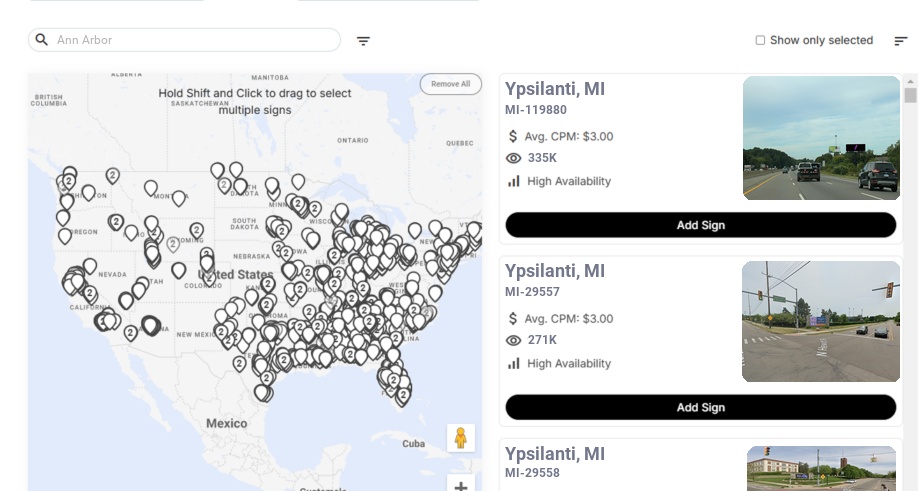
Our digital billboards near Ann Arbor are located in nearby Ypsilanti, about 5.4 miles away. Ypsilanti sits directly along the I‑94 and US‑12 corridors, which serve as primary gateways for traffic moving between Detroit, Detroit Metro Airport (DTW), and the Ann Arbor area. This gives us the ability to reach both locals and visitors before they arrive downtown or at the university, maximizing the impact of billboard advertising near Ann Arbor.
Who sees billboard ads near Ann Arbor, Michigan?
Ann Arbor sits at the intersection of higher education, healthcare, tech, and Midwest culture, making the Ann Arbor area one of the most attractive and data-rich markets for digital billboard advertisers searching for billboards near Ann Arbor. Over 70% of Ann Arbor residents age 25+ hold a bachelor’s degree or higher, more than double the national rate, which contributes to strong adoption of new brands and services promoted on Ann Arbor billboards. The Ann Arbor area welcomes an estimated 3–4 million visitors annually, generating hundreds of millions of dollars in visitor spending.
When is the best time to run Blip campaigns in Ann Arbor, Michigan?
The Ann Arbor area operates on a pronounced academic and event‑driven calendar, so timing matters for billboard rental near Ann Arbor. Late August through early May brings peak student and faculty presence, while September through November adds strong routine with football weekends. In summer, fewer students are on campus, but tourism and family travel increase, and hotel occupancy and average daily rates often climb during peak weekends and major events.
What traffic corridors are best for billboard advertising near Ann Arbor, Michigan?
I‑94, US‑23, M‑14, and Washtenaw Avenue/Michigan Avenue are the key corridors around the Ann Arbor area. I‑94 near the Ann Arbor/Ypsilanti stretch typically ranges from about 80,000 to over 100,000 vehicles per day, while US‑23 sections near Ann Arbor often carry 70,000–90,000 vehicles daily. Surface arteries like Washtenaw Avenue and Michigan Avenue handle dense everyday local traffic, often in the 20,000–35,000 vehicles‑per‑day range on key segments.
Do I need a contract to advertise with Blip in Ann Arbor?
No, Blip has no long-term contracts or minimum commitments. You can start, pause, or stop your campaign at any time.
How fast can I launch a billboard campaign with Blip in Ann Arbor?
You can have your campaign live in minutes. Create a free account, select your locations, set your budget, upload your design, and start running once approved.
Where can I advertise with Blip in Ann Arbor?
Blip has digital billboards in Ann Arbor. You can browse available locations on a map, choose the ones that fit your audience, and start advertising right away.
Still have questions? Launch a campaign in minutes — no contracts, no commitments.
Start Your CampaignAnn Arbor Billboard Advertising Guide
Ann Arbor sits at the intersection of higher education, healthcare, tech, and Midwest culture, making the Ann Arbor area one of the most attractive and data-rich markets for digital billboard advertisers searching for billboards near Ann Arbor. With 3 digital billboards serving the Ann Arbor area from nearby Ypsilanti, we can use flexible Blip campaigns to tap into commuter flows, visitor traffic, and a highly educated local audience with strong purchasing power through targeted billboard advertising near Ann Arbor.
Understanding the Ann Arbor Area Market
Ann Arbor anchors Washtenaw County, a region that combines a major university town with affluent suburbs and blue‑collar commuting corridors, creating strong demand for visible Ann Arbor billboards that can reach both residents and visitors.
Key market facts:
- The City of Ann Arbor reports a population in the low‑120,000s (about 123,000–125,000 residents), while Washtenaw County totals roughly 370,000–375,000 people, making it one of the 10 most populous counties in Michigan.
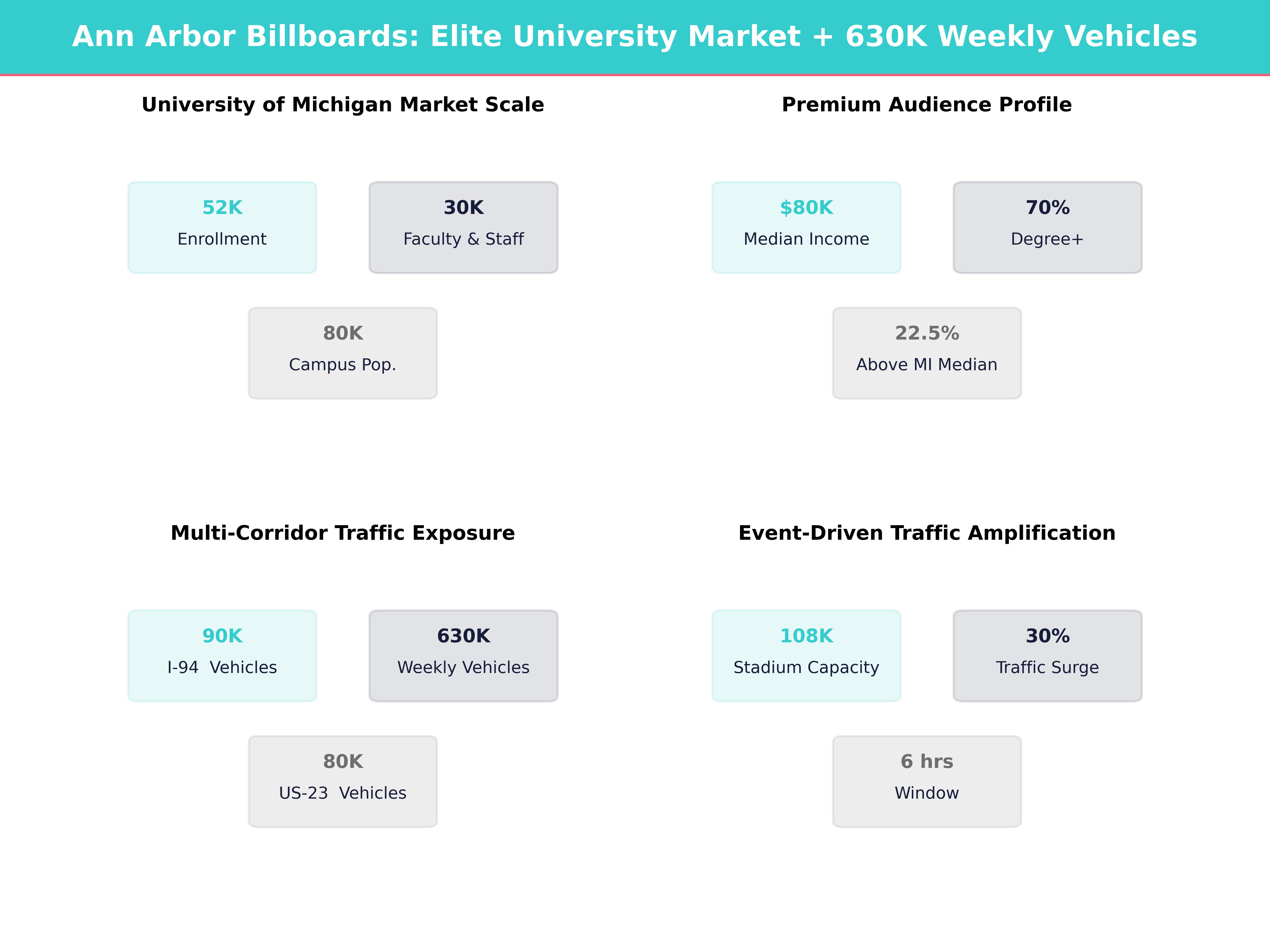
- The University of Michigan – Ann Arbor enrolls about 52,000 students (undergraduate + graduate/professional) and employs more than 30,000 faculty and staff combined. The university’s annual budget exceeds $10 billion, and it supports an estimated 70,000+ jobs statewide when spin‑off and indirect employment are included.
- Ann Arbor’s median household income is typically reported in the upper‑$70,000s to low‑$80,000s (around $80,000), and Washtenaw County’s is in a similar range (mid‑$70,000s to high‑$70,000s). Both sit roughly 20–25% above the Michigan statewide median, supporting higher discretionary spending on dining, entertainment, and specialty retail.
- Over 70% of Ann Arbor residents age 25+ hold a bachelor’s degree or higher, more than double the national rate, which contributes to strong adoption of new brands and services promoted on Ann Arbor billboards.
- The Ann Arbor area welcomes an estimated 3–4 million visitors annually, generating hundreds of millions of dollars in visitor spending. Destination Ann Arbor reports that tourism supports several thousand local jobs across hotels, restaurants, retail, and attractions—an audience that is highly responsive to billboard advertising near Ann Arbor on their way into town.
Our digital billboards near Ann Arbor are located in nearby Ypsilanti, about 5.4 miles away. Ypsilanti sits directly along the I‑94 and US‑12 corridors, which serve as primary gateways for traffic moving between Detroit, Detroit Metro Airport (DTW), and the Ann Arbor area. This gives us the ability to reach both locals and visitors before they arrive downtown or at the university, maximizing the impact of billboard advertising near Ann Arbor.
Where and How People Move Near Ann Arbor
To build effective campaigns, we need to understand the local traffic grid and commuting patterns and how they intersect with billboards near Ann Arbor.
Key corridors around the Ann Arbor area:
- I‑94 (east–west): Connects Detroit and Chicago, passing just south of Ann Arbor and through Ypsilanti. Michigan Department of Transportation (MDOT) traffic counts along I‑94 near the Ann Arbor/Ypsilanti stretch typically range from about 80,000 to over 100,000 vehicles per day, meaning roughly 560,000–700,000 vehicle trips each week.
- US‑23 (north–south): Runs just east of the city, linking the Ann Arbor area to Livingston County (Brighton/Howell) to the north and to I‑94/Toledo routes to the south. Sections near Ann Arbor often carry 70,000–90,000 vehicles daily, or around 2–2.5 million trips per month.
- M‑14: Connects the Ann Arbor area to the northwest side of the Detroit metro region (Plymouth/Northville), moving a large volume of tech and professional commuters. Segments near Ann Arbor frequently see 60,000+ vehicles per day.
- Washtenaw Avenue & Michigan Avenue (Business US‑12): Surface arteries that handle dense everyday local traffic between Ypsilanti and the Ann Arbor area, capturing daily errands, retail trips, and service visits, often in the 20,000–35,000 vehicles‑per‑day range on key segments.
- Local transit provided by the Ann Arbor Area Transportation Authority (TheRide) adds another layer of movement, with several million fixed‑route rides annually, much of it concentrated along Washtenaw Avenue and campus‑to‑downtown corridors.
Implications for billboard strategy:
- Thousands of commuters from Ypsilanti, Canton, Belleville, and other Wayne County suburbs travel on I‑94 and US‑23 each weekday to jobs and classes in the Ann Arbor area. It’s common for peak‑hour volumes to exceed 5,000–6,000 vehicles per lane per hour on the busiest segments, which makes well‑placed Ann Arbor billboards especially valuable.
- Many of the millions of annual patients and visitors traveling to Michigan Medicine
- Game day and special event traffic (football at Michigan Stadium, Ann Arbor Art Fair, graduation, conferences) can push local freeway and arterial volumes 20–40% above typical weekend levels, with sustained congestion windows of 4–8 hours.
Placing messages on digital billboards near Ypsilanti lets us intercept this traffic before people reach their final destination, ideal for influencing restaurant choices, retail stops, entertainment decisions, and brand awareness through billboard advertising near Ann Arbor.
Target Audiences in the Ann Arbor Area
The Ann Arbor area’s diversity means we can tailor creative and scheduling to several distinct high‑value segments.
1. University Students and Staff
- Around 52,000 students plus tens of thousands of staff and faculty at the University of Michigan make up a daily campus population that can rival or exceed 80,000 people on busy weekdays.
- Students skew 18–24, mobile‑first, and heavily online: university surveys and national benchmarks indicate that well over 90% of students own smartphones, and more than 70% use social media multiple times per day.
- Thousands live off‑campus and commute from Ann Arbor neighborhoods, Ypsilanti, Pittsfield Township, and neighboring communities via I‑94 and major surface streets, passing billboards near Ann Arbor on their way in and out of town.
How to reach them:
- Focus weekday morning and late‑afternoon/early‑evening schedules on commuter flows along I‑94 and surface routes connecting Ypsilanti to the Ann Arbor area. Morning peaks often run from about 7–9 a.m., with evening peaks from 4–6:30 p.m.
- Promote student discounts, events, bars, coffee shops, co‑working spaces, transit or shuttle services, and housing—categories where student spending can account for millions of dollars annually in the local economy.
- Use clear, bold visuals and tight copy — think 5–7 words and a powerful call‑to‑action that can be processed in 2–3 seconds at 60–70 mph.
2. Healthcare Visitors and Professionals
- Michigan Medicine
- Nearby Trinity Health Ann Arbor Hospital adds another substantial volume of patients, emergency visits, and staff, serving tens of thousands of inpatients and many more outpatients annually.
- Healthcare workers commute from all over the region via I‑94, US‑23, and M‑14; large hospital campuses often employ 5,000–10,000+ staff on staggered shifts, creating steady early‑morning and late‑evening traffic that regularly passes Ann Arbor billboards.
How to reach them:
- Daytime and early‑morning slots (5–9 a.m.) are effective for healthcare worker commutes, when shift changes create traffic spikes around hospital start times.
- For patients and visitors, midday and early‑evening impressions (10 a.m.–7 p.m.) can heavily influence where they eat, shop, and stay—particularly for the thousands who stay multiple nights for procedures or family visits.
- Ideal advertisers include hotels, extended‑stay lodging, pharmacies, transportation, restaurants, and wellness services such as massage, physical therapy, and fitness centers.
3. Affluent Professionals and Tech Workforce
The Ann Arbor area has a high concentration of professionals in tech, engineering, biotech, and consulting, bolstered by organizations like Ann Arbor SPARK
- Professional and business services, education, and health services together account for a large share of regional employment—often 40%+ of local jobs—creating a dense commuter base of higher‑income workers.
- Many live in higher‑income neighborhoods in Ann Arbor and commute from communities like Saline Dexter, and Canton. In several Ann Arbor ZIP codes, median household incomes exceed $100,000.
- This group tends to value premium brands, experience‑driven services, and local authenticity. They are also heavy users of digital channels, often spending 9–10 hours per day with screens across work and personal devices.
How to reach them:
- Use professional, clean design with brand‑forward messaging and minimal clutter; emphasize trust, quality, and innovation on Ann Arbor billboards.
- Highlight quality, convenience, and local roots (e.g., “Locally Crafted,” “Ann Arbor Area’s Premier…”), which resonate well in a community where more than two‑thirds of residents rate local businesses favorably in surveys.
- Aim for weekday drive times; consider heavier frequency ahead of major local events and holidays, when discretionary spending on dining, retail, and travel increases 20–30%.
4. Visitors and Event‑Driven Traffic
The Destination Ann Arbor calendar is packed with events that drastically increase visitor traffic, including:
- Michigan Wolverines football at Michigan Stadium (capacity 107,601), regularly drawing crowds over 100,000 and making it one of the largest stadiums in the country.
- The Ann Arbor Art Fair (one of the largest art fairs in the U.S.), which can attract 400,000+ attendees over several days in July.
- University graduation ceremonies in late April and early May, which bring tens of thousands of visiting family members and friends into the city over a single weekend.
- Summer festivals, concerts, and conferences that collectively add hundreds of thousands of additional visits between June and August.
How to reach them:
- Ramp up impressions in the days and weeks leading up to major events. For example, weighting spend 3–7 days before a football Saturday or Art Fair week can significantly increase exposure to out‑of‑town visitors driving in.
- Focus on wayfinding and last‑minute decisions: parking, dining, nightlife, attractions, shopping, and lodging. Visitors make a high share of these decisions “on the fly” within the last 30–60 minutes of their trip, often prompted by billboard advertising near Ann Arbor’s main approaches.
- Use simple maps or directional cues (“Exit Now,” “5 Minutes Ahead,” “Next Exit for…”) to drive immediate action and reduce friction for drivers unfamiliar with the area.
Seasonality and Optimal Timing for Blip Campaigns
The Ann Arbor area operates on a pronounced academic and event‑driven calendar. We can use Blip’s scheduling flexibility to match these cycles and get more value from billboard rental near Ann Arbor.
Academic Calendar Patterns
- Late August – Early May: Peak student and faculty presence, with tens of thousands of additional daily trips related to classes, labs, and campus events.
- September – November: Strong routine with football weekends adding surges. Home football Saturdays can see 100,000+ people converging around Michigan Stadium in addition to normal weekend activity.
- January – April: High academic intensity, good for services like tutoring, fitness, restaurants, and delivery; many students report increased use of convenience services during midterms and finals.
- May – August: Fewer students on campus—summer enrollment is typically much smaller—but higher general tourism and family travel. Hotel occupancy and average daily rates in the region often climb during peak summer weekends and major events.
We can:
- Increase budget and frequency during back‑to‑school periods (late August/early September and January) and exam seasons for education‑oriented or student‑focused campaigns.
- Shift messaging in summer toward visitors, families, and locals: outdoor recreation, attractions, and seasonal services such as landscaping, home projects, and festivals.
Event & Sports Timing
- On home football Saturdays, traffic around the Ann Arbor area can start building by 8–9 a.m., peak 2–3 hours before kickoff, and stay heavy through evening, especially after games that end between 3–7 p.m.
- Major events like the Ann Arbor Art Fair attract hundreds of thousands over several days, with daytime pedestrian volumes in downtown often surpassing 50,000 people per day during the fair.
- Large university events such as commencements or welcome weeks can fill hotels across the region, increasing demand for dining, shopping, and entertainment.
We can:
- Use date‑specific scheduling to heavily weight impressions on game days or fair days, potentially increasing bids 2–3x relative to normal weekends if budgets allow.
- Run separate creatives for “Before the Game,” “After the Game,” and “All Weekend Long” offers to match changing needs (breakfast/tailgates vs. post‑game dinners and nightlife).
- Promote time‑sensitive deals, transportation, and parking solutions—critical in a market where prime parking near the stadium and downtown can sell out hours before kickoff or major events.
Daypart Strategies
Consider these broad guidelines:
- Morning (6–10 a.m.): Commuters, healthcare employees, and early‑shift workers — great for coffee shops, breakfast spots, gyms, and B2B awareness. On weekdays, more than half of daily traffic on key corridors can occur in the combined morning and evening peak periods.
- Midday (10 a.m.–3 p.m.): Shoppers, retirees, patients/visitors, and students between classes — ideal for retail, quick‑service restaurants, and local attractions. Midday is also prime for visitor traffic on event days.
- Evening (3–8 p.m.): Return commuters, dining decisions, and entertainment — top slots for restaurants, bars, events, and family activities; restaurant and bar revenues often peak between 5–9 p.m.
- Late evening (8–11 p.m.): Often lower CPM opportunities; still valuable for nightlife, late‑night food, and brand awareness if we’re budget‑constrained, especially on Thursdays–Saturdays when late‑night social activity increases.
With Blip, we can dial up or down our bids by daypart to prioritize the time windows that match our audience and make our billboard rental near Ann Arbor more efficient.
Creative Best Practices for the Ann Arbor Area
The Ann Arbor area’s audience is highly educated and visually literate, but they are still reading our message at 60–70 mph. Design discipline is critical.
Keep It Simple and Smart
- Limit to 1 main idea per creative.
- Aim for 5–7 words of headline text plus a short sub‑line if needed; legibility studies for roadside signs consistently show comprehension drops sharply beyond 8–10 total words.
- Use strong, high‑contrast colors; avoid busy backgrounds that blend with the environment.
- Make logos large enough to be clearly visible at distance—ideally occupying at least 10–15% of the total canvas.
Tap Local Identity and Pride
Ann Arbor is known for its distinct culture, which we can reflect in creative:
- References to the “Ann Arbor area” or “A2” resonate, especially when tied to community support or local sourcing.
- Tasteful nods to the Wolverines (without infringing trademarks) such as “Game Day Ready,” “Blue & Maize Specials,” or “College Town Comfort” can work well on weekends; football game days alone can add 100,000+ extra people to the city.
- Highlight proximity: “Just 10 Minutes from Downtown,” “Right Off Exit ___,” or “Near the Big House,” giving concrete travel times or exits that help visitors navigate easily.
Use Data‑Informed Messaging
Think about what traffic is likely doing when they see your board:
- Commuters on I‑94 heading toward the Ann Arbor area: emphasize convenience, time savings, and daily‑use services (coffee in the next 2–3 miles, quick oil changes, same‑day medical or dental appointments).
- Visitors en route to Michigan Stadium: push parking, tailgating, bars, and quick eats, especially within 1–3 miles of the stadium where walking is feasible.
- Families visiting hospitals: highlight comfort, reliability, and nearby lodging or food, noting features like “Free Parking,” “Kitchenettes,” or “Walk to Hospital” that can meaningfully reduce stress.
Rotate Creative for Different Audiences
With digital, we can easily switch messages:
- One creative for weekday commuters.
- Another for weekend events.
- A separate version geared toward students (with student‑only offers or QR codes).
Running multiple creatives also lets us test which headlines, colors, or offers perform best. For example, comparing a “20% Off” message vs. “$10 Off” over a 2–4 week period can reveal which drives more redemptions per thousand impressions.
Using Ypsilanti Locations to Reach the Ann Arbor Area
Although our boards sit in Ypsilanti, they are strategically positioned to serve the broader Ann Arbor area market.
Ypsilanti benefits:
- Sits directly on I‑94 and US‑12, intercepting a large volume of traffic heading toward the Ann Arbor area from Detroit, the airport, and western suburbs. Daily volumes on this stretch of I‑94 often exceed 80,000–90,000 vehicles, giving billboards tens of thousands of potential impressions per day.
- Home to Eastern Michigan University (EMU)
- Functions as an everyday shopping and service hub for residents who regularly travel into the Ann Arbor area for work, healthcare, and entertainment. Many Ypsilanti households make multiple trips per week toward Ann Arbor for jobs, grocery trips, and appointments.
How this helps advertisers:
- Regional brands can capture both EMU and University of Michigan audiences with a single localized campaign, potentially influencing over 65,000+ students plus tens of thousands of staff and faculty with billboards near Ann Arbor and Ypsilanti.
- Local businesses in Ann Arbor, Pittsfield Township, and Ypsilanti can use the same creative to drive traffic to multiple locations, especially when they are within a 10–15 minute drive of the boards.
- Service providers (auto, home improvement, healthcare) can reach homeowners and renters moving between communities; in Washtenaw County, owner‑occupied housing rates hover around 55–60%, leaving a substantial 40–45% renter population attractive for apartment, moving, and furnishing services.
When we set up campaigns, we should:
- Choose boards that are visible to traffic traveling toward the Ann Arbor area at key times (for example, westbound I‑94 in the morning and eastbound I‑94 in the evening).
- Use directional or distance messaging (“Next Ann Arbor Exit,” “Just West of the Stadium,” “Off State Street in the Ann Arbor Area”) to capture attention from both locals and visitors.
- Consider separate creatives targeting eastbound versus westbound traffic if available, tailoring offers to likely trip purposes (workbound vs. homebound vs. eventbound).
Budgeting, Bidding, and Frequency with Blip
Blip’s model allows us to buy individual “blips” (brief ad plays) on a pay‑per‑display basis. This flexibility is especially valuable in a market with strong seasonality like the Ann Arbor area, where advertisers can scale billboard rental near Ann Arbor up or down quickly.
Setting an Effective Budget
For small local businesses:
- Even modest budgets (for example, $10–$20 per day) can generate thousands of weekly impressions when focused on off‑peak times; at a few cents per display, this can translate to hundreds of plays per day.
- Concentrating spend on specific days (e.g., Thursdays–Saturdays or home game weekends only) can boost impact without requiring large daily budgets, effectively doubling or tripling your share of voice on your most important days.
For regional or multi‑location advertisers:
- Layering higher bids during key events (football games, Art Fair, graduation) while maintaining a steady base level in off‑peak weeks creates continuous presence with strategic bursts. Event‑focused bursts can drive significantly higher response rates, especially when paired with limited‑time offers.
- Consider allocating a separate “event fund” to bid aggressively on those high‑value dates; even a 20–30% reallocation of monthly budget toward 5–10 key dates can noticeably increase total campaign impact for billboard advertising near Ann Arbor.
Smart Bidding Strategies
We can:
- Increase bids during high‑value dayparts (morning/evening commute, pre‑game windows) and reduce bids in lower‑demand hours, effectively shifting impressions toward the 6–10 hours per day when your audience is most active.
- Use date and time filters to avoid paying for impressions when our audience is least active (for example, overnight hours for family‑oriented services).
- Run limited‑time “flights” (e.g., two weeks before a major event) rather than spreading the same budget too thin over many months, which can dilute frequency and recall.
Frequency and Message Retention
In a commuter‑heavy area like the Ann Arbor region:
- The same drivers may pass our boards 5 days a week, 2 times per day. Over a month, a frequent commuter could have 40–50 opportunities to see your creative.
- Repetition matters; aiming for multiple exposures per week per commuter increases brand recall dramatically. Industry research often suggests that 5–7 exposures over a few weeks can significantly lift awareness.
- Rotating 2–3 creatives keeps the message fresh while preserving brand recognition. For instance, use one brand‑building creative, one promotion‑focused creative, and one event‑specific message on your Ann Arbor billboards.
Campaign Ideas Tailored to the Ann Arbor Area
Here are concrete ways different advertisers can leverage digital billboards near the Ann Arbor area:
Local Restaurants and Bars
- Promote “Gameday Specials” on home football weekends with schedules weighted heavily to the 24–48 hours before kickoff; with more than 100,000 attendees, even a small share of game‑day traffic can translate into hundreds of extra covers.
- Use lunch‑focused creative for weekday mid‑day slots and dinner/nightlife creative in the evening, reflecting the fact that food and beverage spending often peaks during 11 a.m.–2 p.m. and 5–9 p.m.
- Call out proximity to downtown, the stadium, or campus with simple distance cues like “0.5 Miles from Main Street” or “5 Minutes from the Big House.”
Healthcare and Wellness Services
- Highlight urgent care, dental, chiropractic, or mental health services during weekday commuting hours when thousands of healthcare workers and patients are passing daily.
- For services near major hospitals, emphasize “Minutes from Michigan Medicine” or “Easy Parking Near the Ann Arbor Area Hospitals,” especially important for the many out‑of‑town visitors unfamiliar with local streets.
- Use calm colors, reassuring language, and clear contact details or URLs. Including simple phrases like “Walk‑In Welcome” or “Same‑Day Appointments” can significantly increase response.
Retail and Shopping Centers
- Run back‑to‑school and holiday campaigns that speak to both students and families. University and K‑12 back‑to‑school periods can drive double‑digit percentage bumps in retail sales.
- Feature limited‑time events: sidewalk sales, “Student Night,” or extended holiday hours, using countdowns (“Ends Sunday”) to create urgency.
- Include strong visual anchors (product imagery, sale percentages like “Up to 50% Off”) and a simple web address. Many viewers will later search or visit your site on their phones rather than exiting immediately.
Events, Venues, and Entertainment
- Promote concerts, theater productions, comedy nights, and conferences at local venues such as downtown theaters, music halls, and campus facilities.
- Use countdown framing (“3 Days to Go,” “This Weekend Only”) leading up to the event, adjusting creative each week for a sense of momentum.
- Schedule ramps in impressions during the final week before the event date, when a high share of ticket purchases and attendance decisions are made.
Education and Training Providers
- Community colleges, bootcamps, and professional training programs can target commuters and recent grads who pass the boards daily. In a county where a high share of adults holds some college or higher, upskilling messages resonate strongly.
- Focus messaging around “Advance Your Career in the Ann Arbor Area,” or “Evening & Online Classes Available,” and include application deadlines or start dates.
- Time creatives around semester starts, application deadlines, and major hiring cycles in local industries such as tech, healthcare, and advanced manufacturing.
Measuring and Optimizing Campaign Performance
To make the most of campaigns near the Ann Arbor area, we need a simple measurement plan.
Define Clear Objectives
Decide whether we’re optimizing for:
- Store visits or reservations.
- Website traffic or online bookings.
- Event attendance.
- General brand awareness and perception.
Each objective may suggest different scheduling patterns—e.g., reservations often spike shortly after work hours, while event ticket sales may cluster in the week before an event.
Use Trackable Elements
- Create billboard‑specific URLs or landing pages and monitor traffic spikes during campaign windows.
- Use offer codes unique to the billboard campaign (“Mention A2BOARD for 10% Off”) and track the number and value of redemptions.
- Track call volume, online chat starts, and form fills during campaign periods compared to similar non‑campaign periods to estimate incremental lift.
Align with Other Channels
- Coordinate creative and timing with local TV, radio, social, or search campaigns targeting the Ann Arbor area. Local media options include outlets like MLive – Ann Arbor News and regional radio clusters.
- Mirror key phrases or slogans across channels to reinforce recall—for example, using the same “Ann Arbor Area’s Home for ___” tagline on billboards, social ads, and search ads.
- Use geotargeted digital ads around the Ann Arbor area to “catch” users after they’ve seen your billboard, focusing on a radius that reflects typical driving distances (e.g., 10–20 miles around downtown or key hospitals).
Iterate Based on Results
- Test different headlines or offers on multiple creatives and compare performance indicators (promo code use, web traffic, reservations) across versions over 2–4 week intervals.
- Adjust schedules if you notice responses peak at certain times or days—e.g., heavier engagement on Thursdays–Saturdays vs. early‑week.
- Increase bids around dates that show the strongest ROI (e.g., specific game days, Art Fair week, or graduation weekends), even if that means dialing back on lower‑performing dates.
Staying Local and Informed
To stay on top of trends, construction, and events that might affect your campaign, it’s helpful to follow local sources:
- City of Ann Arbor – for road projects, city events, and policy updates that can shift traffic patterns or create new advertising opportunities.
- Destination Ann Arbor – for tourism data, major events, and visitor trends, including annual reports on visitor numbers and economic impact.
- Ann Arbor SPARK
- MLive – Ann Arbor News – for local developments, university coverage, and event announcements.
- City of Ypsilanti – for updates near the billboard locations, including festivals, construction, and community events that may increase or divert traffic.
- Washtenaw County – for county‑wide data, infrastructure projects, and economic development updates that shape commuting and growth patterns.
By pairing this local intelligence with Blip’s flexible scheduling and location control, we can build digital billboard campaigns near the Ann Arbor area that are precisely timed, sharply targeted, and deeply tuned to how people actually live, work, and travel in this high‑value market—making the most of billboard advertising near Ann Arbor and any ongoing billboard rental near Ann Arbor.