Billboards near Birmingham, MI
No Minimum Spend. No Long-Term Contracts. Just Results.
Trusted by Leading Brands


Billboard advertising
near Birmingham has never been easier



How much is a billboard near Birmingham?
Why Choose Blip for Billboard Advertising near Birmingham
Blip lets Birmingham brands launch fast on Woodward, I-75 and I-696, reaching affluent commuters without long contracts.
Set any budget in Birmingham and Blip keeps you on track, so even small tests can reach Royal Oak, Auburn Hills, and Warren traffic.
Use dayparting in Birmingham to hit rush-hour professionals on I-75 and evening shoppers downtown when they're most receptive.
Track Birmingham campaign results in real time, then shift spend toward the corridors that work best for your audience.
Blip's creative tools help Birmingham ads stay clean and premium for a design-savvy market that values quality and trust.
Frequently Asked Questions About Billboard Advertising near Birmingham
How much does a billboard cost near Birmingham, Michigan with Blip?
With Blip, you choose your own daily budget for Birmingham billboards, and Blip automatically keeps your campaign within that amount, so you never overspend. Each “blip” is a brief 7.5–10 second ad on digital billboards near Birmingham, Michigan, and you only pay for the blips you receive. Pricing varies based on when and where your ads run and on advertiser demand in the Birmingham area, giving you the flexibility to start small or scale up as you see results.
Where can I advertise with Blip near Birmingham, Michigan?
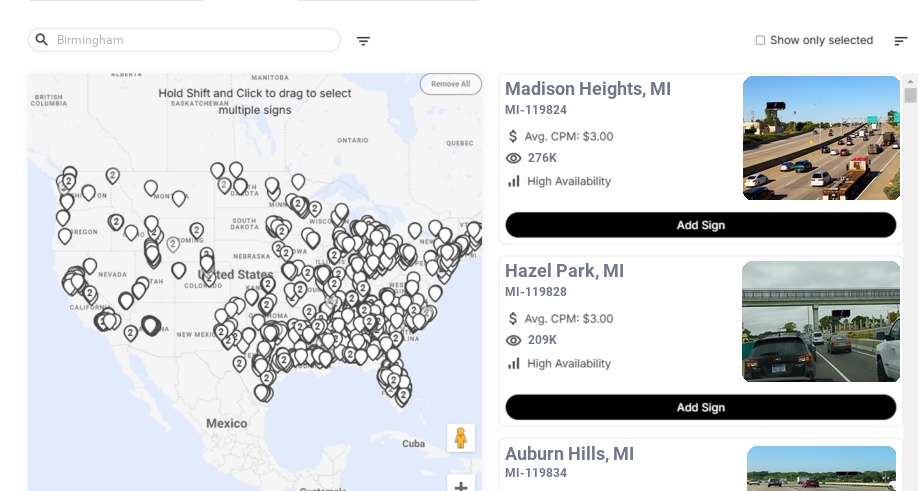
There are 32 digital billboards near Birmingham serving the area from nearby communities like Royal Oak, Oak Park, Madison Heights, Hazel Park, Auburn Hills, Warren, and Center Line. These locations sit along or near major arteries that Birmingham residents and visitors use daily, including I-75, I-696, M-59, and Woodward Avenue. By using Blip’s flexible buying tools, you can concentrate impressions on the times and corridors most relevant to Birmingham-area audiences, without needing boards physically inside the Birmingham city limits.
What kind of people will see Birmingham, Michigan billboards with Blip?
Birmingham sits at the heart of one of metro Detroit’s most affluent and active corridors, so billboards can reach high-income residents, white-collar commuters, shoppers, and visitors. Birmingham’s median household income is typically reported in the $145,000–$155,000 range, and more than 75–80% of adult residents hold a bachelor’s degree or higher. The area is also known for high discretionary spending on dining, fashion, auto, home improvement, and travel.
When is the best time to run a billboard campaign near Birmingham, Michigan?
Because Blip lets you schedule blips by time of day and day of week, timing strategy is crucial in this market. Morning commute runs from 6:30–9:30 a.m. and evening commute runs from 3:30–7:00 p.m., both of which are effective for reaching Birmingham-area commuters. Friday–Sunday evenings and weekend days are also strong for dining, entertainment, shopping, and family traffic.
What corridors get the most traffic for Birmingham, Michigan billboard advertising?
Traffic volumes on the key routes around Birmingham are significant. I-75 in adjacent segments typically ranges between 130,000 and 180,000 vehicles per day, I-696 carries about 150,000–170,000 on busier segments, M-59 near Auburn Hills sees 90,000–110,000, and Woodward Avenue near Birmingham and Royal Oak commonly sees 30,000–50,000 daily. These corridors help your message intersect tens of thousands of daily Birmingham-area commutes.
Do I need a contract to advertise with Blip near Birmingham?
No, Blip has no long-term contracts or minimum commitments. You can start, pause, or stop your campaign at any time.
How fast can I launch a billboard campaign with Blip near Birmingham?
You can have your campaign live in minutes. Create a free account, select your locations, set your budget, upload your design, and start running once approved.
Where can I advertise with Blip near Birmingham?
Blip has digital billboards near Birmingham. You can browse available locations on a map, choose the ones that fit your audience, and start advertising right away.
Still have questions? Launch a campaign in minutes — no contracts, no commitments.
Start Your CampaignBirmingham Billboard Advertising Guide
Birmingham, Michigan sits at the heart of one of metro Detroit’s most affluent and active corridors. With 32 digital billboards near Birmingham serving the area from nearby communities like Royal Oak, Oak Park, Madison Heights, Hazel Park, Auburn Hills, Warren, and Center Line, we can help you put your message in front of high-income residents, white‑collar commuters, shoppers, and visitors who move through this compact but powerful market every day.
Understanding the Birmingham Area Market
Birmingham is a city of just over 21,000 residents, but it punches far above its size economically and culturally. Recent estimates show:
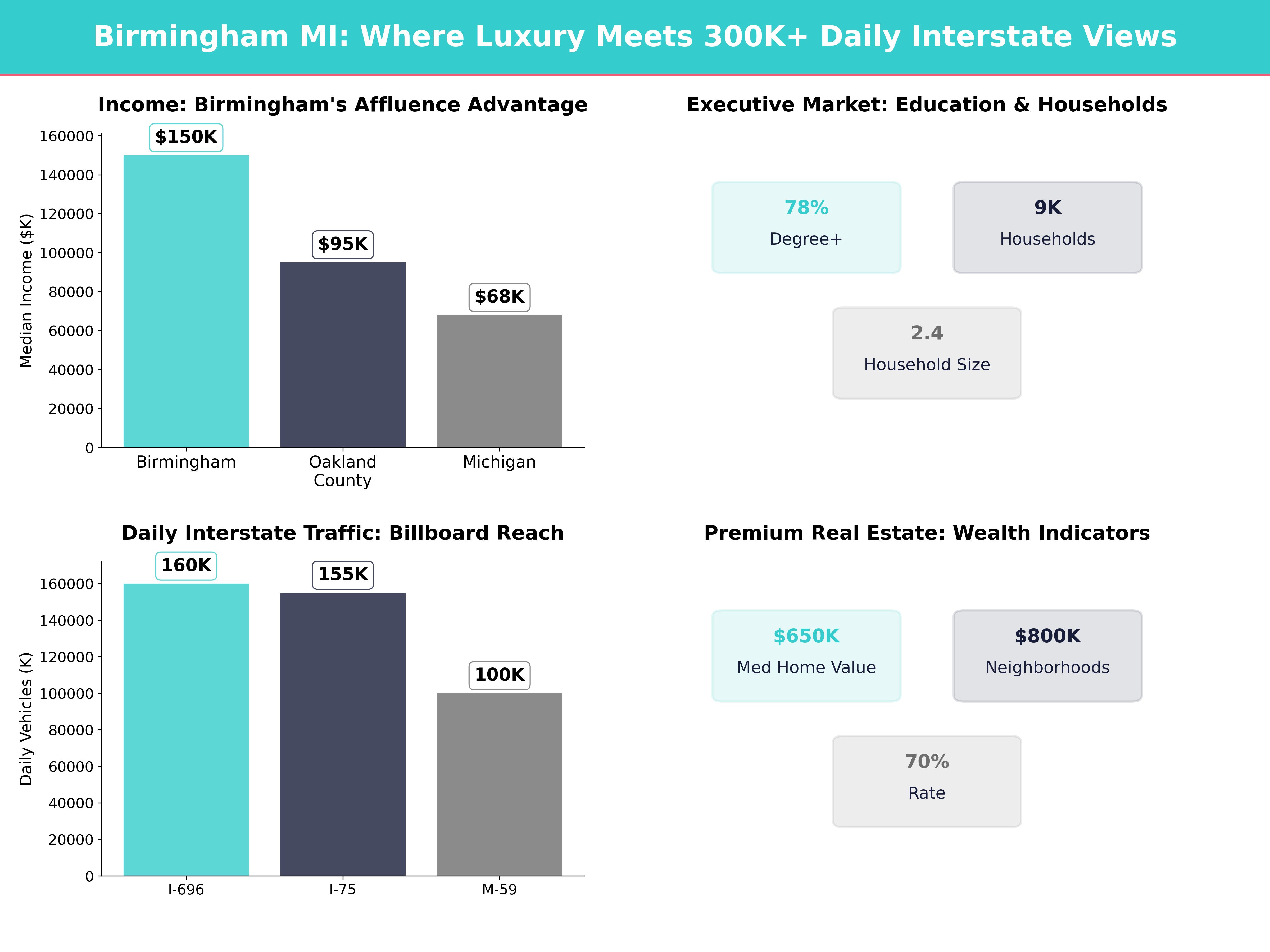
- Birmingham’s population is approximately 21,700, with about 9,000 households and an average household size of around 2.4 people, creating a dense base of potential customers in a compact 4.8‑square‑mile city.
- Birmingham’s median household income is typically reported in the $145,000–$155,000 range, more than double the Michigan median (around $68,000) and roughly 55–65% higher than the broader Oakland County median (around $90,000–$100,000).
- Median home values in Birmingham are commonly reported in the $600,000–$700,000 range, with many neighborhoods exceeding $800,000, underscoring strong spending power and significant home‑equity wealth.
- More than 75–80% of adult residents hold a bachelor’s degree or higher, creating a highly educated consumer base that tends to research purchases, value expertise, and respond to brand reputation.
- Birmingham is part of Oakland County
The city’s official site, the City of Birmingham and the Downtown Birmingham Principal Shopping District
- High discretionary spending on dining, fashion, auto, home improvement, and travel, with local household consumer expenditures significantly above state averages.
- Strong demand for professional services (financial, legal, real estate, medical, specialty clinics), supported by a large white‑collar workforce.
- A consumer base that is brand‑aware and values quality, aesthetics, and local reputation, reinforced by top‑performing Birmingham Public Schools and strong neighborhood civic engagement.
Because Birmingham is relatively compact, the real power of billboard advertising near Birmingham comes from reaching residents and visitors as they move along key commuting, shopping, and entertainment corridors that link Birmingham to its neighbors.
Where Our Billboards Reach the Birmingham Area
Our 32 digital Birmingham billboards serving the area are positioned in nearby cities within roughly 10 miles:
- Royal Oak (about 4.5 miles) – a vibrant downtown and nightlife hub, promoted by Downtown Royal Oak.
- Oak Park (about 4.8 miles) – a dense, diverse suburb accessible via the City of Oak Park.
- Madison Heights (about 6.7 miles) – a major retail and light‑industrial corridor, detailed at the City of Madison Heights.
- Hazel Park (about 7.9 miles) – home to gaming and entertainment venues, highlighted by the City of Hazel Park.
- Auburn Hills (about 8.3 miles) – a major employment and retail center with corporate campuses and Great Lakes Crossing Outlets, promoted by the City of Auburn Hills
- Warren (about 9.3 miles) – Michigan’s third‑largest city with major industrial and defense employers, featured on the City of Warren
- Center Line (about 9.8 miles) – a compact, centrally located community, covered by the City of Center Line.
These locations sit along or near major arteries that Birmingham residents and visitors use daily, including:
- I‑75 (north–south spine carrying Detroit–Troy–Auburn Hills traffic)
- I‑696 (east–west connector between Southfield and Warren)
- M‑59 (near Auburn Hills, linking Oakland and Macomb counties)
- Woodward Avenue (M‑1), the iconic corridor that runs directly by Birmingham and through Royal Oak and Detroit
Traffic volumes on these routes are significant, according to Michigan Department of Transportation SEMCOG
- Average Annual Daily Traffic (AADT) on I‑75 in adjacent segments typically ranges between 130,000 and 180,000 vehicles per day, with many peak segments above 160,000.
- I‑696 carries in the range of 150,000–170,000 vehicles per day on busier segments between Southfield and Warren.
- M‑59 near Auburn Hills routinely records 90,000–110,000 vehicles per day on key stretches.
- Woodward Avenue segments near Birmingham and Royal Oak commonly see 30,000–50,000 vehicles daily, with weekend and event periods pushing volumes even higher.
By using Blip’s flexible buying tools for billboard rental near Birmingham, you can concentrate impressions on the times and corridors most relevant to Birmingham‑area audiences, without needing boards physically inside the Birmingham city limits.
Key Audience Segments in the Birmingham Area
The Birmingham area offers a mix of audiences that many brands try to reach:
-
Affluent Suburban Families and Professionals
- In many Birmingham neighborhoods, homeownership rates exceed 70%, and median home values run well above $500,000, with a substantial share of properties above $750,000.
- A large majority of employed residents work in management, business, science, legal, healthcare, and financial roles, feeding into office clusters in Troy, Southfield, downtown Detroit, Auburn Hills, and along the I‑75 corridor.
- Typical weekday traffic counts of 130,000–180,000 vehicles on I‑75 and 150,000+ on I‑696 mean your message can intersect tens of thousands of daily Birmingham‑area commutes, making billboards in Royal Oak, Oak Park, Madison Heights, Hazel Park, and Warren particularly valuable.
-
Shoppers and Diners
- Downtown Birmingham and neighboring downtown Royal Oak attract regional visitors for dining, boutiques, salons, and entertainment. Event calendars from the City of Birmingham and Downtown Royal Oak regularly list dozens of events per month in peak seasons.
- The Birmingham Bloomfield Chamber and All In Birmingham Bloomfield Hills, Troy, and West Bloomfield Township.
- These consumers typically have household incomes above $120,000 and respond well to offers for luxury goods, experiences, and local services that emphasize quality and convenience.
-
Auto, Tech, and Engineering Workforce
- The Detroit region remains a global automotive and mobility hub. Auburn Hills alone hosts thousands of engineering, R&D, and corporate workers at automotive OEM and supplier facilities, as documented by the City of Auburn Hills
- Many engineers and professionals live in Birmingham‑area neighborhoods and commute along I‑75 and M‑59, contributing to the 90,000–110,000 daily vehicles on M‑59 and the six‑figure volumes on I‑75.
- This audience skews highly educated and tech‑savvy, making them strong targets for advanced manufacturing, SaaS, B2B services, and higher‑end consumer products.
-
Visitors and Event‑Driven Traffic
- The Woodward corridor is home to well‑known events like the Woodward Dream Cruise, which can draw over 1 million visitors in a single weekend, adding significant spikes in traffic through nearby Royal Oak, Hazel Park, and surrounding communities.
- Seasonal events in downtown Birmingham (art fairs, holiday markets, summer concerts) often attract thousands of attendees over a weekend; these are frequently promoted via local news outlets and regional tourism resources like Visit Detroit.
- Nearby attractions, parks, and golf courses promoted by Oakland County Parks
Understanding which of these groups matters most for your business will guide when and where to focus your Blip campaign and which Birmingham billboards will be most effective.
Optimal Times to Run Campaigns Near Birmingham
Because we can schedule your blips by time of day and day of week, timing strategy is crucial for this market.
Weekday Commuters (Mon–Fri)
- Morning commute (6:30–9:30 a.m.): Regional traffic data show that peak hour volumes on I‑75 and I‑696 can reach 8,000–10,000 vehicles per lane, per day, during morning rush. This window is ideal for professional services, healthcare, coffee shops, quick breakfast options, financial institutions, and B2B brands. You’re reaching white‑collar workers on I‑75 and I‑696 heading toward Troy, Detroit, Southfield, and Auburn Hills.
- Evening commute (3:30–7:00 p.m.): Evening peak periods commonly account for 30–35% of daily traffic on regional freeways. This is effective for retail, restaurants, fitness, grocery, home services, and local entertainment. Residents are thinking about where to eat, shop, and unwind as they head back toward the Birmingham area.
Midday and Early Afternoon (10:00 a.m.–3:00 p.m.)
- Midday traffic volumes typically represent 25–30% of daily freeway use, with slightly lower speeds and more discretionary trips. This is great for targeting stay‑at‑home parents, retirees, and flexible professionals who frequent downtown Birmingham shops and services.
- Use these slots for promotions from boutiques, salons, spas, medical offices, and real estate professionals that rely on daytime appointments.
Evenings and Weekends
- Friday–Sunday evenings can see 10–20% higher volumes on retail‑adjacent arterials like Woodward Avenue and local main streets, especially near downtown Royal Oak and entertainment venues in Hazel Park. These are prime for dining, bars, theaters, and event‑driven promotions.
- Weekend days attract shoppers and families to downtown Birmingham, major malls like Somerset Collection Troy, and big‑box retail in Madison Heights and Warren. Weekend highway traffic remains strong, frequently at 70–85% of weekday volumes, making it a strong time for larger‑ticket purchases, home improvement, and auto offers.
Blip allows you to shift your budget dynamically. For instance, an upscale restaurant might run 70% of its impressions between 3:00–8:00 p.m. Thursday–Saturday near Royal Oak and Madison Heights, while a financial advisor might push 80% of their impressions 7:00–9:00 a.m. and 4:00–6:00 p.m. Monday–Friday on routes serving Birmingham‑area commuters.
Matching Creative Strategy to Birmingham’s Demographics
Because Birmingham‑area consumers are design‑savvy and brand‑attuned, your creative needs to reflect that.
1. Use Clean, Sophisticated Design
- Favor minimalist layouts, ample white space, and high‑contrast typography.
- Limit copy to 7–9 words; at 60–70 mph, drivers have roughly 3–6 seconds to absorb your message, and eye‑tracking studies show recall drops sharply beyond 10–12 words.
- Use professional photography or clean vector graphics—avoid cluttered, “bargain‑bin” visuals that clash with Birmingham’s upscale feel and the expectations of a consumer base where 3 in 4 adults have a college degree.
2. Highlight Quality, Expertise, and Trust
Given the high education and income levels:
- Emphasize credentials (“Board‑Certified,” “Over 20 Years Serving Oakland County,” “Top‑Rated in Metro Detroit”).
- For professional services (law, finance, medical, real estate), feature a strong brand mark, a concise value statement, and a direct call to action, as these categories often command high‑ticket transactions and multi‑year client relationships.
- Include subtle signals of prestige (awards, “As featured in” with local media logos like The Detroit News or Detroit Free Press, where applicable and truthful).
3. Align Offers with High Discretionary Spend
- Think “premium,” not “cheap.” For example, “Custom Kitchens, Designed in Birmingham” rather than “Lowest Price Cabinets.”
- Use specific, aspirational benefits: “Transform Your Bloomfield Hills Home,” “Drive the Luxury You Deserve,” “Private, Concierge Dentistry Near Birmingham.”
- Consider anchoring offers in realistic price points for the area—many local households comfortably make five‑figure discretionary purchases (luxury vehicles, major renovations, private school tuition) when value is demonstrated.
4. Tailor Messaging by Direction and Context
- Southbound commuters leaving Birmingham in the morning (toward Detroit/Southfield): emphasize daytime services near downtown Birmingham they’ll return to later (“Tonight: Reserve Your Table in Downtown Birmingham”).
- Northbound or returning commuters in the evening: emphasize local dining, retail, and home services close to Birmingham (“Tonight: Dinner on Maple & Old Woodward”).
- Near Auburn Hills and Warren: highlight B2B services, tech, industrial suppliers, and corporate services that cater to the automotive and manufacturing ecosystem, recognizing the tens of thousands of workers entering and leaving these hubs each day.
Geographic Targeting Strategy Around Birmingham
We can reach Birmingham‑area residents by focusing on the corridors they use daily. Consider a layered geographic approach:
Core Birmingham Commuter Ring (0–6 miles)
- Focus on Royal Oak, Oak Park, Madison Heights.
- Capture traffic traveling along I‑75, I‑696, and segments feeding into Woodward. Many of these short‑haul commutes are under 20 minutes but repeated 5 days a week, leading to high billboard frequency and recall.
- Best for businesses physically located in or very near Birmingham (restaurants, boutiques, salons, medical practices, local banks) that draw from a primary trade area of 3–6 miles and benefit most from billboards near Birmingham that stay top of mind.
Regional Employment and Shopping Ring (6–10 miles)
- Add Auburn Hills, Hazel Park, Warren, Center Line.
- Target Birmingham‑area professionals going to corporate campuses, tech hubs, and large retailers. Warren, for example, has more than 130,000 residents and tens of thousands of industrial and defense jobs, while Auburn Hills is home to major automotive and retail employment centers.
- Effective for brands that serve multiple suburbs (healthcare systems, colleges, auto dealers, home improvement, and regional attractions) whose customer base stretches across Oakland and Macomb counties.
Because Blip allows you to choose specific boards and adjust bids, you might:
- Start with a concentrated set of boards in Royal Oak and Madison Heights to prove impact on Birmingham‑area traffic and establish baseline metrics.
- Gradually layer in Auburn Hills and Warren as your campaign scales to reach more of the commuting workforce and expand your trade area.
- Rotate creative variations by board cluster (e.g., “Just Minutes from Downtown Birmingham” vs. “Serving Oakland & Macomb County”) to reflect realistic drive times—many Birmingham‑to‑Royal Oak trips are under 10 minutes, while Birmingham‑to‑Auburn Hills or Warren typically runs 15–25 minutes in normal traffic.
Seasonal and Event‑Driven Opportunities
Birmingham and its surrounding communities have distinct seasonal patterns and tentpole events that you can leverage:
Spring (March–May)
- Home buying and renovation season accelerates; in many Oakland County markets, 30–40% of annual home listings occur between March and June. Promote real estate agents, mortgage brokers, landscapers, contractors, and interior designers near Birmingham‑area traffic.
- Outdoor dining and events resume; restaurants and entertainment venues should ramp up presence on Thursday–Sunday. Downtown Birmingham’s event calendars often feature weekly or bi‑weekly activities once the weather warms.
- Spring break and graduation planning increase demand for travel services, event venues, and specialty retail.
Summer (June–August)
- Festivals, art fairs, and outdoor events in Birmingham and Royal Oak drive increased leisure traffic. Check local calendars from the City of Birmingham and All In Birmingham
- Auto and motorsport brands can tap into excitement around the Woodward Dream Cruise, which has historically drawn 1–1.5 million spectators along a 16‑mile stretch of Woodward.
- Summer can account for 25–30% of annual tourism‑driven activity in the metro area, according to regional tourism data from Visit Detroit, boosting the value of visibility on major corridors.
Fall (September–November)
- Back‑to‑school and financial planning season. Focus on private schools, tutoring services, colleges, and financial advisors—many families finalize education choices and review budgets in this window.
- Real estate and home services can capture fall sellers and pre‑winter improvement projects; often, 20–25% of annual home transactions in suburban markets occur in late summer and fall.
- Sports seasons (high school, college, and pro) spur demand for dining, bars, and family entertainment.
Winter and Holidays (November–February)
- Upscale retail, jewelry, and gifting thrive. Holiday sales can account for 20–30% of annual revenue for many retailers, making November–December a crucial period for visibility near Birmingham and Royal Oak shopping districts.
- Service providers can promote year‑end offers and new‑year transitions (fitness, healthcare, financial planning, legal services, home organization), capitalizing on the surge of resolutions and benefits renewals in December–January.
- Even with winter weather, freeway traffic remains strong, and early‑dark evenings (4:30–5:00 p.m. sunsets) increase the impact of illuminated digital billboards.
With digital billboard advertising near Birmingham, you can schedule seasonal creative to appear only during key windows (e.g., a 4‑week pre‑event blitz, a 6‑week holiday push), maximizing relevance and budget efficiency.
Integrating Billboards with Local Media and Digital Channels
To fully capitalize on impression‑rich Birmingham‑area traffic, coordinate your Blip campaigns with other channels:
- Local News and Lifestyle Media: If you advertise or receive coverage in outlets like The Oakland Press, Hometown Life – Birmingham, or Detroit‑area TV stations such as WXYZ‑TV Channel 7, echo the same tagline or visual motif on your billboards. Consistent creative across channels can increase brand recall by 20–30% in many multi‑channel campaigns.
- Search and Social Advertising: Use billboard messages that mirror your primary search keywords (“Birmingham Cosmetic Dentist,” “Birmingham Luxury Realtor”). Studies of cross‑channel campaigns often show higher click‑through rates when users have seen the brand offline within the previous 24–72 hours.
- Website and Landing Pages: Create Birmingham‑specific landing pages and mention them in your creative (“Learn More: OakStreetLegal.com/Birmingham”). Geo‑targeting in your web analytics can help you measure uplift in traffic from Birmingham‑area users during your Blip campaign periods.
- Events and Sponsorships: When sponsoring local events, amplify that partnership on nearby boards (“Proud Sponsor of [Event Name] in Birmingham”) to cement your community presence and increase event awareness. Pairing on‑site sponsorship with billboards and local media can lift event attendance and engagement by double‑digit percentages.
Measuring and Optimizing Campaign Performance
While billboards are a top‑funnel medium, you can still measure and refine your strategy:
-
Use Unique URLs, QR Codes, or Offer Codes
- Create short, memorable URLs or specific promo codes only used on your billboard creative.
- While QR code usage in a driving environment is limited, they can be effective on boards near slower traffic or parking lots; just ensure they are large, high‑contrast, and simplified to limit scanning time.
-
Track Birmingham‑Area Web and Store Activity
- Monitor changes in website sessions, form fills, and calls from Birmingham‑area ZIP codes during and after your campaign.
- Retailers and restaurants can watch for lifts in foot traffic or revenue in the weeks your boards run; even a 5–10% increase in same‑store sales during a campaign period can represent a strong ROI relative to billboard spend.
-
Test Multiple Creatives
- Use Blip to rotate 2–4 versions of your artwork.
- Test different headlines (brand‑focused vs. offer‑focused), calls to action (“Call Today” vs. “Book Online”), and imagery (product vs. people).
- Over time, favor the creatives that align with periods of improved leads, calls, or sales. Many advertisers find that incremental optimizations can improve response rates by 15–30% over the life of a campaign.
-
Adjust Board Mix and Time Windows
- If you notice better results when targeting commuters, shift budget toward rush‑hour windows and high‑traffic highway boards near I‑75, I‑696, and M‑59.
- If you’re promoting weekend experiences or retail, emphasize boards and times where weekend traffic is highest (Friday–Sunday near Royal Oak, Hazel Park, and Auburn Hills).
- Review performance at least monthly to re‑allocate impressions toward the corridors and dayparts that line up with your most valuable customer actions.
Types of Businesses That Can Thrive on Billboards Near Birmingham
Because of the Birmingham area’s affluence, commuting patterns, and regional role, certain categories are especially well‑suited for Blip campaigns:
- Professional and Financial Services: Law firms, wealth managers, accountants, insurance agencies, consultants—particularly those targeting households with $150,000+ incomes and significant investable assets.
- Healthcare and Wellness: Specialists, dentists, cosmetic surgeons, orthopedics, behavioral health, fitness studios. Many Birmingham‑area consumers are willing to travel 10–20 minutes for higher‑quality care, opening opportunities across the full 10‑mile ring.
- Real Estate and Home Services: Realtors, mortgage brokers, architects, remodelers, landscapers, roofing and HVAC companies, interior designers. With median home values well above state averages, even modest share‑of‑market gains can drive high revenue.
- Retail and Luxury Goods: Jewelers, boutiques, auto dealers (especially luxury and performance brands), home furnishings, specialty food and wine. Proximity to affluent neighborhoods and high‑traffic retail corridors amplifies exposure.
- Education and Enrichment: Private schools, tutoring centers, music and arts programs, test prep. Families in Birmingham and surrounding communities often invest heavily in enrichment activities and supplemental education.
- Hospitality and Entertainment: Restaurants, cafes, bars, event venues, theaters, regional attractions. Event‑driven and weekend leisure traffic, combined with strong weekday commuter flows, keeps these boards working all week.
If your business depends on reputation, trust, and perceived quality, the Birmingham area’s demographics and commuting routes make digital billboard advertising near Birmingham a powerful complement to your other marketing channels.
Bringing It All Together
With 32 digital billboards serving the Birmingham area from nearby cities like Royal Oak, Oak Park, Madison Heights, Hazel Park, Auburn Hills, Warren, and Center Line, we can help you:
- Reach affluent, educated consumers during their daily commutes and leisure trips across corridors that carry well over 100,000 vehicles per day.
- Tailor your schedule to the exact times your audience is most active, from peak commuter windows to high‑traffic weekends and event periods.
- Align creative with Birmingham’s upscale, design‑conscious aesthetic and high expectations for professionalism and quality.
- Layer campaigns around seasonal events, local happenings, and regional patterns documented by resources such as the City of Birmingham, All In Birmingham Visit Detroit.
- Integrate with local media and digital channels to reinforce your brand and create measurable lift in web traffic, inquiries, and in‑store visits.
By combining local geographic insight with Blip’s flexible, data‑driven platform for billboard rental near Birmingham, you can build a Birmingham‑area billboard strategy that not only looks good on the road, but also moves the needle for your business.