Billboards in Dearborn Heights, MI
No Minimum Spend. No Long-Term Contracts. Just Results.
Trusted by Leading Brands


Billboard advertising
in Dearborn Heights has never been easier



How much is a billboard in Dearborn Heights?
Why Choose Blip for Billboard Advertising in Dearborn Heights
Blip lets you launch on Dearborn Heights commuter corridors like I-94, I-75, and M-39 in minutes—no traditional setup delays.
Set a budget for Dearborn Heights and let Blip keep spend in bounds while you reach Ford Road, Telegraph, and Michigan Avenue traffic.
Daypart your Dearborn Heights ads for 6:30-9 a.m. and 3:30-6:30 p.m. to catch commuters, airport workers, and school pickups.
No contracts means you can test Dearborn Heights billboards during Ramadan, Eid, or Detroit game nights, then shift fast if needed.
Track Dearborn Heights performance in real time and optimize for shifts on I-94, DTW routes, and Westland shopping traffic.
Use Blip's creative tools to tailor Dearborn Heights ads for Arabic-English audiences, auto workers, and family shoppers fast.
Frequently Asked Questions About Billboard Advertising in Dearborn Heights
How much does a billboard cost near Dearborn Heights, Michigan with Blip?
With Blip, you set your own daily budget for Dearborn Heights billboards, and our system automatically keeps your digital ads within that amount, so you stay in control while reaching drivers in the Dearborn Heights area. Each “blip” is a brief 7.5 to 10-second display, and you only pay for the blips you receive, making billboards near Dearborn Heights, Michigan accessible even on a small budget. Pricing per blip varies based on time, location, and advertiser demand, and your total campaign cost is simply the sum of all your blips.
Where can I place Blip billboards near Dearborn Heights, Michigan?
Our 24 digital billboards serving the Dearborn Heights area are positioned in nearby Romulus, Allen Park, Detroit, and Westland—cities that surround Dearborn Heights and capture its commuting flows. This layout gives local businesses practical access to Dearborn Heights billboards without needing inventory on every single city block. Key corridors nearby include I-94, I-75, Southfield Freeway (M‑39), Telegraph Road, Michigan Avenue, and Ford Road.
What kind of traffic do Dearborn Heights, Michigan billboards with Blip reach?
Dearborn Heights sits at the heart of one of Michigan’s busiest commuter corridors, surrounded by major freeways, shopping districts, and Detroit Metropolitan Wayne County Airport traffic. In practice, single freeway-facing digital boards along I‑94, I‑75, and M‑39 routinely see 350,000–750,000 weekly impressions based on typical traffic volumes and occupancy. This combination of stable residential neighborhoods and heavy commuter and visitor traffic makes the Dearborn Heights area ideal for campaigns focused on frequency, local brand-building, and time-sensitive offers.
When is the best time to run Blip ads near Dearborn Heights, Michigan?
Weekday commute patterns are especially important near Dearborn Heights, with morning traffic from 6:30–9:00 a.m. and afternoon school and work traffic from 2:30–6:30 p.m. Evenings and weekends also matter, since dinner, shopping, and entertainment trips can keep traffic elevated into the 10–11 p.m. hour on event nights, and weekend days can account for 35–40% of weekly retail foot traffic. Shift-work and overnight audiences can be reached during 10:00 p.m.–5:00 a.m., when inventory often has less demand and may deliver more impressions per dollar.
Who do Dearborn Heights, Michigan billboards with Blip reach?
Dearborn Heights is a mature, largely residential city in western Wayne County with strong ties to Detroit’s employment base and nearby automotive and logistics hubs, which is why Dearborn Heights billboards perform well for both neighborhood-facing and regional campaigns. Common audience segments include commuter families, auto and manufacturing workers, airport and logistics employees, culturally diverse households, and shoppers and diners. The surrounding corridor that includes Dearborn, Dearborn Heights, and Detroit has one of the nation’s highest concentrations of Arab American residents, alongside sizable Black, Latino, and Eastern European communities.
Do I need a contract to advertise with Blip in Dearborn Heights?
No, Blip has no long-term contracts or minimum commitments. You can start, pause, or stop your campaign at any time.
How fast can I launch a billboard campaign with Blip in Dearborn Heights?
You can have your campaign live in minutes. Create a free account, select your locations, set your budget, upload your design, and start running once approved.
Where can I advertise with Blip in Dearborn Heights?
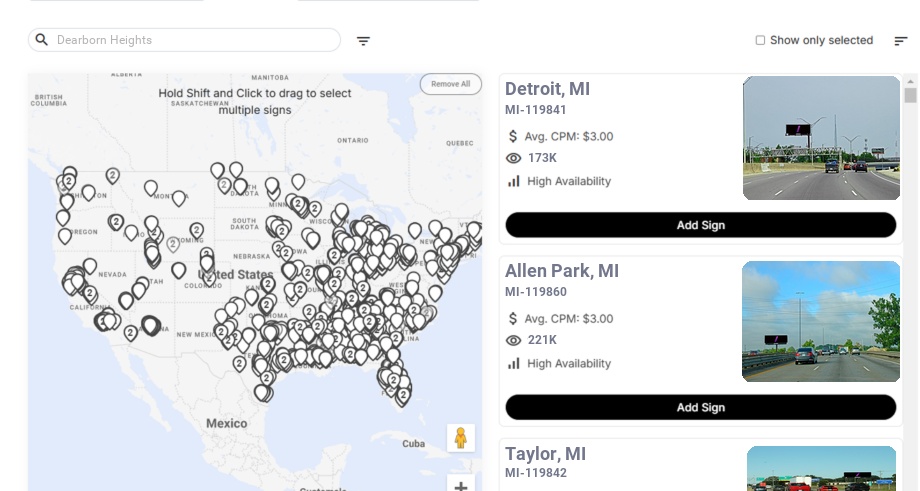
Blip has digital billboards in Dearborn Heights. You can browse available locations on a map, choose the ones that fit your audience, and start advertising right away.
Still have questions? Launch a campaign in minutes — no contracts, no commitments.
Start Your CampaignDearborn Heights Billboard Advertising Guide
Dearborn Heights sits at the heart of one of Michigan’s busiest commuter corridors, surrounded by major freeways, shopping districts, and Detroit Metropolitan Wayne County Airport traffic. With 24 digital billboards serving the Dearborn Heights area from nearby Romulus, Allen Park, Detroit, and Westland, we can help you tap into hundreds of thousands of daily impressions with flexible, data-informed campaigns tailored to this community. For advertisers specifically looking for billboards near Dearborn Heights, this surrounding ring of inventory functions as a highly efficient local network rather than isolated placements. In practice, single freeway-facing digital boards along I‑94, I‑75, and M‑39 routinely see 350,000–750,000 weekly impressions based on typical traffic volumes and occupancy, giving local advertisers sustained reach even at modest budgets.
Understanding the Dearborn Heights Area Market
Dearborn Heights is a mature, largely residential city in western Wayne County with strong ties to Detroit’s employment base and nearby automotive and logistics hubs, which is why Dearborn Heights billboards perform well for both neighborhood-facing and regional campaigns.
Key demographic and market indicators:
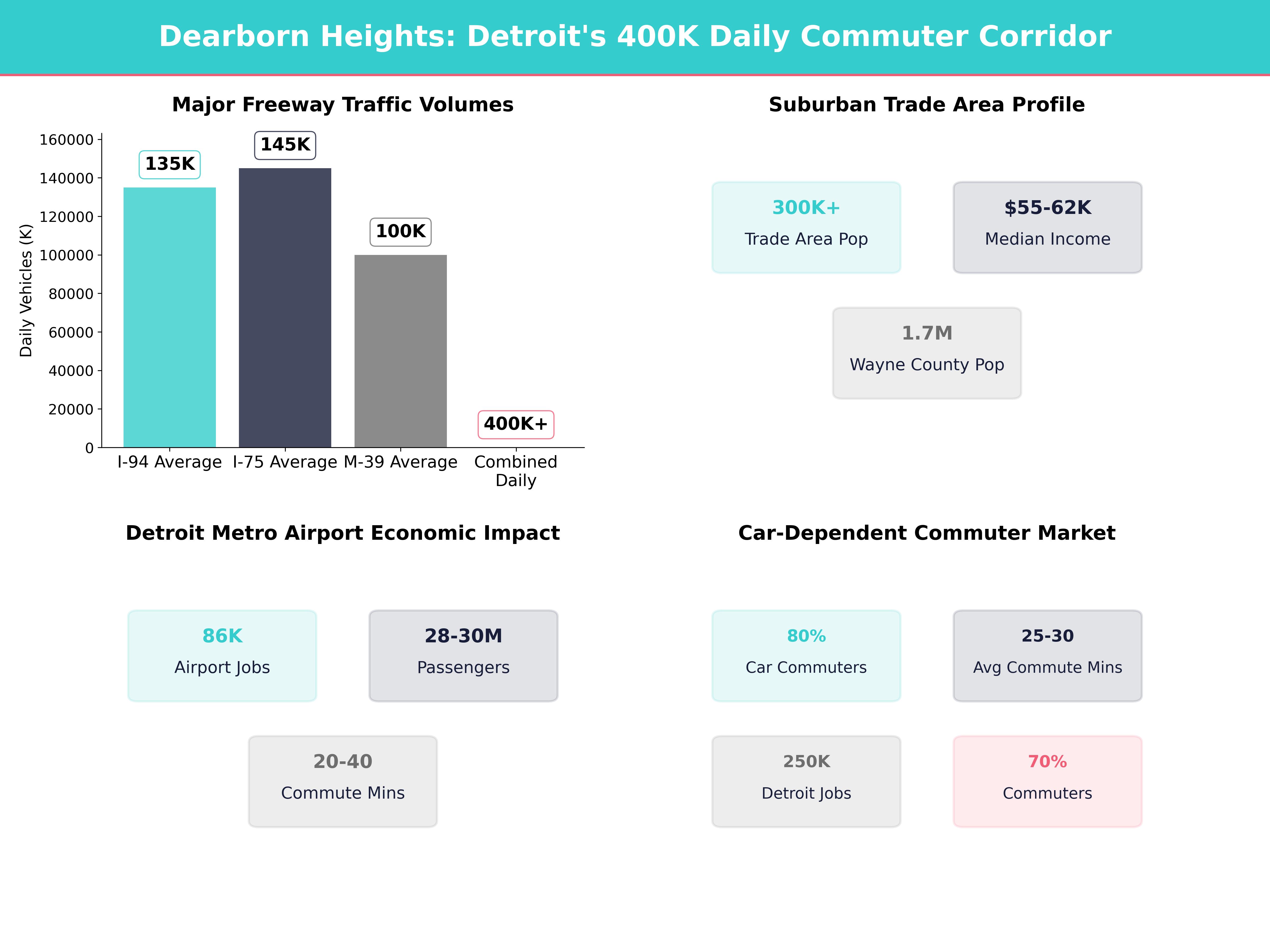
- Population: About 60,000–62,000 residents in the Dearborn Heights area, with more than 1.7 million residents in Wayne County overall, according to local and county estimates. Neighboring cities add significant density, including roughly 109,000 residents in Dearborn, 81,000 in Westland, 25,000 in Allen Park, and 25,000 in Romulus, creating a contiguous suburban trade area of over 300,000 people within a short drive.
- Age: Median age in the Dearborn Heights area is around 39–40 years, with nearly 24% under age 18, roughly 60% in the working‑age 18–64 range, and about 16% aged 65+, supporting campaigns for family services, workforce recruiting, and senior-oriented offerings.
- Households: Roughly 23,000–24,000 households, many of them multigenerational, contributing to an average household size around 2.6–2.8 people, higher than the national average of about 2.5. This favors products and services targeted at families and shared living situations.
- Income: Median household income in the Dearborn Heights area is in the $55,000–$62,000 range, with a substantial share of households in the $50,000–100,000 band. A significant portion of employed residents commute to jobs in healthcare, manufacturing, logistics, and public sector roles in nearby Detroit and suburbs such as Dearborn, Allen Park, and Romulus.
- Diversity: The surrounding corridor that includes Dearborn, Dearborn Heights, and Detroit has one of the nation’s highest concentrations of Arab American residents, alongside sizable Black, Latino, and Eastern European communities. In some nearby neighborhoods, Arabic is spoken in more than 40–50% of households, and in Detroit overall, Black residents represent over 75% of the population. Bilingual or culturally attuned creative can significantly improve response rates versus generic messaging, especially when your billboard advertising near Dearborn Heights aligns with local languages and holidays.
Local context worth noting:
- Dearborn Heights lies between major employment and retail centers in Detroit, Dearborn, Westland, and Romulus. Within a 15–20 minute drive, drivers can access major employment centers holding hundreds of thousands of jobs in manufacturing, healthcare, education, and logistics.
- The city is served by the City of Dearborn Heights government Wayne County, Detroit Metropolitan Wayne County Airport (DTW), and regional healthcare systems such as Henry Ford Health and Corewell Health East
- The broader Detroit region attracts more than 14 million visitors per year, according to Visit Detroit, and hosts well over 1,000 major events and conventions annually. Visitor peaks around major conventions, auto shows, and sports seasons create noticeable spikes in traffic on corridors that pass near the Dearborn Heights area.
This combination of stable residential neighborhoods and heavy commuter and visitor traffic makes the Dearborn Heights area ideal for campaigns focused on frequency, local brand-building, and time-sensitive offers, and it underpins the strong performance of digital billboards near Dearborn Heights.
Traffic Flows and Where Our Billboards Fit
Our 24 digital billboards serving the Dearborn Heights area are positioned in nearby Romulus, Allen Park, Detroit, and Westland—cities that surround Dearborn Heights and capture its commuting flows. This layout gives local businesses practical access to Dearborn Heights billboards without needing inventory on every single city block.
Important traffic corridors and volumes near the Dearborn Heights area:
- I-94 (Detroit–Ann Arbor Freeway) – Running just south of the Dearborn Heights area and through Romulus and Allen Park. Michigan Department of Transportation (MDOT) 120,000 to more than 150,000 vehicles per day on key segments near the airport and Detroit, generating 3.6–4.5 million vehicle trips per month.
- I-75 – Running through Detroit and Allen Park, carrying north–south regional and freight traffic. MDOT reports many segments in south Detroit carrying over 130,000–160,000 vehicles per day, with truck traffic often accounting for 10–15% of volume—ideal for logistics, B2B, and recruitment messages.
- Southfield Freeway (M‑39) – A critical north–south artery just east of the Dearborn Heights area, with daily volumes frequently in the 90,000–110,000 vehicles per day range near Dearborn and Allen Park. That equates to roughly 2.7–3.3 million vehicle trips per month along key segments where digital boards are visible.
- Telegraph Road (US‑24) – A major commercial corridor bordering the Dearborn Heights area to the west, serving big-box retail, auto dealers, and dining; key segments can see 50,000+ vehicles per day, particularly near major intersections like Ford Road and Michigan Avenue.
- Michigan Avenue (US‑12) and Ford Road (M‑153) – High-intensity east–west retail and commuter corridors connecting Dearborn, Dearborn Heights, and Westland, each serving 30,000–50,000+ vehicles daily on busy stretches, according to local traffic studies. These roads funnel shoppers to large-format retail nodes and neighborhood businesses alike and are prime corridors for billboard advertising near Dearborn Heights.
By placing screens:
- In Romulus (6.0 miles from Dearborn Heights) we reach DTW airport traffic and logistics workers. Detroit Metropolitan Airport handled 28–30 million passengers in 2023 and more than 360,000 aircraft operations annually, as well as over 300,000 metric tons of air cargo, creating steady flows of travelers, employees, and airport-related services on I‑94 and surface streets.
- In Allen Park (6.1 miles from Dearborn Heights) we capture I‑94, I‑75, and M‑39 commuters heading to and from Detroit, Downriver communities, and Dearborn/Dearborn Heights. Daily traffic on Allen Park-adjacent segments of these freeways can exceed 350,000 combined vehicles, making the area one of the densest freeway junctions in Wayne County for digital billboard rental near Dearborn Heights.
- In Detroit (7.3 miles from Dearborn Heights) we intersect downtown and Midtown-bound commuters, event-goers, and regional visitors. City of Detroit data notes more than 250,000 jobs in the city, with over 70% of workers commuting in from the suburbs. Major venues such as Ford Field, Comerica Park, and Little Caesars Arena together can draw 100,000+ attendees on a single busy sports night.
- In Westland (7.3 miles from Dearborn Heights) we reach shoppers and workers along Ford Road and Wayne Road, a key retail corridor for residents of the Dearborn Heights area. The City of Westland highlights more than 1,600 businesses and the “All American City” as one of Michigan’s larger retail hubs.
With Blip, we can sequence your blips (ad rotations) along likely commute paths—such as Westland → Dearborn Heights → Dearborn/Detroit in the morning and the reverse in the evening—to maximize repeated exposure. This approach effectively turns multiple billboards near Dearborn Heights into a single, coordinated campaign route. Reaching the same driver 2–4 times per week along their regular route can dramatically increase recall compared with a single isolated impression.
Who You’re Reaching in the Dearborn Heights Area
Designing effective billboard creative starts with a clear understanding of who is actually on the road.
Common audience segments in the Dearborn Heights area:
-
Commuter Families
- Local and regional surveys indicate that more than 80% of workers in the Dearborn Heights area commute by car, with average commute times near 25–30 minutes each way.
- Many households have multiple employed adults, often commuting toward Dearborn, Detroit, or the airport area.
- Peak drive times typically align with 6:30–9:00 a.m. and 3:30–6:30 p.m. on weekdays, matching school and office schedules.
- Message implications: Quick, benefit-first copy (“Save 20% This Week on Ford Road”), family-oriented imagery, school-year promotions, and easy-to-remember URLs or phone numbers that can be read in a few seconds on Dearborn Heights billboards.
-
Auto and Manufacturing Workforce
- The Detroit region remains the heart of U.S. automotive manufacturing. Nearby facilities for Ford, Stellantis, General Motors, and tier‑1 suppliers collectively employ tens of thousands of workers within a 15–25 minute drive of Dearborn Heights.
- In the broader Detroit–Warren–Dearborn metro, manufacturing still represents more than 9–10% of total employment, a much higher share than the national average.
- Skilled trades, shift workers, and engineers often commute at non-traditional hours, including early-morning (4–7 a.m.) and late-night (10 p.m.–1 a.m.) shifts.
- Message implications: Offers for trades, training schools, auto services, and quick-service food; consider overnight or early a.m. scheduling for third-shift traffic.
-
Airport and Logistics Employees
- DTW and its surrounding logistics parks employ more than 86,000 people directly and indirectly across airlines, TSA, cargo, rental cars, ground transportation, and hospitality, according to airport and regional economic impact reports.
- Freight activity is strong: DTW and its logistics cluster support thousands of daily truck movements connecting to I‑94, I‑75, and I‑275.
- Workers commute from Dearborn Heights, Westland, Detroit, and other suburbs, many driving 20–40 minutes each way.
- Message implications: Recruiting campaigns, hospitality offers, and transportation services perform well on billboards near Romulus and along I‑94/M‑39.
-
Culturally Diverse Households
- The Dearborn/Dearborn Heights/Detroit corridor includes large Arab American, Muslim, and Black communities. Local organizations such as the Arab American National Museum tens of thousands of Arab Americans, and mosques and cultural centers like the Islamic Center of America regularly draw hundreds to thousands of attendees for major observances.
- Regional celebrations such as Ramadan and Eid see night‑time shopping, dining, and travel increase markedly in nearby commercial corridors.
-
Message implications:
- Bilingual Arabic–English or culturally resonant imagery during Ramadan, Eid, and other holidays.
- Representation matters—featuring diverse families and professionals improves relevance and can lift engagement significantly versus generic stock imagery.
-
Shoppers and Diners
- Ford Road, Michigan Avenue, and Telegraph Road serve as “main streets” for big-box retail, casual dining, and independent stores. Within a 3–5 mile radius of Dearborn Heights, drivers can access multiple regional shopping areas, including Westland Shopping Center and commercial corridors in Dearborn and Allen Park.
- Visit Detroit highlights food and culture as key draws for both residents and visitors in the region, with the metro Detroit area hosting hundreds of restaurants and cafes featuring Middle Eastern, American, and global cuisines.
- Message implications: Clear calls to action, directional cues (“Next right on Telegraph”), and time-limited offers. Evening and weekend dayparting is especially effective for this segment and should be reflected in your billboard advertising near Dearborn Heights.
Crafting Creative That Works Near Dearborn Heights
To stand out on busy freeways and arterial roads serving the Dearborn Heights area, we should design with simplicity and local resonance.
1. Keep copy ultra-short
- Aim for 7 words or fewer on the main line; drivers typically have 3–6 seconds to absorb your message.
- Use large, high-contrast fonts (e.g., white or yellow on dark blue/black, or black on bright yellow).
- Turn “Family Dental – New patients welcome” into “New Patient Special – Dearborn Heights Dentist” so travelers immediately recognize your focus on the Dearborn Heights area as they pass local billboards.
2. Localize and landmark
Residents navigate by major roads and landmarks more than by city limits:
-
Use references like:
- “On Ford Rd near Telegraph”
- “5 minutes from Southfield Fwy”
- “By Westland Mall – Ford & Wayne Rd”
- If you serve multiple locations, highlight your nearest one to the Dearborn Heights area and use simple directional arrows.
- Including a distance marker like “2 miles ahead” or “Exit now” can lift response, especially on high-speed freeways where decisions are made quickly.
3. Use culturally aware visuals
- Consider diverse models and inclusive imagery that reflect the area’s racial and cultural mix.
- For campaigns during Ramadan or Eid that target residents in the Dearborn Heights area and nearby Dearborn, try concise greetings like “Ramadan Mubarak” alongside your offer or brand.
- Align holiday creatives with local calendars promoted by community organizations and local outlets like the Press & Guide, which frequently covers Dearborn and Dearborn Heights cultural events.
4. Tie into local interests
The broader Detroit region is:
- Auto-obsessed: Car service, car wash, used cars, and accessories respond especially well to outdoor. Metro Detroit’s vehicle ownership rate is well above national averages, with many households owning 2 or more vehicles.
- Sports-driven: Highlight Lions, Tigers, Red Wings, or Pistons game days in promotions—without violating league or team trademarks—using generic phrases like “Big Game Tonight? Grab Wings on Ford Rd”. NFL games at Ford Field can draw 65,000+ fans, while Tigers games at Comerica Park and Red Wings/Pistons games at Little Caesars Arena add tens of thousands more into downtown traffic.
5. Optimize for digital
Because our billboards are digital, we can rotate multiple creatives and test:
- A/B test two messages: an offer-focused version (“$0 Enrollment This Week”) vs. a brand-focused version (“Join Dearborn Heights’ Fitness Community”).
- Rotate seasonal design: winter service specials vs. back-to-school vs. tax-time promotions.
- In many digital billboard networks, advertisers that regularly refresh creative (every 4–8 weeks) see stronger long-term recall and engagement than those that run a single static message for months.
Timing Your Blips: When to Run Ads
With Blip, you can daypart (select specific hours) and adjust budgets dynamically to line up with real-world behavior around the Dearborn Heights area.
Weekday commute patterns
-
Morning (6:30–9:00 a.m.)
- High presence of commuters heading from the Dearborn Heights area toward Dearborn, Detroit, Romulus, and Westland. Across major freeways, this window can capture 30–40% of daily traffic on some segments.
- Best for: coffee shops, quick-service breakfast, staffing/recruitment, financial services, healthcare appointments (“Call Before Work”), school enrollment.
-
Afternoon school and work traffic (2:30–6:30 p.m.)
- Parents and students on Ford Road, Telegraph, Van Born, and Inkster; commuters heading back from Detroit and Dearborn.
- Best for: family dining, retail promotions, after-school programs, entertainment venues.
- Many family-oriented businesses see 25–35% of daily revenue in this late-afternoon to early-evening block, making billboard visibility especially valuable.
Evenings and weekends
-
Evening (6:30–10:00 p.m.)
- Dinner, shopping, and entertainment trips. On event nights in Detroit or Dearborn, traffic volumes can remain elevated into the 10–11 p.m. hour along key routes.
- Target billboards near Westland retail corridors or Allen Park/Detroit event routes leading to downtown.
-
Weekends
- Heavier retail and leisure travel. Regional data shows that weekend days can account for 35–40% of weekly retail foot traffic, despite having only two days.
- Visit Detroit promotes recurring events, festivals, and sports games that draw regional visitors; schedule higher share of blips around game days and major downtown events promoted on calendars from sites like Visit Detroit and local news outlets such as the Detroit Free Press and The Detroit News.
Shift-work and overnight audiences
- Manufacturing plants, logistics centers, and airport operations run 24/7. At DTW, for example, late-night and early-morning flights and cargo operations continue around the clock.
-
We can capture second- and third-shift workers along I‑94, I‑75, and M‑39 with lower-cost impressions during late night/early morning:
- 10:00 p.m.–5:00 a.m. inventory often has less demand, helping stretch budget and sometimes delivering more impressions per dollar.
- Ideal for hiring, fast food, convenience stores, and 24-hour services such as urgent care, towing, or emergency dental.
Location Strategy: Matching Screens to Your Goals
Our 24 digital billboards serving the Dearborn Heights area give us a toolkit to match your objectives with specific surroundings, whether you’re a small business exploring billboard rental near Dearborn Heights for the first time or a regional advertiser optimizing an existing outdoor mix.
1. Brand awareness in the Dearborn Heights commuter shed
- Prioritize high-volume freeway-adjacent screens in Allen Park and Detroit to reach I‑94, I‑75, and M‑39 traffic, which together carry well over 400,000 vehicles per day through the broader corridor.
- Add Westland locations along Ford Road for repeated exposure to local shoppers, where daily traffic commonly exceeds 30,000–40,000 vehicles.
- Strategy: Run all day during weekdays to build broad familiarity. Use consistent branding but periodically refresh the offer. Aim for a frequency where your ideal customer sees your message 3–7 times per week along their usual route.
2. Local retail and service businesses
-
Focus on Westland and Allen Park for shoppers likely to travel to and from the Dearborn Heights area:
- Westland: Ford Road and Wayne Road corridors for malls, big-box stores, and restaurants, supported by thousands of parking spaces and dozens of national brands.
- Allen Park: Screens catching traffic heading toward retail and dining nodes along Southfield Freeway and Outer Drive.
- Include directional copy and distance (“2 miles ahead on Ford Rd”). Studies of out-of-home performance frequently show that including simple directional cues can boost in‑store visits by 10–20% versus brand-only messages for location-dependent businesses.
3. Airport and regional visitors
-
Use Romulus screens close to DTW to reach:
- Inbound visitors seeking hotels, car rentals, attractions, or restaurants. The airport area has more than 8,000 hotel rooms within a short shuttle ride and many travelers making last‑minute decisions.
- Airport employees open to local services or job opportunities.
- Pair these with Detroit screens along routes leading downtown or to Dearborn/Dearborn Heights to reinforce your message. Hitting travelers both near the airport and again closer to their destination can significantly increase recall and conversion, especially when your billboard advertising near Dearborn Heights features simple URLs or offers they can remember between exposures.
4. Hiring and workforce development
-
Place ads on screens along:
- I‑94 and I‑75 for regional commuters.
- M‑39 and Michigan Avenue for auto and manufacturing corridors.
- Run heavier schedules around shift changes—often 5–7 a.m., 2–4 p.m., and 10–11 p.m., depending on employer norms.
- In tight labor markets where local unemployment can dip into the 3–5% range, visible billboard hiring campaigns can differentiate your brand from competitors relying solely on online listings.
Using Blip’s Tools to Maximize Efficiency
Digital flexibility is especially powerful in a dense, multi-city market like the Dearborn Heights area, where a few carefully chosen billboards near Dearborn Heights can cover a large share of local drivers.
Budget control
- Set a total campaign budget as low or high as needed and pay per “blip” (each display of your ad).
- Raise bids during peak periods (weekday rush hours, Lions home games, big concerts) and lower them when demand is softer (late nights, some mid-day windows).
- Many advertisers find that concentrating 60–70% of spend into their highest-performing hours yields better results than evenly spreading budget across the entire day.
Dayparting
-
Choose only the hours that match your audience:
- After-school programs: 2–6 p.m. weekdays.
- Brunch spots: 9 a.m.–1 p.m. weekends.
- Hiring third-shift workers: 9 p.m.–2 a.m. around major industrial and logistics zones.
- Adjust seasonally—winter weather, school schedules, and holiday shopping can significantly shift when and where people are on the road, so your approach to billboard rental near Dearborn Heights may also change by season.
Geographic targeting
-
Select only the screens most relevant to your goal:
- Dearborn Heights resident focus: heavier concentration on Westland and Allen Park screens that sit along common commute and shopping routes.
- Visitor-focused: Romulus and Detroit screens along main access routes from DTW and downtown.
- Use local maps and traffic tools provided by agencies like MDOT
Creative rotation and testing
-
Upload multiple creatives:
- Version A: price-driven.
- Version B: brand or benefit-driven.
- Run both across the same screens and time windows to see which yields more web traffic, calls, or store visits (measured on your end).
- As a rule of thumb, gather at least 2–4 weeks of data per creative variation in a steady schedule before making major optimizations.
Strategies by Industry in the Dearborn Heights Area
Here are practical ways different advertisers can use billboards serving the Dearborn Heights area.
Local restaurants and quick service
- Location: Westland and Allen Park screens near Ford Road and Southfield Freeway, where lunchtime and dinner traffic is strong.
-
Creative:
- “Tacos on Ford Rd – Exit Now”
- “Kids Eat Free Tues – Telegraph & Van Born”
- Timing: 6–9 a.m. (coffee/breakfast), 11 a.m.–2 p.m. (lunch), 4–8 p.m. (dinner), weekend late nights for drive-thru.
- In many markets, restaurants generate 50–60% of weekly revenue from evening and weekend traffic; aligning your blips with those windows maximizes return and makes your billboard advertising near Dearborn Heights more cost-effective.
Auto dealers and services
- Location: Screens near Telegraph, Michigan Avenue, and I‑94, where auto dealers and repair shops are clustered.
-
Creative:
- “Oil Change $29 – 10 Min from Ford Rd”
- “Bad Credit? We Can Help – On Telegraph”
- Timing: All-day coverage with higher bids on weekends, when shoppers visit showrooms. Auto dealers often report 30–40% of sales activity occurring on Saturdays and high-traffic event weekends, which is when nearby Dearborn Heights billboards can be especially impactful.
Healthcare and dental
- Location: Westland and Detroit screens along primary commute routes used by patients and staff.
-
Creative:
- “Same-Day Appointments – Dearborn Heights Area Clinic”
- “Emergency Dental – Call Now, Walk-ins Welcome”
- Timing: 6–9 a.m. and 3–7 p.m., when people are thinking about scheduling or emergencies.
- Many clinics see appointment calls spike during these commute windows; matching billboard schedules to these patterns can improve call volume per impression.
Education and training
- Colleges, trade schools, and certification programs targeting working adults.
- Location: Allen Park and Detroit screens for commuters, Romulus for airport and logistics workers who may be considering upskilling.
-
Creative:
- “Become an Electrician – Classes in the Dearborn Heights Area”
- “IT Training at Night – Enroll by Sept 15”
- Timing: Commutes plus evenings (5–10 p.m.), when prospective students are researching options online at home.
- Short enrollment pushes (3–6 weeks before session start) with strong calls to action often yield the highest response rates.
Staffing and hiring
- Location: Along I‑94, I‑75, M‑39, and Westland’s retail corridors, where workers across retail, healthcare, manufacturing, and logistics travel daily.
-
Creative:
- “Warehouse Jobs Near DTW – Up to $21/hr”
- “Nurses Needed – Bonuses Available – Dearborn Heights Area”
- Timing: All-day with emphasis on shift-switch times and weekends when job seekers have time to respond.
- Including specific wage ranges, bonuses, or benefits (“$1,000 Sign-on Bonus”) can dramatically increase response; staffing firms frequently see higher application rates when a clear pay range is displayed.
Measuring and Improving Campaign Performance
Outdoor advertising in the Dearborn Heights area is strongest when paired with clear, trackable goals.
Set measurable objectives
- Website traffic: Use a vanity URL or UTM-tagged link shown on the board (“/heights”) and monitor how many sessions originate from the Dearborn Heights region within minutes or hours of your scheduled blips.
- Phone calls: Use a unique phone number for billboard campaigns. Call-tracking tools can show which hours and days generate the most calls.
- In-store: Track “How did you hear about us?” responses or promo codes (“Mention ‘Ford Road’ for 10% off”). Even a simple tally can reveal which boards and messages perform best over 4–8 weeks.
Align metrics with traffic patterns
-
Compare web and call spikes by hour and day with your Blip schedule:
- If you see more conversions per blip on weekday evenings, shift budget from midday to after-work hours.
- If weekend impressions deliver higher in-store traffic, re-weight your weekly budget accordingly.
-
Watch performance during specific events:
- Check local news and event calendars from outlets like the Detroit Free Press, The Detroit News, Press & Guide, and Hometown Life for game days, festivals, or construction that might affect traffic flows.
- When major construction pushes traffic onto alternate routes, temporary placement shifts can capture new audiences that may number in the tens of thousands of vehicles per day.
Iterate your creative
-
If awareness is strong but offers underperform, sharpen the call to action:
- Add a clear deadline (“This Weekend Only”) or a numeric benefit (“Save $200 Today”).
- Test adding social proof (“Serving Dearborn Heights Since 1998”) or urgency (“Limited Spots”).
- Refresh visuals periodically (every 4–8 weeks) to avoid “banner blindness,” especially on high-frequency commuter routes where the same driver might pass your board 10–20 times per month.
- Over a quarter or two, use performance data to narrow down to your top 1–3 creative approaches and then scale budget into those winners.
By combining a deep understanding of how residents and workers move through the Dearborn Heights area with the flexibility of Blip’s digital network in nearby Romulus, Allen Park, Detroit, and Westland, we can design campaigns that reach the right drivers, at the right times, on billboards near Dearborn Heights with messages that truly resonate and deliver measurable business results.